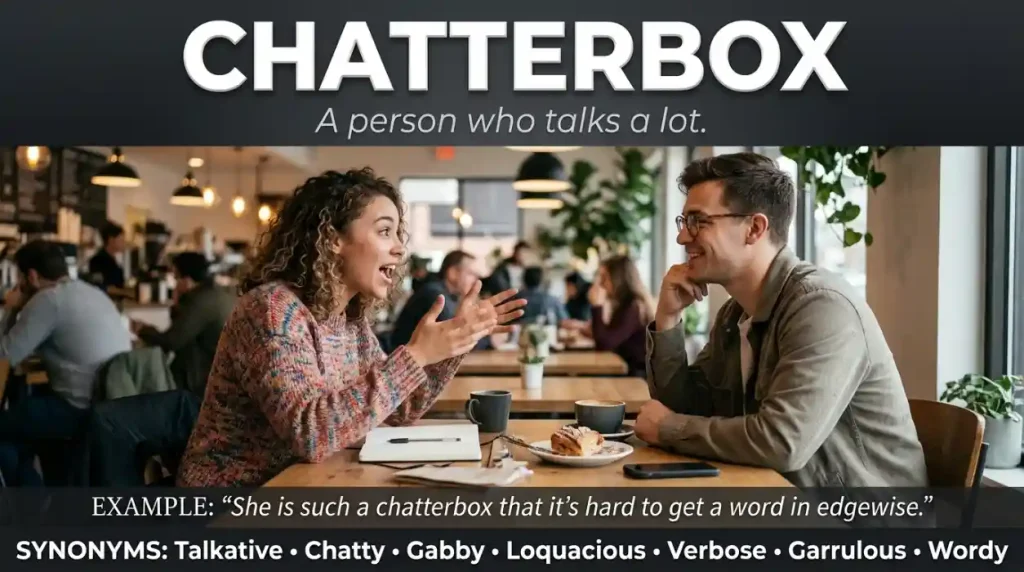
Synonyms for chatterbox include talkative person, blabbermouth, chatterer, gabber, windbag, and motor mouth. These words describe people who talk a lot, but their tones differ. Some sound friendly and playful, while others suggest excessive talking or careless speech.
Imagine meeting a friend who can turn a five-minute coffee break into an hour-long conversation. You might affectionately call them a chatterbox. In another situation, you might choose a more polite or humorous expression.
The word chatterbox appears in everyday conversations, children’s stories, social media, and informal writing. It offers a quick, familiar way to describe someone who enjoys talking frequently.
Learning synonyms for chatterbox helps students expand their vocabulary, bloggers create lively descriptions, and content writers avoid repetitive language. It also helps everyday English users express personality and tone more accurately.
In this guide, you will explore alternatives, their meanings, pronunciation, and real-life examples. You will also learn which expressions sound affectionate, neutral, humorous, or critical.
What Does “Chatterbox” Really Mean?
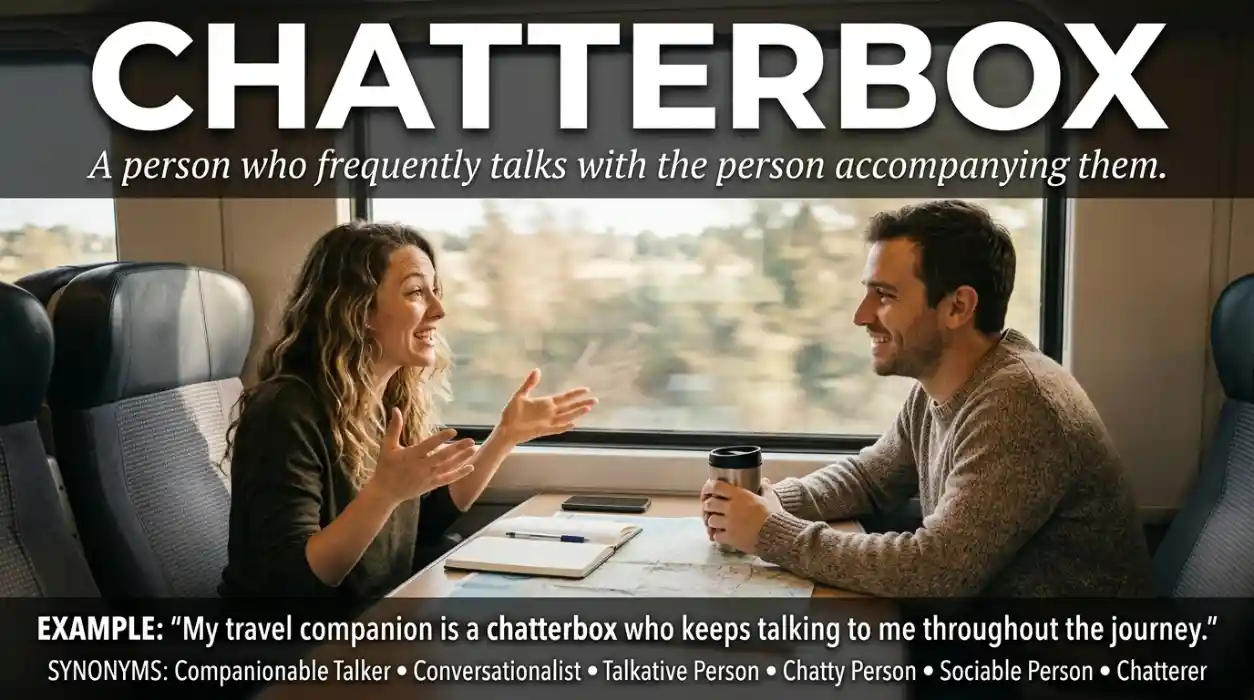
A chatterbox is someone who talks a lot, often in a lively, continuous, or informal way. The word usually describes a person who enjoys conversation and may speak more than others in a group.
For example:
- My little sister is a chatterbox who tells us every detail about her day.
- Everyone knows Daniel as the office chatterbox.
- The children became chatterboxes during the school trip.
Native English speakers often use chatterbox playfully or affectionately. However, the word can also suggest that someone talks too much, especially when other people need quiet or want a chance to speak.
Part of Speech
Noun: Chatterbox is a countable noun used to describe a talkative person.
Plural: Chatterboxes.
Related word: Chatter can function as a verb or noun. It refers to light, informal, often continuous conversation.
Example: “She is a chatterbox” describes a person. “She chatted throughout lunch” describes the action.
Connotative Meaning
(Connotation is the emotional or cultural association a word carries beyond its basic dictionary meaning.)
- Positive tone: Chatterbox can suggest friendliness, enthusiasm, sociability, and a cheerful personality.
- Negative tone: It can imply that someone talks excessively, interrupts others, or struggles to listen.
- Neutral tone: In a casual description, it may simply identify a person who talks frequently.
The meaning depends on the relationship between the speakers. Calling your best friend a chatterbox may sound affectionate. Calling a colleague one during a formal meeting may sound disrespectful.
Etymology: Where Does “Chatterbox” Come From?
The word chatterbox combines chatter, meaning to talk rapidly or casually, and box, a noun element used in the informal label for a person who produces a lot of chatter.
The word belongs to a familiar English pattern in which an everyday action becomes a playful label for a person. The ending does not literally mean that the person is a box.
A Short History of “Chatterbox”
Old English (450–1100): The exact modern compound chatterbox was not an established Old English word. English already had words and expressions for speaking, calling, and making repeated sounds.
Middle English (1100–1500): Forms related to chatter developed in English, describing repeated sounds and rapid or informal speech. The word gradually became associated with human conversation as well as other noises.
Modern English (1500–present): Chatter expanded into everyday descriptions of lively talk. The compound chatterbox later became a familiar informal label for a person who talks a great deal, especially in family conversations, children’s language, and humorous descriptions.
Today, the word remains common in spoken English. It is easy to understand and often conveys personality more vividly than the neutral expression talkative person.
Pronunciation (US and UK IPA)
- US: /ˈtʃæt̬.ɚ.bɑːks/
- UK: /ˈtʃæt.ə.bɒks/
Pronunciation varies slightly across accents. The first syllable receives the main stress.
Syllables
chat-ter-box
The word has three syllables.
Affixation Pattern
- Root: Chatter + box
- Prefix: None
- Suffix: None in the complete compound
- Word formation: Compound noun
The word chatter itself is related to the verb chatter. The element box contributes to the informal compound rather than functioning as a regular suffix.
Synonyms List
The following words and expressions describe people who talk a lot. Some are close synonyms, while others emphasize sociability, nonstop speech, gossip, or excessive talking. Choose according to context and tone.
1. Talkative Person (Noun Phrase) — US / UK: /ˈtɔː.kə.tɪv ˈpɝː.sən/; /ˈtɔː.kə.tɪv ˈpɜː.sən/
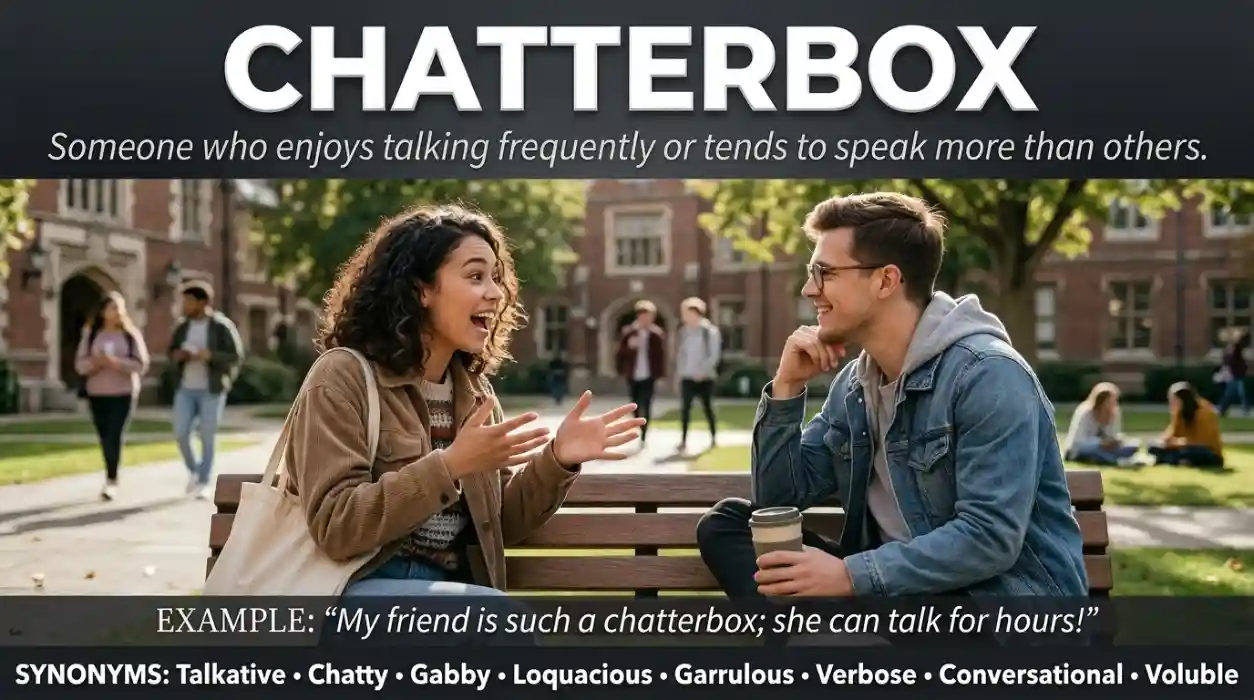
Meaning: Someone who enjoys talking frequently or tends to speak more than others.
Tone/Register: Neutral, everyday English.
Examples:
My new classmate is a talkative person who makes everyone feel welcome.
He becomes especially talkative when the conversation turns to football.
2. Chatterer (Noun) — US / UK: /ˈtʃæt̬.ɚ.ɚ/; /ˈtʃæt.ər.ər/
Meaning: Someone who chats frequently, often in a light and informal way.
Tone/Register: Informal, descriptive.
Examples:
The little chatterer told her grandparents three stories before breakfast.
A cheerful chatterer can make a long journey feel shorter.
3. Blabbermouth (Noun) — US / UK: /ˈblæb.ɚ.maʊθ/; /ˈblæb.ə.maʊθ/
Meaning: A person who talks too much, especially by revealing secrets or private information.
Tone/Register: Informal, negative, sometimes teasing.
Examples:
Don’t tell him about the surprise party; he’s a bit of a blabbermouth.
She felt embarrassed when the office blabbermouth shared her news.
4. Motor Mouth (Noun) — US / UK: /ˈmoʊ.t̬ɚ maʊθ/; /ˈməʊ.tə maʊθ/
Meaning: Someone who speaks rapidly and almost nonstop.
Tone/Register: Informal, humorous.
Examples:
My cousin is a motor mouth who can talk through an entire movie.
Once the debate began, the motor mouth barely paused for breath.
5. Windbag (Noun) — US / UK: /ˈwɪnd.bæɡ/
Meaning: A person who talks at length, often without saying anything useful.
Tone/Register: Informal, critical.
Examples:
The meeting lasted an extra hour because one windbag kept repeating himself.
Nobody wanted to sit beside the office windbag at lunch.
6. Gabber (Noun) — US / UK: /ˈɡæb.ɚ/; /ˈɡæb.ə/
Meaning: An informal term for someone who enjoys chatting a great deal.
Tone/Register: Informal, conversational, sometimes regional.
Examples:
My aunt is a cheerful gabber who knows everyone in the neighborhood.
The two young gabbers talked all the way home.
7. Blabberer (Noun) — US / UK: /ˈblæb.ər.ər/
Meaning: Someone who talks carelessly or excessively, sometimes revealing information they should keep private.
Tone/Register: Informal, usually negative.
Examples:
The blabberer spoiled the ending of the mystery series.
Everyone knew the blabberer would struggle to keep the announcement secret.
8. Jabberer (Noun) — US / UK: /ˈdʒæb.ɚ.ɚ/; /ˈdʒæb.ər.ər/
Meaning: A person who speaks quickly and continuously, sometimes in a way that is difficult to follow.
Tone/Register: Informal, mildly critical or playful.
Examples:
The excited jabberer described every detail of the concert.
I could barely interrupt the jabberer long enough to ask a question.
9. Gabby Person (Noun Phrase) — US / UK: /ˈɡæb.i ˈpɝː.sən/; /ˈɡæb.i ˈpɜː.sən/
Meaning: Someone who talks a lot, often in a friendly and relaxed manner.
Tone/Register: Informal, conversational.
Examples:
Our gabby neighbor always has a story to share.
She is so gabby that even a quick walk becomes a long chat.
10. Gossip (Noun) — US / UK: /ˈɡɑː.sɪp/; /ˈɡɒs.ɪp/
Meaning: A person who frequently discusses other people’s private lives or personal affairs.
Tone/Register: Informal, often negative.
Examples:
The office gossip knew about everyone’s weekend plans.
I avoid sharing personal news with a gossip who spreads rumors.
11. Gossipmonger (Noun) — US / UK: /ˈɡɑː.sɪpˌmʌŋ.ɡɚ/; /ˈɡɒs.ɪpˌmʌŋ.ɡə/
Meaning: Someone who spreads gossip or unverified stories about other people.
Tone/Register: Critical, somewhat formal.
Examples:
The gossipmonger turned a minor disagreement into a workplace rumor.
A responsible friend checks the facts instead of acting like a gossipmonger.
12. Chatterbox Extraordinaire (Noun Phrase) — US / UK: /ˈtʃæt.ɚ.bɑːks ɪkˌstrɔːr.dəˈnɛr/; /ˈtʃæt.ə.bɒks ɪkˌstrɔː.dɪˈneə/
Meaning: A humorous expression for someone who talks exceptionally often or enthusiastically.
Tone/Register: Playful, affectionate.
Examples:
Our grandmother is a chatterbox extraordinaire at family gatherings.
The podcast host proved to be a chatterbox extraordinaire during the interview.
13. Conversationalist (Noun) — US / UK: /ˌkɑːn.vɚˈseɪ.ʃən.ə.lɪst/; /ˌkɒn.vəˈseɪ.ʃən.ə.lɪst/
Meaning: Someone who enjoys conversation and can engage others in discussion.
Tone/Register: Positive, neutral, professional.
Examples:
He is a skilled conversationalist who asks thoughtful questions.
A good conversationalist knows when to speak and when to listen.
14. Social Butterfly (Noun) — US / UK: /ˈsoʊ.ʃəl ˈbʌt̬.ɚ.flaɪ/; /ˈsəʊ.ʃəl ˈbʌt.ə.flaɪ/
Meaning: A sociable person who enjoys meeting people and moving between conversations.
Tone/Register: Positive, informal.
Examples:
Mina is a social butterfly who makes friends at every event.
The social butterfly greeted nearly everyone at the wedding.
15. Chatterbox at Heart (Noun Phrase) — US / UK: /ˈtʃæt.ɚ.bɑːks ət hɑːrt/; /ˈtʃæt.ə.bɒks ət hɑːt/
Meaning: A playful description of someone who naturally loves talking.
Tone/Register: Warm, informal, affectionate.
Examples:
Even after a quiet day, Dad is a chatterbox at heart.
She may seem shy at first, but she is a chatterbox at heart.
16. Loquacious Person (Noun Phrase) — US / UK: /loʊˈkweɪ.ʃəs ˈpɝː.sən/; /ləʊˈkweɪ.ʃəs ˈpɜː.sən/
Meaning: Someone who speaks a great deal, often fluently and at length.
Tone/Register: Formal, literary, academic.
Examples:
The loquacious professor answered every question with a detailed explanation.
Our loquacious guide filled the bus ride with historical stories.
17. Garrulous Person (Noun Phrase) — US / UK: /ˈɡær.ə.ləs ˈpɝː.sən/; /ˈɡær.ə.ləs ˈpɜː.sən/
Meaning: Someone who talks excessively, often about relatively unimportant subjects.
Tone/Register: Formal, literary, usually critical.
Examples:
The garrulous passenger described his entire travel history.
A garrulous speaker can make a short presentation feel endless.
18. Voluble Person (Noun Phrase) — US / UK: /ˈvɑː.ljə.bəl ˈpɝː.sən/; /ˈvɒl.jə.bəl ˈpɜː.sən/
Meaning: Someone who speaks fluently, readily, and at considerable length.
Tone/Register: Formal, descriptive, sometimes positive.
Examples:
The voluble presenter answered questions without hesitation.
She became voluble when discussing her favorite novels.
19. Loquacious Talker (Noun Phrase) — US / UK: /loʊˈkweɪ.ʃəs ˈtɔː.kɚ/; /ləʊˈkweɪ.ʃəs ˈtɔː.kə/
Meaning: A person who habitually speaks at length and rarely runs out of things to say.
Tone/Register: Formal, descriptive.
Examples:
The loquacious talker dominated the discussion about the new project.
His loquacious style suited the lively radio program.
20. Never-Ending Talker (Noun Phrase) — US / UK: /ˌnɛv.ɚˈɛn.dɪŋ ˈtɔː.kɚ/; /ˌnev.ərˈen.dɪŋ ˈtɔː.kə/
Meaning: An informal description of someone whose talking seems to continue without a break.
Tone/Register: Informal, humorous or critical.
Examples:
My brother is a never-ending talker when he discusses video games.
The never-ending talker turned a quick phone call into an afternoon conversation.
21. Nonstop Talker (Noun Phrase) — US / UK: /ˌnɑːnˈstɑːp ˈtɔː.kɚ/; /ˌnɒnˈstɒp ˈtɔː.kə/
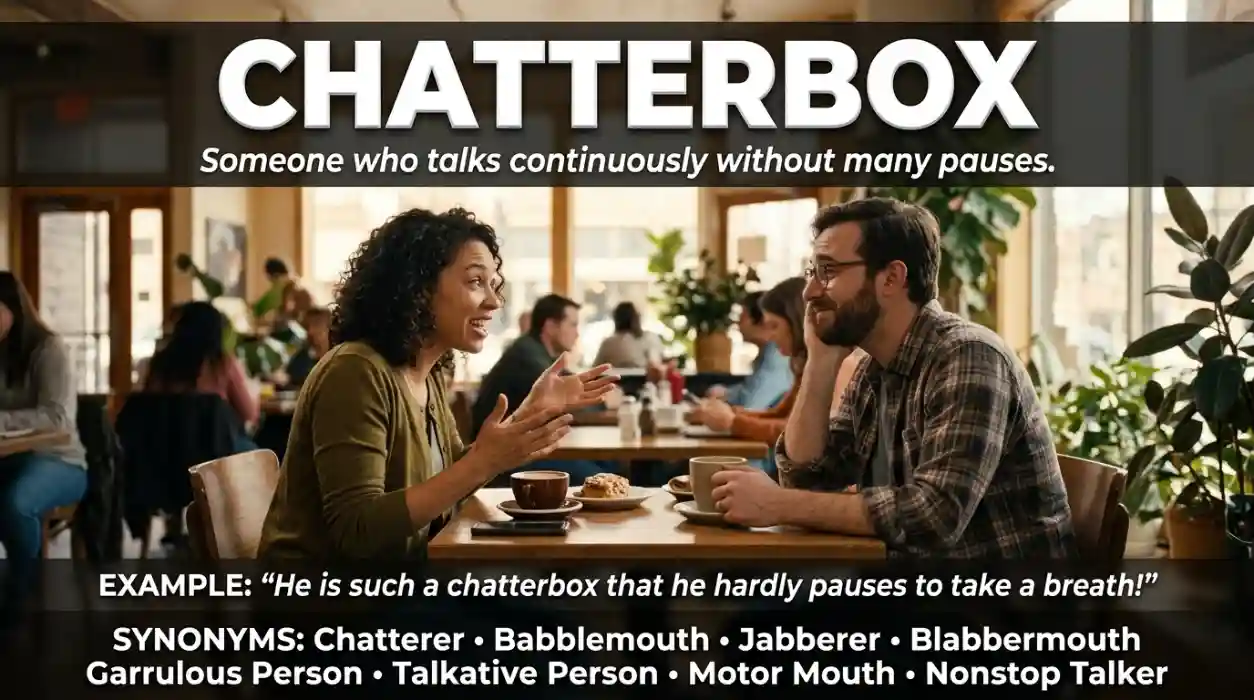
Meaning: Someone who talks continuously with very few pauses.
Tone/Register: Informal, descriptive.
Examples:
The nonstop talker kept the entire car entertained.
My little nephew becomes a nonstop talker after school.
22. Talkative Soul (Noun Phrase) — US / UK: /ˈtɔː.kə.tɪv soʊl/; /ˈtɔː.kə.tɪv səʊl/
Meaning: A warm, expressive description of someone who naturally enjoys talking.
Tone/Register: Affectionate, literary, informal.
Examples:
She is a talkative soul who loves hearing about other people’s lives.
Every gathering needs a talkative soul to keep the conversation flowing.
23. Big Mouth (Noun) — US / UK: /ˌbɪɡ ˈmaʊθ/
Meaning: Someone who talks too freely, often revealing information or making inappropriate remarks.
Tone/Register: Informal, negative, sometimes teasing.
Examples:
Keep the gift a secret; my brother has a big mouth.
He regretted telling the big mouth about his plans.
24. Loudmouth (Noun) — US / UK: /ˈlaʊd.maʊθ/
Meaning: A person who speaks loudly, forcefully, or excessively, often without considering others.
Tone/Register: Informal, critical.
Examples:
The loudmouth interrupted the speaker several times.
Nobody appreciated the loudmouth’s rude comments during dinner.
25. Blabbering Fool (Noun Phrase) — US / UK: /ˈblæb.ər.ɪŋ fuːl/
Meaning: An insulting expression for someone who talks excessively or foolishly.
Tone/Register: Strongly negative, informal.
Examples:
He called himself a blabbering fool after revealing the surprise.
The character was written as a blabbering fool who never listened.
26. Jabberwock (Noun, Playful Coinage) — US / UK: /ˈdʒæb.ɚ.wɑːk/; /ˈdʒæb.ə.wɒk/
Meaning: A playful, nonstandard label that can suggest a person who jabbers constantly.
Tone/Register: Inventive, humorous, nonstandard.
Examples:
The children nicknamed their energetic uncle the family jabberwock.
Our imaginary jabberwock could talk for hours about imaginary adventures.
Usage note: This is a creative coinage, not a standard synonym for chatterbox. Use it for playful writing rather than formal English.
27. Talkaholic (Noun) — US / UK: /ˌtɔː.kəˈhɑː.lɪk/; /ˌtɔː.kəˈhɒl.ɪk/
Meaning: An informal, humorous label for someone who seems unable to stop talking.
Tone/Register: Playful, informal, nontechnical.
Examples:
My best friend is a talkaholic who calls just to share a funny story.
The talkaholic in our group can turn any topic into a long discussion.
28. Chatty Person (Noun Phrase) — US / UK: /ˈtʃæt.i ˈpɝː.sən/; /ˈtʃæt.i ˈpɜː.sən/
Meaning: Someone who enjoys light, friendly conversation.
Tone/Register: Neutral, positive, informal.
Examples:
The chatty person beside me made the train journey enjoyable.
Our new receptionist is friendly and chatty with visitors.
29. Gabby Gossip (Noun Phrase) — US / UK: /ˈɡæb.i ˈɡɑː.sɪp/; /ˈɡæb.i ˈɡɒs.ɪp/
Meaning: Someone who talks a great deal and frequently discusses other people’s affairs.
Tone/Register: Informal, critical or teasing.
Examples:
The gabby gossip shared details about the neighborhood’s latest argument.
Her friends asked the gabby gossip to respect their privacy.
30. Social Talker (Noun Phrase) — US / UK: /ˈsoʊ.ʃəl ˈtɔː.kɚ/; /ˈsəʊ.ʃəl ˈtɔː.kə/
Meaning: Someone who enjoys speaking with others in social settings.
Tone/Register: Neutral, descriptive.
Examples:
As a social talker, Ben feels comfortable at networking events.
The social talker introduced himself to everyone at the gathering.
31. Conversation Lover (Noun Phrase) — US / UK: /ˌkɑːn.vɚˈseɪ.ʃən ˈlʌv.ɚ/; /ˌkɒn.vəˈseɪ.ʃən ˈlʌv.ə/
Meaning: A person who genuinely enjoys exchanging ideas and stories through conversation.
Tone/Register: Positive, informal.
Examples:
My grandfather is a conversation lover who enjoys discussing history.
As a conversation lover, she never turns down a chance to catch up with friends.
32. Wordy Person (Noun Phrase) — US / UK: /ˈwɝː.di ˈpɝː.sən/; /ˈwɜː.di ˈpɜː.sən/
Meaning: Someone who uses more words than necessary when speaking or writing.
Tone/Register: Neutral to critical, educational.
Examples:
The wordy person took ten minutes to explain a simple point.
His wordy answer confused the audience instead of helping them.
Usage note: Wordy describes unnecessary length rather than talkativeness alone.
33. Verbose Speaker (Noun Phrase) — US / UK: /vɚˈboʊs ˈspiː.kɚ/; /vəˈbəʊs ˈspiː.kə/
Meaning: A person who uses too many words when communicating.
Tone/Register: Formal, academic, often critical.
Examples:
The verbose speaker could have explained the results in two minutes.
Her verbose presentation made the main recommendation difficult to identify.
34. Long-Winded Speaker (Noun Phrase) — US / UK: /ˌlɔːŋˈwɪn.dɪd ˈspiː.kɚ/; /ˌlɒŋˈwɪn.dɪd ˈspiː.kə/
Meaning: Someone who speaks for too long without getting to the point quickly.
Tone/Register: Informal to professional, critical.
Examples:
The long-winded speaker repeated the same argument throughout the meeting.
I appreciate his knowledge, but his explanations can be long-winded.
35. Rambling Talker (Noun Phrase) — US / UK: /ˈræm.blɪŋ ˈtɔː.kɚ/; /ˈræm.blɪŋ ˈtɔː.kə/
Meaning: Someone who talks at length without following a clear line of thought.
Tone/Register: Informal, critical.
Examples:
The rambling talker moved from travel stories to politics without warning.
I lost track of the point during his rambling explanation.
36. Storyteller (Noun) — US / UK: /ˈstɔːr.iˌtɛl.ɚ/; /ˈstɔː.riˌtel.ə/
Meaning: Someone who enjoys telling stories, often with detail and enthusiasm.
Tone/Register: Positive, neutral, creative.
Examples:
My uncle is a wonderful storyteller who keeps children fascinated.
The storyteller entertained the guests with memories from his travels.
Usage note: A storyteller may talk a lot, but the word emphasizes telling stories rather than excessive speech.
37. Narrator (Noun) — US / UK: /nəˈreɪ.t̬ɚ/; /nəˈreɪ.tə/
Meaning: A person who tells or describes events in speech or writing.
Tone/Register: Neutral, literary, professional.
Examples:
The narrator explained every stage of the documentary.
Her role as narrator gave the audio story a personal touch.
Usage note: Narrator is not a direct synonym for chatterbox. It fits when the person regularly describes events.
38. Conversational Dynamo (Noun Phrase) — US / UK: /ˌkɑːn.vɚˈseɪ.ʃən.əl ˈdaɪ.nə.moʊ/; /ˌkɒn.vəˈseɪ.ʃən.əl ˈdaɪ.nə.məʊ/
Meaning: A lively person who keeps discussions energetic and moving.
Tone/Register: Positive, humorous, expressive.
Examples:
Our host is a conversational dynamo who makes every guest feel included.
The conversational dynamo kept the reunion lively until midnight.
39. Social Talkaholic (Noun Phrase) — US / UK: /ˌsoʊ.ʃəl ˌtɔː.kəˈhɑː.lɪk/; /ˌsəʊ.ʃəl ˌtɔː.kəˈhɒl.ɪk/
Meaning: A playful expression for someone who seems to thrive on constant social conversation.
Tone/Register: Humorous, informal, nonstandard.
Examples:
The social talkaholic greeted every guest before the music started.
My sister is a social talkaholic who loves chatting with strangers.
40. Eloquent Speaker (Noun Phrase) — US / UK: /ˈɛl.ə.kwənt ˈspiː.kɚ/; /ˈel.ə.kwənt ˈspiː.kə/
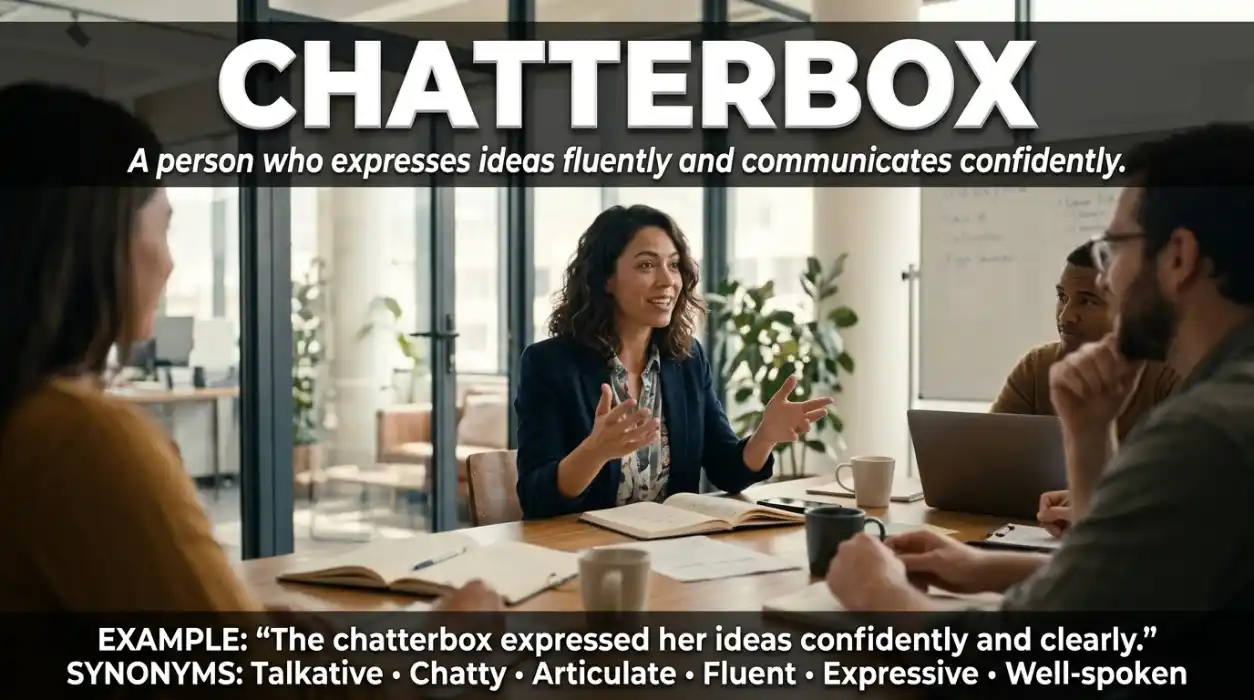
Meaning: Someone who expresses ideas clearly, fluently, and effectively.
Tone/Register: Positive, formal, professional.
Examples:
The eloquent speaker explained the complicated issue with ease.
Her eloquent speech held the audience’s attention.
Usage note: Eloquence concerns the quality of speech, not the amount. It is suitable when a chatterbox also speaks impressively.
41. Verbose Talker (Noun Phrase) — US / UK: /vɚˈboʊs ˈtɔː.kɚ/; /vəˈbəʊs ˈtɔː.kə/
Meaning: Someone who expresses ideas with more words than necessary.
Tone/Register: Formal, critical, analytical.
Examples:
The verbose talker explained the simple schedule in unnecessary detail.
A concise answer would have helped the verbose talker communicate more clearly.
42. Chatty Cathy (Noun Phrase) — US / UK: /ˌtʃæt.i ˈkæθ.i/
Meaning: An informal expression for a girl or woman who talks a lot.
Tone/Register: Playful, familiar, sometimes dated.
Examples:
My cousin called herself a Chatty Cathy after talking through lunch.
The teacher gently reminded the Chatty Cathy to let her classmates speak.
Usage note: This expression can sound gendered or old-fashioned. Chatterbox or chatty person is more widely applicable.
43. Gabfest Enthusiast (Noun Phrase) — US / UK: /ˈɡæb.fɛst ɪnˌθuː.zi.æst/
Meaning: Someone who especially enjoys long, informal conversations or lively group discussions.
Tone/Register: Informal, playful.
Examples:
My friends are gabfest enthusiasts who can spend hours discussing films.
The gabfest enthusiast brought three new stories to our lunch break.
44. Nonstop Chatterer (Noun Phrase) — US / UK: /ˌnɑːnˈstɑːp ˈtʃæt̬.ɚ.ɚ/; /ˌnɒnˈstɒp ˈtʃæt.ər.ər/
Meaning: Someone who chatters continuously, often with very few pauses.
Tone/Register: Informal, humorous or critical.
Examples:
The nonstop chatterer kept the entire family awake during the road trip.
My puppy’s excited owner became a nonstop chatterer at the training class.
45. Tireless Talker (Noun Phrase) — US / UK: /ˈtaɪr.ləs ˈtɔː.kɚ/; /ˈtaɪə.ləs ˈtɔː.kə/
Meaning: A person who seems never to tire of talking.
Tone/Register: Informal, descriptive, often humorous.
Examples:
Grandpa is a tireless talker when someone asks about his childhood.
The tireless talker kept the guests entertained throughout dinner.
46. Eager Conversationalist (Noun Phrase) — US / UK: /ˈiː.ɡɚ ˌkɑːn.vɚˈseɪ.ʃən.ə.lɪst/; /ˈiː.ɡə ˌkɒn.vəˈseɪ.ʃən.ə.lɪst/
Meaning: Someone who enthusiastically participates in discussions and enjoys exchanging ideas.
Tone/Register: Positive, professional, friendly.
Examples:
The eager conversationalist asked thoughtful questions during the book club.
As an eager conversationalist, Noor welcomed every new participant.
47. Social Chatterer (Noun Phrase) — US / UK: /ˈsoʊ.ʃəl ˈtʃæt̬.ɚ.ɚ/; /ˈsəʊ.ʃəl ˈtʃæt.ər.ər/
Meaning: A person who frequently chats with others in social situations.
Tone/Register: Neutral, informal.
Examples:
The social chatterer made friends while waiting for the concert to begin.
A social chatterer can help new guests feel comfortable at a party.
48. Babbling Person (Noun Phrase) — US / UK: /ˈbæb.lɪŋ ˈpɝː.sən/; /ˈbæb.lɪŋ ˈpɜː.sən/
Meaning: Someone who speaks rapidly or incoherently, sometimes because of nervousness or excitement.
Tone/Register: Informal, potentially critical.
Examples:
The nervous babbling person struggled to explain what had happened.
He became a babbling person when he met his favorite actor.
Usage note: Babbling can imply confused or unclear speech, so it does not always mean someone is simply talkative.
49. Talkative Companion (Noun Phrase) — US / UK: /ˈtɔː.kə.tɪv kəmˈpæn.jən/
Meaning: Someone who often talks with the person they accompany.
Tone/Register: Neutral, friendly.
Examples:
My talkative companion made the long train ride feel shorter.
A talkative companion can turn a quiet walk into an enjoyable conversation.
50. Gift of the Gab (Noun Phrase) — US / UK: /ˌɡɪft əv ðə ˈɡæb/
Meaning: The ability to speak fluently and confidently, often making conversation easy and engaging.
Tone/Register: Informal, positive, idiomatic.
Examples:
Our sales manager has the gift of the gab and connects easily with people.
She used her gift of the gab to make the nervous audience laugh.
Usage note: This is an idiom describing a speaking ability, not a direct label for a person. Someone with the gift of the gab may be persuasive without being excessively talkative.
Synonyms by Tone
The right expression depends on whether you want to praise someone’s sociability, describe a habit neutrally, or criticize excessive speech.
Positive Synonyms
Use these when the person is friendly, engaging, or enjoyable to talk to.
- Conversationalist: Suggests an engaging discussion partner.
- Social butterfly: Highlights sociability and a wide circle of contacts.
- Chatty person: Sounds friendly and approachable.
- Storyteller: Emphasizes entertaining stories.
- Eloquent speaker: Highlights clear, effective expression.
- Conversational dynamo: Suggests energy and enthusiasm.
- Eager conversationalist: Emphasizes interest in exchanging ideas.
Neutral Synonyms
These describe frequent speech without necessarily criticizing the speaker.
- Talkative person: A clear, general description.
- Chatterer: Someone who chats frequently.
- Gabber: An informal term for a person who talks a lot.
- Voluble person: Someone who speaks fluently and readily.
- Social talker: A person who enjoys talking in groups.
- Talkative companion: Someone who talks frequently with others.
Negative Synonyms
Use these carefully because they may insult the person or suggest undesirable behavior.
- Blabbermouth: Suggests revealing secrets.
- Windbag: Suggests lengthy, unhelpful speech.
- Loudmouth: Suggests loud or inconsiderate speech.
- Garrulous person: Suggests excessive talking.
- Long-winded speaker: Suggests taking too long to make a point.
- Verbose speaker: Suggests unnecessary words.
- Gossipmonger: Suggests spreading rumors.
Playful and Informal Synonyms
These work well in friendly conversations, humorous stories, and casual social posts.
- Motor mouth: Someone who talks nonstop.
- Talkaholic: Someone who seems addicted to talking.
- Chatty Cathy: A familiar, often gendered expression.
- Tireless talker: Someone who never seems to run out of things to say.
- Chatterbox extraordinaire: An exaggerated, humorous description.
- Nonstop chatterer: Someone who rarely pauses.
- Gift of the gab: An idiom for fluent, confident speaking.
Tone matters because the same person can be described affectionately or critically. Choose an expression that matches your relationship with the person and the situation.
“Chatterbox” vs. Close Alternatives
| Word | Main difference | Typical tone | Best use |
|---|---|---|---|
| Chatterbox | Talks frequently, often in a lively way | Playful or affectionate | Everyday conversation |
| Talkative | Speaks a lot without necessarily implying a problem | Neutral | General descriptions |
| Blabbermouth | Talks too freely or reveals secrets | Negative | Criticism or teasing |
| Motor mouth | Speaks rapidly and almost nonstop | Humorous | Informal conversations |
| Garrulous | Talks excessively, often about trivial subjects | Formal, critical | Literary or descriptive writing |
Which Synonym Is Best?
Choose talkative when you want a safe, neutral description. Choose chatterbox when you want a familiar, playful label. Use blabbermouth only when the person reveals information carelessly or when a teasing tone is appropriate.
For example:
- “My sister is talkative” sounds neutral.
- “My sister is a chatterbox” sounds more playful.
- “My sister is a blabbermouth” suggests that she cannot keep a secret.
These differences help you communicate your attitude without changing the basic facts.
How “Chatterbox” Changes by Context
Daily Conversation
In everyday speech, chatty, talkative, and chatterbox sound natural. Friends and family members often use them affectionately.
For example, “You are such a chatterbox today!” may be a friendly comment rather than a complaint.
Writing and Blogging
Bloggers can use descriptive words to make characters and real-life situations more vivid. Motor mouth creates humor, while conversationalist suggests social confidence.
Avoid repeating chatterbox in every paragraph. Choose the expression that best captures the person’s behavior.
Professional and Academic English
In professional writing, talkative is usually safer than windbag or blabbermouth. For a formal description, consider loquacious or voluble, but use them only when they fit your audience.
For example, “The participant was highly talkative during the interview” is clearer and more respectful than “The participant was a windbag.”
Creative and Informal Writing
Writers can use motor mouth, talkaholic, and tireless talker to create distinctive characters. These expressions add humor and personality.
A fictional character described as a “motor mouth” seems energetic and fast-talking. A “garrulous old traveler” sounds more literary and potentially tiresome.
Common Mistakes and Native Usage
Mistake 1: Assuming Every Synonym Is Friendly
Words such as chatterbox and chatty person can sound affectionate. Windbag and loudmouth usually carry criticism.
Check the emotional tone before using a word to describe someone directly.
Mistake 2: Confusing Talkativeness with Gossip
A chatterbox talks a lot, but a gossip talks about other people’s private affairs. A person may be talkative without spreading rumors.
Use gossip or gossipmonger only when the content of the conversation supports that meaning.
Mistake 3: Confusing Fluency with Excessive Speech
Voluble describes someone who speaks readily and fluently. Verbose describes language that uses too many words. Neither word automatically means that someone enjoys casual conversation.
Mistake 4: Using Informal Insults in Professional Settings
Avoid words such as blabbermouth, windbag, and loudmouth in workplace evaluations or academic reports. These labels may sound personal and disrespectful.
Instead, describe the behavior: “The speaker frequently interrupted colleagues” or “The presentation included unnecessary detail.”
Mistake 5: Treating Creative Expressions as Standard Synonyms
Expressions such as social talkaholic and chatterbox extraordinaire can work in creative writing. They are not all established dictionary synonyms.
Use standard terms for formal work and creative expressions when the context supports humor.
Register Notes
Formal: Loquacious, garrulous, voluble, verbose.
Neutral: Talkative, chatty, conversationalist.
Informal: Chatterbox, motor mouth, gabber, talkaholic.
Potentially insulting: Blabbermouth, windbag, loudmouth, blabbering fool.
A useful vocabulary habit is to learn one neutral word, one positive word, and one negative word for the same behavior. This helps you describe people with greater accuracy.
Real-Life Mini Scenarios
Workplace
A colleague shares stories throughout the lunch break and keeps everyone entertained. You might call them a chatty person or a conversationalist.
If they repeatedly interrupt meetings, a more precise description would be that they tend to dominate discussions.
Social Situations
At a family gathering, one relative greets every guest and keeps conversations moving. Calling them a social butterfly emphasizes their friendliness rather than the amount they speak.
Media and Pop Culture
A television host who speaks quickly, jokes constantly, and rarely pauses might be described as a motor mouth. The phrase gives readers a lively impression of the host’s style.
Writing and Storytelling
A novelist might describe a character as garrulous to suggest that their endless talking frustrates other characters. A description such as a cheerful chatterbox creates a much warmer impression.
Practice Quiz:
1. Your friend enjoys talking and makes everyone feel welcome. Which word fits best?
A. Chatty
B. Windbag
C. Blabbermouth
2. Someone repeatedly reveals other people’s secrets. What would you call this person?
A. Conversationalist
B. Blabbermouth
C. Eloquent speaker
3. A person talks at great length and often says very little of value. Which term fits best?
A. Windbag
B. Social butterfly
C. Storyteller
4. A speaker expresses ideas fluently and confidently. Which description is most appropriate?
A. Loudmouth
B. Eloquent speaker
C. Gossipmonger
5. Someone speaks quickly and continuously during a long car ride. Which informal expression fits?
A. Motor mouth
B. Narrator
C. Verbose speaker
6. A person enjoys meeting new people and chatting at parties. Which phrase is most suitable?
A. Social butterfly
B. Blabberer
C. Long-winded speaker
7. A formal report describes someone who speaks frequently and readily. Which word is most appropriate?
A. Garrulous
B. Loquacious
C. Big mouth
8. A colleague uses unnecessary words and takes too long to explain a simple idea. Which term fits best?
A. Conversationalist
B. Verbose speaker
C. Social talker
9. Someone spreads rumors about coworkers. Which word best describes the behavior?
A. Gossipmonger
B. Storyteller
C. Eloquent speaker
10. A person enjoys telling entertaining stories about past adventures. Which word fits best?
A. Windbag
B. Storyteller
C. Loudmouth
Reflection and Application Task
Choose three synonyms from this guide. Write one sentence for each word about a friend, fictional character, coworker, or family member. Make sure the tone matches the person you are describing.
Answer Key
1-A | 2-B | 3-A | 4-B | 5-A | 6-A | 7-B | 8-B | 9-A | 10-B
External Learning Sources
For authoritative definitions, pronunciation, and examples, consult these dictionaries:
Cambridge Dictionary — learner-friendly definitions and UK and US pronunciation.
Oxford Learner’s Dictionaries — usage examples, grammar patterns, and pronunciation guidance.
Merriam-Webster — definitions, word history, and American English usage.
Conclusion
Choosing the right synonym for chatterbox helps you describe personality more precisely. A person may be friendly, persuasive, energetic, or excessively talkative, and each word highlights a different quality.
Students can use these expressions to improve vocabulary, while bloggers and writers can create more vivid descriptions. Everyday speakers can also choose words that communicate warmth, humor, or criticism more accurately.
You do not need to memorize every expression today. Start with chatty, talkative, conversationalist, and motor mouth, then explore more advanced words as your confidence grows.
Practice three new words in an email, essay, or daily conversation this week. Notice how each word changes the tone, and keep building a vocabulary that makes your English clearer and more natural.
FAQs
1. What is a polite way to say someone is a chatterbox?
A polite alternative is a talkative person or chatty person. Both describe frequent conversation without suggesting that the person is annoying. You can also say someone is sociable or enjoys conversation. In professional settings, describe the specific behavior rather than labeling the person, especially if their talking affects meetings or group discussions.
2. What is the difference between a chatterbox and a blabbermouth?
A chatterbox is someone who talks a lot, often cheerfully or playfully. A blabbermouth is someone who talks carelessly, especially when revealing secrets or private information. A chatterbox may be enjoyable company, while a blabbermouth suggests a problem with discretion. The words are not interchangeable in every situation.
3. What is a sophisticated word for someone who talks a lot?
Loquacious is a sophisticated word for someone who speaks a great deal. Garrulous also describes excessive talking, but it often carries a more critical tone. Voluble emphasizes fluent, readily flowing speech. Choose loquacious for a relatively neutral formal description and garrulous when the person’s lengthy conversation feels excessive.
4. What do you call someone who talks nonstop without listening?
You might describe this person as a motor mouth, nonstop talker, or long-winded speaker, depending on the behavior. If the main problem is interrupting others, say that the person frequently interrupts or dominates conversations. Describing the behavior directly is often clearer and less hurtful than using a negative label.
5. Is chatterbox an insult or a compliment?
Chatterbox can be either affectionate or mildly critical. Friends may use it as a playful nickname for someone who loves conversation. However, the same word may sound negative if someone keeps talking when others need quiet. Your tone, relationship, and situation determine whether the word feels warm or disrespectful.

Hasnain Ali is an SEO Content Strategist and the founder of wordvora.com, a trusted vocabulary platform that helps writers, students, professionals, and English learners find accurate synonyms, antonyms, word meanings, and real-life usage examples. He specializes in keyword research, on-page SEO, topical authority, and creating search-first content that aligns with Google’s latest Search Quality and E-E-A-T guidelines. His work focuses on producing clear, well-structured, and reader-friendly resources that satisfy search intent while maintaining high editorial standards.
Through extensive hands-on experience with SEO tools such as Google Search Console, Google Analytics, SEMrush, and Ahrefs, Hasnain researches user search behavior and develops content that is both informative and easy to understand. Every article published on wordvora.com is carefully reviewed for accuracy, readability, and contextual relevance before publication. His mission is to build one of the web’s most reliable English vocabulary resources by providing practical language guidance, trustworthy explanations, and content that helps readers improve their writing, communication, and vocabulary with confidence.