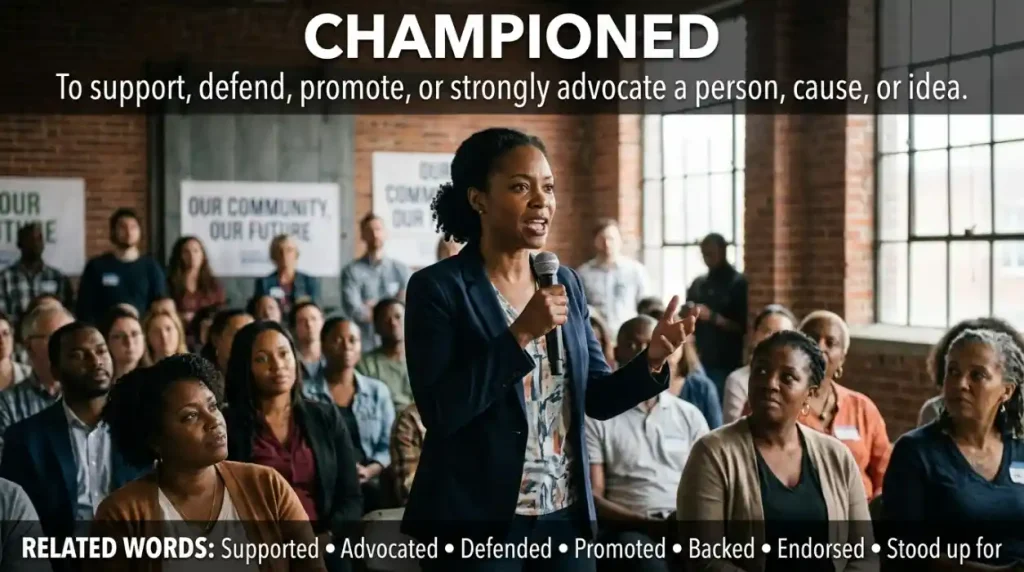
Synonyms for championed include supported, advocated, promoted, defended, endorsed, backed, advanced, and stood up for. These words describe actions taken to support an idea, person, cause, or policy. The best choice depends on context, tone, and the kind of support you want to express.
Imagine a colleague presenting a new idea at work. You believe in it, explain its benefits, and encourage the team to adopt it. You have championed that idea.
Learning synonyms for championed helps you describe this action more precisely. You can show whether someone defended a cause, promoted a proposal, or actively supported a person.
The word appears in news reports, academic essays, business communication, and everyday discussions. It often suggests commitment and action, rather than simple agreement.
For students, bloggers, content writers, and everyday English users, varied vocabulary makes communication clearer. Choosing the right alternative also helps you avoid repeating the same word in every paragraph.
What Does “Championed” Really Mean?
Championed is the past tense and past participle of the verb champion. It means actively supporting, defending, or promoting a person, idea, cause, or policy that you believe deserves attention or success.
For example:
- The teacher championed equal opportunities for every student.
- The manager championed a flexible working policy.
- The journalist championed the rights of vulnerable communities.
In each example, the person does more than express approval. They take action to help something succeed.
Part of Speech
Champion is a verb in these examples. Championing is its present participle, while championed is its past tense and past participle.
The noun champion has a different but related meaning. It can describe a winner of a competition or someone who strongly supports a cause.
How Native Speakers Understand “Championed”
Native English speakers often interpret championed as a strong, purposeful form of support. It suggests that someone took an active role in advancing an idea or defending a person.
The word frequently appears in professional biographies, political reporting, social advocacy, educational writing, and company histories.
It can also sound more forceful than supported. A person who championed a policy may have promoted it publicly, defended it against criticism, or worked to put it into practice.
Connotative Meaning of “Championed”
(Connotation is the emotional or cultural association a word carries beyond its basic dictionary meaning.)
- Positive tone: The word often suggests courage, dedication, leadership, and a willingness to help others.
- Negative tone: It can imply excessive zeal or questionable advocacy when the cause is harmful,o r the support is presented critically.
- Neutral tone: In factual reporting, it can simply describe someone’s active support for a policy, initiative, or proposal.
The surrounding context determines the emotional effect. Someone might champion educational reform positively, while a journalist might report that a politician championed a deeply controversial policy.
Etymology
The word champion entered English through Anglo-French and Old French forms related to Latin campio, meaning a fighter or combatant. The Latin word is associated with campus, meaning an open field or battlefield.
Over time, the word developed beyond its original association with fighting. It came to describe a person who defends another person or cause. Eventually, English speakers began using champion as a verb meaning to support or promote something actively.
A Short History Across English Periods
- Old English (450–1100): The modern verb champion was not an established Old English verb in its present sense. Related ideas of battle, defence, and protection existed in the language.
- Middle English (1100–1500): French influence introduced forms of champion associated with combatants and defenders.
- Modern English (1500–present): The word expanded from fighting and defence to advocacy, leadership, and support for social, political, professional, and personal causes.
The figurative verb developed as English speakers increasingly used the idea of a defender to describe someone who actively advances a cause.

Pronunciation
- US English: /ˈtʃæm.pi.ənd/
- UK English: /ˈtʃæm.pi.ənd/
Syllables: cham-pioned
Word structure:
- Root: champion
- Prefix: None
- Suffix: -ed, marking the past tense or past participle
- Base word: champion
In connected speech, the ending is usually pronounced as part of the final syllable rather than as a separate syllable. The word championed typically has three syllables.
Synonyms List
The following alternatives cover common ways to express active support. Some fit formal writing, while others sound more natural in conversation. Although they share a central meaning, each word has its own shade of meaning.
1. Advocated (verb) — US: /ˈæd.və.keɪ.tɪd/ | UK: /ˈæd.və.keɪ.tɪd/
Meaning: Recommended or publicly supported an idea, policy, or cause.
Tone/Register: Formal, academic, professional.
Examples:
The professor advocated changes to the university curriculum.
She advocated equal access to education for every child.
2. Supported (verb) — US: /səˈpɔːr.tɪd/ | UK: /səˈpɔː.tɪd/
Meaning: Gave help, approval, or encouragement to a person, idea, or initiative.
Tone/Register: Neutral, versatile, conversational.
Examples:
Our director supported the proposal for shorter meetings.
His family supported his decision to study abroad.
3. Promoted (verb) — US: /prəˈmoʊ.tɪd/ | UK: /prəˈməʊ.tɪd/
Meaning: Actively encouraged awareness, acceptance, or adoption of something.
Tone/Register: Professional, business, general.
Examples:
The campaign promoted healthier eating habits among teenagers.
She promoted the new reading programme throughout the school.
4. Defended (verb) — US: /dɪˈfen.dɪd/ | UK: /dɪˈfen.dɪd/
Meaning: Protected a person, position, or idea against criticism or attack.
Tone/Register: Neutral, assertive, formal.
Examples:
He defended the team’s decision during the review.
The lawyer defended the client’s right to privacy.
5. Backed (verb) — US: /bækt/ | UK: /bækt/
Meaning: Gave practical help, approval, or resources to support something.
Tone/Register: Informal, journalistic, business.
Examples:
Several teachers backed the proposal for smaller classes.
The committee backed her plan to improve public transport.
6. Endorsed (verb) — US: /ɪnˈdɔːrst/ | UK: /ɪnˈdɔːst/
Meaning: Expressed clear approval of a person, recommendation, or proposal.
Tone/Register: Formal, political, professional.
Examples:
The association endorsed the updated safety guidelines.
Three respected researchers endorsed the new educational framework.
7. Advanced (verb) — US: /ədˈvænst/ | UK: /ədˈvɑːnst/
Meaning: Helped an idea, cause, or objective make progress.
Tone/Register: Formal, academic, professional.
Examples:
Her research advanced our understanding of language learning.
The organisation advanced policies designed to reduce inequality.
8. Championed Through Action: Campaigned for (verb phrase) — US: /kæmˈpeɪnd fɔːr/ | UK: /kæmˈpeɪnd fɔː/
Meaning: Worked actively and persistently to achieve a particular change or goal.
Tone/Register: Political, social, journalistic.
Examples:
Residents campaigned for safer roads near the school.
She campaigned for stronger protections for freelance workers.
9. Stood Up for (verb phrase) — US: /stʊd ʌp fɔːr/ | UK: /stʊd ʌp fɔː/
Meaning: Defended someone or something, especially when it faced unfair treatment.
Tone/Register: Conversational, supportive, assertive.
Examples:
Maya stood up for her colleague during the meeting.
He stood up for students who felt ignored by the administration.
10. Fought for (verb phrase) — US: /fɔːt fɔːr/ | UK: /fɔːt fɔː/
Meaning: Made determined efforts to secure or protect a right, cause, or goal.
Tone/Register: Emotional, forceful, advocacy-focused.
Examples:
The community fought for access to clean drinking water.
She fought for fair treatment throughout her career.
11. Argued for (verb phrase) — US: /ˈɑːrɡ.juːd fɔːr/ | UK: /ˈɑːɡ.juːd fɔː/
Meaning: Presented reasons in favour of an idea or position.
Tone/Register: Academic, analytical, professional.
Examples:
The researcher argued for a more flexible assessment system.
He argued for investment in local public libraries.
12. Pushed for (verb phrase) — US: /pʊʃt fɔːr/ | UK: /pʊʃt fɔː/
Meaning: Pressed persistently for a proposal or change to happen.
Tone/Register: Conversational, journalistic, business.
Examples:
Employees pushed for clearer promotion criteria.
The mayor pushed for improvements to the city’s bus network.
13. Upheld (verb) — US: /ʌpˈheld/ | UK: /ʌpˈheld/
Meaning: Maintained or defended a principle, standard, right, or decision.
Tone/Register: Formal, legal, institutional.
Examples:
The judge upheld the residents’ right to peaceful assembly.
She upheld the team’s commitment to honest reporting.
14. Promulgated (verb) — US: /ˈprɑː.məl.ɡeɪ.tɪd/ | UK: /ˈprɒm.əl.ɡeɪ.tɪd/
Meaning: Formally made a rule, doctrine, or policy known or put it into effect.
Tone/Register: Highly formal, legal, administrative.
Examples:
The agency promulgated new standards for workplace safety.
The institution promulgated guidelines for responsible research.
Usage note: This is not a general replacement for championed. It emphasises formally announcing or issuing rules rather than supporting a cause.
15. Encouraged (verb) — US: /ɪnˈkɜːr.ɪdʒd/ | UK: /ɪnˈkʌr.ɪdʒd/
Meaning: Gave someone confidence or motivation to pursue an idea or goal.
Tone/Register: Positive, conversational, educational.
Examples:
Her mentor encouraged her to publish her first article.
The teacher encouraged students to question familiar assumptions.
16. Fostered (verb) — US: /ˈfɑː.stɚd/ | UK: /ˈfɒs.təd/
Meaning: Helped an idea, relationship, or quality develop over time.
Tone/Register: Professional, educational, formal.
Examples:
The programme fostered cooperation between local schools.
Her leadership fostered a culture of open communication.
17. Nurtured (verb) — US: /ˈnɝː.tʃɚd/ | UK: /ˈnɜː.tʃəd/
Meaning: Carefully supported the growth or development of a person, idea, or ability.
Tone/Register: Warm, supportive, educational.
Examples:
The editor nurtured young writers through thoughtful feedback.
Their community nurtured a strong tradition of volunteering.
18. Sustained (verb) — US: /səˈsteɪnd/ | UK: /səˈsteɪnd/
Meaning: Kept an effort, cause, or activity going over time.
Tone/Register: Formal, professional, analytical.
Example:
Local donations sustained the literacy project for another year.
Her steady leadership sustained public interest in the issue.
19. Reinforced (verb) — US: /ˌriː.ɪnˈfɔːrst/ | UK: /ˌriː.ɪnˈfɔːst/
Meaning: Strengthened an existing belief, argument, policy, or position.
Tone/Register: Academic, professional, neutral.
Examples:
The new findings reinforced the case for earlier intervention.
His comments reinforced the importance of transparent decision-making.
20. Defended the Cause of (verb phrase) — US: /dɪˈfen.dɪd ðə kɔːz əv/ | UK: /dɪˈfen.dɪd ðə kɔːz əv/
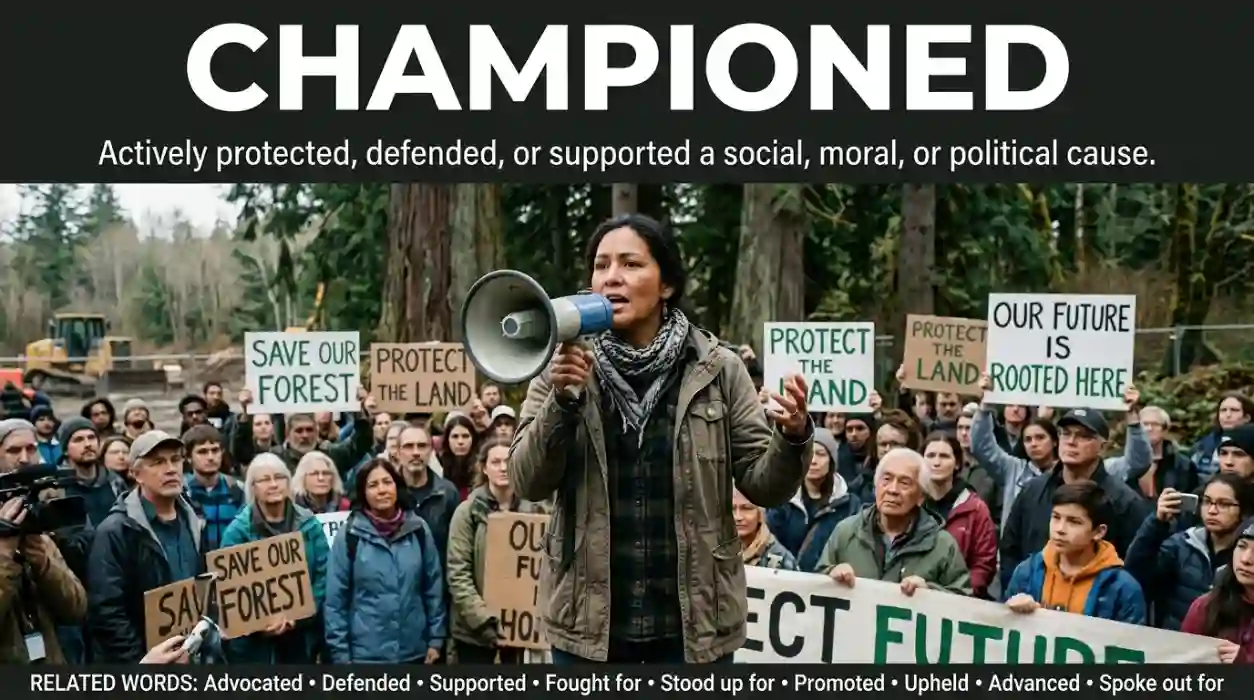
Meaning: Actively protected or supported a particular social, moral, or political cause.
Tone/Register: Formal, advocacy-focused, emphatic.
Examples:
The author defended the cause of accessible public education.
Local volunteers defended the cause of preserving the historic district.
21. Promoted the Interests of (verb phrase) — US: /prəˈmoʊ.tɪd ði ˈɪn.trəsts əv/ | UK: /prəˈməʊ.tɪd ði ˈɪn.trəsts əv/
Meaning: Took action to improve or protect the position of a person or group.
Tone/Register: Formal, diplomatic, business.
Examples:
The representative promoted the interests of small business owners.
Her work promoted the interests of rural communities.
22. Pioneered (verb) — US: /ˌpaɪ.əˈnɪrd/ | UK: /ˌpaɪ.əˈnɪəd/
Meaning: Led the development or introduction of a new method, idea, or approach.
Tone/Register: Professional, innovative, positive.
Examples:
The school pioneered a new approach to teaching reading.
Her team pioneered methods for making public information more accessible.
Usage note: Pioneering involves being among the first to develop something. It does not simply mean supporting an existing idea.
23. Spearheaded (verb) — US: /ˈspɪr.hed.ɪd/ | UK: /ˈspɪə.hed.ɪd/
Meaning: Led an initiative or effort to achieve a particular objective.
Tone/Register: Professional, business, leadership-focused.
Examples:
Nadia spearheaded the company’s accessibility project.
He spearheaded efforts to improve staff training.
24. Orchestrated (verb) — US: /ˈɔːr.kə.streɪ.tɪd/ | UK: /ˈɔː.kɪ.streɪ.tɪd/
Meaning: Organised and coordinated several actions to achieve a desired outcome.
Tone/Register: Professional, strategic, sometimes critical.
Examples:
The coordinator orchestrated a citywide reading festival.
The team orchestrated a smooth transition to remote learning.
Usage note: This word emphasises planning and coordination, not necessarily belief in a cause.
25. Mobilised (verb) — US: /ˈmoʊ.bə.laɪzd/ | UK: /ˈməʊ.bɪ.laɪzd/
Meaning: Organised people or resources to take action in support of a goal.
Tone/Register: Political, organisational, formal.
Examples:
Students mobilised volunteers to clean the neighbourhood park.
The campaign mobilised local support for safer cycling routes.
26. Rallyed Support for (verb phrase) — US: /ˈræl.id səˈpɔːrt fɔːr/ | UK: /ˈræl.id səˈpɔːt fɔː/
Meaning: Brought people together to support a shared goal.
Tone/Register: Persuasive, public-facing, conversational.
Examples:
The principal rallied support for a new school library.
Neighbours rallied support for the family after the fire.
Usage note: The standard spelling is rallied, not rallyed.
27. Lent Support to (verb phrase) — US: /lent səˈpɔːrt tuː/ | UK: /lent səˈpɔːt tuː/
Meaning: Offered assistance or approval to a person, plan, or cause.
Tone/Register: Formal, diplomatic, written English.
Examples:
Several organisations lent support to the emergency appeal.
Her colleagues lent support to the proposed changes.
28. Endorsed Publicly (verb phrase) — US: /ɪnˈdɔːrst ˈpʌb.lɪk.li/ | UK: /ɪnˈdɔːst ˈpʌb.lɪk.li/
Meaning: Expressed support openly so other people could see or hear it.
Tone/Register: Political, professional, journalistic.
Examples:
The association endorsed the call for stronger safeguards publicly.
The athlete publicly endorsed the youth mental health campaign.
Usage note: The more natural word order is usually publicly endorsed. Prefer that form in polished writing.
29. Staunchly Supported (verb phrase) — US: /ˈstɔːntʃ.li səˈpɔːr.tɪd/ | UK: /ˈstɔːntʃ.li səˈpɔː.tɪd/
Meaning: Supported something with strong and unwavering commitment.
Tone/Register: Formal, emphatic, journalistic.
Examples:
The organisation staunchly supported equal access to public services.
He staunchly supported his team’s decision to report the error.
30. Backed Strongly (verb phrase) — US: /bækt ˈstrɔːŋ.li/ | UK: /bækt ˈstrɒŋ.li/
Meaning: Gave firm approval or substantial assistance to a proposal or cause.
Tone/Register: Neutral, journalistic, business.
Examples:
The board strongly backed the plan to modernise the library.
Several residents strongly backed the proposed pedestrian zone.
Usage note: Strongly backed is generally more natural than backed strongly in ordinary English.
31. Promoted the Adoption of (verb phrase) — US: /prəˈmoʊ.tɪd ði əˈdɑːp.ʃən əv/ | UK: /prəˈməʊ.tɪd ði əˈdɒp.ʃən əv/
Meaning: Encouraged people or organisations to begin using a method, policy, or practice.
Tone/Register: Academic, technical, professional.
Examples:
The initiative promoted the adoption of energy-saving habits.
Her report promoted the adoption of accessible design principles.
32. Furthered (verb) — US: /ˈfɝː.ðɚd/ | UK: /ˈfɜː.ðəd/
Meaning: Helped a cause, plan, or objective progress towards success.
Tone/Register: Formal, academic, professional.
Examples:
The partnership furthered efforts to improve adult literacy.
His research furthered the development of safer transport systems.
33. Vindicated (verb) — US: /ˈvɪn.dɪ.keɪ.tɪd/ | UK: /ˈvɪn.dɪ.keɪ.tɪd/
Meaning: Showed that a person, claim, or decision was justified or correct.
Tone/Register: Formal, legal, analytical.
Examples:
The final report vindicated her concerns about data quality.
The investigation vindicated the employee’s account of the incident.
Usage note: Vindication often results from evidence or an outcome. It does not mean actively supporting a cause in the same way as championed.
34. Defended the Rights of (verb phrase) — US: /dɪˈfen.dɪd ðə raɪts əv/ | UK: /dɪˈfen.dɪd ðə raɪts əv/
Meaning: Worked to protect the freedoms, entitlements, or legal interests of people.
Tone/Register: Formal, legal, social advocacy.
Examples:
The organisation defended the rights of migrant workers.
Her legal team defended the rights of tenants facing unfair eviction.
35. Advocated on Behalf of (verb phrase) — US: /ˈæd.və.keɪ.tɪd ɑːn bɪˈhæf əv/ | UK: /ˈæd.və.keɪ.tɪd ɒn bɪˈhɑːf əv/
Meaning: Spoke or acted in support of another person or group.
Tone/Register: Formal, institutional, professional.
Examples:
The adviser advocated on behalf of students with additional needs.
She advocated on behalf of families affected by the policy.
36. Agitated for (verb phrase) — US: /ˈædʒ.ə.teɪ.tɪd fɔːr/ | UK: /ˈædʒ.ɪ.teɪ.tɪd fɔː/
Meaning: Persistently urged or campaigned for a political or social change.
Tone/Register: Formal, historical, political.
Examples:
Reformers agitated for fairer working conditions.
Local activists agitated for better access to public transport.
Usage note: This word can suggest protest, unrest, or persistent pressure. It is more common in historical and political writing than in everyday conversation.
37. Pressed for (verb phrase) — US: /prest fɔːr/ | UK: /prest fɔː/
Meaning: Insisted that a particular action or decision should happen.
Tone/Register: Professional, conversational, journalistic.
Examples:
The union pressed for clearer rules on overtime.
She pressed for a timely response to the community’s concerns.
38. Made the Case for (verb phrase) — US: /meɪd ðə keɪs fɔːr/ | UK: /meɪd ðə keɪs fɔː/
Meaning: Presented reasons and evidence to persuade others to support an idea.
Tone/Register: Academic, analytical, professional.
Examples:
The report made the case for expanding early childhood education.
He made the case for a shorter and more focused meeting schedule.
39. Vouched for (verb phrase) — US: /vaʊtʃt fɔːr/ | UK: /vaʊtʃt fɔː/
Meaning: Confirmed that someone or something was trustworthy, reliable, or worthy of confidence.
Tone/Register: Conversational, professional, personal.
Examples:
Her former supervisor vouched for her reliability.
Several colleagues vouched for the accuracy of his findings.
40. Defended the Merits of (verb phrase) — US: /dɪˈfen.dɪd ðə ˈmer.ɪts əv/ | UK: /dɪˈfen.dɪd ðə ˈmer.ɪts əv/
Meaning: Explained and defended the strengths or value of a proposal, method, or idea.
Tone/Register: Academic, analytical, formal.
Examples:
The researcher defended the merits of the mixed-method approach.
She defended the merits of teaching practical financial literacy.

41. Recommended (verb) — US: /ˌrek.əˈmen.dɪd/ | UK: /ˌrek.əˈmen.dɪd/
Meaning: Suggested that a person or course of action deserved consideration or approval.
Tone/Register: Neutral, professional, conversational.
Examples:
The adviser recommended a more accessible application process.
My tutor recommended the book to students preparing for their exams.
Usage note: A recommendation expresses approval or advice. It may not involve the sustained effort implied by championed.
42. Urged (verb) — US: /ɝːdʒd/ | UK: /ɜːdʒd/
Meaning: Strongly encouraged someone to take a particular action.
Tone/Register: Assertive, formal, journalistic.
Examples:
The doctors urged residents to follow the updated safety guidance.
She urged the committee to consider the wider impact of its decision.
43. Advocated the Adoption of (verb phrase) — US: /ˈæd.və.keɪ.tɪd ði əˈdɑːp.ʃən əv/ | UK: /ˈæd.və.keɪ.tɪd ði əˈdɒp.ʃən əv/
Meaning: Publicly recommended that people begin using a particular system, policy, or practice.
Tone/Register: Formal, academic, policy-focused.
Examples:
The panel advocated the adoption of clearer privacy standards.
Her paper advocated the adoption of inclusive teaching practices.
44. Defended the Principle of (verb phrase) — US: /dɪˈfen.dɪd ðə ˈprɪn.sə.pəl əv/ | UK: /dɪˈfen.dɪd ðə ˈprɪn.sə.pəl əv/
Meaning: Protected a fundamental belief or standard from criticism or weakening.
Tone/Register: Formal, ethical, philosophical.
Examples:
The judge defended the principle of equal treatment under the law.
She defended the principle of academic independence during the debate.
45. Worked to Advance (verb phrase) — US: /wɝːkt tə ədˈvæns/ | UK: /wɜːkt tə ədˈvɑːns/
Meaning: Took practical steps to help a cause, objective, or idea make progress.
Tone/Register: Professional, formal, versatile.
Examples:
The team worked to advance access to digital learning resources.
He worked to advance reforms that would benefit rural schools.
46. Lent Their Voice to (verb phrase) — US: /lent ðer vɔɪs tə/ | UK: /lent ðeə vɔɪs tə/
Meaning: Used their public influence or expression to support a cause or group.
Tone/Register: Expressive, journalistic, advocacy-focused.
Examples:
Several artists lent their voices to the campaign for clean rivers.
She lent her voice to students asking for safer school crossings.
47. Took Up the Cause of (verb phrase) — US: /tʊk ʌp ðə kɔːz əv/ | UK: /tʊk ʌp ðə kɔːz əv/
Meaning: Began supporting or defending a cause, often because others had overlooked it.
Tone/Register: Narrative, formal, conversational.
Examples:
The journalist took up the cause of families seeking better housing.
After hearing their concerns, the councillor took up the cause of local cyclists.
48. Lent Weight to (verb phrase) — US: /lent weɪt tuː/ | UK: /lent weɪt tuː/
Meaning: Added credibility, importance, or persuasive strength to an argument or position.
Tone/Register: Formal, academic, analytical.
Examples:
The new evidence lent weight to the case for reform.
Her testimony lent weight to the residents’ concerns.
Usage note: This expression focuses on strengthening an argument rather than personally campaigning for it.
49. Bolstered (verb) — US: /ˈboʊl.stɚd/ | UK: /ˈbəʊl.stəd/
Meaning: Strengthened a person’s confidence, a position, or an existing effort.
Tone/Register: Formal, professional, journalistic.
Examples:
The independent review bolstered confidence in the new procedure.
Her public statement bolstered support for the community project.
50. Championed the Interests of (verb phrase) — US: /ˈtʃæm.pi.ənd ði ˈɪn.trəsts əv/ | UK: /ˈtʃæm.pi.ənd ði ˈɪn.trəsts əv/
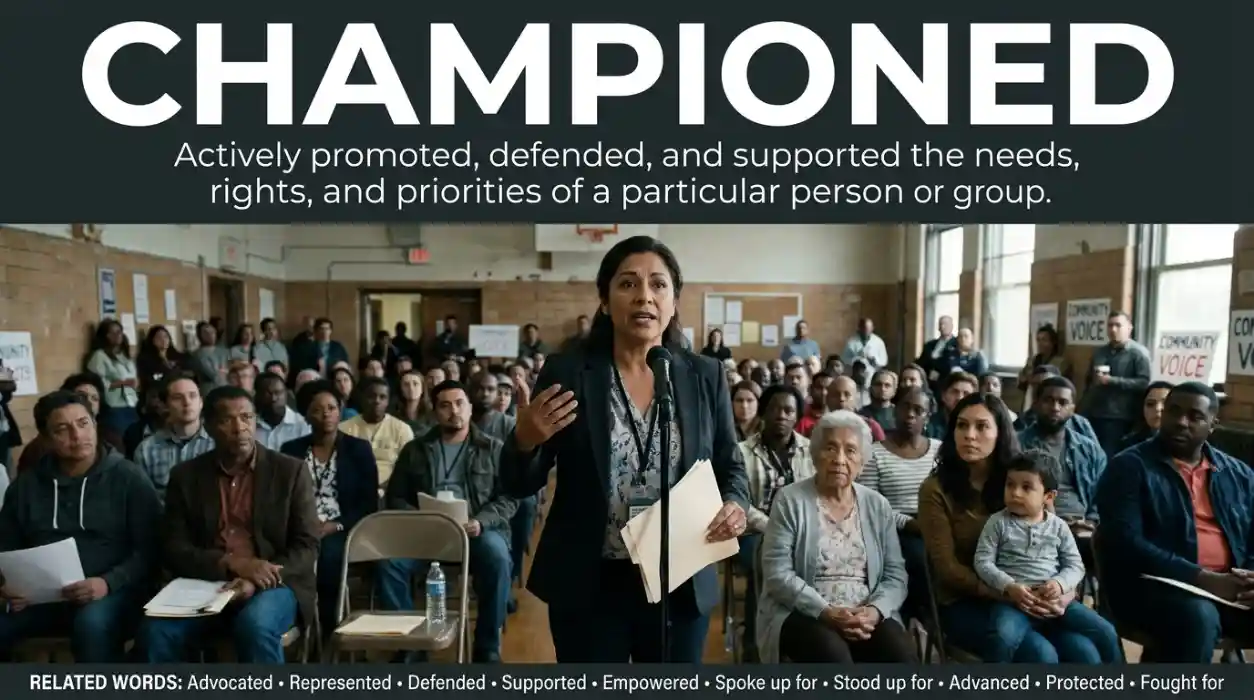
Meaning: Actively promoted or defended the needs and priorities of a particular person or group.
Tone/Register: Formal, professional, advocacy-focused.
Examples:
The representative championed the interests of independent artists.
She championed the interests of employees during the restructuring process.
Usage note: This is a useful extension of the original word rather than an independent synonym. Use it when you want to specify whose interests someone supported.
Synonyms by Tone
Choosing the right synonym involves more than finding a similar dictionary definition. Tone tells your reader how strongly someone supported a cause and whether the action involved persuasion, protection, leadership, or encouragement.
Positive Synonyms
These words highlight commitment, progress, encouragement, and constructive leadership.
- Advocated — expressed support for an idea or policy.
- Fostered — helped something develop.
- Nurtured — supported gradual growth.
- Pioneered — introduced a new approach.
- Spearheaded — led an initiative.
- Encouraged — inspired someone to act.
- Bolstered — strengthened existing support.
- Furthered — helped a goal progress.
Example: The principal spearheaded a programme that fostered creativity and encouraged independent learning.
Neutral Synonyms
These alternatives communicate support without adding much emotional emphasis.
- Supported — provided help or approval.
- Backed — gave practical or public support.
- Promoted — encouraged awareness or adoption.
- Endorsed — expressed approval.
- Recommended — suggested a suitable choice.
- Sustained — kept an effort going.
- Reinforced — strengthened an existing position.
- Advanced — helped a cause progress.
Example: The board endorsed the proposal and supported its gradual introduction.
Negative or Critical Synonyms
Some words become negative in particular contexts. Others imply pressure, conflict, or questionable methods rather than straightforward support.
- Pushed for — may suggest excessive pressure.
- Agitated for — can imply persistent protest or unrest.
- Orchestrated — may sound manipulative when describing a secretive plan.
- Fought for — can suggest conflict or an uncompromising stance.
- Promulgated — may sound critical when rules or doctrines are imposed.
These words are not inherently negative. Their connotations depend on the subject and the surrounding sentence.
Example: The commentator criticised the officials who pushed for the policy despite public objections.
Playful or Informal Alternatives
Everyday English often favours shorter expressions over formal vocabulary.
- Backed — “I backed her idea from day one.”
- Stood up for — “He stood up for his friend.”
- Pushed for — “We pushed for an earlier finish.”
- Fought for — “She fought for a fair chance.”
- Vouched for — “My colleague vouched for me.”
These expressions work well in conversations, messages, personal stories, and accessible blog posts.
Why Tone Matters in Word Choice
Consider three ways to describe the same action:
- “She supported the proposal.” This sounds neutral.
- “She championed the proposal.” This suggests active commitment.
- “She pushed for the proposal.” This emphasises pressure or persistence.
The basic idea remains similar, but the reader receives a different impression of the person’s role and attitude.
“Championed vs. Close Alternatives
Some synonyms are particularly close in meaning. Understanding their differences will help you choose words naturally.
| Word | Main emphasis | Best used when |
|---|---|---|
| Championed | Active, committed support | Someone consistently advances or defends a cause |
| Advocated | Public or reasoned support | Someone recommends an idea or argues for a policy |
| Supported | General help or approval | Someone assists, approves, or encourages |
| Promoted | Encouraging awareness or adoption | Someone tries to increase acceptance of an idea |
| Defended | Protection against criticism or attack | Someone responds to opposition or unfair treatment |
| Spearheaded | Leadership and initiative | Someone leads an organised effort |
Which Word Should You Choose?
Use championed when you want to emphasise commitment and active involvement.
Use advocated when the focus is on expressing or arguing for a position. It works particularly well in academic writing and policy discussions.
Use supported when you want a broad, neutral word. It is suitable when you know someone approved of an idea but do not need to imply public advocacy or sustained effort.
Use promoted when the goal is to increase awareness or encourage adoption. Use defended when the person responds to criticism or protects an existing right.
How “Championed ” Changes by Context
Daily Conversation
In everyday speech, simple alternatives usually sound the most natural. Backed, supported, stood up for, and fought for work well when describing people, decisions, or personal experiences.
For example, “I backed my sister’s decision” sounds conversational. “I championed my sister’s decision” sounds more deliberate and may suggest that you actively advocated for it.
Writing and Blogging
Bloggers and content writers can use championed, advocated, promoted, advanced, and fostered to describe initiatives and causes without repeating the same expression.
Choose each word according to the action. Do not replace a word merely to make a paragraph look varied. Accuracy matters more than vocabulary variety.
Professional and Academic Writing
Formal writing benefits from precise distinctions. Advocated suits arguments and recommendations. Spearheaded suits leadership. Advanced suits progress, while upheld suits principles, standards, and rights.
For example, “The researcher advocated reform” communicates a position. “The researcher advanced the field” describes a contribution to progress.
Creative and Informal Writing
Stories often benefit from vivid expressions such as stood up for, fought for, and took up the cause of. These phrases can convey conflict, emotion, courage, or personal loyalty.
For example, “She stood up for the new student” creates a more immediate scene than “She supported the new student.”
Common Mistakes Learners Make
Using Every Synonym as an Exact Replacement
Not every alternative fits every sentence. Champion often suggests active commitment, while recommend may describe a brief expression of advice.
Incorrect: “The scientist championed the book to me.”
More natural: “The scientist recommended the book to me.”
Confusing Advocacy With Leadership
Advocated means expressing or arguing for a position. Spearheaded means leading an initiative. A person may do both, but the verbs describe different actions.
Using Overly Formal Vocabulary in Casual Speech
Expressions such as promulgated and agitated for can sound unnatural in ordinary conversation. Use supported, backed, or pushed for when the situation is informal.
Choosing a Word That Changes the Meaning
Vindicated means that evidence or events showed a position was justified. It does not simply mean that someone supported the position.
Similarly, orchestrated focuses on coordination, not necessarily advocacy. Check the precise meaning before replacing championed.
Repeating “Championed ” Often
Repetition can make an essay or article feel monotonous. However, replacing every occurrence with a different synonym can make the writing sound forced.
Repeat the original word when it is the clearest choice. Change it only when the alternative expresses the intended meaning more accurately.
Register Notes: Formal vs. Informal
Formal and academic: advocated, advanced, upheld, furthered, endorsed.
Professional and leadership-focused: spearheaded, promoted, mobilised, fostered.
Conversational: backed, stood up for, pushed for, fought for.
Spoken English: Short expressions often sound more natural than abstract vocabulary. Written English allows more room for formal verbs when they add precision.
For further vocabulary practice, consult a reputable learner’s dictionary such as the Cambridge Dictionary and compare the example sentences for champion, advocate, and support.
Real-Life Examples
Workplace Scenario
A team leader believes employees need better training. She collects feedback, presents a plan to management, and encourages colleagues to participate.
You could say she championed professional development. If she organised the project herself, spearheaded may be even more accurate.
Social Situation
A student notices that a classmate is being treated unfairly. He speaks up, explains the problem, and asks others to intervene.
He stood up for his classmate. This expression conveys immediate personal support more naturally than a formal verb such as advanced.
Media and Public Life
A journalist spends years highlighting gaps in access to education. Their reports bring public attention to the issue and encourage policymakers to act.
The journalist championed educational equality. The verb highlights sustained commitment to the cause.
Writing and Storytelling
A character in a novel challenges an unfair rule that affects an entire village. The character persuades others to demand change.
The character fought for justice or took up the cause of the villagers. The first expression stresses determination; the second highlights a decision to defend others.
Practice Exercise
1. A student speaks in favor of extending library opening hours. Which word fits best?
A. Advocated
B. Propagated
C. Promulgated
2. A team leader organizes and directs a major workplace improvement project. Which word is most precise?
A. Endorsed
B. Spearheaded
C. Sustained
3. A company officially expresses approval of a proposed policy. Which word should you choose?
A. Endorsed
B. Fought
C. Pioneered
4. Someone protects a colleague who is being treated unfairly. Which expression sounds most natural in everyday English?
A. Promulgated
B. Stood up for
C. Furthered
5. A researcher introduces a new method that other scientists later adopt. Which verb fits best?
A. Pioneered
B. Backed
C. Called for
6. A community group encourages people to learn about recycling. Which expression is most appropriate?
A. Defended vigorously
B. Promoted awareness of
C. Upheld the principle of
7. A manager approves a proposal but does not lead its implementation. Which word is most accurate?
A. Spearheaded
B. Endorsed
C. Pioneered
8. A group of residents presses the council to repair dangerous roads. Which phrase best describes their action?
A. Pushed for
B. Embraced
C. Vindicated
9. A court maintains an earlier decision after an appeal. Which verb fits the legal context?
A. Encouraged
B. Upheld
C. Mobilized
10. A nonprofit keeps a long-term education project running despite challenges. Which word is best?
A. Sustained
B. Urged
C. Endorsed
Reflection and Application Task
Choose one synonym from this article and write an original sentence about your school, workplace, community, or a cause you care about. Then explain why that word fits better than championed.
Answer Key
1-A | 2-B | 3-A | 4-B | 5-A | 6-B | 7-B | 8-A | 9-B | 10-A
External Learning Sources
For reliable definitions, pronunciation, word history, and usage examples, consult these established language references:
- Merriam-Webster Dictionary:
- Cambridge Dictionary:
- Oxford Learner’s Dictionariehttps://www.oxfordlearnersdictionaries.com/s
- Online Etymology Dictionary:
Use these references to verify nuanced meanings and pronunciation when preparing academic work or publishing vocabulary content.
Conclusion
Learning synonyms for championed helps you express support with greater accuracy. The right word can reveal whether someone encouraged an idea, defended a principle, or led meaningful change.
Students can use these alternatives in essays, while bloggers and content writers can make their articles clearer and less repetitive. Everyday speakers can also communicate their intentions with confidence.
You do not need to memorize all words at once. Start with a few useful alternatives, notice how native speakers use them, and practice choosing words that match each situation.
Try using three new synonyms in an email, an essay, or a daily conversation this week. Small, consistent steps will help you build a richer vocabulary and express your ideas more naturally.
Frequently Asked Questions
1. What is the closest synonym for “championed” in academic writing?
Advocated is often the closest synonym in academic writing when someone argues in favor of a theory, policy, or cause. For example, “The researcher advocated a new approach to literacy.” If the sentence emphasizes practical progress rather than argument, advanced or furthered may communicate the intended meaning more accurately.
2. What is a stronger word than “supported” when describing leadership?
Spearheaded is a stronger choice when someone takes the lead and actively drives an initiative forward. Championed highlights commitment to a cause, while spearheaded emphasizes responsibility for leading an effort. Choose the latter when the person organized the work, coordinated others, or played a central role in getting a project started.
3. Can “championed” describe a person rather than an idea?
Yes. The word can describe active support for an individual, especially when someone defends their rights, reputation, or opportunities. For example, “The mentor championed young artists from underrepresented communities.” In this sentence, the mentor advocates for the people themselves rather than promoting a particular policy or proposal.
4. What is the difference between “championed” and “endorsed” in business English?
Championed usually implies active, sustained support, while endorsed indicates approval or a formal recommendation. A director may endorse a proposal without helping implement it. If the director consistently argues for the project, secures support, and helps move it forward, championed may be the more informative choice.
5. Which synonyms for “championed” are best for a résumé?
Use spearheaded, advanced, promoted, or advocated according to your actual contribution. For example, “Spearheaded an employee mentoring initiative” communicates leadership. “Advanced accessibility improvements” emphasizes progress. Choose the verb that accurately describes your work, and support it with a concrete achievement rather than relying on an impressive-sounding word alone.

Hasnain Ali is an SEO Content Strategist and the founder of wordvora.com, a trusted vocabulary platform that helps writers, students, professionals, and English learners find accurate synonyms, antonyms, word meanings, and real-life usage examples. He specializes in keyword research, on-page SEO, topical authority, and creating search-first content that aligns with Google’s latest Search Quality and E-E-A-T guidelines. His work focuses on producing clear, well-structured, and reader-friendly resources that satisfy search intent while maintaining high editorial standards.
Through extensive hands-on experience with SEO tools such as Google Search Console, Google Analytics, SEMrush, and Ahrefs, Hasnain researches user search behavior and develops content that is both informative and easy to understand. Every article published on wordvora.com is carefully reviewed for accuracy, readability, and contextual relevance before publication. His mission is to build one of the web’s most reliable English vocabulary resources by providing practical language guidance, trustworthy explanations, and content that helps readers improve their writing, communication, and vocabulary with confidence.