Synonyms for clueless include uninformed, unaware, ignorant, confused, bewildered, lost, inexperienced, out of touch, and in the dark. Each expression describes a different kind of missing knowledge, understanding, or awareness. The best choice depends on the situation, the speaker’s intention, and how politely they want to communicate.
Imagine sitting in a meeting where everyone discusses a project you have never heard about. You might say, “I’m completely clueless about this.” It is a natural way to admit that you do not understand what is happening.
The word clueless appears frequently in everyday English because it expresses a common experience. People use it when they lack information, feel confused, or cannot figure something out.
Learning alternatives helps you express the exact shade of meaning you intend. For example, unaware sounds neutral, while ignorant can sound critical. These differences make your English more precise.
Students can use these words in essays and conversations. Bloggers and content writers can avoid repetitive language. Everyday English users can choose expressions that sound natural, polite, humorous, or direct.
What Does “Clueless” Really Mean?
Clueless means having little or no knowledge, understanding, or awareness of a particular subject, situation, or problem. A clueless person may not know what to do, what is happening, or how to find an answer.
The word is an adjective. It usually describes a person who lacks relevant information or someone who cannot understand a situation.
Examples:
- I’m clueless about how this software works.
- He looked clueless when the teacher explained the assignment.
- We were clueless about the surprise party.
Native English speakers use clueless in casual conversations, social media posts, workplace discussions, entertainment, and informal writing. It often refers to a temporary lack of knowledge rather than a person’s overall intelligence.
Connotative Meaning
(Connotation is the emotional or cultural association a word carries beyond its basic dictionary meaning.)
- Positive tone: The word itself is rarely positive, but admitting you are clueless can show honesty, humility, and a willingness to learn.
- Negative tone: It can suggest incompetence, poor judgment, or a failure to understand something obvious.
- Neutral tone: In casual contexts, it simply means that someone does not know something.
For example, “I’m clueless about gardening” sounds like a harmless admission. However, “The manager is clueless” can suggest that the manager lacks the knowledge needed to do the job.
Etymology of “Clueless”
The word clueless combines clue and the suffix -less. The suffix means “without,” so the literal sense is “without a clue.”
The word clue has a more unusual history. It developed from clew, an older word for a ball of thread. The image connects to the thread that helped Theseus navigate the labyrinth in Greek mythology. Over time, clue acquired the figurative meaning of something that helps a person solve a mystery.
The history of clueless follows the development of these two elements rather than a separate ancient meaning.
Historical overview
- Old English (450–1100): The modern word clueless did not exist. English had other words for knowledge, understanding, and ignorance.
- Middle English (1100–1500): Forms related to clew referred to a ball of thread. The word later developed associations with guidance and finding a way through a problem.
- Modern English (1500–present): Clue developed its familiar figurative meaning. Clueless emerged later as an informal adjective meaning without knowledge or understanding.

Pronunciation (US and UK)
- US: /ˈkluː.ləs/
- UK: /ˈkluː.ləs/
Syllables
clue-less — two syllables.
Affixation Pattern of “Clueless”
- Root/base: clue
- Prefix: None
- Suffix: -less, meaning “without”
- Word formation: clue + less = clueless
- Part of speech: Adjective
The same suffix appears in words such as careless, helpless, and fearless. However, each word has its own meaning and emotional associations.
Synonyms List
1. Oblivious (Adjective) — US /əˈblɪv.i.əs/ | UK /əˈblɪv.i.əs/
Meaning: Totally unaware of or not noticing what is happening around oneself.
Tone/Register: Neutral / General
Examples:
He remained completely oblivious to the thunder outside his study room.
She walked past her friend while remaining oblivious to his warm wave.
2. Unaware (Adjective) — US /ˌʌn.əˈwɛr/ | UK /ˌʌn.əˈweə/
Meaning: Having no knowledge or thought of a specific situation or fact.
Tone/Register: General / Neutral
Examples:
They were entirely unaware of the sudden schedule change made yesterday.
He stayed unaware of the surprise party planned for his birthday.
3. Ignorant (Adjective) — US /ˈɪɡ.nər.ənt/ | UK /ˈɪɡ.nər.ənt/
Meaning: Lacking knowledge or information about a particular subject or topic.
Tone/Register: Direct / Slightly Negative
Examples:
She was ignorant of the local customs when she visited the village.
He made an ignorant comment because he had not read the report.
4. Naive (Adjective) — US /naɪˈiːv/ | UK /naɪˈiːv/
Meaning: Showing a lack of experience, wisdom, or judgment that leads to gullibility.
Tone/Register: General / Descriptive
Examples:
It was naive of him to trust the stranger with his money.
She held a naive belief that everything would work out without effort.
5. Uninformed (Adjective) — US /ˌʌn.ɪnˈfɔːrmd/ | UK /ˌʌn.ɪnˈfɔːmd/
Meaning: Not having or showing awareness of relevant facts and details.
Tone/Register: Formal / Academic
Examples:
The article criticized voters for making uninformed choices during elections.
He gave an uninformed opinion about the complex financial reform bill.
6. Inattentive (Adjective) — US /ˌɪn.əˈtɛn.tɪv/ | UK /ˌɪn.əˈtɛn.tɪv/
Meaning: Not paying close attention to what is happening or being said.
Tone/Register: Neutral / Formal
Examples:
The inattentive student missed the key instructions given by the teacher.
Her inattentive driving almost caused a minor traffic accident downtown.
7. Blind (Adjective) — US /blaɪnd/ | UK /blaɪnd/
Meaning: Unwilling or unable to perceive or understand clear truths or facts.
Tone/Register: General / Figurative
Examples:
He was blind to the obvious warning signs in his business partnership.
She stayed blind to her own mistakes despite continuous constructive feedback.
8. Green (Adjective) — US /ɡriːn/ | UK /ɡriːn/
Meaning: Lacking training, maturity, or professional experience in a specific field.
Tone/Register: Informal / Workplace
Examples:
The recruit is still green and needs daily guidance from managers.
Although green, she demonstrated impressive enthusiasm for her new role.
9. Dense (Adjective) — US /dɛns/ | UK /dɛns/
Meaning: Slow to understand things or lacking quick mental comprehension.
Tone/Register: Informal / Critical
Examples:
He was too dense to pick up on her subtle hints during dinner.
Stop acting so dense and listen to the clear instructions provided.
10. Uninitiated (Adjective) — US /ˌʌn.ɪˈnɪʃ.i.eɪ.t̬ɪd/ | UK /ˌʌn.ɪˈnɪʃ.i.eɪ.tɪd/
Meaning: Without special knowledge or experience in a specific subject or group.
Tone/Register: Formal / Academic
Examples:
To the uninitiated, the complex computer code looks like random symbols.
The seminar offers a basic introduction for uninitiated industry newcomers.
11. Lost (Adjective) — US /lɔːst/ | UK /lɒst/
Meaning: Completely confused or unable to follow what is being discussed.
Tone/Register: Informal / General
Examples:
I felt completely lost during the advanced mathematics lecture today.
He looked lost as the team discussed complex software engineering architecture.
12. Blindfolded (Adjective) — US /ˈblaɪnd.foʊl.dɪd/ | UK /ˈblaɪnd.fəʊl.dɪd/
Meaning: Deprived of insight or clear perception regarding ongoing conditions.
Tone/Register: Figurative / General
Examples:
Operating without market data left the executive feeling entirely blindfolded.
They made critical financial choices like blindfolded gamblers in a casino.
13. Unschooled (Adjective) — US /ˌʌnˈskuːld/ | UK /ˌʌnˈskuːld/
Meaning: Lacking formal education or specialized instruction in a specific domain.
Tone/Register: Neutral / Formal
Examples:
His unschooled eye failed to notice the subtle brushwork on the painting.
She was unschooled in corporate politics but managed projects effectively.
14. Unacquainted (Adjective) — US /ˌʌn.əˈkweɪn.t̬ɪd/ | UK /ˌʌn.əˈkweɪn.tɪd/
Meaning: Not familiar with a person, subject, or set of conditions.
Tone/Register: Formal
Examples:
He was unacquainted with the recent developments in international law.
She remained unacquainted with the company software systems until this week.
15. Unenlightened (Adjective) — US /ˌʌn.ɪnˈlaɪ.t̬ənd/ | UK /ˌʌn.ɪnˈlaɪ.tənd/
Meaning: Lacking modern knowledge, understanding, or cultural awareness.
Tone/Register: Formal / Literary
Examples:
The community suffered from unenlightened perspectives on modern healthcare practices.
His unenlightened views on technology made collaboration somewhat difficult.
16. Unlearned (Adjective) — US /ˌʌnˈlɜːrnd/ | UK /ˌʌnˈlɜːnd/
Meaning: Showing a lack of formal education, training, or deep knowledge.
Tone/Register: Formal
Examples:
An unlearned audience struggled to comprehend the scholar’s dense rhetoric.
He offered an unlearned opinion on the historical treaty document.
17. Shallow (Adjective) — US /ˈʃæl.oʊ/ | UK /ˈʃæl.əʊ/
Meaning: Lacking depth of intellect, understanding, or serious mental engagement.
Tone/Register: Critical
Examples:
Her shallow analysis failed to address the core causes of the issue.
He gave a shallow explanation that satisfied nobody in the audience.
18. Thick (Adjective) — US /θɪk/ | UK /θɪk/
Meaning: Slow to learn or understand simple ideas; mentally sluggish.
Tone/Register: Informal / Mildly Insulting
Examples:
Don’t be so thick; the solution is right in front of you.
He can be a bit thick when interpreting subtle personal hints.
19. Unmindful (Adjective) — US /ʌnˈmaɪnd.fəl/ | UK /ʌnˈmaɪnd.fəl/
Meaning: Not conscious or aware of potential consequences or surrounding conditions.
Tone/Register: Formal / Literary
Examples:
Unmindful of the impending storm, they continued their mountain hike.
She proceeded unmindful of the risks involved in the investment project.
20. Out-of-the-loop (Adjective) — US /aʊt əv ðə luːp/ | UK /aʊt əv ðə luːp/
Meaning: Excluded from or unaware of specific information shared within a group.
Tone/Register: Idiomatic / Business Casual
Examples:
I felt completely out of the loop after returning from my two-week vacation.
Keep me informed so I do not remain out of the loop on key updates.
21. Untrained (Adjective) — US /ˌʌnˈtreɪnd/ | UK /ˌʌnˈtreɪnd/
Meaning: Lacking the necessary skills or education required for a task.
Tone/Register: Neutral / Workplace
Examples:
An untrained observer might miss the subtle flaws in the diamond.
They assigned untrained workers to handle the delicate emergency equipment.
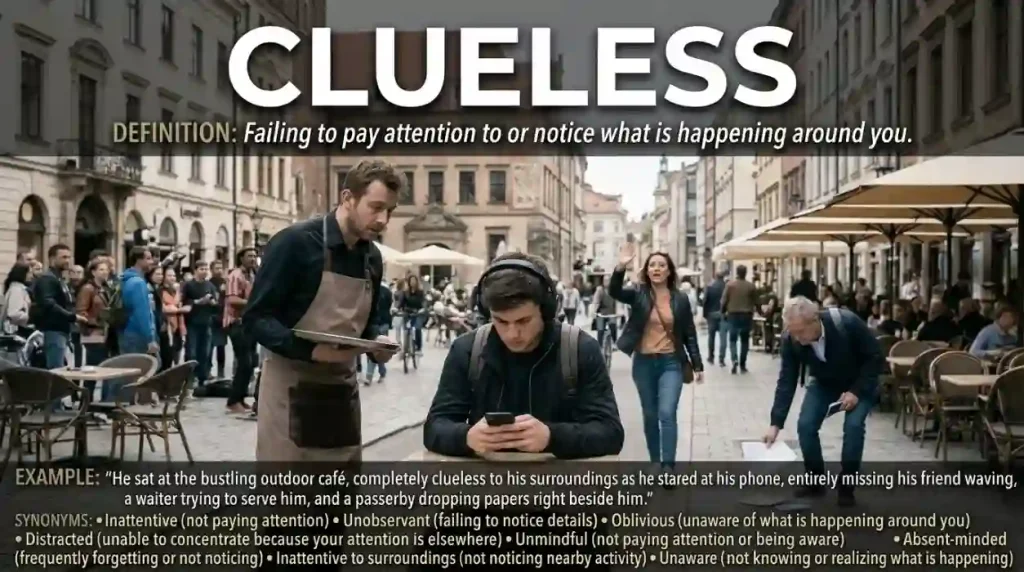
22. Unobservant (Adjective) — US /ˌʌn.əbˈzɜːr.vənt/ | UK /ˌʌn.əbˈzɜː.vənt/
Meaning: Failing to pay close attention or notice things going on around.
Tone/Register: Neutral
Examples:
The unobservant guard failed to notice the broken door lock.
She was surprisingly unobservant regarding the dramatic mood shift in the room.
23. Simple (Adjective) — US /ˈsɪm.pəl/ | UK /ˈsɪm.pəl/
Meaning: Lacking sophistication, mental sharpness, or deep understanding.
Tone/Register: General / Context-Dependent
Examples:
He gave a simple answer that showed he missed the underlying complexity.
Her simple approach worked well, though she lacked advanced knowledge.
24. Unversed (Adjective) — US /ˌʌnˈvɜːrst/ | UK /ˌʌnˈvɜːst/
Meaning: Not experienced or skilled in a particular subject area.
Tone/Register: Formal
Examples:
She was unversed in corporate finance when she took the managerial position.
He felt unversed in the artistic theories discussed at the gallery opening.
25. Spacey (Adjective) — US /ˈspeɪ.si/ | UK /ˈspeɪ.si/
Meaning: Out of touch with reality, distracted, or lacking clear focus.
Tone/Register: Informal
Examples:
He seemed a bit spacey today and forgot his apartment keys twice.
Lack of sleep made her feel spacey during the afternoon lecture.
26. Inexperienced (Adjective) — US /ˌɪn.ɪkˈspɪr.i.ənst/ | UK /ˌɪn.ɪkˈspɪə.ri.ənst/
Meaning: Having little or no knowledge gained from hands-on practice.
Tone/Register: Professional / General
Examples:
The inexperienced chef burnt the delicate sauce during dinner service.
Inexperienced drivers should exercise extra caution on icy winter roads.
27. Blank (Adjective) — US /blæŋk/ | UK /blæŋk/
Meaning: Showing no comprehension, understanding, or emotional awareness on one’s face.
Tone/Register: General
Examples:
He gave me a completely blank stare when I asked for the report.
Her mind went blank as soon as the test papers were handed out.
28. Gullible (Adjective) — US /ˈɡʌl.ə.bəl/ | UK /ˈɡʌl.ə.bəl/
Meaning: Easily persuaded or tricked into believing something false due to ignorance.
Tone/Register: Neutral
Examples:
He was gullible enough to believe the ridiculous Internet rumor.
Scammers often target gullible individuals who lack digital literacy skills.
29. Unperceptive (Adjective) — US /ˌʌn.pɚˈsɛp.tɪv/ | UK /ˌʌn.pəˈsɛp.tɪv/
Meaning: Slow to notice, understand, or intuit subtle details or feelings.
Tone/Register: Formal
Examples:
The manager was unperceptive to the growing burnout among team members.
An unperceptive reader might easily overlook the author’s hidden irony.
30. Unwise (Adjective) — US /ˌʌnˈwaɪz/ | UK /ˌʌnˈwaɪz/
Meaning: Lacking good judgment or clear understanding of potential consequences.
Tone/Register: Formal / General
Examples:
It is unwise to invest all your savings in a single risky asset.
His unwise remarks caused unnecessary friction during the negotiations.
31. Ditsy (Adjective) — US /ˈdɪt.si/ | UK /ˈdɪt.si/
Meaning: Silly, scatterbrained, and noticeably lacking serious focus or awareness.
Tone/Register: Informal / Casual
Examples:
She played a ditsy character in the popular television comedy show.
He made a ditsy mistake by leaving his lunch inside the freezer.
32. Obtuse (Adjective) — US /əbˈtuːs/ | UK /əbˈtjuːs/
Meaning: Annoyingly insensitive or slow to understand clear concepts.
Tone/Register: Formal / Critical
Examples:
Are you being deliberately obtuse, or do you truly not understand?
His obtuse attitude during the crisis frustrated the entire executive board.
33. Unaware-of-facts (Adjective) — US /ˌʌn.əˈwɛr əv fækts/ | UK /ˌʌn.əˈweə əv fækts/
Meaning: Lacking objective information regarding a specific circumstance or event.
Tone/Register: Descriptive
Examples:
He remained unaware of facts that could have altered his final decision.
An unaware-of-facts spokesperson delivered an inaccurate media briefing today.
34. Witless (Adjective) — US /ˈwɪt.ləs/ | UK /ˈwɪt.ləs/
Meaning: Lacking mental sharpness, sense, or resourcefulness in key moments.
Tone/Register: Literary / Critical
Examples:
The witless decision left the startup vulnerable to aggressive competitors.
He stood witless as the fast-moving event unfolded before his eyes.
35. Imperceptive (Adjective) — US /ˌɪm.pɚˈsɛp.tɪv/ | UK /ˌɪm.pəˈsɛp.tɪv/
Meaning: Lacking the ability to perceive subtle cues or underlying truths.
Tone/Register: Formal
Examples:
An imperceptive critic failed to grasp the deeper themes of the play.
She was imperceptive to the subtle tension brewing between her colleagues.
36. Short-sighted (Adjective) — US /ˌʃɔːrtˈsaɪ.t̬ɪd/ | UK /ˌʃɔːtˈsaɪ.tɪd/
Meaning: Lacking foresight or broad understanding of future consequences.
Tone/Register: General / Business
Examples:
Cutting the research budget was a short-sighted strategy for growth.
His short-sighted planning caused severe operational delays later in the project.
37. Vacant (Adjective) — US /ˈveɪ.kənt/ | UK /ˈveɪ.kənt/
Meaning: Showing no thought, concentration, or mental awareness in expression.
Tone/Register: Descriptive
Examples:
She looked at the whiteboard with a completely vacant expression.
His vacant look suggested his thoughts were far away from the room.
38. Off-track (Adjective) — US /ɔːf træk/ | UK /ɒf træk/
Meaning: Misguided or failing to follow the correct line of thought.
Tone/Register: Informal
Examples:
His arguments were completely off-track during the afternoon debate session.
The project went off-track due to poor initial guidance and communication.
39. Unheeding (Adjective) — US /ʌnˈhiː.dɪŋ/ | UK /ʌnˈhiː.dɪŋ/
Meaning: Not paying attention to warnings, advice, or crucial details.
Tone/Register: Literary / Formal
Examples:
Unheeding of the posted warning signs, he swam past the safety markers.
They marched forward, unheeding of the clear economic danger signals.
40. Unmindful-of-cues (Adjective) — US /ʌnˈmaɪnd.fəl əv kjuːz/ | UK /ʌnˈmaɪnd.fəl əv kjuːz/
Meaning: Failing to respond to social signals or environmental prompts.
Tone/Register: Descriptive / Psychological
Examples:
He continued talking endlessly, completely unmindful-of-cues from his bored audience.
Being unmindful-of-cues can sometimes strain delicate personal relationships over time.
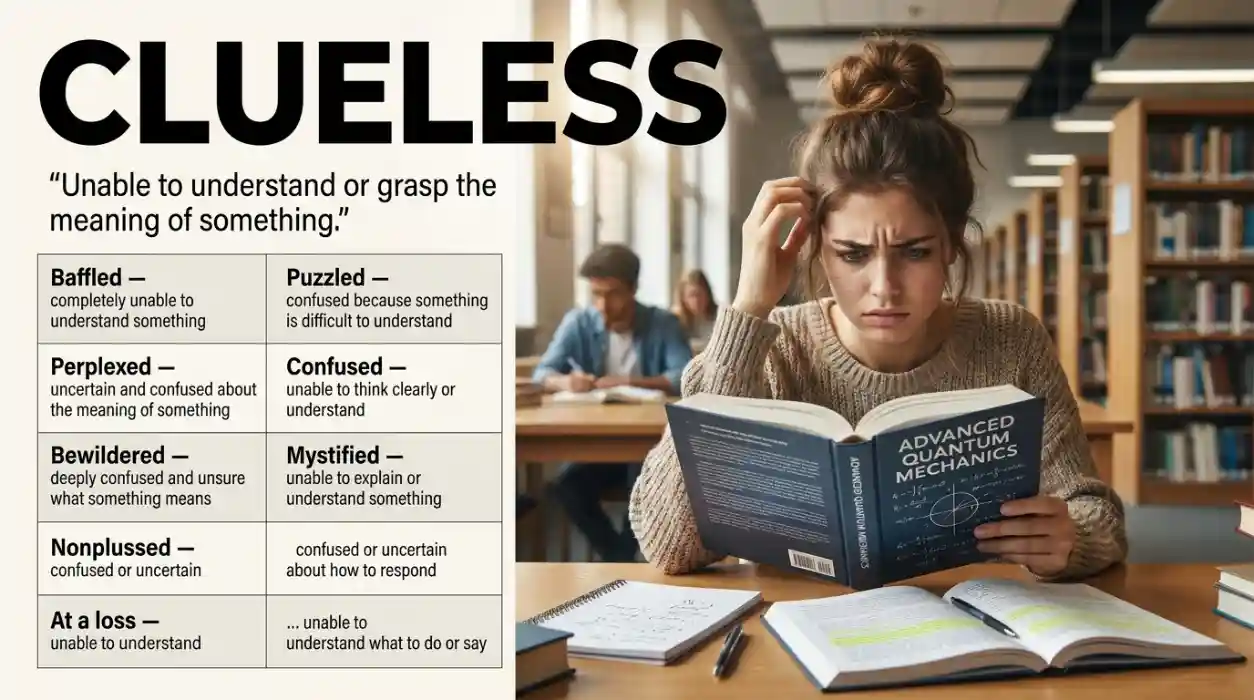
41. Uncomprehending (Adjective) — US /ˌʌn.kɑːm.prəˈhɛn.dɪŋ/ | UK /ˌʌn.kɒm.prɪˈhɛn.dɪŋ/
Meaning: Unable to grasp or understand the meaning of something.
Tone/Register: Formal
Examples:
He gave an uncomprehending shrug when asked about the foreign policy.
The child stared with uncomprehending eyes at the complex mathematical equation.
42. Airheaded (Adjective) — US /ˈɛr.hɛd.ɪd/ | UK /ˈeə.hɛd.ɪd/
Meaning: Silly, foolish, or lacking serious thought and logical consistency.
Tone/Register: Informal
Examples:
Her airheaded remark made everyone in the conference room pause in surprise.
He realized his airheaded mistake when he arrived at the wrong airport terminal.
43. Out-of-it (Adjective) — US /aʊt əv ɪt/ | UK /aʊt əv ɪt/
Meaning: Temporarily confused, detached, or unaware due to exhaustion or illness.
Tone/Register: Informal / Everyday
Examples:
I felt totally out-of-it after taking that heavy allergy medication.
She seemed out-of-it during breakfast and barely spoke a single word.
44. Asleep-at-the-wheel (Adjective) — US /əˈsliːp æt ðə wiːl/ | UK /əˈsliːp æt ðə wiːl/
Meaning: Failing to pay attention to responsibilities during a critical period.
Tone/Register: Idiomatic / Business
Examples:
The security team was asleep-at-the-wheel when the data breach occurred.
Management was caught asleep-at-the-wheel as market trends shifted rapidly.
45. In-the-dark (Adjective) — US /ɪn ðə dɑːrk/ | UK /ɪn ðə dɑːk/
Meaning: Kept uninformed or lacking knowledge about a specific situation.
Tone/Register: Idiomatic / General
Examples:
Employees were left completely in the dark regarding the upcoming company merger.
Don’t leave me in the dark about changes to our weekend travel plans.
46. Soft-headed (Adjective) — US /ˌsɑːftˈhɛd.ɪd/ | UK /ˌsɒftˈhɛd.ɪd/
Meaning: Lacking sound judgment, clear logic, or intellectual capacity.
Tone/Register: Informal / Critical
Examples:
His soft-headed proposal was quickly rejected by the investment committee.
Relying on luck rather than research is a soft-headed approach to business.
47. Disconnected (Adjective) — US /ˌdɪs.kəˈnɛk.tɪd/ | UK /ˌdɪs.kəˈnɛk.tɪd/
Meaning: Lacking a meaningful connection to reality or current circumstances.
Tone/Register: General / Professional
Examples:
His leadership style felt disconnected from the everyday challenges of workers.
She appeared disconnected from the group conversation during the entire dinner.
48. Unknowing (Adjective) — US /ʌnˈnoʊ.ɪŋ/ | UK /ʌnˈnəʊ.ɪŋ/
Meaning: Not aware of what is taking place or what the truth is.
Tone/Register: Literary / Formal
Examples:
An unknowing participant inadvertently revealed the surprise party location.
She passed by the historical monument with an unknowing, casual glance.
49. Uncalculating (Adjective) — US /ˌʌnˈkæl.kjə.leɪ.t̬ɪŋ/ | UK /ˌʌnˈkæl.kjə.leɪ.tɪŋ/
Meaning: Guileless, innocent, and lacking strategic awareness or scheming design.
Tone/Register: Literary / Neutral
Examples:
Her uncalculating nature made her trusting, though sometimes easily misled.
He offered an uncalculating answer that revealed his genuine lack of experience.
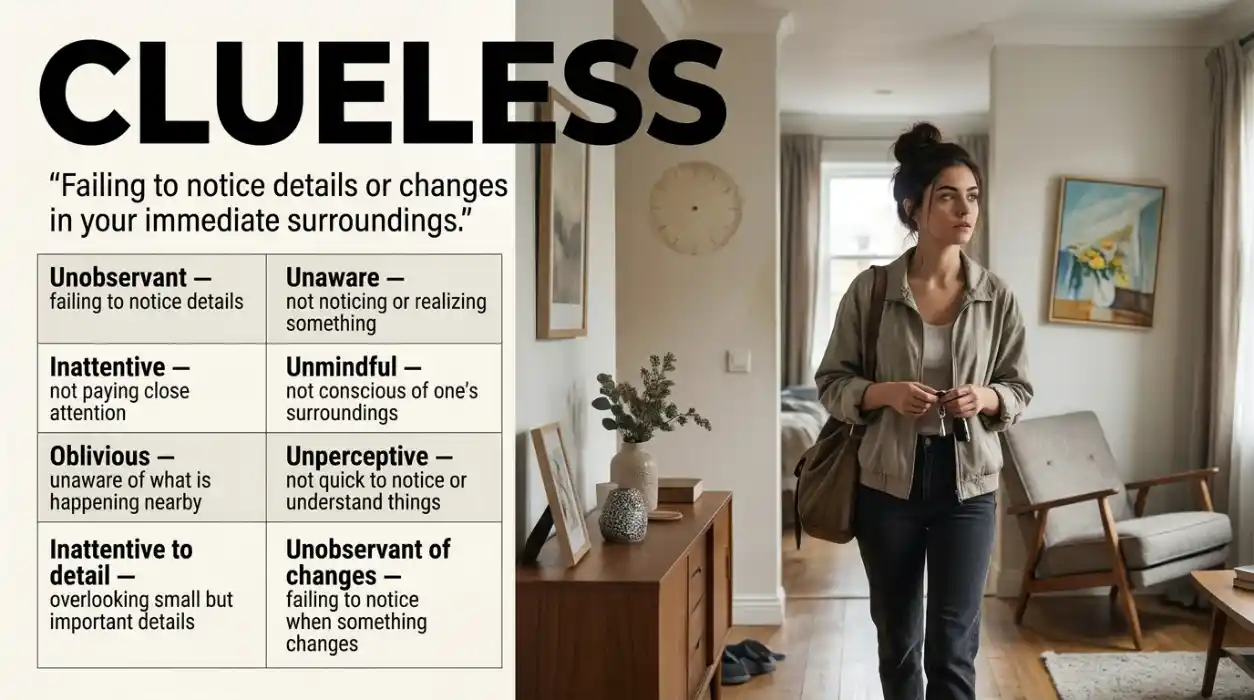
50. Unobserving (Adjective) — US /ˌʌn.əbˈzɝː.vɪŋ/ | UK /ˌʌn.əbˈzɜː.vɪŋ/
Meaning: Not noticing details or changes in the immediate environment.
Tone/Register: Neutral / Formal
Examples:
An unobservant witness could not provide the police with specific vehicle details.
He walked through the crowded market, entirely unobserving of his surroundings.
Synonyms by Tone
The right alternative depends on what you want to communicate. A word that sounds harmless among friends may sound disrespectful in a meeting or an essay.
Positive or Constructive Alternatives
These words do not always mean clueless directly. They help describe limited knowledge without judging someone’s intelligence.
- Inexperienced: Emphasizes a lack of practice.
- Novice: Presents someone as a learner.
- Beginner: Sounds friendly and encouraging.
- Unfamiliar: Focuses on a topic someone has not encountered before.
- Uncertain: Expresses doubt without suggesting incompetence.
Example: “I’m a beginner at data analysis, but I’m eager to learn.”
Neutral Alternatives
These are generally suitable for everyday conversation, schoolwork, and professional communication.
- Uninformed: Lacks relevant facts.
- Unaware: Does not know something is happening.
- Confused: Cannot understand something clearly.
- Puzzled: Wants to understand something.
- Unversed: Lacks knowledge of a subject.
- At a loss: Does not know what to say or do.
- In the dark: Lacks important information.
Example: “I’m unfamiliar with the process. Could you explain it?”
Negative Alternatives
These words can criticize a person’s understanding, judgment, or awareness.
- Ignorant: Lacks knowledge; may imply an unwillingness to learn.
- Oblivious: Fails to notice something important.
- Dense: Suggests difficulty understanding.
- Thick: An insulting term for someone perceived as slow to understand.
- Airheaded: Suggests carelessness or a lack of practical sense.
- Out of touch: Suggests someone does not understand current realities.
Example: “The proposal seems out of touch with what customers actually need.”
Playful or Informal Alternatives
These expressions add personality to casual conversations, stories, and dialogue.
- Baffled: Completely confused.
- Flummoxed: Confused in a slightly humorous way.
- Stumped: Unable to solve a problem.
- Green: New and inexperienced.
- Greenhorn: An inexperienced newcomer.
- Scatterbrained: Forgetful or disorganized.
- Wet behind the ears: Young or inexperienced.
Example: “I’m totally stumped by this puzzle. Can you give me a hint?”
Why Tone Matters in Word Choice
Tone affects how readers interpret your message. Saying “I’m confused” invites an explanation. Saying “You’re ignorant” may start an argument.
For academic writing, prefer uninformed, unfamiliar, or unaware when they express your intended meaning. In friendly conversations, clueless, baffled, and stumped often sound more natural.
“Clueless” vs. Close Alternatives
Several synonyms appear similar but describe different experiences. These distinctions help you choose a precise word.
| Word | Main difference | Best use |
|---|---|---|
| Clueless | Lacks knowledge or an idea about something | Casual conversations and general situations |
| Ignorant | Lacks knowledge about a subject; may sound judgmental | Discussions of knowledge or awareness |
| Unaware | Does not know that something exists or is happening | Neutral explanations and polite communication |
| Confused | Has difficulty understanding information | Complicated instructions or unclear explanations |
| Oblivious | Fails to notice something, especially something noticeable to others | Social behavior and missed signals |
| Inexperienced | Has not gained enough practical experience | Work, education, and skill development |
Compare these examples:
- “I’m clueless about accounting.” The speaker has little idea how accounting works.
- “I’m unaware of the new accounting rules.” The speaker has not received or noticed the relevant information.
- “I’m confused by the accounting instructions.” The speaker has seen the instructions but cannot understand them.
The distinction is simple: clueless emphasizes a lack of understanding, unaware emphasizes missing awareness, and confused emphasizes difficulty making sense of information.
How “Clueless” Changes by Context
Daily Conversation
In everyday English, clueless sounds natural and conversational. It is useful when admitting that you do not understand a task, topic, or situation.
“I’m clueless about cooking rice properly” is an ordinary, friendly statement. You could also say, “I have no idea how to cook rice.”
When discussing another person, however, the word can sound dismissive. Consider saying, “He may need more guidance” instead of “He is clueless.”
Writing and Blogging
Writers often use synonyms to make descriptions more accurate and avoid repetitive language. A blog about learning technology might describe a reader as unfamiliar with the software rather than clueless about technology.
Choose vocabulary according to your audience. Informal lifestyle articles can use expressive language. Educational articles usually benefit from neutral descriptions.
Professional or Academic English
Professional communication often requires tact. Words such as uninformed, uncertain, and unfamiliar can identify a knowledge gap without attacking someone’s character.
For example, “I’m unfamiliar with the current reporting procedure” sounds more constructive than “I’m clueless about reporting.”
In academic writing, use limited knowledge, insufficient understanding, or lack of familiarity when you need a more formal noun phrase.
Creative and Informal English
Fiction writers can use baffled, bewildered, stumped, or flummoxed to show how a character reacts to a situation.
A comedy writer might describe a character as clueless or scatterbrained. These words quickly establish a character’s behavior, but repeated use can make the description feel predictable.
Choose an expression that reflects the character’s experience rather than adding a colorful word without a clear purpose.
Common Mistakes Learners Make
Confusing Lack of Knowledge With Lack of Intelligence
Someone clueless about a topic is not necessarily unintelligent. A skilled engineer may be clueless about cooking, while a talented writer may be unfamiliar with financial accounting.
Describe the specific knowledge gap instead of making a general judgment about the person.
Using “Ignorant” When You Mean “Unaware”
These words are not always interchangeable.
“I was unaware of the announcement” means you did not know about it. “I was ignorant of the regulations” means you lacked knowledge of the regulations. The second expression may sound more critical.
Using “Oblivious” for Every Type of Confusion
Oblivious usually means failing to notice something. It does not necessarily mean struggling to understand an explanation.
“He was oblivious to the warning signs” works naturally. “He was oblivious to this difficult equation” may be less precise if the real problem is understanding the mathematics.
Calling Someone “Dense” or “Thick”
These words can offend people because they suggest that the person is unintelligent. They are rarely appropriate in professional feedback.
Try “The instructions may need clarification” or “Let’s review this together” instead.
Repeating “Clueless” Too Often
Repetition makes writing monotonous. However, replacing every occurrence with a synonym can create awkward sentences.
Use clueless when it is the most natural choice. Switch to another expression only when it adds a useful difference in meaning or tone.
Register Notes: Formal vs. Informal
Formal: uninformed, unversed, unfamiliar, uncertain, lacking sufficient knowledge.
Neutral: unaware, confused, puzzled, inexperienced, unsure.
Informal: clueless, baffled, stumped, flummoxed, greenhorn.
Spoken English often favors short, direct expressions. Written English may require more precise vocabulary, especially in academic or professional contexts.
Real-Life Examples Using “Clueless”
Workplace Scenario
A new employee receives a complicated spreadsheet without instructions.
Instead of saying, “I’m clueless,” the employee says, “I’m unfamiliar with this reporting system. Could you show me how it works?”
The second version identifies the problem and politely asks for help.
Social Scenario
Your friends begin discussing a television series you have never watched.
You might say, “I’m completely out of the loop. What’s happening in the story?”
This expression sounds relaxed and friendly. It shows that you lack recent information rather than suggesting you cannot understand the story.
Media and Pop Culture Scenario
A comedy character misunderstands obvious hints throughout a scene.
A writer could describe the character as clueless or oblivious. The first suggests a broad lack of understanding. The second emphasizes the character’s failure to notice the hints.
Writing and Storytelling Scenario
A detective encounters an unusual clue that does not fit the evidence.
Rather than calling the detective clueless, a writer might say the detective is perplexed by the contradiction. This choice emphasizes a difficult intellectual problem rather than incompetence.
External Learning Sources
For authoritative definitions, pronunciation, and examples, consult these dictionaries:
Cambridge Dictionary — learner-friendly definitions and UK and US pronunciation.
Oxford Learner’s Dictionaries — usage examples, grammar patterns, and pronunciation guidance.
Merriam-Webster — definitions, word history, and American English usage.
Practice Exercise
1:Which synonym best describes someone who fails to notice environmental surroundings
a) Oblivious
b) Uneducated
c) Unfair
d) Strict
2:He was completely _____ about the surprise retirement party organized by his staff
a) Unaware
b) Wise
c) Alert
d) Keen
3:Which term fits best in a formal corporate evaluation report?
a) Airheaded
b) Inexperienced
c) Ditsy
d) Spacey
4:What is the syllable count for the word “Clueless”?
a) 1
b) 2
c) 3
d) 4
5:Which word carries a strong connotation of innocence and youth?
a) Dense
b) Naive
c) Obtuse
d) Thick
6:The manager was caught _____ when the supply chain failed unexpectedly.”
a) Asleep-at-the-wheel
b) Wise to the world
c) Sharp-eyed
d) Clear-headed
7:Select the formal synonym that means lacking special training or initiation:
a) Spacey
b) Uninitiated
c) Blank
d) Green
8:What part of speech is “clueless” in the sentence “She seemed clueless about the news”?
a) Noun
b) Adjective
c) Verb
d) Adverb
9:I felt totally _____ after working a sixteen-hour shift without sleep.”
a) Out-of-it
b) Aware
c) Sharpened
d) Prepared
10:Which synonym implies being deliberately or annoyingly slow to comprehend?
a) Obtuse
b) Naive
c) Unacquainted
d) Unknowing
Application Task:
Write one short, real-life sentence using the synonym “oblivious” to describe a common daily situation.
Answer Key: 1: a | 2: a | 3: b | 4: b | 5: b | 6: a | 7: b | 8: b | 9: a | 10: a
Conclusion:
Learning synonyms for clueless helps you describe missing knowledge, confusion, and inexperience with greater precision. The best word communicates your meaning without creating unnecessary misunderstanding.
For students, vocabulary variety can strengthen essays and improve reading comprehension. Bloggers and content writers can create clearer explanations that feel natural and engaging.
For everyday English users, these alternatives make conversations more expressive. A thoughtful choice can turn a blunt statement into a polite request for clarification.
Start small. Practice one new synonym in an email, an essay, or a daily conversation. Over time, these words will become a natural part of your English vocabulary.
FAQs
1. What is the best synonym for clueless in professional emails?
Unfamiliar is often the best choice when you lack experience with a process or subject. For example, “I’m unfamiliar with the updated procedure. Could you clarify the next step?” If you lack specific facts, use uninformed. If you cannot understand instructions, confused may be more accurate. Choose a word that describes the problem without criticizing yourself or your colleagues.
2. How can I say “I’m clueless” without sounding unintelligent?
Use phrases that identify what you need to learn. Try “I’m not familiar with this topic,” “I could use some guidance,” or “I’m still learning how this works.” These expressions show that you recognize a knowledge gap and want to address it. They also sound constructive in classrooms, interviews, meetings, and conversations with experienced colleagues.
3. What is the difference between clueless, ignorant, and oblivious?
Clueless means having little understanding of a subject or situation. Ignorant means lacking knowledge about something and can sound judgmental. Oblivious means failing to notice something that is happening or affecting others. For example, a person can be clueless about taxes, ignorant of a regulation, or oblivious to a friend’s frustration. The correct word depends on the situation.
4. Which synonyms for clueless are appropriate for academic essays?
Consider uninformed, unfamiliar, uncertain, unversed, and lacking sufficient knowledge. These expressions usually sound more appropriate in academic writing than clueless, thick, or airheaded. However, the best choice depends on your argument. Use unaware when someone lacks awareness, and confused when a person struggles to understand information. Precision matters more than choosing the longest or most formal word.
5. What are some funny or playful ways to say clueless?
In casual conversations, you can use baffled, flummoxed, stumped, or clueless. Phrases such as in the dark can also sound conversational. For example, “I’m completely stumped by this puzzle” expresses confusion without sounding harsh. Avoid using insulting expressions such as thick or dense unless you fully understand their tone and the relationship between the people speaking.

Hasnain Ali is an SEO Content Strategist and the founder of wordvora.com, a trusted vocabulary platform that helps writers, students, professionals, and English learners find accurate synonyms, antonyms, word meanings, and real-life usage examples. He specializes in keyword research, on-page SEO, topical authority, and creating search-first content that aligns with Google’s latest Search Quality and E-E-A-T guidelines. His work focuses on producing clear, well-structured, and reader-friendly resources that satisfy search intent while maintaining high editorial standards.
Through extensive hands-on experience with SEO tools such as Google Search Console, Google Analytics, SEMrush, and Ahrefs, Hasnain researches user search behavior and develops content that is both informative and easy to understand. Every article published on wordvora.com is carefully reviewed for accuracy, readability, and contextual relevance before publication. His mission is to build one of the web’s most reliable English vocabulary resources by providing practical language guidance, trustworthy explanations, and content that helps readers improve their writing, communication, and vocabulary with confidence.