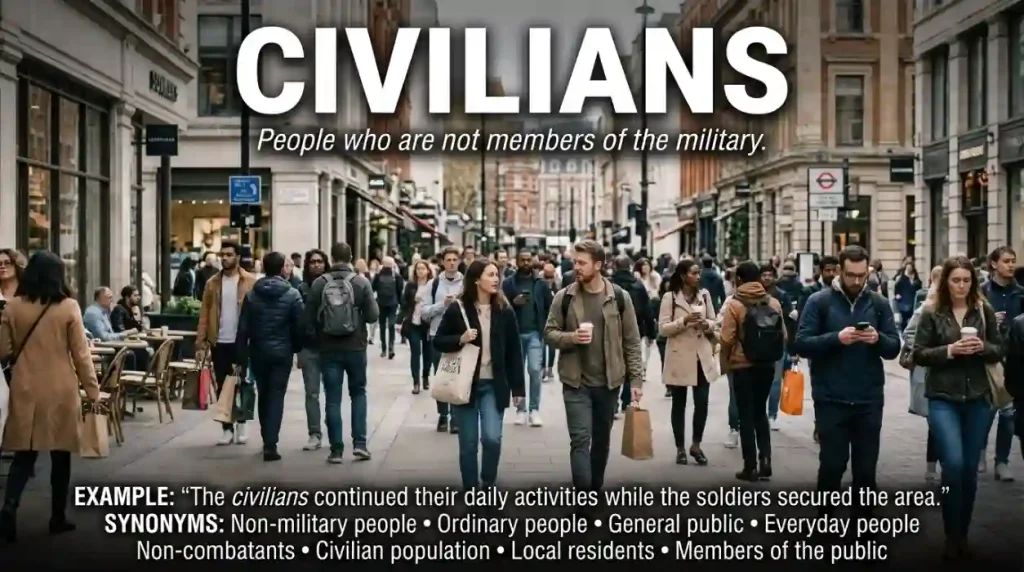
Synonyms for civilians include ordinary people, noncombatants, residents, members of the public, and private citizens. The best choice depends on context. In military discussions, noncombatants may be suitable. In everyday writing, ordinary people or residents may sound more natural.
Imagine reading a news report about a conflict. The article mentions civilians who were forced to leave their homes. You might understand the word, but wonder whether residents, families, or noncombatants would express the same idea.
The word civilians is common in news, politics, history, law, and everyday conversations. It generally distinguishes people who are not serving as military personnel, although the exact meaning depends on the context.
Learning synonyms for civilians helps students write accurate essays, bloggers explain events clearly, and content writers avoid unnecessary repetition. It also helps everyday English users understand news reports and conversations about communities, public life, and conflict.
What Does “Civilians” Really Mean?
Civilians are people who are not members of the armed forces or, in a specific conflict context, are not combatants. The word often refers to ordinary members of a community who are not taking part in military operations.
For example:
- “The evacuation helped civilians leave the affected area.”
- “Civilians attended the public meeting.”
- “The report described the impact of the conflict on local families.”
These examples show why no single alternative works in every situation. Families identify a group by relationship, residents identify people by where they live, and noncombatants emphasize their lack of participation in fighting.
Part of Speech
Civilians is a plural countable noun. Its singular form is civilian.
A civilian is a person who is not serving as a member of the armed forces. In armed-conflict contexts, the word has a more specific legal meaning that distinguishes civilians from combatants.
Example: “The civilian received medical assistance.”
Plural: “The civilians received medical assistance.”
How Native Speakers Understand It
English speakers usually understand civilians as people outside the military. In news reports, the term often appears when describing the effects of conflict on people who are not fighting.
In other settings, it can distinguish military personnel from the general public. For example, “The facility is open to civilians” means it is available to people who are not part of the military.
The word does not automatically mean innocent people, victims, or residents. Those expressions add information that may or may not be accurate.
Common Contexts
You will commonly see civilians in:
- News coverage of wars and armed conflicts
- Military history and defense discussions
- Government and public policy
- Legal and humanitarian writing
- Descriptions of communities and public services
- Comparisons between military personnel and the general population
Connotative Meaning
(Connotation is the emotional or social association a word carries beyond its basic dictionary meaning.)
The word civilians is generally neutral, but its surrounding context can create different emotional effects.
Positive tone: “Civilians volunteered to rebuild the damaged school.” The context emphasizes community spirit and cooperation.
Negative tone: “Civilians faced severe hardship during the conflict.” The sentence conveys suffering through the situation being described, not through the word itself.
Neutral tone: “Civilians may enter the building after registration.” This simply distinguishes the general public from military personnel.
In sensitive writing, use precise terms. Calling people victims, survivors, or noncombatants can communicate different information, so do not treat these words as interchangeable.
Etymology and History
The word civilian is connected to civil, a word associated with citizens, civic life, and society. Its history reflects the distinction between life in the community and military service.
Old English (450–1100)
The modern word civilian was not part of ordinary Old English vocabulary in its current form. Old English used native words such as ceorl, meaning a free man or ordinary person in certain contexts, and words related to citizens and community life.
These older terms were not exact equivalents of the modern word civilian.
Middle English (1100–1500)
After the Norman Conquest, English absorbed many French and Latin terms. The word civil developed through French from Latin civilis, meaning “of a citizen” or “relating to civic life.”
Latin civis means “citizen.” This root also connects to words such as civic and civilization.
Modern English (1500–Present)
The word civilian developed through French and entered English in the early modern period. It increasingly described people who were not members of the military.
Today, civilian is widely used in journalism, military writing, government documents, and legal discussions. Its meaning can be especially important when reporting on armed conflict or distinguishing public life from military activity.
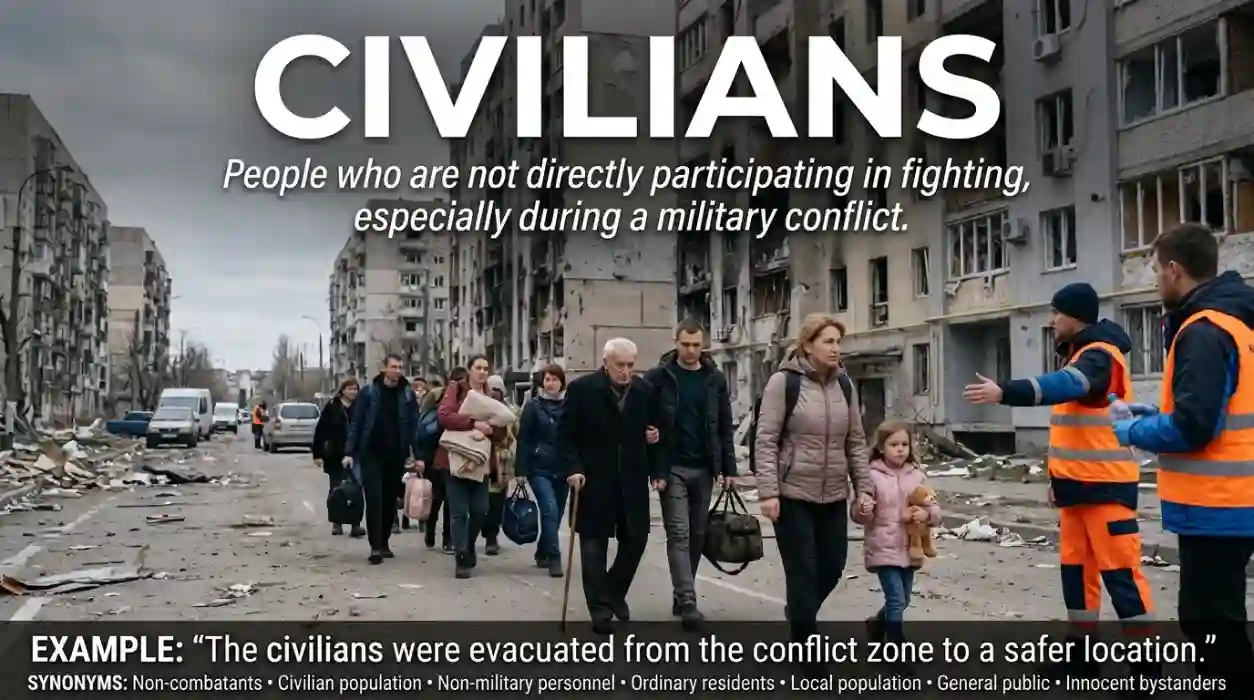
Pronunciation, Syllables, and Affixation
The pronunciation of civilian is similar in American and British English, although individual accents vary.
- US IPA: /səˈvɪliən/
- UK IPA: /sɪˈvɪliən/
- Syllables: ci-vil-ian
- Singular: civilian
- Plural: civilians
Root: civil, from Latin civilis, meaning “of a citizen.”
Prefix: None in the modern word civilian.
Suffix: -ian, a suffix often used to describe a person associated with a particular role, subject, or field.
Affixation pattern: civil + -ian → civilian; adding -s forms the plural civilians.
The word civilian is related to civil, but it should not be confused with respectful or civil servant. Each term has its own meaning.
Synonyms List
The following list includes close alternatives and context-specific expressions. Some describe civilians by their social role, location, or relationship to military activity rather than serving as exact synonyms in every sentence.
1. Ordinary People (Noun Phrase) — US / UK: /ˈɔːrdəneri ˈpiːpəl/ / /ˈɔːdənri ˈpiːpəl/
Meaning: People in everyday society who are not being identified by a special professional or official role.
Tone/Register: Neutral; everyday and journalistic.
Examples:
Ordinary people struggled to reach work during the transport shutdown.
The new policy will affect ordinary people across the country.
2. Noncombatants (Noun) — US / UK: /ˌnɑːnˈkɑːmbətənts/ / /ˌnɒnˈkɒmbətənts/
Meaning: People who are not participating directly in fighting, especially in a military conflict.
Tone/Register: Formal; military, legal, and humanitarian.
Examples:
The agreement called for greater protection of noncombatants.
Aid workers helped noncombatants leave the dangerous area.
3. Residents (Noun) — US / UK: /ˈrezɪdənts/ / /ˈrezɪdənts/
Meaning: People who live in a particular place.
Tone/Register: Neutral; local government and news.
Examples:
Residents gathered outside the town hall.
Residents received updates about the road closure.
4. Members of the Public (Noun Phrase) — US / UK: /ˈmembərz əv ðə ˈpʌblɪk/ / /ˈmembəz əv ðə ˈpʌblɪk/
Meaning: People in the general community rather than members of a particular organization or official group.
Tone/Register: Formal and neutral.
Examples:
Members of the public can attend the information session.
The building will remain closed to members of the public today.
5. Private Citizens (Noun Phrase) — US / UK: /ˈpraɪvət ˈsɪtɪzənz/ / /ˈpraɪvət ˈsɪtɪzənz/
Meaning: Individuals acting in a personal capacity rather than as government or military officials.
Tone/Register: Formal; legal and political.
Examples:
Private citizens organized a neighborhood cleanup.
The official met with private citizens to hear their concerns.
6. The General Public (Noun Phrase) — US / UK: /ðə ˈdʒenərəl ˈpʌblɪk/ / /ðə ˈdʒenrəl ˈpʌblɪk/
Meaning: People in society considered as a whole.
Tone/Register: Neutral to formal.
Examples:
The announcement was intended for the general public.
The museum opened its new exhibit to the general public.
7. Local People (Noun Phrase) — US / UK: /ˈloʊkəl ˈpiːpəl/ / /ˈləʊkəl ˈpiːpəl/
Meaning: People who live in or belong to a particular area.
Tone/Register: Neutral; conversational and journalistic.
Examples:
Local people helped distribute food after the storm.
The project was designed with local people in mind.
8. Townspeople (Noun) — US / UK: /ˈtaʊnzˌpiːpəl/ / /ˈtaʊnzˌpiːpəl/
Meaning: People who live in a town.
Tone/Register: Neutral; narrative and descriptive.
Examples:
The townspeople gathered to welcome the visiting team.
Townspeople raised money to repair the community center.
9. Villagers (Noun) — US / UK: /ˈvɪlɪdʒərz/ / /ˈvɪlɪdʒəz/
Meaning: People who live in a village.
Tone/Register: Neutral; descriptive and journalistic.
Examples:
Villagers carried supplies to families affected by the flood.
The villagers met to discuss the new water system.
10. City Dwellers (Noun Phrase) — US / UK: /ˈsɪti ˈdwelərz/ / /ˈsɪti ˈdweləz/
Meaning: People who live in a city.
Tone/Register: Neutral; descriptive.
Examples:
City dwellers rely on public transport for daily travel.
The heatwave created new challenges for city dwellers.
11. Inhabitants (Noun) — US / UK: /ɪnˈhæbɪtənts/ / /ɪnˈhæbɪtənts/
Meaning: People who live in a particular place.
Tone/Register: Formal; geographical and descriptive.
Examples:
The island’s inhabitants depend heavily on fishing.
Inhabitants of the valley received an evacuation notice.
12. Dwellers (Noun) — US / UK: /ˈdwelərz/ / /ˈdweləz/
Meaning: People who live in a specified place or type of environment.
Tone/Register: Neutral to formal.
Examples:
Urban dwellers often have access to several transport options.
The forest’s human dwellers worked to protect the local ecosystem.
13. Community Members (Noun Phrase) — US / UK: /kəˈmjuːnəti ˈmembərz/ / /kəˈmjuːnəti ˈmembəz/
Meaning: People who belong to or participate in a particular community.
Tone/Register: Positive to neutral; community and public-service writing.
Examples:
Community members organized a weekend food drive.
The meeting gave community members a chance to share ideas.
14. Civilians in the Area (Noun Phrase) — US / UK: /səˈvɪliənz ɪn ði ˈeriə/ / /sɪˈvɪliənz ɪn ði ˈeəriə/
Meaning: Nonmilitary people located within a specified area.
Tone/Register: Neutral; news and humanitarian reporting.
Examples:
Officials urged civilians in the area to follow safety instructions.
Civilians in the area received emergency supplies.
15. Nonmilitary Personnel (Noun Phrase) — US / UK: /ˌnɑːnˈmɪləteri ˌpɜːrsəˈnel/ / /ˌnɒnˈmɪlətri ˌpɜːsəˈnel/
Meaning: People working in a setting who are not members of the military.
Tone/Register: Formal; institutional and administrative.
Examples:
Nonmilitary personnel attended the safety briefing.
The facility employs both military staff and nonmilitary personnel.
16. Civilian Population (Noun Phrase) — US / UK: /səˈvɪliən ˌpɑːpjəˈleɪʃən/ / /sɪˈvɪliən ˌpɒpjəˈleɪʃən/
Meaning: The collective group of civilians living in a particular area or country.
Tone/Register: Formal; news, policy, and humanitarian contexts.
Examples:
The report examined the effects of the disaster on the civilian population.
Medical teams worked to support the civilian population.
17. General Population (Noun Phrase) — US / UK: /ˈdʒenərəl ˌpɑːpjəˈleɪʃən/ / /ˈdʒenrəl ˌpɒpjəˈleɪʃən/
Meaning: The people living in a defined society or area, considered collectively.
Tone/Register: Formal; research and public policy.
Examples:
The survey measured awareness across the general population.
The announcement reached a large part of the general population.
18. Nonmilitary People (Noun Phrase) — US / UK: /ˌnɑːnˈmɪləteri ˈpiːpəl/ / /ˌnɒnˈmɪlətri ˈpiːpəl/
Meaning: People who are not members of the armed forces.
Tone/Register: Neutral; explanatory.
Examples:
The program is open to military families and nonmilitary people.
Nonmilitary people also work at the research center.
19. Civil Society (Noun Phrase) — US / UK: /ˌsɪvəl səˈsaɪəti/ / /ˌsɪvəl səˈsaɪəti/
Meaning: The network of civic groups, associations, and organizations outside the state and commercial sector.
Tone/Register: Formal; political and academic.
Examples:
Civil society groups called for transparent decision-making.
The conference brought together leaders from civil society.
Usage note: Civil society describes organizations and social structures, not simply individual civilians. It is a related concept, not a direct synonym.
20. Civilians at Large (Noun Phrase) — US / UK: /səˈvɪliənz æt lɑːrdʒ/ / /sɪˈvɪliənz æt lɑːdʒ/
Meaning: Civilians considered broadly rather than as a narrowly defined group.
Tone/Register: Formal; political and public discussion.
Examples:
The decision raised questions among civilians at large.
The policy could affect civilians at large, not just local officials.
21. Nonmilitary Residents (Noun Phrase) — US / UK: /ˌnɑːnˈmɪləteri ˈrezɪdənts/ / /ˌnɒnˈmɪlətri ˈrezɪdənts/
Meaning: People living in a place who are not serving in the military.
Tone/Register: Neutral; administrative and descriptive.
Examples:
Nonmilitary residents were asked to use the public entrance.
The notice explained which services were available to nonmilitary residents.

22. Civilian Residents (Noun Phrase) — US / UK: /səˈvɪliən ˈrezɪdənts/ / /sɪˈvɪliən ˈrezɪdənts/
Meaning: People who live in a particular place and are distinguished from military personnel.
Tone/Register: Neutral to formal.
Examples:
Civilian residents attended the emergency planning meeting.
The new rules apply to civilian residents of the facility.
23. Local Population (Noun Phrase) — US / UK: /ˈloʊkəl ˌpɑːpjəˈleɪʃən/ / /ˈləʊkəl ˌpɒpjəˈleɪʃən/
Meaning: The people who live in a specific locality, considered as a group.
Tone/Register: Formal; news and research.
Examples:
The study examined how the storm affected the local population.
Officials consulted the local population before changing the road layout.
24. Civilian Community (Noun Phrase) — US / UK: /səˈvɪliən kəˈmjuːnəti/ / /sɪˈvɪliən kəˈmjuːnəti/
Meaning: A community of people outside the military.
Tone/Register: Neutral to formal.
Examples:
The program connects military veterans with the civilian community.
The base held an open day for the nearby civilian community.
25. Nonuniformed Personnel (Noun Phrase) — US / UK: /ˌnɑːnˈjuːnɪfɔːrmd ˌpɜːrsəˈnel/ / /ˌnɒnˈjuːnɪfɔːmd ˌpɜːsəˈnel/
Meaning: People who do not wear a particular organization’s uniform, especially in an institutional setting.
Tone/Register: Formal; administrative.
Examples:
Nonuniformed personnel entered through the main reception area.
The event included uniformed officers and nonuniformed personnel.
Usage note: This expression is not always equivalent to civilians. Some nonuniformed personnel may still be members of the military or a uniformed service.
26. Civilian Workers (Noun Phrase) — US / UK: /səˈvɪliən ˈwɜːrkərz/ / /sɪˈvɪliən ˈwɜːkəz/
Meaning: Workers who are not serving as military personnel, even if they work in a military-related environment.
Tone/Register: Neutral; workplace and institutional.
Examples:
Civilian workers maintained the facility’s computer systems.
The department recruited civilian workers for administrative roles.
27. Civilian Employees (Noun Phrase) — US / UK: /səˈvɪliən ɪmˈplɔɪiːz/ / /sɪˈvɪliən ɪmˈplɔɪiːz/
Meaning: Employees who work in a civilian capacity rather than as members of the armed forces.
Tone/Register: Professional and administrative.
Examples:
Civilian employees received training on the updated policy.
The agency employs civilian employees alongside service members.
28. Noncombatant Civilians (Noun Phrase) — US / UK: /ˌnɑːnˈkɑːmbətənt səˈvɪliənz/ / /ˌnɒnˈkɒmbətənt sɪˈvɪliənz/
Meaning: Civilians who are not participating in hostilities.
Tone/Register: Formal; humanitarian and legal.
Examples:
The evacuation plan prioritized noncombatant civilians.
Aid organizations called for better protection of noncombatant civilians.
Usage note: This phrase can be redundant in ordinary contexts because civilian and noncombatant overlap. It may be useful when a writer needs to emphasize nonparticipation in fighting.
29. Civilian Bystanders (Noun Phrase) — US / UK: /səˈvɪliən ˈbaɪstændərz/ / /sɪˈvɪliən ˈbaɪstændəz/
Meaning: Civilians who happen to be present at an event without being directly involved in it.
Tone/Register: Neutral; news and descriptive writing.
Examples:
Civilian bystanders moved away when the street was closed.
Witnesses said several civilian bystanders were near the entrance.
30. Bystanders (Noun) — US / UK: /ˈbaɪstændərz/ / /ˈbaɪstændəz/
Meaning: People who are present at an event but are not directly involved.
Tone/Register: Neutral; everyday and journalistic.
Examples:
Bystanders helped direct people toward the exit.
Several bystanders called emergency services after the accident.
Usage note: Not all bystanders are civilians. A person can be a bystander while still belonging to the military or another official service.
31. Unarmed People (Noun Phrase) — US / UK: /ʌnˈɑːrmd ˈpiːpəl/ / /ʌnˈɑːmd ˈpiːpəl/
Meaning: People who do not carry weapons.
Tone/Register: Neutral to cautionary; conflict reporting.
Examples:
The report described unarmed people trying to reach safety.
The organizers asked unarmed people to remain behind the marked boundary.
Usage note: Unarmed does not automatically mean civilian. A military member may be unarmed at a particular moment.
32. Nonparticipants (Noun) — US / UK: /ˌnɑːnpɑːrˈtɪsɪpənts/ / /ˌnɒnpɑːˈtɪsɪpənts/
Meaning: People who are not taking part in a particular activity or event.
Tone/Register: Formal; analytical.
Examples:
Nonparticipants watched the demonstration from a safe distance.
The study compared participants with nonparticipants.
Usage note: This word is broader than civilians. It describes participation in any activity, not military status specifically.
33. Civilian Individuals (Noun Phrase) — US / UK: /səˈvɪliən ˌɪndɪˈvɪdʒuəlz/ / /sɪˈvɪliən ˌɪndɪˈvɪdʒuəlz/
Meaning: Individual people who are not members of the armed forces.
Tone/Register: Formal; administrative or legal.
Examples:
The policy sets out procedures for civilian individuals entering the site.
Officials interviewed several civilian individuals who witnessed the incident.
Usage note: This phrase is often more cumbersome than simply saying civilians or civilian individuals involved in the case when a specific distinction is needed.
34. Civilian Persons (Noun Phrase) — US / UK: /səˈvɪliən ˈpɜːrsənz/ / /sɪˈvɪliən ˈpɜːsənz/
Meaning: People described in their civilian rather than military capacity.
Tone/Register: Formal; legal or bureaucratic.
Examples:
The document explains the rules that apply to civilian persons entering the site.
The review considered the treatment of civilian persons during the operation.
Usage note: In most everyday writing, civilians is more natural and concise.
35. Civilians Not in Service (Noun Phrase) — US / UK: /səˈvɪliənz nɑːt ɪn ˈsɜːrvɪs/ / /sɪˈvɪliənz nɒt ɪn ˈsɜːvɪs/
Meaning: People who are not currently serving in a military role.
Tone/Register: Explanatory; formal contexts.
Examples:
The event welcomed veterans and civilians not in service.
The policy distinguishes active-duty personnel from civilians not in service.
Usage note: This is a descriptive phrase, not a standard dictionary synonym. Use it only when the distinction between active service and civilian status matters.
36. Civilian Population Groups (Noun Phrase) — US / UK: /səˈvɪliən ˌpɑːpjəˈleɪʃən ɡruːps/ / /sɪˈvɪliən ˌpɒpjəˈleɪʃən ɡruːps/
Meaning: Distinct groups within a civilian population.
Tone/Register: Formal; research and public policy.
Examples:
The report examined how the changes affected different civilian population groups.
Researchers compared access to services across civilian population groups.
37. Civilian Households (Noun Phrase) — US / UK: /səˈvɪliən ˈhaʊshoʊldz/ / /sɪˈvɪliən ˈhaʊshəʊldz/
Meaning: Households whose members are being considered in a civilian context.
Tone/Register: Formal; statistics and policy.
Examples:
The survey included civilian households in rural districts.
The program provided information to civilian households about emergency planning.
Usage note: A household is a living arrangement, not a person. Use this phrase when discussing homes or household data rather than people generally.
38. Families (Noun) — US / UK: /ˈfæməliz/ / /ˈfæməliz/
Meaning: Groups of people connected by family relationships, often living together or supporting one another.
Tone/Register: Neutral to warm; everyday and news writing.
Examples:
Families received assistance after the apartment building was damaged.
The community center opened its doors to families needing temporary shelter.
Usage note: Families may describe civilians in a particular story, but it does not mean the same thing as civilians. Civilian populations also include individuals who are not part of a family group.
39. Nonmilitary Residents and Workers (Noun Phrase) — US / UK: /ˌnɑːnˈmɪləteri ˈrezɪdənts ænd ˈwɜːrkərz/ / /ˌnɒnˈmɪlətri ˈrezɪdənts ænd ˈwɜːkəz/
Meaning: People who live or work in a place without serving as military personnel.
Tone/Register: Neutral to formal; administrative.
Examples:
Nonmilitary residents and workers received updated access instructions.
The facility has separate procedures for service members and nonmilitary residents and workers.
40. Civilian Members of Society (Noun Phrase) — US / UK: /səˈvɪliən ˈmembərz əv səˈsaɪəti/ / /sɪˈvɪliən ˈmembəz əv səˈsaɪəti/
Meaning: People who belong to society outside a military role.
Tone/Register: Formal; sociological or explanatory.
Examples:
Civilian members of society participated in the public consultation.
The study considered the relationship between military institutions and civilian members of society.
41. Nonmilitary Members of the Community (Noun Phrase) — US / UK: /ˌnɑːnˈmɪləteri ˈmembərz əv ðə kəˈmjuːnəti/ / /ˌnɒnˈmɪlətri ˈmembəz əv ðə kəˈmjuːnəti/
Meaning: Community members who are not part of the armed forces.
Tone/Register: Neutral; community and institutional writing.
Examples:
Nonmilitary members of the community attended the open house.
The project invited nonmilitary members of the community to share feedback.
42. Civilian Volunteers (Noun Phrase) — US / UK: /səˈvɪliən ˌvɑːlənˈtɪrz/ / /sɪˈvɪliən ˌvɒlənˈtɪəz/
Meaning: People who are not military personnel and who freely offer their time or help.
Tone/Register: Positive; community and humanitarian contexts.
Examples:
Civilian volunteers sorted donated clothing at the relief center.
The event relied on civilian volunteers to guide visitors.
Usage note: This term refers to civilians who volunteer. It does not describe all civilians.

43. Aid Recipients (Noun Phrase) — US / UK: /eɪd rɪˈsɪpiənts/ / /eɪd rɪˈsɪpiənts/
Meaning: People who receive assistance or support.
Tone/Register: Neutral; humanitarian and administrative.
Examples:
Aid recipients collected food packages at the community hall.
The organization surveyed aid recipients about their needs.
Usage note: Some aid recipients are civilians, but the phrase describes their relationship to assistance rather than their military status.
44. Displaced People (Noun Phrase) — US / UK: /dɪˈspleɪst ˈpiːpəl/ / /dɪˈspleɪst ˈpiːpəl/
Meaning: People forced or compelled to leave their usual homes.
Tone/Register: Neutral to serious; humanitarian and news reporting.
Examples:
Displaced people stayed in temporary accommodation after the flood.
The report examined the needs of displaced people in the region.
Usage note: Not all civilians are displaced, and displaced people are not necessarily civilians in every context. Use this term when displacement is relevant.
45. Evacuees (Noun) — US / UK: /ɪˌvækjuˈiːz/ / /ɪˌvækjuˈiːz/
Meaning: People who have been moved from a dangerous place to a safer location.
Tone/Register: Neutral; emergency and news contexts.
Examples:
Evacuees waited at the school until transport arrived.
Officials arranged meals for evacuees staying in the sports hall.
46. Survivors (Noun) — US / UK: /sərˈvaɪvərz/ / /səˈvaɪvəz/
Meaning: People who remain alive or endure after a dangerous or traumatic event.
Tone/Register: Respectful; humanitarian and personal narratives.
Examples:
Survivors shared their experiences with the support team.
The relief group helped survivors rebuild their homes.
Usage note: Survivors describes what people have lived through, not whether they are civilians. Use it only when survival is relevant.
47. Victims (Noun) — US / UK: /ˈvɪktɪmz/ / /ˈvɪktɪmz/
Meaning: People who have suffered harm, injury, loss, or wrongdoing.
Tone/Register: Serious; legal, news, and humanitarian contexts.
Examples:
Victims of the fire received emergency assistance.
The report included testimony from victims of the fraud.
Usage note: Not every civilian is a victim. Use the term when harm or wrongdoing is central to the meaning.
48. Bystanders and Witnesses (Noun Phrase) — US / UK: /ˈbaɪstændərz ænd ˈwɪtnəsɪz/ / /ˈbaɪstændəz ænd ˈwɪtnəsɪz/
Meaning: People who observe an event without necessarily taking part in it, including those who can report what they saw.
Tone/Register: Neutral; legal and journalistic.
Examples:
Bystanders and witnesses were asked to provide statements.
Investigators interviewed bystanders and witnesses who were near the entrance.
Usage note: A witness has observed something relevant; a bystander is simply present. Neither term automatically means civilian.
49. Civilian Population at Risk (Noun Phrase) — US / UK: /səˈvɪliən ˌpɑːpjəˈleɪʃən æt rɪsk/ / /sɪˈvɪliən ˌpɒpjəˈleɪʃən æt rɪsk/
Meaning: Civilians who face a specific danger or threat.
Tone/Register: Formal; risk assessment and humanitarian reporting.
Examples:
The emergency plan identified the civilian population at risk.
Relief teams prioritized areas where the civilian population was at risk.
50. People Outside the Military (Noun Phrase) — US / UK: /ˈpiːpəl ˌaʊtˈsaɪd ðə ˈmɪləteri/ / /ˈpiːpəl ˌaʊtˈsaɪd ðə ˈmɪlətri/
Meaning: People who are not members of the armed forces.
Tone/Register: Neutral; clear and accessible.
Examples:
The program provides support for people outside the military.
People outside the military can apply for the public training course.
Usage note: This plain-English expression can help readers who may not know the term civilian. In legal or military writing, use the more precise terminology required by the context.
Synonyms by Tone
Tone helps you communicate the right meaning without adding unintended emotion. A news report, an academic paper, and a friendly conversation may describe the same people in different ways.
Positive
These expressions can emphasize cooperation, participation, or community support:
- Community members — highlights belonging and participation.
- Civilian volunteers — emphasizes freely offered help.
- Local people — creates a familiar, community-focused tone.
- Families — can add a personal, human perspective when family relationships are relevant.
- Survivors — recognizes people who have endured a serious event.
Example: “Civilian volunteers helped community members rebuild the damaged playground.”
Use positive language when it accurately describes the people involved. Avoid assuming that every civilian is a volunteer or survivor.
Neutral
These expressions generally identify people without making a judgment about them:
- Ordinary people
- Residents
- Members of the public
- Private citizens
- Inhabitants
- General population
- Nonmilitary personnel
- Civilian workers
- People outside the military
Example: “Members of the public can attend the information session.”
Negative or Serious
These expressions may appear in descriptions of hardship, danger, or harm:
- Victims
- Displaced people
- Evacuees
- Civilian population at risk
- Aid recipients
Example: “Displaced people needed safe accommodation after the flooding.”
These terms are not inherently negative. They describe specific circumstances. Use them only when the circumstances apply.
Playful or Informal
There is no widely accepted playful synonym for civilians that works across contexts. In casual conversation, regular people or ordinary folks may sound friendly.
Example: “The event is open to regular people, not just military personnel.”
Avoid joking terms when discussing war, injury, displacement, or other sensitive situations. A lighthearted tone may seem disrespectful.
“Civilians” vs. Close Alternatives
| Word or phrase | Meaning difference | Best use |
|---|---|---|
| Civilians | People outside the military; in armed conflict, a specific legal category | News, military, and general writing |
| Noncombatants | People not participating directly in hostilities, with precise legal distinctions depending on context | Conflict and humanitarian writing |
| Ordinary people | People considered as members of everyday society | General explanations and informal writing |
| Residents | People who live in a particular place | Local news, housing, and community issues |
| Members of the public | People in the general public rather than a particular official group | Notices, public services, and formal announcements |
Example: Choosing the Right Word
Civilians: “Civilians were moved away from the conflict zone.” This emphasizes their status in relation to the conflict.
Noncombatants: “The agreement included protections for noncombatants.” This focuses on participation in hostilities and may carry a specific legal meaning.
Residents: “Residents were moved away from the flooded street.” This emphasizes where the people live, not their military status.
The best alternative is the one that preserves the detail you intend to communicate.
How “Civilians” Changes by Context
Daily Conversation
In everyday conversation, ordinary people, local people, and members of the public may sound more natural than civilians, especially when no military context exists.
For example, “The event is open to everyone” may be clearer than “The event is open to civilians” if military status is irrelevant.
Writing and Blogging
Bloggers can use residents, local people, community members, and members of the public to avoid repetition. Each expression adds a slightly different detail.
- Use residents for people who live in a place. Use community members when participation or belonging matters. Use civilians when the distinction from military personnel is important.
Professional or Academic Writing
Academic writing benefits from precise terminology. Civilian population works when discussing a population as a whole. Civilian employees are appropriate when describing nonmilitary staff in an organization.
In research or policy documents, explain specialized terms when readers may interpret them differently.
Creative or Informal Use
In storytelling, families, villagers, residents, and bystanders can make a scene more specific. They help readers picture who is present and what role those people play.
For example, “The villagers gathered near the bridge” gives a clearer setting than “The civilians gathered near the bridge” if the military distinction is not important.
Common Mistakes Learners Make
Confusing “Civilians” With “Noncombatants”
The words overlap, but they are not always identical in legal or military usage. Civilians refers to civilian status, while noncombatant emphasizes a person’s relationship to fighting. Legal classifications can depend on the circumstances.
Tip: In conflict reporting, consult authoritative humanitarian law sources before treating the words as interchangeable.
Assuming All Civilians Are Innocent
Civilians describes a status, not a complete moral judgment. The word does not automatically mean that every person has behaved innocently or has suffered harm.
Use innocent people only when innocence is relevant and supported by the context.
Using “Residents” When Location Does Not Matter
A civilian may be a visitor, traveler, or aid worker rather than a resident. Calling all civilians residents can introduce inaccurate information.
Choose residents only when living in the place is relevant.
Calling Everyone a “Victim”
A civilian may be safe, working, traveling, volunteering, or attending an event. The word victim applies when a person has suffered harm or wrongdoing.
Avoid adding this meaning unless the facts support it.
Repeating “Civilians” Too Often
Repetition is not always a problem. In legal, military, or humanitarian writing, repeating civilians may improve precision. Do not replace it with a less accurate word just to vary the vocabulary.
Instead, restructure the sentence or use a more specific term when it genuinely applies.
Register Notes: Formal vs. Informal
Formal: Noncombatants, civilian population, civilian personnel, members of the public.
Neutral: Residents, local people, ordinary people, inhabitants.
Community-focused: Community members, civilian volunteers, families.
Situation-specific: Evacuees, displaced people, survivors, victims.
In spoken English, simple expressions often work best. In formal writing, use terminology that fits the subject and has a clear meaning. When describing armed conflict, accuracy matters more than stylistic variety.
For further vocabulary practice, explore related terms used in news reporting and public policy.
Real-Life Mini Scenarios
Workplace:
A military facility employs people who are not members of the armed forces. Calling them civilian employees distinguishes their roles from those of service members.
Social situation:
A local event welcomes everyone, regardless of profession. Members of the public communicate that the event is open to the community.
Media and pop culture:
A news report describes people caught in a conflict. Civilians emphasize their nonmilitary status, while displaced people would be appropriate if they had been forced to leave their homes.
Writing or storytelling:
A novel describes people watching an emergency from the street. Bystanders emphasize their presence at the scene, while residents emphasize that they live nearby.
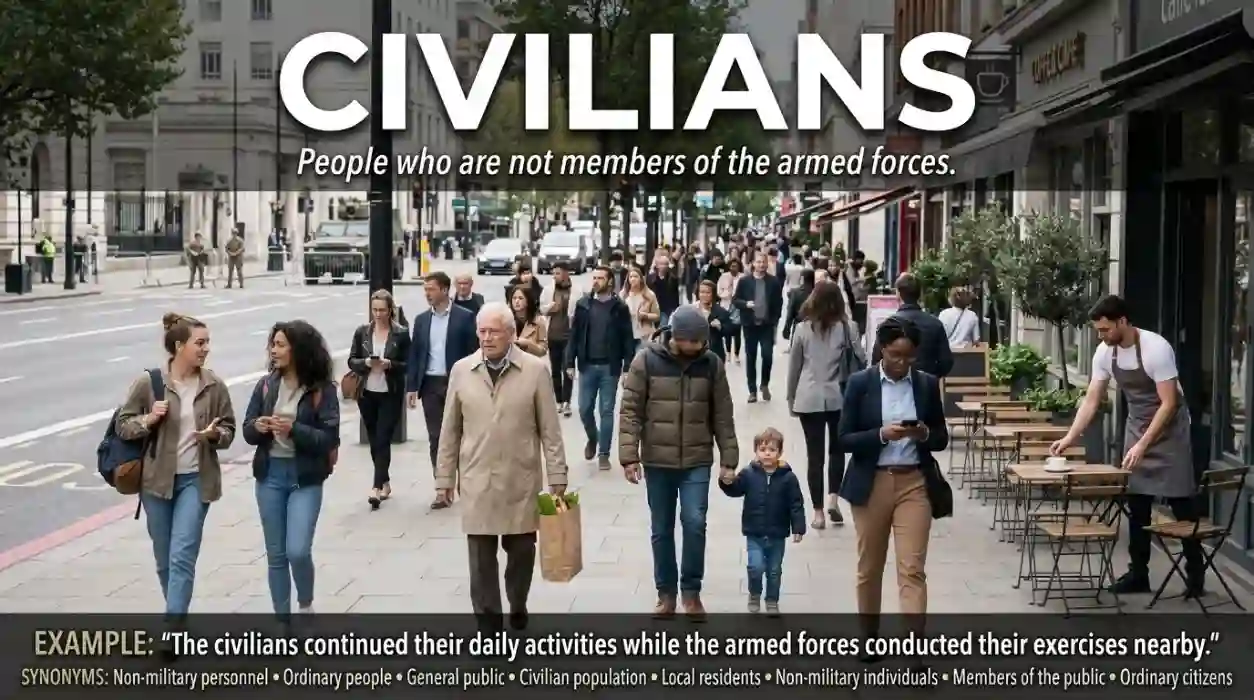
Practice Quiz:
1. A report refers to people who are not members of the armed forces. Which word fits best?
Civilians
Auditors
Combatants
2. People who live in a particular town are being described. Which term is most precise?
Victims
Residents
Nonparticipants
3. A legal discussion focuses on people who are not participating directly in fighting. Which term may fit?
Noncombatants
Townspeople
City dwellers
4. People freely give their time to help at a relief center. What can you call them?
Civilian volunteers
Evacuees
Bystanders
5. People have been forced to leave their homes. Which expression fits?
Private citizens
Displaced people
Civilian employees
6. A person is present at an incident but is not involved in it. Which word fits?
Bystander
Resident
Employee
7. A report discusses people who suffered harm in an accident. Which word fits when harm is central?
Inhabitants
Victims
Members of the public
8. Which term describes people who live in a village?
Villagers
Noncombatants
Civilian workers
9. A government notice is addressed to people generally, rather than to a specific organization. Which phrase fits? Members of the public
Civilian households
Survivors
10. A report describes people who have been moved to safety from a dangerous area. Which term is suitable?
Auditors
Private citizens
Evacuees
Answer key:
1. Civilians · 2. Residents · 3. Noncombatants · 4. Civilian volunteers · 5. Displaced people · 6. Bystander · 7. Victims · 8. Villagers · 9. Members of the public · 10. Evacuees
Reflection task:
Write two sentences about a community event or news story. Use civilians in one sentence and a more specific alternative in the other. Explain how the alternative changes the meaning.
External Learning Sources
For authoritative definitions, pronunciation, and examples, consult these dictionaries:
Cambridge Dictionary — learner-friendly definitions and UK and US pronunciation.
Oxford Learner’s Dictionaries — usage examples, grammar patterns, and pronunciation guidance.
Merriam-Webster — definitions, word history, and American English usage.
Conclusion
Understanding synonyms for civilians helps you describe people accurately in news reports, essays, blogs, and everyday conversations. The best word depends on the details you want to express.
Words such as residents, noncombatants, and members of the public have different meanings. Choosing carefully makes your writing clearer and helps readers understand the situation.
A wider vocabulary can strengthen academic writing, improve storytelling, and make spoken English more precise. You do not need to memorize every alternative at once.
Start by practicing five useful terms in your own sentences, emails, or essays. Notice how each word changes the meaning, and keep building your vocabulary through everyday reading.
FAQs
1. What is the best synonym for civilians in a news report?
The best alternative depends on the story. Noncombatants may suit reporting about participation in armed conflict. Residents identify people who live in a particular place, while members of the public refers to general announcements. If the report specifically concerns people outside the military, civilians is often the clearest and most accurate choice.
2. Are civilians and noncombatants the same thing?
The terms overlap, but they are not always interchangeable. Civilian describes a person’s status in relation to the military, while noncombatant emphasizes nonparticipation in fighting. In international humanitarian law, the distinction can be important, and legal classification depends on the relevant rules and circumstances. Use authoritative legal sources when writing about armed conflict.
3. What is a simple word for civilians?
Ordinary people is a simple, accessible alternative when you mean people in everyday society. People outside the military is even more explicit when military status matters. However, ordinary people is broader and less precise. In a conflict report or formal document, retaining civilians may communicate the intended meaning more accurately.
4. What is the difference between civilians and residents?
Civilians identify people in contrast to military personnel, while residents identify people who live in a particular place. A person can be a civilian visitor without being a resident. Likewise, the word resident does not automatically tell you whether someone serves in the military. Choose the term that reflects the distinction relevant to your sentence.
5. Can “civilians” be used as an adjective?
Yes. Civilian can function as an adjective before a noun, as in civilian clothing, civilian employees, and civilian life. The noun also has a plural form, civilians. For example, “The organization hired civilian staff” uses the adjective, while “The civilians attended the meeting” uses the plural noun.

Hasnain Ali is an SEO Content Strategist and the founder of wordvora.com, a trusted vocabulary platform that helps writers, students, professionals, and English learners find accurate synonyms, antonyms, word meanings, and real-life usage examples. He specializes in keyword research, on-page SEO, topical authority, and creating search-first content that aligns with Google’s latest Search Quality and E-E-A-T guidelines. His work focuses on producing clear, well-structured, and reader-friendly resources that satisfy search intent while maintaining high editorial standards.
Through extensive hands-on experience with SEO tools such as Google Search Console, Google Analytics, SEMrush, and Ahrefs, Hasnain researches user search behavior and develops content that is both informative and easy to understand. Every article published on wordvora.com is carefully reviewed for accuracy, readability, and contextual relevance before publication. His mission is to build one of the web’s most reliable English vocabulary resources by providing practical language guidance, trustworthy explanations, and content that helps readers improve their writing, communication, and vocabulary with confidence.