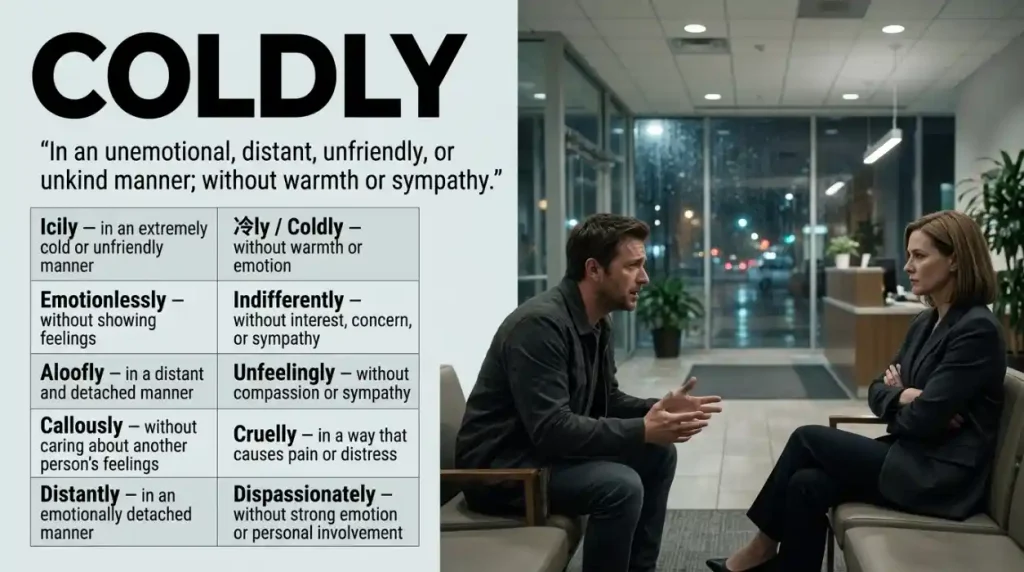
Synonyms for coldly include indifferently, icily, unemotionally, distantly, sternly, curtly, and impassively. These words describe different ways of showing little warmth, emotion, or friendliness. The best choice depends on whether someone seems unfriendly, calm, detached, or deliberately harsh.
Synonyms for coldly can make your English sound more natural and precise. Imagine greeting a colleague who barely looks up. Saying they replied “coldly” conveys distance, but curtly or indifferently may explain their behavior more clearly.
Think about a friend who answers your message with one short sentence. Their reply might feel distant, dismissive, or icy. Learning the right synonym helps you describe that moment without repeating the same word.
The word coldly appears in everyday conversations, novels, news reports, workplace communication, and personal stories. It helps describe behavior when someone seems emotionally distant or shows little kindness.
Students, bloggers, content writers, and everyday English users can all benefit from learning these alternatives. A carefully chosen word makes essays clearer, dialogue more believable, and conversations more expressive.
What Does “Coldly” Really Mean?
Coldly is an adverb that describes how someone speaks, behaves, reacts, or treats another person without warmth, friendliness, or visible emotion.
For example, “She answered coldly” suggests that her response lacked friendliness. She may have sounded distant, unfriendly, or uninterested. The sentence does not automatically mean she was angry.
Native English speakers commonly use coldly to describe facial expressions, conversations, decisions, reactions, and relationships. The word can suggest emotional distance, deliberate unkindness, or a controlled lack of feeling.
Compare these sentences:
- “He looked at me coldly.” His expression seemed unfriendly or distant.
- “She coldly rejected the offer.” Her rejection seemed firm and lacked sympathy.
- “The report described the events coldly.” The writing presented the facts without much emotion.
The precise meaning depends on context. A person can act coldly because they feel angry, want distance, or simply choose not to show emotion.
Connotative Meaning of “Coldly”
Connotation (the emotional or cultural associations a word carries beyond its basic definition) influences how readers understand coldly.
- Positive tone: In limited contexts, coldly can suggest composure, discipline, or clear judgment. For example, “The captain assessed the danger coldly” may suggest control under pressure, although calmly is usually more positive.
- Negative tone: The word often suggests unkindness, indifference, emotional distance, or a lack of compassion.
- Neutral tone: In analytical writing, it can describe an unemotional presentation of facts without necessarily criticizing the writer.
Important distinction: Coldly usually carries a negative emotional association when describing how people treat one another. However, a controlled or unemotional approach may be useful in a crisis or a difficult decision.
Etymology:
The word coldly comes from the adjective cold combined with the adverb-forming suffix -ly. Its history reflects the connection between physical coldness and emotional distance.
Old English (450–1100)
Old English used cald or ceald for the idea of low temperature. These forms developed from older Germanic roots. The physical meaning of coldness provided a foundation for later figurative uses involving a lack of warmth or affection.
Middle English (1100–1500)
During the Middle English period, forms such as cold continued to develop. English increasingly used physical temperature as a way to describe emotional experiences. The suffix -ly also helped form adverbs that explained how an action occurred.
Modern English (1500–Present)
In Modern English, coldly became a familiar way to describe detached speech, unfriendly behavior, and unemotional reactions. Today, it appears in fiction, journalism, professional writing, and everyday conversations.

Pronunciation
- US English: /ˈkoʊld.li/
- UK English: /ˈkəʊld.li/
Syllables: cold-ly (2 syllables)
Affixation pattern:
- Root: cold
- Prefix: None
- Suffix: -ly
- Word formation: cold + ly = coldly
The suffix -ly commonly turns adjectives into adverbs. For example, calm becomes calmly, and polite becomes politely.
Synonyms List
1. Icily (adv) — US: /ˈaɪ.sə.li/ | UK: /ˈaɪ.sɪ.li/
- Meaning: Done with extreme, sharp emotional coldness that feels visibly freezing or hostile.
- Tone/Register: Literary, Dramatic, Formal
- Example 1: She stared icily at the intruder who interrupted her presentation.
- Example 2: “Leave my office now,” he said icily.
2. Callously (adv) — US: /ˈkæl.əs.li/ | UK: /ˈkæl.əs.li/
- Meaning: Done with a complete and hardened disregard for the feelings or suffering of others.
- Tone/Register: Serious, Formal, Academic
- Example 1: The executive callously dismissed the concerns of the laid-off staff.
- Example 2: He callously walked past the injured puppy on the sidewalk.
3. Coolly (adv) — US: /ˈkuːl.li/ | UK: /ˈkuːl.li/
- Meaning: Done in a calm, controlled manner that lacks passion, heat, or panic.
- Tone/Register: Neutral, Informal, General
- Example 1: The pilot coolly handled the engine warning during takeoff.
- Example 2: She coolly declined the pushy salesman’s offer.
4. Aloofly (adv) — US: /əˈluːf.li/ | UK: /əˈluːf.li/
- Meaning: Done while standing apart emotionally or socially from a group.
- Tone/Register: Descriptive, Formal, Literary
- Example 1: He sat aloofly in the corner during the entire holiday party.
- Example 2: The author stood aloofly as guests praised her new book.
5. Indifferently (adv) — US: /ɪnˈdɪf.rənt.li/ | UK: /ɪnˈdɪf.rənt.li/
- Meaning: Done without any preference, interest, care, or concern.
- Tone/Register: General, Neutral, Everyday
- Example 1: She shrugged indifferently when asked about the dinner menu.
- Example 2: The clerk indifferently handed over the stamped documents.
6. Heartlessly (adv) — US: /ˈhɑːrt.ləs.li/ | UK: /ˈhɑːt.ləs.li/
- Meaning: Done without kindness, pitilessly, or showing zero human compassion.
- Tone/Register: Emotional, Dramatic, General
- Example 1: The landlord heartlessly evicted the family right before the holidays.
- Example 2: She heartlessly broke off the engagement over a quick text message.
7. Unfeelingly (adv) — US: /ʌnˈfiː.lɪŋ.li/ | UK: /ʌnˈfiː.lɪŋ.li/
- Meaning: Done without showing any natural human emotion or sensitivity.
- Tone/Register: Formal, Literary
- Example 1: He spoke unfeelingly about his family’s personal struggles.
- Example 2: The judge unfeelingly delivered the harsh legal verdict.
8. Distantly (adv) — US: /ˈdɪs.tənt.li/ | UK: /ˈdɪs.tənt.li/
- Meaning: Done with a lack of personal warmth, intimacy, or mental presence.
- Tone/Register: Conversational, General
- Example 1: She answered the phone distantly while focusing on her laptop screen.
- Example 2: He smiled distantly at his old acquaintance across the room.
9. Frostily (adv) — US: /ˈfrɔː.stə.li/ | UK: /ˈfrɒs.tɪ.li/
- Meaning: Done in a cold, unwelcoming, and visibly displeased social manner.
- Tone/Register: Informal, Descriptive
- Example 1: The receptionist greeted the late-arriving visitor frostily.
- Example 2: “Good morning,” she replied frostily without making eye contact.
10. Clinical/Clinically (adv) — US: /ˈklɪn.ɪ.kəl.i/ | UK: /ˈklɪn.ɪ.kəl.i/
- Meaning: Done with complete scientific detachment and zero personal emotion.
- Tone/Register: Professional, Academic, Technical
- Example 1: The doctor clinically explained the surgical procedure to the patient.
- Example 2: The analyst clinically broke down the company’s severe financial losses.
11. Stiffly (adv) — US: /ˈstɪf.li/ | UK: /ˈstɪf.li/
- Meaning: Done in a rigid, formal, and uncomfortable manner lacking warmth.
- Tone/Register: General, Descriptive
- Example 1: He bowed stiffly to his new business rivals.
- Example 2: She stood stiffly while taking the mandatory group photo.
12. Unsympathetically (adv) — US: /ˌʌn.sɪm.pəˈθet̬.ɪ.kəl.i/ | UK: /ˌʌn.sɪm.pəˈθet.ɪ.kəl.i/
- Meaning: Done without offering any comfort, pity, or emotional support.
- Tone/Register: General, Formal
- Example 1: The teacher unsympathetically rejected the late homework assignment.
- Example 2: He listened unsympathetically to his roommate’s endless complaints.
13. Dispassionately (adv) — US: /dɪsˈpæʃ.ən.ət.li/ | UK: /dɪsˈpæʃ.ən.ət.li/
- Meaning: Done rationally without being affected by personal feelings or bias.
- Tone/Register: Formal, Academic, Legal
- Example 1: The jury reviewed the crime scene evidence dispassionately.
- Example 2: She evaluated the competing job offers dispassionately.
14. Emotionlessly (adv) — US: /ɪˈmoʊ.ʃən.ləs.li/ | UK: /ɪˈməʊ.ʃən.ləs.li/
- Meaning: Done with a complete facial or vocal absence of feeling.
- Tone/Register: General, Descriptive
- Example 1: The witness emotionlessly detailed the events of that night.
- Example 2: He stared emotionlessly at the blank screen for hours.
15. Severely (adv) — US: /səˈvɪr.li/ | UK: /sɪˈvɪə.li/
- Meaning: Done with strict, harsh, and uncompromising seriousness.
- Tone/Register: Formal, Serious
- Example 1: The manager severely scolded the team for missing the deadline.
- Example 2: She looked severely at her children when they misbehaved.
16. Apathetically (adv) — US: /ˌæp.əˈθet̬.ɪ.kəl.i/ | UK: /ˌæp.əˈθet.ɪ.kəl.i/
- Meaning: Done with a total lack of interest, energy, or care.
- Tone/Register: Academic, General
- Example 1: The audience apathetically clapped after the dull presentation.
- Example 2: He apathetically voted in the local council election.
17. Stolidly (adv) — US: /ˈstɑː.lɪd.li/ | UK: /ˈstɒl.ɪd.li/
- Meaning: Done while showing little or no emotion, movement, or reaction.
- Tone/Register: Literary, Formal
- Example 1: The guard stood stolidly outside the palace gate despite the rain.
- Example 2: She absorbed the surprising news stolidly.
18. Harshly (adv) — US: /ˈhɑːrʃ.li/ | UK: /ˈhɑːʃ.li/
- Meaning: Done in a rough, cruel, or unpleasantly strict manner.
- Tone/Register: Everyday, General
- Example 1: He judged his young assistant’s early draft harshly.
- Example 2: The coach criticized the players harshly after their loss.
19. Remote/Remotely (adv) — US: /rɪˈmoʊt.li/ | UK: /rɪˈməʊt.li/
- Meaning: Done from a mental or emotional distance that feels inaccessible.
- Tone/Register: Literary, Conversational
- Example 1: She nodded remotely while lost in her own deep thoughts.
- Example 2: He acted remotely toward his former childhood friends.
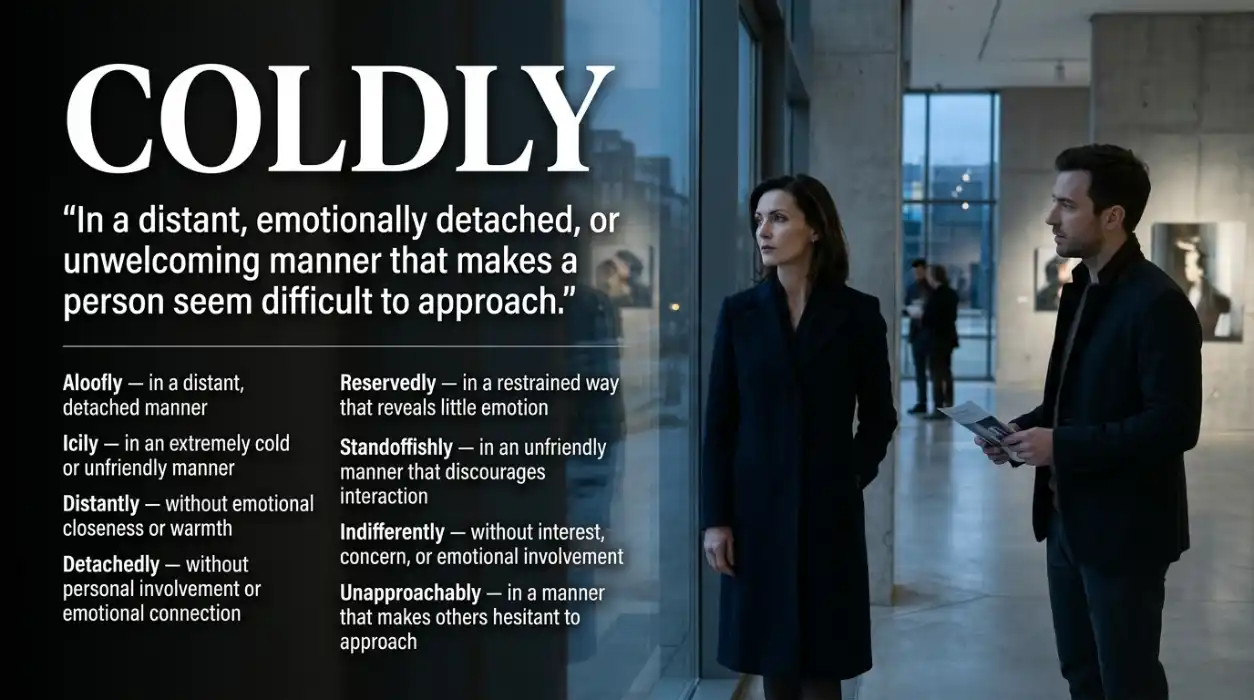
20. Glacially (adv) — US: /ˈɡleɪ.ʃəl.i/ | UK: /ˈɡlæs.i.ə.li/
- Meaning: Done with extreme, slow, and freezing hostility or distance.
- Tone/Register: Literary, Formal
- Example 1: The duchess stared glacially at the rude guest.
- Example 2: Progress on the tense treaty negotiations moved glacially.
21. Woodenly (adv) — US: /ˈwʊd.ən.li/ | UK: /ˈwʊd.ən.li/
- Meaning: Done stiffly, awkwardly, and without natural life or feeling.
- Tone/Register: Descriptive, General
- Example 1: The young actor delivered his famous lines woodenly.
- Example 2: She walked woodenly across the stage to collect her trophy.
22. Unresponsively (adv) — US: /ˌʌn.rɪˈspɑːn.sɪv.li/ | UK: /ˌʌn.rɪˈspɒn.sɪv.li/
- Meaning: Done without offering any feedback, warmth, or reaction.
- Tone/Register: General, Business
- Example 1: The board members sat unresponsively during the proposal pitch.
- Example 2: He listened unresponsively to her heartfelt apology.
23. Stony-faced / Stonily (adv) — US: /ˈstoʊ.nə.li/ | UK: /ˈstəʊ.nɪ.li/
- Meaning: Done with a completely expressionless, hard, and cold facial expression.
- Tone/Register: General, Descriptive
- Example 1: The suspect stonily refused to answer the detective’s questions.
- Example 2: She stonily stared ahead while sitting in the waiting room.
24. Unempathetically (adv) — US: /ˌʌn.em.pəˈθet̬.ɪ.kəl.i/ | UK: /ˌʌn.em.pəˈθet.ɪ.kəl.i/
- Meaning: Done without any attempt to understand another person’s feelings.
- Tone/Register: Academic, Professional
- Example 1: He unempathetically cut off his crying colleague during the meeting.
- Example 2: The manager responded unempathetically to the emergency leave request.
25. Impassively (adv) — US: /ɪmˈpæs.ɪv.li/ | UK: /ɪmˈpæs.ɪv.li/
- Meaning: Done without showing any visible emotion or internal distress.
- Tone/Register: Formal, Literary
- Example 1: The poker player stared impassively across the table.
- Example 2: She sat impassively as the stressful verdict was read aloud.
26. Rigidly (adv) — US: /ˈrɪdʒ.ɪd.li/ | UK: /ˈrɪdʒ.ɪd.li/
- Meaning: Done in an inflexible, strict, and emotionally unyielding manner.
- Tone/Register: Formal, Academic
- Example 1: The officer rigidly enforced the strict curfew rules.
- Example 2: He held his posture rigidly throughout the interview.
27. Blankly (adv) — US: /ˈblæŋk.li/ | UK: /ˈblæŋk.li/
- Meaning: Done without expression, understanding, or emotional presence.
- Tone/Register: Everyday, General
- Example 1: She blinked blankly at the complex math formula on the board.
- Example 2: He stared blankly out the train window for hours.
28. Detachedly (adv) — US: /dɪˈtætʃ.t.li/ | UK: /dɪˈtætʃ.t.li/
- Meaning: Done while standing outside an emotional situation as an observer.
- Tone/Register: Formal, Academic
- Example 1: The journalist reported detachedly on the political crisis.
- Example 2: She viewed her past struggles detachedly from a distance.
29. Offhandedly (adv) — US: /ˌɑːfˈhæn.dɪd.li/ | UK: /ˌɒfˈhæn.dɪd.li/
- Meaning: Done casually with little thought, care, or regard for others.
- Tone/Register: Informal, Everyday
- Example 1: He offhandedly mentioned that he was moving across the country.
- Example 2: She offhandedly dismissed my creative ideas during lunch.
30. Unfriendly (adv/adj mode) — US: /ʌnˈfrend.li/ | UK: /ʌnˈfrend.li/
- Meaning: Done in a hostile, non-welcoming, or harsh manner.
- Tone/Register: General, Conversational
- Example 1: The dog barked unfriendlily at the new mail carrier.
- Example 2: She looked unfriendlily at the person who took her seat.
31. Mechanically (adv) — US: /məˈkæn.ɪ.kəl.i/ | UK: /məˈkæn.ɪ.kəl.i/
- Meaning: Done like an emotionless machine or robot without human warmth.
- Tone/Register: General, Descriptive
- Example 1: The worker mechanically repeated the same assembly line task.
- Example 2: He greeted his guests mechanically without a real smile.
32. Flatly (adv) — US: /ˈflæt.li/ | UK: /ˈflæt.li/
- Meaning: Done with a level tone that shows no excitement, warmth, or interest.
- Tone/Register: Everyday, General
- Example 1: “I am not going,” she stated flatly.
- Example 2: He flatly rejected the proposal without opening the file.
33. Uncompassionately (adv) — US: /ˌʌn.kəmˈpæʃ.ən.ət.li/ | UK: /ˌʌn.kəmˈpæʃ.ən.ət.li/
- Meaning: Done with no pity, care, or desire to help others.
- Tone/Register: Formal, Ethical
- Example 1: The policy was uncompassionately applied to citizens in need.
- Example 2: She acted uncompassionately toward the struggling teammate.
34. Inhumanly (adv) — US: /ɪnˈhjuː.mən.li/ | UK: /ɪnˈhjuː.mən.li/
- Meaning: Done in a way that lacks basic human kindness or feelings.
- Tone/Register: Literary, Serious
- Example 1: The guards acted inhumanly toward the political prisoners.
- Example 2: He treated his domestic staff inhumanly.
35. Sourly (adv) — US: /ˈsaʊ.ɚ.li/ | UK: /ˈsaʊə.li/
- Meaning: Done with an unpleasant, resentful, and bitter attitude.
- Tone/Register: Informal, Everyday
- Example 1: He complained sourly about the poor weather conditions.
- Example 2: She sourly looked at her colleague’s brand-new car.
36. Frigidly (adv) — US: /ˈfrɪdʒ.ɪd.li/ | UK: /ˈfrɪdʒ.ɪd.li/
- Meaning: Done with intense, freezing coldness that shows clear social hostility or rejection.
- Tone/Register: Formal, Literary
- Example 1: She frigidly nodded to her rival before sitting down at the conference table.
- Example 2: He spoke frigidly when answering the reporter’s personal questions.
37. Unaffectedly / Unmovedly (adv) — US: /ˌʌn.əˈfek.tɪd.li/ | UK: /ˌʌn.əˈfek.tɪd.li/
- Meaning: Done without being touched, altered, or emotionally swayed by a situation.
- Tone/Register: Formal, Academic
- Example 1: The judge sat unmoved through the defense attorney’s emotional plea.
- Example 2: She stood unaffectedly as the chaotic crowd argued around her.
38. Glazedly (adv) — US: /ˈɡleɪ.zɪd.li/ | UK: /ˈɡleɪ.zɪd.li/
- Meaning: Done with a dull, vacant, or unseeing look that shows emotional absence or boredom.
- Tone/Register: Descriptive, General
- Example 1: He stared glazedly at his monitor after working twelve hours straight.
- Example 2: She looked glazedly at the speaker during the long lecture.
39. Unfeelingly / Uncaringly (adv) — US: /ʌnˈker.ɪŋ.li/ | UK: /ʌnˈkeə.rɪŋ.li/
- Meaning: Done without showing any genuine concern, warmth, or consideration for others.
- Tone/Register: Everyday, General
- Example 1: The clerk uncaringly pushed the wrong forms back across the desk.
- Example 2: He uncaringly walked away while his friend was still speaking.
40. Glassily (adv) — US: /ˈɡlæs.ə.li/ | UK: /ˈɡlɑː.sɪ.li/
- Meaning: Done with an expressionless, cold, and fixed stare that lacks life or warmth.
- Tone/Register: Literary, Descriptive
- Example 1: The patient looked glassily ahead while the nurse took her vitals.
- Example 2: He blinked glassily before realizing someone was calling his name.
Synonyms by Tone
The right synonym depends on the feeling you want readers to notice. A person who speaks calmly may be managing a difficult situation well. Someone who speaks callously may be ignoring another person’s pain.
Positive or constructive tone
These words can describe emotional control without suggesting cruelty.
- Calmly: Shows self-control and a peaceful attitude.
- Dispassionately: Emphasizes fair, objective judgment.
- Stoically: Suggests endurance without complaint.
- Matter-of-factly: Presents information without unnecessary emotion.
- Authoritatively: Communicates confidence and control.
Neutral tone
These alternatives focus on observable behavior rather than judging a person’s character.
- Unemotionally: Shows little visible emotion.
- Impassively: Reveals no obvious reaction.
- Mechanically: Suggests routine or automatic behavior.
- Expressionlessly: Describes a face that reveals little.
- Formally: Emphasizes official or conventional behavior.
- Impersonally: Focuses on a lack of personal connection.
- Flatly: Describes a direct, emotionless delivery.
- Abruptly: Highlights a sudden change or ending.
Negative tone
Use these when the behavior seems unfriendly, dismissive, harsh, or cruel.
- Icily: Suggests extreme emotional coldness.
- Curtly: Highlights a short, possibly rude response.
- Callously: Suggests a lack of concern for suffering.
- Cruelly: Emphasizes deliberate harm.
- Disdainfully: Communicates a sense of superiority.
- Scornfully: Expresses contempt.
- Dismissively: Treats a concern as unimportant.
- Insensitively: Ignores another person’s feelings.
- Disapprovingly: Shows that an action is considered wrong.
- Frigidly: Conveys extreme unfriendliness.
Playful or informal tone
These words can add personality or subtle humor to a description.
- Dryly: Often suggests understated humor or sarcasm.
- Nonchalantly: Suggests casual indifference.
- Poker-facedly: Emphasizes a deliberately unreadable expression.
- Blankly: Can describe a confused or empty-looking reaction.
- Coolly: May sound composed, confident, or slightly unfriendly.
Tone matters because synonyms communicate more than actions. They tell readers how to interpret the speaker’s attitude and how a moment might feel to another person.
“Coldly” vs. Close Alternatives
Three especially useful alternatives are curtly, icily, and indifferently. Each describes a different aspect of an emotionally cold interaction.
| Word | Main meaning | Typical impression | Best used when |
|---|---|---|---|
| Coldly | Without warmth or friendliness | Emotionally distant or unfriendly | Describing someone’s overall manner |
| Curtly | Briefly and abruptly | Impatient or rude | Describing a short answer |
| Icily | Extremely cold or unfriendly | Intimidating or hostile | Emphasizing a chilling reaction |
| Indifferently | Without much interest or concern | Uninterested or unconcerned | Showing a lack of emotional investment |
Consider these examples:
- Coldly: “She told him the decision was final.” The delivery lacked warmth.
- Curtly: “She said, ‘No,’ and turned away.” The response was brief and abrupt.
- Icily: “She warned him never to return.” The delivery felt hostile or threatening.
- Indifferently: “She barely reacted to the announcement.” The event seemed unimportant to her.
The key difference is intention and emphasis. A cold response can be unfriendly without being openly rude. A curt response is abrupt. An icy response feels especially hostile, while an indifferent response suggests a lack of interest.
How “Coldly” Changes by Context
Daily conversation
In everyday speech, coldly often describes a conversation that feels uncomfortable. Someone might answer a greeting without smiling or respond to a question in a distant voice.
Use curtly if the answer is unusually short, dismissively if someone brushes off a concern, and calmly if the person simply stays composed.
Writing and blogging
Writers can use synonyms to create sharper descriptions. Instead of repeating coldly throughout a blog post, choose words that identify the exact behavior.
For example, a character may speak flatly, look at someone disdainfully, or respond indifferently. Each word creates a different picture for the reader.
Professional and academic writing
In professional settings, words such as dispassionately, impersonally, and matter-of-factly can be more precise than coldly. They describe a restrained or objective approach without automatically accusing someone of being unkind.
Be careful with callously and cruelly. These words make strong judgments and are best used when the context supports them.
Creative and informal writing
In fiction, dialogue, and personal storytelling, icily, dryly, aloofly, and frigidly can establish mood quickly. They help readers sense tension even when a character says very little.
For humor, dryly may suggest sarcasm, while nonchalantly can show that a character acts casual during an unusual or dramatic moment.
Common Mistakes Learners Make
Using “coldly” when “calmly” is more accurate
A person who handles a crisis without panicking is not necessarily unfriendly. Calmly describes self-control, while coldly can imply emotional distance.
Less accurate: “The nurse coldly explained the next steps.”
Better when she is reassuring: “The nurse calmly explained the next steps.”
Confusing “curtly” with “cruelly”
A curt answer may be rude because it is short or abrupt. A cruel answer causes pain or humiliation. The two words describe different levels and types of behavior.
Example: “He curtly declined the invitation” describes his delivery. “He cruelly mocked the host” describes hurtful behavior.
Treating “indifferently” and “impassively” as identical
An indifferent person seems uninterested or unconcerned. An impassive person shows little emotion on the outside. Someone can care deeply while remaining impassive.
Using dramatic synonyms too often
Words such as frigidly, scornfully, and contemptuously create strong impressions. Using them in every paragraph can make writing sound exaggerated.
Choose the mildest word that accurately communicates the situation. Save stronger language for moments that genuinely deserve emphasis.
Assuming every synonym is interchangeable
Officially means in an authorized or formal way. Relentlessly means persistently and without easing up. Neither means coldly in every sentence.
Always check the whole sentence, not just the individual word.
Register Notes: Formal vs. Informal English
Formal or academic: Dispassionately, impersonally, impassively, matter-of-factly, and disdainfully can fit formal analysis when their meanings are appropriate.
Everyday conversation: Coldly, curtly, calmly, flatly, and indifferently sound natural in common speech.
Literary or dramatic writing: Icily, frigidly, scornfully, and contemptuously can convey strong emotional tension.
Spoken vs. written English: Many of these adverbs work in both forms. However, words such as poker-facedly and unwelcomingly may sound awkward in ordinary conversation. A simpler phrase can sometimes sound more natural.
For additional vocabulary practice, consider connecting this topic with a future lesson on synonyms for rudely or indifferently. Comparing related words helps you recognize subtle differences in tone.
Real-Life Scenarios
Workplace
A colleague asks whether you can help with a deadline. Your manager answers, “Handle it yourself,” without offering support. You might describe the response as curt or dismissive. If the manager calmly explains a reasonable boundary, firmly may be more accurate than coldly.
Social situations
You greet an old friend at a gathering, but they barely acknowledge you. They may seem aloof or distant. If they openly insult you, cruelly or scornfully may better describe the interaction.
Media and pop culture
A film villain delivers a threat without raising their voice. The character may speak icily or frigidly. A hero who faces danger without showing fear might instead act stoically.
Writing and storytelling
- Imagine a character receiving disappointing news. If the character simply states the facts, they may speak matter-of-factly. If they show no facial reaction, they may stare expressionlessly. If they disregard another person’s distress, they may callously capture the scene.
These distinctions make descriptions more vivid without adding long explanations.

Practice Exercise:
Which word best describes a doctor giving clear, fact-based medical information without personal bias
a) Frostily
b) Clinically
c) Sourly
If someone ignores an injured animal without caring, they act:
a) Callously
b) Stiffly
c) Offhandedly
Remaining calm and balanced during an emergency means acting:
a) Icily
b) Heartlessly
c) Coolly
Answering with a flat, level voice that shows no interest means speaking:
a) Flatly
b) Glacially
c) Inhumanly
A person standing far away from a group at a party is acting:
a) Aloofly
b) Severely
c) Unsympathetically
Refusing an apology with a freezing, harsh stare is done:
a) Icily
b) Mechanically
c) Offhandedly
Shrugging your shoulders because you do not care about a choice is acting:
a) Indifferently
b) Rigidly
c) Harshly
Enforcing a strict set of rules without room for flexibility is acting:
a) Distantly
b) Rigidly
c) Blankly
Repeating a task like a factory robot is acting:
a) Sourly
b) Mechanically
c) Frostily
Expressing annoyance about the weather in a bitter tone is speaking:
a) Sourly
b) Dispassionately
c) Impassively
Practical Writing Task
Write 1 short sentence describing a movie character using one of the synonyms above.
Answer Key:
1-b, 2-a, 3-c, 4-a, 5-a, 6-a, 7-a, 8-b, 9-b, 10-a
External Learning Sources
For authoritative definitions, pronunciation, and examples, consult these dictionaries:
Cambridge Dictionary — learner-friendly definitions and UK and US pronunciation.
Oxford Learner’s Dictionaries — usage examples, grammar patterns, and pronunciation guidance.
Merriam-Webster — definitions, word history, and American English usage.
Conclusion
Learning synonyms for coldly helps you express emotions with greater accuracy. A word like curtly describes an abrupt reply, while indifferently highlights a lack of interest.
For students and bloggers, precise vocabulary makes essays, articles, and stories easier to follow. It also helps readers understand a speaker’s attitude without lengthy explanations.
In everyday communication, the right synonym can prevent misunderstandings. Choose words carefully in emails, conversations, and professional messages, especially when describing another person’s behavior.
Keep practicing by writing your own examples and comparing similar words. Explore a trusted dictionary, test your understanding, and use one new synonym in a real conversation today.
Frequently Asked Questions
1. What is the best synonym for “coldly” in professional writing?
The best choice depends on the situation. Dispassionately works when describing objective analysis, while matter-of-factly suits a straightforward explanation. Use impersonally when communication lacks a personal touch. If you mean that someone behaved rudely or showed little compassion, coldly or callously may be more accurate. Choose the word that describes the behavior rather than simply making the sentence sound formal.
2. What is a more polite alternative to saying someone spoke coldly?
If you want to describe someone’s manner without sounding overly critical, try reservedly, formally, or matter-of-factly, depending on the context. For example, “She responded formally” sounds less judgmental than “She responded coldly.” Remember that reservedly is often a useful alternative when someone appears cautious or emotionally restrained but has not necessarily acted unkindly.
3. How can I describe a cold text message in English?
You can describe a message as curt, flat, dismissive, or distant. A curt text is unusually brief, a flat message lacks emotional expression, and a dismissive reply brushes off your concern. A distant message feels emotionally detached. These words describe the message’s tone, but they cannot prove what the sender intended. Short texts can seem cold even when the sender is simply busy.
4. What is the difference between “coldly” and “emotionlessly”?
Coldly often suggests a lack of warmth, friendliness, or compassion. Emotionlessly focuses on the absence of visible or expressed emotion. Someone might deliver difficult news emotionlessly without intending to hurt anyone. A person who delivers the same news coldly may seem unfriendly or unsympathetic. Context matters because emotional restraint does not always mean a lack of care.
5. Which synonym for “coldly” is strongest?
Icily, frigidly, callously, and cruelly can all create strong impressions, but they emphasize different qualities. Icily and frigidly suggest extreme emotional coldness. Callously emphasizes disregard for another person’s suffering, while cruelly suggests behavior that causes pain or distress. The strongest choice is the one that accurately describes the action, not necessarily the most dramatic word.

Hasnain Ali is an SEO Content Strategist and the founder of wordvora.com, a trusted vocabulary platform that helps writers, students, professionals, and English learners find accurate synonyms, antonyms, word meanings, and real-life usage examples. He specializes in keyword research, on-page SEO, topical authority, and creating search-first content that aligns with Google’s latest Search Quality and E-E-A-T guidelines. His work focuses on producing clear, well-structured, and reader-friendly resources that satisfy search intent while maintaining high editorial standards.
Through extensive hands-on experience with SEO tools such as Google Search Console, Google Analytics, SEMrush, and Ahrefs, Hasnain researches user search behavior and develops content that is both informative and easy to understand. Every article published on wordvora.com is carefully reviewed for accuracy, readability, and contextual relevance before publication. His mission is to build one of the web’s most reliable English vocabulary resources by providing practical language guidance, trustworthy explanations, and content that helps readers improve their writing, communication, and vocabulary with confidence.