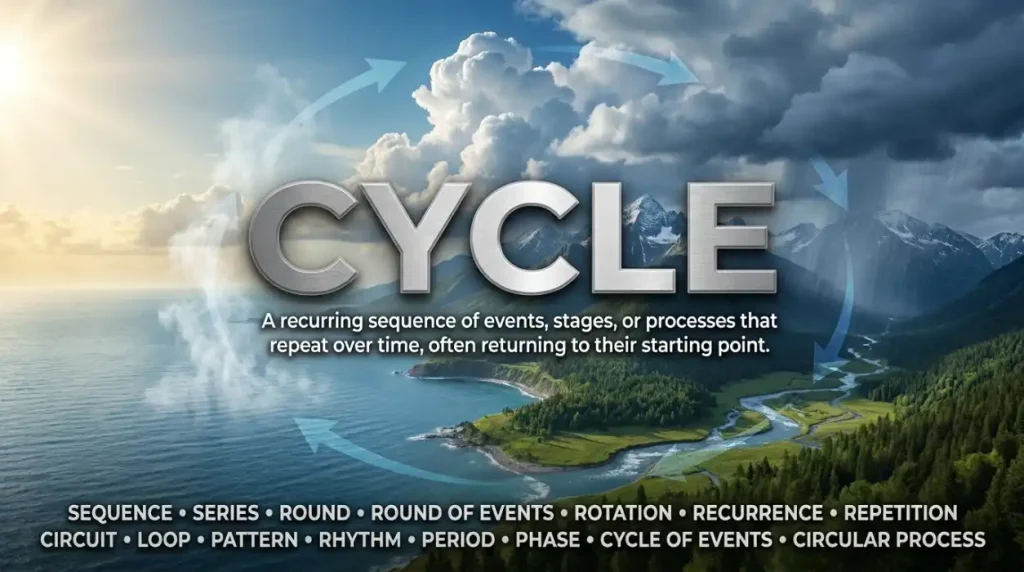
Synonyms for cycle include sequence, series, rotation, round, repetition, loop, recurrence, and circuit. The best alternative depends on the context. These words describe recurring events, repeated patterns, rotating movements, or connected stages.
Imagine explaining how your daily routine repeats every morning. You might call it a cycle. However, if you are writing an academic essay, the word sequence or recurring pattern might communicate your idea more precisely.
This is why learning synonyms for cycle matters. Different words help you express repeated actions, connected events, and natural processes without sounding repetitive.
The word cycle appears in everyday conversations, science, education, business, technology, and environmental discussions. It has several meanings, so choosing the right alternative is important.
Students can use these expressions in essays and examinations. Bloggers and content writers can create more engaging content. Everyday English users can also communicate with greater confidence.
What Does “Cycle” Really Mean?
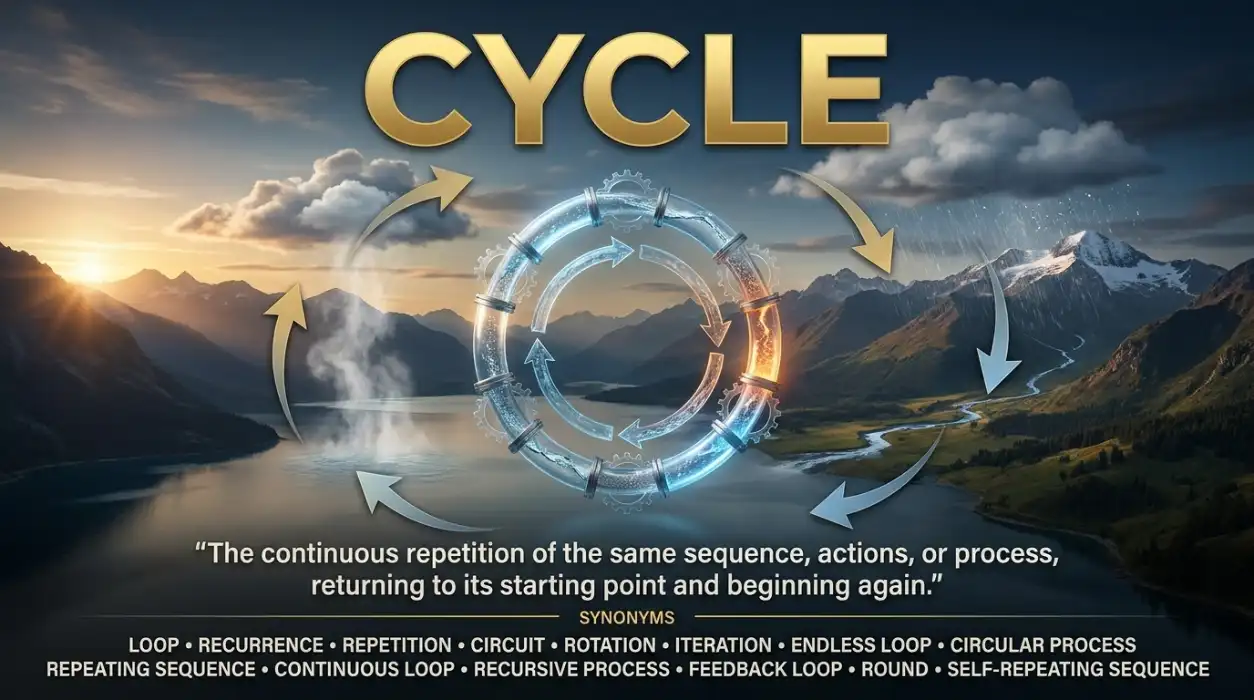
Cycle means a series of events, actions, or stages that happen in a particular order and often repeat.
It can also describe a complete movement around a central point or a regular process that returns to its starting condition.
For example:
- The seasons follow a natural cycle.
- The washing machine has a quick cycle.
- She rides her cycle to school.
Part of Speech
1. Noun
As a noun, cycle describes a repeated sequence, a complete series of events, or a bicycle.
Example: The water cycle supports life on Earth.
2. Verb
As a verb, cycle means to repeat, rotate, move around, or travel using a bicycle.
Example: The machine cycles through different settings.
How Native English Speakers Understand It
Native speakers understand cycle according to the surrounding sentence.
- In science, it often describes a natural process. In business, it can refer to changing economic conditions. In everyday conversation, it may describe a repeated routine or bicycle.
The word is generally neutral. Its emotional meaning depends on the situation.
Connotative Meaning of Cycle
(Connotation means the emotional associations or feelings connected with a word beyond its basic dictionary definition.)
Positive tone: A cycle can suggest renewal, growth, balance, and natural development.
Example: A new learning cycle can bring fresh opportunities.
Negative tone: It can suggest repetition, frustration, stagnation, or an unwanted situation.
Example: He feels trapped in a cycle of negative thinking.
Neutral tone: It can simply describe a regular sequence or process.
Example: The machine completes its operating cycle automatically.
Etymology:
The word cycle comes from Ancient Greek.
It comes from the Greek word kyklos, meaning circle, wheel, or circular movement. It entered English through Latin and French influences.
Its original circular meaning developed into the modern idea of recurring events and processes.
History of Cycle in English
Old English (450–1100)
The modern word cycle was not commonly established in Old English. People used native expressions associated with circles, wheels, recurring seasons, and repeated events.
Middle English (1100–1500)
The word entered English through French and Latin influences during the later medieval period. Its use became associated with circular forms and recurring periods.
Modern English (1500–Present)
Cycle developed into a widely used word for repeated processes, historical periods, scientific systems, and mechanical movements.
Today, it appears in expressions such as life cycle, business cycle, water cycle, and sleep cycle.

Pronunciation
- US: /ˈsaɪ.kəl/
- UK: /ˈsaɪ.kəl/
Syllables: cy-cle (2 syllables)
Word stress: The first syllable receives the primary stress.
Affixation Pattern of Cycle
- Root: Cycle
- Prefix: None
- Suffix: None in the basic word
Affixation can form other useful expressions.
- Cyclic: Relating to a cycle.
- Cyclical: Happening in repeated cycles.
- Cycling: The activity of riding a bicycle or moving in cycles.
- Cyclist: A person who rides a bicycle.
- Recycle: To process or use something again.
Synonyms List
1. Sequence (Noun)
Pronunciation: US /ˈsiː.kwəns/ | UK /ˈsiː.kwəns/
Meaning: A sequence is a series of connected events or actions arranged in a particular order.
Tone/Register: Neutral, academic, and professional.
Examples:
The experiment follows a specific sequence.
Please arrange the photographs in the correct sequence.
2. Series (Noun)
Pronunciation: US /ˈsɪr.iːz/ | UK /ˈsɪə.riːz/
Meaning: A series is a group of related events or activities that follow one another.
Tone/Register: Neutral and formal.
Examples:
The company introduced a series of training sessions.
The documentary explores a series of historical events.
3. Rotation (Noun)
Pronunciation: US /roʊˈteɪ.ʃən/ | UK /rəʊˈteɪ.ʃən/
Meaning: Rotation describes the repeated turning of an object around an axis or central point.
Tone/Register: Technical, scientific, and neutral.
Examples:
Earth’s rotation causes day and night.
The machine uses continuous rotation to operate.
4. Round (Noun)
Pronunciation: US /raʊnd/ | UK /raʊnd/
Meaning: A round is one complete instance of an activity or a repeated process.
Tone/Register: Neutral and conversational.
Examples:
We completed another round of testing.
The team started a new round of interviews.
5. Repetition (Noun)
Pronunciation: US /ˌrep.əˈtɪʃ.ən/ | UK /ˌrep.əˈtɪʃ.ən/
Meaning: Repetition means performing or experiencing something again.
Tone/Register: Neutral, academic, and sometimes negative.
Examples:
Repetition helps children remember new words.
The constant repetition made the lesson boring.
6. Loop (Noun)
Pronunciation: US /luːp/ | UK /luːp/
Meaning: A loop is a repeated sequence or process that returns to its starting point.
Tone/Register: Informal, technical, and neutral.
Examples:
The video plays in a continuous loop.
The software runs through the same loop repeatedly.
7. Recurrence (Noun)
Pronunciation: US /rɪˈkɜːr.əns/ | UK /rɪˈkʌr.əns/
Meaning: Recurrence refers to something happening again after a period of time.
Tone/Register: Formal, academic, and medical.
Examples:
The recurrence of the problem surprised everyone.
Seasonal recurrence is common in nature.
8. Circuit (Noun)
Pronunciation: US /ˈsɝː.kɪt/ | UK /ˈsɜː.kɪt/
Meaning: A circuit is a complete route or path that returns to its starting point.
Tone/Register: Technical, sporting, and neutral.
Examples:
We completed one circuit around the park.
The runners followed a circular circuit.
9. Orbit (Noun)
Pronunciation: US /ˈɔːr.bɪt/ | UK /ˈɔː.bɪt/
Meaning: An orbit is the curved path followed by an object moving around another object.
Tone/Register: Scientific and technical.
Examples:
The satellite entered Earth’s orbit.
The planet follows a regular orbit around the Sun.
10. Revolution (Noun)
Pronunciation: US /ˌrev.əˈluː.ʃən/ | UK /ˌrev.əˈluː.ʃən/
Meaning: A revolution is one complete turn around an axis or central point.
Tone/Register: Scientific and technical.
Examples:
The wheel completes one revolution.
The Earth makes one revolution around the Sun in approximately one year.
11. Recurrence Pattern (Noun Phrase)
Pronunciation: US /rɪˈkɜːr.əns ˈpæt.ɚn/ | UK /rɪˈkʌr.əns ˈpæt.ən/
Meaning: A recurrence pattern describes a recognizable arrangement of events that happens repeatedly.
Tone/Register: Academic and analytical.
Examples:
Researchers identified a recurrence pattern in the data.
The weather follows a noticeable recurrence pattern.
12. Rhythm (Noun)
Pronunciation: US /ˈrɪð.əm/ | UK /ˈrɪð.əm/
Meaning: Rhythm describes a regular pattern of movement, activity, or repeated events.
Tone/Register: Neutral, creative, and conversational.
Examples:
I enjoy the natural rhythm of village life.
The team developed a comfortable working rhythm.
13. Pattern (Noun)
Pronunciation: US /ˈpæt.ɚn/ | UK /ˈpæt.ən/
Meaning: A pattern is a repeated arrangement or recognizable way in which events occur.
Tone/Register: Neutral, academic, and professional.
Examples:
There is a clear pattern in customer behavior.
The same pattern appears every winter.
14. Succession (Noun)
Pronunciation: US /səkˈseʃ.ən/ | UK /səkˈseʃ.ən/
Meaning: Succession describes a series of events or stages following one another.
Tone/Register: Formal and academic.
Examples:
The project developed through a succession of stages.
A succession of storms affected the region.
15. Progression (Noun)
Pronunciation: US /prəˈɡreʃ.ən/ | UK /prəˈɡreʃ.ən/
Meaning: Progression describes a connected series of developments or stages.
Tone/Register: Academic, professional, and neutral.
Examples:
The course follows a logical progression.
Her progression from beginner to expert was impressive.
16. Sequence of Events (Noun Phrase)
Pronunciation: US /ˈsiː.kwəns əv ɪˈvents/ | UK /ˈsiː.kwəns əv ɪˈvents/
Meaning: This phrase describes several connected events occurring in a particular order.
Tone/Register: Formal, academic, and journalistic.
Examples:
The report explains the sequence of events.
Police reconstructed the sequence of events.
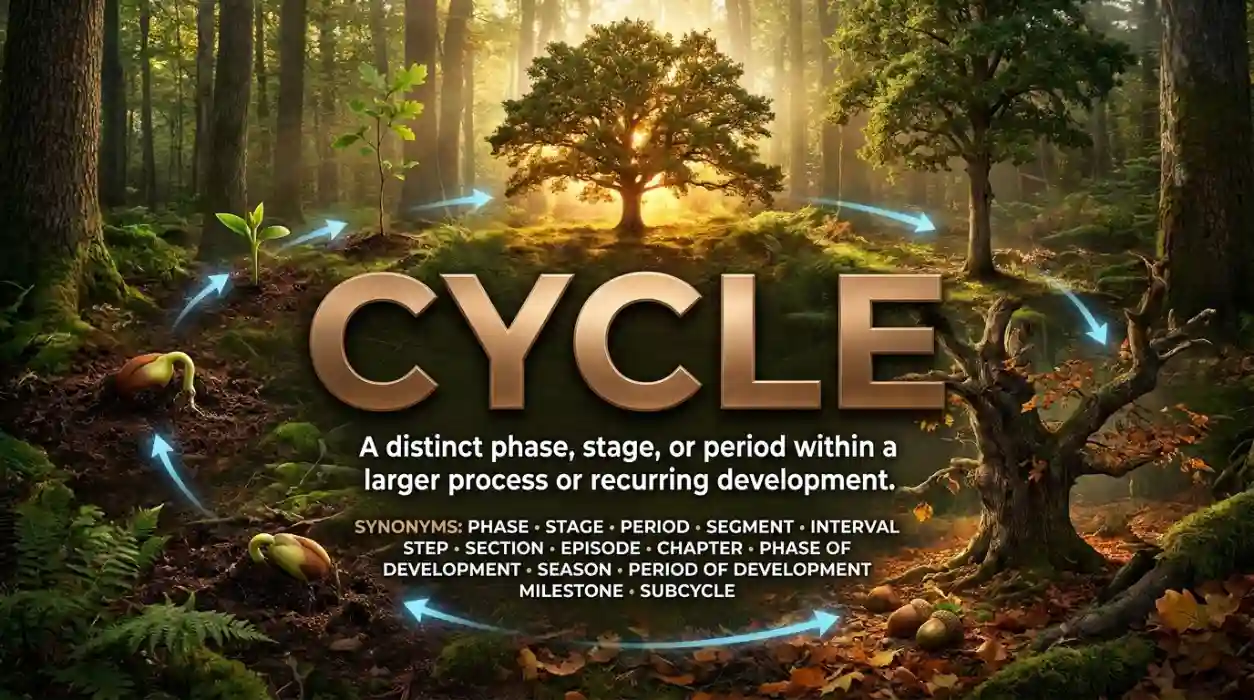
17. Phase (Noun)
Pronunciation: US /feɪz/ | UK /feɪz/
Meaning: A phase is one distinct stage within a larger process or recurring development.
Tone/Register: Neutral and professional.
Examples:
The project has entered its final phase.
Every business experiences a growth phase.
18. Stage (Noun)
Pronunciation: US /steɪdʒ/ | UK /steɪdʒ/
Meaning: A stage is a particular point in a process or series of developments.
Tone/Register: Neutral, academic, and professional.
Examples:
The first stage involves collecting information.
Children learn different skills at each stage.
19. Period (Noun)
Pronunciation: US /ˈpɪr.i.əd/ | UK /ˈpɪə.ri.əd/
Meaning: A period is a particular length of time during which an event or process occurs.
Tone/Register: Neutral and formal.
Examples:
The economy experienced a difficult period.
The plant grows rapidly during this period.
20. Interval (Noun)
Pronunciation: US /ˈɪn.t̬ɚ.vəl/ | UK /ˈɪn.tə.vəl/
Meaning: An interval is a space of time between two events or occurrences.
Tone/Register: Formal, academic, and technical.
Examples:
The machine stops at regular intervals.
The meetings take place at weekly intervals.
21. Rotation Cycle (Noun Phrase)
Pronunciation: US /roʊˈteɪ.ʃən ˈsaɪ.kəl/ | UK /rəʊˈteɪ.ʃən ˈsaɪ.kəl/
Meaning: A rotation cycle is a complete process in which positions or movements rotate according to a pattern.
Tone/Register: Technical and professional.
Examples:
The employees follow a monthly rotation cycle.
The machine operates on a fixed rotation cycle.
22. Alternation (Noun)
Pronunciation: US /ˌɔːl.tɚˈneɪ.ʃən/ | UK /ˌɔːl.təˈneɪ.ʃən/
Meaning: Alternation describes the repeated switching between two or more conditions or activities.
Tone/Register: Formal and academic.
Examples:
The schedule involves an alternation of work and rest.
The pattern shows an alternation between light and dark colors.
23. Oscillation (Noun)
Pronunciation: US /ˌɑː.səˈleɪ.ʃən/ | UK /ˌɒs.ɪˈleɪ.ʃən/
Meaning: Oscillation is repeated movement between two positions or conditions.
Tone/Register: Scientific and technical.
Examples:
The pendulum shows regular oscillation.
Temperature oscillation affects the equipment.
24. Circulation (Noun)
Pronunciation: US /ˌsɝː.kjəˈleɪ.ʃən/ | UK /ˌsɜː.kjəˈleɪ.ʃən/
Meaning: Circulation describes the continuous movement of something through a system or around a route.
Tone/Register: Scientific, medical, and professional.
Examples:
Good circulation helps distribute heat throughout the building.
The circulation of water supports aquatic life.
25. Renewal (Noun)
Pronunciation: US /rɪˈnuː.əl/ | UK /rɪˈnjuː.əl/
Meaning: Renewal describes the process of becoming active, fresh, or effective again.
Tone/Register: Positive, formal, and inspirational.
Examples:
Spring represents renewal in nature.
The organization needs a period of renewal.
26. Cycle of Development (Noun Phrase)
Pronunciation: US /ˈsaɪ.kəl əv dɪˈvel.əp.mənt/ | UK /ˈsaɪ.kəl əv dɪˈvel.əp.mənt/
Meaning: A cycle of development is a recurring series of stages through which something grows or changes.
Tone/Register: Academic and professional.
Examples:
The research examines the cycle of development in plants.
Each generation experiences its own cycle of development.
27. Life Cycle (Noun Phrase)
Pronunciation: US /ˈlaɪf ˌsaɪ.kəl/ | UK /ˈlaɪf ˌsaɪ.kəl/
Meaning: A life cycle is the sequence of stages an organism or product passes through during its existence.
Tone/Register: Scientific, educational, and professional.
Examples:
Students studied the life cycle of a butterfly.
The company analyzed the product life cycle.
28. Business Cycle (Noun Phrase)
Pronunciation: US /ˈbɪz.nəs ˌsaɪ.kəl/ | UK /ˈbɪz.nəs ˌsaɪ.kəl/
Meaning: A business cycle describes recurring periods of economic expansion and contraction.
Tone/Register: Economic and academic.
Examples:
Investors monitor changes in the business cycle.
The recession marked a difficult stage of the business cycle.
29. Rotation Schedule (Noun Phrase)
Pronunciation: US /roʊˈteɪ.ʃən ˈskedʒ.uːl/ | UK /rəʊˈteɪ.ʃən ˈʃed.juːl/
Meaning: A rotation schedule is an organized plan for repeatedly changing assignments, positions, or responsibilities.
Tone/Register: Business and professional.
Examples:
Our department follows a weekly rotation schedule.
The nurses work according to a rotation schedule.
30. Recurring Process (Noun Phrase)
Pronunciation: US /rɪˈkɝː.ɪŋ ˈprɑː.ses/ | UK /rɪˈkɜː.rɪŋ ˈprəʊ.ses/
Meaning: A recurring process is an activity or series of actions that happens repeatedly.
Tone/Register: Professional, academic, and neutral.
Examples:
Monthly reporting is a recurring process.
The company reviews its recurring processes every year.
31. Rotate (Verb)
Pronunciation: US /ˈroʊ.teɪt/ | UK /rəʊˈteɪt/
Meaning: To rotate means to turn around an axis or regularly change positions.
Tone/Register: Neutral and technical.
Examples:
Rotate the image before saving it.
The employees rotate between different departments.
32. Repeat (Verb)
Pronunciation: US /rɪˈpiːt/ | UK /rɪˈpiːt/
Meaning: To repeat means to do or say something again.
Tone/Register: Neutral and conversational.
Examples:
Please repeat the instructions slowly.
The experiment was repeated three times.
33. Recur (Verb)
Pronunciation: US /rɪˈkɝː/ | UK /rɪˈkɜː/
Meaning: To recur means to happen again, usually after an interval.
Tone/Register: Formal and academic.
Examples:
The problem may recur during winter.
Similar themes recur throughout the novel.
34. Circulate (Verb)
Pronunciation: US /ˈsɝː.kjə.leɪt/ | UK /ˈsɜː.kjə.leɪt/
Meaning: To circulate means to move continuously through a system or around an area.
Tone/Register: Neutral, scientific, and professional.
Examples:
Fresh air circulates through the room.
The information began to circulate online.

35. Revolve (Verb)
Pronunciation: US /rɪˈvɑːlv/ | UK /rɪˈvɒlv/
Meaning: To revolve means to move around a central point or axis.
Tone/Register: Scientific and neutral.
Examples:
The planets revolve around the Sun.
The wheels revolve as the machine operates.
36. Repeat Itself (Verb Phrase)
Pronunciation: US /rɪˈpiːt ɪtˈself/ | UK /rɪˈpiːt ɪtˈself/
Meaning: An event or situation repeats itself when a similar occurrence happens again.
Tone/Register: Neutral, conversational, and sometimes negative.
Examples:
History can repeat itself when people ignore past mistakes.
The same problem seems to repeat itself every month.
37. Alternate (Verb)
Pronunciation: US /ˈɔːl.tɚ.neɪt/ | UK /ˈɔːl.tə.neɪt/
Meaning: To alternate means to switch repeatedly between different activities, positions, or conditions.
Tone/Register: Neutral and formal.
Examples:
We alternate between indoor and outdoor activities.
The lights alternate between red and blue.
38. Oscillate (Verb)
Pronunciation: US /ˈɑː.sə.leɪt/ | UK /ˈɒs.ɪ.leɪt/
Meaning: To oscillate means to move repeatedly between two points or conditions.
Tone/Register: Technical and scientific.
Examples:
The needle oscillates between two positions.
Public opinion can oscillate over time.
39. Recycle (Verb)
Pronunciation: US /ˌriːˈsaɪ.kəl/ | UK /ˌriːˈsaɪ.kəl/
Meaning: To recycle means to process or reuse materials instead of throwing them away.
Tone/Register: Environmental and everyday.
Examples:
Our school encourages students to recycle paper.
Many households recycle plastic bottles.
40. Repeat in a Loop (Verb Phrase)
Pronunciation: US /rɪˈpiːt ɪn ə luːp/ | UK /rɪˈpiːt ɪn ə luːp/
Meaning: To repeat in a loop means to perform the same sequence continuously.
Tone/Register: Technical and informal.
Examples:
The animation repeats in a loop.
The program repeats the instruction in a loop.
Synonyms by Tone
Choosing a synonym involves more than understanding its dictionary definition. Tone helps communicate your attitude and purpose.
Positive Synonyms
These alternatives can suggest development, balance, and improvement.
- Renewal
- Progression
- Rhythm
- Life cycle
- Sequence of development
Example: The organization entered a new phase of growth and renewal.
Neutral Synonyms
These words describe repeated activities or processes without strong emotional associations.
- Sequence
- Series
- Rotation
- Round
- Pattern
- Period
- Interval
- Circuit
- Recurrence
- Repetition
- Stage
- Phase
Example: The machine follows a regular operating sequence.
Negative Synonyms
These alternatives can communicate unwanted repetition or frustration.
- Loop
- Repetition
- Recurrence
- Recurrent pattern
- Repeating cycle
Example: She wanted to escape the endless loop of arguments.
Playful and Informal Synonyms
These words are useful in relaxed conversations.
- Bike
- Pedal
- Spin
- Whirl
- Come around again
Example: We decided to bike around the neighborhood after lunch.
Cycle vs. Close Alternatives
Some words have very similar meanings but communicate slightly different ideas.
Cycle vs. Sequence
Cycle: Describes a process that may return to its starting point and happen again.
Sequence: Describes events arranged in a particular order. Repetition is not necessary.
Example:
The water cycle repeats naturally.
The sequence of instructions must be followed carefully.
When to use: Choose cycle for recurring processes. Choose sequence when order is more important than repetition.
Cycle vs. Series
Cycle: Usually emphasizes a repeating process or connected stages.
Series: Refers to several related events, items, or activities.
Example:
The seasons follow a natural cycle.
The school organized a series of educational workshops.
When to use: Use series for related events or items. Use cycle for recurring processes.
Cycle vs. Rotation
Cycle: Can describe a complete recurring process.
Rotation: Specifically describes turning around an axis or regularly changing positions.
Example:
The plant follows a seasonal cycle.
Earth’s rotation creates the day-and-night pattern.
When to use: Choose rotation when physical turning or changing positions is involved.
How Cycle Changes by Context
The most suitable synonym depends on where and why you are using the word.
1. Daily Conversation
In everyday English, people commonly use cycle, round, repeat, and routine.
For example:
- Let’s go for another round of practice.
- My daily routine starts at 7 a.m.
- This problem keeps repeating.
These expressions sound natural in casual discussions.
2. Writing and Blogging
Bloggers and content writers can use sequence, pattern, progression, recurrence, and repetition.
For example:
The article explains the sequence of changes in consumer behavior.
This creates variety and makes explanations easier to understand.
However, do not replace a keyword unnecessarily when it has a specific technical meaning.
3. Professional and Academic English
Formal communication often benefits from precise alternatives.
Use progression when discussing development. Choose recurrence when describing repeated events. Use rotation when explaining physical movement or changing responsibilities.
For example:
The research examines the recurrence of seasonal changes.
The department follows a structured rotation schedule.
4. Creative and Informal English
Creative writing allows more expressive vocabulary.
Words such as rhythm, whirl, spin, and renewal can create stronger descriptions.
For example:
Life moves to its own rhythm.
The dancers whirled beneath the colorful lights.
Common Mistakes Learners Make
Understanding synonyms is useful, but replacing words without checking their meaning can create mistakes.
1. Treating Every Synonym as Interchangeable
Cycle and sequence are related, but they are not identical.
A sequence does not always repeat. A cycle generally involves repetition or a return to an earlier point.
2. Confusing Rotation With Repetition
Rotation describes turning or changing positions. Repetition simply means doing something again.
A repeated instruction does not necessarily involve rotation.
3. Using Formal Words in Casual Conversations
Recurrence and succession may sound unnecessarily formal in relaxed conversations.
Instead, use words such as repeat, round, or happen again when appropriate.
4. Confusing Bicycle With a Repeating Process
In some English varieties, cycle refers to a bicycle.
However, you cannot replace every use of cycle with bicycle.
The sentence must clearly refer to a vehicle.
5. Overusing Synonyms
Using a different synonym in every sentence does not automatically improve writing.
Clarity matters more than vocabulary variety. Repeat a word when it is the most accurate choice.
Native Usage and Register Notes
Formal vs. informal: Sequence, succession, recurrence, and progression work well in academic or professional writing. Round, repeat, and bike are more conversational.
Spoken vs. written English: Native speakers often prefer short expressions in conversation. Written English may use more precise terms to explain complicated processes.
Useful writing tip: Before replacing cycle, ask yourself whether you mean repetition, a sequence of stages, physical rotation, or a bicycle.
For more vocabulary development, explore related dictionary entries and word families in the Cambridge Dictionary.
Real-Life Mini Scenarios
Here are four situations showing how the word and its alternatives work naturally.
Workplace Scenario
A manager explains that employees change departments every month.
Natural expression: “We follow a monthly rotation schedule.”
Social Scenario
Two friends discuss their repeated weekend activities.
Natural expression: “We have developed a comfortable weekend routine.”
Media and Pop Culture Scenario
A television documentary explains recurring political events.
Natural expression: “The documentary examines a recurring pattern in political history.”
Writing and Storytelling Scenario
A writer describes a character who keeps making the same mistakes.
Natural expression: “The character becomes trapped in a repeating cycle of poor decisions.”
External Learning Sources
For further vocabulary development and reliable definitions, consult:
- Cambridge Dictionary – Cycle
- Merriam-Webster – Cycle
- Oxford Learner’s Dictionaries
These resources can help you check pronunciation, grammatical usage, word forms, and example sentences.
Practice Quiz:
1. Which word best describes the repeated turning of Earth around its axis?
A. Sequence
B. Rotation
C. Renewal
D. Succession
2. A teacher explains several activities arranged in a particular order. Which word is most suitable?
A. Sequence
B. Whirl
C. Bicycle
D. Oscillation
3. Which word describes something happening again after a period of time?
A. Progression
B. Recurrence
C. Circuit
D. Stage
4. You want to describe a group of related educational workshops. Which word should you use?
A. Series
B. Rotation
C. Orbit
D. Spin
5. Which word describes the regular movement of a pendulum between two positions?
A. Renewal
B. Oscillation
C. Succession
D. Interval
6. Your company regularly changes employees’ responsibilities. Which expression fits best?
A. Rotation schedule
B. Repeating wheel
C. Creative rhythm
D. Life period
7. Which word describes a recognizable arrangement that happens repeatedly?
A. Pattern
B. Bicycle
C. Revolution
D. Stage
8. You want to describe someone traveling to college using a bicycle. Which informal verb is suitable?
A. Recur
B. Oscillate
C. Bike
D. Revolve
9. Which word best describes the different stages an organism experiences throughout its existence?
A. Life cycle
B. Interval
C. Round
D. Circuit
10. A character keeps making the same mistakes. Which expression best describes this situation?
A. Positive progression
B. Repeating cycle
C. Rotation schedule
D. Sequence of instructions
Reflection and Application Task
Choose any three synonyms from this article.
Write one original sentence for each word. Try using the words in different situations, such as an email, an academic paragraph, and a daily conversation.
Answer Key: 1-B | 2-A | 3-B | 4-A | 5-B | 6-A | 7-A | 8-C | 9-A | 10-B
Conclusion
Learning synonyms for cycle helps you express repeated actions, natural processes, and connected events with greater accuracy. The right word makes your message clearer.
A wider vocabulary also improves essays, blogs, professional writing, and everyday conversations. You can communicate naturally without relying on the same expression repeatedly.
Remember that sequence, rotation, repetition, and recurrence have different meanings. Understanding these differences helps you sound more confident and fluent.
Start practicing today. Use three new synonyms in your next email, essay, or daily conversation, and gradually make them part of your vocabulary.
FAQs
1. What is the best synonym for cycle in academic writing?
Sequence, recurrence, progression, and repetition are useful alternatives in academic writing. The best choice depends on the subject. Use sequence when discussing an ordered set of events, recurrence when describing something happening again, and progression when explaining development through different stages.
2. What is another word for cycle in a business context?
Business cycle, recurring process, rotation, and sequence are useful expressions in professional communication. For example, a company may discuss an employee rotation schedule or a recurring reporting process. When discussing economic expansion and contraction, business cycle is the established technical expression.
3. What is the opposite of cycle?
There is no single opposite of cycle because the word has several meanings. Depending on the context, alternatives include one-time event, single occurrence, uninterrupted progression, or linear process. These expressions describe something that does not return to its starting point or repeat regularly.
4. What is a simple word for cycle for beginners?
Repeat, round, and sequence are useful beginner-friendly alternatives. Repeat is especially easy when discussing an action that happens again. Round works for a complete attempt or session, while sequence describes events that happen in a particular order.
5. What is the difference between cyclical and cyclic?
Both adjectives describe something connected with a cycle. Cyclical commonly refers to recurring events, patterns, or changes, especially in economics and everyday discussion. Cyclic is also correct and frequently appears in mathematics, chemistry, and technical writing. Their meanings overlap, but common usage depends on the subject.

Hasnain Ali is an SEO Content Strategist and the founder of wordvora.com, a trusted vocabulary platform that helps writers, students, professionals, and English learners find accurate synonyms, antonyms, word meanings, and real-life usage examples. He specializes in keyword research, on-page SEO, topical authority, and creating search-first content that aligns with Google’s latest Search Quality and E-E-A-T guidelines. His work focuses on producing clear, well-structured, and reader-friendly resources that satisfy search intent while maintaining high editorial standards.
Through extensive hands-on experience with SEO tools such as Google Search Console, Google Analytics, SEMrush, and Ahrefs, Hasnain researches user search behavior and develops content that is both informative and easy to understand. Every article published on wordvora.com is carefully reviewed for accuracy, readability, and contextual relevance before publication. His mission is to build one of the web’s most reliable English vocabulary resources by providing practical language guidance, trustworthy explanations, and content that helps readers improve their writing, communication, and vocabulary with confidence.