
Synonyms for delusional include mistaken, misguided, unrealistic, irrational, illusory, fanciful, and self-deceived. These words describe beliefs or perceptions that do not match reality. The best alternative depends on whether you mean false thinking, unrealistic expectations, or an incorrect understanding.
Imagine a person who believes they will become famous overnight without making any effort. Their friends may describe their expectations as unrealistic or delusional.
The word delusional is common in everyday conversations, psychology, entertainment, and social media. People often use it when discussing beliefs that seem disconnected from reality.
Learning synonyms for delusional helps you describe false assumptions more accurately. It also makes your writing more varied, natural, and interesting.
These alternatives are useful for students, bloggers, content writers, and everyday English speakers. They help communicate different shades of meaning in essays, articles, emails, and conversations.
What Does “Delusional” Really Mean?
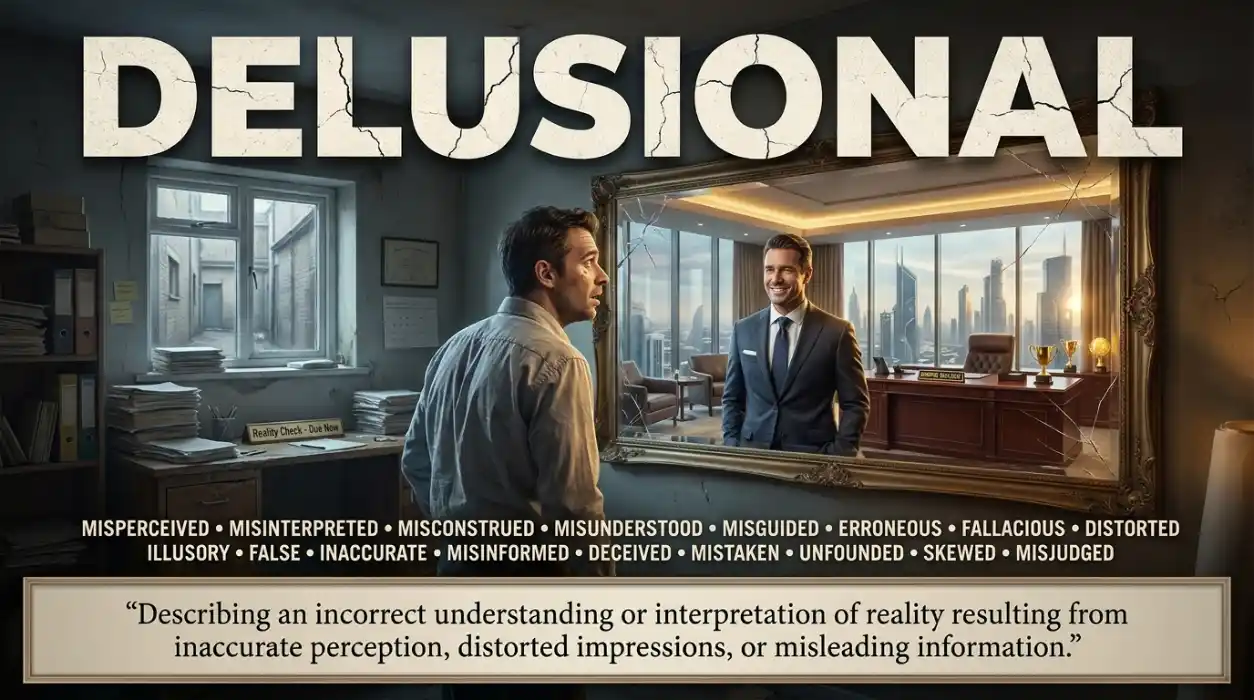
Delusional is an adjective that describes someone who holds a belief that is strongly disconnected from reality, especially when the belief remains despite clear evidence against it.
In everyday English, people also use the word more loosely to describe unrealistic expectations, mistaken assumptions, or overly optimistic thinking.
For example:
- He is delusional if he thinks he can finish the entire project in five minutes.
- She has a delusional belief that everyone admires her.
- Their expectations about the competition were completely unrealistic.
Part of Speech
Delusional is an adjective.
Related word forms:
- Delusion: Noun describing a false or mistaken belief.
- Delude: Verb meaning to mislead someone or cause someone to believe something false.
- Delusional: Adjective describing someone or something characterized by a delusion.
- Delusively: Adverb describing something misleadingly or deceptively.
Simple definition: Having a belief or understanding that does not match reality, often despite evidence showing otherwise.
How Native English Speakers Understand Delusional
Native speakers understand delusional differently depending on the context.
In casual conversations, it can mean unrealistic, mistaken, or disconnected from reality.
For example:
“You’re delusional if you think that team can win without practicing.”
Here, the speaker uses the word informally to criticize an unrealistic expectation.
In psychology and medicine, however, the word has a more specific meaning. It can describe beliefs associated with delusions. It should not be used casually to diagnose someone.
Common Contexts Where Delusional Appears
- Daily conversations: Describing unrealistic expectations.
- Relationships: Discussing mistaken assumptions about someone’s feelings.
- Psychology: Describing certain fixed false beliefs.
- Social media: Criticizing exaggerated expectations or unrealistic thinking.
- Business: Questioning unrealistic plans and projections.
- Literature: Describing characters who misunderstand reality.
Connotative Meaning of Delusional
(Connotation means the emotional feelings or associations connected with a word beyond its literal dictionary meaning.)
The word delusional usually carries a negative connotation. However, its emotional effect depends on the situation.
Positive tone: There is no standard positive meaning of delusional. In playful conversations, it can sometimes be used humorously to describe ambitious or imaginative thinking.
Negative tone: It can suggest irrationality, unrealistic expectations, false beliefs, or a lack of awareness of reality.
Neutral tone: In clinical and academic discussions, it can be used as a descriptive term when supported by appropriate context.
For example:
“His delusional belief affected his understanding of the situation.”
This sentence uses the word descriptively rather than as a joke or insult.
Etymology:
The word delusional comes from the Latin verb deludere, meaning “to deceive” or “to play false.”
It developed through the Latin noun delusio, meaning deception or mockery, and the English word delusion.
The adjective delusional developed from delusion with the addition of the suffix -al.
Historical Development
Old English (450–1100)
The word delusional did not exist in Old English. However, English already had words associated with deception, misleading ideas, and false appearances.
The Latin root existed independently during this period.
Middle English (1100–1500)
The Latin-derived word delusion entered English through French and Latin influences. It was associated with deception, misleading appearances, and false beliefs.
Its use gradually developed in religious, philosophical, and literary writing.
Modern English (1500–Present)
The noun delusion became established in English, followed by the adjective delusional.
Its use expanded in literature, medicine, psychology, and everyday communication.
Today, the word describes both clinically significant false beliefs and, in informal speech, unrealistic expectations.

Pronunciation
- US: /dɪˈluːʒənəl/
- UK: /dɪˈluːʒənəl/
Syllables
de-lu-sion-al
The word has four syllables.
Affixation Pattern of Delusional
Root: Delude / Delusion
Prefix: None
Suffix: -al
The suffix -al helps form adjectives that mean “related to” or “characterized by” something.
Related forms:
- Delude (verb)
- Deluded (adjective)
- Delusion (noun)
- Delusional (adjective)
Synonyms List
Not every word is interchangeable with delusional. Some describe incorrect beliefs, while others focus on imagination, unrealistic expectations, or misleading appearances.
1. Unrealistic (Adjective) — US / UK: /ˌʌnriːəˈlɪstɪk/
Meaning: Not based on practical possibilities or the actual conditions of a situation.
Tone/Register: Neutral, conversational, professional.
Examples:
His expectations about the project were unrealistic.
Setting an unrealistic deadline can create unnecessary stress.
2. Irrational (Adjective) — US / UK: /ɪˈræʃənəl/
Meaning: Not based on logical reasoning, evidence, or sensible judgment.
Tone/Register: Formal, academic, conversational.
Examples:
Her irrational fear prevented her from trying something new.
That was an irrational decision based on emotion.
3. Misguided (Adjective) — US / UK: /ˌmɪsˈɡaɪdɪd/
Meaning: Based on incorrect ideas, poor judgment, or a misunderstanding.
Tone/Register: Neutral, formal.
Examples:
His misguided confidence caused several problems.
The campaign was based on misguided assumptions.
4. Mistaken (Adjective) — US / UK: /mɪˈsteɪkən/
Meaning: Holding an incorrect belief or having an inaccurate understanding of something.
Tone/Register: Neutral, everyday.
Examples:
She was mistaken about the meeting time.
I was mistaken in thinking that the store was open.
5. Deluded (Adjective) — US / UK: /dɪˈluːdɪd/
Meaning: Believing something false or unrealistic, often without recognizing the truth.
Tone/Register: Informal, negative.
Examples:
He is deluded if he believes everyone agrees with him.
They seemed deluded about their chances of winning.
6. Misguidedly (Adverb) — US / UK: /ˌmɪsˈɡaɪdɪdli/
Meaning: In a way that is based on incorrect judgment or mistaken beliefs.
Tone/Register: Formal, written.
Examples:
She misguidedly assumed that money would solve every problem.
The policy was misguidedly presented as a complete solution.
7. Illusory (Adjective) — US / UK: /ɪˈluːsəri/
Meaning: Appearing real or convincing but not actually existing in the way it seems.
Tone/Register: Formal, academic.
Examples:
Their sense of security was largely illusory.
The promise of instant success proved illusory.
8. Fanciful (Adjective) — US / UK: /ˈfænsɪfəl/
Meaning: Based on imagination rather than realistic facts or practical possibilities.
Tone/Register: Literary, descriptive.
Examples:
He developed a fanciful theory about the mysterious building.
Her fanciful plans sounded entertaining but impractical.
9. Impractical (Adjective) — US / UK: /ɪmˈpræktɪkəl/
Meaning: Not sensible or suitable for real-life situations.
Tone/Register: Neutral, professional.
Examples:
The proposal was too impractical to implement.
Buying a house without considering your income is impractical.
10. Absurd (Adjective) — US / UK: /əbˈsɜːrd/
Meaning: Completely unreasonable, illogical, or difficult to believe.
Tone/Register: Informal, formal, critical.
Examples:
His claim that he could learn a language overnight sounded absurd.
The explanation was so absurd that nobody accepted it.
11. Preposterous (Adjective) — US / UK: /prɪˈpɑːstərəs/
Meaning: Extremely unreasonable or contrary to common sense.
Tone/Register: Formal, expressive.
Examples:
She made a preposterous claim about her achievements.
The suggestion that nobody needs preparation is preposterous.
12. Fantastical (Adjective) — US / UK: /fænˈtæstɪkəl/
Meaning: Based on extraordinary imagination rather than ordinary reality.
Tone/Register: Literary, creative.
Examples:
His fantastical explanation involved an imaginary conspiracy.
The story describes a fantastical world beyond human experience.
13. Imaginative (Adjective) — US / UK: /ɪˈmædʒɪnətɪv/
Meaning: Having the ability to create original ideas or mental pictures.
Tone/Register: Positive, neutral, creative.
Examples:
Her imaginative approach transformed the classroom activity.
The writer created an imaginative solution to the problem.
Note: Imaginative is not necessarily negative and is not a direct synonym for delusional.
14. Naive (Adjective) — US / UK: /naɪˈiːv/
Meaning: Showing a lack of experience or understanding about how the world works.
Tone/Register: Informal, neutral to negative.
Examples:
It was naive to believe every online promise.
His naive understanding of business created difficulties.
15. Gullible (Adjective) — US / UK: /ˈɡʌləbəl/
Meaning: Easily persuaded to believe something, especially when it is untrue.
Tone/Register: Informal, negative.
Examples:
The scam targeted gullible internet users.
Don’t be so gullible when strangers make extraordinary promises.
16. Credulous (Adjective) — US / UK: /ˈkrɛdjələs/
Meaning: Too willing to believe information without questioning its truth.
Tone/Register: Formal, academic.
Examples:
Credulous readers may accept misleading headlines.
The advertisement was designed to attract credulous customers.
17. Deceived (Adjective) — US / UK: /dɪˈsiːvd/
Meaning: Misled into believing something that is not true.
Tone/Register: Neutral, formal.
Examples:
She felt deceived after discovering the hidden information.
The false advertisement deceived the customers.
18. Self-deceived (Adjective) — US / UK: /ˌsɛlf dɪˈsiːvd/
Meaning: Convinced of something false because you refuse to recognize the truth.
Tone/Register: Formal, psychological.
Examples:
He was self-deceived about his ability to manage the company.
She seemed self-deceived about the relationship.
19. Confused (Adjective) — US / UK: /kənˈfjuːzd/
Meaning: Unable to understand something clearly or distinguish between different ideas.
Tone/Register: Neutral, everyday.
Examples:
He was confused about what actually happened.
The instructions left several students confused.
20. Misperceiving (Verb) — US / UK: /ˌmɪspərˈsiːvɪŋ/
Meaning: Understanding or interpreting something incorrectly because it has been perceived inaccurately.
Tone/Register: Formal, academic.
Examples:
She was misperceiving his silence as anger.
People sometimes misperceive confidence as arrogance.
21. Disconnected (Adjective) — US / UK: /ˌdɪskəˈnɛktɪd/
Meaning: Not closely connected with actual events, facts, or circumstances.
Tone/Register: Neutral, descriptive.
Examples:
His expectations seemed disconnected from reality.
The proposal was disconnected from the company’s actual needs.
22. Out of touch (Adjective Phrase) — US / UK: /ˌaʊt əv ˈtʌtʃ/
Meaning: Unaware of current realities, common experiences, or other people’s actual circumstances.
Tone/Register: Informal, conversational.
Examples:
The manager seemed out of touch with employee concerns.
His comments made him sound out of touch with modern society.
23. Fantasizing (Verb) — US / UK: /ˈfæntəˌsaɪzɪŋ/
Meaning: Imagining situations or possibilities that are not necessarily realistic.
Tone/Register: Informal, conversational.
Examples:
He spends his evenings fantasizing about becoming famous.
Stop fantasizing about instant success and start preparing.
24. Wishful (Adjective) — US / UK: /ˈwɪʃfəl/
Meaning: Based more on what someone wants to happen than on available evidence.
Tone/Register: Neutral, conversational.
Examples:
Their wishful thinking ignored the financial problems.
That prediction was based on wishful expectations.
25. Wishful-thinking (Noun) — US / UK: /ˌwɪʃfəl ˈθɪŋkɪŋ/
Meaning: The habit of believing something will happen simply because you want it to happen.
Tone/Register: Neutral, everyday, academic.
Examples:
Expecting the problem to disappear was wishful thinking.
The plan relied on wishful thinking rather than research.
26. Unreal (Adjective) — US / UK: /ʌnˈriːəl/
Meaning: Not genuine, actual, or consistent with reality.
Tone/Register: Informal, conversational.
Examples:
His expectations about the job were completely unreal.
The entire situation felt almost unreal.
27. Illogical (Adjective) — US / UK: /ɪˈlɑːdʒɪkəl/
Meaning: Not following reasonable or consistent logic.
Tone/Register: Formal, academic.
Examples:
Her conclusion was based on an illogical argument.
It is illogical to blame someone without checking the facts.
28. Unreasonable (Adjective) — US / UK: /ʌnˈriːzənəbəl/
Meaning: Not fair, sensible, or supported by good judgment.
Tone/Register: Neutral, professional.
Examples:
His expectations were unreasonable for a beginner.
The client made an unreasonable demand.
29. Fallacious (Adjective) — US / UK: /fəˈleɪʃəs/
Meaning: Based on incorrect reasoning or a misleading argument.
Tone/Register: Formal, academic.
Examples:
The report contained a fallacious conclusion.
Her argument relied on a fallacious assumption.
30. Erroneous (Adjective) — US / UK: /ɪˈroʊniəs/
Meaning: Containing mistakes or based on incorrect information.
Tone/Register: Formal, academic, professional.
Examples:
The researcher corrected the erroneous information.
His judgment was based on an erroneous interpretation.
31. Misconceived (Adjective) — US / UK: /ˌmɪskənˈsiːvd/
Meaning: Based on an incorrect understanding or a mistaken idea.
Tone/Register: Formal, professional.
Examples:
The entire strategy was misconceived from the beginning.
It was a misconceived attempt to solve the problem.
32. Misinformed (Adjective) — US / UK: /ˌmɪsɪnˈfɔːrmd/
Meaning: Having incorrect or inaccurate information about a subject.
Tone/Register: Neutral, formal.
Examples:
The public was misinformed about the new policy.
He made a misinformed comment during the discussion.
33. Delusive (Adjective) — US / UK: /dɪˈluːsɪv/
Meaning: Giving a false impression or creating an inaccurate understanding of reality.
Tone/Register: Formal, literary.
Examples:
The advertisement created a delusive sense of security.
His delusive expectations prevented him from seeing the facts.
34. Deceptive (Adjective) — US / UK: /dɪˈsɛptɪv/
Meaning: Giving a false impression or intentionally misleading someone.
Tone/Register: Neutral, formal.
Examples:
The website used deceptive language to attract visitors.
Her deceptive explanation concealed the actual situation.
35. Illusionary (Adjective) — US / UK: /ɪˈluːʒəˌnɛri/
Meaning: Existing only as an illusion or appearing real without having a genuine basis.
Tone/Register: Formal, descriptive.
Examples:
Their sense of control was illusory.
The supposed advantage turned out to be illusory.
36. Hallucinatory (Adjective) — US / UK: /həˈluːsənəˌtɔːri/
Meaning: Related to hallucinations or experiences involving perceptions that do not correspond to external reality.
Tone/Register: Medical, psychological.
Examples:
The doctor asked about possible hallucinatory experiences.
The film included hallucinatory visual sequences.
37. Fantasmagorical (Adjective) — US / UK: /ˌfæntæzməˈɡɔːrɪkəl/
Meaning: Resembling a strange, dreamlike, or rapidly changing imaginary scene.
Tone/Register: Literary, creative, uncommon.
Examples:
The artist created a fantasmagorical world of impossible images.
The dream had a fantasmagorical quality.
38. Dreamlike (Adjective) — US / UK: /ˈdriːmlaɪk/
Meaning: Having the unusual, unreal, or imaginative quality of a dream.
Tone/Register: Neutral, creative.
Examples:
The entire experience felt dreamlike.
She described the imaginary landscape as dreamlike.
39. Airy (Adjective) — US / UK: /ˈɛri/
Meaning: Not sufficiently practical or realistic, especially when describing an idea or plan.
Tone/Register: Informal, literary.
Examples:
His airy promises failed to convince the investors.
The proposal sounded attractive but lacked practical details.
40. Speculative (Adjective) — US / UK: /ˈspɛkjələtɪv/
Meaning: Based on ideas or possibilities that have not yet been established by evidence.
Tone/Register: Academic, professional.
Examples:
The article offered a speculative explanation for the event.
Their predictions remain speculative until the results arrive.

41. Conspiratorial (Adjective) — US / UK: /kənˌspɪrəˈtɔːri/
Meaning: Suggesting or involving a belief that secret groups are working together to influence events.
Tone/Register: Political, informal, analytical.
Examples:
His conspiratorial explanation blamed a secret organization.
The discussion took a conspiratorial turn.
42. Paranoid (Adjective) — US / UK: /ˈpærəˌnɔɪd/
Meaning: Experiencing excessive suspicion or fear that others intend to harm, deceive, or target you.
Tone/Register: Psychological, informal.
Examples:
He became paranoid about every unfamiliar phone call.
The character developed paranoid suspicions about his neighbors.
Note: Paranoid has a specific psychological meaning. Don’t use it as a casual substitute for every unrealistic belief.
43. Eccentric (Adjective) — US / UK: /ɪkˈsɛntrɪk/
Meaning: Unusual or unconventional in behavior, appearance, or ideas.
Tone/Register: Neutral, sometimes positive.
Examples:
The eccentric inventor had several unusual theories.
Her eccentric ideas made the presentation memorable.
44. Absurdist (Adjective) — US / UK: /əbˈsɜːrdɪst/
Meaning: Relating to ideas or situations that emphasize the irrational or meaningless aspects of human existence.
Tone/Register: Literary, philosophical.
Examples:
The play uses absurdist humor to challenge ordinary expectations.
His writing combines absurdist ideas with social criticism.
45. Fantastical-minded (Adjective) — US / UK: /fænˈtæstɪkəl ˈmaɪndɪd/
Meaning: Inclined to imagine unusual or unrealistic possibilities.
Tone/Register: Descriptive, creative.
Examples:
The fantastical-minded child invented stories about distant planets.
Her fantastical-minded approach produced unusual ideas.
46. Overoptimistic (Adjective) — US / UK: /ˌoʊvərˌɑːptɪˈmɪstɪk/
Meaning: More hopeful about a situation than the available facts reasonably justify.
Tone/Register: Neutral, professional.
Examples:
The company made an overoptimistic sales forecast.
His overoptimistic expectations ignored the risks.
47. Presumptuous (Adjective) — US / UK: /prɪˈzʌmptʃuəs/
Meaning: Showing excessive confidence or making assumptions without having sufficient justification.
Tone/Register: Formal, negative.
Examples:
It was presumptuous of him to assume everyone would agree.
Her presumptuous prediction annoyed the committee.
48. Self-deluded (Adjective) — US / UK: /ˌsɛlf dɪˈluːdɪd/
Meaning: Holding an incorrect belief about yourself or a situation because you fail to acknowledge reality.
Tone/Register: Informal, negative.
Examples:
He was self-deluded about his professional abilities.
She seemed self-deluded when discussing her popularity.
49. Unfounded (Adjective) — US / UK: /ʌnˈfaʊndɪd/
Meaning: Not supported by facts, evidence, or convincing reasons.
Tone/Register: Formal, professional.
Examples:
The accusations were completely unfounded.
His fears were based on unfounded assumptions.
50. Misapprehensive (Adjective) — US / UK: /ˌmɪsæprɪˈhɛnsɪv/
Meaning: Based on an incorrect understanding or mistaken interpretation of something.
Tone/Register: Formal, uncommon.
Examples:
His misapprehensive interpretation created confusion.
The discussion revealed a misapprehensive view of the original statement.
Synonyms by Tone
Choosing the right alternative depends on the emotional meaning you want to communicate.
Positive or Constructive Tone
These words can describe imagination, ambition, or unconventional thinking without necessarily criticizing someone.
- Imaginative
- Eccentric
- Dreamlike
- Fantastical
- Speculative
Example: An imaginative student may develop an unusual idea that eventually becomes a successful project.
Neutral Tone
These alternatives describe inaccurate thinking, misunderstandings, or ideas that lack practical support.
- Mistaken
- Unrealistic
- Misguided
- Confused
- Illusory
- Disconnected
- Misinformed
- Unfounded
- Impractical
- Overoptimistic
- Erroneous
- Misconceived
Example: His unrealistic expectations made it difficult to develop a workable business plan.
Negative Tone
These words express stronger criticism of someone’s judgment or beliefs.
- Irrational
- Absurd
- Preposterous
- Deluded
- Gullible
- Credulous
- Self-deceived
- Fallacious
- Unreasonable
- Deceptive
- Presumptuous
- Self-deluded
- Paranoid
Example: The manager considered the proposal absurd because it ignored every practical limitation.
Playful or Informal Tone
These words can describe exaggerated imagination or unrealistic expectations in casual situations.
- Fantasizing
- Unreal
- Out of touch
- Wishful
- Wishful thinking
- Airy
Example: “You’re living in a dream world if you think you can finish all that tonight!”
Why Does Tone Matter?
Tone changes how readers understand your message.
Calling someone’s idea unrealistic sounds less personal than calling the person delusional.
Similarly, mistaken suggests an ordinary error, while irrational criticizes the reasoning behind a decision.
Choose alternatives that match the seriousness of the situation.
Delusional vs. Close Alternatives
Some words are closely related to delusional but have different meanings.
Delusional vs. Unrealistic
Meaning difference: Delusional suggests a belief that is disconnected from reality. Unrealistic describes something that is not practical or reasonably achievable.
Tone difference: Delusional is generally stronger and more personal. Unrealistic is more neutral.
When to use each:
Use delusional when describing a belief that seriously conflicts with reality.
Use unrealistic when discussing expectations, plans, goals, or deadlines.
Delusional vs. Irrational
Meaning difference: Delusional concerns false beliefs that may persist despite contrary evidence. Irrational describes thinking or behavior that does not follow sound reasoning.
Tone difference: Both can be critical, but delusional has a stronger psychological association.
When to use each:
Use delusional when the issue involves a false belief about reality.
Use irrational when someone decides without reasonable logic.
Delusional vs. Misguided
Meaning difference: Delusional describes a belief disconnected from reality. Misguided describes an idea or action based on poor judgment or incorrect understanding.
Tone difference: Misguided sounds softer and less judgmental.
When to use each:
Use delusional for strongly unrealistic beliefs.
Use misguided for decisions or plans based on incorrect assumptions.
How Delusional Changes by Context
The meaning of delusional becomes more specific depending on the situation.
1. Daily Conversation
In everyday conversations, people often use delusional humorously or critically.
For example:
“You’re delusional if you think you can pass the exam without studying.”
Here, the speaker means that the expectation is unrealistic.
However, avoid using this expression when someone is discussing a genuine mental health concern.
2. Writing and Blogging
In articles and blogs, delusional can describe unrealistic beliefs, exaggerated expectations, or incorrect assumptions.
For example:
“Some entrepreneurs develop delusional expectations about overnight business success.”
Writers can use alternatives such as unrealistic, misguided, and overoptimistic to create more precise explanations.
3. Professional and Academic English
Professional writing requires careful word selection.
Calling someone’s business proposal delusional can sound insulting.
Instead, consider expressions such as:
- The proposal is unrealistic.
- The forecast relies on unfounded assumptions.
- The argument contains an erroneous interpretation.
- The strategy appears impractical.
These alternatives communicate disagreement more professionally.
4. Creative and Informal English
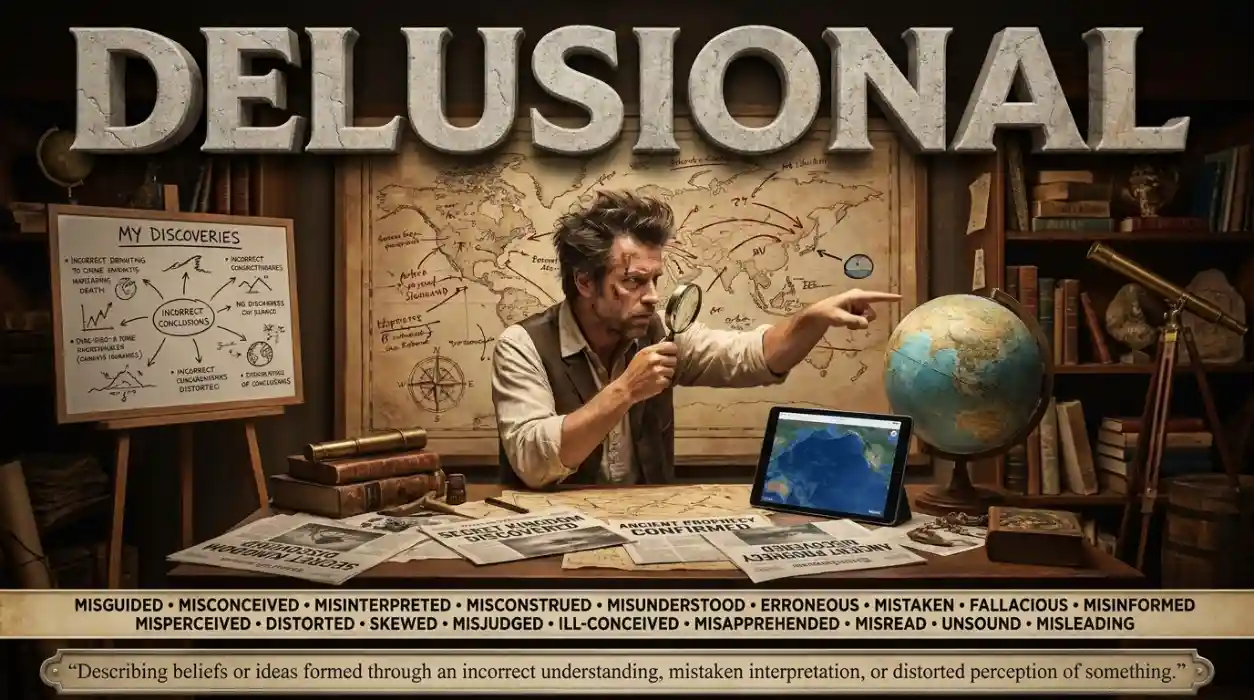
In storytelling, delusional can help describe a character who believes something that conflicts with reality.
For example:
“The character was convinced that the entire city admired him, despite having no evidence.”
Writers can also use self-deluded, fantastical, and disconnected from reality to add variety.
Common Mistakes Learners Make
English learners sometimes use delusional when another word would be more accurate.
Here are some common mistakes.
1. Confusing Delusional with Imaginative
Imagination is not the same as delusion.
An imaginative person creates new ideas, while a delusional person may firmly believe something that conflicts with reality.
2. Using Irrational for Every False Belief
Irrational describes reasoning that lacks logic.
A mistaken belief is not automatically irrational. Sometimes people simply have incomplete or incorrect information.
3. Confusing Gullible with Delusional
A gullible person is easily persuaded to believe something.
A delusional person holds a belief that is disconnected from reality. These meanings are different.
4. Using Paranoid as a Casual Insult
Paranoid has a specific psychological meaning involving excessive suspicion or fear.
It should not be used simply because someone disagrees with you or questions your intentions.
5. Confusing Wishful Thinking with Delusion
Wishful thinking occurs when someone expects something because they strongly want it to happen.
Delusion has a stronger meaning and can involve firmly held false beliefs.
6. Overusing Negative Words
Using words such as absurd, deluded, irrational, and preposterous repeatedly can make your writing sound unnecessarily judgmental.
Choose a word that accurately communicates the intended meaning.
Register Notes: Formal vs. Informal English
Different alternatives work better in different situations.
Formal English:
- Irrational
- Illusory
- Fallacious
- Erroneous
- Misconceived
- Unfounded
- Speculative
- Misguided
Informal English:
- Unrealistic
- Deluded
- Gullible
- Out of touch
- Wishful thinking
- Unreal
- Fantasizing
Academic English:
- Irrational
- Fallacious
- Illusory
- Misperceiving
- Speculative
Creative English:
- Fantastical
- Dreamlike
- Fantasmagorical
- Imaginative
- Eccentric
For more vocabulary practice, explore a related internal article about synonyms for unrealistic.
Real-Life Examples
Workplace Scenario
A new business owner believes their company will become internationally successful within a week.
Their business partner describes the expectation as unrealistic because the company has no customers or marketing strategy.
Social Situation
Someone believes that every person at a social gathering is secretly talking about them.
This assumption may reflect a mistaken interpretation of other people’s behavior.
Media and Pop Culture
A fictional character believes they have extraordinary abilities despite repeated evidence to the contrary.
The character may be described as delusional within the story, depending on the specific circumstances.
Writing and Storytelling
A novelist creates a character who believes they are destined to become a famous musician.
However, the character refuses to recognize their lack of preparation or experience.
The author might describe this character as self-deluded or unrealistic.
Practice Quiz:
1. Someone expects to become a millionaire within two days without working. Which word fits best?
A. Practical
B. Unrealistic
C. Dispassionate
D. Sensible
2. A person believes an online stranger’s unbelievable promises without checking the facts. Which word describes them?
A. Gullible
B. Rational
C. Dispassionate
D. Cautious
3. A student’s conclusion does not follow logical reasoning. Which word is most appropriate?
A. Imaginative
B. Irrational
C. Hopeful
D. Creative
4. Someone has incorrect information about a government policy. Which word fits best?
A. Misinformed
B. Eccentric
C. Dreamlike
D. Fantastical
5. A business plan ignores the actual budget and available resources. Which word describes it?
A. Impractical
B. Generous
C. Credulous
D. Imaginative
6. Someone believes something will happen simply because they strongly want it to happen. What is this called?
A. Fallacious
B. Wishful thinking
C. Deceptive
D. Hallucinatory
7. A person makes a claim that is completely unreasonable and unbelievable. Which word fits best?
A. Preposterous
B. Neutral
C. Practical
D. Accurate
8. Someone creates unusual ideas and original stories. Which word has the most positive meaning?
A. Deluded
B. Imaginative
C. Irrational
D. Gullible
9. A person has an incorrect interpretation of a situation. Which word is appropriate?
A. Mistaken
B. Fantastical
C. Paranoid
D. Absurdist
10. A person believes a secret group controls every event without credible evidence. Which word describes this type of thinking?
A. Conspiratorial
B. Practical
C. Unsentimental
D. Optimistic
Reflection and Application Task
Write two original sentences using different synonyms for delusional.
- Describe an unrealistic expectation in a workplace or academic situation.
- Describe someone who believes something without sufficient evidence.
Try using unrealistic, irrational, misguided, or self-deluded.
Answer Key: 1-B | 2-A | 3-B | 4-A | 5-A | 6-B | 7-A | 8-B | 9-A | 10-A
External Link Sources
For trustworthy definitions, pronunciation, word history, and additional linguistic research, consider linking to:
- Merriam-Webster Dictionary — Meaning, usage, and related word forms.
- Cambridge Dictionary — Learner-friendly definitions and pronunciation.
- Oxford Learner’s Dictionaries — Grammar, pronunciation, and contextual examples.
- Etymonline — Historical development and etymology.
Conclusion
Understanding delusional can help you describe someone who holds beliefs that do not match reality or a situation based on unrealistic ideas. Learning its synonyms, meaning, and examples can improve your English vocabulary and make your communication more precise.
The word delusional is commonly used in everyday conversations, literature, and discussions about thoughts, perceptions, and beliefs. Knowing its related synonyms can help you express ideas about being mistaken, unrealistic, misguided, or misinformed. However, it is important to use this term carefully because it can sound judgmental when used to describe a person.
By practicing delusional in sentences and exploring related words, you can strengthen your vocabulary and writing skills. A clear understanding of this word will help you use it accurately, naturally, and respectfully in different English contexts.
FAQs
1. What is a polite way to say someone is delusional?
Polite alternatives include unrealistic, mistaken, misguided, and disconnected from reality. These expressions criticize an idea without directly insulting the person. For example, instead of saying, “You’re delusional about your career,” you could say, “Your expectations may not reflect the current job market.” This sounds more respectful in professional and personal conversations.
2. What is a slang word for delusional?
In informal English, people sometimes use expressions such as “living in a fantasy world,” “out of touch,” or “dreaming.” Online conversations also use the abbreviation “delulu” as playful slang for delusional. Its meaning is usually exaggerated or humorous, but it may sound disrespectful in serious conversations.
3. What is the difference between delusional and narcissistic?
Delusional describes beliefs that are disconnected from reality, while narcissistic describes personality traits involving excessive self-importance, admiration-seeking, or a lack of empathy. They are not interchangeable. A person may have unrealistic beliefs without being narcissistic, and narcissistic traits do not automatically indicate delusions.
4. What is the opposite of delusional?
Possible opposites include realistic, rational, sensible, clear-headed, grounded, and level-headed. These words describe someone who understands situations accurately and considers available evidence. For example, a grounded person evaluates their abilities honestly rather than relying on unrealistic expectations.
5. What is a strong word for someone who refuses to accept reality?
The word deluded is a strong everyday alternative. Other expressions include self-deluded, disconnected from reality, and unrealistic. The most suitable choice depends on the situation. If someone simply refuses to acknowledge evidence, you could also describe them as being in denial.

Hasnain Ali is an SEO Content Strategist and the founder of wordvora.com, a trusted vocabulary platform that helps writers, students, professionals, and English learners find accurate synonyms, antonyms, word meanings, and real-life usage examples. He specializes in keyword research, on-page SEO, topical authority, and creating search-first content that aligns with Google’s latest Search Quality and E-E-A-T guidelines. His work focuses on producing clear, well-structured, and reader-friendly resources that satisfy search intent while maintaining high editorial standards.
Through extensive hands-on experience with SEO tools such as Google Search Console, Google Analytics, SEMrush, and Ahrefs, Hasnain researches user search behavior and develops content that is both informative and easy to understand. Every article published on wordvora.com is carefully reviewed for accuracy, readability, and contextual relevance before publication. His mission is to build one of the web’s most reliable English vocabulary resources by providing practical language guidance, trustworthy explanations, and content that helps readers improve their writing, communication, and vocabulary with confidence.