

Finding the right words can make your writing clearer, more engaging, and professional. Synonyms for emergence can help you describe the appearance, arrival, development, or rise of something without repeating the same term. Whether you are writing an essay, article, story, or blog post, varied vocabulary can improve your overall communication.
Using synonyms for emergence allows you to choose words that fit different contexts and meanings. Common alternatives include appearance, arrival, rise, development, occurrence, and beginning. Each word can convey a slightly different idea, so understanding their meanings helps you select the most accurate option.
A strong vocabulary is useful when discussing new trends, ideas, events, opportunities, or changes. Instead of repeatedly using “emergence,” choosing an appropriate synonym can make your sentences sound more natural and descriptive. It can also help readers understand your message more easily.
In this guide, we will explore synonyms for emergence, along with their meanings and examples. These alternatives can help you expand your vocabulary, avoid repetition, and improve your writing. Learning how to use each synonym correctly will make your communication more precise, flexible, and effective.
What Does “Emergence” Really Mean?
Emergence means the process of coming into view or becoming prominent after a period of obscurity. It describes both physical appearances and the conceptual growth of new trends or technologies.
Native speakers use this word when discussing technological breakthroughs, political movements, or seasonal changes. It carries an intellectual, forward-looking, and formal emotional tone. It usually suggests progression, discovery, or sudden visibility.
Connotative Meaning
- Positive tone: Associated with innovation, growth, renewal, success, and discovery.
- Negative tone: Occasionally implies a sudden threat or unwanted arrival of a crisis.
- Neutral tone: Used in scientific or analytical contexts to denote structural development.
- Connotation definition: (The emotional or cultural feeling attached to a word beyond its strict dictionary definition).

Etymology
- Source Language: Latin (emergere meaning to rise out or bring to light, from ex- out + mergere to dip).
- Original Meaning: Originally referred to physically rising out of water or submerging liquids.
- Old English (450–1100): Not used in this exact Latinate form; native speakers relied on basic terms like rising or coming forth.
- Middle English (1100–1500): Adopted through scholarly Latin texts to describe physical events and spiritual rising.
- Modern English (1500–Present): Expanded to cover abstract concepts like the rise of nations, trends, and scientific theories.
Pronunciation (US & UK – IPA)
- US: /ɪˈmɜːrdʒəns/
- UK: /ɪˈmɜːdʒəns/
Syllables & Affixation Pattern
- Syllables: e-mer-gence
- Root: emerge (to come forth)
- Prefix: e- (variant of ex-, meaning out of)
- Suffix: -ence (noun-forming suffix indicating state or action)
Synonyms List
Appearance (Noun) — US: /əˈpɪrəns/ — UK: /əˈpɪrəns/
- Meaning: The act of coming into sight or becoming noticeable to others.
- Tone/Register: Standard, everyday.
- Example: The sudden appearance of stars lit up the evening sky.
- Example: Her unexpected appearance at the meeting surprised everyone.
Arrival (Noun) — US: /əˈraɪvəl/ — UK: /əˈraɪvəl/
- Meaning: The act of reaching a destination or coming into existence.
- Tone/Register: Standard, common.
- Example: The delayed arrival of the train caused widespread frustration.
- Example: Scientists celebrated the arrival of spring bird migrations.
Dawn (Noun) — US: /dɔːn/ — UK: /dɔːn/
- Meaning: The first appearance of light in the sky or the start of something new.
- Tone/Register: Literary, poetic.
- Example: The early dawn light illuminated the quiet mountain peak.
- Example: They witnessed the dawn of a new technological era.
Rise (Noun) — US: /raɪz/ — UK: /raɪz/
- Meaning: An upward movement or an increase in importance and status.
- Tone/Register: Standard, business.
- Example: Economic analysts predicted a steady rise in market value.
- Example: The rapid rise of digital banking changed consumer habits.
Advent (Noun) — US: /ˈædvɛnt/ — UK: /ˈadvɛnt/
- Meaning: The arrival of a notable person, thing, or major event.
- Tone/Register: Formal, academic.
- Example: The advent of the internet transformed global communication.
- Example: Historians studied society before the advent of printing presses.
Outbreak (Noun) — US: /ˈaʊtbreɪk/ — UK: /ˈaʊtbreɪk/
- Meaning: A sudden and distinct start of something unwelcome or active.
- Tone/Register: Serious, formal.
- Example: Public health officials monitored the unexpected flu outbreak closely.
- Example: The sudden outbreak of rain ruined the outdoor picnic.
Development (Noun) — US: /dɪˈvɛləpmənt/ — UK: /dɪˈvɛləpmənt/
- Meaning: The process of growing, changing, or becoming more advanced.
- Tone/Register: Professional, standard.
- Example: City planners approved the new residential development project.
- Example: Software development teams released the updated mobile application.
Evolution (Noun) — US: /ˌɛvəˈluːʃən/ — UK: /ˌiːvəˈluːʃn/
- Meaning: The gradual development of something from a simple to a complex form.
- Tone/Register: Academic, formal.
- Example: Biology classes explored the evolution of marine mammal species.
- Example: Music critics discussed the evolution of jazz through decades.
Materialization (Noun) — US: /məˌtɪriəlɪˈzeɪʃən/ — UK: /məˌtɪriəlɪˈzeɪʃn/
- Meaning: The fact of coming into existence or becoming visible.
- Tone/Register: Formal, literary.
- Example: Investors waited anxiously for the materialization of promised profits.
- Example: The sudden materialization of fog grounded morning flights.
Emanation (Noun) — US: /ˌɛməˈneɪʃən/ — UK: /ˌɛməˈneɪʃn/
- Meaning: Something that originates from a source or spreads outward.
- Tone/Register: Literary, formal.
- Example: Faint light emanations glowed from the deep cavern walls.
- Example: Warm emanations from the hearth comforted cold guests.
Upsurge (Noun) — US: /ˈʌpsɜːrdʒ/ — UK: /ˈʌpsɜːdʒ/
- Meaning: A sudden or abrupt increase in activity or occurrence.
- Tone/Register: Business, news.
- Example: Retailers noticed a major upsurge in online holiday shopping.
- Example: Local shelters reported an upsurge in pet adoption requests.
Eruption (Noun) — US: /ɪˈrʌpʃən/ — UK: /ɪˈrʌpʃn/
- Meaning: A sudden breaking out or bursting forth of activity or matter.
- Tone/Register: Dramatic, scientific.
- Example: Volcanic eruptions sent ash columns miles into the atmosphere.
- Example: Tensions caused a sudden eruption of arguments at work.
Genesis (Noun) — US: /ˈdʒɛnəsɪs/ — UK: /ˈdʒɛnəsɪs/
- Meaning: The origin, birth, or initial beginning of something.
- Tone/Register: Literary, formal.
- Example: Researchers traced the genesis of the creative design project.
- Example: The old journal detailed the genesis of the company.
Inception (Noun) — US: /ɪnˈsɛpʃən/ — UK: /ɪnˈsɛpʃn/
- Meaning: The establishment or starting point of an institution or activity.
- Tone/Register: Professional, formal.
- Example: The club has hosted events continuously since its inception in 1995.
- Example: Engineers tracked system performance from project inception.
Sprouting (Noun) — US: /ˈspraʊtɪŋ/ — UK: /ˈspraʊtɪŋ/
- Meaning: The rapid growth of new shoots, plants, or ideas from a base.
- Tone/Register: Agricultural, descriptive.
- Example: Gardeners watched the rapid sprouting of green bean seeds.
- Example: New coffee shops kept sprouting up across downtown streets.
Blossom (Noun) — US: /ˈblɑːsəm/ — UK: /ˈblɒsəm/
- Meaning: A flower or a state of blooming growth and development.
- Tone/Register: Poetic, natural.
- Example: Apple trees showed bright white blossoms in early spring.
- Example: The artist experienced a creative blossom during summer.

Birth (Noun) — US: /bɜːrθ/ — UK: /bɜːθ/
- Meaning: The emergence of a new baby or the start of a concept.
- Tone/Register: Standard, everyday.
- Example: The family celebrated the joyful birth of healthy twins.
- Example: Historians marked the birth of modern democracy in ancient Greece.
Dawn-rise (Noun Phrase) — US: /dɔːn raɪz/ — UK: /dɔːn raɪz/
- Meaning: The early morning period when light breaks across the horizon.
- Tone/Register: Descriptive, literary.
- Example: Photographers captured the quiet dawn-rise over the valley.
- Example: Joggers enjoyed the crisp air during the daily dawn-rise.
Unfolding (Noun) — US: /ʌnˈfoʊldɪŋ/ — UK: /ʌnˈfəʊldɪŋ/
- Meaning: The gradual opening, revelation, or development of events.
- Tone/Register: Literary, descriptive.
- Example: Detectives watched the slow unfolding of the mystery case.
- Example: The unfolding of historical events surprised political analysts.
Looming (Noun) — US: /ˈluːmɪŋ/ — UK: /ˈluːmɪŋ/
- Meaning: The appearance of a large or unclear object coming into view.
- Tone/Register: Descriptive, literary.
- Example: Sailors spotted the looming shape of cliffs through the fog.
- Example: Workers prepared for the looming deadline of project completion.
Material (Noun) — US: /məˈtɪriəl/ — UK: /məˈtɪriəl/
- Meaning: The physical substance or base out of which things are made.
- Tone/Register: Technical, standard.
- Example: Tailors selected fine silk material for the wedding gown.
- Example: Construction crews delivered building material to the site.
Breakthrough (Noun) — US: /ˈbreɪkθruː/ — UK: /ˈbreɪkθruː/
- Meaning: A sudden, dramatic, and important discovery or development.
- Tone/Register: Professional, scientific.
- Example: Medical researchers announced a breakthrough in vaccine design.
- Example: Engineers celebrated a technological breakthrough in battery life.
Unveiling (Noun) — US: /ʌnˈveɪlɪŋ/ — UK: /ʌnˈveɪlɪŋ/
- Meaning: The showing or introduction of a new product or plan to the public.
- Tone/Register: Business, formal.
- Example: Automotive companies hosted a grand vehicle unveiling event.
- Example: The museum planned an official statue unveiling ceremony.
Egress (Noun) — US: /ˈiːɡrɛs/ — UK: /ˈiːɡrɛs/
- Meaning: The action of going out of or leaving an enclosed place.
- Tone/Register: Formal, legal.
- Example: Fire safety inspectors checked emergency building egress routes.
- Example: Passengers sought quick egress from the crowded terminal.
Materializing (Noun) — US: /məˌtɪriəlˈaɪzɪŋ/ — UK: /məˌtɪriəlˈaɪzɪŋ/
- Meaning: The active process of becoming a tangible reality or physical form.
- Tone/Register: Formal, descriptive.
- Example: The dream of owning a home was finally materializing.
- Example: Financial backers watched profits materializing on the ledger.
Appearance (Noun) — US: /əˈpɪrəns/ — UK: /əˈpɪrəns/
- Meaning: The act of coming into view or becoming noticeable in a public setting.
- Tone/Register: Standard, everyday.
- Example: The sudden appearance of the sun warmed the chilly morning air.
- Example: Her unexpected appearance at the conference surprised her colleagues.
Emanation (Noun) — US: /ˌɛməˈneɪʃən/ — UK: /ˌɛməˈneɪʃn/
- Meaning: Something that originates from a source and spreads outward.
- Tone/Register: Literary, formal.
- Example: Faint emanations glowed softly from the ancient artifact.
- Example: Warm emanations from the brick fireplace comforted the guests.
Manifestation (Noun) — US: /ˌmænɪfɛˈsteɪʃən/ — UK: /ˌmanɪfɛˈsteɪʃn/
- Meaning: The public display of an emotion, theory, or abstract state in a physical form.
- Tone/Register: Formal, academic.
- Example: The protest was a clear manifestation of public frustration.
- Example: Artists saw the exhibition as a direct manifestation of their creative vision.
Materialization (Noun) — US: /məˌtɪriəlɪˈzeɪʃən/ — UK: /məˌtɪriəlɪˈzeɪʃn/
- Meaning: The process of taking physical shape or becoming a tangible reality.
- Tone/Register: Formal, literary.
- Example: Investors eagerly awaited the materialization of promised profits.
- Example: The thick fog caused the sudden materialization of shapes in the dark.
Apparition (Noun) — US: /ˌæpəˈrɪʃən/ — UK: /ˌapəˈrɪʃn/
- Meaning: A striking or sudden sight of something unusual, often ghostlike or phantom.
- Tone/Register: Literary, dramatic.
- Example: The old mansion was rumored to be visited by eerie apparitions.
- Example: He caught a fleeting apparition of a deer in the foggy woods.
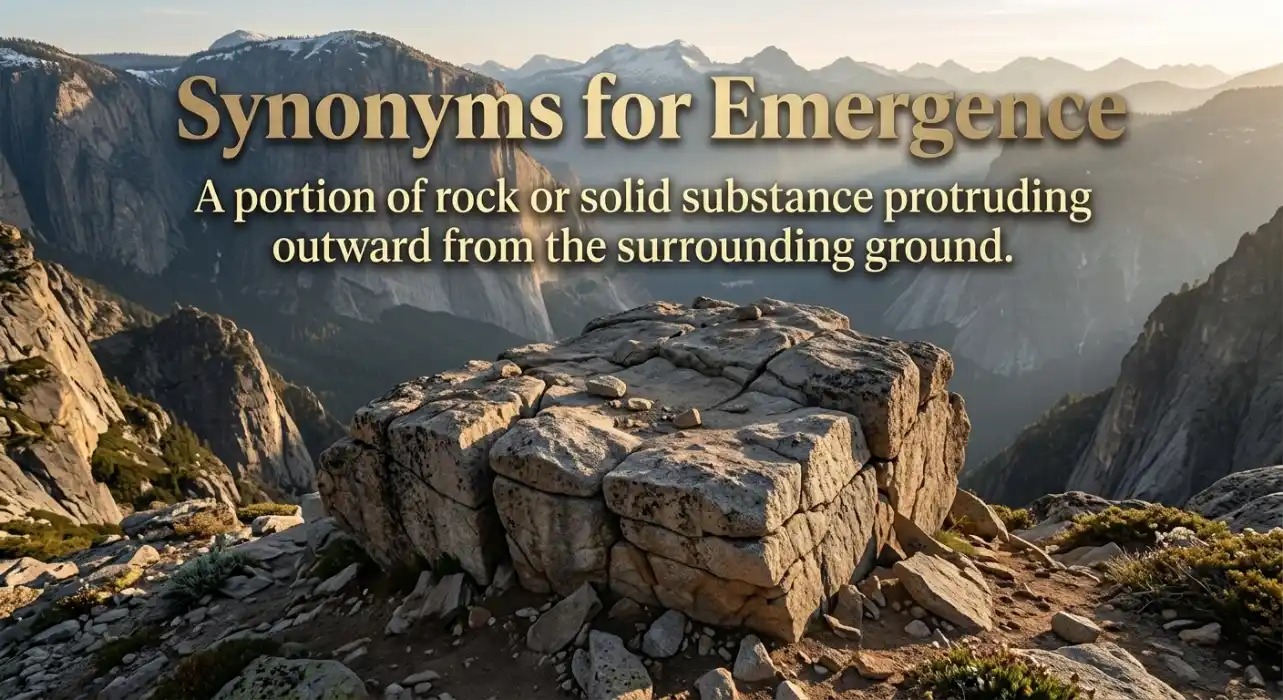
Outcropping (Noun) — US: /ˈaʊtˌkrɑːpɪŋ/ — UK: /ˌaʊtˈkrɒpɪŋ/
- Meaning: A portion of rock or solid substance protruding outward from the surrounding ground.
- Tone/Register: Geological, technical.
- Example: Geologists studied the rocky outcropping for mineral deposits.
- Example: Hikers rested near a steep limestone outcropping along the trail.
Eruption (Noun) — US: /ɪˈrʌpʃən/ — UK: /ɪˈrʌpʃn/
- Meaning: A sudden, violent bursting forth of matter or emotional energy.
- Tone/Register: Dramatic, scientific.
- Example: The volcanic eruption sent ash clouds high into the atmosphere.
- Example: Frustration caused a sudden eruption of arguments during the meeting.
Upwelling (Noun) — US: /ˈʌpˌwɛlɪŋ/ — UK: /ˈʌpˌwɛlɪŋ/
- Meaning: An upward flow of deep ocean water or a surge of intense emotion.
- Tone/Register: Scientific, figurative.
- Example: Marine life thrived near areas of nutrient-rich coastal upwelling.
- Example: She felt a sudden upwelling of gratitude for her friends.
Egress (Noun) — US: /ˈiːɡrɛs/ — UK: /ˈiːɡrɛs/
- Meaning: The action or right of going out or leaving an enclosed area.
- Tone/Register: Formal, legal.
- Example: Building inspectors checked all emergency egress routes carefully.
- Example: Passengers sought quick egress from the crowded terminal hall.
Exits (Noun Plural) — US: /ˈɛɡzɪts/ — UK: /ˈɛɡzɪts/
- Meaning: Places or acts of going out toward a destination or outside world.
- Tone/Register: Standard, practical.
- Example: Clear safety signs marked the theater exits along the walls.
- Example: Stage directors planned the actors’ exits carefully.
Looming (Noun) — US: /ˈluːmɪŋ/ — UK: /ˈluːmɪŋ/
- Meaning: The process of a large, indistinct shape coming into view through mist or distance.
- Tone/Register: Descriptive, literary.
- Example: Sailors watched the looming silhouette of cliffs through the dense fog.
- Example: The team prepared for the looming deadline of the project launch.
Sprouting (Noun) — US: /ˈspraʊtɪŋ/ — UK: /ˈspraʊtɪŋ/
- Meaning: The rapid growth of new green shoots or ideas from a base.
- Tone/Register: Agricultural, descriptive.
- Example: Gardeners watched the rapid sprouting of bean seeds in spring.
- Example: New coffee shops kept sprouting up across downtown streets.
Budding (Noun) — US: /ˈbʌdɪŋ/ — UK: /ˈbʌdɪŋ/
- Meaning: The early stage of plant growth where flowers or leaves begin to form.
- Tone/Register: Descriptive, natural.
- Example: The orchard showed signs of early spring budding.
- Example: She encouraged the budding talents of young local artists.
Blossoming (Noun) — US: /ˈblɑːsəmɪŋ/ — UK: /ˈblɒsəmɪŋ/
- Meaning: The process of opening into full flower or achieving rapid personal growth.
- Tone/Register: Poetic, uplifting.
- Example: Botanists tracked the seasonal blossoming of wildflowers in the valley.
- Example: Teachers praised the blossoming confidence of shy students.
Unfolding (Noun) — US: /ʌnˈfoʊldɪŋ/ — UK: /ʌnˈfəʊldɪŋ/
- Meaning: The gradual opening, revelation, or progression of a sequence of events.
- Tone/Register: Literary, narrative.
- Example: Detectives watched the slow unfolding of the mysterious case.
- Example: Historical analysts studied the unfolding political changes abroad.
Unveiling (Noun) — US: /ʌnˈveɪlɪŋ/ — UK: /ʌnˈveɪlɪŋ/
- Meaning: The formal public presentation or first introduction of a new plan or product.
- Tone/Register: Business, formal.
- Example: Automotive brands hosted a grand vehicle unveiling event downtown.
- Example: The museum planned an official statue unveiling ceremony for patrons.
Surfacing (Noun) — US: /ˈsɜːrfɪsɪŋ/ — UK: /ˈsɜːfɪsɪŋ/
- Meaning: The act of coming up to the top of water or becoming publicly known.
- Tone/Register: Standard, technical.
- Example: Whales require frequent surfacing to breathe fresh air.
- Example: Secret documents surfaced after decades in archives.
Egressing (Gerund/Noun) — US: /ɪˈɡrɛsɪŋ/ — UK: /ɪˈɡrɛsɪŋ/
- Meaning: The active movement of departing from an enclosed space.
- Tone/Register: Formal, technical.
- Example: Security cameras recorded people egressing from the secure building.
- Example: Egressing safely requires following illuminated exit floor guides.
Exiting (Noun) — US: /ˈɛksɪtɪŋ/ — UK: /ˈɛksɪtɪŋ/
- Meaning: The act of leaving a room, vehicle, or digital platform.
- Tone/Register: Practical, standard.
- Example: Smooth exiting from the stadium prevented heavy bottlenecks.
- Example: Software prompts users before exiting active editing windows.
Emanating (Gerund/Noun) — US: /ˈɛməˌneɪtɪŋ/ — UK: /ˈɛməˌneɪtɪŋ/
- Meaning: Flowing out from a specific source point.
- Tone/Register: Formal, descriptive.
- Example: Delicious aromas were emanating from the bakery kitchen.
- Example: Soft music was emanating from the open patio doors.
Materializing (Gerund/Noun) — US: /məˌtɪriəlˈaɪzɪŋ/ — UK: /məˌtɪriəlˈaɪzɪŋ/
- Meaning: Taking real, physical form out of abstract potential.
- Tone/Register: Descriptive, formal.
- Example: Her dream of opening a bookstore was finally materializing.
- Example: Financial backers watched profits materializing on the ledger.
Breakthrough (Noun) — US: /ˈbreɪkθruː/ — UK: /ˈbreɪkθruː/
- Meaning: A sudden, dramatic discovery that overcomes a previous barrier.
- Tone/Register: Professional, scientific.
- Example: Researchers announced a breakthrough in renewable energy storage.
- Example: Engineers celebrated a technological breakthrough in chip design.
Advent (Noun) — US: /ˈædvɛnt/ — UK: /ˈadvɛnt/
- Meaning: The arrival or notable introduction of an important era, event, or invention.
- Tone/Register: Formal, academic.
- Example: The advent of high-speed internet transformed global business.
- Example: Historians studied society before the advent of printing presses.
Genesis (Noun) — US: /ˈdʒɛnəsɪs/ — UK: /ˈdʒɛnəsɪs/
- Meaning: The origin, birth, or initial beginning point of something.
- Tone/Register: Literary, formal.
- Example: Researchers traced the genesis of the creative design project.
- Example: The old journal detailed the genesis of the family business.
Dawn (Noun) — US: /dɔːn/ — UK: /dɔːn/
- Meaning: The first appearance of light in the morning sky or a fresh start.
- Tone/Register: Literary, poetic.
- Example: The early dawn light illuminated the quiet mountain peaks.
- Example: Citizens witnessed the dawn of a new democratic era.
Synonyms by Tone
Choosing the right synonym depends entirely on the tone you want to convey in your writing or speech.
- Positive tone: Breakthrough, advent, dawn, evolution, development.
- Neutral tone: Appearance, arrival, rise, materialization.
- Negative tone: Outbreak, eruption.
- Playful / Informal tone: Sprouting.
Tone matters because using a severe word like outbreak for a positive product launch sounds alarming, while using a poetic word like dawn in a legal architectural report lacks professional precision.
Mini Comparison: Emergence vs. Advent vs. Breakthrough
- Emergence refers broadly to the process of coming into view or becoming prominent over time.
- Advent specifically highlights the arrival or notable introduction of an important event, era, or invention.
- Breakthrough emphasizes a sudden, successful discovery that solves a major problem or barrier.
Use emergence for general arrivals or trends, advent for monumental historical or technological arrivals, and breakthrough for victorious scientific discoveries.
More Synonyms for Emergence: Academic Usage, Antonyms, and Alternatives
The best synonym for emergence depends on the context in which the word is used. In academic writing, research papers, essays, and everyday communication, alternatives such as development, onset, advent, appearance, and rise can express different aspects of something becoming visible, beginning, or gaining importance.
What Is Another Word for Emergence?
Another word for emergence is appearance, arrival, development, rise, or onset. The most suitable alternative depends on the intended meaning.
- Appearance: When something becomes visible or noticeable.
- Arrival: When something new comes into existence or reaches a place.
- Development: When something gradually grows or takes shape.
- Rise: When something increases in importance, popularity, or influence.
- Onset: When a condition, process, or event begins.
- Advent: When an important invention, era, or development arrives.
For example, the emergence of a new technology can also be described as the advent of a new technology or the rise of a new technology, depending on the sentence.
Another Word for Emergence in an Essay
When writing an essay, choose a synonym that matches your argument and maintains a formal, natural tone. Useful alternatives include development, rise, appearance, advent, onset, and manifestation.
Examples:
- Original: The emergence of social media changed communication patterns.
- Alternative: The rise of social media changed communication patterns.
- Original: The emergence of a new political movement influenced public opinion.
- Alternative: The development of a new political movement influenced public opinion.
- Original: The emergence of new economic challenges affected businesses.
- Alternative: The onset of new economic challenges affected businesses.
Use rise when emphasizing growing influence, development when describing a process, and onset when focusing on the beginning of an event or condition.
Emergence Synonyms in Academic and Research Writing
In academic and research contexts, the appropriate synonym depends on the subject and the phenomenon being studied. Common choices include development, manifestation, onset, occurrence, advent, and evolution.
| Synonym | Best context | Example |
|---|---|---|
| Development | Ideas, systems, and processes | The development of new social behaviors was examined. |
| Manifestation | Visible evidence of an abstract phenomenon | The protest was a manifestation of public dissatisfaction. |
| Onset | The beginning of a condition or process | Researchers studied the onset of symptoms. |
| Occurrence | An event or phenomenon taking place | The occurrence of unexpected results required further investigation. |
| Advent | The arrival of a significant innovation or era | The advent of digital technology transformed research methods. |
| Evolution | Gradual change over time | The evolution of scientific theories remains an important research topic. |
| Rise | Increasing prominence or influence | The rise of artificial intelligence has attracted scholarly attention. |
For a research paper, avoid replacing emergence mechanically. For instance, onset is often appropriate for symptoms or processes, while development may be more suitable for ideas, institutions, and social changes.
Synonyms for the Phrase “Emergence Of”
The phrase emergence of can be replaced in several ways, depending on the noun that follows it.
- Emergence of artificial intelligence: the rise of artificial intelligence or the advent of artificial intelligence.
- Emergence of symptoms: the onset of symptoms.
- Emergence of a new theory: the development of a new theory.
- Emergence of evidence: the appearance of new evidence.
- Emergence of a political movement: the rise or development of a political movement.
- Emergence of a problem: the occurrence or onset of a problem.
These alternatives are not always interchangeable. Choose the expression that preserves the original sentence’s meaning.
What Is the Antonym of Emergence?
The antonym of emergence depends on whether the word refers to appearance, growth, or the beginning of something. Common opposites include disappearance, decline, concealment, withdrawal, and suppression.
| Antonym | Meaning | Example |
|---|---|---|
| Disappearance | The act of vanishing from view | The disappearance of the species concerned conservationists. |
| Decline | A decrease in strength, popularity, or importance | The decline of the movement followed years of public opposition. |
| Concealment | The act of keeping something hidden | The concealment of evidence delayed the investigation. |
| Withdrawal | The act of pulling back or leaving | The withdrawal of support weakened the initiative. |
| Suppression | The act of preventing something from being expressed or developing | The suppression of dissent limited public debate. |
For example, the emergence of a trend may contrast with the decline of a trend, while the emergence of evidence may contrast with the concealment of evidence. There is no single antonym that works in every context.
Synonyms for Emerging and Emergent
Although emerging, emergent, and emergence share the same word root, they serve different grammatical purposes.
Emerging is commonly used as a verb form or adjective to describe something that is appearing, developing, or gaining prominence. Possible alternatives include developing, rising, growing, and newly appearing.
Example: Emerging technologies are changing the workplace.
Alternative: Developing technologies are changing the workplace.
Emergent is an adjective often used in formal, scientific, or technical writing. Depending on the context, alternatives include developing, arising, newly formed, and newly apparent.
Example: Researchers investigated emergent patterns in the data.
Alternative: Researchers investigated newly apparent patterns in the data.
Emergence is a noun that describes the process or fact of appearing, beginning, or becoming prominent.
Example: The emergence of new patterns attracted researchers’ attention.
Alternative: The development of new patterns attracted researchers’ attention.
Emergence Synonyms: Quick Thesaurus List
If you need a different word for emergence, use this quick reference to identify an appropriate alternative.
- General use: Appearance, arrival, occurrence, beginning.
- Academic writing: Development, manifestation, evolution, advent.
- Research and science: Onset, occurrence, manifestation, development.
- Growth and popularity: Rise, upsurge, expansion.
- New inventions and discoveries: Advent, breakthrough, introduction.
- Literary writing: Dawn, unfolding, blossoming.
- Negative or sudden events: Outbreak, eruption, onset.
Words such as breakthrough, outbreak, and eruption have more specific meanings and should only be used when the context supports them.
Frequently Asked Questions About Emergence Synonyms
What is a simple synonym for emergence?
Appearance, arrival, beginning, and development are simple alternatives. The best choice depends on whether you mean something becoming visible, arriving, or gradually taking shape.
What is a formal synonym for emergence?
Advent, manifestation, development, and inception can be suitable formal alternatives. Their meanings differ, so select the word that fits your sentence.
What is another word for emergence in research?
Depending on the research topic, useful alternatives include onset, development, manifestation, and occurrence. For example, researchers may study the onset of symptoms or the development of new behaviors.
What is the opposite of emergence?
Possible antonyms include disappearance, decline, concealment, and withdrawal. The appropriate opposite depends on the meaning of emergence in the original sentence.
Are emergence, emerging, and emergent interchangeable?
No. Emergence is a noun, while emerging and emergent are commonly used as verb forms or adjectives. They cannot always replace one another grammatically.
What is the difference between emergence and advent?
Emergence broadly describes something appearing or becoming prominent. Advent emphasizes the arrival of a significant event, invention, or era.
What is the difference between emergence and onset?
Emergence can describe appearance, development, or growing prominence. Onset specifically emphasizes the beginning of a condition, event, or process.
How can I avoid repeating emergence in an essay?
Identify the intended meaning first. Use rise for growing influence, development for gradual change, appearance for visibility, and onset for the beginning of a condition or process.
Context-Based Usage
- Daily conversation: In casual talk, native speakers say appearance, arrival, or rise instead of formal academic terms.
- Writing or blogging: Essayists and tech bloggers use terms like advent, breakthrough, or emergence to sound authoritative.
- Professional or academic tone: Researchers and historians rely on precise terms like genesis, inception, and evolution.
- Creative or informal use: Novelists use words like unfolding, dawn, or looming to establish atmospheric tension.

Common Mistakes & Native Usage
Common Mistakes Learners Make
- Misuse scenarios: Using emergence to describe a physical object moving through a narrow doorway. Egress or exit fits physical movement better.
- Confusing tone: Treating dramatic words like eruption as synonyms for slow seasonal growth.
- Overuse warnings: Repeating the word emergence across every paragraph makes analytical reports sound repetitive and robotic.
Register Notes
- Spoken English favors direct nouns like appearance or rise.
- Written English rewards scholarly terms like advent and genesis.
Real-Life Mini Scenarios
- Workplace: The marketing team tracked the sudden market emergence of eco-friendly consumer goods.
- Social situations: Friends discussed the unexpected emergence of viral fashion trends on social media platforms.
- Media/pop culture: Film critics analyzed the cinematic emergence of independent directors in modern cinema.
- Writing or storytelling: The science fiction novel depicted humanity witnessing the emergence of artificial intelligence.
Practice Exercise
- Which synonym best describes a sudden, successful scientific discovery?
- A) Breakthrough
- B) Jogging
- C) Sleeping
- D) Cooking
- What tone does the word outbreak carry in news and public health reporting?
- A) Cheerful
- B) Serious or alarming
- C) Playful
- D) Commercial
- Which term refers specifically to the arrival of a notable invention or era?
- A) Advent
- B) Hammer
- C) Wrench
- D) Pliers
- If a business tracks its starting point since establishment, it is looking at its:
- A) Inception
- B) Cement
- C) Brickwork
- D) Plumbing
- The biological development of species from simple to complex forms is called:
- A) Evolution
- B) Asphalt
- C) Concrete
- D) Gravel
- What part of speech is the word emergence in English grammar?
- A) Noun
- B) Adverb only
- C) Interjection only
- D) Preposition only
- Which synonym describes the rapid growth of new plant shoots or local shops?
- A) Sprouting
- B) Stumbling
- C) Sinking
- D) Falling
- Legal fire safety routes out of a building are designated as:
- A) Egress
- B) Insulation
- C) Drywall
- D) Siding
- The birth or initial beginning of an idea is known as its:
- A) Genesis
- B) Stumble
- C) Slip
- D) Fall
- Which word describes the formal showing of a new product to the public?
- A) Unveiling
- B) Burial
- C) Closure
- D) Concealment
Reflection Task
Write one short, original sentence using the word advent to describe the impact of a major technological innovation.
Answer Key: 1: A | 2: B | 3: A | 4: A | 5: A | 6: A | 7: A | 8: A | 9: A | 10: A
Conclusion
Understanding synonyms for emergence can help expand your vocabulary and make your writing more precise. Different alternatives can describe the appearance, arrival, development, or rise of something depending on the context. Choosing the right word helps you communicate your ideas clearly.
Using synonyms for emergence can also make your essays, articles, stories, and everyday communication more engaging. Words such as appearance, arrival, rise, development, and occurrence may work well in different situations. Selecting the most suitable synonym can improve sentence flow and reduce repetition.
Exploring synonyms for emergence gives you more flexibility when expressing new ideas, trends, events, or changes. Practice using these alternatives in different sentences to strengthen your vocabulary and improve your writing. With the right word choice, your communication can become clearer, more natural, and more effective.
Frequently Asked Questions
What are the best synonyms for emergence?
Some common synonyms for emergence include appearance, arrival, rise, development, beginning, occurrence, and coming forth. The best choice depends on the context.
What does emergence mean?
Emergence refers to the process of something becoming visible, known, noticeable, or developed. It can describe a person, idea, trend, event, or phenomenon appearing or becoming important.
Is “appearance” a synonym for emergence?
Yes, appearance can be a synonym for emergence when referring to something becoming visible or noticeable. However, “emergence” can also suggest development or gradual growth.
What is a synonym for emergence in writing?
Depending on the context, useful alternatives include rise, development, arrival, appearance, beginning, and occurrence. Choosing the right synonym depends on the intended meaning.
How can synonyms for emergence improve writing?
Using synonyms for emergence can reduce repetition and make your writing more precise and engaging. They allow you to describe different types of appearances, developments, and changes more effectively.

Hasnain Ali is an SEO Content Strategist and the founder of wordvora.com, a trusted vocabulary platform that helps writers, students, professionals, and English learners find accurate synonyms, antonyms, word meanings, and real-life usage examples. He specializes in keyword research, on-page SEO, topical authority, and creating search-first content that aligns with Google’s latest Search Quality and E-E-A-T guidelines. His work focuses on producing clear, well-structured, and reader-friendly resources that satisfy search intent while maintaining high editorial standards.
Through extensive hands-on experience with SEO tools such as Google Search Console, Google Analytics, SEMrush, and Ahrefs, Hasnain researches user search behavior and develops content that is both informative and easy to understand. Every article published on wordvora.com is carefully reviewed for accuracy, readability, and contextual relevance before publication. His mission is to build one of the web’s most reliable English vocabulary resources by providing practical language guidance, trustworthy explanations, and content that helps readers improve their writing, communication, and vocabulary with confidence.