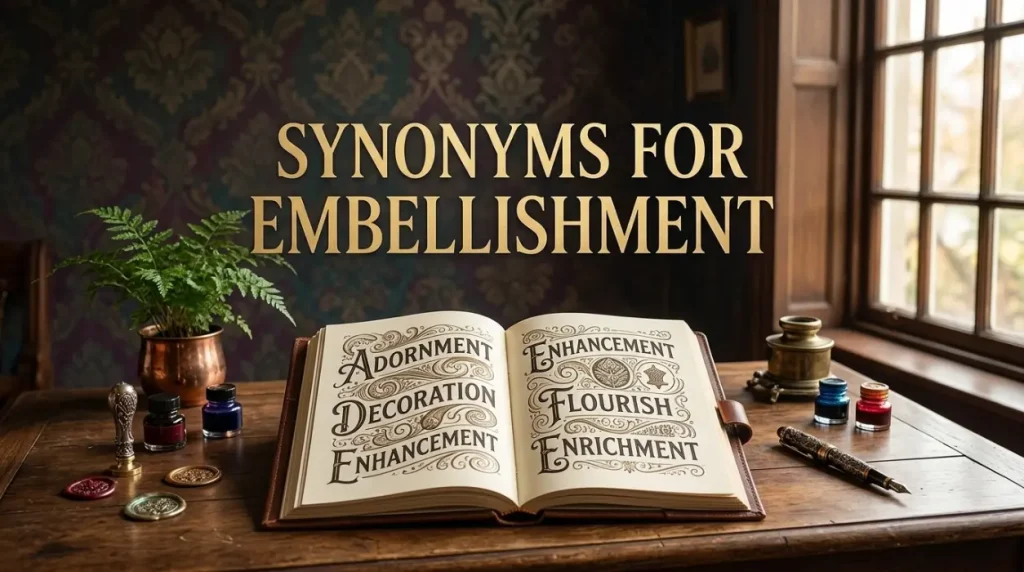
Choosing the right words can make your writing clearer, more engaging, and more professional. Synonyms for embellishment help you describe decoration, improvement, or added details without repeating the same term. They are useful for writers, students, bloggers, and professionals who want to strengthen their vocabulary.
Using synonyms for embellishment allows you to select words that fit different contexts and writing styles. Common alternatives include decoration, adornment, enhancement, ornamentation, and exaggeration. Each word has a slightly different meaning, so choosing the right one can make your message more accurate.
A varied vocabulary also makes your content more interesting and natural. Instead of repeating “embellishment,” you can use a suitable alternative to improve sentence flow and avoid repetition.
In this guide, we will explore synonyms for embellishment, their meanings, and examples to help you choose the best word for your writing.
What Does “Embellishment” Really Mean?
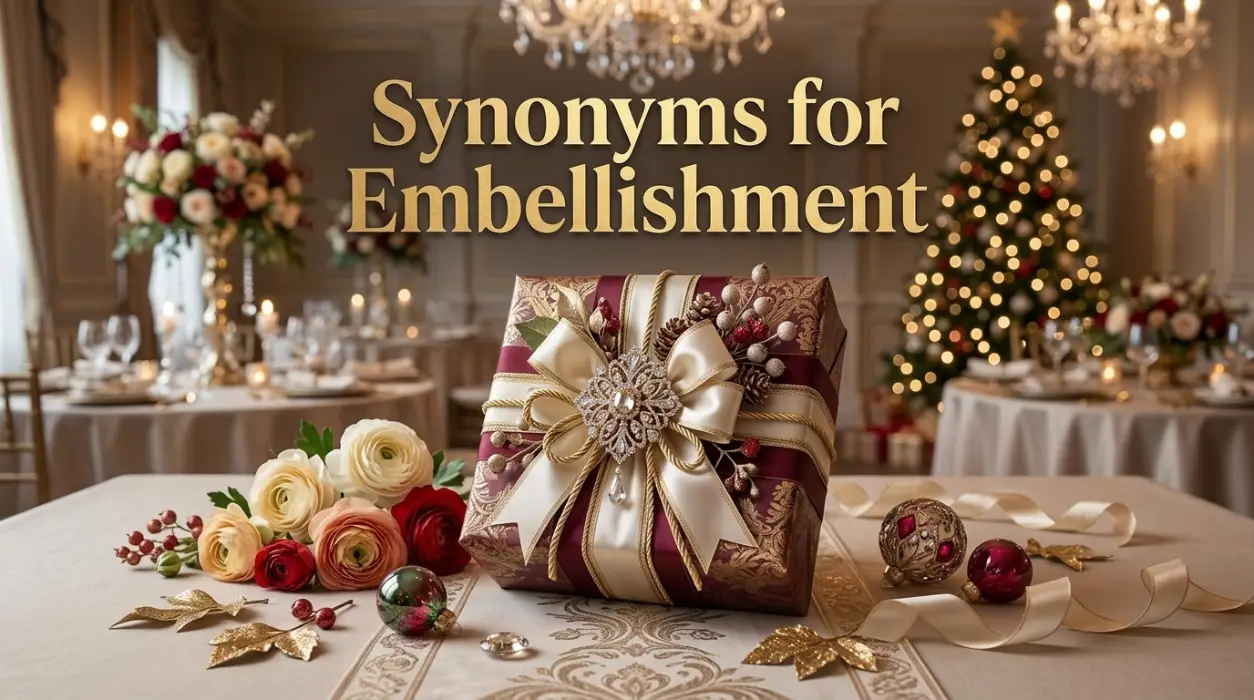
Embellishment means a detail that decorates, clarifies, or adds interesting texture to something to make it more attractive. It describes both physical decorations on objects and exaggerated details added to stories.
Native speakers use this word when discussing fashion embroidery, architectural molding, or dramatic storytelling additions. It carries a creative, artistic, and sometimes critical emotional tone. It usually suggests beauty, elaboration, or added decorative flair.
Connotative Meaning
- Positive tone: Associated with artistry, elegance, creativity, and thoughtful design details.
- Negative tone: Sometimes implies unnecessary exaggeration, falsehood, or over-decoration in speech or writing.
- Neutral tone: Used in technical or manufacturing contexts to denote decorative additions.
- Connotation definition: (The emotional or cultural feeling attached to a word beyond its strict dictionary definition).
Etymology
- Source Language: Old French (embellir meaning to make handsome or beautiful) combined with Latin roots.
- Original Meaning: Originally referred to physical acts of making something look physically attractive or handsome.
- Old English (450–1100): Not used in this exact form; native speakers relied on basic descriptive terms like fair or ornate.
- Middle English (1100–1500): Adopted through Norman French trade and court systems to describe rich clothing and decorations.
- Modern English (1500–Present): Expanded to cover both physical ornaments and figurative exaggerations in storytelling.
Pronunciation (US & UK – IPA)
- US: /ɪmˌbɛlɪʃˈmɛnt/
- UK: /ɪmˌbɛlɪʃˈmɛnt/
Syllables & Affixation Pattern
- Syllables: em-bel-lish-ment
- Root: embellish (to make beautiful)
- Prefix: em- (variant of en-, meaning to put into or cause to be)
- Suffix: -ment (noun-forming suffix indicating action or state)
Synonyms List
Ornamentation (Noun) — US /ˌɔːrnəmɛnˈteɪʃən/ — UK /ˌɔːnəmɛnˈteɪʃn/
- Meaning: Things added to something to provide decoration rather than structural function.
- Tone/Register: Formal, artistic.
- Example: The historic cathedral featured stunning stone ornamentation around every arched window.
- Example: She preferred minimalist interior design with zero excessive ornamentation.
Decoration (Noun) — US /ˌdɛkəˈreɪʃən/ — UK /ˌdɛkəˈreɪʃn/
- Meaning: An item or detail used to make something look more attractive or festive.
- Tone/Register: Standard, everyday.
- Example: The festive holiday decoration brightened up the dark living room corner.
- Example: Children helped hang colorful paper decoration banners for the school party.
Adornment (Noun) — US /əˈdɔːrnmənt/ — UK /əˈdɔːnmənt/
- Meaning: A thing that embellishes, beautifies, or decorates a person or object.
- Tone/Register: Literary, formal.
- Example: Gold necklaces served as her favorite traditional wedding adornment.
- Example: The antique mirror featured delicate floral adornment along its wooden frame.
Trimming (Noun) — US /ˈtrɪmɪŋ/ — UK /ˈtrɪmɪŋ/
- Meaning: Decorative additions or edges applied to clothing, furniture, or food.
- Tone/Register: Standard, craft.
- Example: The velvet dress featured silver lace trimming along the hemline.
- Example: He added holiday trimming to the front porch railing.
Garnishment (Noun) — US /ˈɡɑːrnɪʃmənt/ — UK /ˈɡɑːnɪʃmənt/
- Meaning: A small edible item used to decorate or flavor a prepared dish.
- Tone/Register: Culinary, formal.
- Example: The chef added a fresh parsley garnish to the grilled salmon.
- Example: Lemon wedges served as a bright citrus garnish for the seafood platter.
Frill (Noun) — US /frɪl/ — UK /frɪl/
- Meaning: A decorative gathered strip of fabric or an unnecessary extra feature.
- Tone/Register: Informal, descriptive.
- Example: The vintage blouse featured delicate lace frills along the collar.
- Example: They wanted a basic car model without any expensive technological frills.
Elaborateness (Noun) — US /ɪˈlæbərɪtnəs/ — UK /ɪˈlæbərətnəs/
- Meaning: The quality of being decorated with great detail and careful complexity.
- Tone/Register: Formal, academic.
- Example: Art historians praised the incredible elaborateness of the baroque sculpture.
- Example: The sheer elaborateness of the wedding cake amazed every guest.
Flourish (Noun) — US /ˈflɜːrɪʃ/ — UK /ˈflʌrɪʃ/
- Meaning: A bold or extravagant gesture or decorative touch added for style.
- Tone/Register: Literary, creative.
- Example: The pianist ended the performance with a dramatic musical flourish.
- Example: She signed her name on the legal document with an artistic flourish.
Enhancement (Noun) — US /ɪnˈhænsmənt/ — UK /ɪnˈhɑːnsmənt/
- Meaning: An increase or improvement in quality, value, or beauty.
- Tone/Register: Professional, technical.
- Example: Software updates brought major visual enhancement features to the camera app.
- Example: Landscaping serves as a natural enhancement to suburban home values.
Embroidery (Noun) — US /ɪmˈbrɔɪdəri/ — UK /ɪmˈbrɔɪdəri/
- Meaning: The art of sewing decorative designs onto fabric with thread.
- Tone/Register: Craft, traditional.
- Example: Her grandmother spent winter evenings practicing traditional floral embroidery.
- Example: The denim jacket featured custom embroidery on the back panel.
Finesse (Noun) — US /fɪˈnɛs/ — UK /fɪˈnɛs/
- Meaning: Impressive delicacy and skill in execution or stylistic presentation.
- Tone/Register: Formal, elegant.
- Example: The master chef plated the dessert with incredible creative finesse.
- Example: She handled the delicate diplomatic negotiation with remarkable finesse.
Gilded Touch (Noun Phrase) — US /ˈɡɪldɪd tʌtʃ/ — UK /ˈɡɪldɪd tʌtʃ/
- Meaning: A thin layer of gold or golden decoration applied to surfaces.
- Tone/Register: Literary, descriptive.
- Example: The antique picture frame featured a rich gilded touch along its edges.
- Example: Painters added a gilded touch to the ceiling molding.
Exaggeration (Noun) — US /ɪɡˌzædʒəˈreɪʃən/ — UK /ɪɡˌzædʒəˈreɪʃn/
- Meaning: A statement that represents something as better or worse than it really is.
- Tone/Register: Standard, conversational.
- Example: Saying he caught a fish as big as a boat was pure exaggeration.
- Example: Her story contained minor exaggeration for dramatic comedic effect.
Fabrication (Noun) — US /ˌfæbrɪˈkeɪʃən/ — UK /ˌfæbrɪˈkeɪʃn/
- Meaning: Invented details or false statements added to a narrative.
- Tone/Register: Formal, serious.
- Example: Investigators proved the suspect’s alibi was a complete fabrication.
- Example: The tabloid article relied entirely on journalistic fabrication.
Ornament (Noun) — US /ˈɔːrnəmənt/ — UK /ˈɔːnəmənt/
- Meaning: A thing used to make something look more attractive on display.
- Tone/Register: Standard, everyday.
- Example: They hung glass hand-painted ornaments on the pine tree.
- Example: Small ceramic figurines served as desk ornaments in her office.
Bunting (Noun) — US /ˈbʌntɪŋ/ — UK /ˈbʌntɪŋ/
- Meaning: Festive decorations made of fabric in national colors.
- Tone/Register: Traditional, festive.
- Example: Main street shops hung red, white, and blue bunting for the parade.
- Example: Festival organizers decorated the entrance tents with colorful fabric bunting.
Filigree (Noun) — US /ˈfɪlɪɡriː/ — UK /ˈfɪlɪɡriː/
- Meaning: Delicate ornamental work of fine wire made of gold or silver.
- Tone/Register: Artistic, formal.
- Example: The silver ring featured intricate filigree patterns around the gemstone.
- Example: Jewelers admired the vintage watch casing’s delicate gold filigree.
Touch-up (Noun) — US /ˈtʌtʃ ʌp/ — UK /ˈtʌtʃ ʌp/
- Meaning: A small adjustment or minor decorative improvement made to a surface.
- Tone/Register: Informal, practical.
- Example: The living room wall needed a quick touch-up of white paint.
- Example: She gave her makeup a fast touch-up before walking on stage.
Finishing Touch (Noun Phrase) — US /ˈfɪnɪʃɪŋ tʌtʃ/ — UK /ˈfɪnɪʃɪŋ tʌtʃ/
- Meaning: A final detail that completes or perfects a project.
- Tone/Register: Standard, conversational.
- Example: Placing the star on top was the final finishing touch for the tree.
- Example: Fresh mint leaves served as the finishing touch for the cocktail.
Polish (Noun) — US /ˈpɑːlɪʃ/ — UK /ˈpɒlɪʃ/
- Meaning: Refinement, elegance, or a shiny surface finish applied to objects.
- Tone/Register: Professional, standard.
- Example: The essay lacked the professional polish required for publication.
- Example: He applied furniture polish to the wooden dining table.
Interpolation (Noun) — US /ɪnˌtɜːrpəˈleɪʃən/ — UK /ɪnˌtɜːpəˈleɪʃn/
- Meaning: The insertion of something of a different nature into a text or story.
- Tone/Register: Academic, formal.
- Example: Scholars debated the historical validity of the manuscript interpolation.
- Example: The director made creative script interpolations during film editing.
Overstatement (Noun) — US /ˈoʊvərˌsteɪtmənt/ — UK /ˈəʊvəˌsteɪtmənt/
- Meaning: The action of expressing something too strongly or exaggerating facts.
- Tone/Register: Standard, formal.
- Example: Claiming the software was flawless proved to be a slight overstatement.
- Example: His marketing pitch relied on bold product overstatement.
Add-on (Noun) — US /ˈæd ɑːn/ — UK /ˈæd ɒn/
- Meaning: A thing added that provides extra features or decorative value.
- Tone/Register: Informal, business.
- Example: Heated seats were a popular luxury add-on for the new car.
- Example: The software package included useful graphic design add-on tools.
Rarity (Noun) — US /ˈrɛrəti/ — UK /ˈrɛərɪti/
- Meaning: A rare decorative item or exceptional ornamental object.
- Tone/Register: Formal, literary.
- Example: The museum displayed a gilded porcelain rarity from the Ming dynasty.
- Example: Finding authentic vintage lace trim is a rare retail rarity today.
Accessory (Noun) — US /ækˈsɛsəri/ — UK /əkˈsɛsəri/
- Meaning: A decorative item or article worn or carried to complement an outfit.
- Tone/Register: Fashion, standard.
- Example: Leather boots served as her favorite winter fashion accessory.
- Example: He bought matching cufflinks as a formal suit accessory.
Adornment (Noun) — US /əˈdɔːrnmənt/ — UK /əˈdɔːnmənt/
- Meaning: A thing that embellishes, beautifies, or decorates a person or object.
- Tone/Register: Literary, formal.
- Example: Gold necklaces served as her favorite traditional wedding adornment.
- Example: The antique mirror featured delicate floral adornment along its wooden frame.
Trimming (Noun) — US /ˈtrɪmɪŋ/ — UK /ˈtrɪmɪŋ/
- Meaning: Decorative additions or edges applied to clothing, furniture, or food.
- Tone/Register: Standard, craft.
- Example: The velvet dress featured silver lace trimming along the hemline.
- Example: He added holiday trimming to the front porch railing.
Garnishment (Noun) — US /ˈɡɑːrnɪʃmənt/ — UK /ˈɡɑːnɪʃmənt/
- Meaning: A small edible item used to decorate or flavor a prepared dish.
- Tone/Register: Culinary, formal.
- Example: The chef added a fresh parsley garnish to the grilled salmon.
- Example: Lemon wedges served as a bright citrus garnish for the seafood platter.
Frill (Noun) — US /frɪl/ — UK /frɪl/
- Meaning: A decorative gathered strip of fabric or an unnecessary extra feature.
- Tone/Register: Informal, descriptive.
- Example: The vintage blouse featured delicate lace frills along the collar.
- Example: They wanted a basic car model without any expensive technological frills.
Elaborateness (Noun) — US /ɪˈlæbərɪtnəs/ — UK /ɪˈlæbərətnəs/
- Meaning: The quality of being decorated with great detail and careful complexity.
- Tone/Register: Formal, academic.
- Example: Art historians praised the incredible elaborateness of the baroque sculpture.
- Example: The sheer elaborateness of the wedding cake amazed every guest.
Flourish (Noun) — US /ˈflɜːrɪʃ/ — UK /ˈflʌrɪʃ/
- Meaning: A bold or extravagant gesture or decorative touch added for style.
- Tone/Register: Literary, creative.
- Example: The pianist ended the performance with a dramatic musical flourish.
- Example: She signed her name on the legal document with an artistic flourish.
Enhancement (Noun) — US /ɪnˈhænsmənt/ — UK /ɪnˈhɑːnsmənt/
- Meaning: An increase or improvement in quality, value, or beauty.
- Tone/Register: Professional, technical.
- Example: Software updates brought major visual enhancement features to the camera app.
- Example: Landscaping serves as a natural enhancement to suburban home values.
Embroidery (Noun) — US /ɪmˈbrɔɪdəri/ — UK /ɪmˈbrɔɪdəri/
- Meaning: The art of sewing decorative designs onto fabric with thread.
- Tone/Register: Craft, traditional.
- Example: Her grandmother spent winter evenings practicing traditional floral embroidery.
- Example: The denim jacket featured custom embroidery on the back panel.
Finesse (Noun) — US /fɪˈnɛs/ — UK /fɪˈnɛs/
- Meaning: Impressive delicacy and skill in execution or stylistic presentation.
- Tone/Register: Formal, elegant.
- Example: The master chef plated the dessert with incredible creative finesse.
- Example: She handled the delicate diplomatic negotiation with remarkable finesse.
Gilded Touch (Noun Phrase) — US /ˈɡɪldɪd tʌtʃ/ — UK /ˈɡɪldɪd tʌtʃ/
- Meaning: A thin layer of gold or golden decoration applied to surfaces.
- Tone/Register: Literary, descriptive.
- Example: The antique picture frame featured a rich gilded touch along its edges.
- Example: Painters added a gilded touch to the ceiling molding.
Exaggeration (Noun) — US /ɪɡˌzædʒəˈreɪʃən/ — UK /ɪɡˌzædʒəˈreɪʃn/
- Meaning: A statement that represents something as better or worse than it really is.
- Tone/Register: Standard, conversational.
- Example: Saying he caught a fish as big as a boat was pure exaggeration.
- Example: Her story contained minor exaggeration for dramatic comedic effect.
Fabrication (Noun) — US /ˌfæbrɪˈkeɪʃən/ — UK /ˌfæbrɪˈkeɪʃn/
- Meaning: Invented details or false statements added to a narrative.
- Tone/Register: Formal, serious.
- Example: Investigators proved the suspect’s alibi was a complete fabrication.
- Example: The tabloid article relied entirely on journalistic fabrication.
Ornament (Noun) — US /ˈɔːrnəmənt/ — UK /ˈɔːnəmənt/
- Meaning: A thing used to make something look more attractive on display.
- Tone/Register: Standard, everyday.
- Example: They hung glass hand-painted ornaments on the pine tree.
- Example: Small ceramic figurines served as desk ornaments in her office.
Bunting (Noun) — US /ˈbʌntɪŋ/ — UK /ˈbʌntɪŋ/
- Meaning: Festive decorations made of fabric in national colors.
- Tone/Register: Traditional, festive.
- Example: Main street shops hung red, white, and blue bunting for the parade.
- Example: Festival organizers decorated the entrance tents with colorful fabric bunting.
Filigree (Noun) — US /ˈfɪlɪɡriː/ — UK /ˈfɪlɪɡriː/
- Meaning: Delicate ornamental work of fine wire made of gold or silver.
- Tone/Register: Artistic, formal.
- Example: The silver ring featured intricate filigree patterns around the gemstone.
- Example: Jewelers admired the vintage watch casing’s delicate gold filigree.
Touch-up (Noun) — US /ˈtʌtʃ ʌp/ — UK /ˈtʌtʃ ʌp/
- Meaning: A small adjustment or minor decorative improvement made to a surface.
- Tone/Register: Informal, practical.
- Example: The living room wall needed a quick touch-up of white paint.
- Example: She gave her makeup a fast touch-up before walking on stage.
Finishing Touch (Noun Phrase) — US /ˈfɪnɪʃɪŋ tʌtʃ/ — UK /ˈfɪnɪʃɪŋ tʌtʃ/
- Meaning: A final detail that completes or perfects a project.
- Tone/Register: Standard, conversational.
- Example: Placing the star on top was the final finishing touch for the tree.
- Example: Fresh mint leaves served as the finishing touch for the cocktail.
Polish (Noun) — US /ˈpɑːlɪʃ/ — UK /ˈpɒlɪʃ/
- Meaning: Refinement, elegance, or a shiny surface finish applied to objects.
- Tone/Register: Professional, standard.
- Example: The essay lacked the professional polish required for publication.
- Example: He applied furniture polish to the wooden dining table.
Interpolation (Noun) — US /ɪnˌtɜːrpəˈleɪʃən/ — UK /ɪnˌtɜːpəˈleɪʃn/
- Meaning: The insertion of something of a different nature into a text or story.
- Tone/Register: Academic, formal.
- Example: Scholars debated the historical validity of the manuscript interpolation.
- Example: The director made creative script interpolations during film editing.
Overstatement (Noun) — US /ˈoʊvərˌsteɪtmənt/ — UK /ˈəʊvəˌsteɪtmənt/
- Meaning: The action of expressing something too strongly or exaggerating facts.
- Tone/Register: Standard, formal.
- Example: Claiming the software was flawless proved to be a slight overstatement.
- Example: His marketing pitch relied on bold product overstatement.
Add-on (Noun) — US /ˈæd ɑːn/ — UK /ˈæd ɒn/
- Meaning: A thing added that provides extra features or decorative value.
- Tone/Register: Informal, business.
- Example: Heated seats were a popular luxury add-on for the new car.
- Example: The software package included useful graphic design add-on tools.
Rarity (Noun) — US /ˈrɛrəti/ — UK /ˈrɛərɪti/
- Meaning: A rare decorative item or exceptional ornamental object.
- Tone/Register: Formal, literary.
- Example: The museum displayed a gilded porcelain rarity from the Ming dynasty.
- Example: Finding authentic vintage lace trim is a rare retail rarity today.
Accessory (Noun) — US /ækˈsɛsəri/ — UK /əkˈsɛsəri/
- Meaning: A decorative item or article worn or carried to complement an outfit.
- Tone/Register: Fashion, standard.
- Example: Leather boots served as her favorite winter fashion accessory.
- Example: He bought matching cufflinks as a formal suit accessory.
Festoon (Noun/Verb) — US /fɛˈstuːn/ — UK /fɛˈstuːn/
- Meaning: To adorn or hang with ribbons, garlands, or decorative festoons.
- Tone/Register: Descriptive, literary.
- Example: They festooned the ballroom with paper lanterns and flowers.
- Example: The hallway was festooned with sparkling holiday lights.
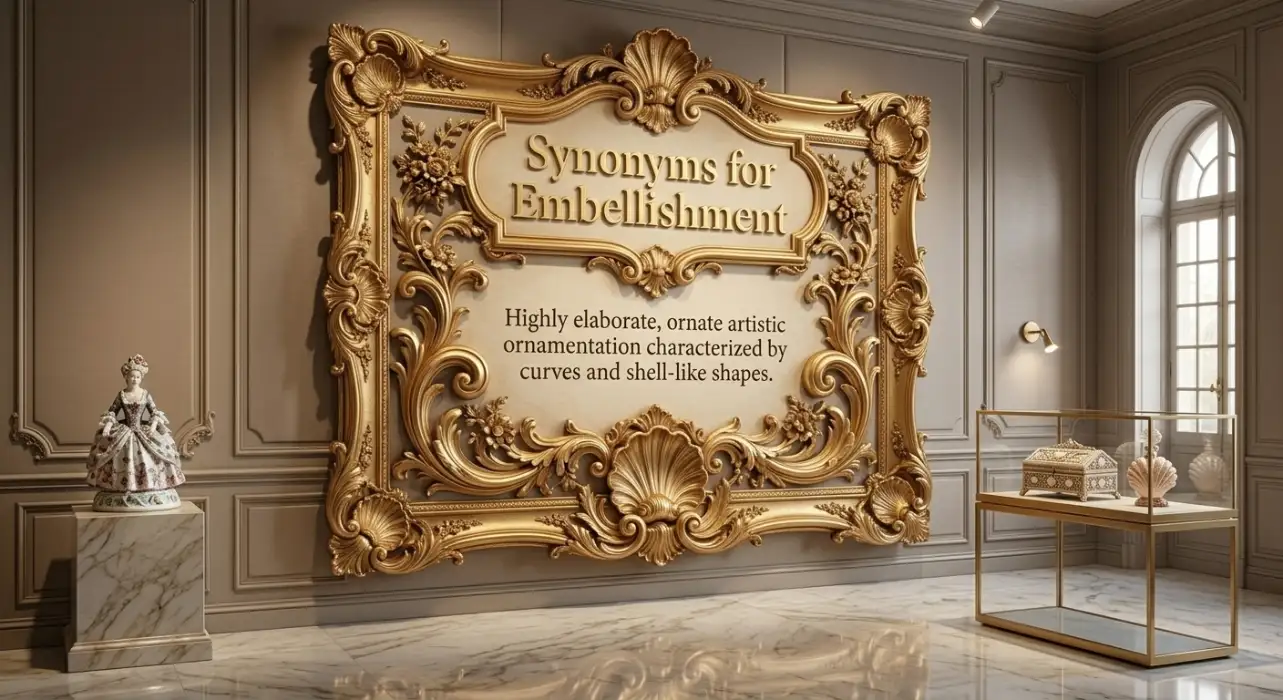
Rococo Detailing (Noun Phrase) — US /rəˈkoʊkoʊ ˈdiːteɪlɪŋ/ — UK /rəˈkəʊkəʊ ˈdiːteɪlɪŋ/
- Meaning: Highly elaborate, ornate artistic ornamentation characterized by curves and shell-like shapes.
- Tone/Register: Artistic, historical.
- Example: The palace ballroom showcased stunning rococo detailing along the walls.
- Example: Antique furniture restorers praised the chair’s intricate rococo detailing.
Synonyms by Tone
Choosing the right synonym depends entirely on the tone you want to convey in your writing or speech.
- Positive tone: Ornamentation, adornment, finesse, finishing touch, polish.
- Neutral tone: Trimming, decoration, garnishment, add-on, accessory.
- Negative tone: Exaggeration, fabrication, overstatement.
- Playful / Informal tone: Frill, touch-up.
Tone matters because using a critical word like fabrication for a decorative cake garnish sounds accusatory, while using a casual term like frill in an academic art history paper lacks professional precision.
Mini Comparison: Embellishment vs. Ornamentation vs. Exaggeration
- Embellishment covers both physical decorations and creative additions or exaggerations in storytelling.
- Ornamentation refers strictly to physical decorative objects or architectural elements added to surfaces.
- Exaggeration specifically highlights verbal overstatements or stretched truths in conversation or writing.
Use embellishment for creative story details or physical decorations, ornamentation for strict architectural or design decor, and exaggeration for stretched facts.
Context-Based Usage
- Daily conversation: In casual talk, native speakers say decoration, trimming, or frill instead of formal literary terms.
- Writing or blogging: Essayists and design bloggers use terms like adornment, flourish, or embellishment to enrich style descriptions.
- Professional or academic tone: Art historians and architects rely on precise terms like ornamentation, filigree, and elaboration.
- Creative or informal use: Novelists use words like flourish or fabrication to describe dramatic character behaviors.
Additional Meanings, Synonyms, and Usage of Embellishment
The word embellishment has several related forms and meanings depending on how it is used. It can describe physical decoration, improvements to an object’s appearance, or additional details that make a story more interesting. Understanding these variations helps you choose the right word for different writing situations.
What Are Embellishments?
Embellishments are the plural form of embellishment. It refers to decorative features or additional details that make something more attractive, interesting, or expressive.
Examples:
- The wedding dress featured beautiful embellishments, including pearls, beads, and floral embroidery.
- The artist added decorative embellishments to the wooden picture frame.
- The author included embellishments in the story to make the characters more memorable.
Embellishments can refer to physical decorations or added details in storytelling. In some contexts, they may also suggest exaggerations that make an account less accurate.
Synonyms of Embellish, Embellished, and Embellishing
The verb embellish means to decorate something or add details that make it more attractive or interesting. Its synonyms vary according to the context.
| Word | Meaning | Example |
|---|---|---|
| Decorate | To make something more attractive | They decorated the room with colorful lights. |
| Adorn | To beautify a person or object | She adorned the dress with pearls. |
| Enhance | To improve quality or appearance | The new lighting enhanced the room’s beauty. |
| Ornament | To decorate with attractive details | The craftsman ornamented the box with carved patterns. |
| Elaborate | To add details or develop an explanation | The writer elaborated on the story’s central theme. |
| Enrich | To make something more meaningful or interesting | Vivid descriptions enriched the novel. |
The related word embellished describes something that has been decorated or supplied with additional details. Depending on the sentence, suitable synonyms include decorated, adorned, ornamented, and enhanced.
Examples:
- Embellished: The embellished jacket featured intricate silver embroidery.
- Embellishing: She was embellishing the invitation with handmade designs.
- Embellishes: The author embellishes his stories with vivid descriptions.
When embellishment refers to storytelling, embellishing can also mean adding dramatic or exaggerated details. In that context, words such as exaggerating or elaborating may be more appropriate.
What Does Embellishment Mean in Writing?
In writing, embellishment means adding descriptive details, stylistic elements, or extra information to make a story, explanation, or piece of prose more engaging. It can improve imagery and storytelling, but it can also refer to exaggerating facts or including details that are not entirely accurate.
Examples of embellishment in writing:
- Creative description: The writer embellished the scene with vivid descriptions of the sunset and surrounding landscape.
- Storytelling: The novelist used imaginative embellishments to make the fictional world more engaging.
- Exaggeration: He embellished his account of the competition by exaggerating his achievements.
In creative writing, embellishment can make descriptions richer and more expressive. In academic, journalistic, or factual writing, however, writers should avoid adding details that distort evidence or mislead readers.
Related words include elaboration, enhancement, descriptive detail, and exaggeration. The best choice depends on whether the added information improves the writing or changes the truth of the original account.
What Does No Embellishment Mean?
The phrase no embellishment means presenting something without unnecessary decoration, additional descriptive details, or exaggeration. Its precise meaning depends on the context.
- In design: A simple appearance without decorative additions.
- In writing: A direct account without unnecessary stylistic details or invented information.
- In conversation: A straightforward statement without exaggerating the truth.
Examples:
- The room was designed with no embellishment, giving it a clean, minimalist appearance.
- She described the incident with no embellishment and reported only what she had witnessed.
- His speech was simple and direct, with no embellishment or dramatic language.
Similar expressions include plain, unadorned, straightforward, and without exaggeration. For physical objects, unadorned is especially useful, while without exaggeration works better when describing speech or storytelling.
Embellishment Meaning in Tagalog
The English word embellishment can be translated into Tagalog in different ways depending on its intended meaning.
| Tagalog word or phrase | English meaning | Best context |
|---|---|---|
| Palamuti | Ornament or decoration | Clothing, jewelry, and objects |
| Dekorasyon | Decoration | Rooms, buildings, and celebrations |
| Pagpapaganda | The act of making something more attractive | Design and appearance |
| Pagpapalabis | Exaggeration or overstating something | Stories, statements, and descriptions |
Examples:
- The dress has beautiful embellishments. — May magagandang palamuti ang damit.
- The room has simple decorations. — May simpleng dekorasyon ang silid.
- The story contains exaggerations. — May mga pagpapalabis sa kuwento.
These translations are context-dependent rather than exact equivalents in every situation. Use palamuti or dekorasyon for physical decoration, and pagpapalabis when embellishment refers to exaggeration.
More Words Related to Embellishment
Several related words can help you describe decorative details and stylistic improvements more precisely.
- Adornment: Something used to beautify a person or object.
- Ornamentation: Decorative elements added to buildings, furniture, or artwork.
- Enhancement: An improvement in quality, appearance, or value.
- Flourish: A distinctive decorative or dramatic touch.
- Finishing touch: A final detail that completes a design or project.
- Polish: Refinement that makes writing, presentation, or work appear more professional.
- Exaggeration: A description that makes something seem greater, smaller, better, or worse than it really is.
- Fabrication: An invented account or false information presented as fact.
Although these words are related to embellishment, they are not interchangeable in every sentence. Ornamentation usually refers to physical decoration, enhancement emphasizes improvement, and exaggeration or fabrication suggests a problem with accuracy.
Choosing the correct synonym allows you to communicate your intended meaning more clearly and avoid unnecessary repetition in writing.
Common Mistakes & Native Usage
Common Mistakes Learners Make
- Misuse scenarios: Using embellishment to describe essential structural parts like foundation walls. Embellishments are strictly non-essential additions.
- Confusing tone: Treating literary storytelling exaggerations as formal architectural ornaments.
- Overuse warnings: Repeating the exact word embellishment across every paragraph makes creative writing sound overly academic.
Register Notes
- Spoken English favors casual nouns like decoration or trimming.
- Written English rewards formal artistic terms like adornment and ornamentation.
Real-Life Mini Scenarios
- Workplace: The presentation designer added professional visual flourishes to elevate the corporate slide deck.
- Social situations: She joked about her friend’s habitual story exaggeration during dinner table conversations.
- Media/pop culture: Fashion reviewers praised the intricate beadwork and embroidery on the runway evening gowns.
- Writing or storytelling: The historical novelist used rich stylistic embellishments to bring Victorian London settings to life.
Practice Exercise
- Which synonym best describes physical decorations added to architectural buildings?
- A) Ornamentation
- B) Jogging
- C) Sleeping
- D) Cooking
- What tone does the word fabrication carry in narrative writing?
- A) Cheerful
- B) False or invented
- C) Playful
- D) Commercial
- Which term refers specifically to a small edible item used to decorate food?
- A) Garnishment
- B) Hammer
- C) Wrench
- D) Pliers
- If a speaker stretches the truth of a story for dramatic effect, they are using:
- A) Exaggeration
- B) Cement
- C) Brickwork
- D) Plumbing
- Delicate wirework art made of gold or silver is known as:
- A) Filigree
- B) Asphalt
- C) Concrete
- D) Gravel
- What part of speech is the word embellishment in English grammar?
- A) Noun
- B) Adverb only
- C) Interjection only
- D) Preposition only
- Which synonym refers to a final detail that completes a project?
- A) Finishing touch
- B) Starting point
- C) Foundation beam
- D) Raw material
- Festive fabric decorations hung in national colors are called:
- A) Bunting
- B) Insulation
- C) Drywall
- D) Siding
- A bold or extravagant gesture added for stylistic flair is a:
- A) Flourish
- B) Stumble
- C) Slip
- D) Fall
- Which word describes unnecessary extra features on a product?
- A) Frills
- B) Core parts
- C) Essentials
- D) Foundations
Reflection Task:
Write one short, original sentence using the word flourish to describe a dramatic signature or musical ending.
Answer Key: 1: A | 2: B | 3: A | 4: A | 5: A | 6: A | 7: A | 8: A | 9: A | 10: A
Conclusion
Understanding synonyms for embellishment can help you improve your vocabulary and make your writing more expressive. By learning different alternatives, you can describe decoration, enhancement, or added details more accurately and avoid unnecessary repetition.
Using synonyms for embellishment in the right context can make your articles, essays, stories, and everyday communication sound more natural and engaging. Words such as adornment, decoration, enhancement, and ornamentation can provide useful alternatives depending on the meaning you want to convey.
Ultimately, exploring synonyms for embellishment gives you more flexibility when choosing words. Practice using these alternatives in different sentences and situations to develop stronger communication skills and make your writing clearer, richer, and more professional.
Frequently Asked Questions
What is the meaning of embellishment?
Embellishment refers to something added to make an object, story, design, or idea more attractive, detailed, or interesting. It can mean decoration or adding extra details.
What are the best synonyms for embellishment?
Some common synonyms include decoration, adornment, ornamentation, enhancement, and ornament. The best choice depends on the context in which the word is used.
Is embellishment always related to decoration?
No. While embellishment often refers to physical decoration, it can also describe adding extra or exaggerated details to a story, explanation, or piece of writing.
What is a synonym for embellishment in writing?
In writing, suitable alternatives include elaboration, exaggeration, enhancement, addition, and ornamentation, depending on the intended meaning.
How can using synonyms improve my writing?
Using synonyms helps reduce repetition, expand your vocabulary, and make your writing more engaging. Choosing precise alternatives can also help communicate your ideas more clearly and effectively.

Hasnain Ali is an SEO Content Strategist and the founder of wordvora.com, a trusted vocabulary platform that helps writers, students, professionals, and English learners find accurate synonyms, antonyms, word meanings, and real-life usage examples. He specializes in keyword research, on-page SEO, topical authority, and creating search-first content that aligns with Google’s latest Search Quality and E-E-A-T guidelines. His work focuses on producing clear, well-structured, and reader-friendly resources that satisfy search intent while maintaining high editorial standards.
Through extensive hands-on experience with SEO tools such as Google Search Console, Google Analytics, SEMrush, and Ahrefs, Hasnain researches user search behavior and develops content that is both informative and easy to understand. Every article published on wordvora.com is carefully reviewed for accuracy, readability, and contextual relevance before publication. His mission is to build one of the web’s most reliable English vocabulary resources by providing practical language guidance, trustworthy explanations, and content that helps readers improve their writing, communication, and vocabulary with confidence.