
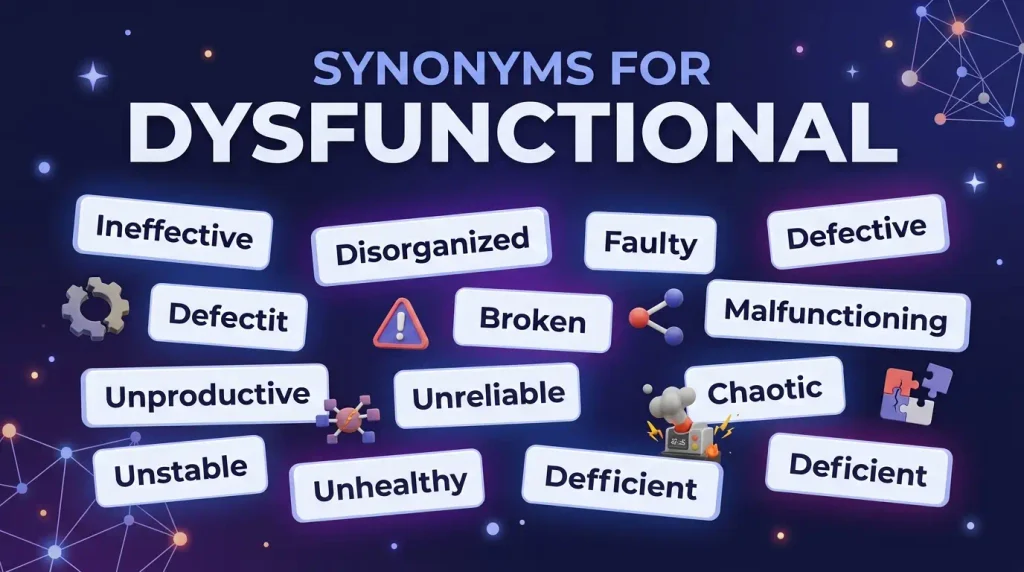
Synonyms for dysfunctional help you describe something that does not work properly. The word can describe a team, relationship, family, machine, or system.
Imagine a workplace where people do not communicate, deadlines are missed, and simple tasks become stressful. You may call the workplace dysfunctional.
A family can also be dysfunctional when members argue often, avoid honest conversations, or repeat unhealthy habits. Learning related words helps you explain these problems more clearly.
For students, bloggers, content writers, and everyday English users, learning synonyms for dysfunctional can make writing and speaking more natural. Words like ineffective, disorganized, unhealthy, chaotic, and malfunctioning have different meanings and tones. Choosing the right alternative helps you avoid repetition and express your ideas with greater accuracy in essays, articles, conversations, and professional writing.
What Does “Dysfunctional” Really Mean?
Dysfunctional means not working normally, effectively, or healthily.
It can describe something physical, such as a machine that does not operate correctly. It can also describe something social or emotional, such as a relationship or family with unhealthy patterns.
Simple Definition
Dysfunctional (adjective): not functioning properly or failing to work in a healthy, effective, or useful way.
For example:
The office has a dysfunctional communication system.
This means the communication system does not work effectively.
Another example:
They grew up in a dysfunctional family.
Here, the word describes unhealthy family relationships or patterns.
Part of Speech
Dysfunctional is an adjective.
Common forms include:
- dysfunctional system
- dysfunctional relationship
- dysfunctional family
- dysfunctional organization
- dysfunctional team
- dysfunctional workplace
- dysfunctional machine
- dysfunctional behavior
The noun dysfunction refers to a problem or abnormality in the way something functions.
The adverb dysfunctionally is possible but uncommon in everyday English.
How Native Speakers Understand “Dysfunctional”
Native speakers usually understand dysfunctional as stronger than simply imperfect.
If something is imperfect, it may still work reasonably well.
If something is dysfunctional, an important part of its operation has broken down or become unhealthy.
Compare:
The team is imperfect.
This sounds mild.
The team is dysfunctional.
This suggests serious problems with how the team operates.
The word can also carry criticism, especially when it describes people, families, workplaces, or organizations.
Connotative Meaning
Connotation (the feeling, attitude, or association that a word suggests beyond its basic meaning) matters when choosing a synonym.
Positive Tone
Most direct synonyms for dysfunctional are negative. However, some alternatives can sound less harsh.
Words such as imperfect, strained, or challenging may describe a difficult situation without making a strong judgment.
Their working relationship is strained.
This sounds less severe than:
Their working relationship is dysfunctional.
Negative Tone
Words such as broken, toxic, chaotic, defective, and malfunctioning can strongly emphasize the problem.
The company has a toxic workplace culture.
This suggests harmful behavior or an unhealthy environment.
Neutral Tone
Words such as ineffective, inefficient, impaired, flawed, and problematic can sound more objective.
The current system is inefficient.
This focuses on performance rather than blame.
The best synonym depends on what exactly has gone wrong.
Etymology of “Dysfunctional”
The word dysfunctional combines the Greek-derived prefix dys- with the word function and the adjective-forming suffix -al.
Dys-
Dys- comes from Greek dys-, which carried meanings such as bad, difficult, abnormal, or impaired.
English uses the combining form in words such as:
- dysfunctional
- dysregulated
- dyslexia
- dysfunction
- dystopia
Function
Function comes through French from Latin functio, meaning performance or execution. It connects with the Latin verb fungi, meaning “to perform” or “to carry out.”
-al
The suffix -al forms adjectives relating to the preceding noun.
So the basic structure is:
dys- + function + -al = dysfunctional
The word therefore carries the basic idea of functioning badly, abnormally, or inadequately.
Short History
Old English: 450–1100
The modern word dysfunctional did not exist in Old English.
English speakers at the time used native Germanic vocabulary to describe things that failed, broke, weakened, or did not work properly.
The Greek-derived prefix dys- belongs to a much older classical vocabulary tradition that later entered English through learned formations.
Middle English: 1100–1500
During Middle English, French and Latin contributed heavily to English vocabulary.
The word function had not yet developed into the full range of modern English uses. Later scientific, philosophical, and technical writing expanded the vocabulary around function and operation.
Modern English: 1500–Present
The word function became increasingly important in science, mathematics, medicine, government, and everyday language.
English later formed dysfunction and dysfunctional to describe abnormal or ineffective operation.
Today, dysfunctional applies to both technical systems and human relationships.
Pronunciation
US: /dɪsˈfʌŋkʃənəl/
UK: /dɪsˈfʌŋkʃənəl/
Syllables
dys-func-tion-al
Affixation Pattern of “Dysfunctional”
Root: function
Prefix: dys-
Suffix: -al
The prefix changes the meaning toward something abnormal, impaired, difficult, or poorly functioning.
Synonyms List
Broken (Adjective) — US: /ˈbroʊkən/ — UK: /ˈbrəʊkən/
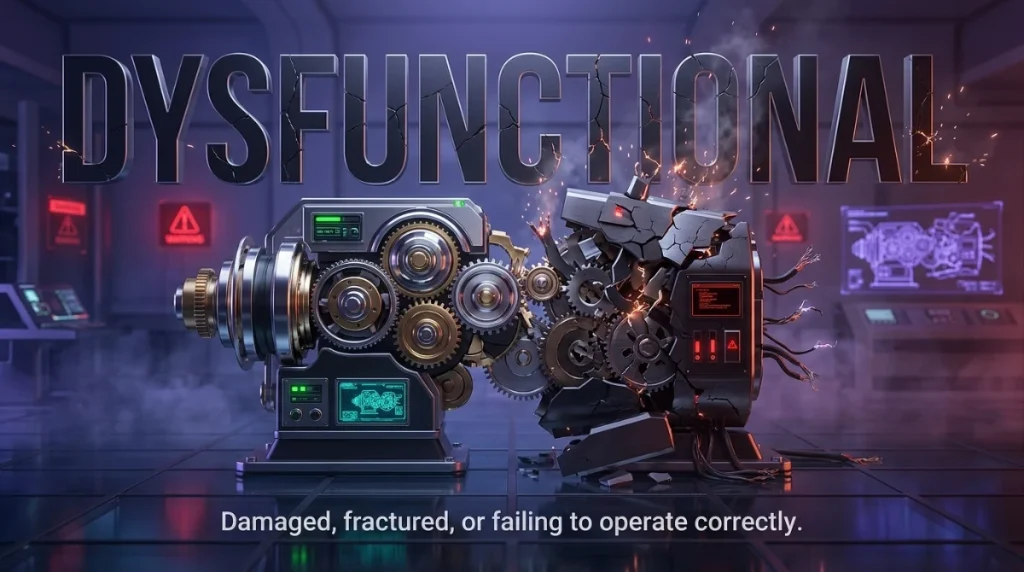
- Meaning: Damaged, fractured, or failing to operate in the correct manner.
- Tone/Register: Standard, everyday.
- Example: He tried to fix the broken office chair before the meeting started.
- Example: She realized their communication patterns were fundamentally broken.
Impaired (Adjective) — US: /ɪmˈpɛrd/ — UK: /ɪmˈpɛəd/
- Meaning: Weakened or damaged in quality, function, or physical ability.
- Tone/Register: Formal, medical.
- Example: Drivers with impaired vision must avoid driving during heavy night rain.
- Example: The factory suffered from impaired production speed after the power outage.
Flawed (Adjective) — US: /flɔːd/ — UK: /flɔːd/
- Meaning: Having faults, mistakes, or weaknesses that spoil overall effectiveness.
- Tone/Register: Standard, academic.
- Example: The research team discovered a deeply flawed methodology in the study.
- Example: He presented a flawed argument during the classroom debate.
Faulty (Adjective) — US: /ˈfɔːlti/ — UK: /ˈfɔːlti/
- Meaning: Working badly or incorrectly due to structural defects or mistakes.
- Tone/Register: Standard, technical.
- Example: Electricians traced the blackout to faulty wiring behind the kitchen wall.
- Example: She returned the faulty toaster to the store for a full refund.
Defective (Adjective) — US: /dɪˈfɛktɪv/ — UK: /dɪˈfɛktɪv/
- Meaning: Imperfect or lacking necessary parts required for proper operation.
- Tone/Register: Technical, formal.
- Example: The manufacturer recalled thousands of cars due to defective brake lines.
- Example: He discarded the defective smartphone battery immediately.
Disordered (Adjective) — US: /dɪsˈɔːrdərd/ — UK: /dɪsˈɔːdəd/
- Meaning: Lacking order, organization, or normal healthy structure.
- Tone/Register: Formal, psychological.
- Example: Doctors studied the patient’s disordered sleep patterns over two weeks.
- Example: The archives department sat in a completely disordered state.
Malfunctioning (Adjective) — US: /ˌmælˈfʌŋkʃənɪŋ/ — UK: /ˌmælˈfʌŋkʃənɪŋ/
- Meaning: Failing to function correctly or perform standard mechanical tasks.
- Tone/Register: Technical, formal.
- Example: Technicians repaired the malfunctioning elevator before morning rush hour.
- Example: The software crashed due to a malfunctioning database query.
Unhealthy (Adjective) — US: /ʌnˈhɛlθi/ — UK: /ʌnˈhɛlθi/
- Meaning: Detrimental to well-being or characterized by poor emotional dynamics.
- Tone/Register: Standard, conversational.
- Example: They decided to end their unhealthy relationship after years of stress.
- Example: Eating fast food daily creates unhealthy habits over time.
Troubled (Adjective) — US: /ˈtrʌbəld/ — UK: /ˈtrʌbəld/
- Meaning: Experiencing difficulties, distress, or persistent operational problems.
- Tone/Register: Standard, emotional.
- Example: The counselor offered guidance to students from troubled backgrounds.
- Example: Investors pulled funds from the troubled startup company.
Disturbed (Adjective) — US: /dɪsˈtɜrbd/ — UK: /dɪsˈtɜːbd/
- Meaning: Having emotional or mental stability disrupted significantly.
- Tone/Register: Psychological, formal.
- Example: The psychologist analyzed the disturbed behavior patterns of the subject.
- Example: Sleep disturbed by loud street noise ruins daytime focus.
Chaotic (Adjective) — US: /keɪˈɑtɪk/ — UK: /keɪˈɒtɪk/
- Meaning: In a state of complete confusion, disorder, and lack of control.
- Tone/Register: Descriptive, intense.
- Example: Morning traffic downtown became utterly chaotic during the storm.
- Example: The children left the playroom in a chaotic mess.
Unbalanced (Adjective) — US: /ʌnˈbælənst/ — UK: /ʌnˈbælənst/
- Register/Tone: Formal, descriptive.
- Meaning: Lacking structural equilibrium, mental stability, or fair distribution.
- Example: The budget report showed an unacceptably unbalanced financial plan.
- Example: He felt emotionally unbalanced following the stressful project review.
Destructive (Adjective) — US: /dɪˈstrʌktɪv/ — UK: /dɪˈstrʌktɪv/
- Meaning: Causing great and permanent harm to systems or relationships.
- Tone/Register: Formal, serious.
- Example: Constant criticism creates a destructive environment in the office.
- Example: Severe storms brought destructive winds across the coastal farmland.
Disruptive (Adjective) — US: /dɪsˈrʌptɪv/ — UK: /dɪsˈrʌptɪv/
- Meaning: Interrupting normal events, processes, or peaceful operations.
- Tone/Register: Standard, formal.
- Example: The teacher removed the disruptive student from the classroom.
- Example: New technologies introduced disruptive changes to traditional retail markets.
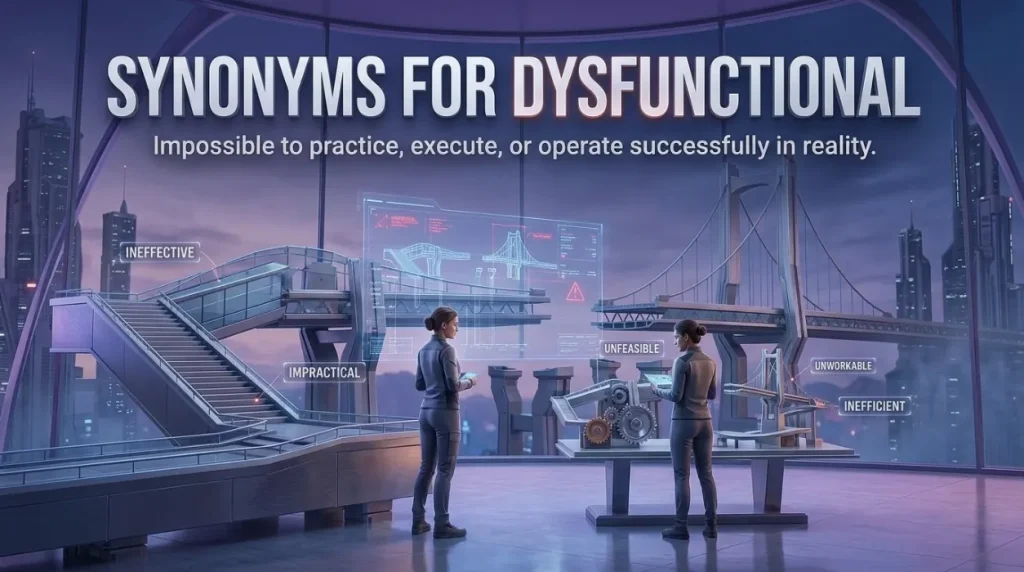
Impracticable (Adjective) — US: /ɪmˈpræktɪkəbəl/ — UK: /ɪmˈpræktɪkəbəl/
- Meaning: Impossible to practice, execute, or operate successfully in reality.
- Tone/Register: Formal, academic.
- Example: The committee rejected the proposal because it proved entirely impracticable.
- Example: Building a bridge across that canyon seemed impracticable.
Ineffective (Adjective) — US: /ˌɪnɪˈfɛktɪv/ — UK: /ˌɪnɪˈfɛktɪv/
- Meaning: Not producing any significant or desired operational result.
- Tone/Register: Standard, formal.
- Example: Old marketing strategies proved ineffective with younger audiences.
- Example: The manager took ineffective steps to resolve team conflicts.
Unproductive (Adjective) — US: /ˌʌnprəˈdʌktɪv/ — UK: /ˌʌnprəˈdʌktɪv/
- Meaning: Yielding little or no useful work, progress, or output.
- Tone/Register: Standard, business.
- Example: The long meeting remained entirely unproductive from start to finish.
- Example: Poor sleep habits leave workers feeling unproductive all afternoon.
Mismanaged (Adjective) — US: /mɪsˈmænɪdʒd/ — UK: /mɪsˈmænɪdʒd/
- Meaning: Handled badly, inefficiently, or incompetently by leadership.
- Tone/Register: Business, formal.
- Example: Shareholders blamed executives for the mismanaged corporate expansion funds.
- Example: The city park fell into disrepair due to mismanaged public budgets.
Deranged (Adjective) — US: /dɪˈreɪndʒd/ — UK: /dɪˈreɪndʒd/
- Meaning: unpredictable or acting with severely disordered mental faculties.
- Tone/Register: Literary, formal.
- Example: The antagonist in the novel exhibited deranged behavioral traits.
- Example: Police detained the individual for making deranged public threats.
Unstable (Adjective) — US: /ʌnˈsteɪbəl/ — UK: /ʌnˈsteɪbəl/
- Meaning: Likely to change, fail, or collapse suddenly without warning.
- Tone/Register: Standard, technical.
- Example: Economic markets remained highly unstable throughout the quarter.
- Example: The injured hiker stood on unstable rock formations.
Impotent (Adjective) — US: /ˈɪmpətənt/ — UK: /ˈɪmpətənt/
- Meaning: Lacking power, strength, or ability to produce desired changes.
- Tone/Register: Literary, formal.
- Example: Officials felt impotent against the massive wave of public complaints.
- Example: The old regulations proved impotent in stopping corporate fraud.
Disjointed (Adjective) — US: /dɪsˈdʒɔɪntɪd/ — UK: /dɪsˈdʒɔɪntɪd/
- Register/Tone: Formal, academic.
- Meaning: Lacking coherence, connection, or smooth operational flow.
- Example: The speaker delivered a disjointed lecture that confused students.
- Example: Initial draft chapters felt disjointed until the final editor arrived.
Unruly (Adjective) — US: /ʌnˈruːli/ — UK: /ʌnˈruːli/
- Meaning: Disorderly, disruptive, and impossible to manage or govern properly.
- Tone/Register: Informal, descriptive.
- Example: Teachers struggled to control the unruly crowd of teenagers.
- Example: He tried trimming his unruly garden hedges on Sunday.
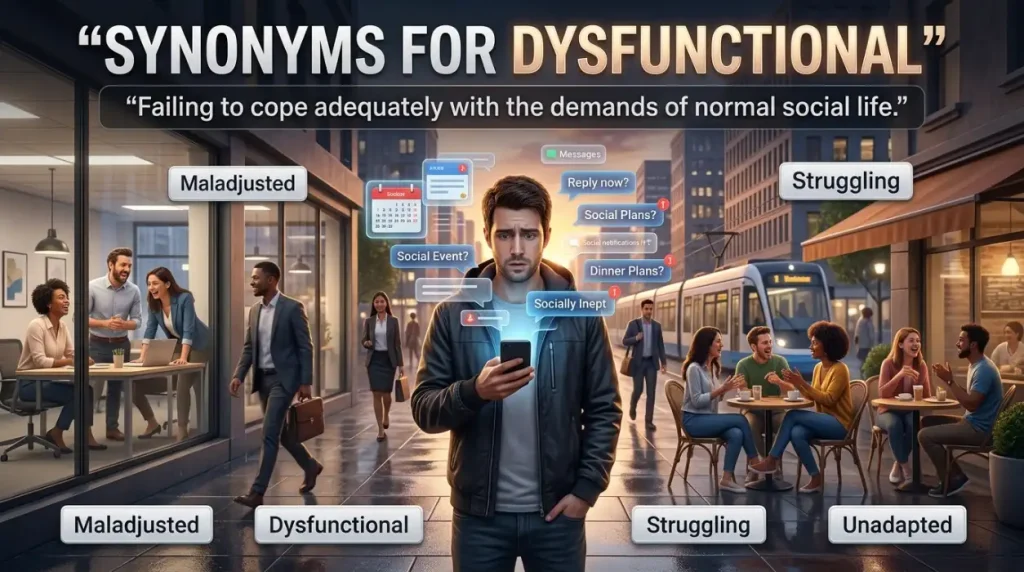
Maladjusted (Adjective) — US: /ˌmæləˈdʒʌstɪd/ — UK: /ˌmæləˈdʒʌstɪd/
- Meaning: Failing to cope adequately with the demands of normal social life.
- Tone/Register: Psychological, formal.
- Example: School counselors support maladjusted youths through peer programs.
- Example: The puppy felt maladjusted to loud city street noises.
Chaotic (Adjective) — US: /keɪˈɑtɪk/ — UK: /keɪˈɒtɪk/
- Meaning: Completely lacking structure, order, or predictable patterns.
- Tone/Register: Descriptive, intense.
- Example: Emergency room corridors grew chaotic during the power failure.
- Example: Her schedule felt chaotic during exam preparation week.
Impaired (Adjective) — US: /ɪmˈpɛrd/ — UK: /ɪmˈpɛəd/
- Meaning: Weakened or damaged in quality, function, or physical ability.
- Tone/Register: Formal, medical.
- Example: Drivers with impaired vision must avoid driving during heavy night rain.
- Example: The factory suffered from impaired production speed after the power outage.
Flawed (Adjective) — US: /flɔːd/ — UK: /flɔːd/
- Meaning: Having faults, mistakes, or weaknesses that spoil overall effectiveness.
- Tone/Register: Standard, academic.
- Example: The research team discovered a deeply flawed methodology in the study.
- Example: He presented a flawed argument during the classroom debate.
Faulty (Adjective) — US: /ˈfɔːlti/ — UK: /ˈfɔːlti/
- Meaning: Working badly or incorrectly due to structural defects or mistakes.
- Tone/Register: Standard, technical.
- Example: Electricians traced the blackout to faulty wiring behind the kitchen wall.
- Example: She returned the faulty toaster to the store for a full refund.
Defective (Adjective) — US: /dɪˈfɛktɪv/ — UK: /dɪˈfɛktɪv/
- Meaning: Imperfect or lacking necessary parts required for proper operation.
- Tone/Register: Technical, formal.
- Example: The manufacturer recalled thousands of cars due to defective brake lines.
- Example: He discarded the defective smartphone battery immediately.
Disordered (Adjective) — US: /dɪsˈɔːrdərd/ — UK: /dɪsˈɔːdəd/
- Meaning: Lacking order, organization, or normal healthy structure.
- Tone/Register: Formal, psychological.
- Example: Doctors studied the patient’s disordered sleep patterns over two weeks.
- Example: The archives department sat in a completely disordered state.
Malfunctioning (Adjective) — US: /ˌmælˈfʌŋkʃənɪŋ/ — UK: /ˌmælˈfʌŋkʃənɪŋ/
- Meaning: Failing to function correctly or perform standard mechanical tasks.
- Tone/Register: Technical, formal.
- Example: Technicians repaired the malfunctioning elevator before morning rush hour.
- Example: The software crashed due to a malfunctioning database query.

Unhealthy (Adjective) — US: /ʌnˈhɛlθi/ — UK: /ʌnˈhɛlθi/
- Meaning: Detrimental to well-being or characterized by poor emotional dynamics.
- Tone/Register: Standard, conversational.
- Example: They decided to end their unhealthy relationship after years of stress.
- Example: Eating fast food daily creates unhealthy habits over time.
Troubled (Adjective) — US: /ˈtrʌbəld/ — UK: /ˈtrʌbəld/
- Meaning: Experiencing difficulties, distress, or persistent operational problems.
- Tone/Register: Standard, emotional.
- Example: The counselor offered guidance to students from troubled backgrounds.
- Example: Investors pulled funds from the troubled startup company.
Disturbed (Adjective) — US: /dɪsˈtɜrbd/ — UK: /dɪsˈtɜːbd/
- Meaning: Having emotional or mental stability disrupted significantly.
- Tone/Register: Psychological, formal.
- Example: The psychologist analyzed the disturbed behavior patterns of the subject.
- Example: Sleep disturbed by loud street noise ruins daytime focus.
Chaotic (Adjective) — US: /keɪˈɑtɪk/ — UK: /keɪˈɒtɪk/
- Meaning: In a state of complete confusion, disorder, and lack of control.
- Tone/Register: Descriptive, intense.
- Example: Morning traffic downtown became utterly chaotic during the storm.
- Example: The children left the playroom in a chaotic mess.
Unbalanced (Adjective) — US: /ʌnˈbælənst/ — UK: /ʌnˈbælənst/
- Register/Tone: Formal, descriptive.
- Meaning: Lacking structural equilibrium, mental stability, or fair distribution.
- Example: The budget report showed an unacceptably unbalanced financial plan.
- Example: He felt emotionally unbalanced following the stressful project review.
Destructive (Adjective) — US: /dɪˈstrʌktɪv/ — UK: /dɪˈstrʌktɪv/
- Meaning: Causing great and permanent harm to systems or relationships.
- Tone/Register: Formal, serious.
- Example: Constant criticism creates a destructive environment in the office.
- Example: Severe storms brought destructive winds across the coastal farmland.
Disruptive (Adjective) — US: /dɪsˈrʌptɪv/ — UK: /dɪsˈrʌptɪv/
- Meaning: Interrupting normal events, processes, or peaceful operations.
- Tone/Register: Standard, formal.
- Example: The teacher removed the disruptive student from the classroom.
- Example: New technologies introduced disruptive changes to traditional retail markets.
Impracticable (Adjective) — US: /ɪmˈpræktɪkəbəl/ — UK: /ɪmˈpræktɪkəbəl/
- Meaning: Impossible to practice, execute, or operate successfully in reality.
- Tone/Register: Formal, academic.
- Example: The committee rejected the proposal because it proved entirely impracticable.
- Example: Building a bridge across that canyon seemed impracticable.
Ineffective (Adjective) — US: /ˌɪnɪˈfɛktɪv/ — UK: /ˌɪnɪˈfɛktɪv/
- Meaning: Not producing any significant or desired operational result.
- Tone/Register: Standard, formal.
- Example: Old marketing strategies proved ineffective with younger audiences.
- Example: The manager took ineffective steps to resolve team conflicts.
Unproductive (Adjective) — US: /ˌʌnprəˈdʌktɪv/ — UK: /ˌʌnprəˈdʌktɪv/
- Meaning: Yielding little or no useful work, progress, or output.
- Tone/Register: Standard, business.
- Example: The long meeting remained entirely unproductive from start to finish.
- Example: Poor sleep habits leave workers feeling unproductive all afternoon.
Mismanaged (Adjective) — US: /mɪsˈmænɪdʒd/ — UK: /mɪsˈmænɪdʒd/
- Meaning: Handled badly, inefficiently, or incompetently by leadership.
- Tone/Register: Business, formal.
- Example: Shareholders blamed executives for the mismanaged corporate expansion funds.
- Example: The city park fell into disrepair due to mismanaged public budgets.
Deranged (Adjective) — US: /dɪˈreɪndʒd/ — UK: /dɪˈreɪndʒd/
- Meaning: unpredictable or acting with severely disordered mental faculties.
- Tone/Register: Literary, formal.
- Example: The antagonist in the novel exhibited deranged behavioral traits.
- Example: Police detained the individual for making deranged public threats.
Unstable (Adjective) — US: /ʌnˈsteɪbəl/ — UK: /ʌnˈsteɪbəl/
- Meaning: Likely to change, fail, or collapse suddenly without warning.
- Tone/Register: Standard, technical.
- Example: Economic markets remained highly unstable throughout the quarter.
- Example: The injured hiker stood on unstable rock formations.
Impotent (Adjective) — US: /ˈɪmpətənt/ — UK: /ˈɪmpətənt/
- Meaning: Lacking power, strength, or ability to produce desired changes.
- Tone/Register: Literary, formal.
- Example: Officials felt impotent against the massive wave of public complaints.
- Example: The old regulations proved impotent in stopping corporate fraud.
Disjointed (Adjective) — US: /dɪsˈdʒɔɪntɪd/ — UK: /dɪsˈdʒɔɪntɪd/
- Register/Tone: Formal, academic.
- Meaning: Lacking coherence, connection, or smooth operational flow.
- Example: The speaker delivered a disjointed lecture that confused students.
- Example: Initial draft chapters felt disjointed until the final editor arrived.
Unruly (Adjective) — US: /ʌnˈruːli/ — UK: /ʌnˈruːli/
- Meaning: Disorderly, disruptive, and impossible to manage or govern properly.
- Tone/Register: Informal, descriptive.
- Example: Teachers struggled to control the unruly crowd of teenagers.
- Example: He tried trimming his unruly garden hedges on Sunday.
Maladjusted (Adjective) — US: /ˌmæləˈdʒʌstɪd/ — UK: /ˌmæləˈdʒʌstɪd/
- Meaning: Failing to cope adequately with the demands of normal social life.
- Tone/Register: Psychological, formal.
- Example: School counselors support maladjusted youths through peer programs.
- Example: The puppy felt maladjusted to loud city street noises.
Out of Order (Adjective Phrase) — US: /aʊt ʌv ˈɔːrdər/ — UK: /aʊt ɒv ˈɔːdə/
- Meaning: Not operating or functioning properly due to mechanical failure.
- Tone/Register: Standard, everyday.
- Example: The public vending machine was marked out of order by maintenance.
- Example: She discovered the building elevator was out of order this morning.
Out of Whack (Adjective Phrase) — US: /aʊt ʌv wæk/ — UK: /aʊt ɒv wæk/
- Meaning: Not working correctly, balanced, or properly aligned.
- Tone/Register: Informal, conversational.
- Example: His car steering felt completely out of whack after hitting the pothole.
- Example: Her sleep schedule went completely out of whack during the holidays.
Synonyms by Tone
Choosing the right synonym depends entirely on the tone you want to convey in your writing or speech.
- Positive tone: None exist, as all variants indicate breakdown or failure.
- Neutral tone: Broken, flawed, faulty, defective, ineffective.
- Negative tone: Destructive, disturbed, deranged, mismanaged.
- Playful/informal tone: Unruly, chaotic.
Tone matters because using a heavy psychological word like maladjusted for a broken coffee maker sounds overly dramatic, while using a casual word like broken in a clinical research paper lacks professional precision.
More Words Related to Dysfunctional: Synonyms, Antonyms, and Meanings
The word dysfunctional has several related forms and alternatives. The best word depends on whether you are describing a person, relationship, family, machine, workplace, or system. Understanding these differences can help you choose a more accurate synonym.
1. Dysfunction Synonym: What Is Another Word for Dysfunction?
Dysfunction is a noun that refers to abnormal, impaired, or ineffective functioning. A synonym for dysfunction depends on the context.
Common synonyms for dysfunction include:
- Malfunction: A failure to operate correctly, especially in a machine or technical system.
- Impairment: A reduction in normal ability or performance.
- Breakdown: A failure of a system, process, relationship, or machine.
- Failure: The inability to perform a required task or achieve a desired result.
- Abnormality: A condition that differs from what is considered normal.
- Disruption: An interruption to the normal operation of something.
- Disturbance: A condition that interferes with normal functioning.
- Disorder: A lack of normal organization or a disturbance in a system or condition.
Examples:
- The machine’s malfunction caused production to stop.
- Poor communication contributed to a breakdown in teamwork.
- The treatment helped reduce the impairment in his daily functioning.
These words are related to dysfunction, but they are not always interchangeable. For example, malfunction usually refers to operational failure, while impairment suggests reduced ability or performance.
2. Dysfunctionality and Dysfunctioning Synonyms
Dysfunctionality refers to the state or quality of being dysfunctional. Depending on the sentence, possible alternatives include ineffectiveness, impaired functioning, poor operation, and lack of proper functioning.
Dysfunctioning is used less commonly than dysfunctional in everyday English. Depending on the intended meaning, alternatives include:
- Malfunctioning
- Failing to function properly
- Operating incorrectly
- Not functioning effectively
- Experiencing impaired functioning
Examples:
- The dysfunctionality of the existing system became apparent during the audit.
- The malfunctioning equipment delayed the production process.
- The department was not functioning effectively because responsibilities were unclear.
For natural English, prefer dysfunctional system, system dysfunction, or malfunctioning system, depending on what you mean.
3. Dysfunctional Family Synonyms
A dysfunctional family is a family in which recurring patterns of communication, behavior, or relationships interfere with members’ well-being.
Depending on the circumstances, alternative expressions include:
- Troubled family: A family experiencing ongoing difficulties.
- Unhealthy family dynamic: A pattern of interaction that negatively affects family members.
- Strained family relationships: Family relationships affected by tension or conflict.
- Conflict-ridden family: A family experiencing frequent disagreements.
- Family with communication problems: A family whose members struggle to communicate effectively.
- Family experiencing ongoing difficulties: A neutral, less judgmental expression.
- Unstable family environment: A home environment characterized by uncertainty or inconsistency.
Examples:
- The counselor helped a troubled family improve its communication.
- Years of unresolved conflict created strained family relationships.
- The children struggled with an unhealthy family dynamic.
Which term should you choose? Use strained family relationships when the focus is tension, conflict-ridden family when arguments are frequent, and unhealthy family dynamics when recurring interaction patterns are harmful. These expressions describe particular problems without automatically labeling every family member.
4. Dysfunctional Meaning in Malayalam and Tamil
The meaning of dysfunctional can be expressed differently depending on whether you are describing a machine, organization, or relationship.
Dysfunctional meaning in Malayalam:
- not functioning properly.
- nonfunctional or not operational, depending on context.
- ineffective or inefficient.
Example: The system is dysfunctional.
Meaning: This system is not functioning properly.
Dysfunctional meaning in Tamil:
- not functioning properly.
- nonfunctional or not operating, depending on context.
- ineffective or lacking effectiveness, depending on context.
Example: The system is dysfunctional.
Meaning: This system is not functioning properly.
These are contextual translations rather than exact equivalents for every use. When describing a dysfunctional family or relationship, the translation may need to emphasize unhealthy relationships or recurring communication problems instead of mechanical failure.
5. Dysfunctional Antonyms: What Is the Opposite of Dysfunctional?
The opposite of dysfunctional depends on the subject being described. There is no single antonym that fits every situation.
Common antonyms and contrasting expressions include:
- Functional: Working or operating as intended.
- Well-functioning: Operating effectively and reliably.
- Effective: Producing the intended result.
- Efficient: Working with minimal waste of time, energy, or resources.
- Healthy: Supporting physical, emotional, or relational well-being.
- Organized: Arranged in a clear and orderly way.
- Stable: Remaining reasonably consistent without unexpected failure.
- Productive: Producing useful results or progress.
- Coordinated: Working together in an organized manner.
Examples:
- Dysfunctional system → Functional system
- Dysfunctional workplace → Well-functioning workplace
- Dysfunctional process → Efficient process
- Dysfunctional relationship → Healthy relationship
- Dysfunctional team → Coordinated team
- Dysfunctional organization → Effectively managed organization
Remember that these words are contextual opposites rather than exact antonyms in every sentence. An efficient system may still have other problems, and a stable relationship is not necessarily a healthy one.
6. Synonyms for Not Functioning Properly
If you want another way to say not functioning properly, choose an expression that describes the specific problem.
| Word or phrase | Meaning | Example |
|---|---|---|
| Malfunctioning | Not operating correctly | The malfunctioning printer stopped halfway through the job. |
| Nonfunctional | Not functioning or not serving its intended purpose | The nonfunctional control panel required replacement. |
| Inoperative | Not operating or unable to function | The emergency lift was temporarily inoperative. |
| Out of order | Not working, especially for equipment or facilities | The elevator is out of order. |
| Faulty | Having a defect or error | Faulty wiring caused the power failure. |
| Ineffective | Failing to produce the intended result | The new policy proved ineffective. |
| Inefficient | Wasting time, effort, or resources | The inefficient process delayed the project. |
| Impaired | Having reduced ability or performance | The storm impaired the network connection. |
| Broken | Physically damaged or no longer working | The broken chair needs repair. |
| Unworkable | Not practical or capable of working successfully | The proposed schedule was unworkable. |
| Inadequate | Not good enough or insufficient for a purpose | The inadequate system could not handle the demand. |
| Disorganized | Lacking proper order or structure | The disorganized workflow caused repeated mistakes. |
Examples in context:
- The printer is malfunctioning.
- The proposal is unworkable.
- The process is inefficient.
- The communication system is ineffective.
- The elevator is out of order.
Although these phrases overlap with dysfunctional, each highlights a different kind of problem.
7. Other Words for Not Working Well
The phrase not working well can refer to poor performance, unreliable operation, weak communication, or unsatisfactory results.
Useful alternatives include:
- Performing poorly
- Operating inefficiently
- Working incorrectly
- Functioning inadequately
- Underperforming
- Failing to deliver results
- Experiencing operational problems
- Working inconsistently
- Performing below expectations
- Failing to operate as intended
Examples:
- The software is performing poorly after the update.
- The department is underperforming because of unclear goals.
- The equipment is operating inefficiently and consuming too much energy.
- The current strategy is failing to deliver results.
For professional writing, underperforming, ineffective, and operating inefficiently are often more precise than simply saying something is dysfunctional.
8. Synonyms for a Damaged or Broken Chair
If a chair has physical damage, broken or damaged is usually more natural than dysfunctional.
Depending on the problem, you can use:
- Broken chair
- Damaged chair
- Defective chair
- Faulty chair
- Unstable chair
- Wobbly chair
- Cracked chair
- Unusable chair
Examples:
- The broken chair had a cracked leg.
- The wobbly chair needed its screws tightened.
- The defective chair was returned to the manufacturer.
- The damaged office chair was replaced for safety reasons.
Use wobbly when the chair moves unsteadily, cracked when a part has split, and defective when it has a fault that affects its intended use.
9. Unfunctional, Nonfunctional, and Dysfunctional: What Is the Difference?
Nonfunctional is the more established choice when something does not operate or serve its intended function. Dysfunctional often suggests that a system operates badly or has serious problems in its functioning. Unfunctional exists but is uncommon and is generally less natural than nonfunctional or not functional.
Compare these examples:
- Nonfunctional: The nonfunctional screen would not display any information.
- Dysfunctional: The dysfunctional approval process repeatedly delayed important decisions.
- Not functional: The device is not functional after the damage.
- Malfunctioning: The device turns on but keeps shutting down unexpectedly.
In most everyday and professional contexts, use nonfunctional, not functioning, or malfunctioning instead of unfunctional.
The spelling dysfunctional is standard in English. Variations such as disfunctional, dysfuntional, and dysfunktional are generally misspellings in standard English writing. The German word dysfunktionell belongs to German usage and is not the standard English spelling.
10. Quick Guide: Choosing the Right Word
| Situation | Best word or phrase |
|---|---|
| A machine is not working correctly | Malfunctioning |
| A device has a physical defect | Faulty or defective |
| A system cannot operate at all | Inoperative or nonfunctional |
| A process wastes time and resources | Inefficient |
| A plan cannot work in practice | Unworkable or impracticable |
| A team lacks coordination | Uncoordinated or disorganized |
| A relationship has persistent tension | Strained |
| A relationship contains harmful patterns | Unhealthy |
| A workplace harms employees | Toxic |
| An argument contains serious weaknesses | Flawed |
| An organization has several serious operational problems | Dysfunctional |
| A family experiences recurring relational problems | Troubled or affected by unhealthy family dynamics |
The most accurate synonym for dysfunctional is the one that identifies the actual problem. Use malfunctioning for operational failure, inefficient for wasted resources, flawed for weaknesses, strained for tension, and unhealthy for harmful relationship patterns.
Mini Comparison: Dysfunctional vs. Flawed vs. Faulty
- Dysfunctional implies an active system, relationship, or machine failing to perform its core purpose.
- Flawed points to an underlying design error, mistake, or imperfection in a plan or object.
- Faulty highlights a specific physical defect or mechanical error causing immediate operational failure.
Use dysfunctional for broken systems or relationships, flawed for imperfect logic or plans, and faulty for broken machines.
Context-Based Usage
- Daily conversation: In casual talk, native speakers say broken, faulty, or chaotic instead of clinical terms.
- Writing or blogging: Essayists and cultural bloggers use terms like dysfunctional, flawed, or unhealthy to critique social dynamics.
- Professional or academic tone: Psychologists and engineers rely on precise terms like maladjusted, impaired, and malfunctioning.
- Creative or informal use: Novelists use words like deranged or troubled to build complex character personalities.
Common Mistakes & Native Usage
Common Mistakes Learners Make
- Misuse scenarios: Using dysfunctional to describe a simple physical object like a wet umbrella. Umbrellas are broken or damaged, not dysfunctional.
- Confusing tone: Treating clinical terms like maladjusted as casual insults in everyday social talk.
- Overuse warnings: Repeating the word dysfunctional in every paragraph makes analytical writing sound repetitive.
Register Notes
- Spoken English favors direct adjectives like broken or faulty.
- Written English rewards descriptive terms like impaired and ineffective.
Real-Life Mini Scenarios
- Workplace: The human resources department addressed the dysfunctional communication channels within the marketing team.
- Social situations: Family therapists helped relatives navigate deeply ingrained, unhealthy behavioral patterns during sessions.
- Media/pop culture: Tech journalists reported on the widespread software update that left millions of devices malfunctioning.
- Writing or storytelling: The historical biography examined the troubled childhood of the monarch and its long-term impact.
Practice Exercise
1. The office printer has completely stopped working. Which word fits best?
A. Toxic
B. Malfunctioning
C. Strained
D. Unproductive
2. A company’s departments rarely communicate with each other. Which word is most precise?
A. Fragmented
B. Healthy
C. Successful
D. Efficient
3. A plan cannot realistically work because it requires impossible resources. Which word fits?
A. Unworkable
B. Friendly
C. Reliable
D. Productive
4. A strategy works, but it produces very poor results. Which word is most appropriate?
A. Ineffective
B. Broken
C. Toxic
D. Chaotic
5. A process wastes too much time and energy. Which word should you use?
A. Inefficient
B. Unhealthy
C. Defective
D. Strained
6. Two coworkers have serious tension after an argument. Which word sounds natural?
A. Strained
B. Inoperative
C. Nonfunctional
D. Defective
7. A workplace culture repeatedly harms employees emotionally. Which word is strongest?
A. Toxic
B. Efficient
C. Impaired
D. Uncoordinated
8. A machine has a damaged component that prevents proper operation. Which word fits best?
A. Defective
B. Troubled
C. Disjointed
D. Unproductive
9. Several teams make decisions without communicating with one another. Which word fits?
A. Uncoordinated
B. Healthy
C. Reliable
D. Successful
10. A system works, but its design contains serious weaknesses. Which word is suitable?
A. Flawed
B. Toxic
C. Friendly
D. Inoperative
11. A meeting produces no useful progress. Which word describes it?
A. Unproductive
B. Defective
C. Malfunctioning
D. Inoperative
12. A relationship contains harmful patterns, but you want a softer expression than “toxic.” Which word works?
A. Unhealthy
B. Broken-down
C. Defective
D. Inoperative
13. A system has stopped operating entirely. Which formal word can describe it?
A. Inoperative
B. Strained
C. Troubled
D. Unproductive
14. A company has widespread problems with communication, leadership, and teamwork. Which general word fits best?
A. Dysfunctional
B. Efficient
C. Successful
D. Reliable
15. A writer wants to describe a plan with weaknesses without sounding extremely negative. Which word is best?
A. Flawed
B. Toxic
C. Broken
D. Chaotic
Reflection task: Write one sentence about a real or imaginary situation using one synonym for dysfunctional. Then explain why that synonym fits better than dysfunctional.
Answer key: 1-B | 2-A | 3-A | 4-A | 5-A | 6-A | 7-A | 8-A | 9-A | 10-A | 11-A | 12-A | 13-A | 14-A | 15-A
Conclusion
Learning synonyms for dysfunctional helps you describe problems with greater accuracy instead of using one broad word for every difficult situation.
Students can improve essays, while bloggers and content writers can make explanations more precise. Better word choices also make everyday conversations clearer and more natural.
The key is to focus on the exact problem. Choose inefficient for wasted resources, malfunctioning for faulty operation, and strained for difficult relationships.
Keep practicing these alternatives in emails, essays, conversations, and creative writing. Try one new synonym today and notice how much clearer your English becomes.
Frequently Asked Questions
What is the best synonym for dysfunctional in a workplace?
The best synonym depends on the problem. Inefficient works when the workplace wastes time or resources. Disorganized fits poor structure. Uncoordinated describes weak teamwork. Toxic suggests harmful workplace behavior. Dysfunctional remains the broadest choice when several serious problems affect how the organization operates.
What are softer words for dysfunctional relationships?
Softer alternatives include strained, troubled, challenging, and unhealthy. Strained works especially well when conflict has created tension. Troubled suggests ongoing difficulties without automatically assigning blame. Unhealthy focuses on harmful patterns. These alternatives can sound less judgmental than dysfunctional or toxic.
Is broken a synonym for dysfunctional?
Broken can work as an informal synonym when something no longer functions properly, especially a machine, device, system, or process. However, it does not always fit relationships or organizations. Saying that a family is “broken” can carry a different emotional meaning from saying that it is “dysfunctional.”
What is the difference between dysfunctional and inefficient?
Dysfunctional suggests that something has serious problems with the way it operates. Inefficient means something works but wastes time, energy, money, or other resources. For example, a slow approval system may be inefficient, while a system that repeatedly prevents departments from completing basic tasks may be dysfunctional.
What is the difference between dysfunctional and toxic?
Dysfunctional describes poor or unhealthy functioning. Toxic emphasizes harmful effects, especially in relationships, workplaces, or social environments. A dysfunctional relationship may involve constant conflict or poor communication. A toxic relationship usually suggests a stronger pattern of emotional or psychological harm.

Hasnain Ali is an SEO Content Strategist and the founder of wordvora.com, a trusted vocabulary platform that helps writers, students, professionals, and English learners find accurate synonyms, antonyms, word meanings, and real-life usage examples. He specializes in keyword research, on-page SEO, topical authority, and creating search-first content that aligns with Google’s latest Search Quality and E-E-A-T guidelines. His work focuses on producing clear, well-structured, and reader-friendly resources that satisfy search intent while maintaining high editorial standards.
Through extensive hands-on experience with SEO tools such as Google Search Console, Google Analytics, SEMrush, and Ahrefs, Hasnain researches user search behavior and develops content that is both informative and easy to understand. Every article published on wordvora.com is carefully reviewed for accuracy, readability, and contextual relevance before publication. His mission is to build one of the web’s most reliable English vocabulary resources by providing practical language guidance, trustworthy explanations, and content that helps readers improve their writing, communication, and vocabulary with confidence.