
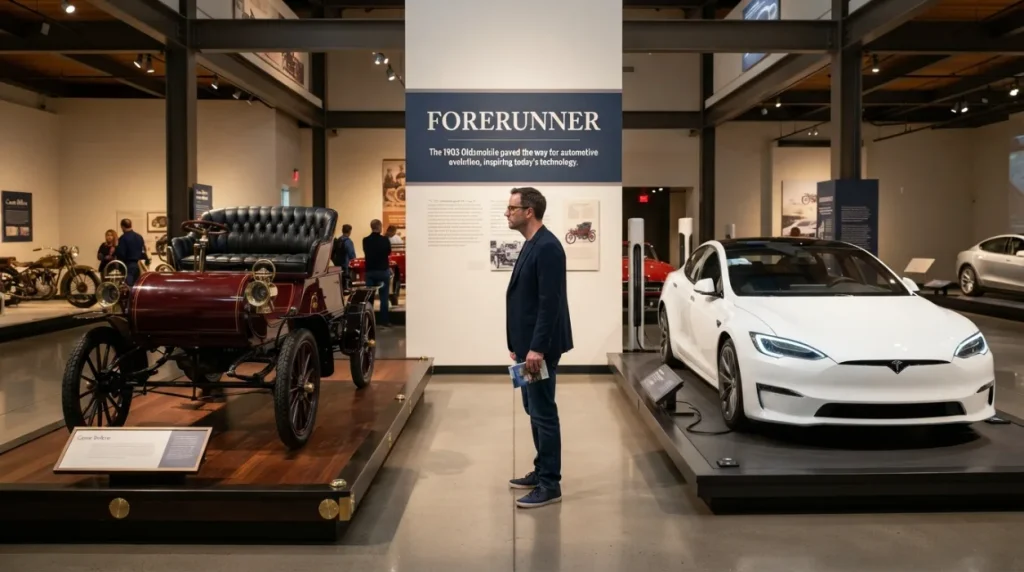
Synonyms for forerunner can make your English more precise and interesting. Imagine an old invention that inspired a modern one. That earlier creation was its forerunner.
In simple terms, a forerunner is someone or something that comes before another and helps prepare the way. For example, early computers became forerunners of today’s advanced digital devices.
Learning synonyms for forerunner helps students, bloggers, content writers, and daily English users avoid repetition. Moreover, the right alternative can make your meaning clearer and your writing more natural.
This guide explores synonyms for forerunner with simple meanings, pronunciations, tones, and examples. Therefore, you can confidently choose the best word for essays, blogs, conversations, and professional writing.
What Does “Forerunner” Really Mean?
A forerunner is a person, thing, idea, or development that comes before another and often prepares the way for it.
In simple English, a forerunner is something or someone that existed earlier and helped lead to what came later.
For example:
The early computer was a forerunner of modern digital technology.
Native speakers commonly use “forerunner” when discussing history, inventions, movements, products, people, ideas, and developments.
The word usually has a neutral or positive tone. It often suggests influence, progress, preparation, or importance.
Part of Speech
Forerunner is primarily a noun.
It refers to:
- A person who comes before another.
- An earlier version of something.
- A sign that something is about to happen.
- A development that prepares the way for a later one.
Connotative Meaning
Connotation (the emotional or cultural feeling associated with a word beyond its basic definition) can change how “forerunner” sounds.
Positive tone: It can suggest innovation, leadership, influence, and progress.
Neutral tone: It can simply identify something that appeared earlier.
Negative tone: The word itself is rarely negative, although its context can describe an earlier development that caused unwanted consequences.
Etymology
“Forerunner” is an English compound formed from fore-, meaning “before,” and runner, referring to someone or something that runs or moves ahead.
The basic idea is therefore “one who goes before.”
Old English: 450–1100
Old English used related forms such as fore-, meaning “before” or “in front of.” The exact modern compound “forerunner” developed later, but its basic concept has Germanic roots.
Middle English: 1100–1500
During Middle English, compounds using “fore-” became increasingly common. English speakers used the element to describe something that came earlier or prepared the way for another event.
Modern English: 1500–Present
In Modern English, “forerunner” became established as a noun for a predecessor, precursor, or earlier influence. Today, it appears frequently in historical, academic, technological, and literary contexts.
Pronunciation
US: /ˈfɔːrˌrʌnər/
UK: /ˈfɔːrˌrʌnə/
Syllables
fore-run-ner
Affixation Pattern
Root: run
Prefix: fore-
Suffix: -er
The prefix fore- adds the meaning “before” or “ahead of.”
Synonyms List
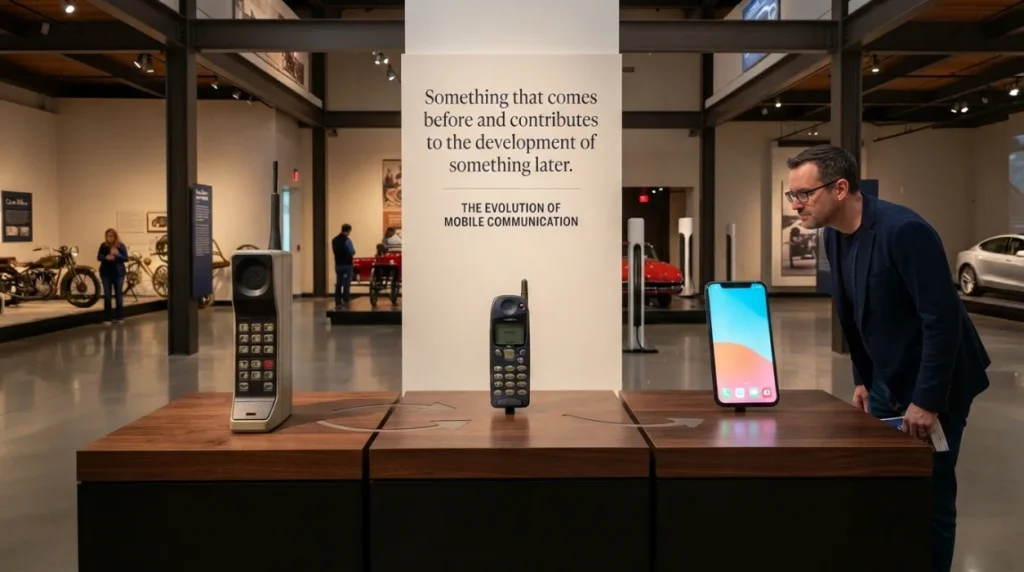
Precursor (Noun) — US /priːˈkɜːrsər/ | UK /priːˈkɜːsə/
Meaning: Something that comes before and contributes to the development of something later.
Tone/Register: Formal, Academic
Example:
The device was a precursor to modern tablets.
Researchers viewed the early experiment as a precursor to later discoveries.
Predecessor (Noun) — US /ˈprɛdəsɛsər/ | UK /ˈpriːdɪsɛsə/
Meaning: A person, product, or thing that existed before another in the same position or sequence.
Tone/Register: Neutral, Formal
Example:
The new camera is lighter than its predecessor.
Her predecessor introduced several important changes.
Antecedent (Noun) — US /ˈæntəsɛdənt/ | UK /ˌæntɪˈsiːdənt/
Meaning: Something that existed or happened before another event or development.
Tone/Register: Academic, Formal
Example:
These customs have several historical antecedents.
The study examined the antecedents of modern democracy.
Pioneer (Noun) — US /ˌpaɪəˈnɪr/ | UK /ˌpaɪəˈnɪə/
Meaning: A person who develops or explores something before others.
Tone/Register: Positive, Professional
Example:
She was a pioneer in digital education.
The engineer pioneered a new approach to renewable energy.
Trailblazer (Noun) — US /ˈtreɪlˌbleɪzər/ | UK /ˈtreɪlˌbleɪzə/
Meaning: A person who creates a new path for others to follow.
Tone/Register: Positive, Modern
Example:
The scientist became a trailblazer in robotics.
His work opened opportunities for younger researchers.
Herald (Noun) — US /ˈhɛrəld/ | UK /ˈherəld/
Meaning: A person or thing that announces or signals something coming.
Tone/Register: Literary, Formal
Example:
The first warm day was a herald of spring.
The new technology heralded a major change in communication.
Harbinger (Noun) — US /ˈhɑːrbɪndʒər/ | UK /ˈhɑːbɪndʒə/
Meaning: Something that indicates or signals that another event is approaching.
Tone/Register: Formal, Literary
Example:
Dark clouds can be a harbinger of a storm.
The early warning served as a harbinger of economic trouble.
Prefiguration (Noun) — US /ˌpriːfɪɡjəˈreɪʃən/ | UK /ˌpriːfɪɡjəˈreɪʃən/
Meaning: An earlier form or event that anticipates something developed later.
Tone/Register: Academic, Formal
Example:
The painting offers a prefiguration of his later style.
The prototype was a prefiguration of the final product.
Prefiguration (Noun) — US /ˌpriːfɪɡjəˈreɪʃən/ | UK /ˌpriːfɪɡjəˈreɪʃən/
Meaning: An early representation or indication of something that appears later.
Tone/Register: Literary, Academic
Example:
The novel contains a prefiguration of modern social themes.
The early design became a prefiguration of the finished building.
Precursor (Noun) — US /priːˈkɜːrsər/ | UK /priːˈkɜːsə/
Meaning: An earlier person, idea, or object that directly leads toward a later one.
Tone/Register: Academic, Formal
Example:
This machine was an important precursor to automation.
The theory became a precursor to modern research.
Originator (Noun) — US /əˈrɪdʒəneɪtər/ | UK /əˈrɪdʒɪneɪtə/
Meaning: A person who first creates or develops an idea or method.
Tone/Register: Formal, Professional
Example:
She was the originator of the new teaching method.
The originator later published the concept.
Founder (Noun) — US /ˈfaʊndər/ | UK /ˈfaʊndə/
Meaning: A person who establishes an organization, movement, or institution.
Tone/Register: Neutral, Professional
Example:
The founder established the organization in 1998.
His early work influenced the movement that followed.
Innovator (Noun) — US /ˈɪnəveɪtər/ | UK /ˈɪnəveɪtə/
Meaning: A person who introduces new ideas, methods, or products.
Tone/Register: Positive, Professional
Example:
The inventor became a major innovator in medicine.
Innovators often influence future generations.
Forerunner (Noun) — US /ˈfɔːrˌrʌnər/ | UK /ˈfɔːˌrʌnə/
Meaning: A person or thing that comes before another and helps prepare the way.
Tone/Register: Neutral, Formal
Example:
The prototype was a forerunner of modern electric vehicles.
Her early research became a forerunner of later studies.
Predecessor (Noun) — US /ˈprɛdəsɛsər/ | UK /ˈpriːdɪsɛsə/
Meaning: An earlier version, holder of a position, or stage in development.
Tone/Register: Neutral, Professional
Example:
The latest model improves on its predecessor.
The manager followed the policies of his predecessor.
Pathfinder (Noun) — US /ˈpæθˌfaɪndər/ | UK /ˈpɑːθˌfaɪndə/
Meaning: Someone who discovers or creates a route for others to follow.
Tone/Register: Positive, Literary
Example:
The researcher became a pathfinder in the field.
Her work created a path for future scientists.
Groundbreaker (Noun) — US /ˈɡraʊndˌbreɪkər/ | UK /ˈɡraʊndˌbreɪkə/
Meaning: A person or development that introduces something genuinely new.
Tone/Register: Positive, Informal
Example:
The invention was a groundbreaker in transportation.
His research proved groundbreaking for the industry.
Leader (Noun) — US /ˈliːdər/ | UK /ˈliːdə/
Meaning: A person who guides others or establishes a direction.
Tone/Register: Neutral, Professional
Example:
She became a leader in environmental research.
His early ideas helped lead the movement.
Pathfinder (Noun) — US /ˈpæθˌfaɪndər/ | UK /ˈpɑːθˌfaɪndə/
Meaning: Someone who opens a new route, method, or field for others.
Tone/Register: Positive, Literary
Example:
The explorer was a pathfinder for later expeditions.
Her discoveries helped others enter the field.
Precedent (Noun) — US /ˈpresɪdənt/ | UK /ˈpresɪdənt/
Meaning: An earlier example that provides a model for later action.
Tone/Register: Formal, Legal, Academic
Example:
The decision established an important precedent.
Earlier cases provided a precedent for the ruling.
Prototype (Noun) — US /ˈproʊtətaɪp/ | UK /ˈprəʊtətaɪp/
Meaning: An early model used to develop or test a later product.
Tone/Register: Technical, Professional
Example:
The prototype became the basis for the final machine.
Engineers tested the prototype before production.
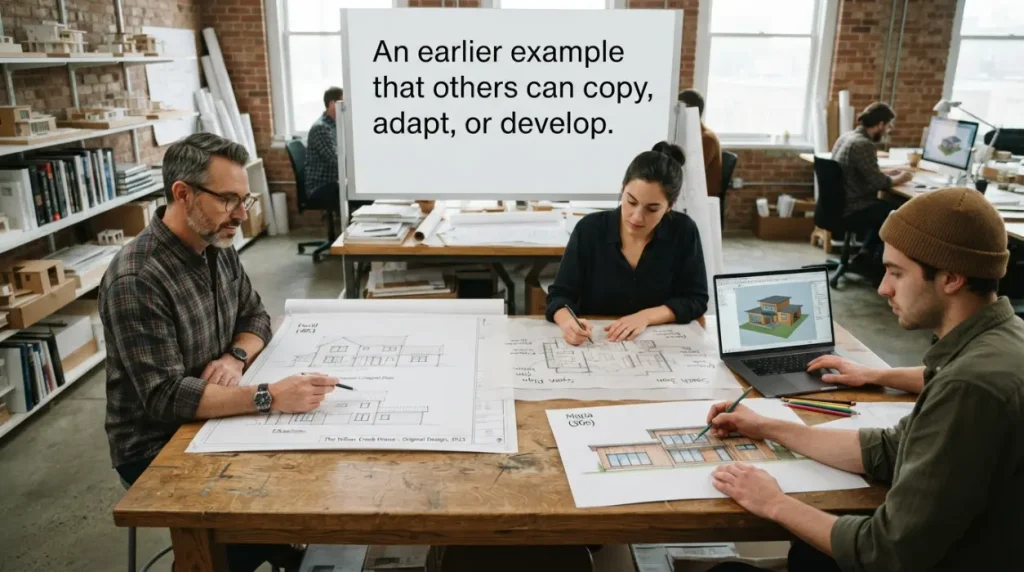
Model (Noun) — US /ˈmɑːdəl/ | UK /ˈmɒdəl/
Meaning: An earlier example that others can copy, adapt, or develop.
Tone/Register: Neutral, Academic
Example:
The system became a model for later programs.
Its success provided a model for other schools.
Example (Noun) — US /ɪɡˈzæmpəl/ | UK /ɪɡˈzɑːmpəl/
Meaning: An earlier case that illustrates or influences later developments.
Tone/Register: Neutral
Example:
|The project became an example for future teams.
Earlier examples helped shape the new policy.
Inspiration (Noun) — US /ˌɪnspəˈreɪʃən/ | UK /ˌɪnspɪˈreɪʃən/
Meaning: A person, idea, or work that influences something created later.
Tone/Register: Positive, Creative
Example:
The artist was an inspiration for younger painters.
Her early work provided inspiration for the movement.
Influence (Noun) — US /ˈɪnfluəns/ | UK /ˈɪnfluəns/
Meaning: A person or idea that affects later development or thinking.
Tone/Register: Neutral, Academic
Example:
The philosopher was a major influence on modern ethics.
His writing became an influence on later authors.
Guide (Noun) — US /ɡaɪd/ | UK /ɡaɪd/
Meaning: Someone or something that shows others a direction or method.
Tone/Register: Neutral
Example:
Her research served as a guide for future studies.
The handbook became a useful guide for new teachers.
Preceding Example (Noun Phrase) — US /prɪˈsiːdɪŋ ɪɡˈzæmpəl/ | UK /prɪˈsiːdɪŋ ɪɡˈzɑːmpəl/
Meaning: An earlier case that helps explain or shape what follows.
Tone/Register: Academic, Formal
Example:
The preceding example explains the later change.
Writers often study preceding examples before creating new models.
Early Model (Noun Phrase) — US /ˈɜːrli ˈmɑːdəl/ | UK /ˈɜːli ˈmɒdəl/
Meaning: An early version that helps lead toward a later form.
Tone/Register: Neutral, Technical
Example:
The early model lacked several modern features.
Nevertheless, it influenced later designs.
Earlier Version (Noun Phrase) — US /ˈɜːrliər ˈvɜːrʒən/ | UK /ˈɜːliə ˈvɜːʒən/
Meaning: A previous form of something that later becomes more developed.
Tone/Register: Neutral
Example:
This software was an earlier version of the current system.
The earlier version introduced the basic concept.
Early Influence (Noun Phrase) — US /ˈɜːrli ˈɪnfluəns/ | UK /ˈɜːli ˈɪnfluəns/
Meaning: An earlier person or idea that affects later development.
Tone/Register: Academic, Neutral
Example:
The poet was an early influence on modern writers.
Her work remained an early influence on the movement.
Pre-existing Model (Noun Phrase) — US /ˌpriːɪɡˈzɪstɪŋ ˈmɑːdəl/ | UK /ˌpriːɪɡˈzɪstɪŋ ˈmɒdəl/
Meaning: A model that existed before a newer development.
Tone/Register: Formal, Academic
Example:
The researchers adapted a pre-existing model.
The model influenced their later framework.
Early Predecessor (Noun Phrase) — US /ˈɜːrli ˈprɛdəsɛsər/ | UK /ˈɜːli ˈpriːdɪsɛsə/
Meaning: An earlier form or person that directly precedes another.
Tone/Register: Formal
Example:
The machine had several early predecessors.
Each early predecessor introduced a useful feature.
Preceding Development (Noun Phrase) — US /prɪˈsiːdɪŋ dɪˈvɛləpmənt/ | UK /prɪˈsiːdɪŋ dɪˈveləpmənt/
Meaning: An earlier development that contributes to a later one.
Tone/Register: Academic
Example:
The preceding development changed the industry.
Later innovations built on that foundation.
Early Stage (Noun Phrase) — US /ˈɜːrli steɪdʒ/ | UK /ˈɜːli steɪdʒ/
Meaning: An initial phase that occurs before later development.
Tone/Register: Neutral, Academic
Example:
The project was successful even at its early stage.
Researchers learned important lessons during this phase.
Earlier Form (Noun Phrase) — US /ˈɜːrliər fɔːrm/ | UK /ˈɜːliə fɔːm/
Meaning: A previous form of something that later changes or develops.
Tone/Register: Neutral
Example:
The language had an earlier form with different spellings.
Historians studied its earlier form carefully.
Initial Model (Noun Phrase) — US /ɪˈnɪʃəl ˈmɑːdəl/ | UK /ɪˈnɪʃəl ˈmɒdəl/
Meaning: The first model created before later versions appear.
Tone/Register: Technical, Professional
Example:
Engineers tested the initial model in the laboratory.
The initial model revealed several design problems.
Early Pioneer (Noun Phrase) — US /ˈɜːrli ˌpaɪəˈnɪr/ | UK /ˈɜːli ˌpaɪəˈnɪə/
Meaning: An early person who explores or develops a new field.
Tone/Register: Positive
Example:
She was an early pioneer of online education.
Her work encouraged others to experiment.
Preceding Figure (Noun Phrase) — US /prɪˈsiːdɪŋ ˈfɪɡjər/ | UK /prɪˈsiːdɪŋ ˈfɪɡə/
Meaning: A person who came before another important person or movement.
Tone/Register: Formal, Historical
Example:
The writer studied several preceding figures.
Those figures influenced his literary style.
Earlier Innovator (Noun Phrase) — US /ˈɜːrliər ˈɪnəveɪtər/ | UK /ˈɜːliə ˈɪnəveɪtə/
Meaning: Someone who introduced new ideas before later innovators.
Tone/Register: Positive, Professional
Example:
The inventor was an earlier innovator in the field.
Later engineers expanded on his work.
First Mover (Noun Phrase) — US /ˌfɜːrst ˈmuːvər/ | UK /ˌfɜːst ˈmuːvə/
Meaning: A person or organization that acts or develops something before competitors.
Tone/Register: Business, Modern
Example:
The company became a first mover in the market.
Its early decision influenced competitors.
Trendsetter (Noun) — US /ˈtrɛndˌsɛtər/ | UK /ˈtrendˌsetə/
Meaning: A person or organization that establishes a trend others later follow.
Tone/Register: Modern, Informal
Example:
The designer became a trendsetter in fashion.
Her unusual ideas influenced younger creators.
Bellwether (Noun) — US /ˈbɛlˌwɛðər/ | UK /ˈbelˌweðə/
Meaning: A person, group, or thing that serves as an indicator of future trends.
Tone/Register: Formal, Business
Example:
The company is a bellwether for the technology sector.
Its performance often signals wider market changes.

Vanguard (Noun) — US /ˈvænɡɑːrd/ | UK /ˈvænɡɑːd/
Meaning: The leading position of a movement or development.
Tone/Register: Formal, Academic
Example:
The researchers stood at the vanguard of medical innovation.
The group pushed new ideas into public discussion.
Advance Guard (Noun Phrase) — US /ədˈvæns ɡɑːrd/ | UK /ədˈvɑːns ɡɑːd/
Meaning: A group or person that moves ahead of the main group.
Tone/Register: Formal, Historical
Example:
The expedition’s advance guard reached the valley first.
They prepared the route for the larger group.
Leading Edge (Noun Phrase) — US /ˈliːdɪŋ ɛdʒ/ | UK /ˈliːdɪŋ edʒ/
Meaning: The most advanced position in a particular field or development.
Tone/Register: Modern, Professional
Example:
The laboratory works at the leading edge of biotechnology.
Its discoveries may influence future research.
Precursor Event (Noun Phrase) — US /priːˈkɜːrsər ɪˈvɛnt/ | UK /priːˈkɜːsə ɪˈvent/
Meaning: An earlier event that leads toward or signals a later event.
Tone/Register: Academic, Formal
Example:
The protest became a precursor event for wider reform.
Historians connected it with later political changes.
Sign (Noun) — US /saɪn/ | UK /saɪn/
Meaning: Something that indicates another event or condition may follow.
Tone/Register: Neutral
Example:
Rising temperatures were a sign of seasonal change.
The warning was an important sign of trouble.
Signal (Noun) — US /ˈsɪɡnəl/ | UK /ˈsɪɡnəl/
Meaning: Something that communicates or indicates what may happen next.
Tone/Register: Neutral, Professional
Example:
The announcement was a signal of changing policy.
Early sales provided a signal of growing demand.
Indication (Noun) — US /ˌɪndəˈkeɪʃən/ | UK /ˌɪndɪˈkeɪʃən/
Meaning: Evidence or information that points toward a later condition or event.
Tone/Register: Formal, Academic
Example:
The results were an indication of future growth.
The symptoms provided an indication of change.
Omen (Noun) — US /ˈoʊmən/ | UK /ˈəʊmən/
Meaning: A sign believed to suggest that something will happen.
Tone/Register: Literary, Traditional
Example:
Some people viewed the unusual event as an omen.
The dark sky seemed like an ominous omen.
Portent (Noun) — US /ˈpɔːrtɛnt/ | UK /ˈpɔːtənt/
Meaning: A sign that suggests something important or significant is coming.
Tone/Register: Formal, Literary
Example:
The sudden silence was a portent of conflict.
The discovery became a portent of major change.
Foreshadowing (Noun) — US /fɔːrˈʃædoʊɪŋ/ | UK /fɔːˈʃædəʊɪŋ/
Meaning: An earlier clue that suggests what will happen later, especially in storytelling.
Tone/Register: Literary, Academic
Example:
The opening scene provides foreshadowing for the ending.
The author uses subtle foreshadowing throughout the novel.
Prelude (Noun) — US /ˈprɛljuːd/ | UK /ˈpreljuːd/
Meaning: An event or action that comes before and introduces something more important.
Tone/Register: Formal, Literary
Example:
The small dispute was a prelude to a larger conflict.
The opening speech served as a prelude to the ceremony.
Prologue (Noun) — US /ˈproʊlɔːɡ/ | UK /ˈprəʊlɒɡ/
Meaning: An introductory section that comes before the main part of a story or work.
Tone/Register: Literary, Formal
Example:
The novel begins with a short prologue.
The prologue introduces the events that shape the story.
Synonyms by Tone
Positive
Pioneer, trailblazer, innovator, groundbreaker, pathfinder, trendsetter, vanguard
These words emphasize leadership, creativity, progress, or influence. Therefore, they work well when praising a person or development.
Neutral
Precursor, predecessor, antecedent, prototype, model, example, earlier version, initial model
These alternatives simply explain that something came before another development.
Negative or Cautionary
Omen, portent, harbinger
These words can suggest that an unwanted or troubling event may follow. However, the context determines the emotional effect.
Playful or Informal
Trailblazer, trendsetter, groundbreaker
These sound more conversational and energetic than formal terms such as “antecedent.”
Tone matters because two words can share a basic meaning while creating different impressions. For example, pioneer praises achievement, whereas antecedent sounds analytical.
“Forerunner” vs. Close Alternatives
| Word | Main Difference | Best Use |
|---|---|---|
| Forerunner | Something that comes before and prepares the way | General writing |
| Precursor | An earlier stage that contributes to later development | Academic and technical writing |
| Predecessor | A person or thing that directly came before another | People, products, positions |
| Pioneer | Someone who develops something new before others | Innovation and achievement |
For example, call an earlier phone a predecessor when discussing product generations. Call it a precursor when emphasizing technological development. Use forerunner when you want a broader description.
More Words Related to Forerunner: Synonyms, Antonyms, and Meanings
Understanding related words can help you use forerunner more accurately in different situations. Some words describe something that came before, while others refer to a person who leads the way or something that follows later.
Quick Synonyms for Forerunner
If you are looking for another word for forerunner, the best alternatives include:
- Precursor: Something that comes before and contributes to a later development.
- Predecessor: A person or thing that came before another in a sequence or position.
- Antecedent: Something that existed or happened before another event.
- Pioneer: Someone who develops or explores something new before others.
- Trailblazer: A person who creates a new path for others to follow.
- Harbinger: Something that signals the arrival of a future event.
- Prototype: An early model used to develop or test a later product.
- Precedent: An earlier example that influences a later decision or action.
- Pathfinder: Someone who discovers a route or method for others to follow.
- Trendsetter: A person or organization that establishes a trend others follow.
The closest general synonym is usually precursor. However, predecessor may be more appropriate when discussing an earlier product, person, or version.
Forerunner Antonyms: What Is the Opposite of Forerunner?
The opposite of forerunner depends on the context. Since a forerunner comes before something else, words describing what comes afterward often provide the clearest contrast.
Common antonyms and contrasting terms include:
- Successor: Someone or something that comes after another in a position, role, or sequence.
- Follower: Someone who follows another person’s example, leadership, or ideas.
- Descendant: A person or thing that develops from an earlier ancestor or source.
- Later version: A version of a product or system developed after an earlier one.
- Subsequent development: Something that occurs or develops afterward.
Examples:
- The old machine was a forerunner of modern equipment, while the newer machine was its successor.
- The scientist was a forerunner of the movement, while later researchers became followers of her approach.
- The original software was a forerunner of the current application, which is a later version.
Note: Successor is generally the strongest opposite when discussing people, products, or positions. The other words are contextual alternatives rather than exact antonyms in every situation.
Forerunner vs. Pioneer
Although forerunner and pioneer have similar meanings, they emphasize different ideas.
| Word | Meaning | Example |
|---|---|---|
| Forerunner | Something or someone that comes before and may prepare the way for later developments | The early computer was a forerunner of modern digital devices. |
| Pioneer | Someone who is among the first to develop, explore, or introduce something | She was a pioneer in online education. |
Use forerunner when emphasizing an earlier stage or influence. Use pioneer when highlighting innovation, leadership, or the achievement of being among the first.
Forerunner vs. Precursor vs. Predecessor
These three words are closely related, but they are not always interchangeable.
- Forerunner: A broad term for someone or something that comes before and may prepare the way for what follows.
- Precursor: An earlier development that contributes to or leads toward something later.
- Predecessor: Someone or something that directly occupied an earlier position or existed in an earlier stage of a sequence.
Examples:
- The early telephone was a forerunner of modern communication technology.
- The early experiment was a precursor to a major scientific discovery.
- The previous smartphone model was the predecessor of the latest model.
Forerunner Thesaurus: Other Words for Forerunner
A thesaurus groups words with related meanings. However, not every synonym can replace forerunner in every sentence.
For people: Pioneer, trailblazer, pathfinder, innovator, predecessor.
For inventions and products: Precursor, predecessor, prototype, early model, earlier version.
For events and warning signs: Harbinger, herald, portent, indication, signal.
For historical or academic writing: Antecedent, precursor, precedent, earlier development.
For trends and innovation: Trendsetter, groundbreaker, pioneer, innovator.
Choose the word that matches the relationship you want to describe rather than selecting a synonym only because it appears in a thesaurus.
Fore Runner Meaning: Is It One Word or Two?
The standard spelling is forerunner, written as one word.
A forerunner is a person, thing, or development that comes before another and often helps prepare the way for it.
Example: Early mobile phones were forerunners of today’s smartphones.
The phrase forerunner is sometimes written as two words by mistake or used informally, but forerunner is the standard spelling for this meaning.
Forerunners: Meaning and Usage
Forerunners is the plural form of forerunner. It refers to two or more people, things, ideas, or developments that came before others.
Examples:
- Early electronic calculators were forerunners of modern computing devices.
- Several researchers were forerunners of the new scientific movement.
- These early designs were forerunners of today’s electric vehicles.
The singular form is used for one person or thing, while the plural form is used for more than one.
Precursor: Spanish Meaning and Synonyms
In Spanish, precursor can be translated as precursor, antecesor, or, depending on context, precursora for a feminine noun or person.
Related Spanish expressions include:
- Antecesor: Someone or something that came before another.
- Predecesor: A predecessor, particularly in a position or sequence.
- Precursor: Someone or something that prepared the way for a later development.
- Precursor de algo: A precursor or forerunner of something.
Example in Spanish: Este invento fue un precursor de la tecnología moderna.
English translation: This invention was a forerunner of modern technology.
The best Spanish equivalent depends on whether the sentence emphasizes historical sequence, influence, or preparation for a later development.
Pelopor: Meaning and Synonyms in Indonesian and Malay
The word pelopor in Indonesian and Malay generally refers to a pioneer, trailblazer, or someone who leads the way.
Related Indonesian words include:
- Perintis: A pioneer or someone who initiates something.
- Pelopor: A pioneer or leading figure.
- Pendahulu: A predecessor or someone who came before.
In Malay, pelopor and perintis can describe someone who introduces a new idea or leads a new movement. Pendahulu is useful when emphasizing someone or something that came earlier.
Example: Dia adalah pelopor pendidikan digital.
English translation: He or she is a pioneer of digital education.
The most suitable synonym depends on whether you want to emphasize leadership, innovation, or an earlier position in a sequence.
Forerunner Meaning in Tagalog
In Tagalog, possible translations of forerunner include nangunguna, tagapanguna, or nauna, depending on the sentence and intended meaning.
- Tagapanguna: A leader or someone who leads the way.
- Nauna: Someone or something that came earlier.
- Nangunguna: Someone who leads or is at the forefront.
These words do not have the same meaning in every context. When discussing an earlier invention that helped prepare the way for a later one, the sentence may need a descriptive translation rather than a single-word equivalent.
Example in English: The early invention was a forerunner of modern technology.
Possible Tagalog translation: Ang naunang imbensiyon ay nagsilbing pasimula sa makabagong teknolohiya.
English meaning: The earlier invention served as a beginning or precursor to modern technology.
Prologue Meaning in Korean
The Korean word 프롤로그 (peu-rollogeu) means prologue in English. A prologue is an introductory section that appears before the main part of a book, story, play, or other work.
Example: The novel begins with a short prologue.
Korean: 소설은 짧은 프롤로그로 시작한다.
English meaning: The novel begins with a short prologue.
A prologue is related to the idea of something coming before the main content, but it is not a direct synonym for forerunner in most contexts.
Frequently Asked Questions About Forerunner Synonyms
1. What is the closest synonym for forerunner?
Precursor is usually the closest general synonym. Predecessor is also suitable when referring to an earlier person, product, or version.
2. What is the opposite of forerunner?
Successor is often the clearest opposite because it refers to someone or something that comes after another in a sequence or position.
3. Is forerunner the same as pioneer?
No. A forerunner comes before something and may prepare the way for it. A pioneer is among the first to develop, explore, or introduce something new.
4. What is the plural of forerunner?
The plural is forerunners. For example, early computers were forerunners of modern digital devices.
5. Is forerunner written as one word?
Yes. Forerunner is the standard spelling. It should normally be written as one word, not fore runner.
6. What is a simple alternative to forerunner?
Depending on the sentence, you can use predecessor, earlier version, precursor, or first example.
7. What is the difference between precursor and predecessor?
A precursor often contributes to a later development, whereas a predecessor directly comes before another person or thing in a sequence or position.
8. Can forerunner describe a person?
Yes. It can describe someone who came before a later figure or movement and helped prepare the way for it. Pioneer or trailblazer may be better when the emphasis is on innovation.
How “Forerunner” Changes by Context
Daily Conversation
In everyday speech, “forerunner” can sound slightly formal. Native speakers may prefer simpler expressions such as earlier version, predecessor, or first example.
For example, instead of saying, “That phone was a forerunner of today’s smartphones,” someone might simply say, “That phone came before today’s smartphones.”
Writing and Blogging
In blogs and articles, “forerunner” works especially well when discussing history, technology, culture, or trends.
Moreover, using alternatives prevents repetitive writing. You can use precursor in one paragraph and predecessor later when the context changes.
Professional and Academic Writing
Academic writers often choose precursor, antecedent, predecessor, or prototype.
These terms allow precise explanations. For instance, “prototype” specifically suggests an early model, while “antecedent” emphasizes something that existed beforehand.
Creative and Informal Writing
Creative writers may choose herald, harbinger, pioneer, or trailblazer.
These words add imagery and personality. However, choose carefully because “harbinger” often carries a stronger sense of an approaching event.
Common Mistakes and Native Usage
Mistake 1: Treating Every Alternative as Identical
Not every synonym works in every sentence. Prototype normally refers to an early model, while pioneer usually describes a person or organization.
Mistake 2: Using “Harbinger” for a Person
“Harbinger” can describe a person, but modern usage often favors it for a sign or event that announces what is coming.
Mistake 3: Confusing “Predecessor” and “Precursor”
A predecessor directly comes before another person or thing. A precursor more strongly emphasizes development or preparation for what follows.
Mistake 4: Using Very Formal Words in Casual Speech
Words such as antecedent and portent may sound unnatural in relaxed conversation. Instead, use simpler alternatives when speaking casually.
Register Notes
Formal: antecedent, precursor, portent, precedent, vanguard
Neutral: predecessor, example, model, signal, indication
Modern: trailblazer, trendsetter, groundbreaker, innovator
Literary: herald, harbinger, omen, foreshadowing, prelude
If you are building related vocabulary, an internal guide about synonyms and word choice can also help you compare register and tone more effectively.
Real-Life Mini Scenarios
Workplace
A manager introduces a new scheduling system. The old system was the predecessor of the current version.
Social Situation
A friend starts a new creative trend. Soon, everyone copies the idea. She has become a trendsetter.
Media and Pop Culture
An early television program introduces a style that later becomes popular. Critics may call it a forerunner of modern shows.
Writing and Storytelling
A character notices a broken clock before something dramatic happens. That detail can act as foreshadowing.
Why Choosing the Right Synonym Matters
Choosing the right synonym does more than replace a repeated word. It adds precision.
For example, pioneer highlights achievement. Predecessor focuses on sequence. Harbinger emphasizes an approaching event. Prototype points to an early model.
Therefore, writers should consider three things before replacing “forerunner”:
- What came before?
- What relationship does it have with the later thing?
- What tone should the sentence create?
This simple approach helps you sound more natural and accurate.

Practice Exercise
1. The first electric car served as a ______ of today’s models.
A) precursor
B) dessert
C) opponent
D) stranger
2. She was a ______ who opened opportunities for women in the field.
A) pioneer
B) signal
C) omen
D) version
3. The older software was the ______ of the current application.
A) predecessor
B) portent
C) herald
D) inspiration
4. Dark clouds can be a ______ of heavy rain.
A) prototype
B) harbinger
C) founder
D) model
5. The engineer tested an early ______ before producing the final machine.
A) prototype
B) leader
C) influence
D) precedent
6. The decision created a legal ______ for future cases.
A) precedent
B) pioneer
C) trendsetter
D) prototype
7. The designer became a ______ after her style spread widely.
A) trendsetter
B) antecedent
C) indication
D) prologue
8. The opening scene gives subtle ______ about the ending.
A) foreshadowing
B) predecessor
C) model
D) founder
9. The early researcher was an important ______ on later scientists.
A) influence
B) omen
C) prototype
D) signal
10. The opening speech acted as a ______ to the main ceremony.
A) prelude
B) predecessor
C) innovator
D) bellwether
11. The company’s sales are often a ______ for the wider industry.
A) bellwether
B) prologue
C) pioneer
D) antecedent
12. The scientist became a ______ in renewable-energy research.
A) trailblazer
B) omen
C) precedent
D) indication
Answer Key: 1-A | 2-A | 3-A | 4-B | 5-A | 6-A | 7-A | 8-A | 9-A | 10-A | 11-A | 12-A
Reflection Task :
Write one sentence using forerunner, precursor, or predecessor. Then rewrite the sentence using a different alternative and notice how the tone changes.
Conclusion
Learning synonyms for forerunner gives you more ways to describe people, ideas, inventions, and developments that came before something new. Each alternative can add a slightly different meaning.
For example, “precursor” highlights development, while “predecessor” focuses on what came before. Similarly, “pioneer” suggests innovation and achievement. Therefore, choosing carefully makes your writing clearer and more engaging.
Using synonyms for forerunner can improve essays, blogs, emails, stories, and everyday conversations. Moreover, a wider vocabulary helps you communicate ideas with greater accuracy and confidence.
Finally, practice synonyms for forerunner by creating your own sentences. Try different alternatives in your writing and speaking. With regular practice, you can naturally understand tone, context, and meaning while making your English more flexible, polished, and expressive.
Frequently Asked Questions
1. What is the closest synonym for forerunner?
The closest general synonym for forerunner is usually precursor. Both describe a person, thing, idea, or development that comes before another. However, “precursor” often emphasizes how an earlier development leads toward a later one. “Predecessor” is also close, especially when discussing earlier products, people, or positions.
2. Is precursor the same as forerunner?
“Precursor” and “forerunner” are very close, but they are not always identical. A precursor usually suggests an earlier stage that contributes to something developed later. A forerunner has a broader meaning and can describe something that simply comes before or prepares the way. Context determines which word sounds more natural.
3. What is a simple word for forerunner?
Simple alternatives include predecessor, earlier version, first example, and model, depending on the sentence. For everyday English, “predecessor” is often the easiest direct replacement. However, “earlier version” works better when discussing products, software, designs, or other things that have been updated over time.
4. Which synonym for forerunner is best for academic writing?
For academic writing, precursor, antecedent, and predecessor are strong choices. “Precursor” works particularly well when explaining how an earlier theory, discovery, or development contributed to a later one. “Antecedent” sounds more technical and focuses on something that existed beforehand.
5. Can forerunner describe a person?
Yes. Forerunner can describe a person who came before another person or group and helped prepare the way. For example, an early scientist may be called a forerunner of a later scientific movement. In such cases, pioneer, trailblazer, or predecessor may also work, depending on the intended meaning.

Hasnain Ali is an SEO Content Strategist and the founder of wordvora.com, a trusted vocabulary platform that helps writers, students, professionals, and English learners find accurate synonyms, antonyms, word meanings, and real-life usage examples. He specializes in keyword research, on-page SEO, topical authority, and creating search-first content that aligns with Google’s latest Search Quality and E-E-A-T guidelines. His work focuses on producing clear, well-structured, and reader-friendly resources that satisfy search intent while maintaining high editorial standards.
Through extensive hands-on experience with SEO tools such as Google Search Console, Google Analytics, SEMrush, and Ahrefs, Hasnain researches user search behavior and develops content that is both informative and easy to understand. Every article published on wordvora.com is carefully reviewed for accuracy, readability, and contextual relevance before publication. His mission is to build one of the web’s most reliable English vocabulary resources by providing practical language guidance, trustworthy explanations, and content that helps readers improve their writing, communication, and vocabulary with confidence.