
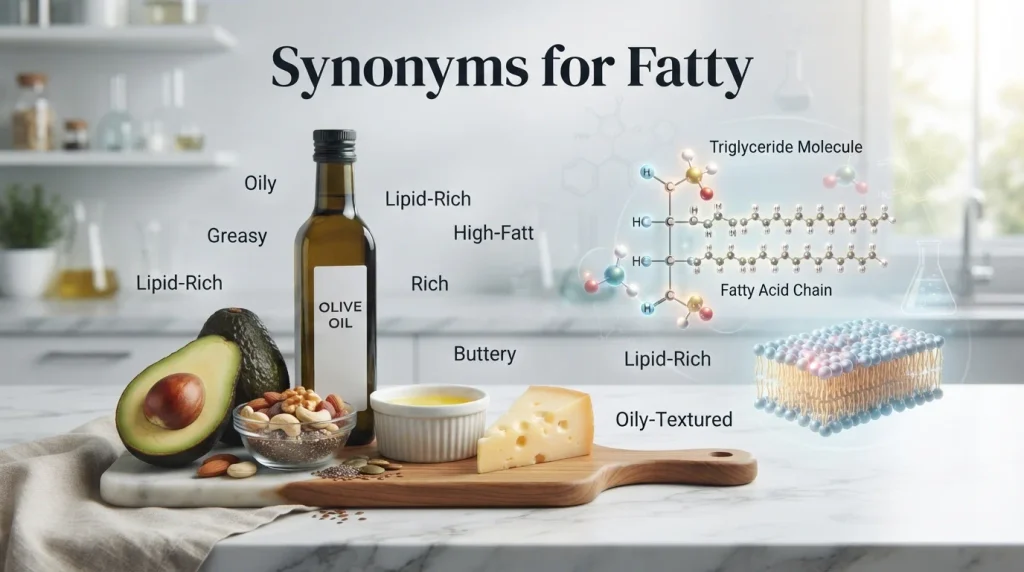
Finding the right synonyms for fatty can help you describe foods, substances, or physical characteristics more accurately. The meaning can vary depending on whether you are discussing nutrition, texture, or appearance.
The word “fatty” commonly refers to something containing a large amount of fat. In different contexts, alternatives such as greasy, oily, rich, lipid-rich, and high-fat may express related ideas, though their meanings can differ slightly.
This guide explores useful synonyms for fatty with clear meanings and practical examples. You’ll learn how each alternative works and which words are most suitable for everyday, descriptive, or professional writing.
Whether you’re a student, writer, or English learner, synonyms for fatty can expand your vocabulary. Using precise alternatives can help you describe food and other subjects naturally, avoid repetition, and communicate your ideas more effectively.
What Does “Fatty” Really Mean?
Fatty means containing a large amount of fat or resembling fat in texture and composition. Native speakers use this term when discussing nutrition, culinary recipes, and biochemical tissue structures. It carries a neutral to informal tone depending on whether it describes food or biological matter. The word appears frequently in dietary guidelines, medical reports, and cooking blogs.
Fatty functions grammatically as an adjective. Its simple definition is containing or resembling fat.
Connotative Meaning
- Positive tone: Represents culinary richness, flavor, satisfaction, and necessary biological energy stores.
- Negative tone: Implies unhealthiness, excess weight, greasiness, or cardiovascular risk factors.
- Neutral tone: Denotes a precise biochemical or structural category without emotional bias.
- Connotation (the emotional or cultural association attached to a word beyond its literal dictionary definition) shapes how readers perceive nutritional descriptions.
Etymology
Fatty originates from Middle English fat, derived from Old English fǣtt (stuffed, sleek, or greased).
- Old English (450–1100): The root fǣtt described well-fed livestock, rich land, or greasy substances.
- Middle English (1100–1500): The vocabulary expanded as French and Latin medical terms merged with Germanic descriptors.
- Modern English (1500–Present): The adjective suffix -y was added to form fatty, designating lipid-rich foods and tissues.
Pronunciation (US & UK – IPA)
- US: /ˈfæti/
- UK: /ˈfæti/
Syllables fat-ty
Affixation Pattern of Fatty
- Root: fat (lipid, grease)
- Prefix: none
- Suffix: -y (adjective-forming suffix)
SYNONYMS LIST
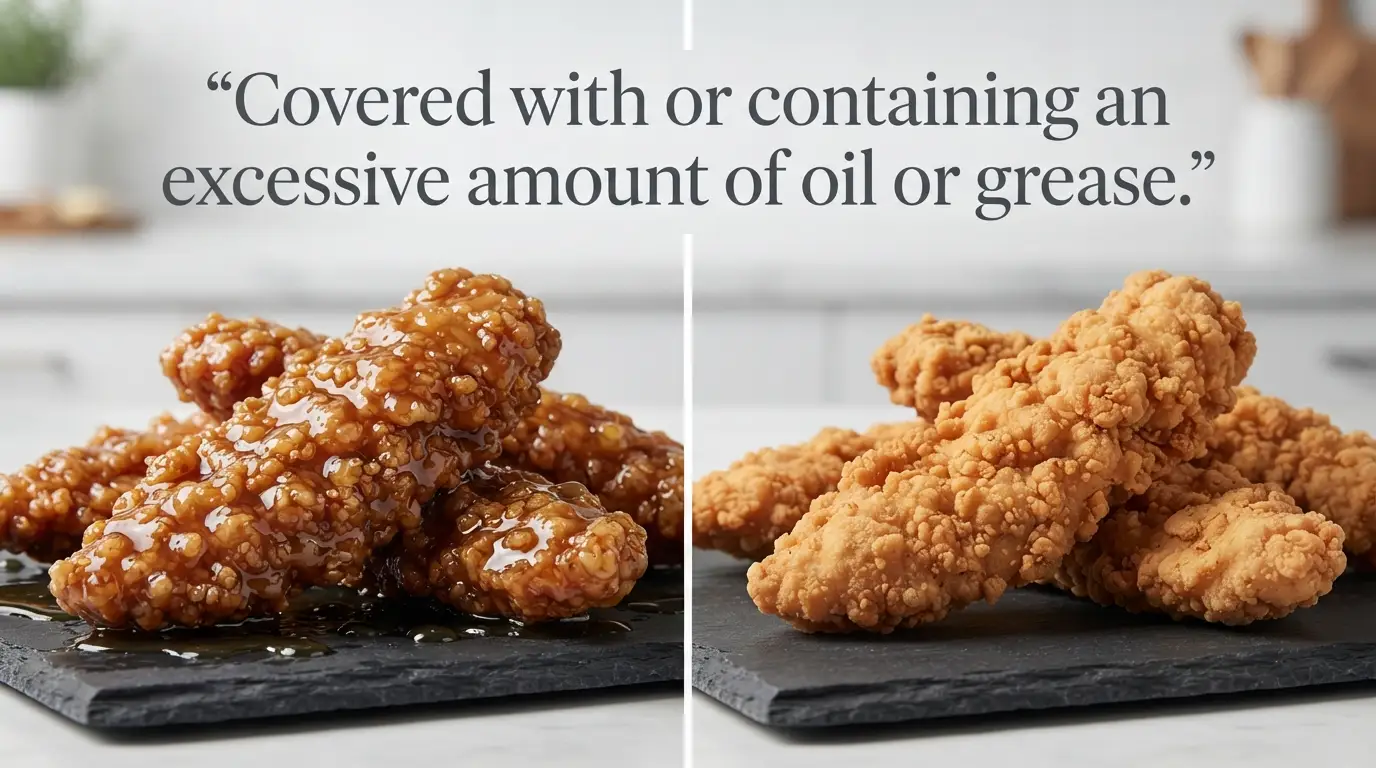
Greasy (Adjective) — US / UK Pronunciation
- Meaning: Covered with or containing an excessive amount of oil or grease.
- Tone/Register: Informal, Descriptive
- Example: The paper plate was soaked through with greasy burger residue.
- Example: He wiped his greasy fingers on a paper napkin.
Oily (Adjective) — US / UK Pronunciation
- Meaning: Containing, consisting of, or resembling oil or fat.
- Tone/Register: General, Descriptive
- Example: The skin on his forehead felt unusually oily by afternoon.
- Example: She applied an oily serum to hydrate her dry hair.
Rich (Adjective) — US / UK Pronunciation
- Meaning: Containing a high proportion of fat, sugar, or spices, making it heavy.
- Tone/Register: Culinary, General
- Example: Chocolate fudge cake is far too rich for a light dessert.
- Example: The creamy sauce tasted exceptionally rich and buttery.
Buttery (Adjective) — US / UK Pronunciation
- Meaning: Having the quality, taste, or soft consistency of butter.
- Tone/Register: Culinary, Informal
- Example: Warm croissants had a delicious, flaky, buttery texture.
- Example: She spread soft, buttery goodness over the toast.
OLEAGINOUS (Adjective) — US / UK Pronunciation
- Meaning: Resembling or containing oil; having a slippery or smooth texture.
- Tone/Register: Formal, Scientific
- Example: Chemical analysis identified oleaginous compounds in the seed extract.
- Example: The machine part leaked an oleaginous fluid onto the floor.
Lipid (Adjective) — US / UK Pronunciation
- Meaning: Relating to organic compounds that are fatty acids and their derivatives.
- Tone/Register: Scientific, Academic
- Example: Scientists tracked lipid metabolism rates in clinical lab tests.
- Example: Cell membranes consist of complex lipid bilayers.
Adipose (Adjective) — US / UK Pronunciation
- Meaning: Used for the storage of fat in biological animal tissue.
- Tone/Register: Medical, Formal
- Example: Doctors examined the adipose tissue samples under a high-power microscope.
- Example: Excess energy is stored primarily in human adipose cells.
Sebaceous (Adjective) — US / UK Pronunciation
- Meaning: Producing or secreting a greasy, lubricating oily substance.
- Tone/Register: Medical, Formal
- Example: Blocked sebaceous glands can lead to common skin blemishes.
- Example: Dermatologists study sebaceous gland activity in patients.
Lardaceous (Adjective) — US / UK Pronunciation
- Meaning: Resembling lard or containing animal fat deposits.
- Tone/Register: Formal, Rare
- Example: The tissue sample showed lardaceous degeneration under review.
- Example: Chefs avoided lardaceous cooking oils for lighter meals.
Suety (Adjective) — US / UK Pronunciation
- Meaning: Resembling or containing hard animal fat found around kidneys.
- Tone/Register: Culinary, Traditional
- Example: Traditional British pudding requires firm, suety ingredients.
- Example: The suety texture gave the pastry a unique crumbly bite.
Blubber (Adjective) — US / UK Pronunciation
- Meaning: Having thick layers of fat used by marine mammals for warmth.
- Tone/Register: Descriptive, Biological
- Example: Whales rely on thick blubber layers to survive freezing oceans.
- Example: Arctic seals maintain high blubber content for thermal insulation.
Unctuous (Adjective) — US / UK Pronunciation
- Meaning: Having a greasy, soapy, or oily texture when touched.
- Tone/Register: Formal, Literary
- Example: The mineral oil left an unctuous residue on glass.
- Example: He disliked the unctuous texture of the heavy cream sauce.
Saturated (Adjective) — US / UK Pronunciation
- Meaning: Containing the highest possible amount of hydrogen atoms in fatty acid chains.
- Tone/Register: Scientific, Nutritional
- Example: Nutritionists advise limiting saturated fats for heart health.
- Example: Coconut oil contains high levels of saturated fatty components.
Heavy (Adjective) — US / UK Pronunciation
- Meaning: Hard to digest because of rich ingredients or high fat content.
- Tone/Register: Everyday, Culinary
- Example: Cream pasta dishes always feel heavy after a long workday.
- Example: He preferred a light salad over a heavy stew.
Creamy (Adjective) — US / UK Pronunciation
- Meaning: Having the consistency or rich taste of cream.
- Tone/Register: Culinary, General
- Example: The barista whipped up a smooth, creamy latte foam.
- Example: Avocado adds a naturally creamy texture to sandwiches.
Saucy (Adjective) — US / UK Pronunciation
- Meaning: Richly coated or drenched in heavy cooking sauces.
- Tone/Register: Informal, Culinary
- Example: Barbecue wings arrived dripping in thick, saucy glaze.
- Example: She ordered a saucy noodle dish for dinner.
Gravy-laden (Adjective) — US / UK Pronunciation
- Meaning: Heavily covered or soaked in meat juices and fat drippings.
- Tone/Register: Descriptive, Casual
- Example: Roast beef slices were served gravy-laden on mashed potatoes.
- Example: Thanksgiving plates are typically gravy-laden and hearty.
Pasty (Adjective) — US / UK Pronunciation
- Meaning: Resembling paste in consistency, often thick from flour and fat mixes.
- Tone/Register: Descriptive, General
- Example: Undercooked dough had a pasty, unappetizing mouthfeel.
- Example: The mixture turned pasty when too much butter melted.
Glaze-coated (Adjective) — US / UK Pronunciation
- Meaning: Covered in a shiny, rich, sugary or oily coating.
- Tone/Register: Culinary, Informal
- Example: Fresh donuts arrived glaze-coated and sweet.
- Example: Ham slices were glazed and sticky with sweet drippings.
Butter-soaked (Adjective) — US / UK Pronunciation
- Meaning: Thoroughly saturated with melted butter.
- Tone/Register: Informal, Culinary
- Example: Movie theater popcorn is famously butter-soaked and salty.
- Example: Toast slices were butter-soaked and golden brown.
Oil-slicked (Adjective) — US / UK Pronunciation
- Meaning: Covered with a thin, glossy film of oil.
- Tone/Register: Descriptive, Informal
- Example: The soup surface looked oil-slicked from rich bone broth.
- Example: Pan-fried noodles appeared oil-slicked under kitchen lights.
Lard-based (Adjective) — US / UK Pronunciation
- Meaning: Prepared or fried using rendered animal fat.
- Tone/Register: Culinary, Traditional
- Example: Authentic pastry crusts are often lard-based for flakiness.
- Example: Traditional frying methods relied on lard-based shortenings.
Tallowy (Adjective) — US / UK Pronunciation
- Meaning: Resembling tallow or hard rendered animal fat.
- Tone/Register: Formal, Technical
- Example: The old soap bar developed a hard, tallowy consistency.
- Example: Chemical tests revealed a tallowy residue on the surface.
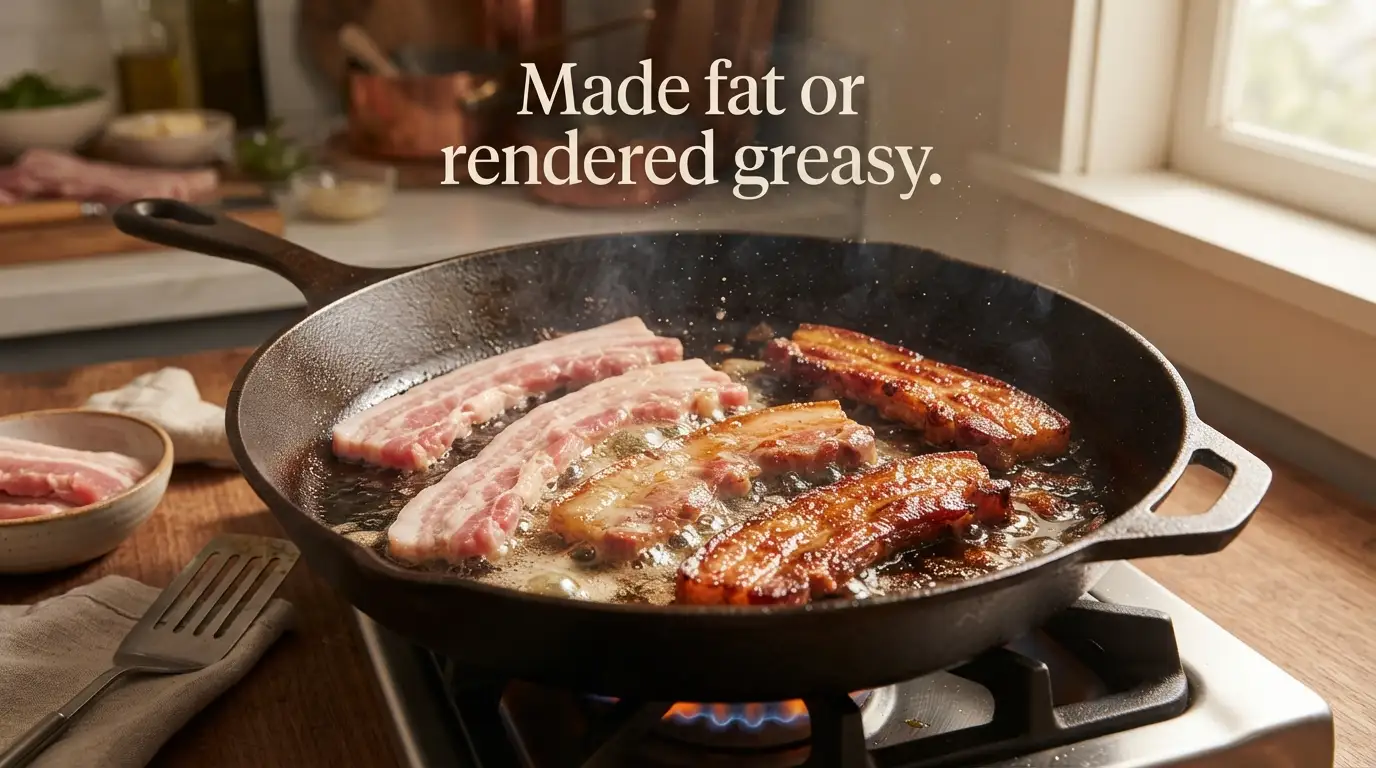
Pinguinized (Adjective) — US / UK Pronunciation
- Meaning: Made fat or rendered greasy.
- Tone/Register: Rare, Formal
- Example: Textbooks rarely use the archaic term pinguinized for oily states.
- Example: The mixture became pinguinized after prolonged heating.
Thick (Adjective) — US / UK Pronunciation
- Meaning: Having a dense, viscous consistency high in solids or fats.
- Tone/Register: General, Everyday
- Example: Chowder soup had a wonderfully thick, hearty texture.
- Example: Greek yogurt is naturally thick and protein-rich.
Viscous (Adjective) — US / UK Pronunciation
- Meaning: Having a sticky, thick, semi-fluid consistency between solid and liquid.
- Tone/Register: Scientific, Formal
- Example: Honey and cooking oils exhibit high viscosity.
- Example: The syrup was too viscous to pour easily.
Syrupy (Adjective) — US / UK Pronunciation
- Meaning: Having the thick, sweet, or sticky consistency of syrup.
- Tone/Register: Descriptive, General
- Example: Maple syrup poured in a thick, golden, syrupy stream.
- Example: The glaze took on a sticky, syrupy texture as it cooled.
Dense (Adjective) — US / UK Pronunciation
- Meaning: Closely compacted in substance, often high in calories or fats.
- Tone/Register: General, Scientific
- Example: Nut butter is a calorie-dense food option.
- Example: The chocolate brownie had a wonderfully dense crumb.
Heavy-calorie (Adjective) — US / UK Pronunciation
- Meaning: Containing a high amount of energy from fats and sugars.
- Tone/Register: Nutritional, Informal
- Example: Dietitians warned against eating heavy-calorie fast food daily.
- Example: Holiday meals are notoriously heavy-calorie feasts.
Energy-rich (Adjective) — US / UK Pronunciation
- Meaning: Providing high amounts of metabolic energy through lipids and carbs.
- Tone/Register: Scientific, Nutritional
- Example: Nuts and seeds are energy-rich foods for hikers.
- Example: Bears consume energy-rich salmon before winter hibernation.
Calorific (Adjective) — US / UK Pronunciation
- Meaning: Relating to the generation or amount of calories in food.
- Tone/Register: Formal, Nutritional
- Example: Fried foods possess a very high calorific value.
- Example: Nutrition labels list the total calorific content per serving.
Nourishing (Adjective) — US / UK Pronunciation
- Meaning: Providing healthy substances needed for life, growth, and energy.
- Tone/Register: General, Positive
- Example: Bone broth provides nourishing fats and minerals.
- Example: A warm bowl of soup felt deeply nourishing.
Substantial (Adjective) — US / UK Pronunciation
- Meaning: Of considerable importance, size, or worth; filling.
- Tone/Register: Formal, General
- Example: Workers ate a substantial breakfast of eggs and bacon.
- Example: The recipe yielded a substantial, hearty casserole.
Hearty (Adjective) — US / UK Pronunciation
- Meaning: Wholesome, nourishing, and large in quantity.
- Tone/Register: Descriptive, Warm
- Example: Winter stews are hearty meals that warm the soul.
- Example: Farmers enjoyed a hearty lunch of meat and potatoes.
Flabby (Adjective) — US / UK Pronunciation
- Meaning: Soft, loose, and lacking firmness in physical muscle or tissue.
- Tone/Register: Informal, Critical
- Example: Regular workouts help tone flabby arm muscles.
- Example: Lack of exercise can lead to flabby physical conditioning.
Corpulent (Adjective) — US / UK Pronunciation
- Meaning: Having a large, bulky body; a higher weight.
- Tone/Register: Formal, Literary
- Example: Historical novels often depicted corpulent merchants feasting.
- Example: Medical charts avoid offensive terms, preferring clinical measures.
Plump (Adjective) — US / UK Pronunciation
- Meaning: Having a pleasantly soft, rounded shape; slightly fat.
- Tone/Register: Gentle, General
- Example: She picked ripe, plump red strawberries from the garden.
- Example: The baby had adorable plump cheeks.
Chubby (Adjective) — US / UK Pronunciation
- Meaning: Plump and rounded in a youthful or endearing way.
- Tone/Register: Informal, Gentle
- Example: Toddlers have sweet chubby hands and feet.
- Example: The fluffy puppy had chubby little paws.
Rotund (Adjective) — US / UK Pronunciation
- Meaning: Round or plump in figure, often describing a person or shape.
- Tone/Register: Formal, Literary
- Example: The cartoon character had a friendly, rotund belly.
- Example: He sat in a comfortable, rotund armchair.
Portly (Adjective) — US / UK Pronunciation
- Meaning: Having a stout body; somewhat higher weight, usually of a man.
- Tone/Register: Formal, Dated
- Example: The portly gentleman wore a tailored tweed suit.
- Example: Old portraits featured portly nobility members.
Stout (Adjective) — US / UK Pronunciation
- Meaning: Rather fat or of heavy build; strong and thick.
- Tone/Register: Formal, Traditional
- Example: Wooden doors required stout iron hinges.
- Example: He possessed a stout frame built for physical labor.
Beefy (Adjective) — US / UK Pronunciation
- Meaning: Muscular and heavily built; large and strong.
- Tone/Register: Informal, Descriptive
- Example: Security guards had a tall, beefy appearance.
- Example: He lifted heavy boxes with his beefy arms.
Hefty (Adjective) — US / UK Pronunciation
- Meaning: Large, heavy, and powerful in build or amount.
- Tone/Register: Informal, General
- Example: Workers hauled a hefty crate of machine parts.
- Example: The restaurant bill came to a hefty sum.
Bulky (Adjective) — US / UK Pronunciation
- Meaning: Taking up much space; large and unwieldy.
- Tone/Register: General, Descriptive
- Example: He wore a bulky winter parka in the snowstorm.
- Example: Bulky packages require special shipping rates.
Massive (Adjective) — US / UK Pronunciation
- Meaning: Large and heavy or solid; exceptionally great in scale.
- Tone/Register: General, Intensive
- Example: Engineers built a massive concrete dam.
- Example: Elephants possess massive physical bodies.

Heavy-set (Adjective) — US / UK Pronunciation
- Meaning: Having a heavy, sturdy, or thick physical build.
- Tone/Register: Descriptive, General
- Example: A heavy-set man opened the front wooden door.
- Example: Football linemen often have heavy-set physiques.
Thickset (Adjective) — US / UK Pronunciation
- Meaning: Heavily built or stocky in body shape.
- Tone/Register: Formal, Descriptive
- Example: The wrestler had a short, thickset frame.
- Example: Oak trees feature thickset trunks and branches.
Stocky (Adjective) — US / UK Pronunciation
- Meaning: Broad and solidly built, especially of a person or animal.
- Tone/Register: Descriptive, General
- Example: Bulldogs have powerful, stocky bodies.
- Example: The gardener had a stocky build from lifting soil bags.
Chunks (Noun used as Adjective) / Chunky (Adjective) — US / UK Pronunciation
- Meaning: Thick, solid, and pleasantly heavy or bulky.
- Tone/Register: Informal, Descriptive
- Example: She wore a cozy, chunky knit wool sweater.
- Example: Soup recipes tasted better with chunky vegetable pieces.
Lardy (Adjective) — US / UK Pronunciation
- Meaning: Resembling or containing lard; excessively fatty.
- Tone/Register: Informal, British
- Example: The pastry crust tasted overly lardy and heavy.
- Example: Avoid lardy snacks if you want a light lunch.
Blubbery (Adjective) — US / UK Pronunciation
- Meaning: Soft, thick, and fleshy like blubber.
- Tone/Register: Descriptive, Informal
- Example: The seal pup had a soft, blubbery body.
- Example: He joked about his blubbery winter belly.
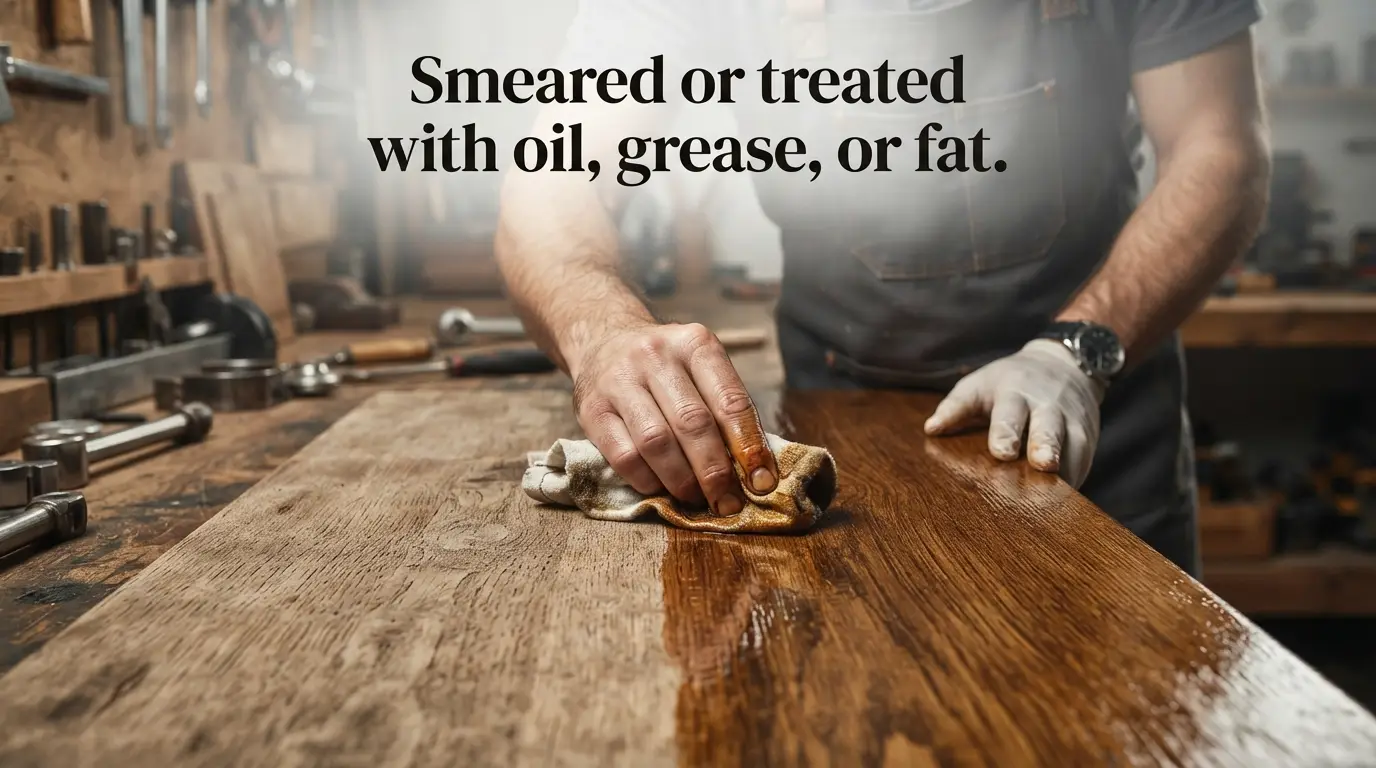
Greased (Adjective) — US / UK Pronunciation
- Meaning: Smearred or treated with oil, grease, or fat.
- Tone/Register: Practical, Descriptive
- Example: Bakers greased baking pans before pouring cake batter.
- Example: Mechanics handled greased engine parts with rags.
SYNONYMS BY TONE
Word choice dictates how an audience receives your message. Using positive synonyms like rich, creamy, or nourishing highlights culinary appeal and energy. Neutral terms like lipid, adipose, or viscous keep scientific writing precise and objective. Medical or critical contexts favor words like higher weight or flabby, while everyday speech uses greasy or heavier. Selecting the right tone ensures your writing resonates accurately with your readers.
More Synonyms for Fat, Fatty Foods, and Cooking Fat
Different contexts require different words to describe fat, fatty foods, cooking ingredients, and fatty substances. The best synonym depends on whether you are discussing food, nutrition, animal fat, or physical characteristics.
Synonyms for Fatty Foods and Snacks
Common synonyms and alternative expressions for fatty foods include high-fat, fat-rich, greasy, oily, rich, and fat-laden. Each term describes a slightly different characteristic.
- High-fat: Containing a relatively large amount of fat.
- Fat-rich: Providing a substantial amount of dietary fat.
- Greasy: Covered with or containing noticeable oil or grease.
- Oily: Having an oily texture or containing considerable oil.
- Rich: Having a full, heavy flavor, often because of fat or cream.
- Fat-laden: Containing a large amount of fat.
Examples:
- Potato chips are often considered high-fat snacks.
- Greasy fries can leave an oily residue on your fingers.
- Creamy desserts are rich and satisfying.
- Nuts and seeds are fat-rich foods that also provide other nutrients.
These expressions are not always interchangeable. For example, high-fat describes nutritional composition, whereas greasy usually describes texture or excess oil.
What Is Another Word for Cooking Fat?
Cooking fat refers to fats and oils used to prepare food, fry ingredients, or improve the texture of baked goods. Common terms include cooking oil, lard, shortening, butter, ghee, and rendered fat.
- Cooking oil: Oil used for frying, roasting, or other cooking methods.
- Lard: Rendered fat obtained from pigs, commonly used in baking and cooking.
- Shortening: A solid or semi-solid fat used to create a tender texture in baked goods.
- Butter: A dairy product containing milk fat, used in cooking and baking.
- Ghee: Clarified butter commonly used in South Asian and other cuisines.
- Rendered fat: Fat separated from animal tissue through heating.
Example: Butter, ghee, and cooking oil can all be used to prepare food, but their flavor, composition, and cooking properties differ.
The word fat is a general term, while these alternatives identify particular ingredients or types of cooking fat.
What Is the Synonym for Pork Fat?
The most common term for rendered pork fat is lard. Other related expressions include pork fat, back fat, and pork fat trimmings, depending on the specific part of the animal and how the fat is used.
- Lard: Rendered pork fat used in cooking and baking.
- Pork fat: A general term for fatty tissue obtained from a pig.
- Back fat: Fat taken from the back of a pig, which may be rendered or used in food preparation.
- Pork fat trimmings: Fatty portions removed when meat is trimmed.
Example: Traditional pastry recipes sometimes use lard to produce a flaky crust.
Although these terms are related, they are not exact synonyms. Lard specifically refers to rendered pork fat, while back fat and trimmings describe particular forms of pork fat.
Fancy and Formal Words for Fat
Writers sometimes look for more sophisticated alternatives to the word fat. The appropriate choice depends on whether they are describing a person’s build, food, or biological tissue.
- Corpulent: A formal, old-fashioned term for a person with a large body.
- Rotund: Describes a rounded body shape or appearance.
- Stout: Can describe a solid or heavy build; it may sound dated when used for people.
- Portly: A traditional, somewhat dated term for a person with a large build.
- Adipose: A scientific adjective referring to fat or fat-storing tissue.
- Lipid-rich: Describes a substance containing a substantial amount of lipids.
- Fat-laden: A descriptive term for something containing considerable fat.
Examples:
- The scientist examined adipose tissue under a microscope.
- The recipe produced a rich, fat-laden sauce.
- The historical novel described a rotund merchant.
When describing people, neutral expressions such as larger-bodied or person with a larger build may be more respectful than judgmental or outdated terms.
Synonyms for Fat That Start With S
Several words beginning with the letter S can describe a heavy build or a quality associated with animal fat. However, not all of them are direct synonyms for fat.
- Stout: Describes a solid or heavy body build.
- Stocky: Refers to a broad, compact, and solid physique.
- Suety: Resembling suet, the hard fat found around the kidneys of certain animals.
Examples:
- The stocky dog had a broad chest and short legs.
- Traditional recipes sometimes use suet to prepare puddings.
- The stout man wore a heavy winter coat.
Use stocky or stout when describing body build, and suety when discussing the texture or composition of animal fat.
Fat vs. Fats vs. Lipids vs. Fatty Acids
The words fat, fats, lipids, and fatty acids are related, but they have different meanings in nutritional and scientific writing.
- Fat: Can refer to a substance containing lipids, body fat, or the general category of dietary fat.
- Fats: Commonly refers to dietary fats or different fat substances.
- Lipids: A broad scientific category of biological molecules that includes fats, oils, phospholipids, and sterols.
- Fatty acids: Molecules that serve as components of many fats and other lipids.
- Adipose tissue: Specialized body tissue that stores energy largely in the form of fat.
Examples:
- The nutrition label lists the total fat per serving.
- Researchers measured the lipid content of the sample.
- Fatty acids contribute to the structure and function of cell membranes.
- Adipose tissue stores energy and helps insulate the body.
These scientific terms should not be used as exact substitutes for one another. For example, lipid is broader than fatty acid, while adipose specifically relates to fat tissue.
Other Words for Fat: Quick Reference
Here is a quick reference to help you choose the right synonym for your sentence.
| Context | Suitable word or phrase |
|---|---|
| Food containing much fat | High-fat, fat-rich |
| Food with excess oil | Greasy, oily |
| Rich-tasting food | Rich, buttery, creamy |
| Pork fat | Lard, pork fat |
| Cooking ingredients | Cooking oil, butter, ghee, shortening |
| Scientific writing | Lipid-rich, adipose |
| Fat-storing body tissue | Adipose tissue |
| Fatty molecules | Lipids, fatty acids |
| Broad or compact body build | Stocky, stout |
| Hard animal fat | Suet; suety as an adjective |
Choosing the right alternative to fat or fatty makes your writing more accurate and natural. Always consider the subject and context before selecting a synonym, particularly when distinguishing food texture, nutritional composition, and scientific terminology.
MINI COMPARISON
Fatty vs. Greasy vs. Oily
- Fatty: Refers broadly to foods or biological tissues containing lipids, fats, or heavy nourishment. Use it in nutritional or medical contexts.
- Greasy: Implies an unpleasant, excessive layer of animal fat or cooking oil residue. Use it for foods or surfaces that feel slick and dirty.
- Oily: Denotes a smooth liquid consistency resembling plant or mineral oils. Use it for skin types, cosmetics, or machine lubricants.
CONTEXT-BASED USAGE
Daily conversation requires simple terms like greasy or heavy rather than complex biochemical nouns. Writing or blogging benefits from engaging variations like buttery or rich to capture reader appetite and sensory appeal. Professional and academic papers demand precise vocabulary such as adipose or lipid. Creative storytelling uses nuanced alternatives like rotund or stout to build memorable character descriptions.
COMMON MISTAKES & NATIVE USAGE
Writers often confuse fatty with fetid, misspelling words or misapplying medical terms in food descriptions. Overusing clinical words like adipose in restaurant reviews makes text sound robotic. Native speakers prefer concise phrases like greasy food in spoken English, saving words like oleaginous for academic chemistry reports. Always match your word choice to your audience’s reading level.
REAL-LIFE MINI SCENARIOS
- Workplace: The nutritional scientist analyzed the lipid profile of the dairy sample.
- Social situations: Friends laughed over a plate of greasy late-night fries.
- Media/pop culture: The documentary explored animal blubber layers in marine survival.
- Writing or storytelling: The author described the village innkeeper as a jolly, rotund man.
CONCLUSION
Understanding synonyms for fatty helps you describe foods, substances, and textures with greater precision. However, related words are not always exact substitutes. For example, oily often describes a noticeable oiliness, while high-fat specifically refers to a large amount of fat.
Using synonyms for fatty can make your writing more varied and descriptive. Words such as greasy, oily, rich, high-fat, and lipid-rich can suit different contexts. Selecting the wrong alternative may change the meaning or make a sentence sound unnatural, so context is important.
Learning synonyms for fatty can strengthen your vocabulary and improve descriptive writing. These alternatives are useful when discussing food, ingredients, textures, or scientific topics. With regular practice, you can choose words that communicate your intended meaning clearly while making your writing more natural, specific, and engaging.
PRACTICE EXERCISE
- Which synonym best fits a scientific report on animal fat storage cells?
- A) Adipose
- B) Greasy
- C) Saucy
- D) Pasty
- Select the best term for French fries covered in excess cooking oil.
- A) Greasy
- B) Adipose
- C) Lipid
- D) Sebaceous
- Which word describes a rich chocolate cake that is heavy to digest?
- A) Rich
- B) Dry
- C) Lean
- D) Crisp
- What term fits a medical study measuring fat-related biochemical molecules?
- A) Lipid
- B) Gravy-laden
- C) Butter-soaked
- D) Glaze-coated
- Which alternative highlights marine mammal fat used for thermal warmth?
- A) Blubber
- B) Syrup
- C) Water
- D) Broth
- Choose the synonym for skin glands that secrete natural oils.
- A) Sebaceous
- B) Skeletal
- C) Muscular
- D) Dental
- Which word suits a polite, gentle description of a baby’s soft cheeks?
- A) Plump
- B) Corpulent
- C) Higher weight
- D) Rotund
- Select the term for a short, solidly built wrestling physique.
- A) Stocky
- B) Flabby
- C) Slender
- D) Gaunt
- What word describes a thick, honey-like viscous liquid flow?
- A) Viscous
- B) Thin
- C) Aqueous
- D) Dry
- Which synonym works best for warm, comforting, and nourishing winter stew?
- A) Hearty
- B) Greasy
- C) Oily
- D) Pasty
Reflection Task: Write one original sentence using the synonym rich in a culinary review context.
Answer Key: 1. A, 2. A, 3. A, 4. A, 5. A, 6. A, 7. A, 8. A, 9. A, 10. A
FAQs
What Does “Fatty” Mean?
“Fatty” generally describes something that contains a high amount of fat. It can refer to food, substances, or physical characteristics.
What Is the Best Synonym for “Fatty”?
Common synonyms include oily, greasy, rich, high-fat, and lipid-rich. The most suitable option depends on the context.
Is “Oily” a Synonym for “Fatty”?
Yes, oily can be used in some contexts, especially when describing food or substances containing or covered with oil. However, the two words are not always interchangeable.
What Is a Formal Synonym for “Fatty”?
Lipid-rich or high-fat can be appropriate in scientific, nutritional, or professional contexts, depending on what you are describing.
How Can I Use Synonyms for “Fatty” in Writing?
Choose a synonym based on the intended meaning. For example, greasy can describe an unpleasant oily texture, while high-fat is useful for nutritional descriptions.

Hasnain Ali is an SEO Content Strategist and the founder of wordvora.com, a trusted vocabulary platform that helps writers, students, professionals, and English learners find accurate synonyms, antonyms, word meanings, and real-life usage examples. He specializes in keyword research, on-page SEO, topical authority, and creating search-first content that aligns with Google’s latest Search Quality and E-E-A-T guidelines. His work focuses on producing clear, well-structured, and reader-friendly resources that satisfy search intent while maintaining high editorial standards.
Through extensive hands-on experience with SEO tools such as Google Search Console, Google Analytics, SEMrush, and Ahrefs, Hasnain researches user search behavior and develops content that is both informative and easy to understand. Every article published on wordvora.com is carefully reviewed for accuracy, readability, and contextual relevance before publication. His mission is to build one of the web’s most reliable English vocabulary resources by providing practical language guidance, trustworthy explanations, and content that helps readers improve their writing, communication, and vocabulary with confidence.