
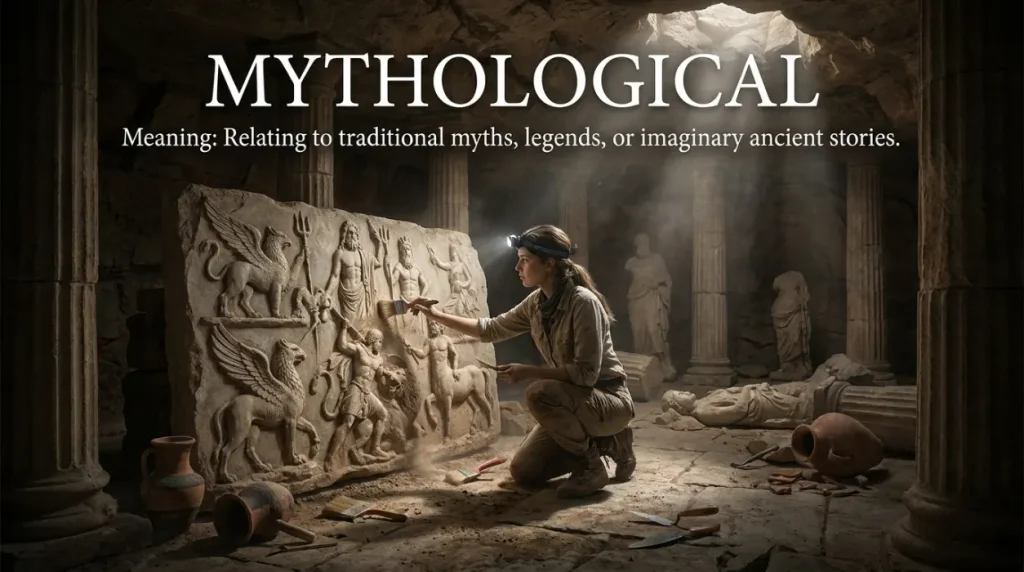
Synonyms for mythological can make a story sound richer. Imagine describing an ancient hero, a legendary beast, or a sacred tale without repeating the same adjective.
A student writing about Greek gods may call a story mythological. A blogger, however, might choose legendary, folkloric, or mythic to create a different effect.
Learning synonyms for mythological helps you express age, tradition, mystery, and cultural importance with greater precision and style.
In this article, we will explore mythological synonyms, their meanings, and useful examples. Learning these related words will help you expand your vocabulary and choose the right expression for different writing and communication situations.
What Does “Mythological” Really Mean?
Mythological is an adjective. It describes something connected with myths, especially traditional stories involving gods, supernatural beings, heroes, origins, or extraordinary events.
Simple Definition
Mythological: relating to myths, legendary stories, or traditional tales about gods, heroes, supernatural beings, or a culture’s origins.
For example:
The museum displayed a statue of a mythological goddess.
Here, mythological tells us that the goddess belongs to a traditional mythic tradition.
The word can also describe creatures, places, objects, characters, events, or themes.
The novel contains several mythological creatures.
Native speakers usually associate mythological with ancient cultures, traditional stories, religion-related traditions, folklore, fantasy, and classical literature.
However, the word does not necessarily mean false. That distinction is important. A mythological story can have deep cultural, symbolic, religious, or historical importance even when it is not presented as literal history.
Part of Speech
Mythological is primarily an adjective.
It commonly appears before nouns:
- mythological creature
- mythological hero
- mythological story
- mythological figure
- mythological tradition
- mythological world
It can also appear after linking verbs:
The character is mythological in origin.
Connotative Meaning
Connotation (the emotional or cultural feeling associated with a word beyond its basic dictionary meaning) matters when choosing an alternative to mythological.
Positive Tone
The word can suggest wonder, beauty, mystery, cultural richness, and imagination.
The garden had a mythological atmosphere.
Here, the adjective creates a sense of enchantment.
Negative Tone
In some contexts, alternatives such as fabulous, fictitious, or imaginary can suggest that something is invented or unreliable.
However, mythological itself is usually not strongly negative.
Neutral Tone
In academic writing, mythological is generally descriptive.
The paper examines mythological traditions in ancient Greece.
The sentence does not praise or criticize the tradition. It simply identifies the subject.

Etymology of “Mythological”
The English word mythological comes from the Greek-rooted word mythology.
The key root is Greek mythos, meaning “story,” “tale,” or “traditional narrative.” The related Greek logia refers to the study or systematic treatment of a subject.
The adjective developed through Latin and French influence before becoming established in English.
Old English: 450–1100
Mythological was not an Old English word.
Old English speakers had their own vocabulary for stories, tales, traditions, gods, and supernatural beliefs. However, the Greek-derived academic terminology used today had not yet entered English.
Middle English: 1100–1500
After the Norman Conquest, English absorbed many French and Latin terms.
Classical learning gradually became more influential in English intellectual vocabulary. Words connected with Greek and Roman literature entered scholarly language through Latin and French channels.
Modern English: 1500–Present
During the Renaissance, interest in classical Greek and Roman culture increased significantly.
Consequently, myth, mythology, and mythological became established English vocabulary. Today, mythological appears in literature, history, religious studies, anthropology, education, journalism, entertainment, and fantasy writing.
Pronunciation
US: /ˌmɪθəˈlɑːdʒɪkəl/
UK: /ˌmɪθəˈlɒdʒɪkəl/
Syllables
my-tho-log-i-cal
Affixation Pattern of “Mythological”
Root: myth
Prefix: none
Suffix: -ological
The word ultimately connects to Greek mythos, meaning story or traditional tale.
Synonyms List
Legendary (Adjective) — US: /ˈlɛndənɛri/ — UK: /ˈlɛndənəri/
- Meaning: Remarkable enough to be famous; based on legends.
- Tone/Register: Common, admiring.
- Example: The musician achieved legendary status worldwide.
- Example: Ancient texts described legendary heroes fighting dragons.
Fabled (Adjective) — US: /ˈfeɪbəld/ — UK: /ˈfeɪbəld/
- Meaning: Celebrated in fables; traditional and legendary.
- Tone/Register: Literary, descriptive.
- Example: Travelers searched for the fabled city of gold.
- Example: The book explored fabled creatures of the deep ocean.
Mythic (Adjective) — US: /ˈmɪθɪk/ — UK: /ˈmɪθɪk/
- Meaning: Relating to or characteristic of myths or folk tales.
- Tone/Register: Literary, elevated.
- Example: The poem captured a powerful mythic atmosphere.
- Example: Painters portrayed mythic battles on canvas.
Folklore (Adjective use / Noun) — US: /ˈfoʊkˌlɔːr/ — UK: /ˈfəʊkˌlɔː/
- Meaning: Traditional beliefs, customs, and stories of a community.
- Tone/Register: Cultural, common.
- Example: Local folklore warned children away from dark woods.
- Example: Village elders shared rich folklore tales at night.
Traditional (Adjective) — US: /trəˈdɪʃənəl/ — UK: /trəˈdɪʃənəl/
- Meaning: Existing in or as part of a long-established custom.
- Tone/Register: Common, formal.
- Example: Families celebrated weddings with traditional dances.
- Example: Craftspeople used traditional woodworking methods.
Folkloric (Adjective) — US: /ˌfoʊkˈlɔːrɪk/ — UK: /ˌfəʊkˈlɔːrɪk/
- Meaning: Relating to folklore or traditional stories.
- Tone/Register: Academic, cultural.
- Example: Anthropologists analyzed folkloric motifs in local art.
- Example: The festival celebrated folkloric music traditions.
Epic (Adjective) — US: /ˈɛpɪk/ — UK: /ˈepɪk/
- Meaning: Long and grand; relating to a heroic poem or story.
- Tone/Register: Dramatic, common.
- Example: The film featured an epic battle sequence.
- Example: Travelers embarked on an epic cross-country journey.
Saga (Noun / Adjective use) — US: /ˈsɑːɡə/ — UK: /ˈsɑːɡə/
- Meaning: A long, involved story, account, or series of incidents.
- Tone/Register: Literary, descriptive.
- Example: Norse sagas detailed voyages across freezing seas.
- Example: The family drama became a multi-generational saga.
Classical (Adjective) — US: /ˈklæsɪkəl/ — UK: /ˈklæsɪkl/
- Meaning: Relating to ancient Greek or Latin literature and art.
- Tone/Register: Academic, formal.
- Example: Students read classical Greek philosophy in college.
- Example: The museum exhibited classical marble statues.
Ancient (Adjective) — US: /ˈeɪnʃənt/ — UK: /ˈeɪnʃənt/
- Meaning: Belonging to the very distant past.
- Tone/Register: Common, historical.
- Example: Archaeologists unearthed ancient pottery shards in ruins.
- Example: Ancient civilizations built massive stone monuments.
Old (Adjective) — US: /oʊld/ — UK: /əʊld/
- Meaning: Having lived for a long time or dating from the past.
- Tone/Register: Common, casual.
- Example: Grandfather shared old stories by the fire.
- Example: They renovated an old farmhouse downtown.
Timeless (Adjective) — US: /ˈtaɪmləs/ — UK: /ˈtaɪmləs/
- Meaning: Not restricted by time; remaining valuable forever.
- Tone/Register: Literary, admiring.
- Example: Shakespearean plays offer timeless human insights.
- Example: The pianist performed a timeless classical melody.
Enduring (Adjective) — US: /ɪnˈdʊrɪŋ/ — UK: /ɪnˈdjʊərɪŋ/
- Meaning: Lasting over a long period of time.
- Tone/Register: Formal, descriptive.
- Example: Friendship is built on enduring mutual trust.
- Example: The artwork left an enduring cultural impression.
Historic (Adjective) — US: /hɪˈstɔːrɪk/ — UK: /hɪˈstɒrɪk/
- Meaning: Famous or important in history, past or future.
- Tone/Register: Formal, professional.
- Example: Leaders signed a historic peace treaty today.
- Example: The town square preserved historic colonial buildings.
Historical (Adjective) — US: /hɪˈstɔːrɪkəl/ — UK: /hɪˈstɒrɪkl/
- Meaning: Concerning past events or history.
- Tone/Register: Academic, formal.
- Example: Researchers verified historical records in archives.
- Example: Historical novels require careful factual research.
Chronicle (Noun / Adjective use) — US: /ˈkrɒnɪkəl/ — UK: /ˈkrɒnɪkl/
- Meaning: A factual or fictional written account of important events.
- Tone/Register: Literary, formal.
- Example: Monks wrote medieval chronicles of royal reigns.
- Example: The documentary served as a vivid chronicle of war.
Annals (Noun) — US: /ˈænəlz/ — UK: /ˈænəlz/
- Meaning: Historical records or a periodic journal of events.
- Tone/Register: Academic, formal.
- Example: The discovery entered the annals of scientific history.
- Example: Library archives stored ancient town annals securely.
Archives (Noun) — US: /ˈɑːrkaɪvz/ — UK: /ˈɑːkaɪvz/
- Meaning: A collection of historical documents or records.
- Tone/Register: Professional, academic.
- Example: Historians searched government archives for old maps.
- Example: University archives preserved student newspapers.
Lore (Noun) — US: /lɔːr/ — UK: /lɔː/
- Meaning: Traditions and knowledge on a subject held by a group.
- Tone/Register: Literary, cultural.
- Example: Woodland lore taught travelers how to track wildlife.
- Example: Fantasy novels built intricate worlds filled with magical lore.
Saga-like (Adjective) — US: /ˈsɑːɡə laɪk/ — UK: /ˈsɑːɡə laɪk/
- Meaning: Resembling a long, heroic narrative saga.
- Tone/Register: Descriptive, literary.
- Example: The movie offered a saga-like storytelling scope.
- Example: Readers loved the saga-like plot twists.
Mythical (Adjective) — US: /ˈmɪθɪkəl/ — UK: /ˈmɪθɪkl/
- Meaning: Occurring in or characteristic of myths or folk tales.
- Tone/Register: Common, descriptive.
- Example: Unicorns are popular mythical creatures in stories.
- Example: Ancient sailors feared mythical sea monsters.
Legendary Tale (Phrase) — US: /ˈlɛndənɛri teɪl/ — UK: /ˈlɛndənəri teɪl/
- Meaning: A story passed down that has become famous.
- Tone/Register: Descriptive, narrative.
- Example: Grandparents told children a legendary tale of bravery.
- Example: The book collection featured every legendary tale.
Fabled Story (Phrase) — US: /ˈfeɪbəld ˈstɔːri/ — UK: /ˌfeɪbəld ˈstɔːri/
- Meaning: A narrative rooted in traditional fable and myth.
- Tone/Register: Literary, casual.
- Example: The bard sang a fabled story of royal romance.
- Example: Children listened to a fabled story before sleep.
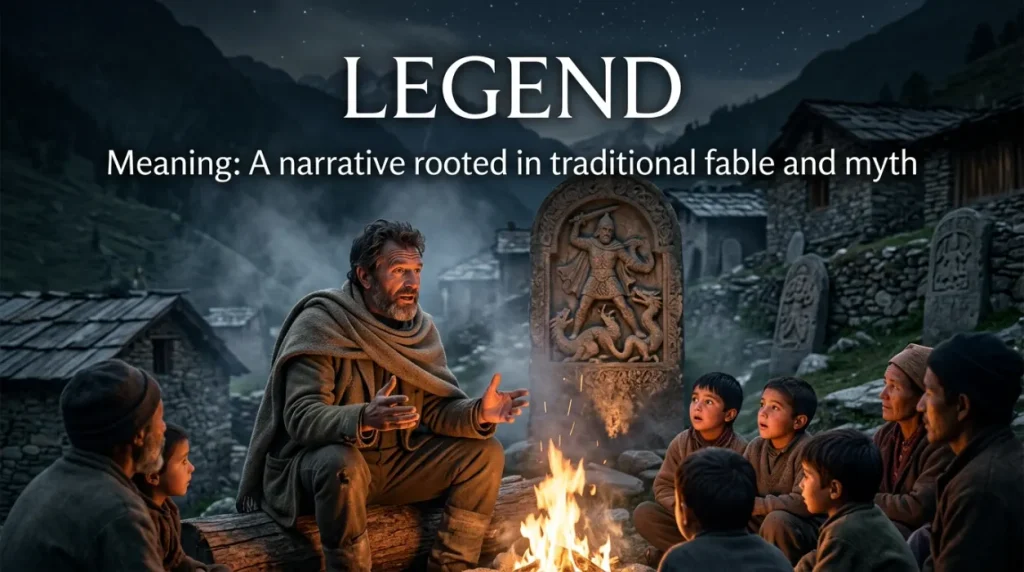
Mythic Lore (Phrase) — US: /ˈmɪθɪk lɔːr/ — UK: /ˈmɪθɪk lɔː/
- Meaning: Traditional stories and knowledge of myths.
- Tone/Register: Academic, literary.
- Example: Scholars studied ancient Greek mythic lore.
- Example: Game designers drew inspiration from mythic lore.
Apocryphal (Adjective) — US: /əˈpɒkrɪfəl/ — UK: /əˈpɒkrɪfl/
- Meaning: Of doubtful authenticity, although widely circulated as true.
- Tone/Register: Academic, formal.
- Example: The story about the hidden treasure was entirely apocryphal.
- Example: Historians dismissed the apocryphal royal letter.
Fabulist (Adjective / Noun) — US: /ˈfæbjʊlɪst/ — UK: /ˈfæbjʊlɪst/
- Meaning: A composer of fables or someone who invents false stories.
- Tone/Register: Literary, formal.
- Example: Aesop remains history’s most famous ancient fabulist.
- Example: Critics labeled the tall tales the work of a fabulist.
Invented (Adjective) — US: /ɪnˈvɛntɪd/ — UK: /ɪnˈventɪd/
- Meaning: Made up or created in the mind rather than real.
- Tone/Register: Common, direct.
- Example: Children played games with invented magic rules.
- Example: The sci-fi author used an invented alien language.
Fictional (Adjective) — US: /ˈfɪkʃənəl/ — UK: /ˈfɪkʃənəl/
- Meaning: Existing in imagination or fiction, not real.
- Tone/Register: Common, literary.
- Example: Sherlock Holmes is a famous fictional detective.
- Example: The library organized shelves by fictional genres.
Imaginary (Adjective) — US: /ɪˈmædʒɪnəri/ — UK: /ɪˈmædʒɪnəri/
- Meaning: Existing only in the imagination.
- Tone/Register: Common, descriptive.
- Example: The child played happily with an imaginary friend.
- Example: Writers create imaginary worlds in fantasy books.
Fabricated (Adjective) — US: /ˈfæbrɪkeɪtɪd/ — UK: /ˈfæbrɪkeɪtɪd/
- Meaning: Invented or made up; artificial or false.
- Tone/Register: Formal, critical.
- Example: Investigators proved the alibi was entirely fabricated.
- Example: The newspaper retracted the fabricated article.
Made-Up (Adjective) — US: /meɪd ʌp/ — UK: /meɪd ʌp/
- Meaning: Invented or artificial, not based on truth.
- Tone/Register: Casual, common.
- Example: The boy told a made-up excuse for being late.
- Example: Board games often feature made-up fantasy rules.
Supposed (Adjective) — US: /səˈpoʊzd/ — UK: /səˈpəʊzd/
- Meaning: Generally considered or believed to be true.
- Tone/Register: Neutral, common.
- Example: The supposed treasure map turned out to be blank.
- Example: She met her supposed cousin at the family reunion.
Alleged (Adjective) — US: /əˈlɛdʒd/ — UK: /əˈlɛdʒd/
- Meaning: Said, without proof, to have taken place or happened.
- Tone/Register: Legal, formal.
- Example: Reporters investigated the alleged financial fraud.
- Example: The suspect denied participation in the alleged crime.
Rumored (Adjective) — US: /ˈruːmərd/ — UK: /ˈruːməd/
- Meaning: Circulated as an unverified report or story.
- Tone/Register: Casual, common.
- Example: A rumored corporate merger boosted stock prices.
- Example: Villagers whispered about rumored ghosts in the attic.
Folklore-based (Adjective) — US: /ˈfoʊkˌlɔːr beɪst/ — UK: /ˈfəʊkˌlɔː beɪst/
- Meaning: Rooted in traditional folk stories and myths.
- Tone/Register: Cultural, descriptive.
- Example: The indie film featured a folklore-based monster plot.
- Example: Artists crafted folklore-based wooden sculptures.
Traditionalist (Adjective / Noun) — US: /trəˈdɪʃənəlɪst/ — UK: /trəˈdɪʃənəlɪst/
- Meaning: Adhering to traditional practices or beliefs.
- Tone/Register: Formal, cultural.
- Example: Cultural traditionalists preserved ancient weaving methods.
- Example: The museum director was a staunch traditionalist.
Folklorist (Noun / Adjective use) — US: /ˈfoʊklərɪst/ — UK: /ˈfəʊklərɪst/
- Meaning: A person who studies traditional folklore.
- Tone/Register: Academic, professional.
- Example: Fieldwork allowed the folklorist to record old songs.
- Example: University folklorists published regional ghost stories.
Mythmaker (Noun) — US: /ˈmɪθˌmeɪkər/ — UK: /ˈmɪθˌmeɪkə/
- Meaning: A person who invents or perpetuates myths.
- Tone/Register: Literary, descriptive.
- Example: Ancient bards acted as community mythmakers.
- Example: Fantasy authors are modern cultural mythmakers.
Storyteller (Noun) — US: /ˈstɔːriˌtɛlər/ — UK: /ˈstɔːriˌtelə/
- Meaning: A person who tells or writes stories.
- Tone/Register: Common, warm.
- Example: The grandmother was a gifted evening storyteller.
- Example: Librarians hosted a children’s storyteller session.
Bard (Noun) — US: /bɑːrd/ — UK: /bɑːd/
- Meaning: A poet, traditionally one reciting epic poems.
- Tone/Register: Literary, historical.
- Example: Traveling bards sang of ancient heroic battles.
- Example: Shakespeare is often called the immortal bard.
Minstrel (Noun) — US: /ˈmɪnstrəl/ — UK: /ˈmɪnstrəl/
- Meaning: A medieval singer or musician who sang lyric or narrative poetry.
- Tone/Register: Historical, literary.
- Example: Court minstrels entertained nobles with lute music.
- Example: Festival performers dressed up like medieval minstrels.
Chronicler (Noun) — US: /ˈkrɒnɪklər/ — UK: /ˈkrɒnɪklə/
- Meaning: A person who records historical events in a chronicle.
- Tone/Register: Formal, academic.
- Example: Royal chroniclers kept meticulous court journals.
- Example: The journalist served as a chronicler of modern change.
Biographer (Noun) — US: /baɪˈɒɡrəfər/ — UK: /baɪˈɒɡrəfə/
- Meaning: An author who writes someone’s life story.
- Tone/Register: Professional, formal.
- Example: The author worked as Lincoln’s lead biographer.
- Example: Biographers researched presidential letters in archives.
Historian (Noun) — US: /hɪˈstɔːriən/ — UK: /hɪˈstɔːriən/
- Meaning: An expert in or student of history.
- Tone/Register: Academic, professional.
- Example: Museum historians authenticated the medieval armor.
- Example: University historians published new findings on war.
Scholar (Noun) — US: /ˈskɒlər/ — UK: /ˈskɒlə/
- Meaning: A specialist in a particular branch of study.
- Tone/Register: Academic, formal.
- Example: Classical scholars translated ancient Latin texts.
- Example: Research grants supported visiting academic scholars.
Academic (Adjective) — US: /ˌækəˈdɛmɪk/ — UK: /ˌækəˈdemɪk/
- Meaning: Relating to education and scholarship.
- Tone/Register: Formal, professional.
- Example: Students debated economic theories in academic seminars.
- Example: The library purchased new academic science journals.

Scholarly (Adjective) — US: /ˈskɒlərli/ — UK: /ˈskɒləli/
- Meaning: Involving or relating to serious academic study.
- Tone/Register: Formal, academic.
- Example: The professor wrote a scholarly book on poetry.
- Example: Researchers conducted scholarly reviews of data.
Erudite (Adjective) — US: /ˈɛrʊdaɪt/ — UK: /ˈerʊdaɪt/
- Meaning: Having or showing great knowledge or learning.
- Tone/Register: Formal, elevated.
- Example: The speaker delivered an erudite lecture on physics.
- Example: Erudite professors analyzed ancient language patterns.
Learned (Adjective) — US: /ˈlɜːrnɪd/ — UK: /lɜːnɪd/
- Meaning: Having much knowledge acquired by study.
- Tone/Register: Formal, academic.
- Example: Learned societies met annually to discuss science.
- Example: The judge gave a learned legal opinion.
Cultured (Adjective) — US: /ˈkʌltʃərd/ — UK: /ˈkʌltʃəd/
- Meaning: Characterized by refined taste, manners, and education.
- Tone/Register: Formal, polite.
- Example: Art collectors are typically very cultured individuals.
- Example: She enjoyed attending cultured classical concerts.
Refined (Adjective) — US: /rɪˈfaɪnd/ — UK: /rɪˈfaɪnd/
- Meaning: Elegant and polished in manner or appearance.
- Tone/Register: Formal, polite.
- Example: The restaurant offered refined dining experiences.
- Example: He spoke with refined literary eloquence.
Sophisticated (Adjective) — US: /səˈfɪstɪkeɪtɪd/ — UK: /səˈfɪstɪkeɪtɪd/
- Meaning: Having a great deal of worldly experience and knowledge.
- Tone/Register: Professional, formal.
- Example: Engineers built a sophisticated automated robot.
- Example: Investors used sophisticated financial software.
Polished (Adjective) — US: /ˈpɒlɪʃt/ — UK: /ˈpɒlɪʃt/
- Meaning: Stylish, elegant, and free from flaws or roughness.
- Tone/Register: Professional, polished.
- Example: The dancer delivered a polished performance.
- Example: Editors reviewed the manuscript until it was polished.
Elegant (Adjective) — US: /ˈɛlɪɡənt/ — UK: /ˈelɪɡənt/
- Meaning: Graceful and stylish in appearance or manner.
- Tone/Register: Formal, admiring.
- Example: She wore an elegant silk evening gown.
- Example: The mathematical proof was wonderfully elegant.
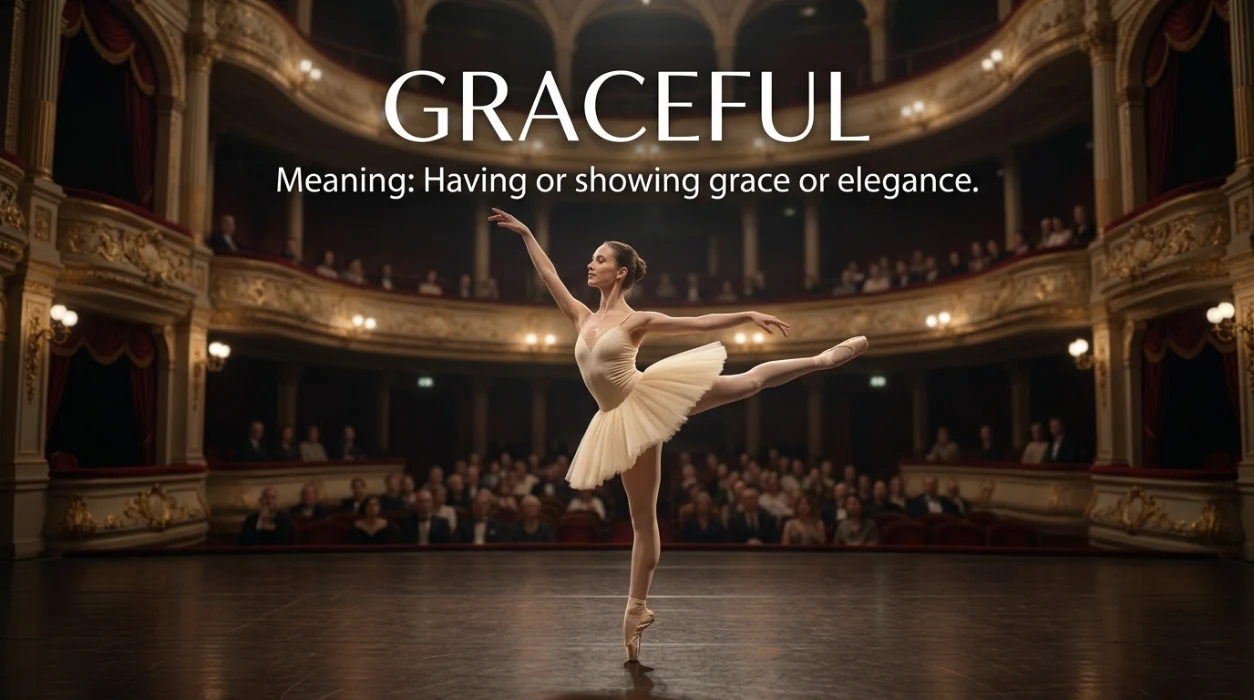
Graceful (Adjective) — US: /ˈɡreɪsfəl/ — UK: /ˈɡreɪsfəl/
- Meaning: Having or showing grace or elegance.
- Tone/Register: Common, admiring.
- Example: Ballet dancers moved with graceful precision.
- Example: Willow trees swept graceful branches downward.
Synonyms by Tone
Choosing the right alternative depends entirely on whether you want to sound literary, historical, or casual.
- Positive tone: Legendary, fabled, epic, timeless, mythical.
- Neutral tone: Traditional, folkloric, historical, classic.
- Negative tone: Apocryphal, fabricated, fictional, made-up.
- Playful/informal tone: Invented, rumored, tall-tale.
Tone matters because calling a historical account legendary sounds admiring and respectful, whereas dismissing it as apocryphal sounds skeptical and critical.
Mini Comparison: Mythological vs. Legendary vs. Fabled
- Mythological emphasizes direct roots in traditional religious or cultural myths and folklore.
- Legendary focuses on historical fame, grand heroism, or stories celebrated across generations.
- Fabled highlights imaginative storytelling, fairy tales, or magical literary fables.
Use mythological for ancient cultural myths, legendary for famous heroic exploits, and fabled for storybook wonder.
Context-Based Usage
- Daily conversation: In casual talk, native speakers use friendly terms like made-up, fictional, or legendary.
- Writing or blogging: Authors use evocative terms like fabled, mythic, or timeless to build rich fantasy prose.
- Professional or academic tone: Specialists rely on precise terms like folkloric, apocryphal, or classical.
- Creative or informal use: Bloggers employ vivid terms like mythmaker, saga, or lore to describe creative world-building.
Common Mistakes & Native Usage
Common Mistakes Learners Make
- Misuse scenarios: Applying dismissive words like fabricated when discussing cherished cultural myths and heritage.
- Confusing tone: Mixing overly scholarly terms like apocryphal into casual chats about weekend movies.
- Overuse warnings: Repeating the same descriptive adjective throughout an article makes your vocabulary feel repetitive rather than rich.
Register Notes
- Spoken chats favor direct words like legendary and fictional.
- Written essays reward descriptive choices like mythic, fabled, and mythological.
Real-Life Mini Scenarios
- Workplace: Marketing teams crafted epic branding campaigns inspired by legendary heroes.
- Social situations: Friends gathered at game nights to discuss fantasy lore and mythical creatures.
- Media/pop culture: Documentaries explored how ancient cultures turned historic leaders into legendary figures.
- Writing or storytelling: Authors revised book manuscripts, replacing basic words with fabled words for narrative depth.
Conclusion
In conclusion, mythological is a useful word for describing things connected to myths, legends, ancient traditions, and supernatural stories. It is commonly used when discussing legendary characters, gods, heroes, and imaginary events.
There are several helpful synonyms for mythological, including mythical, legendary, folkloric, supernatural, and fictional. Choosing the right alternative can make your writing more varied, descriptive, and engaging.
By understanding mythological and its related synonyms, you can expand your vocabulary and communicate ideas more effectively. Using these alternatives in the right context can make your writing clearer and more interesting.
Practice Exercise
- Which adjective best describes something based on traditional myths and legends?
- A) Mythological
- B) Mathematical
- C) Statistical
- D) Numerical
- What emotional tone does the admiring term legendary typically carry?
- A) Famous and remarkable
- B) Utterly boring
- C) Deeply offensive
- D) Completely mathematical
- Which term is ideal for describing a story celebrated in traditional fables?
- A) Fabled
- B) Industrial
- C) Commercial
- D) Corporate
- If a historical account is of doubtful authenticity, scholars call it:
- A) Apocryphal
- B) Verified
- C) Proven
- D) Exact
- The formal literary term for traditional community stories and customs is:
- A) Folklore
- B) Algebra
- C) Calculus
- D) Geometry
- What part of speech category do words like mythological and legendary belong to?
- A) Adjectives
- B) Verbs only
- C) Nouns only
- D) Conjunctions only
- Which expression is a common term for a person who invents or perpetuates myths?
- A) Mythmaker
- B) Accountant
- C) Auditor
- D) Plumber
- Describing a story or event as existing only in the mind uses the term:
- A) Imaginary
- B) Concrete
- C) Solid
- D) Physical
- The formal academic noun for a specialist in traditional folklore is:
- A) Folklorist
- B) Botanist
- C) Geologist
- D) Physicist
- Which word describes a traditional singer or poet of epic tales?
- A) Bard
- B) Baker
- C) Tailor
- D) Mason
Reflection Task
Write one short, original sentence using the word legendary to describe an ancient hero.
Answer Key: 1: A | 2: A | 3: A | 4: A | 5: A | 6: A | 7: A | 8: A | 9: A | 10: A
FAQs
1. What is the best synonym for mythological in academic writing?
Mythic, folkloric, and archetypal can work in academic writing, but they are not interchangeable. Mythic focuses on mythology or myth-like qualities, while folkloric covers a broader range of traditional cultural material. Archetypal emphasizes recurring symbolic patterns. For a direct reference to myths, however, mythological is often the clearest and most precise choice.
2. What is a simple synonym for mythological?
For everyday English, mythic, legendary, or myth-inspired can sometimes replace mythological. The best choice depends on context. Legendary is especially useful for famous traditional figures, while myth-inspired works when a modern creation takes ideas from mythology. If the subject directly belongs to a mythology, keeping mythological may be clearer.
3. Is legendary the same as mythological?
No. The meanings overlap, but they are different. Mythological specifically relates to myths, gods, supernatural figures, and traditional mythic narratives. Legendary can describe traditional stories, but it can also mean extremely famous or remarkable. For example, a legendary athlete does not have to be mythological. Context determines which adjective is accurate.
4. What is the difference between mythological and folkloric?
Mythological relates specifically to mythology and its stories, figures, gods, and supernatural narratives. Folkloric has a wider meaning and can include traditional songs, customs, beliefs, legends, fairy tales, sayings, and community practices. Therefore, mythology can be part of folklore, but folklore is not limited to mythology.
5. What word can replace mythological in a fantasy story?
Mythic, fantastical, magical, otherworldly, enchanted, and myth-inspired can all work in fantasy writing. Each creates a different effect. Mythic sounds grand and literary; magical emphasizes wonder, while otherworldly suggests an unfamiliar realm. Choose the alternative that best matches the atmosphere rather than replacing the word mechanically.

Hasnain Ali is an SEO Content Strategist and the founder of wordvora.com, a trusted vocabulary platform that helps writers, students, professionals, and English learners find accurate synonyms, antonyms, word meanings, and real-life usage examples. He specializes in keyword research, on-page SEO, topical authority, and creating search-first content that aligns with Google’s latest Search Quality and E-E-A-T guidelines. His work focuses on producing clear, well-structured, and reader-friendly resources that satisfy search intent while maintaining high editorial standards.
Through extensive hands-on experience with SEO tools such as Google Search Console, Google Analytics, SEMrush, and Ahrefs, Hasnain researches user search behavior and develops content that is both informative and easy to understand. Every article published on wordvora.com is carefully reviewed for accuracy, readability, and contextual relevance before publication. His mission is to build one of the web’s most reliable English vocabulary resources by providing practical language guidance, trustworthy explanations, and content that helps readers improve their writing, communication, and vocabulary with confidence.