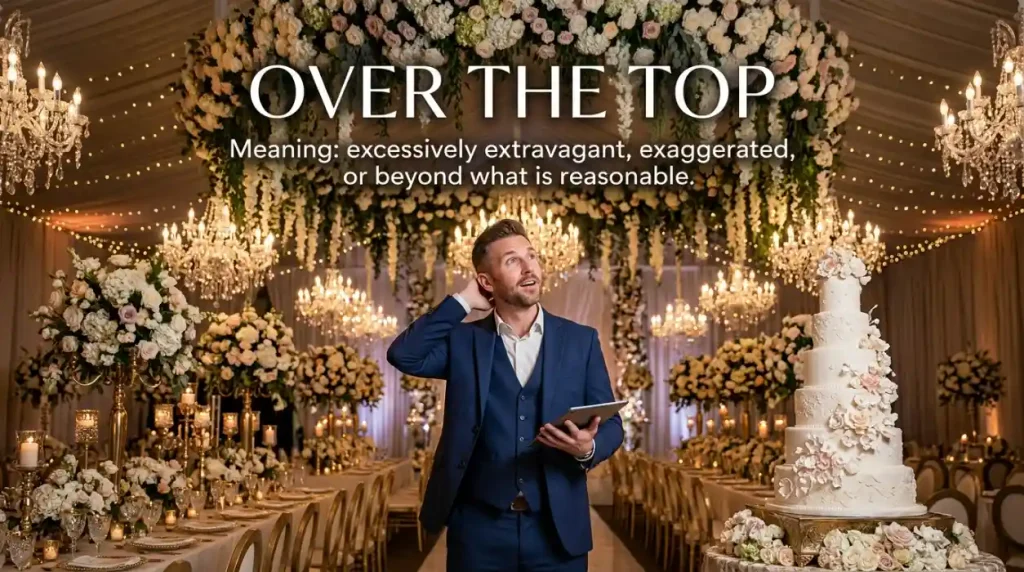
Synonyms for over the top become useful when “too much” feels too plain. Imagine a birthday party with fireworks, dancers, and a giant cake.
A friend might call it over the top because the celebration goes far beyond what people normally expect. The phrase is common in everyday English.
Learning synonyms for over the top helps you describe excess with greater precision. Students, bloggers, writers, and speakers can sound more natural.
Whether you are writing an essay, describing a movie, or chatting with friends, synonyms for over the top give you better choices.
What Does “Over the Top” Really Mean?
Over the top is an idiomatic adjective phrase that describes something excessive, exaggerated, dramatic, extravagant, or beyond what seems reasonable.
In simple English, it means “more than necessary or more extreme than expected.”
For example:
“Her reaction was over the top.”
This means her reaction was much stronger or more dramatic than the situation seemed to require.
Another example is:
“The decorations were completely over the top.”
Here, the decorations were extremely elaborate or extravagant.
Part of Speech
Over the top usually functions as an adjective phrase when it describes a person, action, style, event, reaction, or object.
It can also appear in other grammatical structures. For example:
“The celebration went over the top.”
“That costume is a little over the top.”
Native speakers commonly use the phrase in informal conversation, entertainment writing, reviews, social media, storytelling, and casual commentary.
How Native Speakers Understand It
Native speakers usually understand over the top as a judgment about degree.
The speaker thinks something has crossed an expected boundary.
However, the judgment is not always negative. A person may describe an extravagant party as “over the top” with admiration.
The meaning therefore depends heavily on context, voice, and intention.
Connotative Meaning
Connotation (the feeling, association, or emotional suggestion connected to a word beyond its basic dictionary meaning) plays an important role here.
Positive Tone
In a positive context, over the top can suggest excitement, creativity, generosity, glamour, or impressive extravagance.
“Her wedding was over the top, but everyone loved it.”
Negative Tone
In a negative context, it can suggest excess, poor judgment, unnecessary drama, wastefulness, or exaggeration.
“His response was completely over the top.”
Neutral Tone
Sometimes the phrase simply describes something unusually large, dramatic, or elaborate without strong praise or criticism.
“The movie uses over-the-top special effects.”
Therefore, choosing the right synonym depends on the emotion you want to communicate.
Etymology of “Over the Top”
The expression over the top originally has a literal connection with going beyond a physical boundary.
The phrase later became strongly associated with military language, especially the idea of soldiers going “over the top” of a trench during World War I.
From there, the expression developed a figurative meaning connected with going beyond normal limits.
Old English: 450–1100
The individual words have Germanic roots.
Over developed from Old English forms such as ofer, meaning above, across, or beyond.
Top developed from Germanic vocabulary referring to the highest point or upper part.
The modern idiom itself, however, did not exist in Old English in its present figurative form.
Middle English: 1100–1500
During Middle English, words related to over and top continued to develop and broaden.
English increasingly used combinations of words to express position, movement, and degree.
The modern figurative idiom came much later.
Modern English: 1500–Present
In Modern English, over the top gained specialized literal uses before developing broader figurative meanings.
By the twentieth century, the expression was commonly used to describe behavior, performances, designs, reactions, and situations that seemed excessively dramatic or elaborate.
Today, it is an established idiom in global English.
Pronunciation
US: /ˌoʊvər ðə ˈtɑːp/
UK: /ˌəʊvə ðə ˈtɒp/
Syllables
o-ver-the-top
The phrase contains four spoken units when pronounced naturally.
Affixation Pattern of “Over the Top”
The expression is a multi-word idiomatic phrase, not a single affixed word.
Root: over and top have Germanic roots.
Prefix: None.
Suffix: None.
The meaning comes from the combination of the words rather than from prefix or suffix changes.
Synonyms List
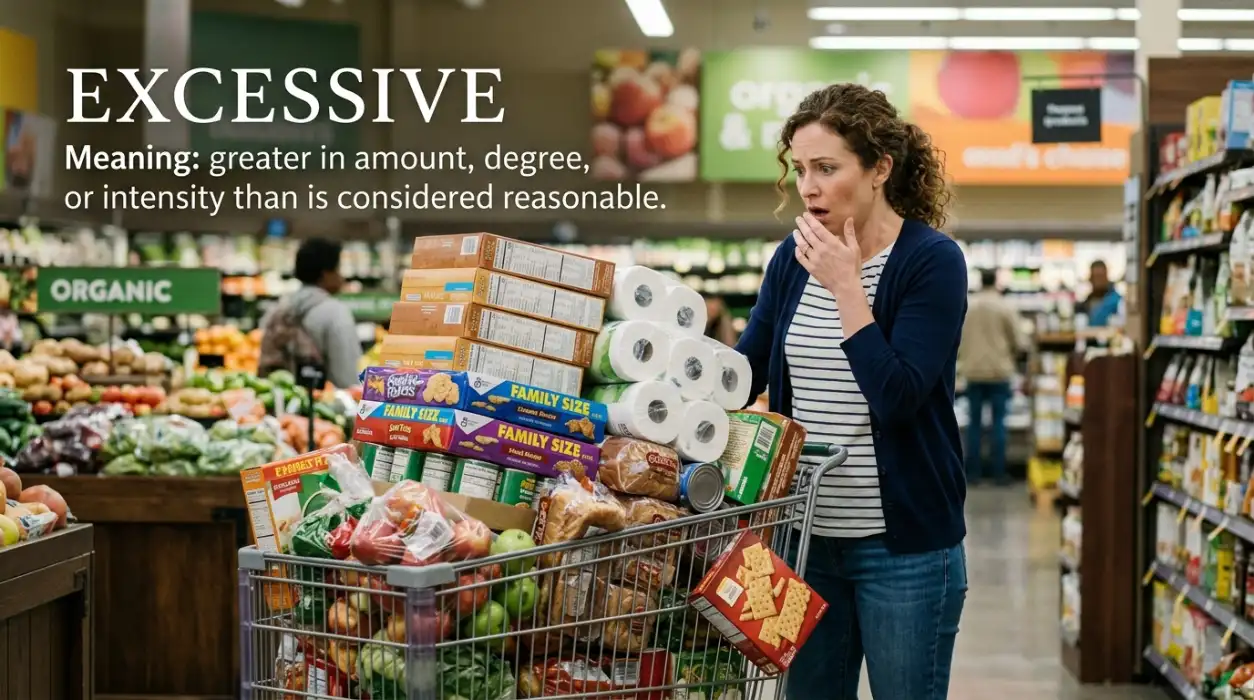
Excessive (Adjective) — US /ɪkˈsesɪv/ — UK /ɪkˈsesɪv/
Meaning: Greater in amount, degree, or intensity than is considered reasonable.
Tone/Register: Neutral, formal, academic.
Example:
The amount of paperwork was excessive.
The manager thought the rules were excessive.
Exaggerated (Adjective) — US /ɪɡˈzædʒəreɪtɪd/ — UK /ɪɡˈzædʒəreɪtɪd/
Meaning: Made to seem larger, stronger, or more important than it really is.
Tone/Register: Neutral, common.
Example:
His description of the accident sounded exaggerated.
The advertisement made exaggerated claims.
Extravagant (Adjective) — US /ɪkˈstrævəɡənt/ — UK /ɪkˈstrævəɡənt/
Meaning: Excessively elaborate, expensive, generous, or luxurious.
Tone/Register: Neutral to formal.
Example:
They planned an extravagant wedding.
Her gift was extravagant but thoughtful.
Extreme (Adjective) — US /ɪkˈstriːm/ — UK /ɪkˈstriːm/
Meaning: Far beyond what is ordinary, moderate, or expected.
Tone/Register: Neutral.
Example:
His reaction seemed extreme.
The team took an extreme approach to the problem.
Outrageous (Adjective) — US /aʊtˈreɪdʒəs/ — UK /aʊtˈreɪdʒəs/
Meaning: Shockingly excessive, unreasonable, or unconventional.
Tone/Register: Informal to neutral.
Example:
The actor wore an outrageous costume.
That was an outrageous response to a small mistake.
Overblown (Adjective) — US /ˌoʊvərˈbloʊn/ — UK /ˌəʊvəˈbləʊn/
Meaning: Excessively dramatic, elaborate, or exaggerated.
Tone/Register: Neutral, often critical.
Example:
The review used overblown language.
The speech felt overblown and theatrical.
Overdone (Adjective) — US /ˌoʊvərˈdʌn/ — UK /ˌəʊvəˈdʌn/
Meaning: Taken too far in style, emotion, decoration, or presentation.
Tone/Register: Neutral.
Example:
The special effects were overdone.
Her makeup looked slightly overdone.
Dramatic (Adjective) — US /drəˈmætɪk/ — UK /drəˈmætɪk/
Meaning: Very striking, emotional, or theatrical in a way that attracts attention.
Tone/Register: Neutral.
Example:
His entrance was wonderfully dramatic.
She gave a dramatic reaction to the news.
Theatrical (Adjective) — US /θiˈætrɪkəl/ — UK /θiˈætrɪkəl/
Meaning: Deliberately dramatic or showy, like a stage performance.
Tone/Register: Neutral to formal.
Example:
His apology was highly theatrical.
The presentation had a theatrical quality.
Melodramatic (Adjective) — US /ˌmelədrəˈmætɪk/ — UK /ˌmelədrəˈmætɪk/
Meaning: Excessively emotional or dramatic in a way that may seem unrealistic.
Tone/Register: Neutral, often critical.
Example:
Her reaction sounded melodramatic.
The film becomes melodramatic near the ending.
Histrionic (Adjective) — US /hɪˈstriɑːnɪk/ — UK /hɪˈstriɒnɪk/
Meaning: Extremely emotional or theatrical, especially when seeking attention.
Tone/Register: Formal, literary.
Example:
His histrionic response surprised everyone.
The article described the debate as histrionic.
Hyperbolic (Adjective) — US /ˌhaɪpərˈbɑːlɪk/ — UK /ˌhaɪpəˈbɒlɪk/
Meaning: Containing deliberate exaggeration for emphasis or effect.
Tone/Register: Academic, formal.
Example:
The headline was deliberately hyperbolic.
Her statement was colorful but hyperbolic.
Inflated (Adjective) — US /ɪnˈfleɪtɪd/ — UK /ɪnˈfleɪtɪd/
Meaning: Made to seem greater, more important, or more impressive than it really is.
Tone/Register: Neutral to formal.
Example:
The report contained inflated figures.
He has an inflated opinion of his abilities.
Magnified (Adjective) — US /ˈmæɡnəfaɪd/ — UK /ˈmæɡnɪfaɪd/
Meaning: Made to appear larger or more significant than it naturally is.
Tone/Register: Formal, neutral.
Example:
Social media can create magnified reactions.
The problem was magnified by poor communication.
Embellished (Adjective) — US /ɪmˈbelɪʃt/ — UK /ɪmˈbelɪʃt/
Meaning: Made more elaborate or interesting by adding extra details or decoration.
Tone/Register: Neutral.
Example:
He told an embellished version of the story.
The costume was heavily embellished.
Ornate (Adjective) — US /ɔːrˈneɪt/ — UK /ɔːˈneɪt/
Meaning: Highly decorated with many detailed or elaborate features.
Tone/Register: Formal, descriptive.
Example:
The ballroom had an ornate ceiling.
She chose an ornate frame for the painting.
Lavish (Adjective) — US /ˈlævɪʃ/ — UK /ˈlævɪʃ/
Meaning: Very generous, elaborate, or luxurious.
Tone/Register: Neutral to formal.
Example:
They hosted a lavish dinner.
The hotel gave the guests a lavish welcome.
Opulent (Adjective) — US /ˈɑːpjələnt/ — UK /ˈɒpjʊlənt/
Meaning: Extremely luxurious, rich, and expensive-looking.
Tone/Register: Formal, descriptive.
Example:
The palace has an opulent interior.
The film shows an opulent lifestyle.
Grandiose (Adjective) — US /ɡrænˈdioʊs/ — UK /ˈɡrændiəʊs/
Meaning: Impressively large or ambitious, sometimes to an unrealistic degree.
Tone/Register: Formal, often critical.
Example:
The proposal sounded grandiose.
His grandiose plans impressed some people and worried others.
Magnificent (Adjective) — US /mæɡˈnɪfəsənt/ — UK /mæɡˈnɪfɪsənt/
Meaning: Extremely impressive, beautiful, or splendid.
Tone/Register: Positive, formal to neutral.
Example:
The ceremony was magnificent.
They created a magnificent garden.
Spectacular (Adjective) — US /spekˈtækjələr/ — UK /spekˈtækjʊlə/
Meaning: Extremely impressive or visually striking.
Tone/Register: Positive, neutral.
Example:
The fireworks were spectacular.
She made a spectacular entrance.
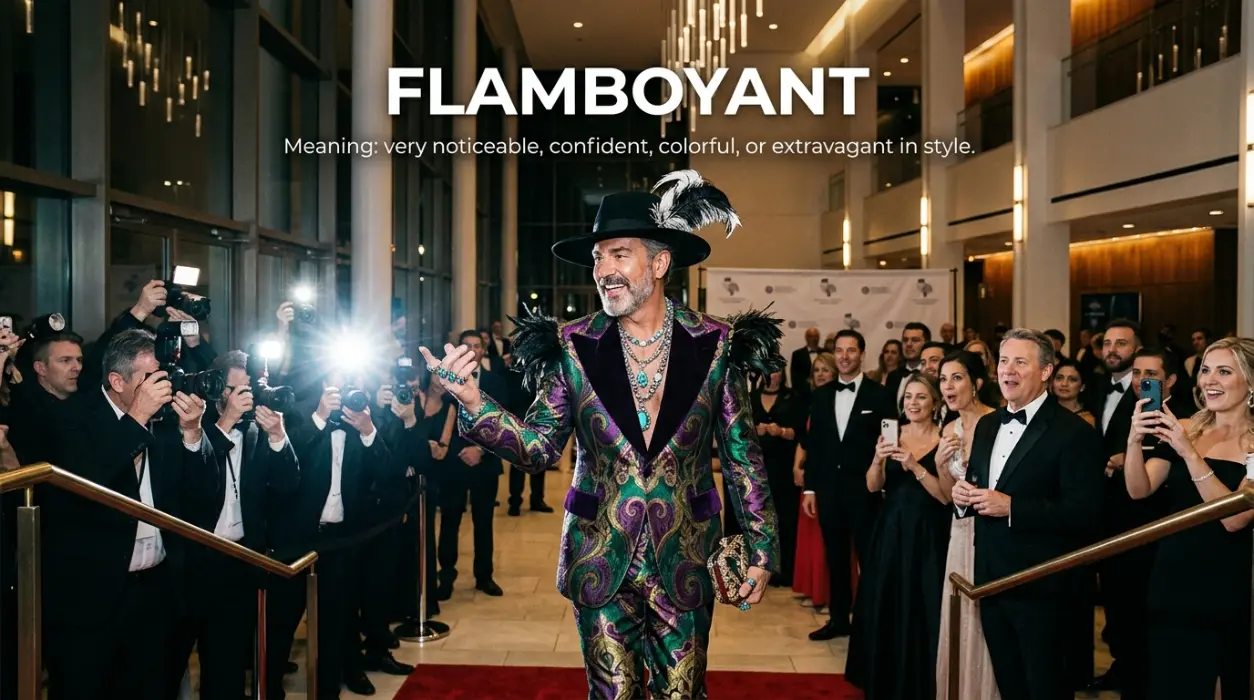
Flamboyant (Adjective) — US /flæmˈbɔɪənt/ — UK /flæmˈbɔɪənt/
Meaning: Very noticeable, confident, colorful, or extravagant in style.
Tone/Register: Neutral to playful.
Example:
He has a flamboyant fashion style.
Her flamboyant personality made her memorable.
Ostentatious (Adjective) — US /ˌɑːstenˈteɪʃəs/ — UK /ˌɒstenˈteɪʃəs/
Meaning: Designed to attract attention by displaying wealth or importance.
Tone/Register: Formal, usually negative.
Example:
His car seemed ostentatious.
The restaurant’s décor was stylish rather than ostentatious.
Showy (Adjective) — US /ˈʃoʊi/ — UK /ˈʃəʊi/
Meaning: Designed to attract attention through appearance or performance.
Tone/Register: Informal to neutral.
Example:
She prefers simple clothes to showy outfits.
The presentation was colorful and showy.
Gaudy (Adjective) — US /ˈɡɔːdi/ — UK /ˈɡɔːdi/
Meaning: Excessively bright, decorated, or flashy in a way that seems unattractive.
Tone/Register: Informal, negative.
Example:
The room looked gaudy.
He thought the bright gold lettering was gaudy.
Flashy (Adjective) — US /ˈflæʃi/ — UK /ˈflæʃi/
Meaning: Very noticeable or impressive-looking, often in a way that seeks attention.
Tone/Register: Informal.
Example:
He bought a flashy sports car.
Her flashy outfit stood out immediately.
Pompous (Adjective) — US /ˈpɑːmpəs/ — UK /ˈpɑːmpəs/
Meaning: Showing excessive self-importance or seriousness.
Tone/Register: Negative, informal to formal.
Example:
His speech sounded pompous.
The writer uses a pompous style throughout the article.
Bombastic (Adjective) — US /bɑːmˈbæstɪk/ — UK /bɒmˈbæstɪk/
Meaning: Using language that sounds impressive but is excessively grand or forceful.
Tone/Register: Formal, critical.
Example:
The politician gave a bombastic speech.
The article’s bombastic tone distracted from its message.
Pretentious (Adjective) — US /prɪˈtenʃəs/ — UK /prɪˈtenʃəs/
Meaning: Trying too hard to appear important, intelligent, sophisticated, or impressive.
Tone/Register: Informal to neutral, negative.
Example:
The restaurant’s description sounded pretentious.
His writing became pretentious in places.
Excessive (Adjective) — US /ɪkˈsesɪv/ — UK /ɪkˈsesɪv/
Meaning: More than necessary or reasonable.
Tone/Register: Formal, neutral.
Example:
The criticism was excessive.
Excessive decoration can make a room feel crowded.
Intense (Adjective) — US /ɪnˈtens/ — UK /ɪnˈtens/
Meaning: Extremely strong in emotion, activity, or effect.
Tone/Register: Neutral.
Example:
The discussion became intense.
She felt an intense burst of excitement.
Fierce (Adjective) — US /fɪrs/ — UK /fɪəs/
Meaning: Extremely strong, forceful, or aggressive.
Tone/Register: Informal to neutral.
Example:
The debate became fierce.
She gave him a fierce look.
Extreme-looking (Adjective) — US /ɪkˈstriːm ˈlʊkɪŋ/ — UK /ɪkˈstriːm ˈlʊkɪŋ/
Meaning: Appearing unusually dramatic, unusual, or intense.
Tone/Register: Informal.
Example:
His new hairstyle is extreme-looking.
The design is extreme-looking but memorable.
Unrestrained (Adjective) — US /ˌʌnrɪˈstreɪnd/ — UK /ˌʌnrɪˈstreɪnd/
Meaning: Not controlled, limited, or held back.
Tone/Register: Formal.
Example:
Her excitement was unrestrained.
The event featured unrestrained creativity.
Uncontrolled (Adjective) — US /ˌʌnkənˈtroʊld/ — UK /ˌʌnkənˈtrəʊld/
Meaning: Not limited or managed effectively.
Tone/Register: Neutral.
Example:
The celebration became uncontrolled.
His laughter was almost uncontrolled.
Unrestrainedly (Adverb) — US /ˌʌnrɪˈstreɪnɪdli/ — UK /ˌʌnrɪˈstreɪnɪdli/
Meaning: In a way that shows little or no restraint.
Tone/Register: Formal.
Example:
She laughed unrestrainedly at the joke.
The audience cheered unrestrainedly.
Excessively Dramatic (Phrase) — US /ɪkˈsesɪvli drəˈmætɪk/ — UK /ɪkˈsesɪvli drəˈmætɪk/
Meaning: More emotional or theatrical than the situation reasonably requires.
Tone/Register: Neutral.
Example:
His response was excessively dramatic.
The scene felt excessively dramatic for a comedy.
Highly Elaborate (Phrase) — US /ˈhaɪli ɪˈlæbərət/ — UK /ˈhaɪli ɪˈlæbərət/
Meaning: Extremely detailed, complicated, or carefully decorated.
Tone/Register: Formal, neutral.
Example:
They prepared a highly elaborate display.
Her costume was highly elaborate.
Too Much (Phrase) — US /tuː mʌtʃ/ — UK /tuː mʌtʃ/
Meaning: More than is comfortable, suitable, or necessary.
Tone/Register: Informal, very common.
Example:
That joke was too much for me.
The decoration feels like too much.
Larger Than Life (Phrase) — US /ˌlɑːrdʒər ðən ˈlaɪf/ — UK /ˌlɑːdʒə ðən ˈlaɪf/
Meaning: Unusually impressive, dramatic, colorful, or memorable.
Tone/Register: Informal, positive.
Example:
She has a larger-than-life personality.
The singer became a larger-than-life cultural figure.
High-Drama (Noun/Adjective) — US /ˌhaɪ ˈdrɑːmə/ — UK /ˌhaɪ ˈdrɑːmə/
Meaning: Characterized by strong emotion, conflict, suspense, or theatrical behavior.
Tone/Register: Informal.
Example:
The series is full of high-drama moments.
Their argument became high-drama very quickly.
Attention-Grabbing (Adjective) — US /əˈtenʃən ˌɡræbɪŋ/ — UK /əˈtenʃən ˌɡræbɪŋ/
Meaning: Designed to attract immediate notice.
Tone/Register: Neutral, marketing, media.
Example:
The headline was attention-grabbing.
She chose an attention-grabbing outfit.
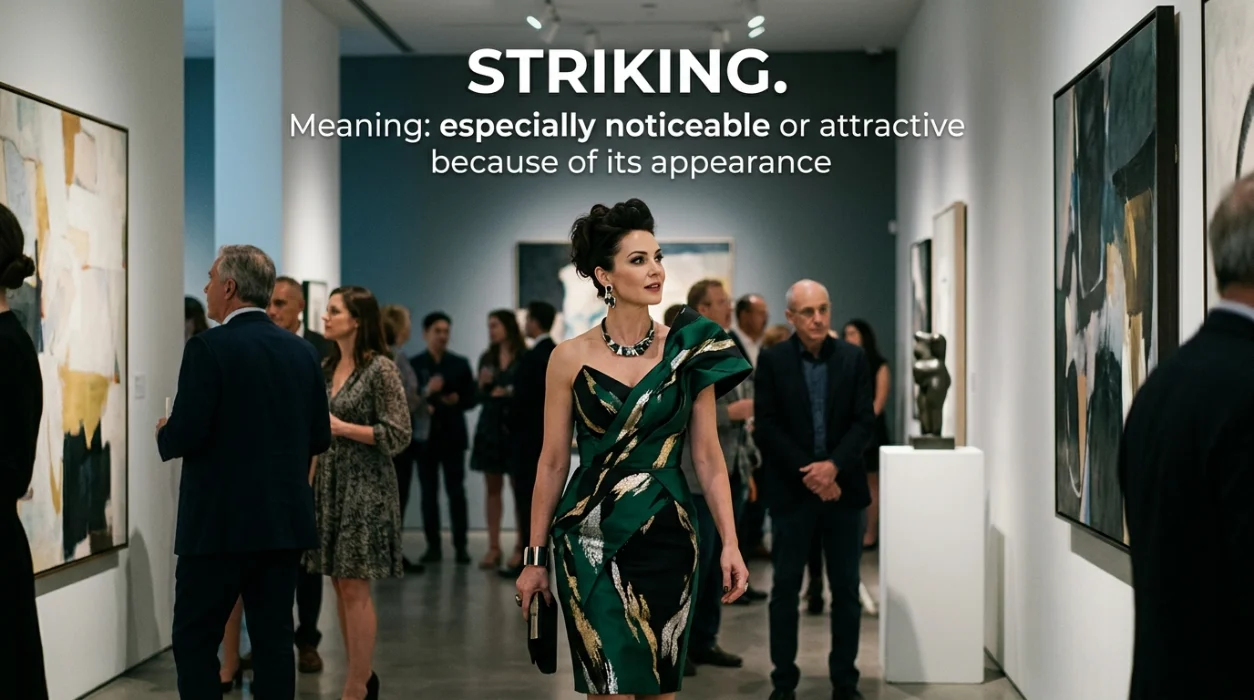
Eye-Catching (Adjective) — US /ˈaɪ ˌkætʃɪŋ/ — UK /ˈaɪ ˌkætʃɪŋ/
Meaning: Especially noticeable or attractive because of its appearance.
Tone/Register: Neutral, positive.
Example:
The poster has an eye-catching design.
Her bright shoes were eye-catching.
Attention-Seeking (Adjective) — US /əˈtenʃən ˌsiːkɪŋ/ — UK /əˈtenʃən ˌsiːkɪŋ/
Meaning: Intended to attract attention, often in a way others consider excessive.
Tone/Register: Informal, usually negative.
Example:
His behavior seemed attention-seeking.
The post felt slightly attention-seeking.
Dramaticized (Adjective) — US /ˈdræmətəˌtaɪzd/ — UK /ˈdræmətaɪzd/
Meaning: Presented as more dramatic or exciting than reality.
Tone/Register: Neutral, media.
Example:
The documentary used a dramatized version of events.
Some details were clearly dramatized for television.
Amplified (Adjective) — US /ˈæmpləfaɪd/ — UK /ˈæmplɪfaɪd/
Meaning: Increased in strength, importance, or effect.
Tone/Register: Neutral, formal.
Example:
Online comments amplified the controversy.
The media response amplified the original problem.
Intensified (Adjective) — US /ɪnˈtensəfaɪd/ — UK /ɪnˈtensɪfaɪd/
Meaning: Made stronger, more serious, or more extreme.
Tone/Register: Formal, academic.
Example:
The argument intensified overnight.
The criticism intensified after the announcement.
Aggrandized (Adjective) — US /əˈɡrænˌdaɪzd/ — UK /əˈɡrænˌdaɪzd/
Meaning: Made to appear more important, powerful, or impressive than it really is.
Tone/Register: Formal, literary.
Example:
The biography gave an aggrandized account of his career.
The story seemed heavily aggrandized.
Magniloquent (Adjective) — US /mæɡˈnɪləkwənt/ — UK /mæɡˈnɪləkwənt/
Meaning: Using very grand or impressive language, sometimes excessively.
Tone/Register: Formal, literary.
Example:
His magniloquent speech impressed the audience.
The essay becomes magniloquent in its final section.
Ornamental (Adjective) — US /ˌɔːrnəˈmentəl/ — UK /ˌɔːnəˈmentəl/
Meaning: Mainly intended to decorate or add visual richness.
Tone/Register: Neutral, formal.
Example:
The room contains ornamental details.
The design is decorative without being excessively ornamental.
Decorated (Adjective) — US /ˈdekəreɪtɪd/ — UK /ˈdekəreɪtɪd/
Meaning: Made more attractive by adding visual details or ornaments.
Tone/Register: Neutral.
Example:
The hall was beautifully decorated.
The cake was heavily decorated for the celebration.
Luxurious (Adjective) — US /lʌɡˈʒʊəriəs/ — UK /lʌɡˈʒʊəriəs/
Meaning: Extremely comfortable, elegant, or expensive.
Tone/Register: Neutral, positive.
Example:
The hotel has a luxurious feel.
They designed a luxurious living room.
Extravagantly (Adverb) — US /ɪkˈstrævəɡəntli/ — UK /ɪkˈstrævəɡəntli/
Meaning: In a highly excessive, elaborate, or luxurious way.
Tone/Register: Neutral to formal.
Example:
The room was extravagantly decorated.
They celebrated extravagantly after the victory.
Dramatically (Adverb) — US /drəˈmætɪkli/ — UK /drəˈmætɪkli/
Meaning: In a striking, emotional, or theatrical way.
Tone/Register: Neutral.
Example:
She dramatically changed her hairstyle.
The lights dimmed dramatically.
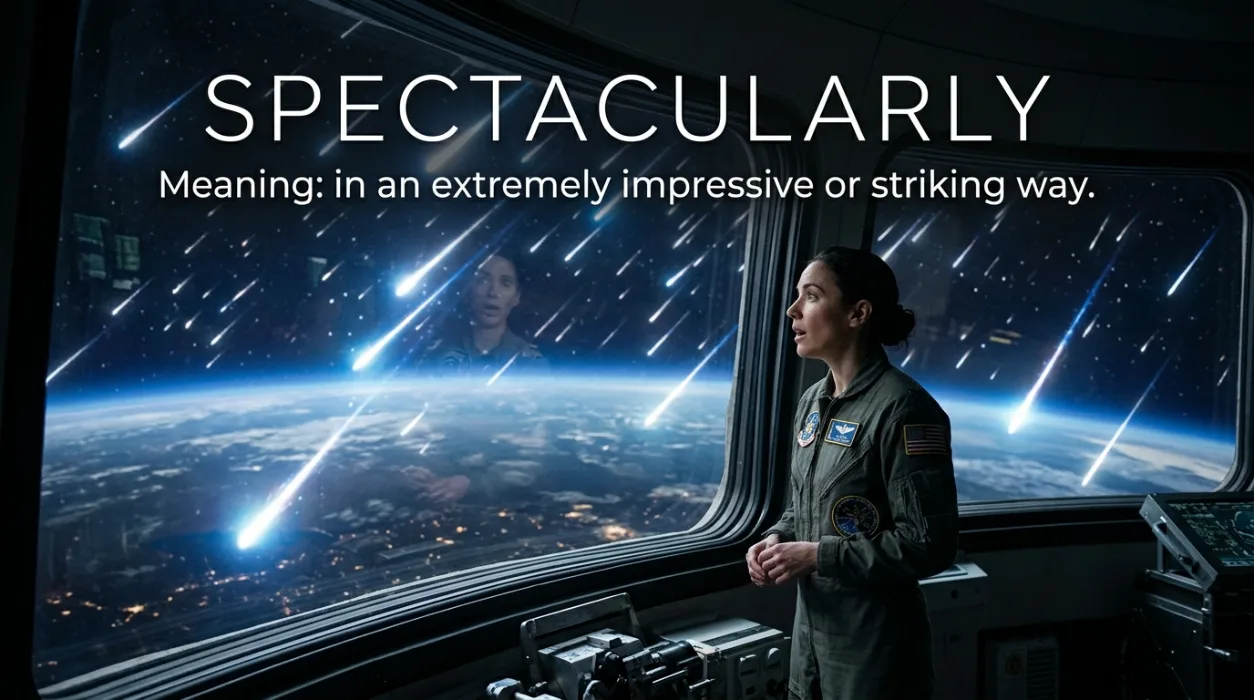
Spectacularly (Adverb) — US /spekˈtækjələrli/ — UK /spekˈtækjələrli/
Meaning: In an extremely impressive or striking way.
Tone/Register: Positive, neutral.
Example:
The show ended spectacularly.
The fireworks failed spectacularly.
Synonyms by Tone
Positive
Use positive alternatives when excess is exciting, impressive, creative, or enjoyable.
Good choices include:
- magnificent
- spectacular
- lavish
- luxurious
- flamboyant
- larger than life
- eye-catching
- impressive
- extravagant
For example, calling a celebration lavish can sound admiring.
Calling the same celebration ostentatious can sound critical.
The basic situation may be identical, but the speaker’s attitude changes.
Neutral
Neutral alternatives work well when you simply want to describe unusual intensity or scale.
Useful choices include:
- excessive
- extreme
- exaggerated
- elaborate
- dramatic
- amplified
- intensified
- decorated
- unusually elaborate
These words are especially useful in essays, reports, explanations, and educational writing.
Negative
Negative choices highlight poor judgment, unnecessary drama, bad taste, or excessive self-presentation.
Useful examples include:
- overblown
- overdone
- gaudy
- pompous
- bombastic
- pretentious
- ostentatious
- histrionic
- attention-seeking
These words should be used carefully because they can sound judgmental.
Playful or Informal
Casual conversations often favor expressive alternatives.
Examples include:
- too much
- flashy
- showy
- outrageous
- high-drama
- hyperdramatic
- wildly exaggerated
- eye-catching
These choices can make speech sound lively and natural.
“Over the Top” vs Close Alternatives
Excessive vs Over the Top
Over the top is more conversational and expressive.
Excessive is more neutral and precise.
Use over the top in casual conversation:
“That reaction was over the top.”
Use excessive in formal writing:
“The reaction was excessive.”
Over the Top vs Extravagant
Extravagant often suggests luxury, spending, generosity, or elaborate design.
Over the top has a wider range.
You can describe an emotional reaction as over the top, but extravagant would usually sound unnatural in that context.
Over the Top vs Exaggerated
Exaggerated focuses on making something seem greater than reality.
Over the top focuses more broadly on excessive style, behavior, emotion, or presentation.
Therefore, “an exaggerated claim” is natural, while “an over-the-top party” is more natural than “an exaggerated party.”
How “Over the Top” Changes by Context
Daily Conversation
In everyday speech, over the top is highly natural.
Friends might use it to describe clothing, reactions, parties, jokes, decorations, or behavior.
“That was a bit over the top.”
The phrase sounds relaxed and conversational.
Writing and Blogging
Bloggers can use the expression when discussing entertainment, fashion, food, design, celebrity culture, or social behavior.
However, writers should vary their vocabulary.
For example, instead of repeatedly writing over the top, use extravagant, excessive, dramatic, or flamboyant when those words are more precise.
Professional or Academic Tone
Formal writing usually benefits from alternatives such as excessive, exaggerated, disproportionate, grandiose, or hyperbolic.
For example:
“The response was disproportionate to the original complaint.”
That sentence sounds more professional than:
“The response was over the top.”
Creative or Informal Use
Creative writing can make excellent use of over-the-top.
It quickly creates an image of something extreme.
A novelist might describe a character’s personality as larger than life.
A comedy writer might describe a scene as wildly exaggerated.
A film critic might call a performance melodramatic.
Common Mistakes Learners Make
Mistake 1: Assuming “over the top” is always negative
It is not.
The phrase can be humorous, admiring, neutral, or critical.
Context determines the attitude.
Mistake 2: Using every synonym interchangeably
Synonyms have different meanings.
Ostentatious suggests showing off.
Melodramatic suggests excessive emotion.
Lavish often suggests generosity or luxury.
Hyperbolic usually concerns exaggeration.
Mistake 3: Using formal synonyms in casual speech
Some words sound unusually formal in everyday conversation.
For example, magniloquent and histrionic are valid words, but they are much less common than dramatic, exaggerated, or overblown.
Mistake 4: Overusing “over the top”
The phrase is useful, but repetition can make writing feel flat.
Strong writers choose alternatives based on the precise meaning they want.
Mistake 5: Confusing “extravagant” with “exaggerated”
An extravagant wedding may genuinely be enormous and luxurious.
An exaggerated story may simply contain details that are not accurate.
The two ideas overlap, but they are not identical.
Register Notes
Over the top is primarily informal to neutral.
It works naturally in conversations, reviews, blogs, social media, entertainment articles, and casual storytelling.
In academic writing, choose a more precise alternative when possible.
For example, excessive, disproportionate, hyperbolic, and exaggerated can provide greater precision.
For related vocabulary, an internal link to a guide on “words to describe exaggeration” can help readers continue building their vocabulary.
Real-Life Mini Scenarios
Workplace
Imagine a manager sends a five-page email about a minor scheduling issue.
A colleague might say:
“That response was a little over the top.”
A more formal report might call the response excessive or disproportionate.
Social Situation
A friend arrives at a casual dinner wearing a dramatic costume.
You might smile and say:
“That outfit is definitely over the top.”
If you admire it, flamboyant or eye-catching may sound more positive.
Media and Pop Culture
A superhero movie may contain huge explosions, dramatic speeches, and impossible stunts.
A reviewer might describe it as over-the-top, spectacular, bombastic, or hyperdramatic, depending on the reviewer’s attitude.
Writing and Storytelling
A character may react to a small problem as though the world is ending.
A writer could call the reaction melodramatic, histrionic, or wildly exaggerated.
Each word creates a slightly different image.
Practice Exercise
1. Your friend spends three hours decorating a desk for a five-minute meeting. Which word fits best?
A. Excessive
B. Quiet
C. Ordinary
D. Brief
2. A politician uses extremely grand language that says very little. Which word is most suitable?
A. Bombastic
B. Comfortable
C. Modest
D. Practical
3. A celebrity wears a bright, dramatic outfit designed to attract attention. Which word fits?
A. Flamboyant
B. Invisible
C. Reserved
D. Plain
4. A person claims that a small delay destroyed their life. Which word best describes the claim?
A. Hyperbolic
B. Accurate
C. Concise
D. Literal
5. A luxury hotel has marble floors, gold details, and expensive furniture. Which word is strongest?
A. Opulent
B. Basic
C. Minimal
D. Casual
6. Someone reacts to a tiny mistake by screaming and crying for an hour. Which word fits best?
A. Melodramatic
B. Efficient
C. Subtle
D. Reserved
7. A room has too many bright colors and decorations that clash. Which word could describe it negatively?
A. Gaudy
B. Elegant
C. Simple
D. Minimalist
8. You want a neutral word for something that goes beyond a reasonable limit. Which word should you choose?
A. Excessive
B. Magnificent
C. Charming
D. Tiny
9. A character in a novel is unusually dramatic, memorable, and colorful. Which phrase works well?
A. Larger than life
B. Under control
C. Out of sight
D. By the book
10. A company creates a complicated process for a very simple task. Which phrase is appropriate?
A. Unnecessarily elaborate
B. Spectacular
C. Magnificent
D. Luxurious
Reflection task:
Write one sentence about a real person, event, movie, outfit, or reaction using one synonym for over the top. Then explain whether your word sounds positive, neutral, or negative.
Answer key:
1-A, 2-A, 3-A, 4-A, 5-A, 6-A, 7-A, 8-A, 9-A, 10-A,
Conclusion
In conclusion, over the top is a phrase used to describe something that is excessive, exaggerated, extravagant, or more extreme than necessary. It can refer to behavior, emotions, reactions, or situations.
There are several useful synonyms for over the top, including excessive, exaggerated, extreme, extravagant, dramatic, and outrageous. Choosing the right alternative depends on the context and the level of intensity being described.
By understanding over the top and its related synonyms, you can expand your vocabulary and make your writing more expressive. Using suitable alternatives can help you communicate ideas clearly while avoiding unnecessary repetition.
FAQs
1. What are the best synonyms for “over the top” in formal English?
The strongest formal alternatives include excessive, exaggerated, disproportionate, hyperbolic, grandiose, ostentatious, and unrestrained. The best choice depends on context. For example, “excessive” works well for quantity, while “hyperbolic” is better for exaggerated language. In professional writing, precision is usually more important than simply finding a direct replacement.
2. What is a positive synonym for “over the top”?
Positive alternatives include spectacular, magnificent, lavish, luxurious, flamboyant, and larger than life. These words can describe something unusually impressive without sounding strongly critical. For example, “The ceremony was spectacular” sounds appreciative, while “The ceremony was excessive” suggests that it went beyond what was appropriate.
3. What is a polite way to say someone is “over the top”?
If you want to sound polite, try dramatic, enthusiastic, expressive, flamboyant, or larger than life, depending on the situation. These choices soften criticism. Instead of saying, “Your reaction was over the top,” you could say, “Your reaction was quite dramatic.” The second version can sound less harsh.
4. What is the difference between “over the top” and “overdone”?
Both can describe excess, but over the top is broader and more conversational. Overdone often suggests that something has been taken too far and has lost its effectiveness or appeal. For example, a party can be over the top, while makeup, acting, decoration, or special effects are often described as overdone.
5. Which synonym for “over the top” means showing off?
Ostentatious is one of the closest choices when the idea is displaying wealth, status, or importance to attract attention. Showy, flashy, and attention-seeking can also work. However, each has a slightly different emphasis. “Ostentatious” is more formal and usually negative, while “showy” and “flashy” are more conversational.

Hasnain Ali is an SEO Content Strategist and the founder of wordvora.com, a trusted vocabulary platform that helps writers, students, professionals, and English learners find accurate synonyms, antonyms, word meanings, and real-life usage examples. He specializes in keyword research, on-page SEO, topical authority, and creating search-first content that aligns with Google’s latest Search Quality and E-E-A-T guidelines. His work focuses on producing clear, well-structured, and reader-friendly resources that satisfy search intent while maintaining high editorial standards.
Through extensive hands-on experience with SEO tools such as Google Search Console, Google Analytics, SEMrush, and Ahrefs, Hasnain researches user search behavior and develops content that is both informative and easy to understand. Every article published on wordvora.com is carefully reviewed for accuracy, readability, and contextual relevance before publication. His mission is to build one of the web’s most reliable English vocabulary resources by providing practical language guidance, trustworthy explanations, and content that helps readers improve their writing, communication, and vocabulary with confidence.