
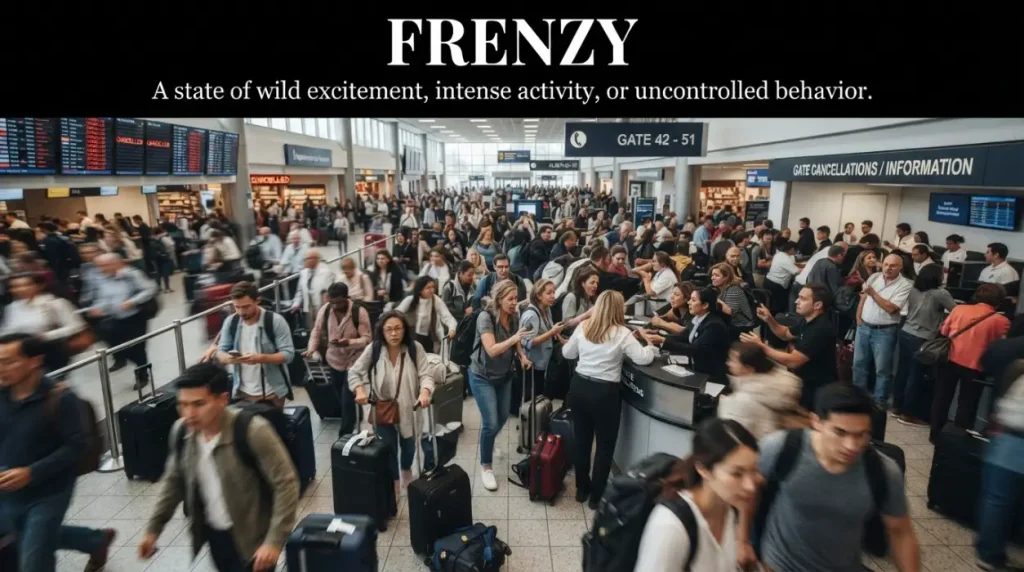
Synonyms for frenzy can make your English more vivid when you need to describe sudden excitement, confusion, or uncontrolled activity. Imagine a concert where fans rush toward the stage.
That moment feels intense and energetic. A word like “frenzy” works well, but vocabulary can help you describe the mood more precisely. Offer useful choices for different situations.
Students can use these alternatives to improve essays, while bloggers and content writers can avoid repeating the same word. Daily English users can choose words that match the emotion or level of disorder they mean.
Learning synonyms for frenzy builds vocabulary and improves communication. In this guide, you will discover natural alternatives, their meanings, tones, pronunciations, and examples for use.
What Does “Frenzy” Really Mean?
Frenzy is a noun meaning a state of extreme excitement, agitation, panic, or uncontrolled activity.
In simple English, frenzy describes a situation where emotions or actions become unusually intense and difficult to control.
Native speakers often use the word for crowded events, public reactions, sudden excitement, intense activity, or emotional behavior.
For example:
“Fans went into a frenzy when the singer appeared.”
The sentence suggests powerful excitement rather than ordinary happiness.
Part of Speech
Frenzy — Noun
Simple definition: An intense state of excitement, confusion, anger, or uncontrolled activity.
The adjective frenzied is also common. It describes something that is extremely excited, rushed, or chaotic.
Connotative Meaning
Connotation (the emotional or cultural feeling associated with a word beyond its basic meaning) can change how frenzy sounds.
Positive tone: It may suggest thrilling excitement, passionate enthusiasm, or energetic celebration.
Negative tone: It can suggest panic, irrational behavior, disorder, or emotional loss of control.
Neutral tone: In factual writing, it can simply describe unusually intense activity or public reaction.
Therefore, context matters. A “shopping frenzy” may sound energetic, while “a frenzy of violence” carries a clearly negative meaning.
Etymology
The word frenzy did not develop directly from Old English. It entered English through Middle English, ultimately tracing back to Greek.
It is related to Greek phrenitis, meaning inflammation or disorder of the mind. The term passed through Latin phrenesis and Old French forms before becoming the Middle English frenesie.
Old English: 450–1100
There was no direct modern English form of frenzy in Old English. Similar ideas were expressed through words connected with madness, anger, agitation, or disturbed thought.
Middle English: 1100–1500
During Middle English, forms such as frenesie appeared. The meaning was closely connected with madness, mental disturbance, or extreme irrational behavior.
Modern English: 1500–Present
In Modern English, frenzy developed broader meanings. Today, it can describe not only mental disturbance but also intense excitement, public reaction, rushing activity, or temporary chaos.
Pronunciation
US: /ˈfrɛn.zi/
UK: /ˈfrɛn.zi/
Syllables
fren-zy
Affixation Pattern of “Frenzy”
Root: From Middle English frenesie, ultimately related to Greek phrenitis.
Prefix: None in modern English.
Suffix: The ending -y forms the noun as it appears in modern English.
Synonyms List
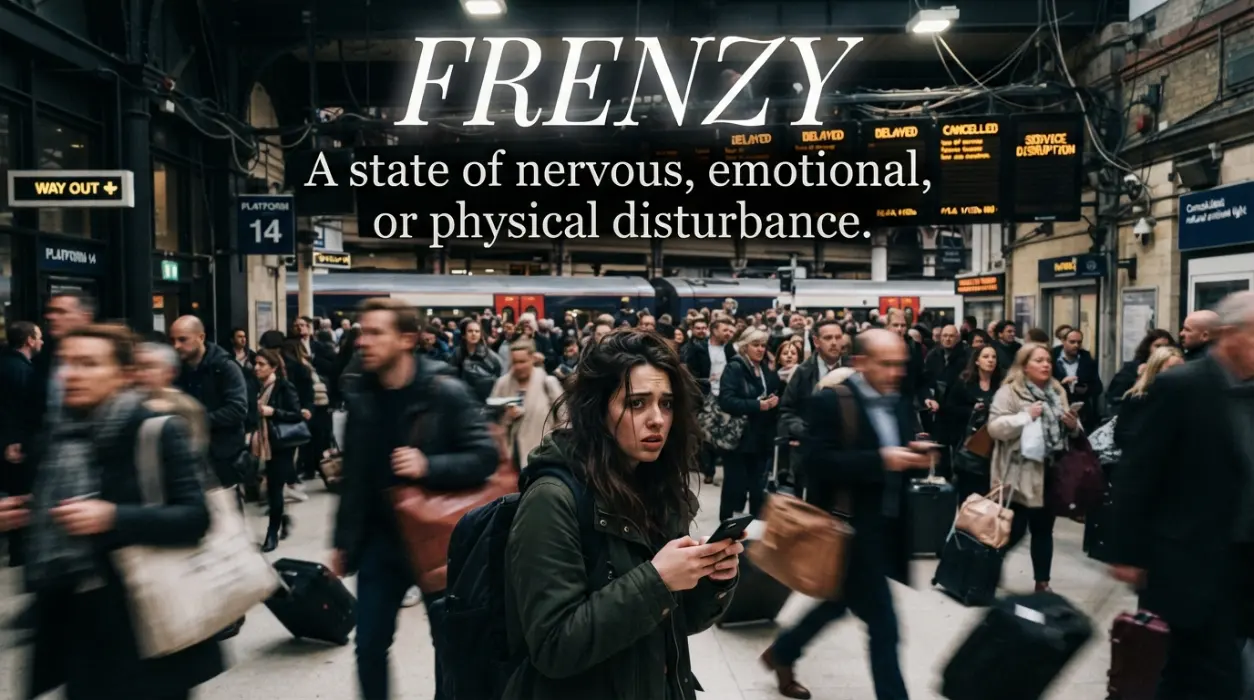
Agitation (Noun) — US /ˌædʒəˈteɪʃən/ | UK /ˌædʒɪˈteɪʃən/
Meaning: A state of nervous, emotional, or physical disturbance.
Tone/Register: Neutral; formal.
Example:
The announcement caused considerable agitation among employees.
She spoke calmly despite the agitation around her.
Commotion (Noun) — US /kəˈmoʊʃən/ | UK /kəˈməʊʃən/
Meaning: Noisy confusion or disturbance caused by many people or events.
Tone/Register: Neutral; everyday.
Example:
A sudden commotion started outside the restaurant.
Everyone looked toward the door to see what happened.
Hysteria (Noun) — US /hɪˈstɪriə/ | UK /hɪˈstɪəriə/
Meaning: Extremely uncontrolled emotion, especially fear or excitement shared by a group.
Tone/Register: Informal; journalistic.
Example:
Social media quickly created hysteria around the rumor.
The story spread before anyone checked the facts.
Pandemonium (Noun) — US /ˌpændəˈmoʊniəm/ | UK /ˌpændəˈməʊniəm/
Meaning: A situation of complete noise, confusion, and disorder.
Tone/Register: Neutral; vivid.
Example:
Pandemonium broke out when the gates opened.
Security struggled to manage the crowd.
Turmoil (Noun) — US /ˈtɜːrmɔɪl/ | UK /ˈtɜːmɔɪl/
Meaning: A state of serious confusion, disorder, or emotional disturbance.
Tone/Register: Formal; journalistic.
Example:
The company faced months of internal turmoil.
The sudden decision created uncertainty across the team.
Uproar (Noun) — US /ˈʌp.rɔːr/ | UK /ˈʌp.rɔː/
Meaning: A loud or angry reaction from many people.
Tone/Register: Neutral; journalistic.
Example:
The decision caused an uproar among fans.
Several customers complained about the change.
Tumult (Noun) — US /ˈtuːmʌlt/ | UK /ˈtjuːmʌlt/
Meaning: Loud, confused, and disorderly activity.
Tone/Register: Formal; literary.
Example:
The speaker tried to continue through the tumult.
The hall filled with voices and movement.
Chaos (Noun) — US /ˈkeɪɑːs/ | UK /ˈkeɪɒs/
Meaning: A state in which everything seems disorganized or uncontrolled.
Tone/Register: Neutral; very common.
Example:
The delayed trains created chaos at the station.
By noon, the entire schedule was disrupted.
Mayhem (Noun) — US /ˈmeɪhɛm/ | UK /ˈmeɪhem/
Meaning: Extreme disorder, confusion, or destructive activity.
Tone/Register: Informal; vivid.
Example:
The storm left mayhem across the neighborhood.
Traffic became difficult to manage.
Mania (Noun) — US /ˈmeɪniə/ | UK /ˈmeɪniə/
Meaning: An intense enthusiasm or obsession with something.
Tone/Register: Neutral; informal.
Example:
There was a sudden mania for the new game.
The trend dominated online conversations.
Furor (Noun) — US /ˈfjʊrɔːr/ | UK /ˈfjʊərɔːr/
Meaning: Intense public excitement, anger, or controversy.
Tone/Register: Formal; journalistic.
Example:
The policy sparked a furor online.
The debate continued for several days.
Excitement (Noun) — US /ɪkˈsaɪtmənt/ | UK /ɪkˈsaɪtmənt/
Meaning: A strong feeling of enthusiasm or anticipation.
Tone/Register: Neutral; everyday.
Example:
Excitement filled the stadium before the match.
Fans waved flags and sang together.
Fervor (Noun) — US /ˈfɜːrvər/ | UK /ˈfɜːvə/
Meaning: Intense enthusiasm or passionate feeling.
Tone/Register: Formal; literary.
Example:
Supporters defended the team with great fervor.
Their passion remained strong throughout the season.
Freneticism (Noun) — US /frəˈnɛtɪsɪzəm/ | UK /frəˈnɛtɪsɪzəm/
Meaning: A quality of being extremely fast-paced, energetic, or agitated.
Tone/Register: Formal; descriptive.
Example:
The film captures the freneticism of city life.
Every scene feels fast and crowded.
Frenetic Activity (Noun Phrase) — US /frəˈnɛtɪk ækˈtɪvəti/ | UK /frəˈnɛtɪk ækˈtɪvəti/
Meaning: Extremely fast and energetic activity.
Tone/Register: Neutral; descriptive.
Example:
Frenetic activity filled the newsroom before the deadline.
Editors moved quickly between different stories.
Disorder (Noun) — US /dɪsˈɔːrdər/ | UK /dɪsˈɔːdə/
Meaning: A lack of order, control, or organization.
Tone/Register: Formal; general.
Example:
The event descended into disorder after the announcement.
Staff members worked to restore control.
Disturbance (Noun) — US /dɪˈstɜːrbəns/ | UK /dɪˈstɜːbəns/
Meaning: An interruption or disruption that affects normal calm.
Tone/Register: Neutral; formal.
Example:
Police responded to a disturbance near the venue.
The crowd gradually became quieter.
Stir (Noun) — US /stɜːr/ | UK /stɜː/
Meaning: Excitement, controversy, or public attention caused by something unusual.
Tone/Register: Informal; everyday.
Example:
The celebrity announcement caused quite a stir.
Fans immediately began discussing it online.
Hubbub (Noun) — US /ˈhʌbʌb/ | UK /ˈhʌbʌb/
Meaning: A mixture of loud voices and noisy activity.
Tone/Register: Informal; conversational.
Example:
I could barely hear her above the hubbub.
The café was packed after the game.
Ruckus (Noun) — US /ˈrʌkəs/ | UK /ˈrʌkəs/
Meaning: A noisy disturbance or lively disagreement.
Tone/Register: Informal; playful.
Example:
The children made a ruckus in the hallway.
Their teacher quickly asked them to settle down.
Bedlam (Noun) — US /ˈbɛdləm/ | UK /ˈbedləm/
Meaning: A scene of extreme confusion and disorder.
Tone/Register: Informal; vivid.
Example:
The airport was complete bedlam after the cancellation.
Passengers crowded around the information desk.
Racket (Noun) — US /ˈrækɪt/ | UK /ˈrækɪt/
Meaning: A loud and unpleasant mixture of sounds.
Tone/Register: Informal; everyday.
Example:
The construction site created a terrible racket.
I could hear the noise from several blocks away.
Buzz (Noun) — US /bʌz/ | UK /bʌz/
Meaning: Excited public interest or lively discussion.
Tone/Register: Informal; modern.
Example:
The new series generated a huge buzz online.
Everyone seemed eager to watch it.
Rush (Noun) — US /rʌʃ/ | UK /rʌʃ/
Meaning: A sudden period of intense activity or movement.
Tone/Register: Neutral; everyday.
Example:
We experienced a rush of customers at lunchtime.
The staff worked quickly to keep up.
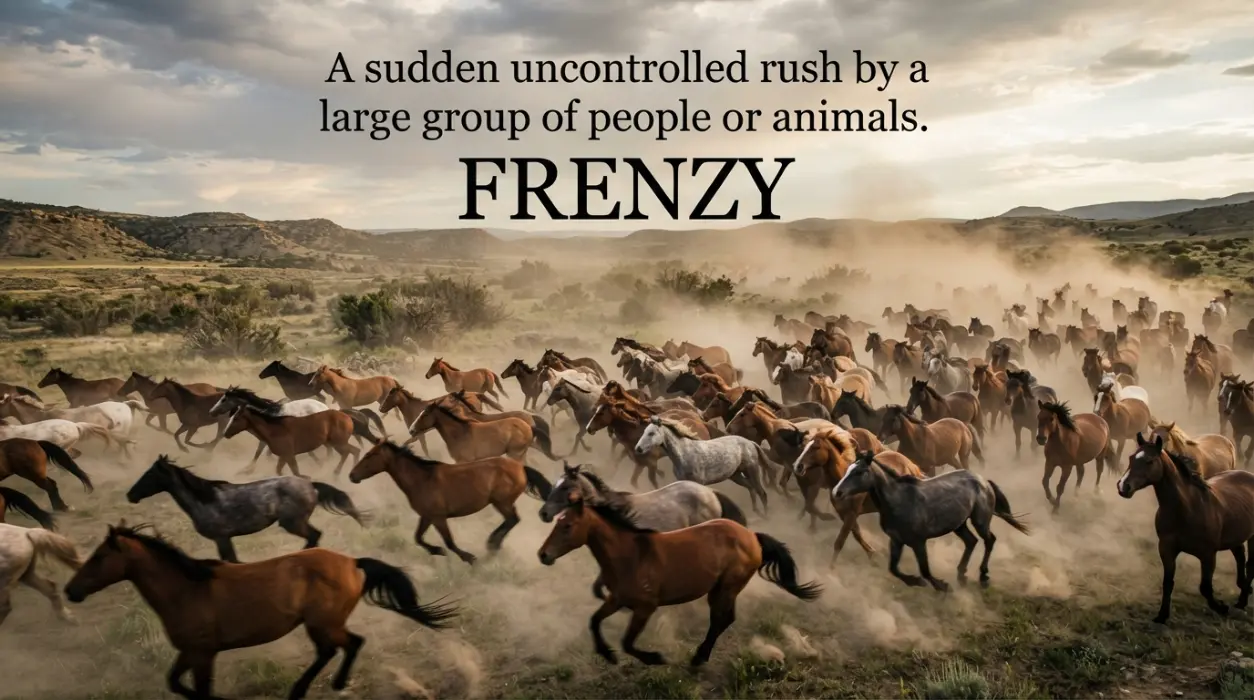
Stampede (Noun) — US /stæmˈpiːd/ | UK /stæmˈpiːd/
Meaning: A sudden uncontrolled rush by a large group of people or animals.
Tone/Register: Neutral; serious.
Example:
The crowd moved like a stampede toward the exit.
Officials urged everyone to remain calm.
Riot (Noun) — US /ˈraɪət/ | UK /ˈraɪət/
Meaning: A violent and disorderly public disturbance.
Tone/Register: Formal; serious.
Example:
The protest later developed into a riot.
Authorities closed nearby roads for safety.
Outburst (Noun) — US /ˈaʊtbɜːrst/ | UK /ˈaʊtbɜːst/
Meaning: A sudden expression of strong emotion.
Tone/Register: Neutral; everyday.
Example:
His angry outburst surprised the entire room.
He later apologized for losing his temper.
Agitation (Noun) — US /ˌædʒəˈteɪʃən/ | UK /ˌædʒɪˈteɪʃən/
Meaning: A visible state of nervous or emotional unrest.
Tone/Register: Formal.
Example:
Her agitation was obvious during the interview.
She kept checking the clock.
Alarm (Noun) — US /əˈlɑːrm/ | UK /əˈlɑːm/
Meaning: Sudden fear or concern caused by a perceived threat.
Tone/Register: Neutral.
Example:
The warning caused alarm among residents.
People quickly moved away from the area.
Panic (Noun) — US /ˈpænɪk/ | UK /ˈpænɪk/
Meaning: Sudden overwhelming fear that can cause irrational action.
Tone/Register: Neutral; everyday.
Example:
Panic spread when the lights suddenly went out.
Staff members calmly guided everyone outside.
Daze (Noun) — US /deɪz/ | UK /deɪz/
Meaning: A confused mental state in which someone struggles to think clearly.
Tone/Register: Informal; everyday.
Example:
She stood in a daze after hearing the news.
For several minutes, she could not respond.
Delirium (Noun) — US /dɪˈlɪriəm/ | UK /dɪˈlɪəriəm/
Meaning: A state of severe confusion or wildly excited behavior.
Tone/Register: Formal; medical/literary.
Example:
The crowd seemed to reach a state of delirium.
The final score triggered wild reactions.
Wildness (Noun) — US /ˈwaɪldnəs/ | UK /ˈwaɪldnəs/
Meaning: Uncontrolled or unusually energetic behavior.
Tone/Register: Neutral; descriptive.
Example:
The wildness of the celebration surprised visitors.
Music continued late into the night.
Unrest (Noun) — US /ʌnˈrest/ | UK /ʌnˈrest/
Meaning: A state of social or emotional disturbance.
Tone/Register: Formal; journalistic.
Example:
Political unrest affected daily life.
The situation remained uncertain for weeks.
Turbulence (Noun) — US /ˈtɜːrbjələns/ | UK /ˈtɜːbjʊləns/
Meaning: A condition of instability, disturbance, or rapid change.
Tone/Register: Formal; descriptive.
Example:
The industry experienced months of turbulence.
Several major changes followed.
Flurry (Noun) — US /ˈflɜːri/ | UK /ˈflʌri/
Meaning: A sudden burst of energetic activity.
Tone/Register: Neutral; journalistic.
Example:
A flurry of messages appeared after the announcement.
Fans quickly shared their reactions.
Whirlwind (Noun) — US /ˈwɜːrlwɪnd/ | UK /ˈwɜːlwɪnd/
Meaning: A period of rapid and confusing activity.
Tone/Register: Informal; metaphorical.
Example:
The wedding week was a complete whirlwind.
Everything happened faster than expected.
Clamor (Noun) — US /ˈklæmər/ | UK /ˈklæmə/
Meaning: A loud mixture of voices, demands, or complaints.
Tone/Register: Formal; journalistic.
Example:
There was a growing clamor for change.
Public pressure increased throughout the week.
Din (Noun) — US /dɪn/ | UK /dɪn/
Meaning: A continuous loud and unpleasant noise.
Tone/Register: Neutral; literary.
Example:
The din from the crowd filled the arena.
Conversation became nearly impossible.
Noise (Noun) — US /nɔɪz/ | UK /nɔɪz/
Meaning: Sound or activity that is loud, distracting, or disruptive.
Tone/Register: Neutral; everyday.
Example:
The sudden noise startled everyone.
The street became quiet a few minutes later.
Excitement (Noun) — US /ɪkˈsaɪtmənt/ | UK /ɪkˈsaɪtmənt/
Meaning: A strong feeling of enthusiasm or anticipation.
Tone/Register: Neutral; everyday.
Example:
Excitement grew before the final performance.
The audience waited eagerly.
Enthusiasm (Noun) — US /ɪnˈθuːziæzəm/ | UK /ɪnˈθjuːziæzəm/
Meaning: Strong interest, energy, or eagerness toward something.
Tone/Register: Neutral; positive.
Example:
Her enthusiasm energized the whole team.
She volunteered for the extra project.
Zeal (Noun) — US /ziːl/ | UK /ziːl/
Meaning: Strong enthusiasm and dedication toward a cause or activity.
Tone/Register: Formal; positive.
Example:
He approached the project with remarkable zeal.
His commitment encouraged his colleagues.
Passion (Noun) — US /ˈpæʃən/ | UK /ˈpæʃən/
Meaning: Powerful enthusiasm or emotional commitment.
Tone/Register: Neutral; positive.
Example:
She spoke about the subject with passion.
Her energy made the presentation memorable.
Eagerness (Noun) — US /ˈiːɡərnəs/ | UK /ˈiːɡənəs/
Meaning: A strong desire to do or experience something.
Tone/Register: Neutral; positive.
Example:
The children showed eagerness to open their gifts.
Their smiles revealed how excited they were.
Obsession (Noun) — US /əbˈseʃən/ | UK /əbˈseʃən/
Meaning: An intense and persistent interest that may become excessive.
Tone/Register: Neutral; sometimes negative.
Example:
His obsession with the series grew quickly.
He talked about every episode for hours.
Preoccupation (Noun) — US /priˌɑːkjəˈpeɪʃən/ | UK /priˌɒkjʊˈpeɪʃən/
Meaning: A strong focus on something that occupies a person’s thoughts.
Tone/Register: Formal; academic.
Example:
Her preoccupation with the problem affected her concentration.
She found it difficult to focus elsewhere.
Intensity (Noun) — US /ɪnˈtensəti/ | UK /ɪnˈtensəti/
Meaning: The degree of strength or force in an emotion or activity.
Tone/Register: Neutral; academic.
Example:
The intensity of the debate increased quickly.
Both speakers remained passionate.
Ferocity (Noun) — US /fəˈrɑːsəti/ | UK /fəˈrɒsəti/
Meaning: Extreme force, aggression, or fierceness.
Tone/Register: Formal; vivid.
Example:
The players competed with surprising ferocity.
The match became increasingly intense.
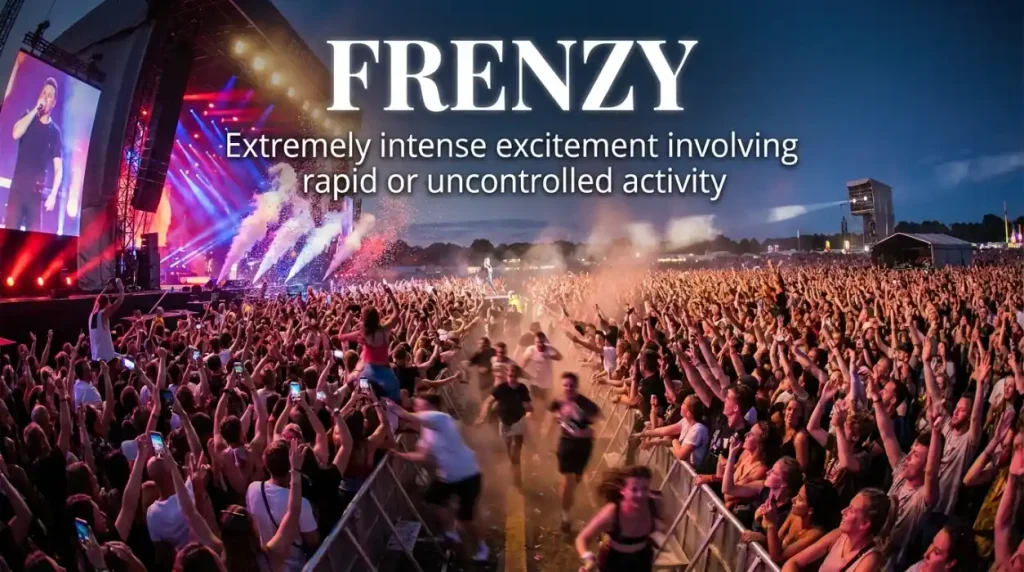
Frenzied Excitement (Noun Phrase) — US /ˈfrenzid ɪkˈsaɪtmənt/ | UK /ˈfrenzid ɪkˈsaɪtmənt/
Meaning: Extremely intense excitement involving rapid or uncontrolled activity.
Tone/Register: Informal; descriptive.
Example:
Frenzied excitement spread through the arena.
Fans jumped and shouted after the goal.
Frenzied Activity (Noun Phrase) — US /ˈfrenzid ækˈtɪvəti/ | UK /ˈfrenzid ækˈtɪvəti/
Meaning: Very fast and energetic activity that seems difficult to control.
Tone/Register: Neutral; descriptive.
Example:
Frenzied activity began before the deadline.
Everyone hurried to finish the work.
Convulsion (Noun) — US /kənˈvʌlʃən/ | UK /kənˈvʌlʃən/
Meaning: A violent or sudden disturbance affecting a person, group, or situation.
Tone/Register: Formal; literary.
Example:
The organization went through a period of social convulsion.
Leadership changes followed soon afterward.
Agitation and Excitement (Noun Phrase) — US /ˌædʒəˈteɪʃən ænd ɪkˈsaɪtmənt/ | UK /ˌædʒɪˈteɪʃən ænd ɪkˈsaɪtmənt/
Meaning: A combination of nervous energy and heightened emotion.
Tone/Register: Neutral; descriptive.
Example:
Agitation and excitement filled the room before the announcement.
Nobody knew what would happen next.
Emotional Storm (Noun Phrase) — US /ɪˈmoʊʃənəl stɔːrm/ | UK /ɪˈməʊʃənəl stɔːm/
Meaning: A metaphor for overwhelming and rapidly changing emotions.
Tone/Register: Creative; informal.
Example:
The news triggered an emotional storm online.
People expressed anger, fear, and surprise.
Fever (Noun) — US /ˈfiːvər/ | UK /ˈfiːvə/
Meaning: A period of intense excitement or enthusiasm about something.
Tone/Register: Literary; journalistic.
Example:
Football fever swept through the city.
Shops displayed team colors everywhere.
Craze (Noun) — US /kreɪz/ | UK /kreɪz/
Meaning: A short-lived period of intense enthusiasm for something.
Tone/Register: Informal; common.
Example:
The dance became a worldwide craze.
Millions of users copied it online.
Mania (Noun) — US /ˈmeɪniə/ | UK /ˈmeɪniə/
Meaning: Excessive enthusiasm or intense interest in something.
Tone/Register: Informal; journalistic.
Example:
Ticket-buying mania began early in the morning.
Fans waited for hours.
Feverishness (Noun) — US /ˈfiːvərɪʃnəs/ | UK /ˈfiːvərɪʃnəs/
Meaning: A state of intense excitement, urgency, or nervous activity.
Tone/Register: Formal; literary.
Example:
There was a sense of feverishness before the launch.
Workers checked every detail repeatedly.
Restlessness (Noun) — US /ˈrestləsnəs/ | UK /ˈrestləsnəs/
Meaning: An inability to remain calm, still, or settled.
Tone/Register: Neutral.
Example:
Restlessness spread through the audience during the delay.
People began checking their phones.
Frenzy-Like Activity (Noun Phrase) — US /ˈfrenzi laɪk ækˈtɪvəti/ | UK /ˈfrenzi laɪk ækˈtɪvəti/
Meaning: Activity that resembles uncontrolled excitement or rushing.
Tone/Register: Neutral; descriptive.
Example:
Frenzy-like activity surrounded the stadium entrance.
Volunteers tried to organize the line.
Pandemonium-Like Disorder (Noun Phrase) — US /ˌpændəˈmoʊniəm laɪk dɪsˈɔːrdər/ | UK /ˌpændəˈməʊniəm laɪk dɪsˈɔːdə/
Meaning: Extremely chaotic activity resembling complete disorder.
Tone/Register: Informal; vivid.
Example:
Pandemonium-like disorder followed the sudden announcement.
Staff members quickly restored order.
Collective Excitement (Noun Phrase) — US /kəˈlektɪv ɪkˈsaɪtmənt/ | UK /kəˈlektɪv ɪkˈsaɪtmənt/
Meaning: Strong excitement experienced by many people at the same time.
Tone/Register: Neutral; formal.
Example:
Collective excitement filled the stadium.
The crowd celebrated together.
Public Excitement (Noun Phrase) — US /ˈpʌblɪk ɪkˈsaɪtmənt/ | UK /ˈpʌblɪk ɪkˈsaɪtmənt/
Meaning: Strong excitement shared by a large audience or community.
Tone/Register: Neutral; journalistic.
Example:
Public excitement increased after the trailer was released.
The announcement dominated entertainment news.
Public Outcry (Noun Phrase) — US /ˈpʌblɪk ˈaʊtkraɪ/ | UK /ˈpʌblɪk ˈaʊtkraɪ/
Meaning: A strong public expression of anger, criticism, or opposition.
Tone/Register: Formal; journalistic.
Example:
The decision triggered public outcry.
Officials promised to review the policy.
Mass Excitement (Noun Phrase) — US /mæs ɪkˈsaɪtmənt/ | UK /mɑːs ɪkˈsaɪtmənt/
Meaning: Powerful excitement shared by a large number of people.
Tone/Register: Neutral; descriptive.
Example:
Mass excitement surrounded the championship.
Celebrations continued across the city.
Overexcitement (Noun) — US /ˌoʊvərɪkˈsaɪtmənt/ | UK /ˌəʊvərɪkˈsaɪtmənt/
Meaning: An unusually high level of excitement that may reduce calm judgment.
Tone/Register: Neutral; everyday.
Example:
His overexcitement made him speak too quickly.
He took a breath and slowed down.
Overstimulation (Noun) — US /ˌoʊvərˌstɪmjəˈleɪʃən/ | UK /ˌəʊvəˌstɪmjʊˈleɪʃən/
Meaning: A state caused by receiving more stimulation or activity than one can comfortably manage.
Tone/Register: Formal; modern.
Example:
The busy environment caused sensory overstimulation.
She moved somewhere quieter for a few minutes.
Emotional Uproar (Noun Phrase) — US /ɪˈmoʊʃənəl ˈʌprɔːr/ | UK /ɪˈməʊʃənəl ˈʌprɔː/
Meaning: A highly emotional reaction involving strong public or personal feelings.
Tone/Register: Neutral; expressive.
Example:
The announcement created emotional uproar among supporters.
Online discussions became heated.
Social Turmoil (Noun Phrase) — US /ˈsoʊʃəl ˈtɜːrmɔɪl/ | UK /ˈsəʊʃəl ˈtɜːmɔɪl/
Meaning: Widespread disturbance or instability within a community.
Tone/Register: Formal; journalistic.
Example:
The crisis caused social turmoil.
Communities struggled to find stability.
Wild Excitement (Noun Phrase) — US /waɪld ɪkˈsaɪtmənt/ | UK /waɪld ɪkˈsaɪtmənt/
Meaning: Extremely strong enthusiasm that is difficult to contain.
Tone/Register: Informal; positive.
Example:
Wild excitement erupted after the team won.
Supporters filled the streets.
Chaotic Excitement (Noun Phrase) — US /keɪˈɑːtɪk ɪkˈsaɪtmənt/ | UK /keɪˈɒtɪk ɪkˈsaɪtmənt/
Meaning: Excitement mixed with confusion and lack of control.
Tone/Register: Informal; descriptive.
Example:
Chaotic excitement filled the venue before the show.
Fans moved between entrances.
Uncontrolled Excitement (Noun Phrase) — US /ˌʌnkənˈtroʊld ɪkˈsaɪtmənt/ | UK /ˌʌnkənˈtrəʊld ɪkˈsaɪtmənt/
Meaning: Excitement that becomes difficult to manage or contain.
Tone/Register: Neutral.
Example:
Uncontrolled excitement spread through the crowd.
The organizers asked everyone to stay calm.
Emotional Frenzy (Noun Phrase) — US /ɪˈmoʊʃənəl ˈfrenzi/ | UK /ɪˈməʊʃənəl ˈfrenzi/
Meaning: A period of overwhelming and uncontrolled emotional activity.
Tone/Register: Neutral; descriptive.
Example:
The rumor created an emotional frenzy online.
Thousands reacted within minutes.
Excitable Rush (Noun Phrase) — US /ɪkˈsaɪtəbəl rʌʃ/ | UK /ɪkˈsaɪtəbəl rʌʃ/
Meaning: A sudden burst of energetic excitement.
Tone/Register: Informal.
Example:
An excitable rush swept through the crowd.
People cheered when the doors opened.
Intense Stir (Noun Phrase) — US /ɪnˈtens stɜːr/ | UK /ɪnˈtens stɜː/
Meaning: Strong public excitement or attention around an event.
Tone/Register: Informal; journalistic.
Example:
The announcement caused an intense stir.
News outlets quickly picked up the story.
Emotional Turbulence (Noun Phrase) — US /ɪˈmoʊʃənəl ˈtɜːrbjələns/ | UK /ɪˈməʊʃənəl ˈtɜːbjʊləns/
Meaning: Rapid and difficult emotional changes.
Tone/Register: Neutral; literary.
Example:
The character experiences emotional turbulence throughout the novel.
Her feelings change from hope to fear.
Synonyms by Tone
Positive
For excitement with an energetic or enjoyable feeling, choose:
- Excitement
- Enthusiasm
- Fervor
- Zeal
- Passion
- Eagerness
- Wild excitement
- Collective excitement
- Mass excitement
- Buzz
These choices work especially well for concerts, sports, celebrations, entertainment, and popular events.
Neutral
For general descriptions without a strongly positive or negative feeling, use:
- Commotion
- Stir
- Rush
- Flurry
- Restlessness
- Disturbance
- Disorder
- Intensity
- Whirlwind
- Public excitement
Negative
For fear, disorder, anger, or instability, consider:
- Panic
- Hysteria
- Turmoil
- Mayhem
- Chaos
- Uproar
- Unrest
- Furor
- Riot
- Emotional turbulence
Playful or Informal
For casual conversations, these can sound more natural:
- Ruckus
- Hubbub
- Craze
- Buzz
- Whirlwind
- Stir
- Mayhem
- Fever
- Mania
Tone matters because synonyms carry different emotional weight. A blogger may choose buzz for excitement, while a news writer may prefer furor for controversy.
“Frenzy” vs Close Alternatives
Panic vs Frenzy
Frenzy can involve excitement, anger, or confusion. Panic specifically emphasizes intense fear.
“Fans went into a frenzy.”
This sounds excited.
“Passengers were in a panic.”
This clearly suggests fear.
Frenzy vs Hysteria
Hysteria usually describes extreme and uncontrolled emotion, often spreading among a group.
Frenzy is broader. It can describe excitement, activity, or disorder without requiring fear or irrational behavior.
Frenzy vs Chaos
Chaos focuses on disorder and lack of organization.
Frenzy focuses more strongly on intense emotional energy or uncontrolled activity.
Thus, a workplace can experience a frenzy of activity without actually being in complete chaos.
How “Frenzy” Changes by Context
Daily Conversation
In everyday English, frenzy often describes an unusually intense situation.
For example, someone might say, “The store was a frenzy before the holiday.” This creates a vivid picture of crowds, rushing, and excitement.
However, casual speakers may choose simpler words such as rush, chaos, buzz, or craze.
Writing and Blogging
Writers use frenzy because it creates a strong mental image.
For example, “The internet erupted into a frenzy after the announcement” is more vivid than simply saying “People became excited.”
Similarly, bloggers can use alternatives to avoid repetition and create more precise descriptions.
Professional and Academic Writing
Formal writing usually benefits from precise vocabulary.
Instead of using frenzy repeatedly, writers may choose agitation, turmoil, unrest, public outcry, or intense activity, depending on the situation.
In academic writing, always select the word that accurately describes the evidence rather than choosing a dramatic word simply because it sounds stronger.
Creative and Informal Use
Storytellers can use vivid alternatives such as pandemonium, whirlwind, bedlam, or emotional storm.
These words help create movement and atmosphere. As a result, the reader can imagine the scene more clearly.
Common Mistakes Learners Make
Mistake 1: Treating Every Synonym as Identical
Words such as panic, craze, and commotion are related to frenzy, but they do not mean the same thing.
Always check whether the situation involves fear, excitement, noise, confusion, or public anger.
Mistake 2: Using Formal Words in Casual Speech
Words such as furor, tumult, and fervor can sound more formal or literary.
In a relaxed conversation, buzz, craze, or rush may sound more natural.
Mistake 3: Confusing “Frenzy” With “Anger”
Frenzy can involve anger, but anger is not its basic meaning.
Someone can be in a frenzy because they are excited, frightened, confused, or extremely active.
Mistake 4: Overusing Dramatic Vocabulary
Words such as pandemonium and mayhem are powerful.
Using them for every small inconvenience can make your writing sound exaggerated. Therefore, reserve strong terms for genuinely intense situations.
Register Notes
Frenzy is flexible but generally more expressive than plain words such as activity or excitement.
In spoken English, casual alternatives such as craze, buzz, rush, and ruckus are common.
In formal writing, turmoil, agitation, unrest, and furor may be more suitable.
For academic writing, focus on precision. For creative writing, stronger imagery can be useful.
Real-Life Mini Scenarios
Workplace
A major deadline can create a frenzy of activity.
A more formal description might call it intense activity or agitation, depending on the circumstances.
Social Situation
A surprise celebrity appearance may create a buzz or frenzy among fans.
If people begin shouting and pushing, commotion or pandemonium may be more accurate.
Media and Pop Culture
A new movie release can cause a craze online.
If controversy follows, the media may describe the reaction as a furor or public outcry.
Sports
A last-minute goal can send supporters into a frenzy.
For a positive description, wild excitement, collective excitement, or fervor may work well.
Storytelling
A writer describing a busy city might use whirlwind, tumult, or frenetic activity.
The best choice depends on whether the scene should feel exciting, frightening, confusing, or overwhelming.

Practice Quiz
1. The stadium erupted after the winning goal.
A. Panic
B. Frenzy
C. Silence
D. Calm
2. The rumor caused widespread anger online.
A. Furor
B. Eagerness
C. Buzz
D. Passion
3. The airport became extremely noisy and disorganized.
A. Zeal
B. Bedlam
C. Enthusiasm
D. Eagerness
4. A new dance became extremely popular for a short time.
A. Craze
B. Turmoil
C. Disturbance
D. Alarm
5. People became extremely afraid after the warning.
A. Passion
B. Panic
C. Buzz
D. Fervor
6. The busy newsroom was filled with fast activity.
A. Frenetic activity
B. Silence
C. Calmness
D. Stillness
7. The community strongly demanded a policy change.
A. Public outcry
B. Eagerness
C. Whirlwind
D. Craze
8. The children were making loud, playful noise.
A. Ruckus
B. Furor
C. Unrest
D. Turmoil
9. The event involved a large crowd shouting and moving unpredictably.
A. Pandemonium
B. Zeal
C. Eagerness
D. Passion
10. The football tournament created huge public interest.
A. Buzz
B. Disorder
C. Agitation
D. Alarm
11. The organization experienced serious internal instability.
A. Turmoil
B. Excitement
C. Craze
D. Enthusiasm
12. The speaker continued despite loud voices from the audience.
A. Tumult
B. Eagerness
C. Passion
D. Zeal
Reflection Task
Write one sentence using any synonym for frenzy. Try to choose a word that matches a specific emotion, such as excitement, fear, anger, or confusion.
Answer Key: 1-B | 2-A | 3-B | 4-A | 5-B | 6-A | 7-A | 8-A | 9-A | 10-A | 11-A | 12-A
Conclusion
Learning synonyms for frenzy can make your English more expressive, precise, and natural. Instead of repeating one word, you can choose an alternative that matches the exact situation.
Synonyms for frenzy are useful for students, bloggers, writers, and everyday speakers. Words such as chaos, turmoil, excitement, and uproar can add variety while showing different shades of meaning.
Understanding synonyms for frenzy also helps you recognize tone. Some alternatives sound informal and emotional, while others work better in serious writing or storytelling. Choosing the right word makes your message clearer and more engaging.
Keep practicing these alternatives in essays, emails, stories, and daily conversations. Try using one new word today, then build your vocabulary naturally through regular practice and confident communication.
More Meanings, Synonyms, and Related Expressions for “Frenzy”
The word frenzy can appear in many expressions related to excitement, fear, emotion, public reaction, and uncontrolled activity. The best synonym depends on the exact situation and the type of emotion or behavior being described.
Synonyms for “Frenzied”
Frenzied is an adjective describing something extremely excited, agitated, rushed, or difficult to control. Useful synonyms include:
- Frantic — extremely anxious, hurried, or excited.
- Feverish — marked by intense excitement, urgency, or nervous activity.
- Manic — showing unusually intense or uncontrolled energy.
- Hysterical — showing extreme and uncontrolled emotion, especially fear or excitement.
- Agitated — emotionally disturbed, nervous, or restless.
- Chaotic — confused, disorganized, or lacking control.
- Wild — extremely energetic or difficult to control.
- Uncontrolled — not easily managed or restrained.
- Frenetic — extremely fast-moving, energetic, or busy.
For example:
“The fans became frenzied after the final goal.”
Possible alternatives include:
“The fans became frantic after the final goal.”
“The fans showed feverish excitement after the final goal.”
The best choice depends on whether the situation emphasizes excitement, anxiety, speed, confusion, or loss of control.
Another Word for “Frenzied”
If you need another word for frenzied, choose according to the context:
- Frantic for rushed or anxious behavior
- Frenetic for extremely fast activity
- Manic for intense or uncontrolled energy
- Feverish for intense excitement or urgency
- Agitated for nervous or emotional disturbance
- Chaotic for confused and disorganized activity
- Hysterical for extreme uncontrolled emotion
Therefore, there is no single perfect synonym for every use of frenzied.
Opposite of “Frenzy”
The opposite of frenzy depends on what aspect of frenzy is being contrasted.
Common opposites include:
- Calm — a peaceful state without agitation or excitement
- Composure — a calm and controlled emotional state
- Serenity — a peaceful and undisturbed condition
- Tranquility — freedom from disturbance or agitation
- Order — a controlled and organized situation
- Stillness — a state without movement or activity
For example:
“The crowd went from frenzy to calm after the announcement.”
In this context, calm is the most natural opposite. When the focus is on disorder, order may be a better contrast.
“Frenzy of Fear” Meaning
A frenzy of fear describes an intense and uncontrolled state of fear involving strong emotional reactions or hurried activity.
For example:
“The warning sent the community into a frenzy of fear.”
The expression emphasizes both fear and the uncontrolled intensity associated with a frenzy. In some contexts, panic may be a more direct alternative.
“Panic Frenzy” Meaning
Panic frenzy refers to an extremely intense state in which fear or panic causes people to react in an uncontrolled or hurried way.
For example:
“The sudden warning created a panic frenzy among the crowd.”
However, in natural English, panic, a frenzy of fear, or mass panic may sound more natural depending on the sentence.
“Emotional Frenzy” Meaning
An emotional frenzy is a period of overwhelming and uncontrolled emotional activity. The emotions may include excitement, fear, anger, confusion, or a mixture of several strong feelings.
For example:
“The announcement created an emotional frenzy online.”
This expression is useful when the main focus is on the intensity of people’s emotional reactions rather than simply noise or physical activity.
“Communal Frenzy” Meaning
Communal frenzy describes an intense and uncontrolled emotional reaction shared by a community or group of people.
For example:
“The victory created a communal frenzy throughout the city.”
The phrase emphasizes shared excitement or emotional intensity rather than the reaction of one individual.
Related expressions include:
- collective excitement
- mass excitement
- public excitement
- collective frenzy
- group hysteria
The best choice depends on whether the situation is positive, negative, emotional, or chaotic.
“Media Frenzy” Synonyms
A media frenzy is intense and widespread media attention surrounding a person, event, story, or controversy.
Depending on the context, possible alternatives include:
- media storm
- media uproar
- press frenzy
- media furor
- intense media attention
- media hype
- publicity storm
For example:
“The celebrity’s announcement created a media frenzy.”
A more formal version could be:
“The announcement attracted intense media attention.”
If the attention involves controversy or anger, media furor or media uproar may be more appropriate.
“Verbal Frenzy” Meaning
A verbal frenzy describes a period of extremely intense, rapid, or uncontrolled speech, argument, discussion, or verbal reaction.
For example:
“The debate turned into a verbal frenzy as both sides began speaking over each other.”
Depending on the situation, related expressions may include:
- verbal uproar
- heated exchange
- furious debate
- rapid-fire discussion
- verbal chaos
The expression usually focuses on the intensity and lack of restraint in verbal communication.
“Frenzy Person” Meaning
Frenzy person is not a standard English expression for a person. If you want to describe a person who is acting in a frenzy, more natural expressions include:
- a frenzied person
- a frantic person
- an agitated person
- an excited person
- a person in a frenzy
- someone acting frantically
For example:
“The person was in a frenzy after hearing the news.”
The phrase a person in a frenzy is more natural than frenzy person.
“Whirlwind of Emotions” Synonyms
A whirlwind of emotions describes a rapidly changing or overwhelming mixture of strong feelings.
Possible alternatives include:
- emotional turbulence
- emotional storm
- emotional turmoil
- emotional upheaval
- a flood of emotions
- an emotional frenzy
For example:
“She experienced a whirlwind of emotions after receiving the news.”
A more literary alternative is emotional storm, while emotional turbulence emphasizes rapidly changing feelings.
“Frenzy” Synonyms and Antonyms
Some useful synonyms for frenzy include:
- commotion
- chaos
- turmoil
- hysteria
- pandemonium
- mania
- excitement
- furor
- uproar
- mayhem
- rush
- craze
Common contextual opposites include:
- calm
- peace
- composure
- serenity
- tranquility
- order
- stillness
Remember that an antonym should match the specific meaning of frenzy. For example, calm contrasts with emotional excitement, while order contrasts more directly with disorder and confusion.
Frequently Asked Questions
1. What is the best synonym for frenzy in everyday English?
The best everyday alternative depends on the situation. Chaos, rush, commotion, and excitement are useful choices, but they have different meanings. Use chaos for disorder, rush for intense activity, commotion for noisy disturbance, and excitement for strong positive energy. For a general replacement, commotion is often a natural choice.
2. What is a strong synonym for frenzy in formal writing?
For formal writing, turmoil, agitation, furor, unrest, or fervor may work well. The correct choice depends on context. Turmoil suggests instability, furor often indicates public controversy, and agitation describes emotional or nervous disturbance. Academic writers should select the term that most accurately matches the situation.
3. Is frenzy positive or negative?
Frenzy can be either positive or negative. It may describe joyful excitement, such as fans celebrating a major victory. It can also describe panic, disorder, or uncontrolled behavior. Context determines the emotional meaning. Phrases such as “shopping frenzy” often sound energetic, while “frenzy of violence” has a clearly negative sense.
4. What is the difference between frenzy and chaos?
Frenzy emphasizes intense emotional energy or uncontrolled activity, while chaos emphasizes disorder and lack of organization. A workplace may experience a frenzy of activity while employees are still organized. If everything becomes confused and difficult to control, chaos is usually the more precise word.
5. What synonym for frenzy is best for excitement?
For positive excitement, enthusiasm, fervor, passion, buzz, wild excitement, and collective excitement can work. The choice depends on the setting. Buzz sounds casual and modern, while fervor sounds more formal and passionate. For a lively crowd, wild excitement can create a vivid image.

Hasnain Ali is an SEO Content Strategist and the founder of wordvora.com, a trusted vocabulary platform that helps writers, students, professionals, and English learners find accurate synonyms, antonyms, word meanings, and real-life usage examples. He specializes in keyword research, on-page SEO, topical authority, and creating search-first content that aligns with Google’s latest Search Quality and E-E-A-T guidelines. His work focuses on producing clear, well-structured, and reader-friendly resources that satisfy search intent while maintaining high editorial standards.
Through extensive hands-on experience with SEO tools such as Google Search Console, Google Analytics, SEMrush, and Ahrefs, Hasnain researches user search behavior and develops content that is both informative and easy to understand. Every article published on wordvora.com is carefully reviewed for accuracy, readability, and contextual relevance before publication. His mission is to build one of the web’s most reliable English vocabulary resources by providing practical language guidance, trustworthy explanations, and content that helps readers improve their writing, communication, and vocabulary with confidence.