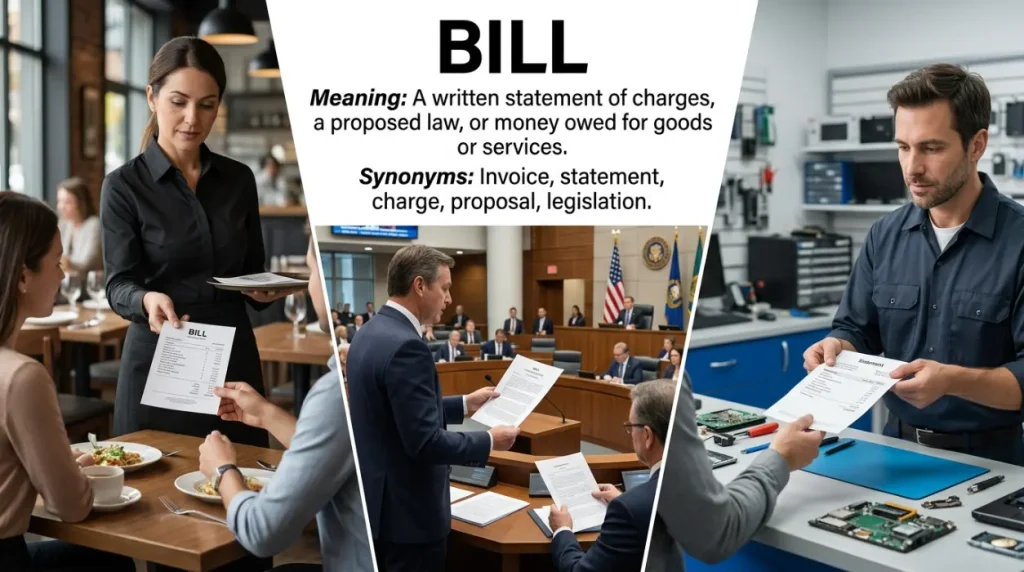
Synonyms for bill become useful when you want to describe a payment, restaurant check, legal proposal, or written notice without repeating one familiar word.
Imagine finishing dinner with friends and asking, “Could we get the bill?” In American English, “check” often sounds more natural in that setting.
Learning a synonym for bill helps students, bloggers, writers, and daily speakers choose words that match the exact situation, tone, and audience.
The word bill is common because it covers several everyday ideas. Knowing its alternatives makes emails, essays, conversations, and content sound more precise and natural.
What Does “Synonym for Bill” Really Mean?
The word bill has several distinct meanings, so there is no single synonym that works everywhere.
In its most common financial sense, a bill is a document or request showing what someone owes for goods or services. For example, you might receive an electricity bill, repair bill, phone bill, or restaurant bill.
In British English, bill is especially common for restaurant payments. American English usually uses check in that context.
The word can also mean a proposed law, a piece of paper money, a public notice, or a bird’s beak. As a verb, bill can mean to send someone a payment request or advertise someone in a particular way.
Part of speech: noun and verb.
Simple definition: A bill is usually a written request for payment, but it can also refer to a proposed law, banknote, public notice, bird’s beak, or the act of charging or promoting someone.
For native speakers, context normally makes the intended meaning clear.
🧠 Connotative Meaning
Connotation (the feeling, association, or emotional shade connected with a word beyond its basic dictionary meaning) depends strongly on the sense of bill.
Positive tone
A bill can feel neutral or even positive when it represents a completed service, such as a professional invoice for successful work.
Words such as statement, invoice, and account can sound organized and professional.
Negative tone
Financial bills can sometimes suggest pressure, expense, or an unwanted obligation.
Phrases such as hefty charge, tax demand, or payment notice may create a stronger sense of financial urgency.
Neutral tone
In everyday English, bill itself is usually neutral.
The tone changes because of the surrounding words. Compare “monthly bill” with “massive bill” or “unexpected charge.” The nouns remain factual, but the modifiers change the emotional effect.
📖 Etymology
The modern financial and document-related bill comes through Anglo-French bille and Anglo-Latin billa, meaning a writing, list, or document. These forms connect to Medieval Latin bulla, meaning a decree, seal, or sealed document.
Another bill, meaning a bird’s beak, has a separate history. It comes from Old English bill, referring to a bird’s beak. This sense is therefore not historically connected to the financial/document sense.
Old English: 450–1100
Old English had bill for a bird’s beak. It also had a related word for a hooked cutting weapon.
The document-related word developed later through French and Latin influences.
Middle English: 1100–1500
During Middle English, bille referred to a written list, document, or formal statement.
By the late fourteenth century, bill meant a written statement describing goods or services.
Modern English: 1500–Present
The word expanded further.
By the sixteenth century, bill could describe an order requiring payment and a proposed law. Later, it also came to mean paper money and public notices.
This history explains why modern English uses bill for several seemingly unrelated things.

Pronunciation of Bill
- US: /bɪl/
- UK: /bɪl/
Cambridge gives the same pronunciation in both American and British English.
Syllables
bill
It is a one-syllable word.
Affixation Pattern of Bill
Root: bill
Prefix: none
Suffix: none
The word is a simple lexical item rather than a modern prefixed or suffixed form.
Synonyms List
Invoice (noun) — US /ˈɪn.vɔɪs/ — UK /ˈɪn.vɔɪs/
Meaning: A formal document requesting payment for goods or services.
Tone/Register: Formal, professional, business.
Example:
The designer emailed the invoice after completing the project.
Please check the invoice before sending the payment.
Account (noun) — US /əˈkaʊnt/ — UK /əˈkaʊnt/
Meaning: A record of money owed or a financial arrangement used to settle charges.
Tone/Register: Neutral, business.
Example:
The restaurant added the meal to our account.
She checked her account before paying.
Statement (noun) — US /ˈsteɪt.mənt/ — UK /ˈsteɪt.mənt/
Meaning: A document showing financial transactions, charges, or an amount owed.
Tone/Register: Neutral, formal.
Example:
Your monthly statement arrived this morning.
I noticed an unfamiliar charge on the statement.
Check (noun) — US /tʃek/ — UK /tʃek/
Meaning: The document showing the amount owed for a restaurant meal, especially in American English.
Tone/Register: Informal to neutral, everyday American English.
Example:
Could we get the check when you have a moment?
We decided to split the check evenly.
Tab (noun) — US /tæb/ — UK /tæb/
Meaning: The total amount owed for food, drinks, or services, often in informal speech.
Tone/Register: Informal, conversational.
Example:
I’ll pick up the tab tonight.
The dinner tab was higher than we expected.
Charge (noun) — US /tʃɑrdʒ/ — UK /tʃɑːdʒ/
Meaning: An amount of money requested for a particular service, item, or transaction.
Tone/Register: Neutral, business.
Example:
There was an extra delivery charge.
The hotel removed the incorrect charge.
Fee (noun) — US /fiː/ — UK /fiː/
Meaning: A specific amount charged for a professional service or particular activity.
Tone/Register: Formal, professional.
Example:
The consultant explained the service fee clearly.
There is no additional registration fee.
Payment Request (noun phrase) — US /ˈpeɪ.mənt rɪˈkwest/ — UK /ˈpeɪ.mənt rɪˈkwest/
Meaning: A message or document asking someone to pay money that is owed.
Tone/Register: Neutral, professional.
Example:
I received a payment request by email.
The request included the correct amount.
Payment Notice (noun phrase) — US /ˈpeɪ.mənt ˈnoʊ.tɪs/ — UK /ˈpeɪ.mənt ˈnəʊ.tɪs/
Meaning: A formal notice informing someone that a payment is due.
Tone/Register: Formal, administrative.
Example:
The landlord sent a payment notice.
The notice gave a clear due date.
Demand for Payment (noun phrase) — US /dɪˈmænd fər ˈpeɪ.mənt/ — UK /dɪˈmɑːnd fə ˈpeɪ.mənt/
Meaning: A formal request requiring payment of an outstanding amount.
Tone/Register: Formal, legal.
Example:
The company received a demand for payment.
The letter warned that further action could follow.
Itemized Statement (noun) — US /ˈaɪ.təˌmaɪzd ˈsteɪt.mənt/ — UK /ˈaɪ.tə.maɪzd ˈsteɪt.mənt/
Meaning: A statement that lists individual goods, services, or charges separately.
Tone/Register: Formal, professional.
Example:
Please send me an itemized statement.
The document showed every charge separately.
Cost Statement (noun) — US /kɔːst ˈsteɪt.mənt/ — UK /kɒst ˈsteɪt.mənt/
Meaning: A document explaining the costs associated with goods, work, or services.
Tone/Register: Formal, business.
Example:
The contractor prepared a cost statement.
We reviewed each section before approval.
Docket (noun) — US /ˈdɑː.kɪt/ — UK /ˈdɒk.ɪt/
Meaning: A document or list recording items, charges, or matters requiring attention, with specialized uses in law and administration.
Tone/Register: Formal, specialized.
Example:
The clerk attached the docket to the case file.
The document listed the relevant charges.
Assessment (noun) — US /əˈses.mənt/ — UK /əˈses.mənt/
Meaning: An official calculation of an amount owed, especially tax or another required payment.
Tone/Register: Formal, administrative.
Example:
The taxpayer questioned the new assessment.
The assessment arrived by mail.
Tax Assessment (noun phrase) — US /tæks əˈses.mənt/ — UK /tæks əˈses.mənt/
Meaning: An official statement calculating tax that a person or organization owes.
Tone/Register: Formal, legal, financial.
Example:
She reviewed the tax assessment carefully.
The accountant found an error in the calculation.
Tax Demand (noun) — US /tæks dɪˈmænd/ — UK /tæks dɪˈmɑːnd/
Meaning: A formal request for payment of tax that is owed.
Tone/Register: Formal, official.
Example:
The business received a tax demand.
They contacted the tax office about the amount.
Utility Statement (noun) — US /juːˈtɪl.ə.t̬i ˈsteɪt.mənt/ — UK /juːˈtɪl.ə.ti ˈsteɪt.mənt/
Meaning: A statement showing charges for household services such as electricity, gas, or water.
Tone/Register: Neutral, everyday.
Example:
My utility statement arrived yesterday.
The electricity usage was higher this month.
Expense Statement (noun) — US /ɪkˈspens ˈsteɪt.mənt/ — UK /ɪkˈspens ˈsteɪt.mənt/
Meaning: A document listing expenses and amounts spent.
Tone/Register: Professional, business.
Example:
The employee submitted an expense statement.
Finance reviewed the travel costs.
Charge Sheet (noun) — US /ˈtʃɑrdʒ ʃiːt/ — UK /ˈtʃɑːdʒ ʃiːt/
Meaning: A document listing charges or amounts associated with a transaction or service.
Tone/Register: Formal, administrative.
Example:
The technician attached a charge sheet.
It listed the labor and materials separately.
Receipt (noun) — US /rɪˈsiːt/ — UK /rɪˈsiːt/
Meaning: A document confirming that payment has been made rather than a payment request.
Tone/Register: Neutral, everyday.
Example:
Keep the receipt for your records.
The cashier printed a receipt after payment.
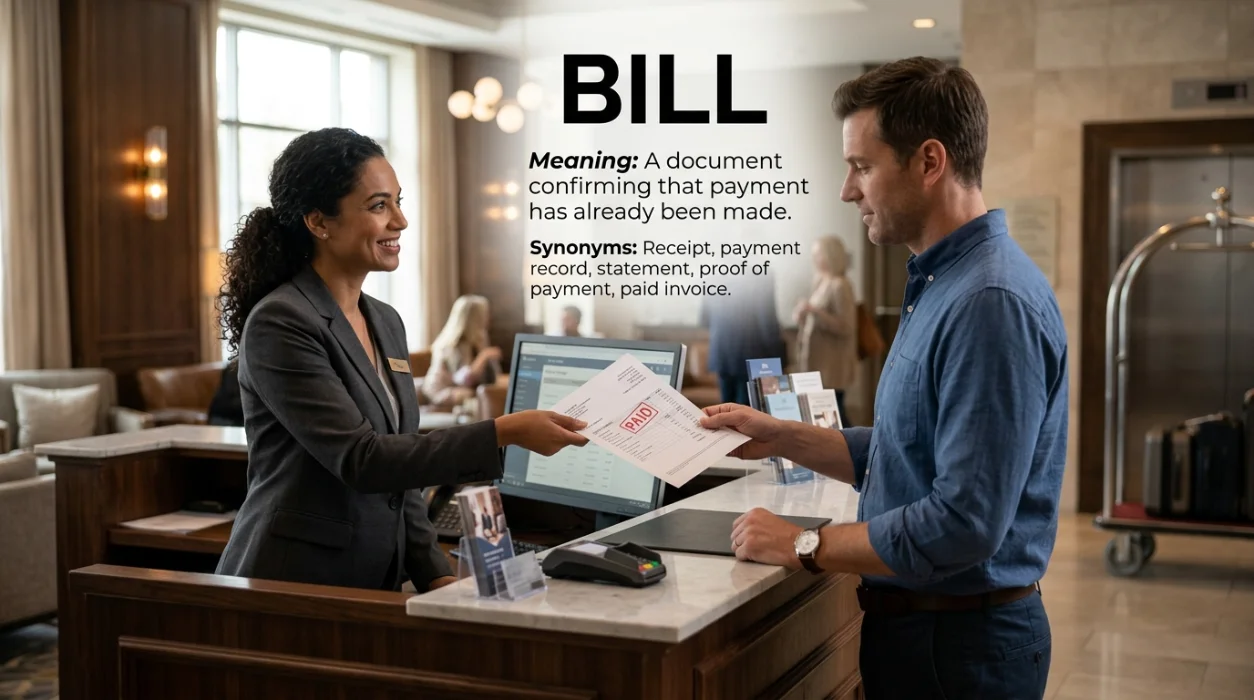
Restaurant Check (noun phrase) — US /ˈres.tə.rɑːnt tʃek/ — UK /ˈres.tər.ɒnt tʃek/
Meaning: The amount and record of what diners owe at a restaurant, especially in American English.
Tone/Register: Neutral, conversational.
Example:
The server brought the restaurant check.
We looked over it before paying.
Restaurant Account (noun phrase) — US /ˈres.tə.rɑːnt əˈkaʊnt/ — UK /ˈres.tər.ɒnt əˈkaʊnt/
Meaning: The total amount recorded for food and drinks consumed at a restaurant.
Tone/Register: Neutral, less common.
Example:
The restaurant account included our drinks.
We asked the server to separate the account.
Invoice Statement (noun) — US /ˈɪn.vɔɪs ˈsteɪt.mənt/ — UK /ˈɪn.vɔɪs ˈsteɪt.mənt/
Meaning: A financial document summarizing invoices or amounts owed.
Tone/Register: Formal, business.
Example:
The supplier sent an invoice statement.
Our accounts team reviewed the outstanding balance.
Charge Notice (noun) — US /tʃɑrdʒ ˈnoʊ.tɪs/ — UK /tʃɑːdʒ ˈnəʊ.tɪs/
Meaning: A notice informing someone that a particular charge applies.
Tone/Register: Formal, administrative.
Example:
The parking authority issued a charge notice.
The driver checked the date carefully.
Balance Due (noun phrase) — US /ˈbæl.əns duː/ — UK /ˈbæl.əns djuː/
Meaning: The amount of money that remains unpaid.
Tone/Register: Neutral, financial.
Example:
The balance due appears at the bottom.
Please check the balance before making the transfer.
Outstanding Balance (noun phrase) — US /aʊtˈstæn.dɪŋ ˈbæl.əns/ — UK /aʊtˈstæn.dɪŋ ˈbæl.əns/
Meaning: Money that remains owed after previous payments or credits.
Tone/Register: Formal, financial.
Example:
The account has an outstanding balance.
She paid part of it last week.
Proposed Law (noun phrase) — US /prəˈpoʊzd lɔː/ — UK /prəˈpəʊzd lɔː/
Meaning: A planned law presented for discussion before it becomes law.
Tone/Register: Formal, legal.
Example:
The proposed law attracted public debate.
Lawmakers discussed several amendments.
Legislative Proposal (noun phrase) — US /ˈledʒ.əˌsleɪ.t̬ɪv prəˈpoʊ.zəl/ — UK /ˈledʒ.ɪ.slə.tɪv prəˈpəʊ.zəl/
Meaning: A formal proposal for new legislation.
Tone/Register: Formal, academic, legal.
Example:
The committee reviewed the legislative proposal.
Several experts submitted comments.
Draft Law (noun phrase) — US /dræft lɔː/ — UK /drɑːft lɔː/
Meaning: A preliminary version of a proposed law.
Tone/Register: Formal, legal.
Example:
The committee published the draft law.
Citizens were invited to comment.
Measure (noun) — US /ˈmeʒ.ər/ — UK /ˈmeʒ.ər/
Meaning: A proposed legislative action, especially in political or parliamentary contexts.
Tone/Register: Formal, political, legal.
Example:
The measure will receive another hearing.
Lawmakers debated its possible effects.
Legislative Measure (noun phrase) — US /ˈledʒ.əˌsleɪ.t̬ɪv ˈmeʒ.ər/ — UK /ˈledʒ.ɪ.slə.tɪv ˈmeʒ.ər/
Meaning: A formal proposal or action considered by a legislative body.
Tone/Register: Formal, legal.
Example:
The legislative measure passed its first stage.
Further discussion is expected next week.
Banknote (noun) — US /ˈbæŋk.noʊt/ — UK /ˈbæŋk.nəʊt/
Meaning: A piece of paper or polymer currency issued by a bank.
Tone/Register: Neutral, formal.
Example:
He handed me a banknote.
The machine accepted several denominations.
Note (noun) — US /noʊt/ — UK /nəʊt/
Meaning: A piece of paper currency, especially in British English.
Tone/Register: Neutral, everyday.
Example:
She gave me a twenty-pound note.
I didn’t have a smaller note.
Paper Money (noun) — US /ˈpeɪ.pər ˈmʌn.i/ — UK /ˈpeɪ.pər ˈmʌn.i/
Meaning: Money issued in printed or flexible note form rather than coins.
Tone/Register: Neutral.
Example:
Some travelers still prefer paper money.
He kept a little paper money in his wallet.
Currency Note (noun phrase) — US /ˈkɝː.ən.si noʊt/ — UK /ˈkʌr.ən.si nəʊt/
Meaning: A physical note representing a denomination of currency.
Tone/Register: Formal, financial.
Example:
The bank verified the currency note.
The design changes between denominations.
Denomination (noun) — US /dɪˌnɑː.məˈneɪ.ʃən/ — UK /dɪˌnɒm.ɪˈneɪ.ʃən/
Meaning: A particular stated value of a banknote or coin.
Tone/Register: Formal, financial.
Example:
Do you have a smaller denomination?
The machine accepts several denominations.
Beak (noun) — US /biːk/ — UK /biːk/
Meaning: The hard projecting mouthpart of a bird.
Tone/Register: Neutral, biological, everyday.
Example:
The parrot cracked the seed with its beak.
The bird wiped its beak on the branch.
Mouthpart (noun) — US /ˈmaʊθ.pɑːrt/ — UK /ˈmaʊθ.pɑːt/
Meaning: A structure used by an animal for feeding or handling food.
Tone/Register: Scientific, academic.
Example:
The insect has specialized mouthparts.
Researchers examined the structure under a microscope.
Mandible (noun) — US /ˈmæn.də.bəl/ — UK /ˈmæn.dɪ.bəl/
Meaning: A jaw or jaw-like structure, including the lower jaw of vertebrates and certain feeding structures in insects.
Tone/Register: Scientific, technical.
Example:
The researcher examined the bird’s mandible.
Its mandible was unusually strong.
Rostrum (noun) — US /ˈrɑː.strəm/ — UK /ˈrɒ.strəm/
Meaning: A projecting structure resembling a beak or snout, especially in zoological descriptions.
Tone/Register: Technical, scientific.
Example:
The marine animal has a long rostrum.
The researcher measured its shape carefully.
Culmen (noun) — US /ˈkʌl.mən/ — UK /ˈkʌl.mən/
Meaning: The upper ridge of a bird’s bill.
Tone/Register: Scientific, ornithological.
Example:
The ornithologist measured the bird’s culmen.
The feature helps distinguish related species.
Snout (noun) — US /snaʊt/ — UK /snaʊt/
Meaning: The projecting nose and mouth area of an animal.
Tone/Register: Neutral, informal to biological.
Example:
The puppy pushed its snout through the gap.
The animal had a short, rounded snout.
Placard (noun) — US /ˈplæk.ɑrd/ — UK /ˈplæk.ɑːd/
Meaning: A sign or notice displayed publicly to communicate information.
Tone/Register: Formal, public, historical.
Example:
A placard announced the evening performance.
Visitors read the placard near the entrance.
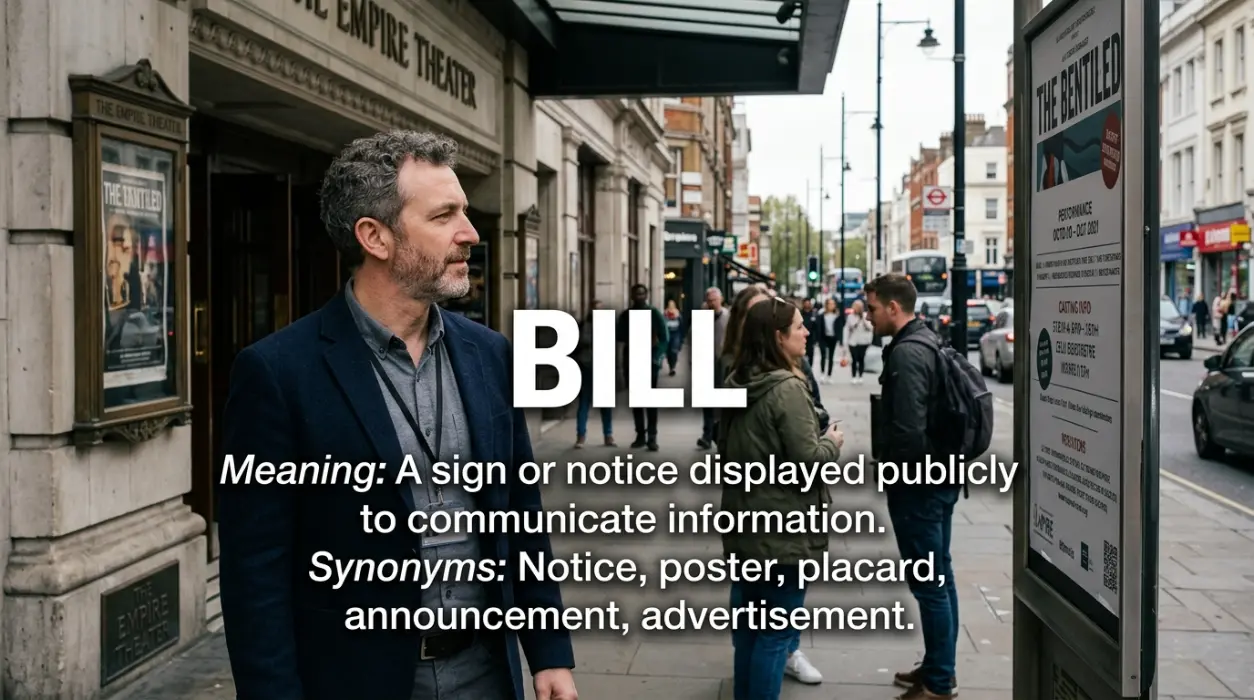
Handbill (noun) — US /ˈhænd.bɪl/ — UK /ˈhænd.bɪl/
Meaning: A printed sheet distributed by hand to announce or advertise something.
Tone/Register: Neutral, somewhat old-fashioned.
Example:
Volunteers handed out a handbill downtown.
The handbill announced a local performance.
Flyer (noun) — US /ˈflaɪ.ər/ — UK /ˈflaɪ.ər/
Meaning: A small printed notice used to provide information or promote an event.
Tone/Register: Informal, everyday.
Example:
I found a flyer for the community concert.
She designed a simple flyer for the event.
Leaflet (noun) — US /ˈliː.flət/ — UK /ˈliː.flət/
Meaning: A small printed sheet containing information or an announcement.
Tone/Register: Neutral, common in British English.
Example:
The museum gave us a leaflet.
The leaflet explained the exhibition.
Notice (noun) — US /ˈnoʊ.t̬ɪs/ — UK /ˈnəʊ.tɪs/
Meaning: A written announcement intended to inform people about something.
Tone/Register: Neutral, formal.
Example:
A notice was posted beside the door.
The notice explained the new opening hours.
Circular (noun) — US /ˈsɝː.kjə.lər/ — UK /ˈsɜː.kjə.lər/
Meaning: A printed message distributed to many people.
Tone/Register: Formal, administrative.
Example:
The school sent a circular to parents.
The circular contained updated instructions.
Broadside (noun) — US /ˈbrɔːd.saɪd/ — UK /ˈbrɔːd.saɪd/
Meaning: A large printed sheet or public notice designed for display or distribution.
Tone/Register: Historical, literary.
Example:
The archive contains a nineteenth-century broadside.
The printed sheet announced a public event.
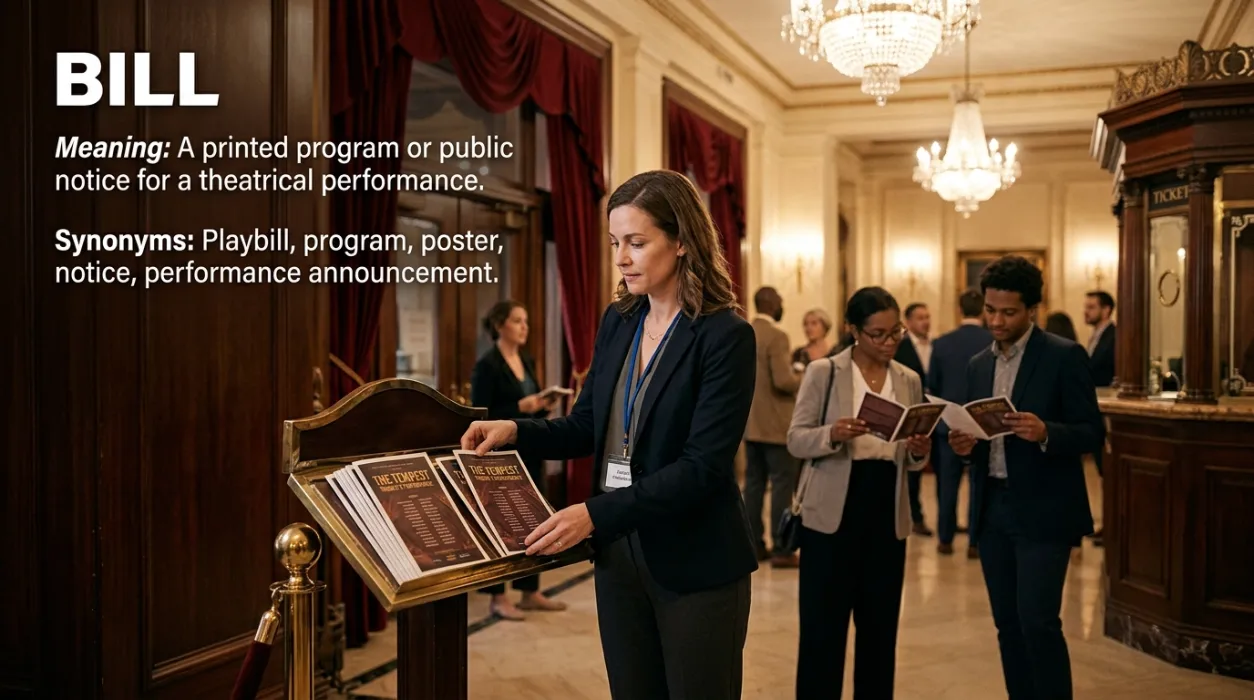
Playbill (noun) — US /ˈpleɪ.bɪl/ — UK /ˈpleɪ.bɪl/
Meaning: A printed program or notice for a theatrical performance.
Tone/Register: Cultural, theatrical.
Example:
She kept the playbill as a souvenir.
The playbill listed the actors and scenes
Synonyms by Tone
Because bill has multiple meanings, tone depends on the replacement you choose.
Positive
- Account
- Statement
- Invoice
- Program
- Featured act
- Promote
These choices can sound organized, professional, or enthusiastic.
Neutral
- Bill
- Check
- Charge
- Fee
- Notice
- Flyer
- Leaflet
- Beak
- Banknote
- Note
These words usually communicate information without adding much emotion.
Negative or Urgent
- Demand for payment
- Payment notice
- Tax demand
- Outstanding balance
- Hefty charge
These terms can suggest obligation, urgency, or financial pressure.
Playful or Informal
- Tab
- Check
- Lineup
- Flyer
- Snout
These work well in casual conversation when the context supports them.
Why Does Tone Matter?
A synonym can change how a sentence feels.
For example, invoice sounds professional, while tab sounds relaxed. Demand for payment sounds much more serious than statement.
Therefore, good vocabulary is not only about finding another word. It is about finding the right word for the situation.
“Bill” vs Close Alternatives
| Word | Meaning Difference | Tone | Best Use |
|---|---|---|---|
| Bill | General request for money owed | Neutral | Everyday speech and writing |
| Invoice | Formal request for payment for goods or work | Professional | Business and freelance work |
| Statement | Record showing transactions or balance | Neutral/Formal | Banking and account records |
| Check | Restaurant payment document, mainly US English | Informal/Neutral | American restaurant conversations |
| Tab | Amount owed, especially informally | Casual | Bars, restaurants, social settings |
The most important distinction is between bill, invoice, and statement.
An invoice usually requests payment for goods or services. A statement normally summarizes account activity. A bill is broader and more common in everyday English.
How “Bill” Changes by Context
Daily Conversation
In everyday speech, bill usually refers to money owed.
You might say:
“Did the electricity bill arrive?”
At a restaurant, British speakers commonly ask for the bill, while American speakers commonly ask for the check.
The word also appears in familiar expressions such as foot the bill, meaning to pay the cost.
Writing and Blogging
Writers often replace bill with a more specific word.
For example, a financial article may use invoice, statement, or payment notice.
A travel article might use restaurant check for an American audience and restaurant bill for a British audience.
This small choice improves clarity.
Professional or Academic Tone
Professional writing benefits from precision.
Instead of saying:
“We received a bill for the work.”
you might say:
“We received an invoice for the completed work.”
In legal writing, bill may refer to proposed legislation. In that setting, draft law, legislative proposal, or measure may provide a more exact description.
Creative or Informal Use
Creative writing can use tab, check, flyer, playbill, or banknote, depending on the scene.
A novelist might write:
“He dropped a twenty-dollar bill onto the counter.”
Here, bill means paper money, not a payment request.
Common Mistakes Learners Make
Mistake 1: Treating Every Synonym as Universal
You cannot replace every use of bill with invoice.
A proposed law is not an invoice. A bird’s bill is not a statement.
Always identify the meaning first.
Mistake 2: Confusing Bill and Receipt
A bill tells you what you owe.
A receipt usually confirms that you have paid.
This distinction matters in restaurants, shops, accounting, and business writing.
Mistake 3: Using Check Everywhere
Check is particularly natural for a restaurant payment in American English.
In British English, bill is usually preferred for that situation.
Mistake 4: Using Invoice in Casual Situations
Invoice sounds more professional.
You might say:
“The company sent an invoice.”
You would not normally say:
“Can we get the invoice?”
when casually asking for a restaurant payment.
Mistake 5: Confusing the Different Bills
English has several unrelated or historically separate senses of bill.
A bill can mean a payment request, proposed law, banknote, public notice, or bird’s beak.
Context controls the meaning.
Register Notes
Bill is highly versatile and works in both speech and writing.
Invoice is more common in professional and business settings.
Tab is informal.
Demand for payment is formal and often serious.
Playbill and handbill have more specialized or historical uses.
For another useful vocabulary resource, an internal guide on synonyms and register can help you compare formal, neutral, and informal word choices.
Real-Life Mini Scenarios
Workplace
A freelance designer finishes a project and sends an invoice.
The client later receives a statement showing the account history.
This distinction makes the communication sound precise and professional.
Social Situation
A group finishes dinner.
In the United States, someone might say:
“Can we get the check?”
In Britain, the same situation would commonly use:
“Could we have the bill?”
Both are natural within their regional varieties.
Media and Pop Culture
A movie may be billed as a comedy.
That means it is advertised or described as a comedy. Oxford specifically records this advertising sense of the verb bill.
A theater performance may also have a playbill listing its production information.
Writing and Storytelling
A historical story might describe a performer reading a handbill.
A modern story might mention a flyer taped to a wall.
A financial drama could focus on an outstanding balance or an unexpected charge.
The best choice depends on the scene.
Practice Exercise
1. A freelancer sends a formal document asking a client to pay for completed work. What is the best word?
A. Beak
B. Invoice
C. Flyer
D. Playbill
2. You are eating at a restaurant in the United States and want to pay. What would you normally ask for?
A. The check
B. The banknote
C. The handbill
D. The measure
3. A document summarizes transactions on a financial account. Which word fits best?
A. Statement
B. Snout
C. Flyer
D. Tab
4. Which word is most informal for the amount owed at a restaurant or bar?
A. Legislative proposal
B. Tab
C. Assessment
D. Invoice
5. A proposed piece of legislation is being discussed before a vote. Which term fits?
A. Banknote
B. Draft law
C. Receipt
D. Fee
6. Which word means a bird’s projecting mouth structure?
A. Check
B. Invoice
C. Beak
D. Statement
7. A printed sheet is distributed by hand to announce an event. What is it?
A. Handbill
B. Assessment
C. Account
D. Charge
8. Which word normally confirms that payment has already been made?
A. Receipt
B. Demand
C. Invoice
D. Bill
9. Which word sounds most professional for a formal payment request?
A. Tab
B. Invoice
C. Snout
D. Lineup
10. A theater production gives audience members a printed guide. Which word fits best?
A. Playbill
B. Tax demand
C. Balance due
D. Check
Answer Key: 1-B | 2-A | 3-A | 4-B | 5-B | 6-C | 7-A | 8-A | 9-B | 10-A
Reflection Task
Write three short sentences using different alternatives for bill.
Try one financial word, one everyday word, and one specialized word.
For example, use invoice, check, and banknote in three different contexts.
Conclusion
Understanding bill can help you describe a statement showing the amount of money owed for goods or services. It can also refer to a proposed law, a paper currency note, or the beak of a bird, depending on the context. Learning its synonyms, meaning, and examples can improve your English vocabulary.
The word bill is commonly used in financial, business, legal, everyday, and natural contexts. Knowing its related synonyms can help you express ideas about charges, invoices, proposed laws, statements, or bird beaks in different ways.
By practicing bill in sentences and exploring its related meanings, you can strengthen your vocabulary and writing skills. A clear understanding of this word will help you use it naturally, accurately, and confidently in different English contexts.
FAQs
1. What is the best synonym for bill in a business email?
Invoice is usually the strongest choice when you mean a formal request for payment for goods or services. It sounds professional and precise. However, statement may be better when you are referring to a summary of account activity rather than a single request for payment. The best choice depends on what the document actually contains.
2. What is the American English synonym for bill at a restaurant?
The most common American English alternative is check. For example, an American diner might say, “Could we get the check, please?” In British English, bill is more typical in the same situation. Both words refer to the amount a restaurant customer needs to pay.
3. Is invoice a formal synonym for bill?
Yes, invoice can function as a formal alternative to bill when the meaning involves a request for payment for goods or services. However, the words are not identical in every context. Bill is broader and more common in everyday language, while invoice strongly suggests business, professional, or commercial documentation.
4. What is another word for a bill that shows money already paid?
A receipt is usually the appropriate word when you mean a document confirming payment. It is important not to confuse it with a bill. A bill generally tells you what you owe, while a receipt records or confirms a completed payment. This distinction is especially useful in accounting and everyday shopping situations.
5. What is a synonym for bill meaning proposed law?
Depending on the context, alternatives include proposed law, draft law, legislative proposal, and measure. These terms emphasize slightly different aspects of the legislative process. A bill is generally a proposed piece of legislation that is discussed before it becomes law.

Hasnain Ali is an SEO Content Strategist and the founder of wordvora.com, a trusted vocabulary platform that helps writers, students, professionals, and English learners find accurate synonyms, antonyms, word meanings, and real-life usage examples. He specializes in keyword research, on-page SEO, topical authority, and creating search-first content that aligns with Google’s latest Search Quality and E-E-A-T guidelines. His work focuses on producing clear, well-structured, and reader-friendly resources that satisfy search intent while maintaining high editorial standards.
Through extensive hands-on experience with SEO tools such as Google Search Console, Google Analytics, SEMrush, and Ahrefs, Hasnain researches user search behavior and develops content that is both informative and easy to understand. Every article published on wordvora.com is carefully reviewed for accuracy, readability, and contextual relevance before publication. His mission is to build one of the web’s most reliable English vocabulary resources by providing practical language guidance, trustworthy explanations, and content that helps readers improve their writing, communication, and vocabulary with confidence.