
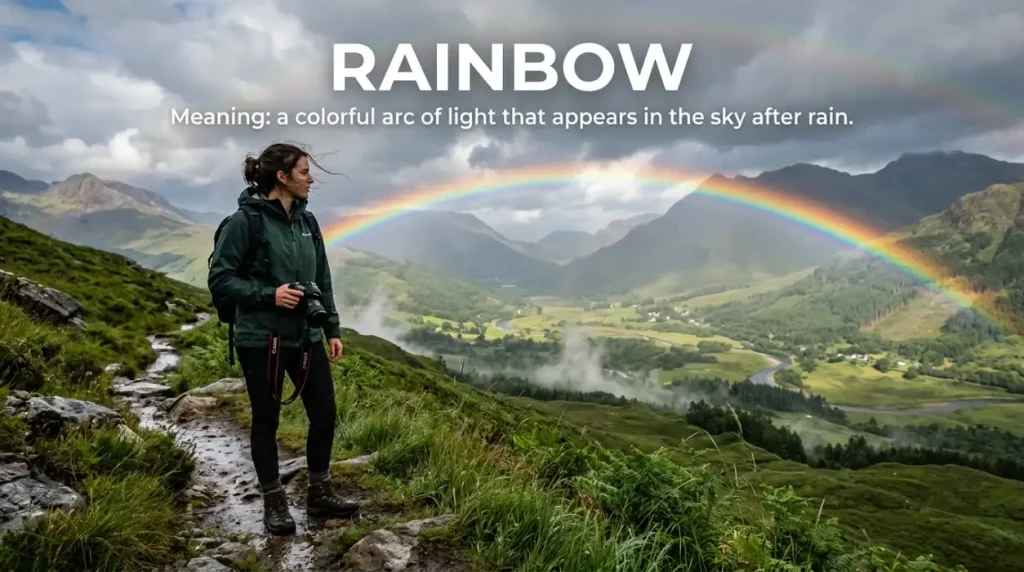
Synonyms for rainbow become useful when you describe a bright arc after rain but want something more vivid than the same familiar word every time.
Imagine looking outside after a summer shower and seeing a rainbow above the houses. A few different words can make that scene feel fresh.
Learning synonyms for rainbow can improve descriptive vocabulary because each alternative can highlight color, shape, light, weather, or emotion.
Students, bloggers, content writers, and daily English users can use these alternatives to make stories, captions, essays, and conversations more expressive.
What Does “Rainbow” Really Mean?
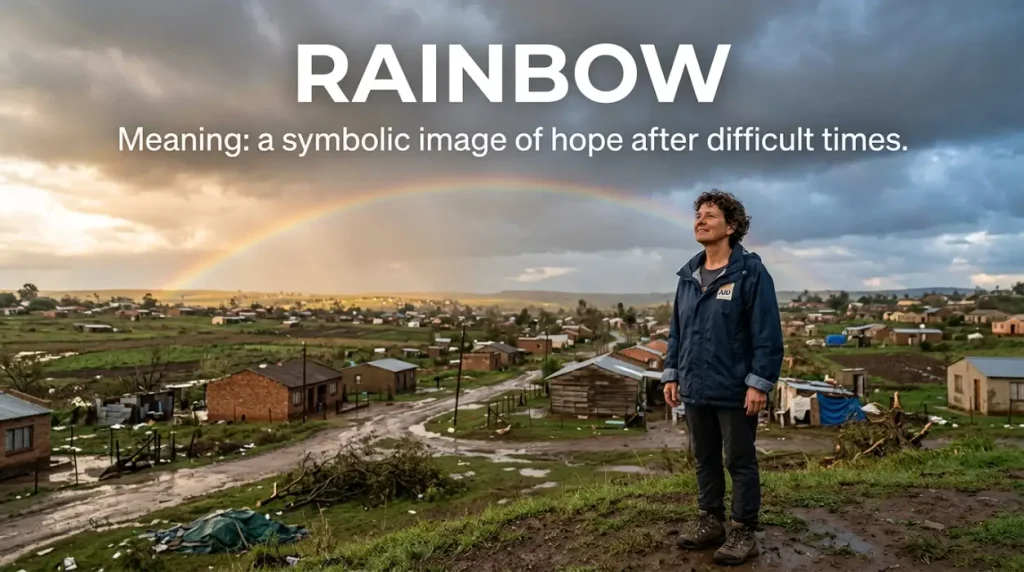
A rainbow is a curved band of colors that appears when light interacts with water droplets in the atmosphere.
Most people recognize the familiar sequence of colors as red, orange, yellow, green, blue, indigo, and violet. However, the visible appearance can vary with lighting and viewing conditions.
In everyday English, rainbow is mainly a noun. It can describe the natural atmospheric phenomenon, but it can also be used symbolically.
For example, a rainbow may represent hope, beauty, peace, diversity, renewal, or happiness. Therefore, its meaning can be literal or figurative depending on context.
Part of Speech
Rainbow is primarily a noun.
It can also function as an adjective in compounds such as:
- rainbow colors
- rainbow pattern
- rainbow flag
- rainbow effect
- rainbow-colored
Simple Definition
Rainbow: a curved display of colors formed when light is refracted, reflected, and dispersed by water droplets.
Connotative Meaning
Connotation means the emotional or cultural feeling that a word suggests beyond its basic dictionary meaning.
Positive Tone
Rainbow usually has a strongly positive association. It can suggest beauty, hope, joy, peace, celebration, and new beginnings.
Negative Tone
The word itself normally has no negative meaning. A negative association can appear only because of the surrounding context.
For example, a writer might use a rainbow ironically in a scene that contrasts beauty with sadness.
Neutral Tone
In science and weather descriptions, rainbow is usually neutral and factual.
A meteorologist can discuss a rainbow without adding any emotional meaning.
Etymology of “Rainbow”
The word rainbow is a transparent English compound made from rain + bow.
The second element, bow, refers to the curved shape of the phenomenon. Thus, the literal idea is a bow-shaped display associated with rain.
Old English: 450–1100
The concept existed in Old English, although the modern spelling rainbow developed later. Old English used regnboga, formed from words corresponding to “rain” and “bow.”
Middle English: 1100–1500
During Middle English, forms related to rainbow continued to be used. English spelling was becoming less standardized, so several historical forms could occur.
Modern English: 1500–Present
The modern compound rainbow became established in English. Over time, its meaning expanded beyond weather.
Today, the rainbow is also used in art, literature, symbolism, popular culture, and discussions of diversity.
Pronunciation of “Rainbow”
- US: /ˈreɪn.boʊ/
- UK: /ˈreɪn.bəʊ/
Syllables
rain-bow
Two syllables.
Affixation Pattern
Root: rain + bow
Prefix: None
Suffix: None
Rainbow is a compound word, not a word created by adding a normal English prefix or suffix.
Synonyms List
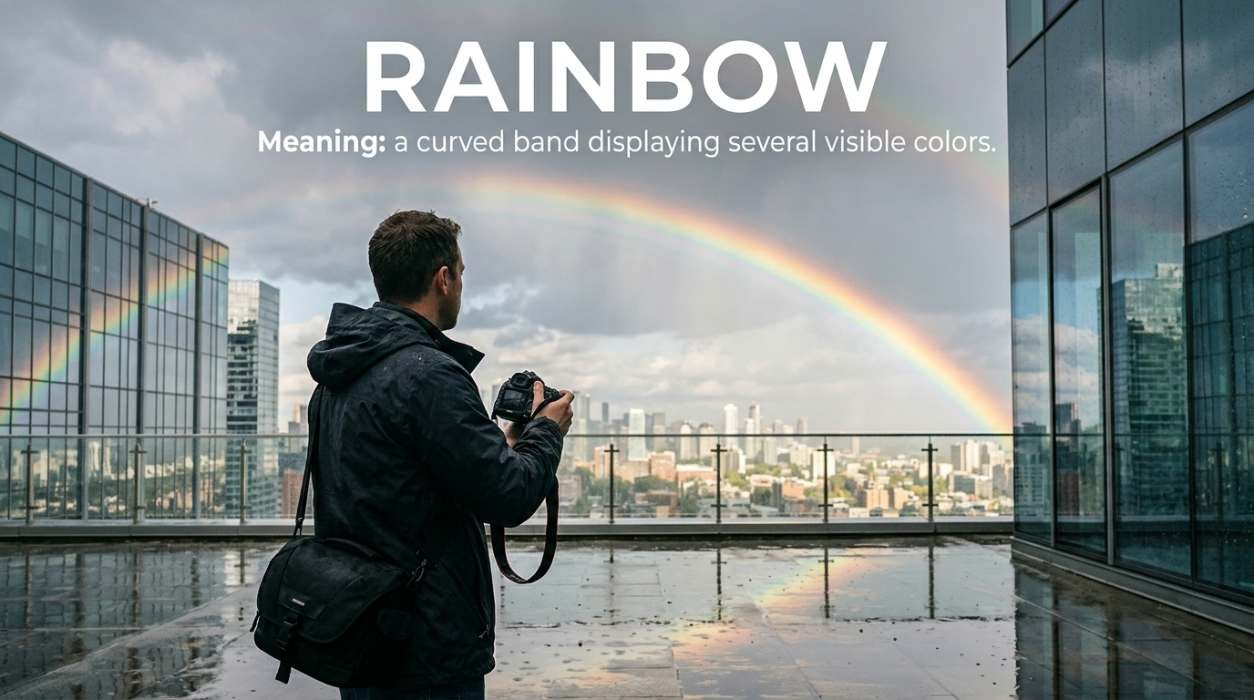
Color Arc (Noun Phrase) — US /ˈkʌl.ɚ ɑːrk/ | UK /ˈkʌl.ə ɑːk/
Meaning: A curved band displaying several visible colors.
Tone/Register: Neutral, descriptive.
Example:
A bright color arc appeared above the valley.
The photographer captured the color arc just before sunset.
Colored Arc (Noun Phrase) — US /ˈkʌl.ɚd ɑːrk/ | UK /ˈkʌl.əd ɑːk/
Meaning: A curved shape containing multiple colors.
Tone/Register: Neutral, visual.
Example:
A colored arc stretched across the clouds.
The children pointed excitedly at the colored arc.
Multicolored Arc (Noun Phrase) — US /ˌmʌl.tiˈkʌl.ɚd ɑːrk/ | UK /ˌmʌl.tiˈkʌl.əd ɑːk/
Meaning: A curved display containing several different colors.
Tone/Register: Descriptive.
Example:
The storm left a multicolored arc in the sky.
She painted a multicolored arc above the mountains.
Prismatic Arc (Noun Phrase) — US /prɪˈzmæt̬.ɪk ɑːrk/ | UK /prɪzˈmæt.ɪk ɑːk/
Meaning: A color arc associated with the separation of light into different wavelengths.
Tone/Register: Scientific, formal.
Example:
The photographer described the phenomenon as a prismatic arc.
A prismatic arc appeared through the mist.
Light Arc (Noun Phrase) — US /laɪt ɑːrk/ | UK /laɪt ɑːk/
Meaning: A curved band of visible light.
Tone/Register: Neutral, poetic.
Example:
A delicate light arc formed over the lake.
The artist used a light arc to suggest hope.
Spectral Arc (Noun Phrase) — US /ˈspek.trəl ɑːrk/ | UK /ˈspek.trəl ɑːk/
Meaning: A curved display of colors produced by the separation of visible light.
Tone/Register: Scientific.
Example:
The textbook explains how a spectral arc forms.
The students observed a spectral arc after the experiment.
Color Spectrum (Noun Phrase) — US /ˈkʌl.ɚ ˌspek.trəm/ | UK /ˈkʌl.ə ˌspek.trəm/
Meaning: A range of visible colors arranged across a spectrum.
Tone/Register: Scientific, educational.
Example:
The poster shows the visible color spectrum.
The rainbow seemed to display a natural color spectrum.
Visible Spectrum (Noun Phrase) — US /ˈvɪz.ə.bəl ˈspek.trəm/ | UK /ˈvɪz.ə.bəl ˈspek.trəm/
Meaning: The portion of electromagnetic radiation that human eyes can detect.
Tone/Register: Scientific, academic.
Example:
Red and violet occupy different parts of the visible spectrum.
The lesson connected the rainbow with the visible spectrum.
Spectrum (Noun) — US /ˈspek.trəm/ | UK /ˈspek.trəm/
Meaning: A continuous range of colors or other measurable properties.
Tone/Register: Academic, scientific.
Example:
The glass separated the light into a spectrum.
The artist used the entire spectrum in the design.
Prismatic Display (Noun Phrase) — US /prɪˈzmæt̬.ɪk dɪˈspleɪ/ | UK /prɪzˈmæt.ɪk dɪˈspleɪ/
Meaning: A visible display of colors created through the separation of light.
Tone/Register: Scientific, descriptive.
Example:
The prism created a beautiful prismatic display.
Sunlight produced a small prismatic display on the wall.
Chromatic Arc (Noun Phrase) — US /kroʊˈmæt̬.ɪk ɑːrk/ | UK /krəʊˈmæt.ɪk ɑːk/
Meaning: A curved visual form characterized by multiple colors.
Tone/Register: Technical, artistic.
Example:
The designer added a chromatic arc to the poster.
The mural features a bold chromatic arc.
Chromatic Band (Noun Phrase) — US /kroʊˈmæt̬.ɪk bænd/ | UK /krəʊˈmæt.ɪk bænd/
Meaning: A strip or band distinguished by color.
Tone/Register: Technical, descriptive.
Example:
A chromatic band appeared near the horizon.
The illustrator turned the natural scene into a chromatic band.
Color Band (Noun Phrase) — US /ˈkʌl.ɚ bænd/ | UK /ˈkʌl.ə bænd/
Meaning: A visible strip of color.
Tone/Register: Neutral.
Example:
A soft color band crossed the gray sky.
The child drew each color band carefully.
Bow of Colors (Noun Phrase) — US /boʊ əv ˈkʌl.ɚz/ | UK /bəʊ əv ˈkʌl.əz/
Meaning: A curved arrangement of different colors.
Tone/Register: Poetic, literary.
Example:
A bow of colors appeared after the storm.
The poet compared the sky to a bow of colors.
Colored Bow (Noun Phrase) — US /ˈkʌl.ɚd boʊ/ | UK /ˈkʌl.əd bəʊ/
Meaning: A bow-shaped display containing several colors.
Tone/Register: Descriptive.
Example:
A colored bow rose above the fields.
The children searched for the end of the colored bow.
Sky Bow (Noun Phrase) — US /skaɪ boʊ/ | UK /skaɪ bəʊ/
Meaning: A poetic description of a curved band of colors in the sky.
Tone/Register: Poetic, informal.
Example:
The sky bow appeared just before dinner.
She photographed the sky bow from her balcony.
Rainbow Arc (Noun Phrase) — US /ˈreɪn.boʊ ɑːrk/ | UK /ˈreɪn.bəʊ ɑːk/
Meaning: A curved rainbow shape.
Tone/Register: Descriptive.
Example:
The rainbow arc was visible above the trees.
The camera captured only half of the rainbow arc.
Atmospheric Arc (Noun Phrase) — US /ˌæt.məˈsfɪr.ɪk ɑːrk/ | UK /ˌæt.məˈsfɪə.rɪk ɑːk/
Meaning: A curved optical phenomenon appearing in the atmosphere.
Tone/Register: Scientific.
Example:
The guide explained the atmospheric arc to visitors.
The unusual atmospheric arc lasted for several minutes.
Atmospheric Color Display (Noun Phrase) — US /ˌæt.məˈsfɪr.ɪk ˈkʌl.ɚ dɪˈspleɪ/ | UK /ˌæt.məˈsfɪə.rɪk ˈkʌl.ə dɪˈspleɪ/
Meaning: A naturally occurring display of colors in the atmosphere.
Tone/Register: Scientific, formal.
Example:
The atmospheric color display became brighter as the rain stopped.
Researchers photographed the atmospheric color display.
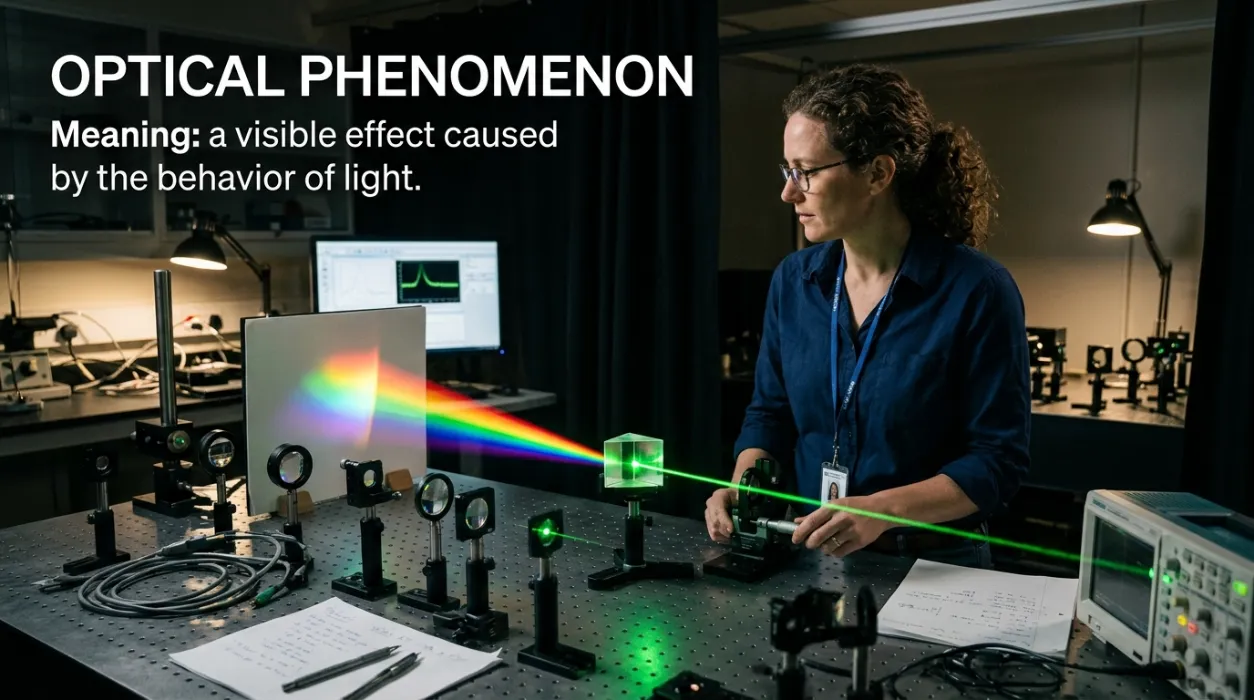
Optical Phenomenon (Noun Phrase) — US /ˈɑːp.tɪ.kəl fəˈnɑː.mə.nɑːn/ | UK /ˈɒp.tɪ.kəl fəˈnɒm.ɪ.nən/
Meaning: A visible effect caused by the behavior of light.
Tone/Register: Academic, scientific.
Example:
A rainbow is a familiar optical phenomenon.
The teacher demonstrated another optical phenomenon with glass.
Optical Arc (Noun Phrase) — US /ˈɑːp.tɪ.kəl ɑːrk/ | UK /ˈɒp.tɪ.kəl ɑːk/
Meaning: A curved visual effect produced by light.
Tone/Register: Technical.
Example:
The photographer waited for the optical arc to become brighter.
The optical arc disappeared when the sunlight changed.
Light Phenomenon (Noun Phrase) — US /laɪt fəˈnɑː.mə.nɑːn/ | UK /laɪt fəˈnɒm.ɪ.nən/
Meaning: A visible event created by the interaction of light.
Tone/Register: Educational, neutral.
Example:
The rainbow is a striking light phenomenon.
The museum exhibit explains several light phenomena.
Refraction Display (Noun Phrase) — US /rɪˈfræk.ʃən dɪˈspleɪ/ | UK /rɪˈfræk.ʃən dɪˈspleɪ/
Meaning: A visual display associated with the bending of light.
Tone/Register: Scientific.
Example:
The demonstration produced a refraction display.
Students watched the refraction display through a glass prism.
Prism Effect (Noun Phrase) — US /ˈprɪz.əm ɪˈfekt/ | UK /ˈprɪz.əm ɪˈfekt/
Meaning: A color effect caused when light separates into different components.
Tone/Register: Scientific, everyday.
Example:
The window created a prism effect on the floor.
The artist recreated the prism effect with transparent materials.
Light Spectrum (Noun Phrase) — US /laɪt ˈspek.trəm/ | UK /laɪt ˈspek.trəm/
Meaning: The range of colors or wavelengths contained in visible light.
Tone/Register: Scientific.
Example:
The experiment revealed the light spectrum.
The rainbow gives a familiar visual example of separated light.
Color Gradient (Noun Phrase) — US /ˈkʌl.ɚ ˈɡreɪ.di.ənt/ | UK /ˈkʌl.ə ˈɡreɪ.di.ənt/
Meaning: A gradual transition from one color to another.
Tone/Register: Design, artistic.
Example:
The sky showed a beautiful color gradient.
The designer copied the natural color gradient into the illustration.
Color Sweep (Noun Phrase) — US /ˈkʌl.ɚ swiːp/ | UK /ˈkʌl.ə swiːp/
Meaning: A broad flowing movement or spread of color.
Tone/Register: Artistic, informal.
Example:
A color sweep crossed the evening sky.
The painter created a soft color sweep across the canvas.
Arc of Light (Noun Phrase) — US /ɑːrk əv laɪt/ | UK /ɑːk əv laɪt/
Meaning: A curved band or path of visible light.
Tone/Register: Poetic, descriptive.
Example:
An arc of light appeared above the wet road.
The photographer captured the arc of light perfectly.
Arc of Color (Noun Phrase) — US /ɑːrk əv ˈkʌl.ɚ/ | UK /ɑːk əv ˈkʌl.ə/
Meaning: A curved arrangement of visible colors.
Tone/Register: Poetic, neutral.
Example:
An arc of color appeared through the mist.
The children watched the arc of color fade.
Band of Colors (Noun Phrase) — US /bænd əv ˈkʌl.ɚz/ | UK /bænd əv ˈkʌl.əz/
Meaning: A strip or region containing several colors.
Tone/Register: Descriptive.
Example:
A band of colors stretched across the horizon.
The artist painted a band of colors over the hills.
Ribbon of Color (Noun Phrase) — US /ˈrɪb.ən əv ˈkʌl.ɚ/ | UK /ˈrɪb.ən əv ˈkʌl.ə/
Meaning: A long, flowing visual band of color described metaphorically as a ribbon.
Tone/Register: Poetic.
Example:
A ribbon of color floated above the distant mountains.
The writer compared the rainbow to a ribbon of color.
Ribbon of Light (Noun Phrase) — US /ˈrɪb.ən əv laɪt/ | UK /ˈrɪb.ən əv laɪt/
Meaning: A narrow or flowing band of light.
Tone/Register: Poetic.
Example:
A ribbon of light appeared after the rain.
The scene looked magical beneath the ribbon of light.
Curtain of Color (Noun Phrase) — US /ˈkɝː.tən əv ˈkʌl.ɚ/ | UK /ˈkɜː.tən əv ˈkʌl.ə/
Meaning: A broad display of colors compared with a hanging curtain.
Tone/Register: Literary.
Example:
A curtain of color covered the distant sky.
The novelist described the scene as a curtain of color.
Veil of Color (Noun Phrase) — US /veɪl əv ˈkʌl.ɚ/ | UK /veɪl əv ˈkʌl.ə/
Meaning: A soft or delicate layer of color described metaphorically as a veil.
Tone/Register: Poetic.
Example:
A veil of color softened the horizon.
The photograph showed a delicate veil of color.
Bridge of Colors (Noun Phrase) — US /brɪdʒ əv ˈkʌl.ɚz/ | UK /brɪdʒ əv ˈkʌl.əz/
Meaning: A rainbow described metaphorically as a bridge made of colors.
Tone/Register: Poetic, symbolic.
Example:
A bridge of colors connected the two hills.
The poem calls the rainbow a bridge of colors.
Bridge in the Sky (Noun Phrase) — US /brɪdʒ ɪn ðə skaɪ/ | UK /brɪdʒ ɪn ðə skaɪ/
Meaning: A poetic description of a rainbow’s curved shape.
Tone/Register: Literary, imaginative.
Example:
The children called it a bridge in the sky.
She used the phrase bridge in the sky in her story.
Sky Ribbon (Noun Phrase) — US /skaɪ ˈrɪb.ən/ | UK /skaɪ ˈrɪb.ən/
Meaning: A poetic name for a long colorful band across the sky.
Tone/Register: Poetic, informal.
Example:
The sky ribbon appeared after the storm.
The children imagined the sky ribbon was painted by giants.
Celestial Arc (Noun Phrase) — US /səˈles.tʃəl ɑːrk/ | UK /səˈles.tʃəl ɑːk/
Meaning: A poetic description of a curved feature appearing in the sky.
Tone/Register: Literary.
Example:
The poet described the rainbow as a celestial arc.
A celestial arc brightened the landscape after the rain.
Heavenly Arc (Noun Phrase) — US /ˈhev.ən.li ɑːrk/ | UK /ˈhev.ən.li ɑːk/
Meaning: A poetic expression suggesting a beautiful arc in the heavens.
Tone/Register: Poetic, spiritual.
Example:
A heavenly arc appeared above the village.
The painting centers on a heavenly arc.
Sky Spectacle (Noun Phrase) — US /skaɪ ˈspek.tə.kəl/ | UK /skaɪ ˈspek.tə.kəl/
Meaning: A visually impressive event in the sky.
Tone/Register: Informal, expressive.
Example:
The rainbow was a stunning sky spectacle.
Everyone stopped to watch the sky spectacle.
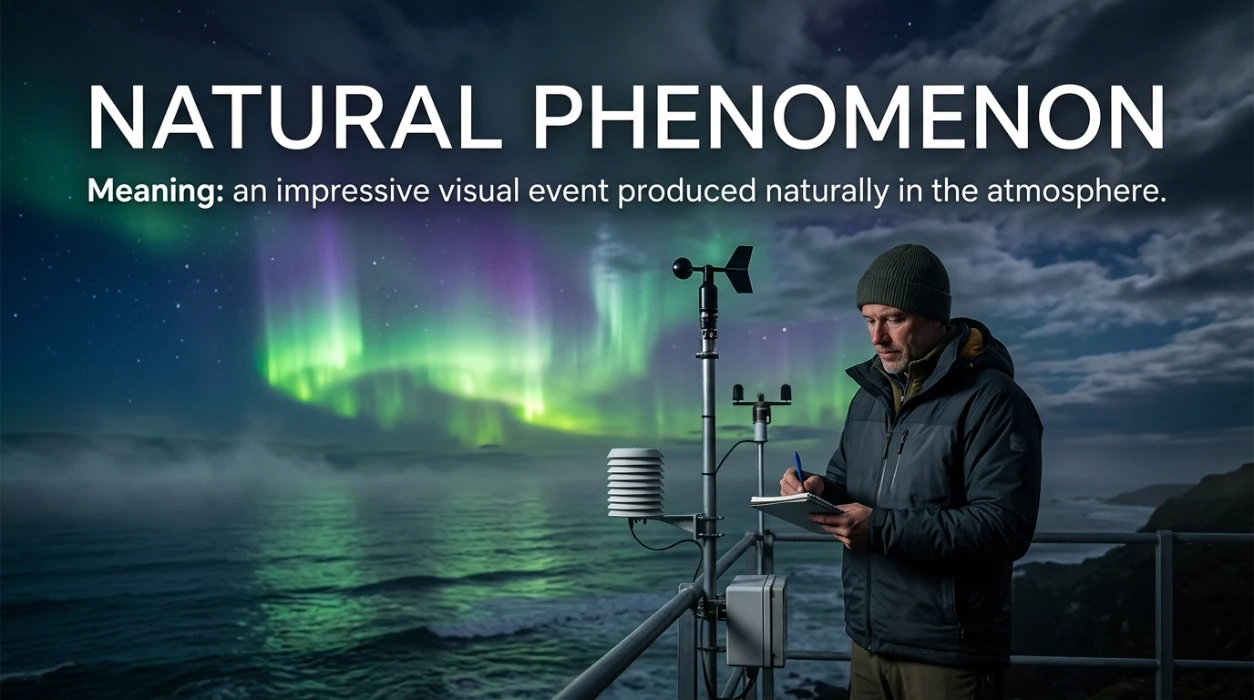
Atmospheric Spectacle (Noun Phrase) — US /ˌæt.məˈsfɪr.ɪk ˈspek.tə.kəl/ | UK /ˌæt.məˈsfɪə.rɪk ˈspek.tə.kəl/
Meaning: An impressive visual event produced naturally in the atmosphere.
Tone/Register: Formal, descriptive.
Example:
The rainbow became an unforgettable atmospheric spectacle.
Tourists gathered to photograph the atmospheric spectacle.
Natural Light Display (Noun Phrase) — US /ˈnætʃ.ɚ.əl laɪt dɪˈspleɪ/ | UK /ˈnætʃ.ər.əl laɪt dɪˈspleɪ/
Meaning: A naturally occurring visual display involving light.
Tone/Register: Neutral, educational.
Example:
The rainbow is a beautiful natural light display.
The children learned how this natural light display forms.
Natural Color Display (Noun Phrase) — US /ˈnætʃ.ɚ.əl ˈkʌl.ɚ dɪˈspleɪ/ | UK /ˈnætʃ.ər.əl ˈkʌl.ə dɪˈspleɪ/
Meaning: A naturally occurring presentation of several colors.
Tone/Register: Neutral.
Example:
The storm produced a natural color display.
We watched the natural color display from the garden.
Atmospheric Color Arc (Noun Phrase) — US /ˌæt.məˈsfɪr.ɪk ˈkʌl.ɚ ɑːrk/ | UK /ˌæt.məˈsfɪə.rɪk ˈkʌl.ə ɑːk/
Meaning: A curved atmospheric display containing visible colors.
Tone/Register: Technical, descriptive.
Example:
The atmospheric color arc lasted only a few minutes.
The guide explained the atmospheric color arc to the group.
Rain-Born Arc (Noun Phrase) — US /ˈreɪn bɔːrn ɑːrk/ | UK /ˈreɪn bɔːn ɑːk/
Meaning: A poetic expression for an arc that appears after rain.
Tone/Register: Literary.
Example:
A rain-born arc appeared above the forest.
The poem celebrates the beauty of the rain-born arc.
Rainlit Arc (Noun Phrase) — US /ˈreɪn.lɪt ɑːrk/ | UK /ˈreɪn.lɪt ɑːk/
Meaning: A poetic description of a colorful arc associated with rain and sunlight.
Tone/Register: Poetic.
Example:
The rainlit arc glowed against the dark clouds.
She used “rainlit arc” as a creative image in her poem.
Storm Arc (Noun Phrase) — US /stɔːrm ɑːrk/ | UK /stɔːm ɑːk/
Meaning: A curved display appearing around or after stormy weather.
Tone/Register: Informal, descriptive.
Example:
A storm arc appeared as the clouds moved away.
The photographer waited for the storm arc to brighten.
After-Rain Arc (Noun Phrase) — US /ˌæf.tɚ ˈreɪn ɑːrk/ | UK /ˌɑːf.tə ˈreɪn ɑːk/
Meaning: A descriptive expression for a colorful arc appearing after rainfall.
Tone/Register: Everyday, descriptive.
Example:
An after-rain arc appeared over the fields.
We saw the after-rain arc on our way home.
Post-Rain Arc (Noun Phrase) — US /ˌpoʊst ˈreɪn ɑːrk/ | UK /ˌpəʊst ˈreɪn ɑːk/
Meaning: A formal-sounding description of an arc seen after rain.
Tone/Register: Formal, descriptive.
Example:
The post-rain arc was visible from the observation deck.
The report recorded the appearance of the post-rain arc.
Prism in the Sky (Noun Phrase) — US /ˈprɪz.əm ɪn ðə skaɪ/ | UK /ˈprɪz.əm ɪn ðə skaɪ/
Meaning: A poetic comparison between a rainbow and a prism displaying separated colors.
Tone/Register: Poetic, educational.
Example:
The children called the rainbow a prism in the sky.
The teacher used “prism in the sky” to make the lesson memorable.
Paintbrush of Light (Noun Phrase) — US /ˈpeɪnt.brʌʃ əv laɪt/ | UK /ˈpeɪnt.brʌʃ əv laɪt/
Meaning: A metaphor for a colorful streak or arc of light.
Tone/Register: Creative, literary.
Example:
The rainbow looked like a paintbrush of light.
The poet imagined the clouds being painted by a paintbrush of light.
Brushstroke of Color (Noun Phrase) — US /ˈbrʌʃ.stroʊk əv ˈkʌl.ɚ/ | UK /ˈbrʌʃ.strəʊk əv ˈkʌl.ə/
Meaning: A metaphor comparing a curved color display with a painter’s brushstroke.
Tone/Register: Artistic.
Example:
The rainbow looked like a brushstroke of color.
The artist recreated that brushstroke of color on canvas.
Arc of Hope (Noun Phrase) — US /ɑːrk əv hoʊp/ | UK /ɑːk əv həʊp/
Meaning: A symbolic description of a rainbow representing hope.
Tone/Register: Emotional, poetic.
Example:
The rainbow became an arc of hope after the difficult night.
Her speech used the image of an arc of hope.
Synonyms by Tone
Because rainbow names a specific phenomenon, tone-based alternatives work differently from ordinary synonym lists.
Positive and Uplifting
- Arc of hope
- Symbol of hope
- Symbol of renewal
- Symbol of peace
- Ribbon of color
- Bridge of colors
- Paintbrush of light
These expressions emphasize beauty, optimism, recovery, or emotional warmth.
Neutral and Descriptive
- Color arc
- Colored arc
- Multicolored arc
- Color band
- Spectrum
- Light spectrum
- Optical phenomenon
- Natural color display
- Full rainbow
These are useful when accuracy matters more than emotion.
Scientific and Academic
- Prismatic arc
- Spectral arc
- Visible spectrum
- Optical arc
- Circumhorizontal arc
- Primary rainbow
- Secondary rainbow
- Moonbow
These terms are suitable for science lessons, educational writing, and factual explanations.
Playful or Informal
- Sky bow
- Sky ribbon
- Prism in the sky
- Fire rainbow
- Sky spectacle
These expressions can make casual writing more colorful. However, some are metaphors rather than technical synonyms.
Why Tone Matters
Word choice changes the image in the reader’s mind.
For example, optical phenomenon sounds factual, while ribbon of color sounds artistic. Similarly, circumhorizontal arc provides scientific precision, while arc of hope adds emotional meaning.
Therefore, choose the alternative according to your purpose rather than simply searching for a different word.
“Rainbow” vs Close Alternatives
Color Arc vs Rainbow
Rainbow is the everyday word for the atmospheric phenomenon.
Color arc is broader and more descriptive. It can refer to any curved arrangement of colors, even when no actual rainbow is present.
Use rainbow in ordinary conversation. Use color arc when describing an artistic or visual shape.
Rainbow vs Spectrum
A rainbow is a visible atmospheric optical phenomenon.
A spectrum is a much broader scientific concept involving a range of wavelengths or values.
Therefore, “I saw a spectrum after the rain” sounds less natural than “I saw a rainbow.”
Rainbow vs Moonbow
A moonbow is specifically associated with moonlight.
A rainbow is normally associated with sunlight interacting with water droplets.
So, moonbow is a specialized term rather than a general replacement.
How “Rainbow” Changes by Context
Daily Conversation
In everyday English, rainbow is by far the most natural choice.
You can say:
“I saw a rainbow this morning.”
“Look at that rainbow!”
“My daughter loves drawing rainbows.”
Most poetic alternatives would sound unusual in casual speech.
Writing and Blogging
Bloggers have more freedom to vary their vocabulary.
Instead of writing “a beautiful rainbow” several times, you might describe a ribbon of color, arc of light, or sky spectacle.
However, clarity should remain the priority.
Professional or Academic Writing
Scientific writing benefits from specific terminology.
For example, primary rainbow, secondary rainbow, optical phenomenon, and circumhorizontal arc can provide greater precision.
A technical term should be used only when it accurately describes the phenomenon.
Creative or Informal Use
Poetry and fiction allow imaginative expressions.
A writer might call a rainbow a bridge of colors, veil of color, or paintbrush of light.
These are not dictionary synonyms. They are creative metaphors.
Common Mistakes Learners Make
Mistake 1: Calling Every Colorful Arc a Rainbow
Not every colorful curve in the sky is a rainbow.
Some atmospheric displays are halos or other optical phenomena. Therefore, scientific writing should identify the phenomenon carefully.
Mistake 2: Using “Spectrum” as a Complete Replacement
A spectrum is not automatically a rainbow.
You can say, “The rainbow displays a range of colors.” You should not assume that spectrum always means the same thing as rainbow.
Mistake 3: Using Poetic Phrases in Formal Reports
“Paintbrush of light” sounds beautiful, but it would be inappropriate in most scientific reports.
Instead, use a precise term such as optical phenomenon or primary rainbow.
Mistake 4: Treating “Fire Rainbow” as an Exact Scientific Name
Fire rainbow is a popular expression. It is commonly used for a circumhorizontal arc, which is different from an ordinary rainbow.
For accurate educational writing, the scientific name should be preferred.
Mistake 5: Overusing “Beautiful”
Native speakers often vary descriptions rather than repeatedly writing “beautiful rainbow.”
Try brilliant, vivid, striking, delicate, faint, dramatic, or brilliantly colored, depending on what you actually see.
Register Notes
Formal: optical phenomenon, spectral arc, circumhorizontal arc, atmospheric arc
Academic: visible spectrum, primary rainbow, secondary rainbow, prismatic arc
Neutral: rainbow, color arc, colored arc, color band
Poetic: ribbon of color, arc of hope, bridge of colors, paintbrush of light
Informal: sky bow, sky spectacle, fire rainbow
The safest rule is simple: use rainbow when you want ordinary clarity. Choose a specialized or poetic alternative only when it adds useful meaning.
Real-Life Mini Scenarios
Workplace
A designer is preparing a presentation about a company’s colorful branding.
Instead of saying “rainbow colors” repeatedly, the designer might write spectrum of colors or multicolored arc when discussing the visual design.
This creates variation without losing the main idea.
Social Situations
You are walking home after rain when someone says, “Look!”
A natural response is:
“Wow, that’s a beautiful rainbow!”
Calling it a “chromatic arc” would sound overly technical in casual conversation.
Media and Pop Culture
A travel writer may describe a spectacular landscape as featuring a sky spectacle or ribbon of color.
Those expressions create a stronger visual mood than repeatedly using the basic noun.
Writing and Storytelling
A novelist might write:
“A ribbon of color stretched above the silent village.”
This creates an image without directly saying rainbow. The metaphor also allows the writer to control the emotional atmosphere.
Practice Exercise
1. You are talking casually about colors appearing after rain. Which word sounds most natural?
A. Rainbow
B. Circumhorizontal arc
C. Spectral arc
D. Chromatic band
2. A science teacher discusses the brighter arc in a double-rainbow display.
A. Sky ribbon
B. Primary rainbow
C. Arc of hope
D. Paintbrush of light
3. A poet wants to compare a rainbow with something flowing.
A. Ribbon of color
B. Optical phenomenon
C. Visible spectrum
D. Secondary rainbow
4. A scientific article describes a colorful atmospheric phenomenon caused by ice crystals.
A. Sky bow
B. Circumhorizontal arc
C. Bridge of colors
D. Color sweep
5. A writer wants a symbolic expression connected with optimism.
A. Arc of hope
B. Color band
C. Spectrum
D. Optical arc
6. Which word is broader than “rainbow” and refers to a range of wavelengths or colors?
A. Spectrum
B. Moonbow
C. Sky bow
D. Full rainbow
7. Which term describes a rainbow associated with moonlight?
A. Fire rainbow
B. Moonbow
C. Light arc
D. Storm arc
8. A blogger wants an artistic phrase for a rainbow.
A. Ribbon of color
B. Circumhorizontal arc
C. Visible spectrum
D. Primary rainbow
9. Which expression is most appropriate for a formal scientific discussion?
A. Paintbrush of light
B. Sky spectacle
C. Optical phenomenon
D. Bridge in the sky
10. Which phrase emphasizes diversity rather than weather?
A. Symbol of diversity
B. After-rain arc
C. Color band
D. Light arc
Answer Key: 1-A | 2-B | 3-A | 4-B | 5-A | 6-A | 7-B | 8-A | 9-C | 10-A
Reflection Task:
Choose one alternative from this article and write your own sentence. Then rewrite it using rainbow and compare how the tone and image change.
Conclusion
Understanding rainbow can help you describe the beautiful arc of colors that appears in the sky when sunlight interacts with water droplets. Learning its synonyms, meaning, and examples can enrich your English vocabulary and improve your descriptive writing.
The word rainbow is often associated with beauty, hope, nature, and colorful imagery. Exploring related words and expressions can help you describe this natural phenomenon in different ways and make your communication more vivid and engaging.
By practicing rainbow in sentences and learning its related vocabulary, you can strengthen your English skills and express ideas more creatively. A clear understanding of this word will help you use it confidently in everyday conversations and descriptive writing.
Frequently Asked Questions
1. What is a poetic synonym for rainbow?
There is no single exact poetic synonym for rainbow, but several metaphors work beautifully. Ribbon of color, bridge of colors, arc of hope, paintbrush of light, and veil of color are good choices. Each creates a slightly different image, so select one based on whether you want to emphasize beauty, movement, hope, or artistic imagery.
2. What is the scientific term for a rainbow?
The ordinary scientific term is still rainbow. In more specific contexts, scientists may distinguish a primary rainbow from a secondary rainbow. Other colorful atmospheric phenomena have different names, such as a circumhorizontal arc. Therefore, it is better to use the specific scientific term only when the phenomenon being described actually matches it.
3. What are some other words for rainbow in creative writing?
Creative writers can use expressions such as ribbon of color, arc of light, bridge of colors, sky ribbon, curtain of color, and paintbrush of light. These are descriptive metaphors rather than exact dictionary synonyms. They are especially useful in poetry, fiction, travel writing, and descriptive essays where imagery matters.
4. Is “spectrum” another word for rainbow?
Not exactly. A spectrum is a range of wavelengths, colors, or other measurable values. A rainbow is a natural optical phenomenon in which sunlight is separated into visible colors by water droplets. You can describe a rainbow as displaying a spectrum of colors, but spectrum should not normally replace rainbow in everyday sentences.
5. What is a good synonym for rainbow in an essay?
For a general essay, color arc, arc of light, or multicolored arc can provide variation without becoming overly poetic. If the essay is scientific, terms such as primary rainbow, secondary rainbow, or optical phenomenon may be better. Always choose the expression that matches the exact idea you want to communicate.

Hasnain Ali is an SEO Content Strategist and the founder of wordvora.com, a trusted vocabulary platform that helps writers, students, professionals, and English learners find accurate synonyms, antonyms, word meanings, and real-life usage examples. He specializes in keyword research, on-page SEO, topical authority, and creating search-first content that aligns with Google’s latest Search Quality and E-E-A-T guidelines. His work focuses on producing clear, well-structured, and reader-friendly resources that satisfy search intent while maintaining high editorial standards.
Through extensive hands-on experience with SEO tools such as Google Search Console, Google Analytics, SEMrush, and Ahrefs, Hasnain researches user search behavior and develops content that is both informative and easy to understand. Every article published on wordvora.com is carefully reviewed for accuracy, readability, and contextual relevance before publication. His mission is to build one of the web’s most reliable English vocabulary resources by providing practical language guidance, trustworthy explanations, and content that helps readers improve their writing, communication, and vocabulary with confidence.