
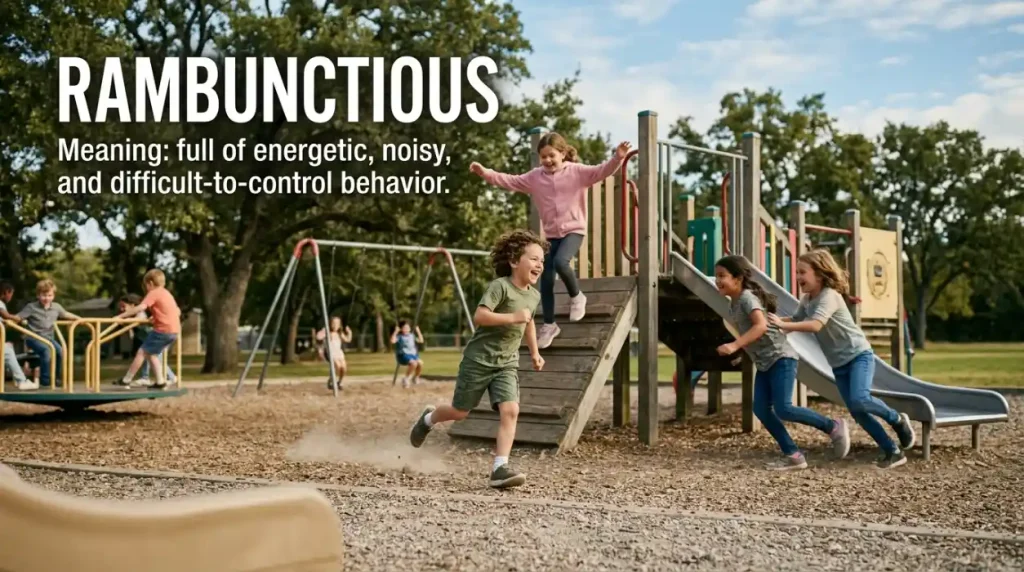
Synonyms for rambunctious become useful when a classroom suddenly gets noisy, energetic, and hard to manage, especially when one lively moment turns into complete chaos.
Imagine a puppy racing across the room, children laughing loudly, and chairs moving everywhere. You could call them rambunctious, but English offers many sharper choices.
Learning synonyms for rambunctious helps students, bloggers, writers, and daily speakers describe energy, noise, playfulness, and disorder with greater precision.
Because rambunctious is mainly associated with American English, its alternatives also help you adjust your vocabulary for different audiences, tones, and writing situations.
What Does “Rambunctious” Really Mean?
Rambunctious is an adjective that describes someone or something full of energetic activity and difficult to control.
Cambridge defines it as being “full of energy and difficult to control.” It is commonly used for children, puppies, crowds, students, parties, behavior, and other lively situations.
For example:
The children became rambunctious after lunch.
This does not necessarily mean the children are badly behaved. They may simply have too much energy and be difficult to settle.
Native speakers often hear a slightly playful quality in rambunctious. It can describe troublesome behavior without sounding as harsh as words such as disobedient or aggressive.
Part of Speech
Rambunctious is an adjective.
It modifies a noun:
- a rambunctious child
- a rambunctious puppy
- a rambunctious crowd
- a rambunctious party
- rambunctious behavior
The adverb is rambunctiously, while the noun is rambunctiousness.
Connotative Meaning
Connotation means the feeling or association a word carries beyond its basic dictionary meaning.
Positive tone
Rambunctious can sound affectionate when describing playful children, energetic pets, or an exciting crowd.
Example:
“Our rambunctious puppy keeps the whole family laughing.”
Negative tone
It can also suggest that someone is noisy, disruptive, or difficult to control.
Example:
“The rambunctious students made it hard for the teacher to continue.”
Neutral tone
In descriptive writing, it can simply mean highly energetic and uncontrolled without strongly praising or criticizing the subject.
That flexibility makes the word useful. However, the best synonym depends on exactly what you want to emphasize.
Etymology of “Rambunctious”
The history of rambunctious is unusually interesting.
Unlike many English words, it does not have a clear Old English root. Modern etymological sources generally connect it with the earlier word rumbustious, which appeared in the late eighteenth century.
Etymonline records rumbustious from 1778 and describes rambunctious as an altered form that appeared in the nineteenth century. It records an early form, rumbunctious, from 1824 and rambunctious from 1834.
Merriam-Webster likewise notes that rambunctious appeared in print around 1830 and connects it historically with rumbustious, which probably developed from robustious.
Old English: 450–1100
Rambunctious did not exist in Old English.
There is therefore no genuine Old English form of the word to trace.
Middle English: 1100–1500
The modern word still had not appeared during the Middle English period.
However, English already had words describing roughness, noise, disorder, and energetic behavior. Those older vocabulary patterns later influenced the broader semantic field surrounding rambunctious.
Modern English: 1500–Present
The immediate story begins in the eighteenth and nineteenth centuries.
Rumbustious emerged in the late 1700s, while rambunctious developed in American English during the nineteenth century. Oxford describes rambunctious as a mid-nineteenth-century word of uncertain origin and notes that British English commonly uses rumbustious instead.
The exact internal formation remains uncertain. Some dictionaries connect it to rumbustious and older forms such as robustious.
Pronunciation
US: /ræmˈbʌŋk.ʃəs/
UK: /ræmˈbʌŋk.ʃəs/
Cambridge gives the same IPA pronunciation for both wide varieties.
Syllables
ram-bunc-tious
The main stress falls on the second syllable:
ram-BUNK-shus
Affixation Pattern of “Rambunctious”
The structure is not completely transparent because the word has an uncertain historical formation.
Root: historically uncertain; probably connected with rumbustious.
Prefix: no clearly established productive prefix.
Suffix: -ous, an adjective-forming suffix.
So it is better not to teach rambunctious as though it were a simple modern root-plus-prefix construction.
Synonyms List
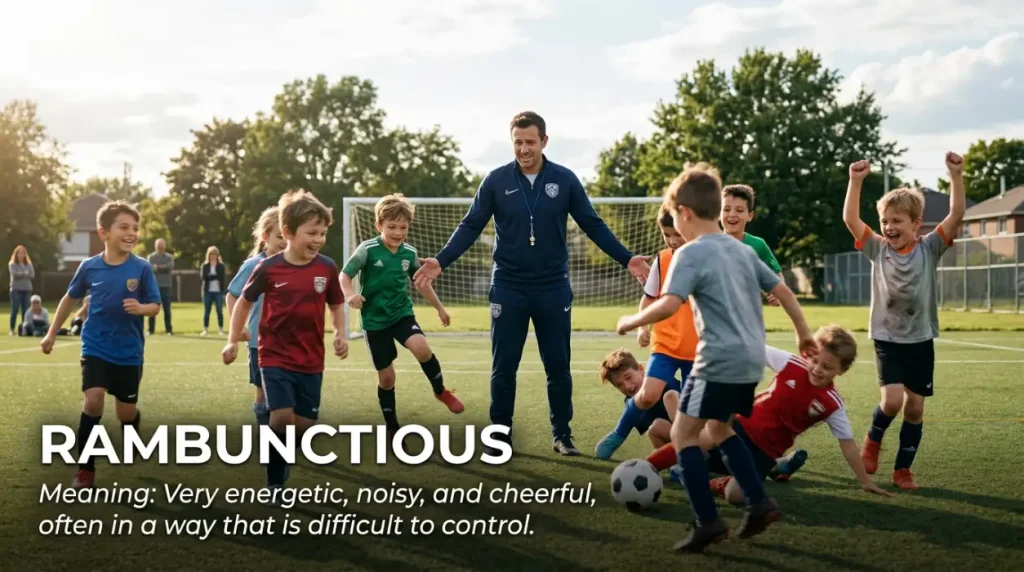
Boisterous (Adjective) — US /ˈbɔɪ.stər.əs/ — UK /ˈbɔɪ.stər.əs/
Meaning: Very energetic, noisy, and cheerful, often in a way that is difficult to control.
Tone/Register: Neutral to informal.
Example:
The boisterous children raced around the garden.
Their laughter could be heard from the next room.
Unruly (Adjective) — US /ʌnˈruː.li/ — UK /ʌnˈruː.li/
Meaning: Difficult to control because of disorderly or disobedient behavior.
Tone/Register: Neutral, sometimes negative.
Example:
The teacher separated the unruly students.
The class became much quieter afterward.
Rowdy (Adjective) — US /ˈraʊ.di/ — UK /ˈraʊ.di/
Meaning: Noisy, disorderly, and often overly energetic.
Tone/Register: Informal.
Example:
A rowdy crowd gathered outside the stadium.
Security asked everyone to stay calm.
Disorderly (Adjective) — US /dɪsˈɔːr.dɚ.li/ — UK /dɪsˈɔː.də.li/
Meaning: Lacking order and behaving in a disruptive way.
Tone/Register: Formal to neutral.
Example:
The party became disorderly after midnight.
The host eventually asked the guests to leave.
Wild (Adjective) — US /waɪld/ — UK /waɪld/
Meaning: Extremely energetic, uncontrolled, or difficult to manage.
Tone/Register: Informal.
Example:
The kids went wild when the music started.
Their excitement lasted all evening.
Raucous (Adjective) — US /ˈrɔː.kəs/ — UK /ˈrɔː.kəs/
Meaning: Very loud, rough, and noisy.
Tone/Register: Descriptive, neutral to informal.
Example:
A raucous cheer erupted from the stands.
The players could barely hear the referee.
Noisy (Adjective) — US /ˈnɔɪ.zi/ — UK /ˈnɔɪ.zi/
Meaning: Producing a lot of sound, often more than is comfortable or appropriate.
Tone/Register: Neutral.
Example:
The children were noisy after the school trip.
The librarian gently reminded them to lower their voices.
Lively (Adjective) — US /ˈlaɪv.li/ — UK /ˈlaɪv.li/
Meaning: Full of energy, movement, enthusiasm, or activity.
Tone/Register: Positive to neutral.
Example:
We had a lively discussion after dinner.
Everyone wanted to share an opinion.
Energetic (Adjective) — US /ˌen.ɚˈdʒet̬.ɪk/ — UK /ˌen.əˈdʒet.ɪk/
Meaning: Having or showing a high level of physical or mental energy.
Tone/Register: Neutral to positive.
Example:
Our new puppy is incredibly energetic.
She needs several walks every day.
Spirited (Adjective) — US /ˈspɪr.ɪ.t̬ɪd/ — UK /ˈspɪr.ɪ.tɪd/
Meaning: Full of enthusiasm, confidence, and lively energy.
Tone/Register: Positive.
Example:
She gave a spirited defense of her idea.
Her enthusiasm impressed the whole team.
High-spirited (Adjective) — US /ˌhaɪˈspɪr.ɪ.t̬ɪd/ — UK /ˌhaɪˈspɪr.ɪ.tɪd/
Meaning: Cheerfully energetic and sometimes difficult to keep calm.
Tone/Register: Positive to informal.
Example:
The high-spirited children played outside.
Their parents enjoyed watching them have fun.
Excitable (Adjective) — US /ɪkˈsaɪ.t̬ə.bəl/ — UK /ɪkˈsaɪ.tə.bəl/
Meaning: Easily stimulated into a state of strong excitement or activity.
Tone/Register: Neutral.
Example:
The puppy is very excitable around visitors.
She jumps up whenever someone enters.
Hyperactive (Adjective) — US /ˌhaɪ.pɚˈæk.tɪv/ — UK /ˌhaɪ.pərˈæk.tɪv/
Meaning: Extremely active or restless, especially when someone cannot easily remain still.
Tone/Register: Informal; can be clinical in specific contexts.
Example:
The children seemed hyperactive after the long break.
They struggled to sit quietly during the lesson.
Restless (Adjective) — US /ˈrest.ləs/ — UK /ˈrest.ləs/
Meaning: Unable or unwilling to stay still or remain calm.
Tone/Register: Neutral.
Example:
The restless children kept changing seats.
They were clearly ready to go outside.
Fidgety (Adjective) — US /ˈfɪdʒ.ə.t̬i/ — UK /ˈfɪdʒ.ə.ti/
Meaning: Frequently moving because of impatience, nervousness, or excess energy.
Tone/Register: Informal.
Example:
The students became fidgety near the end of class.
The teacher shortened the final activity.
Frisky (Adjective) — US /ˈfrɪs.ki/ — UK /ˈfrɪs.ki/
Meaning: Playfully energetic and eager to move around.
Tone/Register: Informal.
Example:
The frisky kitten chased every moving object.
Even a shoelace became a toy.
Frolicsome (Adjective) — US /ˈfrɑː.lɪk.səm/ — UK /ˈfrɒl.ɪk.səm/
Meaning: Cheerfully playful, active, and full of fun.
Tone/Register: Literary, playful.
Example:
The frolicsome puppies tumbled across the grass.
Their playful energy made everyone smile.
Playful (Adjective) — US /ˈpleɪ.fəl/ — UK /ˈpleɪ.fəl/
Meaning: Full of fun, games, teasing, or lighthearted activity.
Tone/Register: Neutral to positive.
Example:
The playful children turned the hallway into a race track.
Their parents soon joined the game.
Mischievous (Adjective) — US /ˈmɪs.tʃə.vəs/ — UK /ˈmɪs.tʃɪ.vəs/
Meaning: Enjoying minor trouble or naughty behavior without necessarily intending serious harm.
Tone/Register: Informal, often affectionate.
Example:
The mischievous boy hid his sister’s shoes.
He laughed when she finally found them.
Impish (Adjective) — US /ˈɪm.pɪʃ/ — UK /ˈɪm.pɪʃ/
Meaning: Playfully naughty or mischievous.
Tone/Register: Informal, playful.
Example:
She gave me an impish smile.
Then she quietly moved the birthday cards.
Roguish (Adjective) — US /ˈroʊ.ɡɪʃ/ — UK /ˈrəʊ.ɡɪʃ/
Meaning: Playfully mischievous, cheeky, or slightly rebellious.
Tone/Register: Informal to literary.
Example:
The roguish puppy stole a sandwich from the table.
He looked completely pleased with himself.
Riotous (Adjective) — US /ˈraɪ.ə.t̬əs/ — UK /ˈraɪ.ə.təs/
Meaning: Extremely lively, noisy, or uncontrolled.
Tone/Register: Informal to literary.
Example:
The celebration became riotous after the final goal.
Music filled every corner of the street.
Uproarious (Adjective) — US /ʌpˈrɔːr.i.əs/ — UK /ʌpˈrɔː.ri.əs/
Meaning: Extremely noisy, energetic, or filled with loud amusement.
Tone/Register: Informal to literary.
Example:
The audience gave an uproarious response.
Even the serious speaker started laughing.
Tumultuous (Adjective) — US /tuːˈmʌl.tʃu.əs/ — UK /tʃuːˈmʌl.tʃu.əs/
Meaning: Characterized by confusion, noise, disorder, or intense activity.
Tone/Register: Formal, literary.
Example:
The meeting ended in a tumultuous exchange.
Several people were speaking at once.

Turbulent (Adjective) — US /ˈtɝː.bjə.lənt/ — UK /ˈtɜː.bjə.lənt/
Meaning: Characterized by disorder, instability, or intense movement.
Tone/Register: Formal to neutral.
Example:
The team went through a turbulent period.
Emotions ran high during the transition.
Chaotic (Adjective) — US /keɪˈɑː.t̬ɪk/ — UK /keɪˈɒt.ɪk/
Meaning: Completely disorganized, confused, or difficult to control.
Tone/Register: Neutral.
Example:
The morning was chaotic from the start.
Three children needed attention at the same time.
Out-of-control (Adjective phrase) — US /ˌaʊt əv kənˈtroʊl/ — UK /ˌaʊt əv kənˈtrəʊl/
Meaning: No longer manageable or subject to effective control.
Tone/Register: Informal to neutral.
Example:
The classroom became completely out of control.
The teacher paused the activity and reset the rules.
Uncontrollable (Adjective) — US /ˌʌn.kənˈtroʊ.lə.bəl/ — UK /ˌʌn.kənˈtrəʊ.lə.bəl/
Meaning: Impossible or extremely difficult to control.
Tone/Register: Neutral.
Example:
His laughter became uncontrollable.
Soon, everyone in the room was laughing too.
Undisciplined (Adjective) — US /ˌʌnˈdɪs.ə.plɪnd/ — UK /ˌʌnˈdɪs.ə.plɪnd/
Meaning: Lacking the self-control or order expected in a situation.
Tone/Register: Formal to neutral.
Example:
The coach criticized the undisciplined team.
Players kept ignoring the agreed strategy.
Unmanageable (Adjective) — US /ʌnˈmæn.ɪ.dʒə.bəl/ — UK /ʌnˈmæn.ɪ.dʒə.bəl/
Meaning: Too difficult to control, organize, or deal with effectively.
Tone/Register: Neutral.
Example:
The group became unmanageable after the schedule changed.
The organizer divided everyone into smaller teams.
Hard-to-handle (Adjective phrase) — US /ˌhɑːrd tə ˈhæn.dəl/ — UK /ˌhɑːd tə ˈhæn.dəl/
Meaning: Difficult to manage because of strong energy, behavior, or resistance.
Tone/Register: Informal.
Example:
That puppy is adorable but hard to handle.
He needs plenty of exercise.
Troublesome (Adjective) — US /ˈtrʌb.əl.səm/ — UK /ˈtrʌb.əl.səm/
Meaning: Causing difficulty, annoyance, or problems.
Tone/Register: Neutral to negative.
Example:
The troublesome behavior continued during lunch.
The staff decided to speak with the parents.
Feisty (Adjective) — US /ˈfaɪ.sti/ — UK /ˈfaɪ.sti/
Meaning: Energetic, lively, and willing to resist or fight back.
Tone/Register: Informal, often positive.
Example:
The feisty little dog refused to back down.
She barked at every much larger dog in the park.
Obstreperous (Adjective) — US /əbˈstrep.ər.əs/ — UK /əbˈstrep.ər.əs/
Meaning: Noisy, difficult to control, and resistant to authority.
Tone/Register: Formal.
Example:
The manager dealt with an obstreperous customer.
His complaints had become increasingly loud.
Rumbustious (Adjective) — US /rʌmˈbʌs.tʃəs/ — UK /rʌmˈbʌs.tʃəs/
Meaning: Cheerfully noisy, energetic, or unruly; it is especially associated with British English.
Tone/Register: Informal, British.
Example:
The rumbustious crowd filled the old pub.
Their singing continued late into the evening.
Oxford notes that rumbustious is especially British, while North American English usually uses rambunctious.
Rollicking (Adjective) — US /ˈrɑː.lɪ.kɪŋ/ — UK /ˈrɒl.ɪ.kɪŋ/
Meaning: Full of energetic movement, excitement, and cheerful disorder.
Tone/Register: Informal, lively.
Example:
The children had a rollicking afternoon at the beach.
Nobody wanted the games to end.
Rip-roaring (Adjective) — US /ˈrɪpˌrɔːr.ɪŋ/ — UK /ˈrɪpˌrɔː.rɪŋ/
Meaning: Extremely exciting, energetic, noisy, or lively.
Tone/Register: Informal, expressive.
Example:
They had a rip-roaring party on Saturday.
The neighbors could hear the music all night.
Zany (Adjective) — US /ˈzeɪ.ni/ — UK /ˈzeɪ.ni/
Meaning: Amusingly strange, energetic, or unconventional.
Tone/Register: Informal, playful.
Example:
The show is famous for its zany characters.
Every episode becomes more unpredictable.
Animated (Adjective) — US /ˈæn.ə.meɪ.t̬ɪd/ — UK /ˈæn.ɪ.meɪ.tɪd/
Meaning: Showing strong energy, excitement, or emotion.
Tone/Register: Neutral.
Example:
The students became animated during the debate.
Everyone suddenly had something to say.
Vivacious (Adjective) — US /vɪˈveɪ.ʃəs/ — UK /vɪˈveɪ.ʃəs/
Meaning: Attractive, lively, energetic, and full of enthusiasm.
Tone/Register: Positive, somewhat formal.
Example:
Her vivacious personality made the event memorable.
She quickly connected with everyone.
Exuberant (Adjective) — US /ɪɡˈzuː.bɚ.ənt/ — UK /ɪɡˈzjuː.bər.ənt/
Meaning: Showing very strong excitement, happiness, or energy.
Tone/Register: Positive, formal to neutral.
Example:
The children gave an exuberant welcome.
Their excitement was impossible to hide.
Sprightly (Adjective) — US /ˈspraɪt.li/ — UK /ˈspraɪt.li/
Meaning: Lively, active, and full of youthful energy.
Tone/Register: Literary, positive.
Example:
The sprightly puppy kept everyone busy.
She chased leaves around the garden.
Vibrant (Adjective) — US /ˈvaɪ.brənt/ — UK /ˈvaɪ.brənt/
Meaning: Full of energy, activity, color, or enthusiasm.
Tone/Register: Neutral to positive.
Example:
The neighborhood has a vibrant evening atmosphere.
Street performers add to the energy.
Dynamic (Adjective) — US /daɪˈnæm.ɪk/ — UK /daɪˈnæm.ɪk/
Meaning: Energetic and constantly active or changing.
Tone/Register: Professional, positive.
Example:
The dynamic team works quickly under pressure.
Their meetings are energetic but focused.
Bustling (Adjective) — US /ˈbʌs.lɪŋ/ — UK /ˈbʌs.lɪŋ/
Meaning: Full of busy activity, movement, and people.
Tone/Register: Neutral to positive.
Example:
The market was bustling before the holiday.
Vendors called out to passing shoppers.

Crackling (Adjective) — US /ˈkræk.lɪŋ/ — UK /ˈkræk.lɪŋ/
Meaning: Full of lively energy, excitement, or tension.
Tone/Register: Informal to literary.
Example:
The concert had a crackling atmosphere.
The audience stayed excited from beginning to end.
Frothy (Adjective) — US /ˈfrɔː.θi/ — UK /ˈfrɒθ.i/
Meaning: Light, lively, playful, and sometimes lacking seriousness.
Tone/Register: Informal, literary.
Example:
The movie has a frothy, playful energy.
It never takes itself too seriously.
Mercurial (Adjective) — US /mɚˈkjʊr.i.əl/ — UK /mɜːˈkjʊə.ri.əl/
Meaning: Changing quickly and unpredictably in mood or behavior.
Tone/Register: Literary, formal.
Example:
His mercurial behavior kept everyone guessing.
One moment he was calm, and the next he was joking loudly.
Boisterously Energetic (Adjective phrase) — US /ˌbɔɪ.stər.əs ˈen.ɚˌdʒet̬.ɪk/ — UK /ˌbɔɪ.stər.əs ˈen.əˌdʒet.ɪk/
Meaning: Extremely lively and energetic in a noisy way.
Tone/Register: Descriptive.
Example:
The children were boisterously energetic after the game.
They needed time to settle down.
Carefree (Adjective) — US /ˈker.friː/ — UK /ˈkeə.friː/
Meaning: Cheerful and unconcerned about rules, problems, or consequences.
Tone/Register: Positive.
Example:
The carefree group danced in the rain.
Nobody seemed worried about getting wet.
Restive (Adjective) — US /ˈres.tɪv/ — UK /ˈres.tɪv/
Meaning: Unable to remain still or calm because of boredom, impatience, or dissatisfaction.
Tone/Register: Formal.
Example:
The audience grew restive during the delay.
Several people began checking their phones.
Wayward (Adjective) — US /ˈweɪ.wɚd/ — UK /ˈweɪ.wəd/
Meaning: Difficult to control because someone does not follow expected behavior or direction.
Tone/Register: Literary to formal.
Example:
The farmer finally caught the wayward goat.
It had escaped through a broken gate.
Rebellious (Adjective) — US /rɪˈbel.jəs/ — UK /rɪˈbel.i.əs/
Meaning: Resisting rules, authority, or accepted expectations.
Tone/Register: Neutral to negative.
Example:
The rebellious teenager ignored the house rules.
Still, her parents knew she was testing boundaries.
Boisterousness (Noun) — US /ˈbɔɪ.stər.əs.nəs/ — UK /ˈbɔɪ.stər.əs.nəs/
Meaning: The quality of being noisy, energetic, and difficult to control.
Tone/Register: Neutral.
Example:
The children’s boisterousness filled the playground.
Their teacher waited patiently for them to settle.
Unrestrained (Adjective) — US /ˌʌn.rɪˈstreɪnd/ — UK /ˌʌn.rɪˈstreɪnd/
Meaning: Not held back, controlled, or limited.
Tone/Register: Neutral to formal.
Example:
The crowd showed unrestrained enthusiasm.
Their cheering continued for several minutes.
Synonyms by Tone
Tone matters because synonyms do not carry the same emotional message.
Positive
These words usually emphasize enjoyable energy:
- lively
- energetic
- spirited
- high-spirited
- playful
- frolicsome
- vivacious
- exuberant
- sprightly
- vibrant
- dynamic
- full of life
- full of beans
Use these when you want to describe energy without strongly criticizing it.
Neutral
These choices describe activity or difficulty without automatically sounding harsh:
- rambunctious
- animated
- excitable
- restless
- noisy
- bustling
- energetic
- chaotic
- turbulent
- unrestrained
These work well in everyday descriptions and explanatory writing.
Negative
These words highlight disorder, poor behavior, or difficulty with control:
- unruly
- rowdy
- disorderly
- undisciplined
- unmanageable
- troublesome
- obstreperous
- rebellious
- out-of-control
- uncontrollable
- wayward
Choose them carefully. A word such as unruly can sound more critical than rambunctious.
Playful or Informal
For friendly, humorous, or expressive writing, consider:
- mischievous
- impish
- roguish
- zany
- rollicking
- rip-roaring
- frisky
- rumbustious
- full of beans
- on the go
These choices can make a sentence feel warmer and more colorful.
Why Tone Matters in Word Choice
Consider these three sentences:
The puppy is lively.
The puppy is rambunctious.
The puppy is unruly.
All three describe an active animal. However, the emotional effect changes.
Lively sounds positive.
Rambunctious suggests energetic behavior that may be difficult to manage.
Unruly focuses more strongly on a lack of control.
That difference is important for students, bloggers, and professional writers. A good synonym does more than replace a word. It changes the reader’s impression.
“Rambunctious” vs Close Alternatives
Rambunctious vs Boisterous
Both describe high energy and noise.
Rambunctious emphasizes energy combined with difficulty controlling the behavior.
Boisterous places more emphasis on loud, cheerful activity.
Use rambunctious for children, puppies, or difficult-to-manage groups. Use boisterous when loud enthusiasm is the main idea.
Rambunctious vs Unruly
Both can describe people who are difficult to control.
However, unruly is more critical. It often suggests that someone is breaking rules or refusing to behave properly.
Rambunctious can sound affectionate.
Unruly usually sounds disapproving.
Rambunctious vs Rowdy
Rowdy usually suggests noisy, disorderly behavior, especially among groups.
Rambunctious has a broader and often friendlier range.
You can describe a puppy as rambunctious. Calling a puppy rowdy is possible, but less natural in many contexts.
How “Rambunctious” Changes by Context
Daily Conversation
In everyday speech, rambunctious often describes children or animals.
“The kids were pretty rambunctious today.”
It sounds natural and conversational, especially in American English.
If you want a simpler word, use lively, energetic, or wild.
Writing or Blogging
Bloggers can use rambunctious to create a vivid image.
For example:
“Our rambunctious puppy turned a quiet Sunday morning into a miniature adventure.”
Here, the word adds personality without making the puppy sound badly behaved.
For more variety, alternate it with playful, frisky, spirited, or mischievous.
Professional or Academic Tone
In formal writing, rambunctious can sound slightly informal.
Depending on the subject, alternatives such as disorderly, unruly, restless, highly active, or uncontrolled may work better.
For example:
“The participants became increasingly restless during the delay.”
That sounds more professional than:
“The participants became rambunctious during the delay.”
Creative or Informal Use
Creative writing gives you more freedom.
Words such as rollicking, zany, mischievous, rip-roaring, and rumbustious can add personality.
They work particularly well in stories, humorous descriptions, children’s writing, and entertainment content.
Common Mistakes Learners Make
Mistake 1: Treating “rambunctious” as always negative
It is not necessarily negative.
A rambunctious child may simply be energetic and playful.
If you mean serious misconduct, unruly, disruptive, or undisciplined may be clearer.
Mistake 2: Using “rambunctious” for every energetic person
The word often implies some difficulty with control.
Therefore, saying “My colleague is rambunctious” may sound strange unless the colleague is unusually noisy, playful, or disorderly.
For ordinary workplace energy, energetic, dynamic, or enthusiastic usually works better.
Mistake 3: Confusing “lively” with “rambunctious”
A lively person can be energetic while remaining well-behaved.
A rambunctious person or group is usually more difficult to control.
Mistake 4: Using formal synonyms in casual situations
Obstreperous and tumultuous are valid words, but they may sound overly formal in ordinary conversation.
A native speaker might simply say:
“The kids were really rowdy.”
Mistake 5: Repeating the same synonym
Replacing rambunctious with boisterous in every sentence does not improve vocabulary.
Instead, identify the exact quality you want to describe: noise, playfulness, excitement, disorder, movement, or rebellion.
For broader vocabulary practice, an internal article on synonyms for energetic can complement this topic.
Register Notes
Informal: rowdy, wild, frisky, zany, full of beans, on the go
Neutral: lively, energetic, restless, noisy, animated, chaotic
Formal: disorderly, tumultuous, obstreperous, undisciplined, unrestrained
Literary: frolicsome, sprightly, roguish, mercurial
The best word depends on your audience.
A classroom conversation can sound natural with rowdy. An academic report may require disorderly or restless.
Real-Life Mini Scenarios
Workplace
A team finishes a stressful project and starts joking loudly.
“The office became unusually lively after the deadline.”
Here, lively sounds more professional than rambunctious.
Social Situation
Friends attend a sports celebration.
“The crowd became rowdy after the winning goal.”
Rowdy works because the group is noisy and disorderly.
Media and Pop Culture
A comedy show features unpredictable characters.
“The series has a zany cast of characters.”
Zany emphasizes humorous eccentricity rather than simple noise.
Writing and Storytelling
A children’s story introduces an energetic puppy.
“A rambunctious puppy burst through the garden gate.”
The word creates an immediate picture of movement and playful disorder.

Practice Quiz
1. Your puppy is energetic, playful, and difficult to keep still. Which word fits best?
A. Formal
B. Rambunctious
C. Silent
D. Reserved
2. A group of football fans is loudly celebrating outside the stadium. Which word best emphasizes disorderly noise?
A. Rowdy
B. Timid
C. Academic
D. Careful
3. You are writing a positive description of an enthusiastic child. Which word is most suitable?
A. Troublesome
B. Spirited
C. Disorderly
D. Obstreperous
4. You need a formal word for noisy and difficult behavior.
A. Obstreperous
B. Frisky
C. Zany
D. Playful
5. Which word focuses mainly on playful naughtiness?
A. Mischievous
B. Tumultuous
C. Unmanageable
D. Disorderly
6. A business report describes a group that cannot settle during a long delay. Which word works best?
A. Restless
B. Frolicsome
C. Impish
D. Zany
7. Which word is most strongly associated with British English as an alternative to “rambunctious”?
A. Rumbustious
B. Hyperactive
C. Lively
D. Animated
8. A party is extremely loud and energetic but still cheerful. Which word fits?
A. Boisterous
B. Reserved
C. Subdued
D. Motionless
9. Which word emphasizes serious disorder rather than playful energy?
A. Unruly
B. Frisky
C. Sprightly
D. Vivacious
10. You want to describe a highly energetic but positive personality.
A. Exuberant
B. Troublesome
C. Undisciplined
D. Wayward
Answer key: 1-B | 2-A | 3-B | 4-A | 5-A | 6-A | 7-A | 8-A | 9-A | 10-A
Reflection Task
Choose one synonym from this article and write a sentence about a person, animal, crowd, classroom, or event you know.
Conclusion
Knowing synonyms for rambunctious helps you describe energy with more feeling, from playful excitement to noisy disorder, without relying on the same word again.
The right synonym can make writing clearer and more natural. It also helps bloggers, students, and speakers express small differences in mood and behavior.
Try these words in emails, essays, stories, and daily conversations. Notice how each one changes the picture in your reader’s or listener’s mind.
Most importantly, practice one new synonym at a time. Build your vocabulary slowly, and soon your English will sound more precise, flexible, and confident.
FAQs
1. What is the best synonym for rambunctious in formal writing?
For formal writing, disorderly, restless, undisciplined, or obstreperous may work better, depending on the context. Rambunctious is generally informal and especially common in North American English. If the main idea is high energy, use energetic. If the issue is disruptive behavior, disorderly or unruly may be more precise.
2. What is a positive synonym for rambunctious?
Good positive alternatives include lively, spirited, energetic, high-spirited, exuberant, vivacious, sprightly, and full of life. These words emphasize energy without strongly criticizing behavior. For example, calling a child “spirited” often sounds warmer than calling the same child “unruly,” even though both can describe energetic behavior.
3. Is “rambunctious” a positive or negative word?
It can be either, depending on context. The word often describes energetic behavior that is somewhat difficult to control. In a family story, it may sound affectionate. In a classroom report, it may suggest disruption. Therefore, context and the noun being described strongly influence whether readers hear it positively, negatively, or neutrally.
4. What is the difference between rambunctious and unruly?
Rambunctious emphasizes excessive energy and difficulty with control. Unruly places more emphasis on failure to follow rules or expected behavior. A playful puppy can be rambunctious without being deliberately disobedient. An unruly student, however, usually suggests behavior that interferes with rules, authority, or order.
5. Is rambunctious mainly American English?
Yes. Major learner dictionaries describe rambunctious as mainly North American or American English. British English commonly uses rumbustious instead. The two words overlap strongly in meaning, especially when describing cheerful, noisy, energetic, or unruly behavior.

Hasnain Ali is an SEO Content Strategist and the founder of wordvora.com, a trusted vocabulary platform that helps writers, students, professionals, and English learners find accurate synonyms, antonyms, word meanings, and real-life usage examples. He specializes in keyword research, on-page SEO, topical authority, and creating search-first content that aligns with Google’s latest Search Quality and E-E-A-T guidelines. His work focuses on producing clear, well-structured, and reader-friendly resources that satisfy search intent while maintaining high editorial standards.
Through extensive hands-on experience with SEO tools such as Google Search Console, Google Analytics, SEMrush, and Ahrefs, Hasnain researches user search behavior and develops content that is both informative and easy to understand. Every article published on wordvora.com is carefully reviewed for accuracy, readability, and contextual relevance before publication. His mission is to build one of the web’s most reliable English vocabulary resources by providing practical language guidance, trustworthy explanations, and content that helps readers improve their writing, communication, and vocabulary with confidence.