

Synonyms for ranged become useful when you want to describe variety, distance, movement, or position without repeating the same verb in every sentence.
For example, a report might say prices ranged from $20 to $80, while a story might say explorers ranged across the valley.
Because ranged has several meanings, its best synonym depends on context. Students, bloggers, writers, and speakers can gain precision by choosing carefully.
Learning synonyms for ranged also makes descriptions smoother. You can show that something varied, stretched, moved, covered an area, or stood in an organized position.
What Does “Ranged” Really Mean?
Ranged is the past tense and past participle of the verb range.
It does not have just one meaning. Instead, the meaning changes according to the sentence.
For example:
Prices ranged from $50 to $200.
Here, ranged means varied between two limits.
Now consider:
The discussion ranged across several important topics.
Here, ranged means covered or included several subjects.
Another example is:
The horses ranged freely across the fields.
In this sentence, ranged means moved or traveled freely over an area.
Finally:
The soldiers were ranged along the road.
Here, ranged means positioned or arranged in a particular place or formation.
Cambridge identifies these major uses: having upper and lower limits, positioning people or things, moving freely through an area, and dealing with a range of subjects.
Part of Speech
Ranged is a verb form.
It can function as:
- the simple past of range
- the past participle of range
Common patterns include:
- ranged from A to B
- ranged between A and B
- ranged across something
- ranged over something
- ranged through something
- ranged widely
- were ranged along something
Oxford also records range as meaning “vary,” “arrange,” and “move around,” which explains why the word has such a broad synonym set.
Connotative Meaning of “Ranged”
Connotation means the feeling or association a word carries beyond its basic literal meaning.
Positive Tone
When ranged describes broad variety or extensive exploration, it can have a positive or impressive effect.
Her interests ranged from classical music to modern technology.
The sentence suggests breadth and curiosity.
Negative Tone
The word itself is usually neutral. However, context can make it sound negative.
The discussion ranged into several irrelevant subjects.
Here, the idea of covering many areas suggests a lack of focus.
Neutral Tone
Most uses of ranged are neutral.
It can simply describe:
- numerical variation
- physical distance
- movement
- subject coverage
- arrangement
- position
That neutrality makes it common in academic, journalistic, professional, scientific, and everyday English.
Etymology of “Ranged”
The history of ranged comes from the verb range.
The verb dates to around the thirteenth century in English. Etymonline traces it to Middle English rengen, from Old French ranger or rangier, with an earlier sense connected to placing something in a row or arranging it. The word is ultimately linked to a Germanic source associated with a row, line, circle, or ring.
Old English: 450–1100
Ranged did not exist in Old English in its modern form.
The modern verb entered English later through French after the Norman Conquest.
Middle English: 1100–1500
This is where the history becomes clearer.
Middle English rengen carried ideas such as moving across an area and arranging things in a line. Old French rengier meant to place things in order or get into line.
Modern English: 1500–Present
Over time, range developed several related meanings.
It came to describe movement across an area, arrangement in rows, numerical extent, variety, distance, and subject coverage.
The past forms ranged and ranging developed naturally from the verb.

Pronunciation
US: /reɪndʒ/
UK: /reɪndʒ/
The pronunciation is essentially the same in standard American and British English. Cambridge gives /reɪndʒ/ for both.
Syllables
ranged
It is pronounced as one syllable.
Affixation Pattern of “Ranged”
Root: range
Prefix: none
Suffix: -ed, marking the simple past or past participle.
The structure is therefore:
range + -ed → ranged
Synonyms List
Varied (Verb) — US /ˈver.id/ — UK /ˈveər.id/
Meaning: Changed or differed between two or more amounts, levels, types, or conditions.
Tone/Register: Neutral, academic, professional.
Example:
Attendance varied from 40 to 90 students.
The numbers changed considerably during the semester.
Spanned (Verb) — US /spænd/ — UK /spænd/
Meaning: Extended across a particular period, distance, subject, or range.
Tone/Register: Neutral to formal.
Example:
The exhibition spanned three decades.
Its collection included paintings from several countries.
Extended (Verb) — US /ɪkˈsten.dɪd/ — UK /ɪkˈsten.dɪd/
Meaning: Continued or stretched over a particular distance or period.
Tone/Register: Neutral, formal.
Example:
The forest extended for several miles.
Small villages appeared along the route.
Stretched (Verb) — US /stretʃt/ — UK /stretʃt/
Meaning: Continued across a physical distance or period.
Tone/Register: Neutral.
Example:
The beach stretched along the entire coastline.
We walked for hours without reaching the end.
Covered (Verb) — US /ˈkʌv.ɚd/ — UK /ˈkʌv.əd/
Meaning: Included or dealt with a particular area, distance, or subject.
Tone/Register: Neutral.
Example:
The lecture covered several important theories.
The final section focused on practical applications.
Included (Verb) — US /ɪnˈkluː.dɪd/ — UK /ɪnˈkluː.dɪd/
Meaning: Contained something as part of a larger group or range.
Tone/Register: Neutral.
Example:
The survey included people from many age groups.
Researchers collected responses from across the region.
Encompassed (Verb) — US /ɪnˈkʌm.pəst/ — UK /ɪnˈkʌm.pəst/
Meaning: Included a wide variety or broad area within something.
Tone/Register: Formal, academic.
Example:
The study encompassed several fields of science.
Its conclusions were unusually broad.
Embraced (Verb) — US /ɪmˈbreɪst/ — UK /ɪmˈbreɪst/
Meaning: Included or accepted a broad range of subjects, ideas, or activities.
Tone/Register: Formal to literary.
Example:
The course embraced both theory and practice.
Students also completed several creative projects.
Comprised (Verb) — US /kəmˈpraɪzd/ — UK /kəmˈpraɪzd/
Meaning: Consisted of particular parts or elements.
Tone/Register: Formal, academic.
Example:
The research team comprised five specialists.
Each member contributed a different area of expertise.
Consisted of (Verb phrase) — US /kənˈsɪstəd əv/ — UK /kənˈsɪstɪd əv/
Meaning: Was made up of several particular parts or members.
Tone/Register: Neutral to formal.
Example:
The collection consisted of more than 200 photographs.
Each image documented a different location.
Included a Range of (Verb phrase) — US /ɪnˈkluːd ə reɪndʒ əv/ — UK /ɪnˈkluːd ə reɪndʒ əv/
Meaning: Contained several different types, levels, or categories.
Tone/Register: Neutral.
Example:
The program included a range of activities.
Students could choose from art, music, and sports.
Spanned Across (Verb phrase) — US /spænd əˈkrɔːs/ — UK /spænd əˈkrɒs/
Meaning: Extended across different places, periods, or categories.
Tone/Register: Neutral to formal.
Example:
The project spanned several departments.
Everyone shared responsibility for the final result.
Extended Across (Verb phrase) — US /ɪkˈsten.dɪd əˈkrɔːs/ — UK /ɪkˈsten.dɪd əˈkrɒs/
Meaning: Continued from one point or area to another.
Tone/Register: Formal.
Example:
The network extended across the entire region.
Remote communities could finally access the service.
Fell Between (Verb phrase) — US /fel bɪˈtwiːn/ — UK /fel bɪˈtwiːn/
Meaning: Had a value or position somewhere between two limits.
Tone/Register: Neutral.
Example:
Most scores fell between 70 and 85.
Only a few students scored above that range.
Lay Between (Verb phrase) — US /leɪ bɪˈtwiːn/ — UK /leɪ bɪˈtwiːn/
Meaning: Existed between two limits, places, or points.
Tone/Register: Neutral to formal.
Example:
The temperature lay between 18 and 22 degrees.
The conditions remained comfortable all afternoon.
Fluctuated (Verb) — US /ˈflʌk.tʃu.eɪ.t̬ɪd/ — UK /ˈflʌk.tʃu.eɪ.tɪd/
Meaning: Changed repeatedly rather than remaining at one level.
Tone/Register: Formal, academic.
Example:
Demand fluctuated throughout the year.
The highest figures appeared during summer.
Differed (Verb) — US /ˈdɪf.ɚd/ — UK /ˈdɪf.əd/
Meaning: Were unlike one another in amount, type, quality, or character.
Tone/Register: Neutral.
Example:
The results differed across the three groups.
The researchers examined the reasons for the variation.
Varied Between (Verb phrase) — US /ˈver.id bɪˈtwiːn/ — UK /ˈveər.id bɪˈtwiːn/
Meaning: Changed within two stated limits.
Tone/Register: Neutral, academic.
Example:
The response time varied between two and five minutes.
The difference depended on the workload.
Varied From (Verb phrase) — US /ˈver.id frəm/ — UK /ˈveər.id frəm/
Meaning: Changed from one stated level, amount, or type to another.
Tone/Register: Neutral.
Example:
The classes varied from small workshops to large lectures.
Each format required a different teaching approach.

Ran From (Verb phrase) — US /ræn frəm/ — UK /ræn frəm/
Meaning: Extended or varied from one point or limit to another.
Tone/Register: Neutral, conversational.
Example:
The prices ran from $10 to $100.
The larger packages offered more features.
Went From (Verb phrase) — US /went frəm/ — UK /went frəm/
Meaning: Changed or progressed from one state, amount, or point to another.
Tone/Register: Informal.
Example:
The conversation went from sports to politics.
Nobody expected the topic to change so quickly.
Covered a Range (Verb phrase) — US /ˈkʌv.ɚd ə reɪndʒ/ — UK /ˈkʌv.əd ə reɪndʒ/
Meaning: Included many different subjects, types, or possibilities.
Tone/Register: Neutral to formal.
Example:
The workshop covered a wide range of writing skills.
We practiced everything from headlines to introductions.
Dealt With (Verb phrase) — US /delt wɪð/ — UK /delt wɪð/
Meaning: Discussed, examined, or addressed a particular set of subjects.
Tone/Register: Neutral.
Example:
The article dealt with several environmental issues.
It also examined possible solutions.
Discussed (Verb) — US /dɪˈskʌst/ — UK /dɪˈskʌst/
Meaning: Talked or wrote about one or more subjects.
Tone/Register: Neutral, academic.
Example:
The class discussed several interpretations of the poem.
Students then compared their responses.
Explored (Verb) — US /ɪkˈsplɔːrd/ — UK /ɪkˈsplɔːd/
Meaning: Examined different subjects, ideas, places, or possibilities.
Tone/Register: Neutral to academic.
Example:
The documentary explored several causes of migration.
It included interviews with residents.
Addressed (Verb) — US /əˈdrest/ — UK /əˈdrest/
Meaning: Considered or dealt with a particular issue.
Tone/Register: Professional, academic.
Example:
The report addressed several concerns.
Its recommendations focused on practical improvements.
Ranged Over (Verb phrase) — US /reɪndʒd ˈoʊvɚ/ — UK /reɪndʒd ˈəʊvə/
Meaning: Covered or extended across several subjects or areas.
Tone/Register: Formal to literary.
Example:
The conversation ranged over art, history, and science.
The speakers moved naturally from one topic to another.
Ranged Across (Verb phrase) — US /reɪndʒd əˈkrɔːs/ — UK /reɪndʒd əˈkrɒs/
Meaning: Covered several areas, subjects, or categories.
Tone/Register: Neutral to formal.
Example:
The research ranged across four major disciplines.
That breadth made the findings especially useful.
Ranged Through (Verb phrase) — US /reɪndʒd θruː/ — UK /reɪndʒd θruː/
Meaning: Moved throughout an area or examined different parts of something.
Tone/Register: Neutral.
Example:
The hikers ranged through the valley before sunset.
They returned to camp after exploring the western trail.
Roamed (Verb) — US /roʊmd/ — UK /rəʊmd/
Meaning: Moved freely from place to place without a fixed route.
Tone/Register: Neutral to literary.
Example:
Wild horses roamed across the open plains.
They moved in small groups throughout the morning.
Wandered (Verb) — US /ˈwɑːn.dɚd/ — UK /ˈwɒn.dəd/
Meaning: Moved around without a clear direction or fixed destination.
Tone/Register: Neutral.
Example:
We wandered through the old market.
Every street seemed to reveal something new.
Traveled (Verb) — US /ˈtræv.əld/ — UK /ˈtræv.əld/
Meaning: Moved from one place to another, especially over some distance.
Tone/Register: Neutral.
Example:
The researchers traveled across the country.
They visited schools in twelve different cities.
Traversed (Verb) — US /trəˈvɝːst/ — UK /trəˈvɜːst/
Meaning: Traveled across or through a particular area.
Tone/Register: Formal, literary.
Example:
The expedition traversed the mountain pass.
Snow made the journey especially difficult.
Roved (Verb) — US /roʊvd/ — UK /rəʊvd/
Meaning: Moved around freely without staying in one place.
Tone/Register: Literary.
Example:
The travelers roved across the countryside.
They stopped whenever they found an interesting village.
Patrolled (Verb) — US /pəˈtroʊld/ — UK /pəˈtrəʊld/
Meaning: Moved through an area regularly to watch or protect it.
Tone/Register: Professional.
Example:
Security teams patrolled the grounds throughout the night.
They checked every entrance before dawn.
Explored (Verb) — US /ɪkˈsplɔːrd/ — UK /ɪkˈsplɔːd/
Meaning: Traveled around an unfamiliar place to learn more about it.
Tone/Register: Neutral.
Example:
The children explored the forest with their guide.
They discovered a small stream near the trail.
Searched (Verb) — US /sɝːtʃt/ — UK /sɜːtʃt/
Meaning: Looked through or around an area to find something.
Tone/Register: Neutral.
Example:
The rescue team searched the valley.
They found the missing hiker before dark.
Scanned (Verb) — US /skænd/ — UK /skænd/
Meaning: Looked quickly and carefully across an area or collection.
Tone/Register: Neutral, professional.
Example:
She scanned the room for an empty seat.
Only one chair remained near the window.
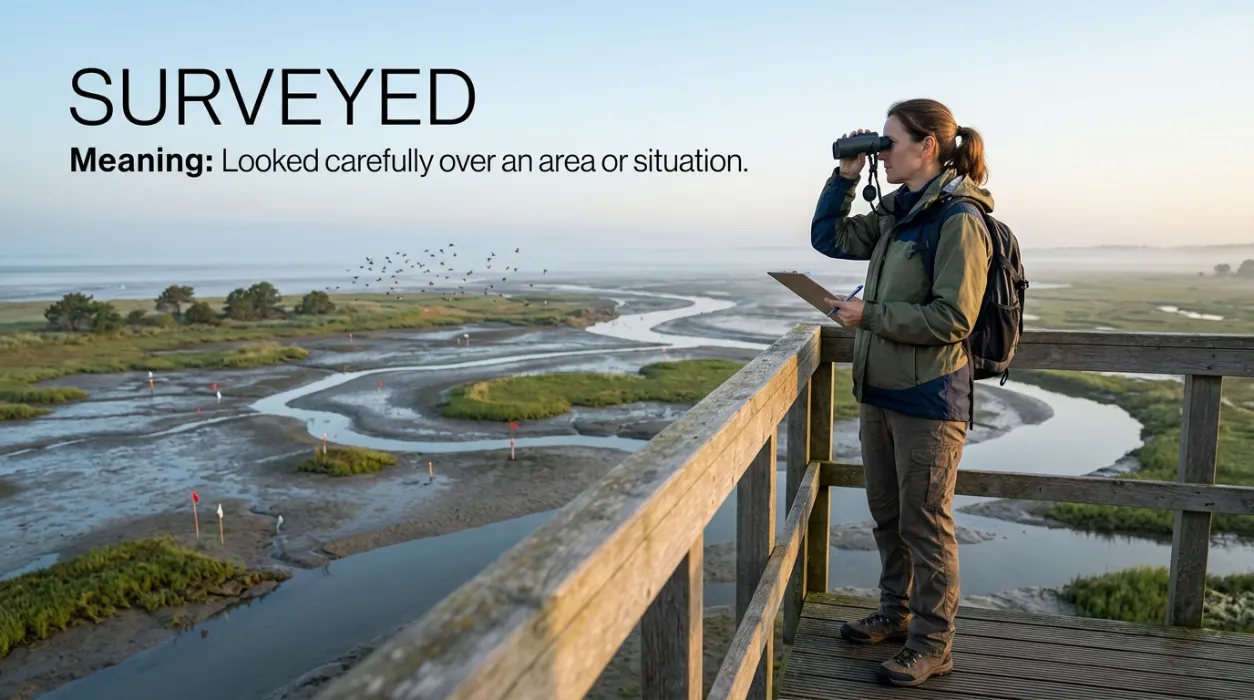
Surveyed (Verb) — US /sɚˈveɪd/ — UK /səˈveɪd/
Meaning: Looked carefully over an area or situation.
Tone/Register: Formal, professional.
Example:
The engineer surveyed the damaged bridge.
He recorded several structural concerns.
Inspected (Verb) — US /ɪnˈspek.tɪd/ — UK /ɪnˈspek.tɪd/
Meaning: Examined something carefully to assess its condition.
Tone/Register: Formal, professional.
Example:
The technician inspected every machine.
She found a loose connection in one unit.
Looked Over (Verb phrase) — US /lʊkt ˈoʊvɚ/ — UK /lʊkt ˈəʊvə/
Meaning: Examined something casually or carefully, depending on context.
Tone/Register: Informal to neutral.
Example:
I looked over the documents before the meeting.
Everything seemed accurate.
Examined (Verb) — US /ɪɡˈzæmɪnd/ — UK /ɪɡˈzæmɪnd/
Meaning: Studied something carefully to understand or evaluate it.
Tone/Register: Academic, professional.
Example:
The researchers examined several possible explanations.
Their analysis revealed a clear pattern.
Arranged (Verb) — US /əˈreɪndʒd/ — UK /əˈreɪndʒd/
Meaning: Put people or things into a particular order or position.
Tone/Register: Neutral.
Example:
The chairs were arranged around the table.
Everyone could see the presentation clearly.
Positioned (Verb) — US /pəˈzɪʃ.ənd/ — UK /pəˈzɪʃ.ənd/
Meaning: Put someone or something in a particular place.
Tone/Register: Professional, neutral.
Example:
The cameras were positioned near the entrance.
They recorded everyone who entered.
Arrayed (Verb) — US /əˈreɪd/ — UK /əˈreɪd/
Meaning: Arranged people or things in an orderly or visually striking formation.
Tone/Register: Formal, literary.
Example:
The paintings were arrayed along the gallery wall.
Visitors could view the entire collection at once.
Aligned (Verb) — US /əˈlaɪnd/ — UK /əˈlaɪnd/
Meaning: Positioned things in a straight line or appropriate relationship.
Tone/Register: Neutral, technical.
Example:
The desks were aligned in neat rows.
The students could move easily between them.
Deployed (Verb) — US /dɪˈplɔɪd/ — UK /dɪˈplɔɪd/
Meaning: Positioned people, equipment, or resources for a particular purpose.
Tone/Register: Professional, technical.
Example:
The team deployed additional staff at the entrance.
They helped manage the large crowd.
Stationed (Verb) — US /ˈsteɪ.ʃənd/ — UK /ˈsteɪ.ʃənd/
Meaning: Placed a person or group in a particular location for a purpose.
Tone/Register: Neutral, professional.
Example:
Two officers were stationed outside the building.
They monitored the entrance during the event.
Synonyms by Tone
The right alternative depends heavily on what you want the reader to notice.
Positive or Broad
These often suggest breadth, variety, or richness:
- varied
- spanned
- encompassed
- embraced
- explored
- vibrant
- extended
- covered
Neutral
These are useful for everyday, academic, and informational writing:
- included
- differed
- stretched
- reached
- discussed
- addressed
- traveled
- moved
- spread
- grouped
- arranged
Formal or Academic
These choices work especially well in reports and research:
- encompassed
- comprised
- traversed
- surveyed
- examined
- fluctuated
- arrayed
- deployed
- distributed
- extended over
Informal
These sound more natural in conversation:
- went from
- ran from
- looked over
- wandered
- roamed
- lined up
- set out
Tone matters because a synonym can change the level of precision and formality.
For example, wandered sounds relaxed, while traversed sounds deliberate and formal.
Likewise, went from is conversational, while varied between is more suitable for analytical writing.
“Ranged” vs Close Alternatives
Ranged vs Varied
These are especially close when talking about numbers, prices, ages, temperatures, or levels.
Prices ranged from $20 to $100.
Prices varied from $20 to $100.
Both work.
However, varied focuses more strongly on difference or change. Ranged emphasizes the limits within which those values occurred.
Ranged vs Spanned
These overlap when describing distance, time, or coverage.
The project ranged across several disciplines.
The project spanned several disciplines.
Spanned strongly emphasizes breadth or extension.
Ranged can suggest movement across topics or a broad spread.
Ranged vs Arranged
These words look similar, but their meanings differ.
Ranged can mean positioned in a particular order.
Arranged directly means organized or positioned deliberately.
Compare:
The soldiers were ranged along the road.
The chairs were arranged in rows.
The first sounds more formal and descriptive. The second is more ordinary and natural.
How “Ranged” Changes by Context
Daily Conversation
In casual English, ranged most often appears in familiar patterns such as:
The prices ranged from $10 to $50.
The conversation ranged from movies to travel.
For simple speech, went from, varied, or covered may sometimes sound more natural.
Writing and Blogging
Writers often use ranged to show breadth without repeating included.
For example:
The article ranged across history, culture, and modern technology.
This gives the sentence a polished feel.
However, avoid using ranged simply because it sounds sophisticated. If covered communicates the idea more clearly, use covered.
Professional and Academic Writing
This is one of the strongest environments for ranged.
Academic writing frequently describes:
- numerical values
- research findings
- age groups
- temperatures
- scores
- topics
- geographical areas
For example:
Participant ages ranged from 18 to 65.
That structure is concise and natural.
In formal writing, varied between, spanned, encompassed, and fluctuated can provide useful alternatives.
Creative and Informal Writing
In storytelling, ranged can describe movement or position.
Wolves ranged across the snowy valley.
It creates a broad visual image.
For more conversational writing, roamed, wandered, or moved across may feel warmer.
Common Mistakes and Native Usage
Mistake 1: Confusing “ranged” with “ranged from”
When giving two limits, English commonly uses:
The scores ranged from 60 to 95.
Do not usually write:
The scores ranged 60 to 95.
The preposition from is important in this construction.
Mistake 2: Confusing “ranged from” and “ranged between”
Both structures can work, but their grammar differs.
Prices ranged from $20 to $80.
Prices ranged between $20 and $80.
Remember:
from + A + to + B
between + A + and + B
Mistake 3: Using “ranged” when you mean “changed”
If something moved repeatedly up and down, fluctuated may be more precise.
Prices fluctuated throughout the year.
This emphasizes repeated change.
Mistake 4: Using “ranged” when “arranged” is clearer
If you simply mean that objects were organized, arranged is usually the easier choice.
The books were arranged alphabetically.
That sentence is clearer than forcing ranged into the same context.
Mistake 5: Assuming every synonym works in every context
This is the biggest vocabulary mistake.
You cannot replace:
The ages ranged from 18 to 60.
with:
The ages wandered from 18 to 60.
The grammar may look possible, but the meaning is wrong.
A good synonym must preserve both the meaning and the grammatical pattern.
Register Notes
Formal: encompassed, traversed, surveyed, examined, arrayed, deployed
Academic: varied, fluctuated, spanned, differed, ranged across
Professional: addressed, covered, distributed, positioned, stationed
Neutral: included, extended, reached, spread, moved
Informal: went from, looked over, wandered, lined up
One useful vocabulary exercise is to compare this article with a related guide on synonyms for varied. The comparison can help you notice when ranged and varied overlap.
Real-Life Mini Scenarios
Workplace
A manager describes employee experience:
Employee experience ranged from two years to more than twenty.
Here, ranged from clearly expresses numerical limits.
Social Situation
Friends discuss many subjects during dinner:
Our conversation ranged from travel plans to childhood memories.
The word shows how broadly the discussion moved.
Media and Pop Culture
A documentary covers many subjects:
The documentary ranged across music, politics, and social history.
Here, covered would also work, but ranged across highlights breadth.
Travel and Storytelling
A writer describes explorers:
The travelers ranged through remote villages for weeks.
Here, ranged through emphasizes movement across an area.

Practice Exercise
1. The prices changed from $25 to $90. Which word fits best?
A. Wandered
B. Varied
C. Inspected
D. Arrayed
2. A discussion included history, science, and literature. Which verb works best?
A. Ranged
B. Stationed
C. Aligned
D. Patrolled
3. Wild animals moved freely across the plains.
A. Roamed
B. Ordered
C. Examined
D. Distributed
4. A research paper needs a formal word for “covered a broad area.”
A. Encompassed
B. Went from
C. Lined up
D. Wandered
5. The chairs were put into organized rows.
A. Fluctuated
B. Arranged
C. Traveled
D. Varied
6. The expedition traveled across difficult terrain.
A. Traversed
B. Included
C. Comprised
D. Differed
7. The temperature repeatedly moved up and down.
A. Fluctuated
B. Stationed
C. Arrayed
D. Positioned
8. The security officers were placed at different entrances.
A. Wandered
B. Deployed
C. Spanned
D. Varied
9. You want a casual phrase meaning “changed from one point to another.”
A. Went from
B. Encompassed
C. Surveyed
D. Traversed
10. A scientist carefully examined an area.
A. Surveyed
B. Roamed
C. Spread
D. Went from
Answer key: 1-B | 2-A | 3-A | 4-A | 5-B | 6-A | 7-A | 8-B | 9-A | 10-A
Reflection Task:
Choose one sentence containing ranged from your own writing.
Replace it with a synonym such as varied, spanned, covered, roamed, examined, or arranged.
Conclusion
Understanding raved can help you describe someone speaking with great enthusiasm, excitement, or admiration about something. Learning its synonyms, meaning, and examples can improve your English vocabulary and make your communication more expressive.
The word raved is often used when someone strongly praises a person, experience, performance, or product. Knowing its related synonyms can help you express enthusiasm in different ways and choose words that fit the context.
By practicing raved in sentences and exploring its related words, you can strengthen your vocabulary and writing skills. A clear understanding of this word will help you communicate feelings of excitement and admiration more naturally and confidently.
Frequently Asked Questions
1. What is the best synonym for “ranged from” in academic writing?
Varied from is often the closest replacement when you describe numerical limits. For example, “The scores ranged from 60 to 90” can become “The scores varied from 60 to 90.” Depending on context, fell between, extended from, or spanned may also work, but each emphasizes a slightly different relationship.
2. What can I use instead of “ranged from” when describing numbers?
For numerical information, useful alternatives include varied from, fell between, lay between, and extended from. However, they are not always identical. “Fell between” emphasizes where values were located, while “varied from” emphasizes differences across the values. Choose the construction that best matches the data you are describing.
3. Is “ranged” formal or informal English?
Ranged is generally neutral and works well in both everyday and formal writing. The construction “ranged from A to B” is particularly common in academic, scientific, business, and statistical writing. In casual conversation, speakers may sometimes prefer simpler expressions such as “went from” or “varied from.”
4. What is the difference between “ranged” and “varied”?
Ranged often emphasizes the limits or extent of something, while varied focuses more directly on differences or changes. Compare “Temperatures ranged from 10 to 25 degrees” with “Temperatures varied throughout the day.” The first gives a defined span; the second emphasizes changing conditions.
5. Can “ranged” mean “moved”?
Yes. Range can mean to move freely through or across an area, so ranged can describe past movement. For example, “The animals ranged across the plains” means they moved freely over that area. Depending on the context, roamed, wandered, traveled, roved, or traversed may provide a more specific alternative.

Hasnain Ali is an SEO Content Strategist and the founder of wordvora.com, a trusted vocabulary platform that helps writers, students, professionals, and English learners find accurate synonyms, antonyms, word meanings, and real-life usage examples. He specializes in keyword research, on-page SEO, topical authority, and creating search-first content that aligns with Google’s latest Search Quality and E-E-A-T guidelines. His work focuses on producing clear, well-structured, and reader-friendly resources that satisfy search intent while maintaining high editorial standards.
Through extensive hands-on experience with SEO tools such as Google Search Console, Google Analytics, SEMrush, and Ahrefs, Hasnain researches user search behavior and develops content that is both informative and easy to understand. Every article published on wordvora.com is carefully reviewed for accuracy, readability, and contextual relevance before publication. His mission is to build one of the web’s most reliable English vocabulary resources by providing practical language guidance, trustworthy explanations, and content that helps readers improve their writing, communication, and vocabulary with confidence.