
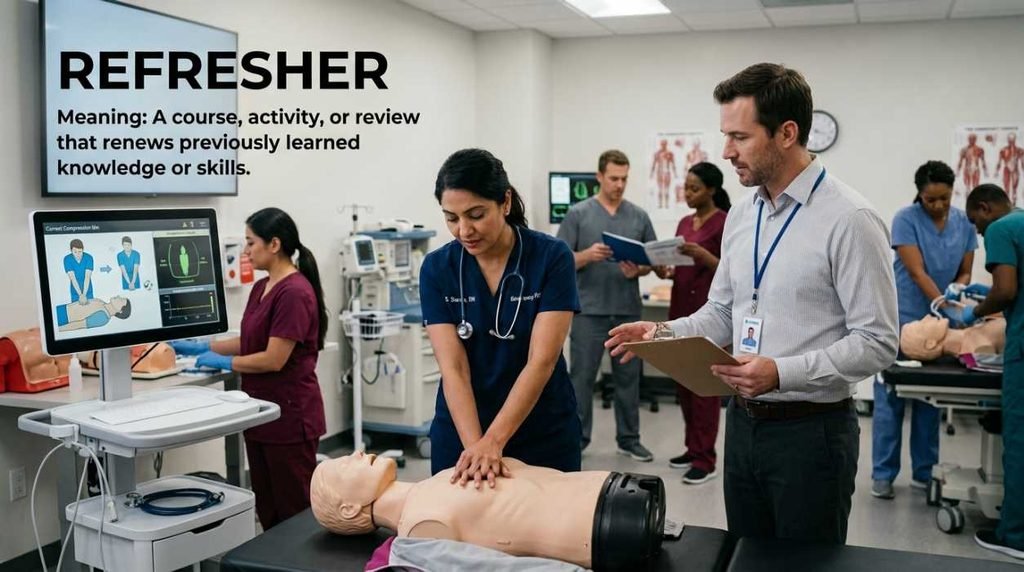
Synonyms for refresher can make everyday English sound sharper. Imagine a student reopening old notes before an exam and wanting a better phrase than “refresher.”
A refresher is commonly used for a quick review, a short course, or something that restores energy. Knowing alternatives helps you choose the exact shade.
For students, bloggers, content writers, and daily English users, synonyms prevent repetition. They also make emails, lessons, articles, and conversations feel more natural.
Learning synonyms for refresher is especially useful when the context changes. A “review” may suit study, while a “brush-up” feels friendlier in casual speech.
What Does “Refresher” Really Mean?
Refresher is a noun.
In simple English, a refresher is something that helps you remember information, regain a skill, restore energy, or feel fresh again.
The word commonly appears in two main senses.
First, it can mean a short review or course designed to bring old knowledge back to mind.
For example:
“I took a refresher course before returning to work.”
Second, it can describe something that refreshes or revives you.
For example:
“A cool drink was a welcome refresher after the long walk.”
Therefore, the best synonym depends on the context. In education, review, revision, and brush-up are often suitable. In a physical or emotional context, refreshment, rejuvenation, or pick-me-up may work better.
Native speakers usually understand refresher as practical and neutral. It does not normally sound emotional or judgmental.
Part of Speech
Refresher: noun
Simple definition: Something that helps you remember something again or makes you feel fresh and renewed.
Connotative Meaning
Connotation means the feeling, association, or extra meaning that a word can suggest beyond its basic dictionary definition.
Positive Tone
“Refresher” often has a positive tone because it suggests improvement, renewed confidence, or renewed energy.
A refresher course, for example, can help someone feel prepared again.
Negative Tone
The word itself is not normally negative. However, context can make it sound slightly negative if it suggests that someone has forgotten important information.
For example:
“You clearly need a refresher.”
Depending on the situation, that sentence may sound critical.
Neutral Tone
In professional, academic, and everyday contexts, refresher is usually neutral.
For example:
“The company offers annual refresher training.”
Etymology of “Refresher”
The noun refresher comes from the verb refresh plus the agent noun suffix -er.
Refresh developed through French influence from Anglo-French forms related to refreschir, meaning “to refresh” or “make fresh again.” The deeper history connects with the idea of becoming fresh or new again.
Old English: 450–1100
The modern word refresh was not an Old English word in its present form. However, Old English had native words related to freshness, newness, nourishment, and restoration.
The concept behind the modern word therefore existed before the modern form appeared.
Middle English: 1100–1500
During Middle English, French influence became important after the Norman Conquest. Forms related to refresh entered English through French.
The meaning developed around making something fresh again, restoring strength, and giving renewed comfort.
Modern English: 1500–Present
Modern English expanded refresh into many contexts.
Today, people can refresh their memory, refresh a skill, refresh themselves with a drink, or take a refresher course.
The noun refresher naturally developed from this productive verb.

Pronunciation
US: /rɪˈfrɛʃər/
UK: /rɪˈfrɛʃə/
Syllables
re-fresh-er
Affixation Pattern of “Refresher”
Root/base: fresh
Prefix: re-
Suffix: -er
The prefix re- suggests “again,” while -er forms a noun referring to something or someone that performs an action or has a particular function.
Synonyms List
Review (Noun) — US / UK: /rɪˈvjuː/ / /rɪˈvjuː/
Meaning: A review is a look at information again to strengthen memory or understanding.
Tone/Register: Neutral, academic, professional
Example:
I did a quick review before the test.
The manager gave us a review of the new safety rules.
Recap (Noun) — US / UK: /ˈriːkæp/ / /ˈriːkæp/
Meaning: A recap gives a short reminder of information that has already been discussed.
Tone/Register: Informal, conversational
Example:
Can you give me a quick recap of the meeting?
The teacher started with a recap of yesterday’s lesson.
Revision (Noun) — US / UK: /rɪˈvɪʒən/ / /rɪˈvɪʒən/
Meaning: Revision means studying material again, especially before an examination.
Tone/Register: Academic, especially British English
Example:
I need some revision before my final exam.
She spent the weekend revising.
Brush-Up (Noun) — US / UK: /ˈbrʌʃ ʌp/ / /ˈbrʌʃ ʌp/
Meaning: A brush-up is a short period of practice that improves an old skill.
Tone/Register: Informal, friendly
Example:
I need a quick brush-up on my Spanish.
He took a brush-up course before his trip.
Refresher Course (Noun Phrase) — US / UK: /rɪˈfrɛʃər kɔːrs/ / /rɪˈfrɛʃə kɔːs/
Meaning: A refresher course is a course that reviews previously learned knowledge or skills.
Tone/Register: Professional, academic
Example:
Nurses often complete refresher courses.
I joined a refresher course before returning to the field.
Review Session (Noun Phrase) — US / UK: /rɪˈvjuː ˈsɛʃən/ / /rɪˈvjuː ˈseʃən/
Meaning: A review session is a planned period for revisiting previously studied material.
Tone/Register: Academic, neutral
Example:
We have a review session tomorrow morning.
The students stayed after class for a review session.
Recap Session (Noun Phrase) — US / UK: /ˈriːkæp ˈsɛʃən/ / /ˈriːkæp ˈseʃən/
Meaning: A recap session briefly revisits important information.
Tone/Register: Informal, professional
Example:
The team held a recap session after the workshop.
Our teacher used a recap session before the new unit.
Revision Session (Noun Phrase) — US / UK: /rɪˈvɪʒən ˈsɛʃən/ / /rɪˈvɪʒən ˈseʃən/
Meaning: A revision session is a study period focused on previously learned material.
Tone/Register: Academic
Example:
Our revision session lasted two hours.
She organized a revision session for her classmates.
Review Lesson (Noun Phrase) — US / UK: /rɪˈvjuː ˈlɛsən/ / /rɪˈvjuː ˈlesən/
Meaning: A review lesson revisits earlier material to strengthen understanding.
Tone/Register: Educational, neutral
Example:
Today’s review lesson covers basic grammar.
The tutor planned a review lesson before the exam.
Review Class (Noun Phrase) — US / UK: /rɪˈvjuː klæs/ / /rɪˈvjuː klɑːs/
Meaning: A review class is a class designed to revisit previously taught material.
Tone/Register: Educational
Example:
The school added a review class before the test.
I attended the review class on Saturday.
Revision Class (Noun Phrase) — US / UK: /rɪˈvɪʒən klæs/ / /rɪˈvɪʒən klɑːs/
Meaning: A revision class focuses on reviewing material already studied.
Tone/Register: Academic, especially British
Example:
We have a revision class after lunch.
She joined an extra revision class before the exam.
Review Course (Noun Phrase) — US / UK: /rɪˈvjuː kɔːrs/ / /rɪˈvjuː kɔːs/
Meaning: A review course provides organized instruction that revisits an existing subject.
Tone/Register: Academic, professional
Example:
The university offers a review course for graduates.
He enrolled in a review course before the certification exam.
Revision Course (Noun Phrase) — US / UK: /rɪˈvɪʒən kɔːrs/ / /rɪˈvɪʒən kɔːs/
Meaning: A revision course is a structured course for reviewing previously learned material.
Tone/Register: Academic, especially British
Example:
She signed up for a revision course.
The revision course covered the main exam topics.
Update (Noun) — US / UK: /ˈʌpdeɪt/ / /ˈʌpdeɪt/
Meaning: An update provides newer information and can refresh someone’s existing knowledge.
Tone/Register: Neutral, professional
Example:
I need an update on the safety procedures.
The manager gave us an update after the policy changed.
Update Session (Noun Phrase) — US / UK: /ˈʌpdeɪt ˈsɛʃən/ / /ˈʌpdeɪt ˈseʃən/
Meaning: An update session gives people current information about a familiar subject.
Tone/Register: Professional
Example:
The department held an update session.
We attended an update session on new regulations.
Update Course (Noun Phrase) — US / UK: /ˈʌpdeɪt kɔːrs/ / /ˈʌpdeɪt kɔːs/
Meaning: An update course helps learners bring older knowledge in line with current information.
Tone/Register: Professional, academic
Example:
The engineer completed an update course.
The update course covered recent industry changes.
Follow-Up Session (Noun Phrase) — US / UK: /ˈfɑːloʊ ʌp ˈsɛʃən/ / /ˈfɒləʊ ʌp ˈseʃən/
Meaning: A follow-up session continues earlier instruction and can reinforce important information.
Tone/Register: Professional, neutral
Example:
The trainer scheduled a follow-up session.
We used the follow-up session to revisit key points.
Follow-Up Lesson (Noun Phrase) — US / UK: /ˈfɑːloʊ ʌp ˈlɛsən/ / /ˈfɒləʊ ʌp ˈlesən/
Meaning: A follow-up lesson builds on earlier teaching while revisiting important material.
Tone/Register: Educational, neutral
Example:
The tutor arranged a follow-up lesson.
The follow-up lesson helped me remember the grammar rules.
Reinforcement (Noun) — US / UK: /ˌriːɪnˈfɔːrsmənt/ / /ˌriːɪnˈfɔːsmənt/
Meaning: Reinforcement strengthens knowledge or skills that have already been learned.
Tone/Register: Academic, professional
Example:
The exercise provides useful reinforcement.
Students need reinforcement after learning difficult concepts.
Reinforcement Practice (Noun Phrase) — US / UK: /ˌriːɪnˈfɔːrsmənt ˈpræktɪs/ / /ˌriːɪnˈfɔːsmənt ˈpræktɪs/
Meaning: Reinforcement practice uses repeated activities to make existing knowledge stronger.
Tone/Register: Educational
Example:
The workbook includes reinforcement practice.
We used reinforcement practice after the grammar lesson.
Consolidation (Noun) — US / UK: /kənˌsɑːləˈdeɪʃən/ / /kənˌsɒlɪˈdeɪʃən/
Meaning: Consolidation is the process of strengthening knowledge that has already been learned.
Tone/Register: Academic, formal
Example:
The final lesson focuses on consolidation.
Regular practice supports vocabulary consolidation.
Consolidation Exercise (Noun Phrase) — US / UK: /kənˌsɑːləˈdeɪʃən ˈɛksərsaɪz/ / /kənˌsɒlɪˈdeɪʃən ˈeksəsaɪz/
Meaning: A consolidation exercise helps learners strengthen existing knowledge.
Tone/Register: Academic
Example:
Complete the consolidation exercise after the lesson.
The teacher added a short consolidation exercise.
Practice Review (Noun Phrase) — US / UK: /ˈpræktɪs rɪˈvjuː/ / /ˈpræktɪs rɪˈvjuː/
Meaning: A practice review combines revision with active exercises.
Tone/Register: Educational, neutral
Example:
I did a practice review before the interview.
The practice review covered the most important skills.
Practice Session (Noun Phrase) — US / UK: /ˈpræktɪs ˈsɛʃən/ / /ˈpræktɪs ˈseʃən/
Meaning: A practice session gives someone a chance to rehearse a familiar skill again.
Tone/Register: Neutral, conversational
Example:
I scheduled a practice session before the presentation.
Our team had one final practice session.
Revision Exercise (Noun Phrase) — US / UK: /rɪˈvɪʒən ˈɛksərsaɪz/ / /rɪˈvɪʒən ˈeksəsaɪz/
Meaning: A revision exercise tests or strengthens previously learned material.
Tone/Register: Academic
Example:
The textbook includes a revision exercise.
Try the revision exercise before moving on.

Review Exercise (Noun Phrase) — US / UK: /rɪˈvjuː ˈɛksərsaɪz/ / /rɪˈvjuː ˈeksəsaɪz/
Meaning: A review exercise helps learners revisit important information through practice.
Tone/Register: Educational
Example:
The teacher assigned a review exercise.
This review exercise checks your understanding.
Summary (Noun) — US / UK: /ˈsʌməri/ / /ˈsʌməri/
Meaning: A summary gives the main points of information in a shorter form.
Tone/Register: Neutral, academic, professional
Example:
I read a summary before the meeting.
The article ends with a useful summary.
Recapitulation (Noun) — US / UK: /ˌriːkəˌpɪtʃəˈleɪʃən/ / /ˌriːkəˌpɪtʃəˈleɪʃən/
Meaning: Recapitulation is a formal review or restatement of information already presented.
Tone/Register: Formal, academic
Example:
The lecturer offered a brief recapitulation.
The final section provides a recapitulation of the argument.
Rundown (Noun) — US / UK: /ˈrʌndaʊn/ / /ˈrʌndaʊn/
Meaning: A rundown is a concise account of the main information about something.
Tone/Register: Informal, conversational
Example:
Can you give me a quick rundown?
She gave us a rundown of the schedule.
Run-Through (Noun) — US / UK: /ˈrʌn θruː/ / /ˈrʌn θruː/
Meaning: A run-through is a complete practice or review of something from beginning to end.
Tone/Register: Informal, professional
Example:
Let’s do a quick run-through before the presentation.
The actors had one final run-through.
Walkthrough (Noun) — US / UK: /ˈwɔːkθruː/ / /ˈwɔːkθruː/
Meaning: A walkthrough explains or reviews a process step by step.
Tone/Register: Professional, instructional
Example:
The trainer gave us a walkthrough of the procedure.
I watched a walkthrough before using the new system.
Revisit (Noun) — US / UK: /ˈriːˌvɪzɪt/ / /ˈriːˌvɪzɪt/
Meaning: A revisit is another look at something that was previously studied or discussed.
Tone/Register: Neutral, written
Example:
The teacher planned a revisit of the main grammar rules.
The article offers a revisit of an important topic.
Recheck (Noun) — US / UK: /ˈriːtʃɛk/ / /ˈriːtʃek/
Meaning: A recheck is another examination of information to confirm accuracy or understanding.
Tone/Register: Neutral, practical
Example:
I did a recheck of my notes.
The supervisor requested a recheck of the procedure.
Reminder (Noun) — US / UK: /rɪˈmaɪndər/ / /rɪˈmaɪndə/
Meaning: A reminder brings information back to someone’s attention.
Tone/Register: Neutral
Example:
This chart is a useful reminder of the rules.
I wrote myself a reminder before the test.
Memory Jogger (Noun Phrase) — US / UK: /ˈmɛməri ˌdʒɑːɡər/ / /ˈmeməri ˌdʒɒɡə/
Meaning: A memory jogger is something that helps you remember information you already know.
Tone/Register: Informal
Example:
I keep a small checklist as a memory jogger.
That photo was a helpful memory jogger.
Study Review (Noun Phrase) — US / UK: /ˈstʌdi rɪˈvjuː/ / /ˈstʌdi rɪˈvjuː/
Meaning: A study review is a focused return to material that has already been learned.
Tone/Register: Academic, neutral
Example:
I completed a study review before dinner.
The study review helped me identify weak areas.
Study Session (Noun Phrase) — US / UK: /ˈstʌdi ˈsɛʃən/ / /ˈstʌdi ˈseʃən/
Meaning: A study session is a period devoted to learning or reviewing material.
Tone/Register: Neutral, academic
Example:
I planned a study session for Saturday.
Our study session focused on vocabulary.
Retrieval Practice (Noun Phrase) — US / UK: /rɪˈtriːvəl ˈpræktɪs/ / /rɪˈtriːvəl ˈpræktɪs/
Meaning: Retrieval practice involves actively recalling information instead of simply rereading it.
Tone/Register: Academic, educational
Example:
Retrieval practice helped me remember the terms.
The teacher used retrieval practice at the start of class.
Recall Exercise (Noun Phrase) — US / UK: /rɪˈkɔːl ˈɛksərsaɪz/ / /rɪˈkɔːl ˈeksəsaɪz/
Meaning: A recall exercise asks learners to bring previously learned information back to mind.
Tone/Register: Academic
Example:
The lesson began with a recall exercise.
Try the recall exercise without looking at your notes.
Relearning (Noun) — US / UK: /ˌriːˈlɜːrnɪŋ/ / /ˌriːˈlɜːnɪŋ/
Meaning: Relearning means learning something again after it has been forgotten or weakened.
Tone/Register: Academic, neutral
Example:
I needed some relearning after years away from mathematics.
Relearning an old skill took less time than expected.
Reacquaintance (Noun) — US / UK: /ˌriːəˈkweɪntəns/ / /ˌriːəˈkweɪntəns/
Meaning: Reacquaintance is the process of becoming familiar with something again.
Tone/Register: Formal
Example:
The workshop offered reacquaintance with the software.
I needed a little reacquaintance with the old system.
Reintroduction (Noun) — US / UK: /ˌriːɪntrəˈdʌkʃən/ / /ˌriːɪntrəˈdʌkʃən/
Meaning: Reintroduction presents something again after a period of absence or unfamiliarity.
Tone/Register: Neutral, professional
Example:
The lesson provided a reintroduction to basic statistics.
The workshop served as a reintroduction to the subject.
Top-Up Course (Noun Phrase) — US / UK: /ˈtɑːp ʌp kɔːrs/ / /ˈtɒp ʌp kɔːs/
Meaning: A top-up course adds to or renews existing knowledge, especially in British English.
Tone/Register: Educational, especially British
Example:
She took a top-up course after several years away.
The top-up course covered recent changes.
Top-Up Training (Noun Phrase) — US / UK: /ˈtɑːp ʌp ˈtreɪnɪŋ/ / /ˈtɒp ʌp ˈtreɪnɪŋ/
Meaning: Top-up training provides additional instruction to renew or extend existing skills.
Tone/Register: British, professional
Example:
Staff completed top-up training this month.
The company arranged top-up training for returning workers.
Refresher Training (Noun Phrase) — US / UK: /rɪˈfrɛʃər ˈtreɪnɪŋ/ / /rɪˈfrɛʃə ˈtreɪnɪŋ/
Meaning: Refresher training reviews skills that employees have previously learned.
Tone/Register: Professional
Example:
All staff must complete refresher training annually.
The instructor delivered refresher training on emergency procedures.
Continuing Education (Noun Phrase) — US / UK: /kənˈtɪnjuɪŋ ˌɛdʒəˈkeɪʃən/ / /kənˈtɪnjuɪŋ ˌedʒʊˈkeɪʃən/
Meaning: Continuing education involves further learning after initial education or training.
Tone/Register: Formal, academic, professional
Example:
She completed continuing education in her field.
Continuing education keeps professional knowledge current.
Continuing Instruction (Noun Phrase) — US / UK: /kənˈtɪnjuɪŋ ɪnˈstrʌkʃən/ / /kənˈtɪnjuɪŋ ɪnˈstrʌkʃən/
Meaning: Continuing instruction provides ongoing teaching that can reinforce existing knowledge.
Tone/Register: Formal, educational
Example:
The program includes continuing instruction.
Continuing instruction helps staff maintain important skills.
Refreshment (Noun) — US / UK: /rɪˈfrɛʃmənt/ / /rɪˈfrɛʃmənt/
Meaning: Refreshment can mean something that restores energy, comfort, or freshness.
Tone/Register: Neutral, sometimes formal
Example:
We stopped for refreshments after the hike.
The cold water provided welcome refreshment.
Revival (Noun) — US / UK: /rɪˈvaɪvəl/ / /rɪˈvaɪvəl/
Meaning: Revival means a return of energy, activity, interest, or strength.
Tone/Register: Neutral, formal
Example:
The festival sparked a revival of local traditions.
The campaign led to a revival of interest in the subject.
Renewal (Noun) — US / UK: /rɪˈnuːəl/ / /rɪˈnjuːəl/
Meaning: Renewal refers to making something fresh, active, or strong again.
Tone/Register: Formal, positive
Example:
The retreat gave her a sense of renewal.
The project brought renewal to the old community space.
Rejuvenation (Noun) — US / UK: /rɪˌdʒuːvəˈneɪʃən/ / /rɪˌdʒuːvəˈneɪʃən/
Meaning: Rejuvenation means restoring freshness, energy, or vitality.
Tone/Register: Formal, positive
Example:
A quiet weekend gave me some rejuvenation.
The garden project created a feeling of rejuvenation.

Revitalization (Noun) — US / UK: /ˌriːvaɪtələˈzeɪʃən/ / /ˌriːvaɪtəlaɪˈzeɪʃən/
Meaning: Revitalization is the process of giving renewed energy or life to something.
Tone/Register: Formal, professional
Example:
The new program supported the revitalization of the area.
The team needed revitalization after a difficult season.
Restoration (Noun) — US / UK: /ˌrɛstəˈreɪʃən/ / /ˌrestəˈreɪʃən/
Meaning: Restoration means returning something to a former condition, strength, or state.
Tone/Register: Formal
Example:
The break helped with the restoration of my energy.
The project focused on the restoration of the historic building.
Reinvigoration (Noun) — US / UK: /ˌriːɪnˌvɪɡəˈreɪʃən/ / /ˌriːɪnˌvɪɡəˈreɪʃən/
Meaning: Reinvigoration means giving something renewed energy or strength.
Tone/Register: Formal
Example:
The new routine brought reinvigoration to the team.
A short holiday provided personal reinvigoration.
Pick-Me-Up (Noun) — US / UK: /ˈpɪk mi ʌp/ / /ˈpɪk mi ʌp/
Meaning: A pick-me-up is something that makes you feel more energetic, cheerful, or refreshed.
Tone/Register: Informal, conversational
Example:
I need a short walk as a pick-me-up.
That funny video was a welcome pick-me-up.
Synonyms by Tone
Positive
Words such as renewal, rejuvenation, revitalization, reinvigoration, and revival can suggest renewed energy or improvement.
They work especially well when the goal is to create an encouraging tone.
Neutral
Review, recap, summary, reminder, update, recheck, and revisit are generally neutral.
They are useful when you want to communicate clearly without adding much emotion.
Negative
There are few inherently negative synonyms for refresher.
However, words such as relearning can sometimes imply that previous knowledge has been forgotten. The surrounding sentence determines whether that implication feels negative.
Playful or Informal
Brush-up, rundown, memory jogger, run-through, and pick-me-up sound more conversational.
They can make everyday communication warmer and less formal.
Why Tone Matters
Word choice changes how a message feels.
For example, “I need a review” sounds neutral. “I need a brush-up” sounds casual. “I need a refresher course” sounds more structured and professional.
Therefore, choosing a synonym is not simply about avoiding repetition. It is about matching the word to the situation.
“Refresher” vs Close Alternatives
Refresher vs Review
A refresher often suggests restoring knowledge that has become less familiar.
A review is broader. It can mean examining information again for study, checking quality, or looking back at something.
Use refresher when the purpose is renewed familiarity. Use review when you simply want another look.
Refresher vs Revision
Revision is strongly associated with studying, particularly in British English.
Refresher is broader and can refer to professional training or practical skills.
For example, a student may revise, while an experienced employee may complete refresher training.
Refresher vs Brush-Up
Brush-up is more informal.
It suggests a quick improvement in an existing skill rather than a formal course.
Therefore, “I need a brush-up on my French” sounds casual, while “I need a refresher course in workplace safety” sounds more professional.
How “Refresher” Changes by Context
Daily Conversation
In everyday speech, refresher, review, recap, reminder, and brush-up are useful.
For example:
“Can you give me a quick recap?”
This sounds natural when someone wants a short reminder.
Meanwhile:
“I need a brush-up on my driving skills.”
This sounds relaxed and conversational.
Writing or Blogging
Bloggers often need alternatives because repeating one word can make an article feel mechanical.
Instead of using refresher several times, a writer can use review, recap, summary, revisit, or update when the context supports them.
For example:
“Before we continue, here is a quick recap.”
This is more natural than repeating “refresher” throughout an educational article.
Professional or Academic Tone
In professional writing, refresher training, review, revision, continuing education, consolidation, and update can be useful.
For example:
“Employees completed annual refresher training.”
The phrase clearly communicates that existing knowledge is being renewed.
Creative or Informal Use
Creative writing allows more expressive choices.
Words such as pick-me-up, revival, renewal, and rejuvenation can create a stronger emotional image.
For example:
“The morning walk was the pick-me-up I needed.”
That sentence feels much more personal than a formal expression such as “energy restoration.”
Common Mistakes Learners Make
Mistake 1: Treating Every Synonym as Interchangeable
Not every alternative can replace refresher in every sentence.
For example:
“I need a refresher course.”
Changing this to:
“I need a renewal course.”
would sound unnatural in most contexts.
The meaning may be related, but the collocation is different.
Mistake 2: Using “Revision” in Every Situation
Revision is particularly common in British academic English.
However, American English often uses review for the same educational situation.
Therefore, consider both regional preference and context.
Mistake 3: Using “Recap” in Formal Academic Writing
“Recap” is perfectly natural, but it is relatively conversational.
In a formal report, summary or recapitulation may be more suitable.
Mistake 4: Confusing “Update” With “Review”
An update usually introduces new or current information.
A review normally revisits existing information.
For example:
“The manager gave us an update on the new policy.”
This suggests new information.
However:
“The manager gave us a review of the policy.”
suggests that the policy was examined again.
Mistake 5: Overusing “Refresher”
Even an accurate word can become repetitive.
If an article says “refresher” in every section, the writing may feel predictable.
Instead, use natural semantic alternatives when the meaning remains accurate.
Native Usage Tip
Native speakers often choose a phrase based on collocation, not just dictionary meaning.
For example, these combinations sound natural:
- refresher course
- refresher training
- review session
- revision class
- brush-up course
- quick recap
- memory jogger
- continuing education
Learning common word combinations is often more useful than memorizing isolated synonyms.
Register Notes
Formal: recapitulation, consolidation, continuing education, reinvigoration
Neutral: refresher, review, update, reminder, summary, recheck
Informal: brush-up, recap, rundown, run-through, pick-me-up
Academic: revision, review, retrieval practice, consolidation
Professional: refresher training, update course, continuing instruction, follow-up session
For additional vocabulary practice, you can create an internal vocabulary-learning link around related terms such as synonyms for review, synonyms for update, or words for learning again.
Real-Life Mini Scenarios
Workplace
A software company changes its security procedures.
Instead of assuming employees remember everything, the manager schedules refresher training.
A shorter meeting afterward may be called a review session or update session.
Social Situation
A friend asks how a trip went several months ago.
You cannot remember every detail, so you look at old photos.
The photos act as a memory jogger.
Media and Pop Culture
A television series returns after several years.
Before the new season begins, a streaming service may provide a recap of earlier events.
The recap helps viewers remember characters and storylines.
Writing and Storytelling
A writer returns to an important idea from an earlier chapter.
The writer may revisit the idea rather than repeat the entire explanation.
This keeps the story connected without sounding repetitive.

Practice Quiz
1. You want to ask a friend for a short explanation of what happened at a meeting. Which word fits best?
A. Rejuvenation
B. Recap
C. Restoration
D. Consolidation
2. A student studies old material before an exam in British English. Which term is especially natural?
A. Revision
B. Pick-me-up
C. Refreshment
D. Renewal
3. An employee takes formal training to review workplace safety procedures. Which phrase fits best?
A. Memory jogger
B. Refresher training
C. Revival
D. Rundown
4. You want a casual phrase for improving an old language skill.
A. Brush-up
B. Recapitulation
C. Reinvigoration
D. Restoration
5. A manager provides new information about a changed policy.
A. Update
B. Revision
C. Rejuvenation
D. Recall exercise
6. A teacher asks students to remember information without looking at their notes.
A. Retrieval practice
B. Refreshment
C. Renewal
D. Rundown
7. You need a formal word for reviewing the main points again.
A. Pick-me-up
B. Recapitulation
C. Brush-up
D. Run-through
8. A checklist helps you remember important steps.
A. Memory jogger
B. Revival
C. Top-up course
D. Rejuvenation
9. An employee needs training that brings older knowledge up to date.
A. Update course
B. Pick-me-up
C. Summary
D. Recheck
10. You want a casual account of the main details.
A. Consolidation
B. Rundown
C. Relearning
D. Continuing instruction
Reflection task:
Write one sentence using any synonym from this article. Then rewrite your sentence with a different synonym and compare the tone.
Answer key: 1-B | 2-A | 3-B | 4-A | 5-A | 6-A | 7-B | 8-A | 9-A | 10-B
Conclusion
Learning synonyms for refresher gives you more control over tone. Your writing becomes clearer, your speaking sounds more flexible, and your message feels more precise.
Small word choices can change the mood of an email, essay, lesson, or conversation. Practice helps you notice which alternative sounds natural in each setting.
Try replacing refresher with one suitable alternative today. Write a short sentence, say it aloud, and compare the tone. This simple habit builds lasting vocabulary.
Keep a few useful choices ready for study, work, and daily life. Practice them in emails, essays, and conversations, then revisit this guide whenever you need a boost.
Frequently Asked Questions
1. What is the best synonym for refresher in an educational context?
The best choice depends on the situation. Review is a broad and natural option, while revision is especially common in British academic English. Brush-up is more informal. For formal workplace learning, refresher training or a review course may be more precise.
2. What can I say instead of “refresher course”?
You can use review course, revision course, top-up course, or update course, depending on the purpose. A review course mainly revisits existing knowledge. An update course emphasizes newer information. A top-up course often adds to or renews existing qualifications or skills.
3. Is “brush-up” the same as “refresher”?
They are closely related, but the tone differs. Brush-up is informal and usually suggests improving a skill that has become rusty. Refresher is broader and can sound more neutral or professional. For example, “I need a brush-up on French” sounds casual, while “I need refresher training” sounds more formal.
4. What is a good synonym for refresher in professional writing?
Review, update, refresher training, continuing education, and follow-up session can work well. The right choice depends on the purpose. Use update when new information is involved. Use review when existing information is being examined again.
5. What is the difference between a refresher and a recap?
A recap is usually a summary of information that has already been presented. A refresher can be broader. It may involve a course, training, practice, or review designed to restore knowledge or skill. Therefore, every recap can remind you, but not every refresher is simply a recap.

Hasnain Ali is an SEO Content Strategist and the founder of wordvora.com, a trusted vocabulary platform that helps writers, students, professionals, and English learners find accurate synonyms, antonyms, word meanings, and real-life usage examples. He specializes in keyword research, on-page SEO, topical authority, and creating search-first content that aligns with Google’s latest Search Quality and E-E-A-T guidelines. His work focuses on producing clear, well-structured, and reader-friendly resources that satisfy search intent while maintaining high editorial standards.
Through extensive hands-on experience with SEO tools such as Google Search Console, Google Analytics, SEMrush, and Ahrefs, Hasnain researches user search behavior and develops content that is both informative and easy to understand. Every article published on wordvora.com is carefully reviewed for accuracy, readability, and contextual relevance before publication. His mission is to build one of the web’s most reliable English vocabulary resources by providing practical language guidance, trustworthy explanations, and content that helps readers improve their writing, communication, and vocabulary with confidence.