

Synonyms for scandalous can transform a simple description into something sharper, especially when a shocking story or controversial action needs the right tone.
Imagine hearing that a celebrity made a shocking public statement. You might call it scandalous, but words like disgraceful, shocking, or controversial can sound more precise.
Learning synonyms for scandalous helps students, bloggers, writers, and daily English users describe shocking behavior without repeating the same adjective.
The word is common in news, social media, entertainment, and conversation. However, choosing the right alternative makes your English clearer, more natural, and more expressive.
What Does “Scandalous” Really Mean?
Scandalous is an adjective that describes something considered shocking, improper, disgraceful, offensive, or likely to cause public criticism.
In simple English, scandalous means “so bad, shocking, or improper that people may strongly criticize it.”
For example:
The politician’s scandalous behavior dominated the news.
Here, scandalous suggests more than ordinary bad behavior. It implies that the behavior has attracted serious public attention or disapproval.
Native speakers commonly use the word for:
- shocking behavior
- unethical actions
- offensive statements
- public controversies
- inappropriate conduct
- morally questionable situations
- embarrassing revelations
- behavior that violates social expectations
The exact meaning depends on context. In some situations, scandalous means morally wrong. In others, it simply means extremely shocking or controversial.
Part of Speech
Scandalous is an adjective.
Simple definition: Something scandalous is shocking, disgraceful, improper, or likely to cause public outrage or criticism.
Related forms include:
- Scandal — noun
- Scandalously — adverb
- Scandalize — verb
- Scandalized — adjective
- Scandalizing — adjective/participle
Connotative Meaning of “Scandalous”
Connotation (the emotional or cultural feeling associated with a word beyond its basic dictionary meaning) is especially important with scandalous.
Positive Tone
Scandalous is rarely positive in ordinary English. However, it can occasionally be used playfully to describe something daring.
“You ate the last slice of cake? Absolutely scandalous!”
Here, the word is humorous rather than genuinely condemning.
Negative Tone
This is the dominant use.
The word can suggest:
- disgrace
- moral criticism
- public embarrassment
- inappropriate conduct
- outrage
- social disapproval
The company faced criticism after the scandalous decision.
Neutral Tone
Scandalous itself is usually emotionally charged, so it is not completely neutral.
For neutral reporting, words such as controversial, disputed, questionable, or contentious may be safer.
Etymology of “Scandalous”
The word scandalous ultimately comes from the Greek skandalon, meaning a stumbling block, trap, or cause of offense.
The term passed through Latin and French before developing into English scandal and scandalous.
Old English: 450–1100
The modern word scandalous was not an ordinary Old English vocabulary item. Old English had other words for shame, disgrace, wrongdoing, and dishonor.
Middle English: 1100–1500
Forms related to scandal entered English through Anglo-French and Latin influence. The idea increasingly referred to behavior that caused offense or public criticism.
Modern English: 1500–Present
Over time, scandalous became a common adjective for behavior or events viewed as shocking, disgraceful, improper, or publicly offensive.
Today, it appears frequently in journalism, entertainment writing, political reporting, social media, and everyday speech.
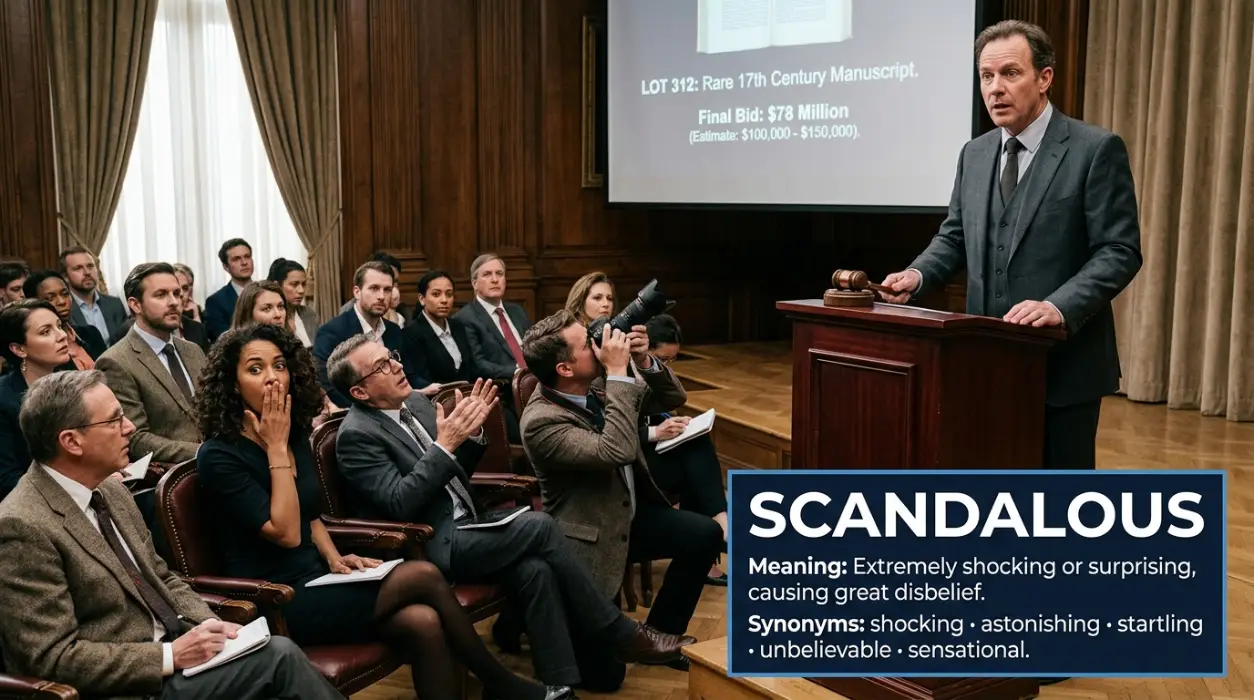
Pronunciation of “Scandalous”
- US: /ˈskændələs/
- UK: /ˈskændələs/
Syllables
scan-da-lous
Affixation Pattern of “Scandalous”
Root: scandal
Prefix: none
Suffix: -ous
The suffix -ous often forms adjectives meaning “characterized by” or “full of.”
So, scandalous describes something characterized by scandal or that causes scandal.
Synonyms List
Shocking (Adjective) — US /ˈʃɑːkɪŋ/ — UK /ˈʃɒkɪŋ/
Meaning: Something shocking causes great surprise or disbelief.
Tone/Register: Neutral to strong; common in news and conversation.
Example:
The shocking announcement surprised everyone at the meeting.
The documentary revealed a shocking pattern of misconduct.
Disgraceful (Adjective) — US /dɪsˈɡreɪsfəl/ — UK /dɪsˈɡreɪsfəl/
Meaning: Something disgraceful is deeply shameful or unacceptable.
Tone/Register: Strongly negative; formal and conversational.
Example:
The manager called the employee’s behavior disgraceful.
Many residents described the neglected conditions as disgraceful.
Shameful (Adjective) — US /ˈʃeɪmfəl/ — UK /ˈʃeɪmfəl/
Meaning: Something shameful deserves embarrassment, criticism, or moral disapproval.
Tone/Register: Strong; common in serious discussions.
Example:
The investigation exposed a shameful abuse of authority.
She apologized for her shameful remarks.
Outrageous (Adjective) — US /aʊtˈreɪdʒəs/ — UK /aʊtˈreɪdʒəs/
Meaning: Something outrageous is extremely shocking, unreasonable, or offensive.
Tone/Register: Strong; common in speech and journalism.
Example:
The customer called the unexpected charge outrageous.
His outrageous comments quickly spread across social media.
Controversial (Adjective) — US /ˌkɑːntrəˈvɜːrʃəl/ — UK /ˌkɒntrəˈvɜːʃəl/
Meaning: Something controversial causes disagreement or strong public debate.
Tone/Register: Neutral to formal; excellent for careful writing.
Example:
The author published a controversial opinion about the industry.
The controversial decision divided the audience.
Infamous (Adjective) — US /ˈɪnfəməs/ — UK /ˈɪnfəməs/
Meaning: Someone or something infamous is widely known for something bad.
Tone/Register: Formal or dramatic.
Example:
The building became infamous after the investigation.
He is remembered for an infamous act of corruption.
Notorious (Adjective) — US /noʊˈtɔːriəs/ — UK /nəʊˈtɔːriəs/
Meaning: Something notorious is widely known for negative reasons.
Tone/Register: Formal; common in journalism.
Example:
The company became notorious for misleading advertising.
The neighborhood was once notorious for violent crime.
Disreputable (Adjective) — US /dɪsˈrɛpjətəbəl/ — UK /dɪsˈrɛpjʊtəbəl/
Meaning: Something disreputable is considered dishonest, unreliable, or socially unacceptable.
Tone/Register: Formal.
Example:
The journalist refused to use a disreputable source.
The business developed a disreputable reputation.
Disgracing (Adjective) — US /dɪsˈɡreɪsɪŋ/ — UK /dɪsˈɡreɪsɪŋ/
Meaning: Something disgracing causes a person, group, or institution to lose respect.
Tone/Register: Formal and serious.
Example:
The disgracing conduct damaged the organization’s reputation.
His actions were viewed as disgracing the entire department.
Discreditable (Adjective) — US /dɪsˈkrɛdɪtəbəl/ — UK /dɪsˈkrɛdɪtəbəl/
Meaning: Something discreditable damages someone’s reputation or credibility.
Tone/Register: Formal; more common in writing.
Example:
The report uncovered several discreditable practices.
The committee rejected the discreditable proposal.
Disreputable (Adjective) — US /dɪsˈrɛpjətəbəl/ — UK /dɪsˈrɛpjʊtəbəl/
Meaning: Something disreputable is not respected because it is considered dishonest or improper.
Tone/Register: Formal.
Example:
He avoided the disreputable organization.
The article criticized the site’s disreputable methods.
Improper (Adjective) — US /ɪmˈprɑːpər/ — UK /ɪmˈprəʊpə/
Meaning: Something improper is inappropriate or unacceptable in a particular situation.
Tone/Register: Neutral to formal.
Example:
The official was criticized for improper conduct.
The teacher explained why the comment was improper.
Inappropriate (Adjective) — US /ˌɪnəˈproʊpriət/ — UK /ˌɪnəˈprəʊpriət/
Meaning: Something inappropriate does not fit accepted standards or the situation.
Tone/Register: Neutral; extremely common.
Example:
The comedian apologized for the inappropriate joke.
The employee received a warning about inappropriate messages.
Offensive (Adjective) — US /əˈfensɪv/ — UK /əˈfensɪv/
Meaning: Something offensive causes anger, hurt, or strong disapproval.
Tone/Register: Neutral to strong.
Example:
Several viewers found the advertisement offensive.
He removed the offensive comment after complaints.
Provocative (Adjective) — US /prəˈvɑːkətɪv/ — UK /prəˈvɒkətɪv/
Meaning: Something provocative deliberately or naturally causes a strong reaction.
Tone/Register: Neutral to formal; often used in media.
Example:
The magazine published a provocative cover.
Her provocative statement started a heated discussion.
Sensational (Adjective) — US /senˈseɪʃənəl/ — UK /senˈseɪʃənəl/
Meaning: Something sensational creates intense public interest or excitement.
Tone/Register: Journalistic; sometimes critical.
Example:
The newspaper used a sensational headline.
The story became sensational after new details appeared.
Sensationalist (Adjective) — US /senˈseɪʃənəlɪst/ — UK /senˈseɪʃənəlɪst/
Meaning: Something sensationalist presents information in an exaggerated way to attract attention.
Tone/Register: Critical; journalism and media.
Example:
Critics accused the channel of sensationalist reporting.
The article was criticized for its sensationalist language.
Startling (Adjective) — US /ˈstɑːrtlɪŋ/ — UK /ˈstɑːtlɪŋ/
Meaning: Something startling produces sudden surprise.
Tone/Register: Neutral.
Example:
The audit revealed a startling error.
There was a startling change in the final report.
Astonishing (Adjective) — US /əˈstɑːnɪʃɪŋ/ — UK /əˈstɒnɪʃɪŋ/
Meaning: Something astonishing causes great surprise or disbelief.
Tone/Register: Neutral to strong.
Example:
The investigation uncovered an astonishing number of complaints.
Her astonishing admission changed the conversation.
Appalling (Adjective) — US /əˈpɔːlɪŋ/ — UK /əˈpɔːlɪŋ/
Meaning: Something appalling is extremely bad, disturbing, or unacceptable.
Tone/Register: Strong; formal and conversational.
Example:
The report described appalling working conditions.
Residents were shocked by the appalling treatment of animals.
Shocking (Adjective) — US /ˈʃɑːkɪŋ/ — UK /ˈʃɒkɪŋ/
Meaning: Something shocking causes great surprise, concern, or disbelief.
Tone/Register: Common and flexible.
Example:
The shocking footage led to a public investigation.
She received a shocking message that morning.
Disturbing (Adjective) — US /dɪˈstɜːrbɪŋ/ — UK /dɪˈstɜːbɪŋ/
Meaning: Something disturbing causes worry, discomfort, or emotional unease.
Tone/Register: Neutral to strong.
Example:
The documentary contained disturbing evidence.
The witness described a disturbing incident.
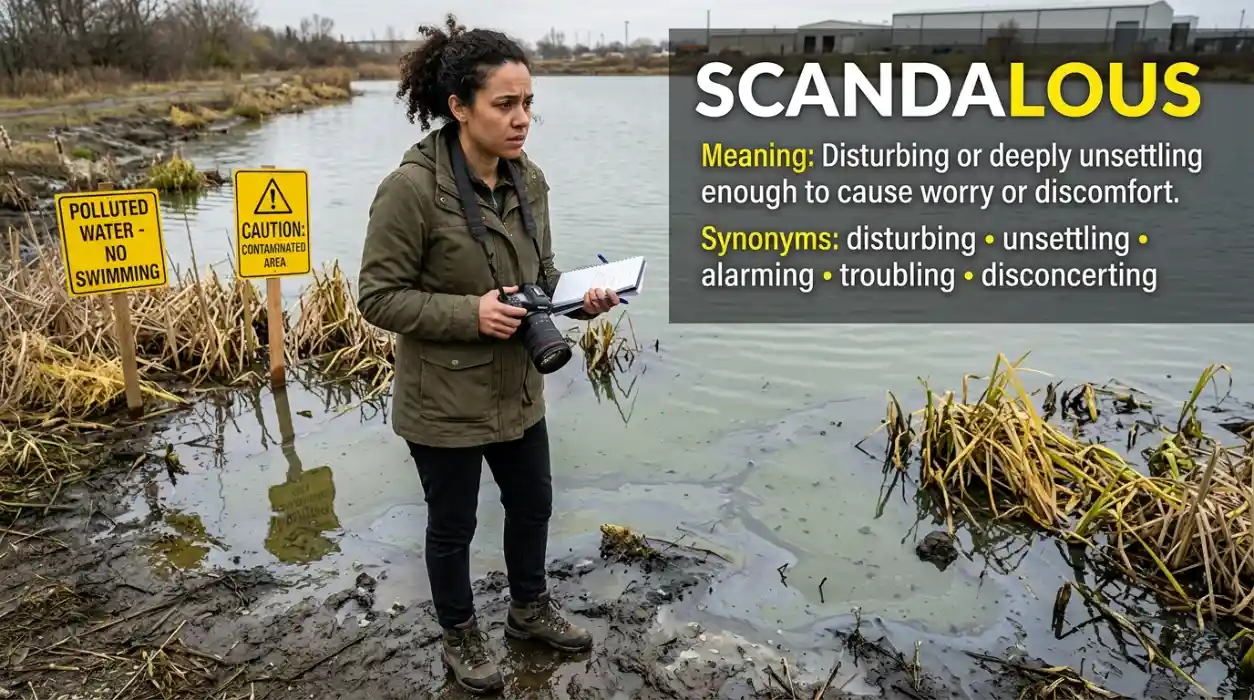
Troubling (Adjective) — US /ˈtrʌblɪŋ/ — UK /ˈtrʌblɪŋ/
Meaning: Something troubling causes concern or makes people uneasy.
Tone/Register: Neutral to formal.
Example:
The survey revealed troubling attitudes among respondents.
The company faced troubling questions about its practices.
Alarming (Adjective) — US /əˈlɑːrmɪŋ/ — UK /əˈlɑːmɪŋ/
Meaning: Something alarming causes serious concern or fear.
Tone/Register: Neutral to formal.
Example:
The report contained alarming statistics.
The sudden decline raised alarming questions.
Scandalous (Adjective) — US /ˈskændələs/ — UK /ˈskændələs/
Meaning: Something scandalous is shocking, disgraceful, improper, or likely to cause public criticism.
Tone/Register: Strong; common in journalism, entertainment, and conversation.
Example:
The celebrity’s scandalous behavior dominated the headlines.
The committee investigated the scandalous allegations.
Disgraceful (Adjective) — US /dɪsˈɡreɪsfəl/ — UK /dɪsˈɡreɪsfəl/
Meaning: Something disgraceful is seriously shameful or unworthy of respect.
Tone/Register: Strongly negative.
Example:
The organization admitted that the treatment was disgraceful.
The public demanded an explanation for the disgraceful decision.
Debauched (Adjective) — US /dɪˈbɔːtʃt/ — UK /dɪˈbɔːtʃt/
Meaning: Someone or something debauched is associated with excessive or morally unrestrained behavior.
Tone/Register: Formal, literary, and strongly negative.
Example:
The novel portrays a debauched aristocrat.
The article described the celebrity’s debauched lifestyle.
Depraved (Adjective) — US /dɪˈpreɪvd/ — UK /dɪˈpreɪvd/
Meaning: Something depraved is viewed as extremely morally corrupt or cruel.
Tone/Register: Very strong; formal or dramatic.
Example:
The court heard evidence of depraved behavior.
The character is portrayed as deeply depraved.
Immoral (Adjective) — US /ɪˈmɔːrəl/ — UK /ɪˈmɒrəl/
Meaning: Something immoral violates accepted moral principles.
Tone/Register: Formal and serious.
Example:
The investigation focused on allegedly immoral practices.
Many readers considered the character’s actions immoral.
Unethical (Adjective) — US /ʌnˈɛθɪkəl/ — UK /ʌnˈɛθɪkəl/
Meaning: Something unethical violates accepted professional or moral standards.
Tone/Register: Professional and academic.
Example:
The researcher was accused of unethical conduct.
The company changed the policy after concerns about unethical behavior.
Corrupt (Adjective) — US /kəˈrʌpt/ — UK /kəˈrʌpt/
Meaning: Something corrupt involves dishonesty, abuse of power, or improper influence.
Tone/Register: Strong; political, legal, and everyday contexts.
Example:
The investigation exposed corrupt officials.
The organization was accused of corrupt practices.
Deceptive (Adjective) — US /dɪˈseptɪv/ — UK /dɪˈseptɪv/
Meaning: Something deceptive is intended to mislead or create a false impression.
Tone/Register: Neutral to formal.
Example:
Customers complained about deceptive advertising.
The report described the statement as deceptive.
Dishonest (Adjective) — US /dɪsˈɑːnɪst/ — UK /dɪsˈɒnɪst/
Meaning: Something dishonest involves lying, cheating, or deliberately hiding the truth.
Tone/Register: Common; direct and strong.
Example:
The employee admitted that the claim was dishonest.
The investigation uncovered dishonest accounting.
Shameful (Adjective) — US /ˈʃeɪmfəl/ — UK /ˈʃeɪmfəl/
Meaning: Something shameful deserves strong disapproval or embarrassment.
Tone/Register: Strong; common in emotional speech.
Example:
The organization apologized for the shameful incident.
His treatment of the staff was described as shameful.
Embarrassing (Adjective) — US /ɪmˈbærəsɪŋ/ — UK /ɪmˈbærəsɪŋ/
Meaning: Something embarrassing causes shame, awkwardness, or loss of confidence.
Tone/Register: Everyday and informal.
Example:
The leaked email was embarrassing for the company.
It was an embarrassing mistake during the live broadcast.
Humiliating (Adjective) — US /hjuːˈmɪlieɪtɪŋ/ — UK /hjuːˈmɪlieɪtɪŋ/
Meaning: Something humiliating causes someone to lose dignity or feel deeply ashamed.
Tone/Register: Strong and emotional.
Example:
The public argument became humiliating for both people.
The incident was described as a humiliating failure.
Indecent (Adjective) — US /ɪnˈdiːsənt/ — UK /ɪnˈdiːsənt/
Meaning: Something indecent violates accepted standards of sexual, social, or public behavior.
Tone/Register: Formal; often used in legal or social contexts.
Example:
The broadcaster removed the indecent material.
The performer was criticized for an indecent gesture.
Obscene (Adjective) — US /əbˈsiːn/ — UK /əbˈsiːn/
Meaning: Something obscene is considered offensively sexual, vulgar, or unacceptable.
Tone/Register: Strong; legal, formal, and everyday contexts.
Example:
The website removed obscene content.
Several viewers complained about the obscene language.
Lewd (Adjective) — US /luːd/ — UK /luːd/
Meaning: Something lewd is sexually suggestive, offensive, or inappropriate.
Tone/Register: Formal or legal; strongly negative.
Example:
The actor apologized for the lewd gesture.
The platform removed the lewd comments.
Vulgar (Adjective) — US /ˈvʌlɡər/ — UK /ˈvʌlɡə/
Meaning: Something vulgar is crude, offensive, or lacking social refinement.
Tone/Register: Common; informal to neutral.
Example:
The comedian was criticized for vulgar jokes.
His vulgar comment upset several guests.
Tacky (Adjective) — US /ˈtæki/ — UK /ˈtæki/
Meaning: Something tacky is considered cheap, tasteless, or socially inappropriate.
Tone/Register: Informal.
Example:
The promotional stunt looked tacky.
Many viewers thought the outfit was flashy but tacky.
Tasteless (Adjective) — US /ˈteɪstləs/ — UK /ˈteɪstləs/
Meaning: Something tasteless shows poor judgment about what is socially appropriate or respectful.
Tone/Register: Neutral to strong.
Example:
The joke was criticized as tasteless.
The advertisement was considered tasteless after the tragedy.
Unseemly (Adjective) — US /ʌnˈsiːmli/ — UK /ʌnˈsiːmli/
Meaning: Something unseemly is inappropriate or unsuitable according to social expectations.
Tone/Register: Formal.
Example:
The officials avoided an unseemly public argument.
The article criticized the unseemly behavior of the guests.
Indiscreet (Adjective) — US /ˌɪndɪˈskriːt/ — UK /ˌɪndɪˈskriːt/
Meaning: Someone indiscreet reveals information or behaves without enough care or privacy.
Tone/Register: Formal.
Example:
His indiscreet remarks revealed confidential details.
The interview included several indiscreet comments.

Inappropriate (Adjective) — US /ˌɪnəˈproʊpriət/ — UK /ˌɪnəˈprəʊpriət/
Meaning: Something inappropriate does not meet the expected standard for a situation.
Tone/Register: Neutral and widely used.
Example:
The employee apologized for the inappropriate message.
The teacher addressed the inappropriate behavior privately.
Questionable (Adjective) — US /ˈkwestʃənəbəl/ — UK /ˈkwestʃənəbəl/
Meaning: Something questionable appears doubtful, suspicious, or open to criticism.
Tone/Register: Neutral; useful for careful writing.
Example:
The company made a questionable decision.
The report raised questions about several questionable practices.
Contentious (Adjective) — US /kənˈtenʃəs/ — UK /kənˈtenʃəs/
Meaning: Something contentious causes disagreement or argument.
Tone/Register: Formal and academic.
Example:
The committee discussed a contentious proposal.
The policy remains contentious among researchers.
Disputed (Adjective) — US /dɪˈspjuːtɪd/ — UK /dɪˈspjuːtɪd/
Meaning: Something disputed is challenged or not generally accepted as true or correct.
Tone/Register: Neutral and formal.
Example:
The newspaper published disputed claims.
The disputed decision remains under review.
Divisive (Adjective) — US /dɪˈvaɪsɪv/ — UK /dɪˈvaɪsɪv/
Meaning: Something divisive creates strong disagreement between groups of people.
Tone/Register: Neutral to formal.
Example:
The divisive campaign attracted intense debate.
The proposal became a divisive issue online.
Infuriating (Adjective) — US /ɪnˈfjʊrieɪtɪŋ/ — UK /ɪnˈfjʊəriətɪŋ/
Meaning: Something infuriating makes people extremely angry.
Tone/Register: Strong and conversational.
Example:
The delayed response was infuriating for customers.
His dismissive attitude was infuriating.
Scandalizing (Adjective) — US /ˈskændəlaɪzɪŋ/ — UK /ˈskændəlaɪzɪŋ/
Meaning: Something scandalizing causes people to feel shocked or morally offended.
Tone/Register: Formal or literary.
Example:
The scandalizing behavior shocked the audience.
The novel contains several scandalizing scenes.
Startlingly Improper (Adjective Phrase) — US /ˈstɑːrtlɪŋli ɪmˈprɑːpər/ — UK /ˈstɑːtlɪŋli ɪmˈprəʊpə/
Meaning: This phrase describes conduct that is unusually shocking because it violates expected standards.
Tone/Register: Formal and descriptive.
Example:
The official made a startlingly improper remark.
Her startlingly improper behavior became a topic of discussion.
Morally Offensive (Adjective Phrase) — US /ˈmɔːrəli əˈfensɪv/ — UK /ˈmɒrəli əˈfensɪv/
Meaning: Something morally offensive strongly conflicts with a person’s or society’s ethical standards.
Tone/Register: Formal and analytical.
Example:
The campaign was criticized as morally offensive.
Many readers found the scene morally offensive.
Publicly Disgraceful (Adjective Phrase) — US /ˈpʌblɪkli dɪsˈɡreɪsfəl/ — UK /ˈpʌblɪkli dɪsˈɡreɪsfəl/
Meaning: Something publicly disgraceful causes serious loss of respect in front of others.
Tone/Register: Formal and emphatic.
Example:
The incident was publicly disgraceful for the organization.
The behavior was described as publicly disgraceful.
Shockingly Improper (Adjective Phrase) — US /ˈʃɑːkɪŋli ɪmˈprɑːpər/ — UK /ˈʃɒkɪŋli ɪmˈprəʊpə/
Meaning: This phrase emphasizes that inappropriate behavior is also highly surprising.
Tone/Register: Strong and formal.
Example:
The official made a shockingly improper statement.
Many observers considered the decision shockingly improper.
Synonyms by Tone
Positive or Playful
Although scandalous is normally negative, playful English can soften it.
- scandalous
- outrageous
- shocking
- daring
- sensational
In casual conversation, exaggeration can make these words humorous.
“You finished the whole pizza? Outrageous!”
Neutral
These choices are useful when you want to describe controversy without making an extreme moral judgment.
- controversial
- questionable
- disputed
- contentious
- inappropriate
- improper
- troubling
- provocative
These are especially useful in academic and professional writing.
Negative
These alternatives carry stronger criticism.
- disgraceful
- shameful
- appalling
- immoral
- unethical
- corrupt
- depraved
- offensive
- obscene
- disreputable
Use them carefully because they can express a clear judgment.
Playful or Informal
For lighthearted situations, speakers may use:
- scandalous
- outrageous
- shocking
- embarrassing
- tacky
The surrounding context determines whether the word sounds humorous or serious.
“Scandalous” vs Close Alternatives
Controversial vs Scandalous
Scandalous usually suggests shock, disgrace, or serious public criticism.
Controversial simply means that people strongly disagree about something.
Use scandalous when the behavior itself is shocking or improper. Use controversial when the main point is disagreement.
Scandalous vs Shocking
Shocking focuses on surprise.
Scandalous adds a stronger sense of social or moral criticism.
The announcement was shocking.
This says people were surprised.
The behavior was scandalous.
This suggests that people also viewed it as improper or disgraceful.
Scandalous vs Outrageous
Outrageous often describes something extremely unreasonable, offensive, or excessive.
Scandalous more strongly suggests public disgrace or a scandal.
Therefore, outrageous works well in emotional speech, while scandalous often fits stories involving reputation or public criticism.
How “Scandalous” Changes by Context
Daily Conversation
In everyday English, scandalous is often used dramatically.
“That was scandalous!”
The speaker may be genuinely offended. However, they may also be joking.
For mild situations, ridiculous, embarrassing, or unacceptable may sound more natural.
Writing and Blogging
Bloggers often use scandalous for entertainment, celebrity stories, social controversies, or dramatic commentary.
However, careful writers should avoid using it when the evidence only shows disagreement.
For example, controversial is usually safer than scandalous when describing a disputed opinion.
Professional and Academic English
Professional writing generally benefits from precise alternatives.
Instead of saying:
The decision was scandalous.
You might write:
The decision was controversial and raised concerns about professional ethics.
This version identifies the specific issue instead of relying on an emotionally loaded adjective.
Creative and Informal English
Creative writing can use scandalous for drama, humor, or character development.
She gave him a scandalous smile and walked away.
Here, the word can create mystery without describing a literal public scandal.
Common Mistakes Learners Make
Mistake 1: Treating “Controversial” and “Scandalous” as Identical
They are related, but they are not interchangeable in every situation.
A controversial subject can be perfectly ethical.
Mistake 2: Using “Scandalous” for Every Bad Action
The word usually implies more than ordinary wrongdoing.
For a simple mistake, unfortunate, careless, or poor may be better.
Mistake 3: Using Strong Moral Words Without Evidence
Words such as depraved, immoral, and corrupt make serious claims.
In formal writing, use them only when the context supports that judgment.
Mistake 4: Confusing “Scandalous” With “Scandalized”
Scandalous describes the thing offending.
Scandalized describes the person who feels shocked or offended.
The behavior was scandalous.
The audience was scandalized.
Mistake 5: Overusing Dramatic Language
If every event is called scandalous, the word loses impact.
Instead, vary your vocabulary according to the level of seriousness.
Register Notes
Formal: discreditable, unseemly, unethical, contentious, questionable
Neutral: controversial, inappropriate, improper, troubling, shocking
Informal: outrageous, embarrassing, tacky
Strong: disgraceful, depraved, obscene, appalling
Journalistic: sensational, notorious, infamous, controversial
One useful internal vocabulary exercise is to compare these words with synonyms for controversial and notice how their emotional strength changes.
Real-Life Mini Scenarios
Workplace
A manager discovers that confidential information was deliberately shared.
Possible descriptions include unethical, improper, disgraceful, or discreditable.
The best choice depends on whether you want to emphasize professional standards, reputation, or moral criticism.
Social Situation
Someone tells a deeply private story about a friend in public.
You might describe the behavior as indiscreet, inappropriate, or embarrassing.
These words are more precise than simply calling the behavior scandalous.
Media and Pop Culture
A celebrity makes a highly controversial public statement.
A headline might call it shocking, sensational, controversial, or scandalous.
The choice depends on whether the writer wants to emphasize surprise, attention, disagreement, or disgrace.
Writing and Storytelling
A novelist may describe a character’s secret as scandalous to create suspense.
A darker story might use depraved, immoral, or disturbing.
Meanwhile, a humorous story could exaggeratedly use scandalous.
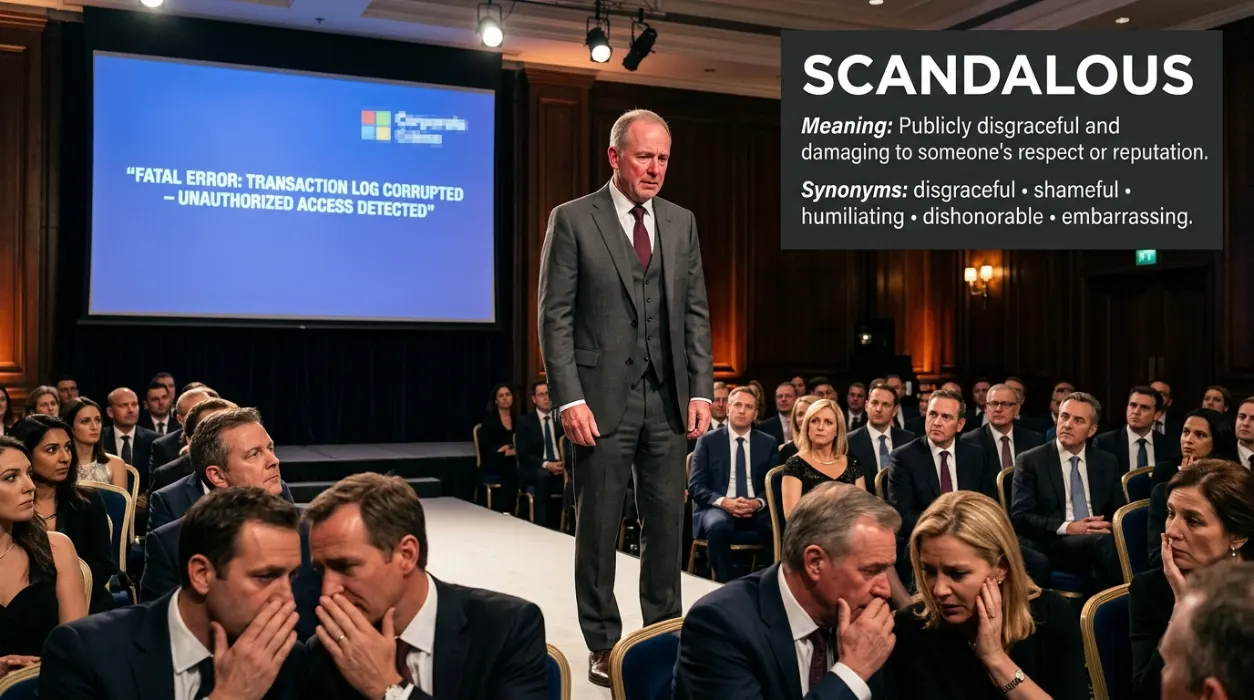
Practice Exercise
1. A policy creates strong disagreement but is not necessarily unethical. Which word fits best?
A. Depraved
B. Controversial
C. Obscene
D. Shameful
2. A company deliberately lies to customers.
A. Deceptive
B. Playful
C. Startling
D. Divisive
3. A joke is inappropriate because it makes light of a tragedy.
A. Tasteless
B. Astonishing
C. Disputed
D. Notorious
4. A person becomes widely known for repeated criminal activity.
A. Notorious
B. Embarrassing
C. Tacky
D. Improper
5. A professional violates accepted ethical standards.
A. Unethical
B. Sensational
C. Startling
D. Humiliating
6. A statement causes sudden surprise.
A. Shocking
B. Disreputable
C. Corrupt
D. Unseemly
7. A person reveals private information without thinking.
A. Indiscreet
B. Divisive
C. Appalling
D. Infamous
8. A report uses exaggerated language to attract attention.
A. Sensationalist
B. Neutral
C. Disputed
D. Appropriate
9. A behavior is extremely cruel and morally corrupt.
A. Depraved
B. Controversial
C. Questionable
D. Startling
10. A crude joke is socially offensive.
A. Vulgar
B. Contentious
C. Astonishing
D. Disputed
Answer Key: 1-B | 2-A | 3-A | 4-A | 5-A | 6-A | 7-A | 8-A | 9-A | 10-A
Reflection Task
Choose one synonym from this article and write your own sentence about a workplace, social, media, or fictional situation. Then ask yourself: Does the word describe surprise, disagreement, shame, immorality, or public criticism?
Conclusion
Learning synonyms for scandalous gives you more control over tone. You can describe shock, controversy, shame, or wrongdoing without repeating one dramatic word.
Strong vocabulary also makes writing feel more natural. Bloggers, students, and speakers can choose precise words that match the seriousness of each situation.
With practice, words like controversial, disgraceful, questionable, unethical, and shocking become useful tools for clearer communication.
Try using one new synonym in an email, essay, story, or daily conversation today. Small vocabulary choices can make your English sound much more confident
Frequently Asked Questions
1. What is the best synonym for scandalous in formal writing?
There is no single best synonym for every formal sentence. Controversial, questionable, unethical, improper, and discreditable can work depending on the meaning. If you want a neutral academic tone, controversial is often safer. If you mean that conduct violates professional standards, unethical is more precise. Choose the word that identifies the exact problem.
2. What is a polite way to say something is scandalous?
For a softer expression, try controversial, questionable, inappropriate, concerning, or troubling. These words allow you to describe a problem without making an extremely strong moral judgment. In professional communication, softer wording is often preferable when facts are still being investigated or when you want to avoid sounding unnecessarily emotional.
3. Is controversial a synonym for scandalous?
Controversial and scandalous overlap, but they are not exact synonyms. Something controversial creates disagreement, while something scandalous usually suggests shock, disgrace, impropriety, or public criticism. A scientific theory can be controversial without being scandalous. Likewise, a person’s disgraceful behavior can be scandalous even if it does not create a broad intellectual debate.
4. What is the difference between scandalous and outrageous?
Scandalous usually connects an action or event with public disgrace, impropriety, or moral criticism. Outrageous focuses more on something being extreme, unreasonable, offensive, or unacceptable. For example, a public official’s secret misconduct may be called scandalous, while an extremely unreasonable demand may be called outrageous. Context determines which word sounds more natural.
5. Which synonym for scandalous is strongest?
Words such as depraved, disgraceful, appalling, and obscene can be much stronger than neutral alternatives such as questionable or controversial. However, strength is not the same as accuracy. A strong word should be used only when its meaning fits the situation. Otherwise, the writing may sound exaggerated or unfair.

Hasnain Ali is an SEO Content Strategist and the founder of wordvora.com, a trusted vocabulary platform that helps writers, students, professionals, and English learners find accurate synonyms, antonyms, word meanings, and real-life usage examples. He specializes in keyword research, on-page SEO, topical authority, and creating search-first content that aligns with Google’s latest Search Quality and E-E-A-T guidelines. His work focuses on producing clear, well-structured, and reader-friendly resources that satisfy search intent while maintaining high editorial standards.
Through extensive hands-on experience with SEO tools such as Google Search Console, Google Analytics, SEMrush, and Ahrefs, Hasnain researches user search behavior and develops content that is both informative and easy to understand. Every article published on wordvora.com is carefully reviewed for accuracy, readability, and contextual relevance before publication. His mission is to build one of the web’s most reliable English vocabulary resources by providing practical language guidance, trustworthy explanations, and content that helps readers improve their writing, communication, and vocabulary with confidence.