

Synonyms for sacrilege help us express disrespect toward sacred items, deeply held beliefs, or traditional customs with vivid accuracy. Imagine visiting a historic cathedral.
Someone suddenly decides to spray paint graffiti directly across the altar. This shocking situation clearly demonstrates why learning synonyms for sacrilege adds strong, precise emotion to our writing.
Exploring related terms enriches vocabulary while helping writers avoid constant word repetition. Furthermore, students, essayists, and online creators can articulate cultural or spiritual offense accurately.
Mastering synonyms for sacrilege grants you precise language for expressing deep disrespect. Consequently, expanding your vocabulary will naturally elevate your everyday English fluency.
What Does “Sacrilege” Really Mean?
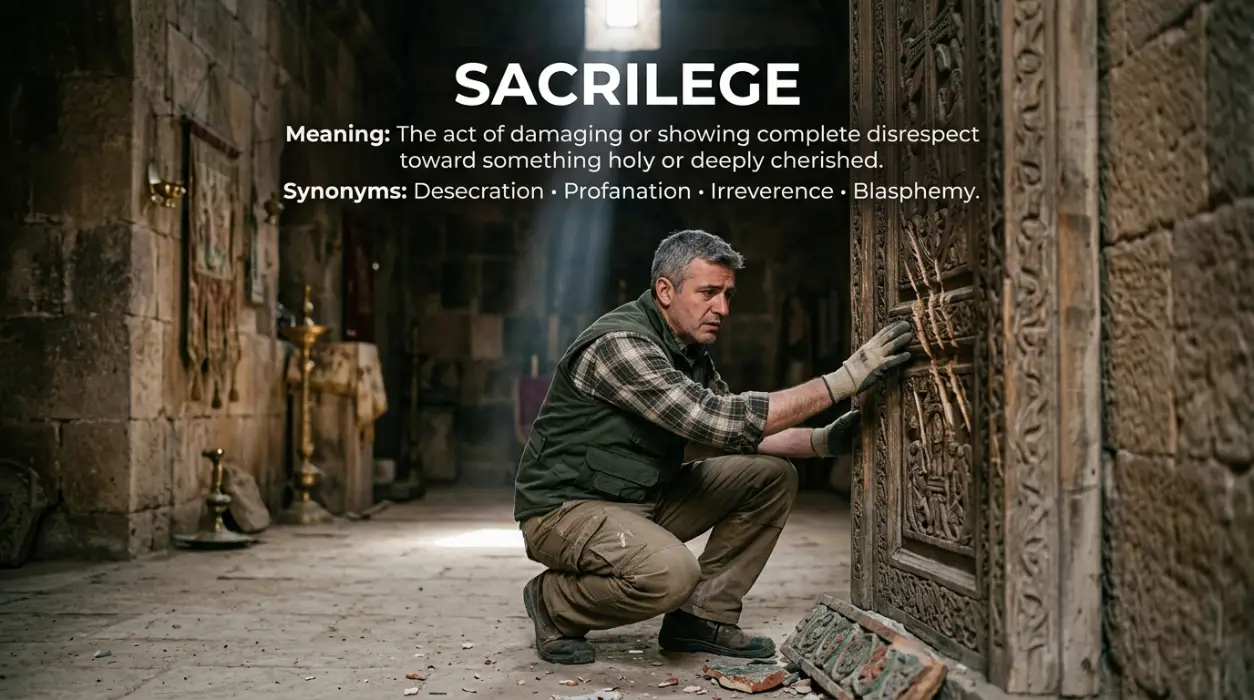
The word “sacrilege” functions primarily as a noun in English. It refers to the violation, misuse, or disrespectful treatment of something held sacred, holy, or deeply revered. Native speakers understand it as an act that intentionally disrespects religious spaces, cherished traditions, or highly respected symbols. Moreover, it appears frequently in historical texts, political debates, news commentary, and pop culture discussions.
The emotional weight of the term ranges from severe spiritual outrage to lighthearted cultural exaggeration. Therefore, understanding context helps you choose the right variation in conversation.
Part of speech: Noun.
Definition: The violation, profanation, or disrespectful treatment of something sacred, holy, or highly valued by a community.
Connotative Meaning
(Connotation is the emotional feeling, cultural association, or tone attached to a word beyond its literal dictionary definition.)
- Positive tone: Extremely rare, though sometimes used ironically in creative art to celebrate bold boundary-breaking or fearless rebellion against rigid rules.
- Negative tone: Strongly highlights moral outrage, deep disrespect, spiritual violation, offensive misconduct, and cultural offense.
- Neutral tone: Identifies an act of rule-breaking, formal violation, or improper behavior objectively without intense emotional drama.
Etymology
The term originated from the Latin noun sacrilegium, which combined sacer (sacred) and legere (to steal or gather). Thus, its original ancient meaning literally translated to “stealing sacred items.”
- Old English (450–1100): English speakers relied on native Germanic roots like hālignes (holiness) or mān (wicked act) before Latin loans entered the language.
- Middle English (1100–1500): Adopted the term sacrilege from Anglo-Norman French during the 14th century to describe church theft and spiritual violations.
- Modern English (1500–Present): Expanded its meaning beyond strict church theft to include disrespect toward non-religious traditions, art, and societal values.
Pronunciation
- US: /ˈsæk.rə.lɪdʒ/
- UK: /ˈsæk.rɪ.lɪdʒ/
Syllables & Structure
- Syllable breakdown: sac-ri-lege
- Root: sacrilege (from Latin sacrilegium)
- Prefix: None
- Suffix: None (base form)
Synonyms List
Desecration (Noun) — US: /ˌdes.əˈkreɪ.ʃən/ | UK: /ˌdes.ɪˈkreɪ.ʃən/
Meaning: The act of damaging or showing complete disrespect toward a holy place or cherished object.
Tone/Register: Formal, Serious
Example:
The community protested against the desecration of the ancient cemetery.
Vandals faced severe penalties for the desecration of the monument.
Profanation (Noun) — US: /ˌprɑː.fəˈneɪ.ʃən/ | UK: /ˌprɒf.əˈneɪ.ʃən/
Meaning: The act of treating something sacred with disrespect or irreverence.
Tone/Register: Formal, Academic
Example:
The court condemned the deliberate profanation of religious symbols.
Scholars debated the profanation of sacred texts in historic literature.
Blasphemy (Noun) — US: /ˈblæs.fə.mi/ | UK: /ˈblæs.fə.mi/
Meaning: Great disrespect shown toward God, religion, or sacred concepts through speech.
Tone/Register: Serious, Religious
Example:
He was accused of committing blasphemy during his public speech.
Ancient laws punished blasphemy with severe imprisonment.
Irreverence (Noun) — US: /ɪˈrev.ɚ.əns/ | UK: /ɪˈrev.ər.əns/
Meaning: A noticeable lack of respect for people or things that are usually taken seriously.
Tone/Register: Neutral, Conversational
Example:
The comedian was famous for his lighthearted irreverence toward authority.
Her sudden irreverence during the ceremony surprised the audience.
Impiety (Noun) — US: /ɪmˈpaɪ.ə.t̬i/ | UK: /ɪmˈpaɪ.ə.ti/
Meaning: Lack of proper respect for God, religion, or established spiritual values.
Tone/Register: Formal, Literary
Example:
The preacher warned the town against moral weakness and impiety.
His open impiety isolated him from the conservative village.
Defilement (Noun) — US: /dɪˈfaɪl.mənt/ | UK: /dɪˈfaɪl.mənt/
Meaning: The act of making something sacred or pure filthy, dirty, or spoiled.
Tone/Register: Dramatic, Serious
Example:
The river suffered heavy defilement from toxic industrial waste.
Guards protected the temple against physical defilement.
Violation (Noun) — US: /ˌvaɪ.əˈleɪ.ʃən/ | UK: /ˌvaɪ.əˈleɪ.ʃən/
Meaning: The breaking of a sacred oath, formal law, or respected boundary.
Tone/Register: Formal, Legal
Example:
Intruding on sacred land represents a clear violation of local custom.
The agreement stopped further violation of human rights.
Disrespect (Noun) — US: /ˌdɪs.rɪˈspekt/ | UK: /ˌdɪs.rɪˈspekt/
Meaning: A general lack of honor, politeness, or consideration for someone or something.
Tone/Register: Everyday, General
Example:
Talking loudly during the silent prayer showed deep disrespect.
She apologized quickly for her accidental disrespect.
Violation of sanctity (Noun Phrase) — US: /ˌvaɪ.əˈleɪ.ʃən ʌv ˈsæŋk.tə.t̬i/ | UK: /ˌvaɪ.əˈleɪ.ʃən ɒv ˈsæŋk.tɪ.ti/
Meaning: An action that ruins the holy or protected status of a place or idea.
Tone/Register: Formal, High Register
Example:
Trespassing in the shrine was viewed as a direct violation of sanctity.
The community fought hard to prevent any violation of sanctity.
Violation of holiness (Noun Phrase) — US: /ˌvaɪ.əˈleɪ.ʃən ʌv ˈhoʊ.li.nəs/ | UK: /ˌvaɪ.əˈleɪ.ʃən ɒv ˈhəʊ.li.nəs/
Meaning: An act that corrupts the pure or holy nature of a spiritual entity.
Tone/Register: Religious, Literary
Example:
The ceremony addressed the perceived violation of holiness in the shrine.
Elders prayed after the shocking violation of holiness occurred.
Unholiness (Noun) — US: /ʌnˈhoʊ.li.nəs/ | UK: /ʌnˈhəʊ.li.nəs/
Meaning: The state of being ungodly, sinful, or spiritually corrupt.
Tone/Register: Literary, Religious
Example:
Ancient tales depicted the dark unholiness of the abandoned castle.
The ritual aimed to purge all unholiness from the village.
Offense (Noun) — US: /əˈfens/ | UK: /əˈfens/
Meaning: An action that causes hurt feelings, anger, or moral disgust in others.
Tone/Register: Neutral, Common
Example:
His rude comments caused severe offense among the elders.
She did not mean to offend with her creative art.
Outrage (Noun) — US: /ˈaʊt.reɪdʒ/ | UK: /ˈaʊt.reɪdʒ/
Meaning: A shocking act that sparks extreme anger and public indignation.
Tone/Register: Dramatic, Public
Example:
The destruction of historical books triggered a national outrage.
Citizens expressed deep outrage over the vandalism.
Abuse (Noun) — US: /əˈbjuːs/ | UK: /əˈbjuːs/
Meaning: The improper, harmful, or corrupt treatment of a valuable privilege or object.
Tone/Register: Direct, Serious
Example:
Misusing public funds remains a serious abuse of trust.
The report revealed widespread abuse of sacred symbols.
Misuse (Noun) — US: /ˌmɪsˈjuːs/ | UK: /ˌmɪsˈjuːs/
Meaning: Using something incorrectly or inappropriately for an unintended purpose.
Tone/Register: Practical, Neutral
Example:
Using sacred relics as movie props is a careless misuse.
He regretted the accidental misuse of the temple equipment.
Contempt (Noun) — US: /kənˈtempt/ | UK: /kənˈtempt/
Meaning: The feeling that a person, rule, or sacred idea is worthless and deserves no respect.
Tone/Register: Formal, Critical
Example:
He showed total contempt for traditional social values.
Her actions demonstrated clear contempt for authority.
Mockery (Noun) — US: /ˈmɑː.kɚ.i/ | UK: /ˈmɒk.ər.i/
Meaning: Action or speech that makes fun of something sacred in an insulting way.
Tone/Register: Critical, Direct
Example:
The parade appeared to be a cruel mockery of sacred traditions.
He made a complete mockery of the solemn proceedings.
Slighting (Noun / Gerund) — US: /ˈslaɪ.t̬ɪŋ/ | UK: /ˈslaɪ.tɪŋ/
Meaning: The act of treating a respected idea or person with insulting indifference.
Tone/Register: Subtly Critical
Example:
Ignoring the elder’s advice was an intentional slighting of custom.
Her quiet slighting of traditions upset her family.
Disregard (Noun) — US: /ˌdɪs.rɪˈɡɑːrd/ | UK: /ˌdɪs.rɪˈɡɑːd/
Meaning: Complete lack of attention, care, or respect toward rules or traditions.
Tone/Register: Neutral, Administrative
Example:
He acted with total disregard for local customs.
Their disregard for safety rules led to minor damage.
Heresy (Noun) — US: /ˈher.ə.si/ | UK: /ˈher.ə.si/
Meaning: A belief or opinion that strongly opposes accepted religious or official doctrines.
Tone/Register: Historical, Formal
Example:
In medieval times, teaching new scientific ideas was called heresy.
Her modern theory was viewed as scientific heresy by traditionalists.
Dishonor (Noun) — US: /dɪsˈɑː.nɚ/ | UK: /dɪsˈɒn.ər/
Meaning: Loss of respect, grace, or reputation caused by shameful behavior.
Tone/Register: Formal, Moral
Example:
His corrupt actions brought deep dishonor upon his family.
They tried hard to avoid bringing dishonor to the school.
Degradation (Noun) — US: /ˌdeɡ.rəˈdeɪ.ʃən/ | UK: /ˌdeɡ.rəˈdeɪ.ʃən/
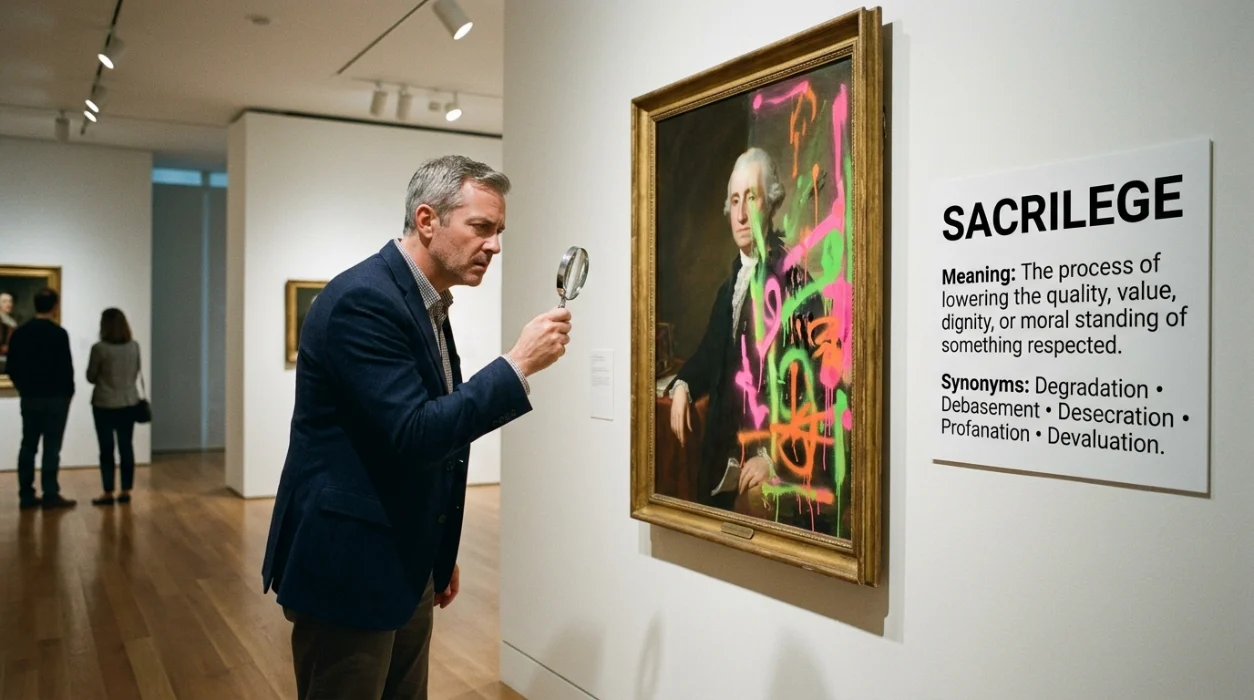
Meaning: The process of lowering the quality, value, or moral standing of something.
Tone/Register: Formal, Academic
Example:
Pollution caused the severe degradation of natural reserves.
The movie highlighted the moral degradation of modern society.
Pollution (Noun) — US: /pəˈluː.ʃən/ | UK: /pəˈluː.ʃən/
Meaning: The act of making a pure environment or sacred area dirty or contaminated.
Tone/Register: Environmental, General
Example:
Industrial runoff led to the pollution of holy springs.
Guards protected the sanctuary from environmental pollution.
Contamination (Noun) — US: /kənˌtæm.əˈneɪ.ʃən/ | UK: /kənˌtæm.ɪˈneɪ.ʃən/
Meaning: Making something dangerous or impure by adding poisonous or improper elements.
Tone/Register: Technical, Scientific
Example:
The water supply faced chemical contamination last week.
Careless handling caused the contamination of clean samples.
Vandalism (Noun) — US: /ˈvæn.dəl.ɪ.zəm/ | UK: /ˈvæn.dəl.ɪ.zəm/
Meaning: The willful or malicious destruction and defacement of public or private property.
Tone/Register: Legal, Common
Example:
Police investigated the overnight vandalism at the public park.
Security cameras helped stop local street vandalism.
Ruination (Noun) — US: /ˌruː.əˈneɪ.ʃən/ | UK: /ˌruː.ɪˈneɪ.ʃən/
Meaning: The process or result of destroying something completely.
Tone/Register: Dramatic, Literary
Example:
Neglect brought about the slow ruination of the historic castle.
Greed caused the ultimate ruination of his great career.
Destruction (Noun) — US: /dɪˈstrʌk.ʃən/ | UK: /dɪˈstrʌk.ʃən/
Meaning: The act of causing so much damage that something no longer exists or functions.
Tone/Register: Objective, Direct
Example:
The fire caused the complete destruction of the wooden temple.
Storms led to widespread destruction along the coast.
Corruption (Noun) — US: /kəˈrʌp.ʃən/ | UK: /kəˈrʌp.ʃən/
Meaning: Dishonest or fraudulent conduct by those in power, or decay of moral standards.
Tone/Register: Formal, Political
Example:
Bribery led to widespread corruption within the government agency.
The essay examined the moral corruption of ancient rulers.
Transgression (Noun) — US: /trænzˈɡreʃ.ən/ | UK: /trænzˈɡreʃ.ən/
Meaning: An act that goes beyond the limits of what is morally or legally acceptable.
Tone/Register: Academic, Formal
Example:
Forgiving a serious transgression requires deep patience.
His sudden transgression shocked everyone in attendance.
Infringement (Noun) — US: /ɪnˈfrɪndʒ.mənt/ | UK: /ɪnˈfrɪndʒ.mənt/
Meaning: An action that limits or breaks a rule, legal right, or established boundary.
Tone/Register: Legal, Business
Example:
Copying images without permission is a copyright infringement.
The new law stops any infringement on personal privacy.
Breaching (Noun / Gerund) — US: /ˈbriː.tʃɪŋ/ | UK: /ˈbriː.tʃɪŋ/
Meaning: Breaking through a protective wall, contract, or sacred promise.
Tone/Register: Technical, Legal
Example:
Breaching the boundary fence triggered immediate security alarms.
He faced fines for breaching the confidentiality contract.
Trespass (Noun) — US: /ˈtres.pæs/ | UK: /ˈtres.pəs/
Meaning: Entering an unauthorized sacred space or private property without permission.
Tone/Register: Legal, Formal
Example:
Walking into sacred ruins without a guide counts as trespass.
The land sign clearly warns visitors against illegal trespass.
Impropriety (Noun) — US: /ˌɪm.prəˈpraɪ.ə.t̬i/ | UK: /ˌɪm.prəˈpraɪ.ə.ti/
Meaning: Behavior that is not detailed, correct, or proper in a formal setting.
Tone/Register: Formal, Professional
Example:
An audit revealed financial impropriety within the firm.
She avoided any suggestion of moral impropriety.
Sacrilegiousness (Noun) — US: /ˌsæk.rəˈlɪdʒ.əs.nəs/ | UK: /ˌsæk.rɪˈlɪdʒ.əs.nəs/
Meaning: The quality or condition of being sacrilegious in thought or behavior.
Tone/Register: Technical, Rare
Example:
The essay analyzed the sacrilegiousness of modern art movements.
Elders criticized the sacrilegiousness of the casual performance.
Unsanctifying (Noun / Gerund) — US: /ʌnˈsæŋk.tə.faɪ.ɪŋ/ | UK: /ʌnˈsæŋk.tɪ.faɪ.ɪŋ/
Meaning: Removing the holy or blessed status from a dedicated object or sanctuary.
Tone/Register: Religious, Academic
Example:
The unsanctifying of the ancient chapel upset local historians.
They performed a ceremony to address the unsanctifying incident.
Unhallowing (Noun / Gerund) — US: /ʌnˈhæl.oʊ.ɪŋ/ | UK: /ʌnˈhæl.əʊ.ɪŋ/
Meaning: Stripping away the sacred character of a holy location or artifact.
Tone/Register: Literary, Archaic
Example:
Stories told of the dark unhallowing of forgotten altars.
The poem mourned the unhallowing of nature’s beauty.
Despoilment (Noun) — US: /dɪˈspoɪl.mənt/ | UK: /dɪˈspoɪl.mənt/
Meaning: The act of stripping a valuable or sacred site of its treasures by force.
Tone/Register: Literary, Historical
Example:
Invaders were responsible for the despoilment of the royal tombs.
History books documented the systematic despoilment of ancient shrines.
Looting (Noun / Gerund) — US: /ˈluː.t̬ɪŋ/ | UK: /ˈluː.tɪŋ/
Meaning: Stealing goods from a sacred site, store, or building during chaos.
Tone/Register: Practical, News
Example:
Police arrested three people for looting cultural artifacts.
The museum increased security to prevent looting during riots.
Plundering (Noun / Gerund) — US: /ˈplʌn.dɚ.ɪŋ/ | UK: /ˈplʌn.dər.ɪŋ/
Meaning: Stealing valuable items forcefully from a captured city or holy place.
Tone/Register: Dramatic, Historical
Example:
The plundering of ancient temples left little behind.
Soldiers stopped the uncontrolled plundering of historic sites.
Pillaging (Noun / Gerund) — US: /ˈpɪl.ɪ.dʒɪŋ/ | UK: /ˈpɪl.ɪ.dʒɪŋ/
Meaning: Violent looting and destruction of a village, church, or region during war.
Tone/Register: Historical, Dramatic
Example:
Ancient sagas described the pillaging of coastal monasteries.
The countryside suffered from brutal pillaging by invading forces.
Violation of belief (Noun Phrase) — US: /ˌvaɪ.əˈleɪ.ʃən ʌv bɪˈliːf/ | UK: /ˌvaɪ.əˈleɪ.ʃən ɒv bɪˈliːf/
Meaning: Forcing someone to act directly against their core spiritual values.
Tone/Register: Human Rights, Legal
Example:
Forcing employees to break sacred rules is a violation of belief.
The law protects citizens against any violation of belief.
Irreverent act (Noun Phrase) — US: /ɪˈrev.ɚ.ənt ækt/ | UK: /ɪˈrev.ər.ənt ækt/
Meaning: A specific gesture or action that fails to show customary respect.
Tone/Register: Conversational, Descriptive
Example:
Wearing hats inside the sanctuary was viewed as an irreverent act.
He apologized quickly for making an irreverent act in class.
Mocking sacredness (Noun Phrase) — US: /ˈmɑː.kɪŋ ˈseɪ.krəd.nəs/ | UK: /ˈmɒk.ɪŋ ˈseɪ.krəd.nəs/
Meaning: Publicly ridiculing traditional religious values or holy symbols.
Tone/Register: Descriptive, Critical
Example:
The play faced criticism for mocking sacredness on stage.
She argued that mocking sacredness causes unnecessary pain.
Insult to faith (Noun Phrase) — US: /ˈɪn.sʌlt tuː feɪθ/ | UK: /ˈɪn.sʌlt tuː feɪθ/
Meaning: A statement or behavior that intentionally offends a religious group.
Tone/Register: Emotional, Serious
Example:
Tearing the sacred book was seen as a direct insult to faith.
Leaders called for peace after the public insult to faith.

Profane act (Noun Phrase) — US: /prəˈfeɪn ækt/ | UK: /prəˈfeɪn ækt/
Meaning: A specific action that treats holy ideas with secular vulgarity.
Tone/Register: Formal, Religious
Example:
Leaving trash near the shrine was considered a profane act.
Community members condemned the profane act swiftly.
Disrespect of tradition (Noun Phrase) — US: /ˌdɪs.rɪˈspekt ʌv trəˈdɪʃ.ən/ | UK: /ˌdɪs.rɪˈspekt ɒv trəˈdɪʃ.ən/
Meaning: Disregarding long-held cultural customs or family practices.
Tone/Register: Everyday, Cultural
Example:
Skipping the harvest dinner showed a disrespect for tradition.
Grandparents disliked any modern disrespect of tradition.
Cultural violation (Noun Phrase) — US: /ˈkʌl.tʃɚ.əl ˌvaɪ.əˈleɪ.ʃən/ | UK: /ˈkʌl.tʃər.əl ˌvaɪ.əˈleɪ.ʃən/
Meaning: Breaking an important unwritten social or cultural rule of a community.
Tone/Register: Academic, Sociological
Example:
Filming sacred dances without asking represents a cultural violation.
Tourists should learn local rules to avoid a cultural violation.
Offense to custom (Noun Phrase) — US: /əˈfens tuː ˈkʌs.təm/ | UK: /əˈfens tuː ˈkʌs.təm/
Meaning: Doing something that contradicts traditional manners or regional etiquette.
Tone/Register: Polite, Formal
Example:
Wearing shoes indoors was a minor offense to custom there.
He studied local etiquette to prevent any offense to custom.
Cultural disrespect (Noun Phrase) — US: /ˈkʌl.tʃɚ.əl ˌdɪs.rɪˈspekt/ | UK: /ˈkʌl.tʃər.əl ˌdɪs.rɪˈspekt/
Meaning: Treating another group’s history, language, or values dismissively.
Tone/Register: Modern, Social
Example:
Mislabeling native artifacts shows clear cultural disrespect.
The workshop teaches visitors how to avoid cultural disrespect.
Violation of trust (Noun Phrase) — US: /ˌvaɪ.əˈleɪ.ʃən ʌv trʌst/ | UK: /ˌvaɪ.əˈleɪ.ʃən ɒv trʌst/
Meaning: Breaking a deep personal, moral, or professional confidence.
Tone/Register: Everyday, Emotional
Example:
Sharing private secrets online was a painful violation of trust.
He felt that lying about the results was a violation of trust.
Moral offense (Noun Phrase) — US: /ˈmɔːr.əl əˈfens/ | UK: /ˈmɒr əl əˈfens/.əl əˈfens/
Meaning: An action that violates fundamental human ethics or community standards.
Tone/Register: Philosophical, Serious
Example:
Cheating struggling families remains a severe moral offense.
The committee decided the action was a serious moral offense.
Breach of reverence (Noun Phrase) — US: /briːtʃ ʌv ˈrev.ɚ.əns/ | UK: /briːtʃ ɒv ˈrev.ər.əns/
Meaning: Failing to show expected honor or quiet dignity in a solemn environment.
Tone/Register: High Register, Formal
Example:
Laughing during the funeral speech was a breach of reverence.
Visitors maintained silence to avoid any breach of reverence.
Sacrilegious behavior (Noun Phrase) — US: /ˌsæk.rəˈlɪdʒ.əs bɪˈheɪ.vjɚ/ | UK: /ˌsæk.rɪˈlɪdʒ.əs bɪˈheɪ.vjər/
Meaning: Specific actions that display a total lack of respect for sacred things.
Tone/Register: Direct, Descriptive
Example:
The school suspended students for their sacrilegious behavior.
She reported the sacrilegious behavior to local authorities.
Unhallowed act (Noun Phrase) — US: /ʌnˈhæl.oʊd ækt/ | UK: /ʌnˈhæl.əʊd ækt/
Meaning: A wicked or unholy deed performed in a respected space.
Tone/Register: Literary, Dramatic
Example:
Legends warned of the consequences following an unhallowed act.
The movie plot revolved around an unhallowed act in a forest.
Violation of heritage (Noun Phrase) — US: /ˌvaɪ.əˈleɪ.ʃən ʌv ˈher.ə.t̬ɪdʒ/ | UK: /ˌvaɪ.əˈleɪ.ʃən ɒv ˈher.ɪ.tɪdʒ/
Meaning: Damaging or ignoring historical artifacts, landmarks, or oral histories.
Tone/Register: Historical, Legal
Example:
Demolishing the old library was a clear violation of heritage.
Conservation groups fight against any violation of heritage.
Synonyms by Tone
Choosing synonyms for sacrilege requires careful attention to audience and emotional context. Therefore, grouping these expressions by tone simplifies selecting the right word.
Positive Tone
While terms related to sacrilege rarely carry a genuinely positive meaning, certain words are used constructively in modern artistic or lighthearted contexts:
- Irreverence
- Boundary-pushing (idiomatic)
- Iconoclasm (artistic challenge to rigid norms)
Neutral Tone
These options state that a rule, boundary, or custom was broken without adding dramatic anger:
- Disregard
- Misuse
- Offense
- Infringement
- Cultural violation
Negative Tone
These words highlight intense moral anger, severe religious insult, or severe legal damage:
- Desecration
- Blasphemy
- Defilement
- Profanation
- Outrage
Playful / Informal
These express exaggerated, dramatic, or lighthearted reactions to minor social mistakes:
- Food sacrilege (slang for weird food combinations)
- Major party foul (slang for breaking informal social rules)
- Total disrespect (casual emphasis)
Mini Comparison
Sacrilege vs. Desecration vs. Blasphemy
| Feature | Sacrilege | Desecration | Blasphemy |
| Primary Focus | Misusing or disrespecting sacred objects, rules, or traditions. | Physical damage or defilement of a sacred place or monument. | Verbal disrespect toward God, religion, or holy concepts. |
| Tone | Formal to informal (often used casually for social rules). | Severe, formal, and intense. | Serious, spiritual, and deeply religious. |
| Best Usage Context | “Putting pineapple on authentic pizza is culinary sacrilege.” | “Vandals faced charges for the desecration of the shrine.” | “He was tried for blasphemy after his public speech.” |
Context-Based Usage
Daily Conversation
In casual chats, native speakers frequently use sacrilege and irreverence in an exaggerated way. For example, sports fans might jokingly say that tearing a team jersey is total sacrilege.
Writing or Blogging
Bloggers benefit from versatile terms like cultural disrespect, outrage, or disregard. These choices express clear opinions without sounding overly academic.
Professional or Academic Tone
In formal research papers or legal contexts, prefer precise terms like infringement, impropriety, transgression, or desecration. These words maintain strong authority.
Creative or Informal Use
When writing fiction or dramatic prose, reach for expressive terms like defilement, unhallowment, ruination, or profanation. These options build intense atmosphere and emotion.
Common Mistakes & Native Usage
Common Mistakes Learners Make
- Confusing “sacrilege” with “sacred”: Sacred means holy, whereas sacrilege is the disrespectful act against what is holy.
- Overusing severe terms for minor issues: Calling a small social mistake a desecration sounds overly dramatic unless used as intentional comedy.
- Spelling errors: Learners often spell the word incorrectly as “sacrilige” or “sacrelige.” Always remember the “i” in the middle.
Register Notes
- Spoken English: Native speakers prefer disrespect, irreverence, offense, or violation.
- Written English: Academic papers favor profanation, transgression, heresy, and desecration.
- For additional phrasing advice to polish your grammar, explore our detailed vocabulary guides on formal speech.
Real-Life Mini Scenarios
Workplace
During an executive presentation, a manager openly mocked the founder’s original company mission. Employees viewed this behavior as an absolute violation of trust.
Social Situations
At a formal dinner, a guest poured ketchup over an expensive steak. The head chef joked that the action was a hilarious culinary sacrilege.
Media / Pop Culture
When a movie director changed the ending of a beloved classic novel, long-time fans expressed intense outrage across social media platforms.
Writing or Storytelling
In a fantasy novel, an invading army entered the forbidden forest. Their actions resulted in the complete defilement of the ancient spirit shrine.

Practice Quiz
1. Which synonym specifically refers to spoken disrespect toward God or religion?
A) Misuse
B) Blasphemy
C) Infringement
D) Disregard
2. Which word carries a severe tone specifically describing physical damage to a holy place?
A) Irreverence
B) Offense
C) Desecration
D) Misuse
3. What is the main difference between “sacrilege” and “blasphemy”?
A) Sacrilege involves objects or traditions, while blasphemy focuses on speech against God
B) Sacrilege is always positive
C) Blasphemy refers strictly to breaking traffic laws
D) Both terms mean exact physical damage to cars
4. Which term fits best when a business breaks a formal written privacy agreement?
A) Defilement
B) Infringement
C) Unholiness
D) Pillaging
5. What is an informal or exaggerated usage of sacrilege in everyday life?
A) Stealing from an altar
B) Putting ketchup on fine sushi
C) Writing a legal contract
D) Painting a house wall white
6. If a person treats a formal ceremony with lighthearted lack of seriousness, they show:
A) Irreverence
B) Pillaging
C) Despoilment
D) Destruction
7. Which choice best fits an army stealing ancient treasures forcefully during war?
A) Impropriety
B) Plundering
C) Disregard
D) Slight
8. What phrase describes breaking a deeply held community rule regarding historical monuments?
A) Misuse of tools
B) Violation of heritage
C) Minor impropriety
D) Casual disrespect
9. In academic essays, describing an act that goes beyond acceptable moral limits uses:
A) Transgression
B) Party foul
C) Zipped
D) Dash
Application Task
Write one short original sentence describing a time you witnessed someone break a traditional rule, using one of the synonyms above (such as irreverence, disregard, or violation of custom).
Answer Key
1: B | 2: C | 3: A | 4: B | 5: B | 6: A | 7: B | 8: B | 9: A
FAQs
1. What is the most common formal synonym for sacrilege in literature?
The most common formal synonyms in literary and historical texts are desecration, profanation, and transgression. These terms effectively convey deep moral disrespect and spiritual violation.
2. Can sacrilege be used in a non-religious context?
Yes, modern English speakers frequently use sacrilege informally to describe breaking cherished cultural rules, art traditions, or culinary customs, such as altering a famous traditional recipe.
3. Is “blasphemy” the same thing as “sacrilege”?
Not exactly. While both involve deep disrespect, blasphemy refers specifically to offensive speech or writing against God, whereas sacrilege broadens to include physical actions against sacred objects or traditions.
4. What is a mild synonym for sacrilege in everyday speech?
Mild alternatives include irreverence, disrespect, offense, or disregard. These options express a lack of proper respect without carrying intense religious anger.
5. How do I spell sacrilege correctly without making common mistakes?
A simple memory trick is to remember that sacrilege ends like “privilege.” It contains an “i” in the middle rather than an “e” or “a.”
Conclusion
Understanding sacrilege can help you describe an act that shows serious disrespect toward something considered sacred or holy. Learning its synonyms, meaning, and examples can improve your English vocabulary and help you use the word accurately.
The word sacrilege is often used in religious, historical, cultural, and literary contexts. Knowing its related synonyms can help you express ideas about disrespect or violation of sacred things in different ways and make your writing more precise.
By practicing sacrilege in sentences and exploring related words, you can strengthen your vocabulary and communication skills. A clear understanding of this term will help you use it appropriately and confidently in different English contexts.

Hasnain Ali is an SEO Content Strategist and the founder of wordvora.com, a trusted vocabulary platform that helps writers, students, professionals, and English learners find accurate synonyms, antonyms, word meanings, and real-life usage examples. He specializes in keyword research, on-page SEO, topical authority, and creating search-first content that aligns with Google’s latest Search Quality and E-E-A-T guidelines. His work focuses on producing clear, well-structured, and reader-friendly resources that satisfy search intent while maintaining high editorial standards.
Through extensive hands-on experience with SEO tools such as Google Search Console, Google Analytics, SEMrush, and Ahrefs, Hasnain researches user search behavior and develops content that is both informative and easy to understand. Every article published on wordvora.com is carefully reviewed for accuracy, readability, and contextual relevance before publication. His mission is to build one of the web’s most reliable English vocabulary resources by providing practical language guidance, trustworthy explanations, and content that helps readers improve their writing, communication, and vocabulary with confidence.