
Collaborated synonym for resume searches often begin with a simple problem: you have used the word “collaborated” too many times on your CV and want something stronger.
Imagine writing, “Collaborated with the marketing team” in several job descriptions. A suitable alternative can make each achievement sound more precise, confident, and professional.
Finding the right collaborated synonym for resume writing also helps expand your vocabulary. Words such as “partnered,” “coordinated,” and “co-created” can show different types of teamwork.
Whether you are a student, blogger, content writer, or everyday English user, learning a collaborated synonym for resume can improve your communication. The right word makes your experience easier to understand.
What Does “Collaborated” Really Mean?
Collaborated is the past tense of collaborate.
Simple definition
Collaborated means worked together with one or more people to achieve a shared goal.
For example:
I collaborated with the marketing team to develop a new campaign.
The sentence shows that the speaker worked jointly with others.
Part of speech
Collaborated is a verb, specifically the past tense and past participle form of collaborate.
The basic pattern is:
Subject + collaborated + with + person/team
Example:
She collaborated with engineers on the project.
It can also appear with on:
They collaborated on a research paper.
Emotional tone
“Collaborated” is usually neutral to positive.
It suggests cooperation, shared effort, and professional teamwork. On a resume, it can communicate that you can work effectively with other people.
However, the word does not always show how you contributed. A more specific verb may reveal whether you coordinated, partnered, assisted, led, supported, or co-created something.
Connotative Meaning
Connotation means the feeling, association, or implied idea that a word carries beyond its basic dictionary meaning.
Positive tone: “Collaborated” can suggest teamwork, openness, cooperation, and shared success.
Negative tone: The word itself is rarely negative. However, vague use can make a resume sound less specific.
Neutral tone: In professional writing, “collaborated” often simply states that people worked together.
Etymology
The word collaborate comes from Latin collaborare, meaning “to work together.”
It combines Latin com-, meaning “together,” with laborare, meaning “to work.”
The English verb developed through later European usage and became increasingly common in formal English.
Old English: 450–1100
The modern word “collaborate” was not a normal Old English term. Old English had other expressions for working, helping, joining, and cooperating.
Middle English: 1100–1500
During Middle English, English vocabulary absorbed many French and Latin-derived terms. Ideas connected with joint work were expressed through several different constructions.
Modern English: 1500–Present
“Collaborate” entered established English usage as a learned Latin-derived verb. Today, it is especially common in business, education, science, technology, creative industries, and professional resumes.

Pronunciation
Collaborated
- US: /kəˈlæbəˌreɪtɪd/
- UK: /kəˈlæbəreɪtɪd/
Syllables
col-lab-o-rat-ed
Affixation Pattern
Root: labor
Prefix: col- / com- conceptually connected with “together”
Suffix: -ate + -ed
The central historical idea is working together.
Synonyms List
Worked Together (Verb) — US / UK: /wɜrkt təˈɡɛðər/ /wɜːkt təˈɡɛðə/
Meaning: Worked with another person or group toward a shared result.
Tone/Register: Neutral, clear, conversational.
Example:
I worked together with developers to improve the website.
We worked together to complete the project before launch.
Cooperated (Verb) — US / UK: /koʊˈɑːpəreɪtɪd/ /kəʊˈɒpəreɪtɪd/
Meaning: Worked willingly with others to achieve an objective.
Tone/Register: Professional, neutral.
Example:
I cooperated with department managers during the transition.
The teams cooperated to resolve customer issues.
Coordinated (Verb) — US / UK: /koʊˈɔːrdəneɪtɪd/ /kəʊˈɔːdɪneɪtɪd/
Meaning: Organized people, activities, or resources so they worked effectively together.
Tone/Register: Professional, business.
Example:
I coordinated five departments during the annual campaign.
She coordinated schedules across multiple project teams.
Partnered (Verb) — US / UK: /ˈpɑːrtnərd/ /ˈpɑːtnəd/
Meaning: Worked closely with another person, team, or organization on a shared objective.
Tone/Register: Professional, modern.
Example:
I partnered with the sales team to improve customer retention.
We partnered with local organizations to expand outreach.
Teamed Up (Phrasal Verb) — US / UK: /tiːmd ʌp/ /tiːmd ʌp/
Meaning: Joined another person or group to accomplish something together.
Tone/Register: Informal, energetic.
Example:
I teamed up with two designers to create the campaign.
The developers teamed up to solve a complex technical issue.
Joined Forces (Phrase) — US / UK: /dʒɔɪnd ˈfɔːrsɪz/ /dʒɔɪnd ˈfɔːsɪz/
Meaning: Combined efforts with another group or person.
Tone/Register: Professional, slightly expressive.
Example:
We joined forces with the communications team for the launch.
Two departments joined forces to improve internal training.
Cooperated With (Verb Phrase) — US / UK: /koʊˈɑːpəreɪtɪd wɪð/ /kəʊˈɒpəreɪtɪd wɪð/
Meaning: Worked supportively with another person or group.
Tone/Register: Formal, neutral.
Example:
I cooperated with auditors during the compliance review.
She cooperated with colleagues to streamline reporting.
Contributed (Verb) — US / UK: /kənˈtrɪbjuːtɪd/ /kənˈtrɪbjuːtɪd/
Meaning: Added useful work, ideas, skills, or resources to a shared project.
Tone/Register: Professional, academic.
Example:
I contributed ideas to the product development process.
He contributed technical expertise to the research project.
Participated (Verb) — US / UK: /pɑːrˈtɪsəpeɪtɪd/ /pɑːˈtɪsɪpeɪtɪd/
Meaning: Took part in an activity or project with others.
Tone/Register: Neutral, academic.
Example:
I participated in cross-functional product meetings.
She participated in a team project focused on customer experience.
Engaged (Verb) — US / UK: /ɪnˈɡeɪdʒd/ /ɪnˈɡeɪdʒd/
Meaning: Became actively involved with people, ideas, or activities.
Tone/Register: Professional, polished.
Example:
I engaged with designers throughout the development process.
The team engaged stakeholders before introducing the new policy.
Assisted (Verb) — US / UK: /əˈsɪstɪd/ /əˈsɪstɪd/
Meaning: Helped someone complete a task or achieve a shared goal.
Tone/Register: Professional, formal.
Example:
I assisted engineers with product testing.
She assisted the communications team during the launch.
Supported (Verb) — US / UK: /səˈpɔːrtɪd/ /səˈpɔːrtɪd/
Meaning: Provided practical, technical, or organizational help to others.
Tone/Register: Professional, neutral.
Example:
I supported the sales team with market research.
We supported colleagues during a major system migration.
Liaised (Verb) — US / UK: /liˈeɪzd/ /liˈeɪzd/
Meaning: Maintained communication and cooperation between people or groups.
Tone/Register: Formal, business.
Example:
I liaised with clients and developers throughout the project.
She liaised between regional offices and headquarters.
Consulted (Verb) — US / UK: /kənˈsʌltɪd/ /kənˈsʌltɪd/
Meaning: Worked with or sought advice from another person before making decisions.
Tone/Register: Professional, academic.
Example:
I consulted with engineers before approving the design.
The team consulted subject-matter experts during development.
Communicated (Verb) — US / UK: /kəˈmjuːnəkeɪtɪd/ /kəˈmjuːnəkeɪtɪd/
Meaning: Shared information clearly with others involved in a project.
Tone/Register: Professional, neutral.
Example:
I communicated with designers to clarify project requirements.
She communicated project updates across several departments.
Coordinated With (Verb Phrase) — US / UK: /koʊˈɔːrdəneɪtɪd wɪð/ /kəʊˈɔːdɪneɪtɪd wɪð/
Meaning: Worked with others while organizing tasks or activities.
Tone/Register: Business, professional.
Example:
I coordinated with vendors to meet production deadlines.
He coordinated with analysts during the reporting cycle.
Aligned (Verb) — US / UK: /əˈlaɪnd/ /əˈlaɪnd/
Meaning: Brought people, goals, or activities into agreement.
Tone/Register: Corporate, professional.
Example:
I aligned marketing and sales teams around shared objectives.
We aligned project priorities with customer needs.
Integrated (Verb) — US / UK: /ˈɪntəɡreɪtɪd/ /ˈɪntɪɡreɪtɪd/
Meaning: Combined different teams, systems, or ideas into one effective whole.
Tone/Register: Formal, technical.
Example:
I integrated feedback from design and engineering teams.
She integrated multiple workflows into one process.
United (Verb) — US / UK: /juːˈnaɪtɪd/ /juːˈnaɪtɪd/
Meaning: Brought people together around a common objective.
Tone/Register: Formal, leadership-oriented.
Example:
I united project members around a clear delivery plan.
The manager united teams during a period of organizational change.
Mobilized (Verb) — US / UK: /ˈmoʊbəlaɪzd/ /ˈməʊbəlaɪzd/
Meaning: Organized people or resources so they could act toward a goal.
Tone/Register: Strong, leadership, formal.
Example:
I mobilized volunteers for a community outreach project.
She mobilized internal teams to respond to customer needs.
Facilitated (Verb) — US / UK: /fəˈsɪləteɪtɪd/ /fəˈsɪlɪteɪtɪd/
Meaning: Made cooperation, discussion, or progress easier.
Tone/Register: Professional, formal.
Example:
I facilitated discussions between technical and creative teams.
He facilitated workshops to identify process improvements.
Organized (Verb) — US / UK: /ˈɔːrɡənaɪzd/ /ˈɔːɡənaɪzd/
Meaning: Arranged people, tasks, or resources to complete a shared activity.
Tone/Register: Neutral, professional.
Example:
I organized cross-team meetings during the project.
She organized volunteers for the annual event.
Arranged (Verb) — US / UK: /əˈreɪndʒd/ /əˈreɪndʒd/
Meaning: Planned or coordinated the practical details of working with others.
Tone/Register: Neutral, professional.
Example:
I arranged meetings between clients and developers.
We arranged team sessions to review project progress.
Negotiated (Verb) — US / UK: /nɪˈɡoʊʃieɪtɪd/ /nɪˈɡəʊʃieɪtɪd/
Meaning: Worked with others to reach an agreement.
Tone/Register: Professional, business.
Example:
I negotiated with stakeholders to resolve project conflicts.
She negotiated priorities with several department leaders.
Co-Created (Verb) — US / UK: /ˌkoʊkriˈeɪtɪd/ /ˌkəʊkriˈeɪtɪd/
Meaning: Created something jointly with another person or group.
Tone/Register: Modern, creative, professional.
Example:
I co-created a training program with senior instructors.
We co-created content with customers during product testing.
Co-Developed (Verb) — US / UK: /ˌkoʊdɪˈvɛləpt/ /ˌkəʊdɪˈveləpt/
Meaning: Developed something jointly with others.
Tone/Register: Professional, technical.
Example:
I co-developed a new onboarding system with HR.
The engineers co-developed the platform with external specialists.
Co-Designed (Verb) — US / UK: /ˌkoʊdɪˈzaɪnd/ /ˌkəʊdɪˈzaɪnd/
Meaning: Designed something jointly with another person or team.
Tone/Register: Creative, professional.
Example:
I co-designed the user experience with product specialists.
She co-designed training materials with instructional experts.
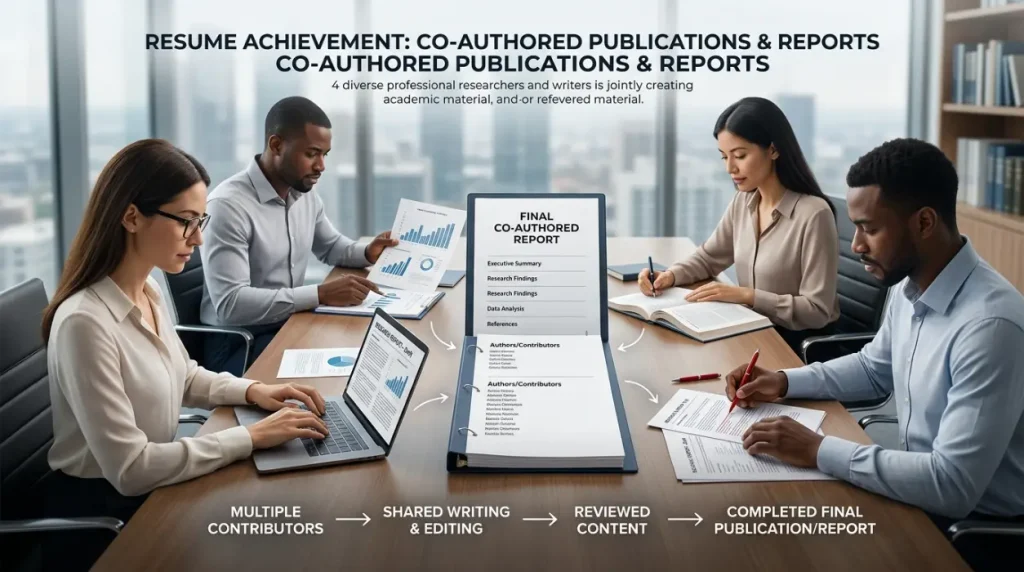
Co-Authored (Verb) — US / UK: /ˌkoʊˈɔːθərd/ /ˌkəʊˈɔːθəd/
Meaning: Wrote a document, publication, report, or study jointly with others.
Tone/Register: Academic, professional.
Example:
I co-authored a research paper on digital learning.
We co-authored a report for senior leadership.
Brainstormed (Verb) — US / UK: /ˈbreɪnˌstɔːrmd/ /ˈbreɪnˌstɔːmd/
Meaning: Generated ideas together, usually during a group discussion.
Tone/Register: Informal, modern workplace.
Example:
I brainstormed campaign ideas with the creative team.
We brainstormed solutions before selecting the final concept.
Collaborated Closely (Verb Phrase) — US / UK: /kəˈlæbəreɪtɪd ˈkloʊsli/ /kəˈlæbəreɪtɪd ˈkləʊsli/
Meaning: Worked very closely with others on a shared task.
Tone/Register: Professional, neutral.
Example:
I collaborated closely with product managers during development.
She collaborated closely with teachers to improve the curriculum.
Worked Cross-Functionally (Verb Phrase) — US / UK: /wɜrkt ˌkrɔːsˈfʌŋkʃənəli/ /wɜːkt ˌkrɒsˈfʌŋkʃənəli/
Meaning: Worked with people from different departments or specialties.
Tone/Register: Corporate, professional.
Example:
I worked cross-functionally with marketing and engineering teams.
He worked cross-functionally to improve the customer journey.
Joined (Verb) — US / UK: /dʒɔɪnd/ /dʒɔɪnd/
Meaning: Became part of a group activity or effort.
Tone/Register: Neutral.
Example:
I joined the product team during the redesign.
She joined colleagues to deliver a community workshop.
Teamed With (Verb Phrase) — US / UK: /tiːmd wɪð/ /tiːmd wɪð/
Meaning: Worked as part of a team with another person or group.
Tone/Register: Neutral, professional.
Example:
I teamed with analysts to improve reporting accuracy.
He teamed with designers to develop new campaign materials.
Shared (Verb) — US / UK: /ʃerd/ /ʃeəd/
Meaning: Contributed something jointly or divided responsibility with others.
Tone/Register: Neutral.
Example:
I shared responsibility for client communications.
We shared ideas during weekly planning sessions.
Exchanged Ideas (Verb Phrase) — US / UK: /ɪksˈtʃeɪndʒd aɪˈdiːəz/ /ɪksˈtʃeɪndʒd aɪˈdɪəz/
Meaning: Discussed and contributed ideas with other people.
Tone/Register: Neutral, conversational.
Example:
I exchanged ideas with designers during planning sessions.
The teams exchanged ideas before developing the final strategy.
Pooled Resources (Verb Phrase) — US / UK: /puːld rɪˈsɔːrsɪz/ /puːld rɪˈzɔːsɪz/
Meaning: Combined available resources to achieve a shared goal.
Tone/Register: Professional, business.
Example:
We pooled resources to complete the research project.
I pooled technical expertise with colleagues to solve the issue.
Combined Efforts (Verb Phrase) — US / UK: /kəmˈbaɪnd ˈɛfərts/ /kəmˈbaɪnd ˈefəts/
Meaning: Used the efforts of multiple people together.
Tone/Register: Neutral, professional.
Example:
We combined efforts to improve the customer onboarding process.
The teams combined efforts to deliver the project on time.
Shared Expertise (Verb Phrase) — US / UK: /ʃerd ˌɛkspərˈtiːz/ /ʃeəd ˌekspəˈtiːz/
Meaning: Contributed specialized knowledge to a joint task.
Tone/Register: Professional, academic.
Example:
I shared expertise with analysts during the research phase.
Our specialists shared expertise to strengthen the final report.
Exchanged Knowledge (Verb Phrase) — US / UK: /ɪksˈtʃeɪndʒd ˈnɑːlɪdʒ/ /ɪksˈtʃeɪndʒd ˈnɒlɪdʒ/
Meaning: Shared information or understanding with other people.
Tone/Register: Academic, professional.
Example:
I exchanged knowledge with international research teams.
The specialists exchanged knowledge during technical workshops.
Coordinated Efforts (Verb Phrase) — US / UK: /koʊˈɔːrdəneɪtɪd ˈɛfərts/ /kəʊˈɔːdɪneɪtɪd ˈefəts/
Meaning: Organized multiple people’s efforts toward one outcome.
Tone/Register: Formal, business.
Example:
I coordinated efforts across three departments.
She coordinated efforts to improve service delivery.
Worked Jointly (Verb Phrase) — US / UK: /wɜrkt ˈdʒɔɪntli/ /wɜːkt ˈdʒɔɪntli/
Meaning: Worked together with another person or group.
Tone/Register: Formal, neutral.
Example:
I worked jointly with researchers on the study.
The teams worked jointly to develop a new framework.
Partnered With (Verb Phrase) — US / UK: /ˈpɑːrtnərd wɪð/ /ˈpɑːtnəd wɪð/
Meaning: Worked in an active partnership with another person or organization.
Tone/Register: Business, professional.
Example:
I partnered with finance to improve budget reporting.
She partnered with community leaders to organize the event.
Worked Alongside (Verb Phrase) — US / UK: /wɜrkt əˈlɔːŋsaɪd/ /wɜːkt əˈlɒŋsaɪd/
Meaning: Worked beside or closely with another person or team.
Tone/Register: Neutral, professional.
Example:
I worked alongside senior developers during the migration.
He worked alongside teachers to improve classroom resources.
Worked With (Verb Phrase) — US / UK: /wɜrkt wɪð/ /wɜːkt wɪð/
Meaning: Performed tasks or projects in cooperation with others.
Tone/Register: Neutral and highly common.
Example:
I worked with designers to improve the website.
She worked with managers to simplify internal processes.
Conferred (Verb) — US / UK: /kənˈfɜrd/ /kənˈfɜːd/
Meaning: Discussed an issue with another person to exchange views or reach a decision.
Tone/Register: Formal, academic.
Example:
I conferred with legal advisers before finalizing the policy.
The researchers conferred about the study results.
Consulted With (Verb Phrase) — US / UK: /kənˈsʌltɪd wɪð/ /kənˈsʌltɪd wɪð/
Meaning: Discussed plans or problems with another person for guidance or agreement.
Tone/Register: Formal, professional.
Example:
I consulted with managers before changing the workflow.
She consulted with specialists during the project.
Deliberated (Verb) — US / UK: /dɪˈlɪbəreɪtɪd/ /dɪˈlɪbəreɪtɪd/
Meaning: Carefully discussed options before reaching a decision.
Tone/Register: Formal, academic.
Example:
We deliberated with stakeholders before selecting the proposal.
The committee deliberated over several possible solutions.
Contributed To (Verb Phrase) — US / UK: /kənˈtrɪbjuːtɪd tuː/ /kənˈtrɪbjuːtɪd tuː/
Meaning: Added effort, knowledge, or work to a larger project.
Tone/Register: Professional, academic.
Example:
I contributed to a cross-functional research project.
She contributed to the development of new training materials.
Assisted In (Verb Phrase) — US / UK: /əˈsɪstɪd ɪn/ /əˈsɪstɪd ɪn/
Meaning: Helped with a particular activity or process.
Tone/Register: Formal, professional.
Example:
I assisted in developing the annual communications plan.
He assisted in preparing materials for the workshop.
Supported By (Phrase) — US / UK: /səˈpɔːrtɪd baɪ/ /səˈpɔːtɪd baɪ/
Meaning: Describes work completed with help or backing from other people.
Tone/Register: Neutral, professional.
Example:
The project was supported by a multidisciplinary team.
The research was supported by experienced analysts.
Engaged With (Verb Phrase) — US / UK: /ɪnˈɡeɪdʒd wɪð/ /ɪnˈɡeɪdʒd wɪð/
Meaning: Actively interacted with people during a project or activity.
Tone/Register: Professional, modern.
Example:
I engaged with stakeholders to understand their concerns.
She engaged with users throughout the design process.
Interacted With (Verb Phrase) — US / UK: /ˌɪntərˈæktɪd wɪð/ /ˌɪntərˈæktɪd wɪð/
Meaning: Communicated or worked directly with other people.
Tone/Register: Neutral, professional.
Example:
I interacted with clients during product demonstrations.
He interacted with multiple departments during implementation.
Involved (Verb) — US / UK: /ɪnˈvɑːlvd/ /ɪnˈvɒlvd/
Meaning: Took an active part in a shared project or process.
Tone/Register: Neutral.
Example:
I was involved in a company-wide process improvement project.
She was involved in developing the new curriculum.
Helped Develop (Verb Phrase) — US / UK: /hɛlpt dɪˈvɛləp/ /helpt dɪˈveləp/
Meaning: Played a supporting role in creating or improving something.
Tone/Register: Neutral, clear.
Example:
I helped develop onboarding materials for new employees.
He helped develop a new customer feedback process.
Helped Create (Verb Phrase) — US / UK: /hɛlpt kriˈeɪt/ /helpt kriˈeɪt/
Meaning: Contributed to the creation of something with other people.
Tone/Register: Neutral, conversational.
Example:
I helped create social media content with the marketing team.
She helped create resources for community workshops.
Built Together (Verb Phrase) — US / UK: /bɪlt təˈɡeðər/ /bɪlt təˈɡeðə/
Meaning: Created or developed something jointly.
Tone/Register: Modern, informal-professional.
Example:
We built the training program together.
I built the project framework together with senior colleagues.
Worked in Partnership (Verb Phrase) — US / UK: /wɜrkt ɪn ˈpɑːrtnərʃɪp/ /wɜːkt ɪn ˈpɑːtnəʃɪp/
Meaning: Worked through an organized relationship with another person or group.
Tone/Register: Formal, professional.
Example:
I worked in partnership with regional managers.
The team worked in partnership with local educators.
Formed a Partnership (Verb Phrase) — US / UK: /fɔːrmd ə ˈpɑːrtnərʃɪp/ /fɔːmd ə ˈpɑːtnəʃɪp/
Meaning: Established a cooperative relationship to pursue a shared objective.
Tone/Register: Formal, business.
Example:
We formed a partnership with a nonprofit organization.
I formed a partnership with another department to improve training.

Worked Collectively (Verb Phrase) — US / UK: /wɜrkt kəˈlɛktɪvli/ /wɜːkt kəˈlektɪvli/
Meaning: Worked as a group rather than independently.
Tone/Register: Formal, academic.
Example:
We worked collectively to address customer concerns.
The researchers worked collectively on the final analysis.
Acted in Concert (Phrase) — US / UK: /ˈæktɪd ɪn ˈkɑːnsərt/ /ˈæktɪd ɪn ˈkɒnsət/
Meaning: Acted together in a coordinated way.
Tone/Register: Very formal.
Example:
The departments acted in concert to improve service delivery.
The teams acted in concert during the emergency response.
Worked Cooperatively (Verb Phrase) — US / UK: /wɜrkt koʊˈɑːpərətɪvli/ /wɜːkt kəʊˈɒpərətɪvli/
Meaning: Worked in a helpful and mutually supportive way.
Tone/Register: Formal, professional.
Example:
I worked cooperatively with colleagues from different departments.
She worked cooperatively with external researchers.
Worked Collaboratively (Verb Phrase) — US / UK: /wɜrkt kəˈlæbərətɪvli/ /wɜːkt kəˈlæbərətɪvli/
Meaning: Worked jointly while sharing ideas, responsibilities, or expertise.
Tone/Register: Professional, academic.
Example:
I worked collaboratively with product and design teams.
The researchers worked collaboratively throughout the study.
Shared Responsibility (Verb Phrase) — US / UK: /ʃerd rɪˌspɑːnsəˈbɪləti/ /ʃeəd rɪˌspɒnsəˈbɪləti/
Meaning: Took joint responsibility for completing a task or achieving an outcome.
Tone/Register: Professional.
Example:
I shared responsibility for project planning and delivery.
We shared responsibility for customer communications.
Divided Responsibilities (Verb Phrase) — US / UK: /dɪˈvaɪdɪd rɪˌspɑːnsəˈbɪlətiz/ /dɪˈvaɪdɪd rɪˌspɒnsəˈbɪlətiz/
Meaning: Distributed different duties among members of a team.
Tone/Register: Neutral, professional.
Example:
We divided responsibilities to keep the project on schedule.
The team divided responsibilities according to individual expertise.
Leveraged Team Expertise (Verb Phrase) — US / UK: /ˈlɛvərd tiːm ˌɛkspərˈtiːz/ /ˈliːvərd tiːm ˌekspəˈtiːz/
Meaning: Used the knowledge and abilities of team members to produce a better result.
Tone/Register: Corporate, advanced.
Example:
I leveraged team expertise to improve the implementation plan.
She leveraged technical knowledge across departments.
Mobilized Team Efforts (Verb Phrase) — US / UK: /ˈmoʊbəlaɪzd tiːm ˈɛfərts/ /ˈməʊbɪlaɪzd tiːm ˈefəts/
Meaning: Directed or organized a team’s combined efforts toward a goal.
Tone/Register: Leadership, formal.
Example:
I mobilized team efforts to meet an urgent deadline.
The manager mobilized team efforts during the system upgrade.
Synchronized (Verb) — US / UK: /ˈsɪŋkrənaɪzd/ /ˈsɪŋkrənaɪzd/
Meaning: Made activities happen in coordination with one another.
Tone/Register: Technical, professional.
Example:
I synchronized activities across product and marketing teams.
We synchronized project schedules to prevent delays.
How to Choose the Best Collaboration Synonym for a Resume
The strongest alternative depends on what you actually did.
When your role simply involved working with others, worked with, worked alongside, or worked together may be the most accurate choices.
For responsibilities involving people, schedules, or deadlines, coordinated offers a stronger and more specific description.
Jointly creating a product, design, or project? Consider co-created, co-developed, or co-designed.
When your main contribution was specialist knowledge, words such as contributed, shared expertise, or leveraged team expertise can highlight your value more effectively.
Communication between different groups is better expressed with terms like liaised, facilitated, or aligned, depending on your exact role.
For situations where you reached an agreement through discussion, negotiated is more precise than the broader word collaborated.
The goal is not to replace “collaborated” to sound sophisticated. The goal is to describe your actual contribution more precisely.
Synonyms by Tone
Positive
Some alternatives can emphasize active teamwork and achievement.
- Partnered
- Co-created
- Co-developed
- Co-designed
- Teamed up
- Joined forces
- Shared expertise
- Leveraged team expertise
- Mobilized team efforts
- Built together
These work well when the teamwork produced a meaningful result.
Neutral
These options describe cooperation without adding a strong emotional tone.
- Worked with
- Worked together
- Cooperated
- Participated
- Assisted
- Supported
- Engaged
- Joined
- Interacted with
- Contributed
They are useful when accuracy and clarity matter more than persuasive language.
Negative or Potentially Limiting
“Collaborated” itself is not negative. However, some alternatives can imply a smaller or less influential role when used in the wrong context.
- Assisted
- Participated
- Involved
- Helped create
- Helped develop
- Supported
For example, “assisted” may make a candidate sound like a supporting contributor rather than the person driving the project.
Therefore, choose these words only when they accurately describe your role.
Playful or Informal
For a formal resume, use informal alternatives carefully.
- Teamed up
- Brainstormed
- Built together
- Joined forces
These can work in creative portfolios or less traditional professional profiles, but conventional resumes usually benefit from more precise professional verbs.
“Collaborated” vs Close Alternatives
Coordinated vs Collaborating
Collaborated means working jointly toward a shared goal.
Coordinated emphasizes organizing people, schedules, activities, or resources.
Use collaborated when teamwork is the key point. Use coordinated when you managed how different parts worked together.
Collaborated vs Partnered
Collaborated is broad and can describe almost any joint effort.
Partnered often suggests a closer or more deliberate working relationship.
For example, “partnered with the sales team” can sound more relationship-focused than “collaborated with the sales team.”
Collaborated vs Contributed
Collaborated focuses on joint work.
Contributed focuses on what you personally added.
If your resume needs to highlight your individual value, “contributed” may be more precise.
How “Collaborated” Changes by Context
Daily Conversation
In everyday English, people often choose simpler expressions.
Instead of saying:
I collaborated with my brother.
A native speaker might naturally say:
I worked with my brother.
However, “collaborated” is still understandable in ordinary conversation. It simply sounds more formal.
Writing and Blogging
Bloggers can use “collaborated” when discussing joint projects, guest content, research, interviews, or creative work.
However, repeated use can make writing monotonous. Alternatives such as “partnered,” “co-created,” and “worked alongside” can add variety.
Professional or Academic Tone
“Collaborated” is especially common in business and academic writing.
It works well for cross-functional teams, research projects, product development, publications, and organizational initiatives.
Still, precision matters. “Co-authored” tells readers more than “collaborated” when describing a research paper.
Creative or Informal Use
Creative professionals may prefer expressions such as “teamed up,” “joined forces,” or “brainstormed.”
These words create a more energetic voice.
Nevertheless, a traditional resume should favor clarity over personality unless the industry encourages a creative style.
Common Mistakes Learners Make
Mistake 1: Using “collaborated” for every teamwork activity
Not every team activity requires the same verb.
For team organization, coordinated is the most precise choice.
A jointly written research paper is better described as co-authored.
When two or more people create a design together, co-designed clearly communicates that shared contribution.
Mistake 2: Writing “collaborated” without explaining the result
A resume becomes stronger when the action connects to an outcome.
Weak:
Collaborated with the marketing team.
Stronger:
Collaborated with the marketing team to increase campaign engagement.
Mistake 3: Confusing “collaborated” with “led”
Collaboration does not automatically mean leadership.
If you directed the project, use a leadership verb such as “led,” “managed,” “directed,” or “mobilized” when accurate.
Mistake 4: Choosing impressive words that are not accurate
Words such as “mobilized,” “negotiated,” and “synchronized” sound powerful.
However, they should only appear when they genuinely describe your work.
Native Usage Note
Native English speakers often prefer specific verbs over broad verbs.
Instead of:
I collaborated with the team to create a report.
A more informative resume statement could be:
I co-authored a quarterly report with three analysts.
The second sentence tells the reader exactly what happened.
For additional vocabulary practice, consider connecting this topic with broader lessons about professional action verbs and resume language.
Real-Life Mini Scenarios
Workplace Scenario
A project manager works with designers, developers, and marketers.
Instead of repeating “collaborated,” the resume could use coordinated, partnered, and worked cross-functionally.
Each phrase highlights a different part of the experience.
Social Scenario
Two friends organize a charity event.
They might say:
We worked together to organize the event.
In professional writing, this could become:
Partnered with volunteers to organize a community event.
Media or Pop Culture Scenario
A singer works with another artist on a song.
“Collaborated” works well, but co-created or teamed up with may sound more natural depending on the publication’s style.
Writing Scenario
Two researchers write an article.
“Co-authored” is more precise than “collaborated” because it identifies the actual shared activity.
How to Make “Collaborated” Stronger on a Resume
A useful formula is:
Action verb + who you worked with + what you did + measurable or clear result
For example:
Partnered with the sales team to redesign customer outreach, increasing qualified leads.
Another example:
Coordinated cross-functional teams to launch a new onboarding process.
A third example:
Co-developed training materials with senior instructors for a company-wide program.
Notice the difference. Each sentence gives the reader a clearer picture of the candidate’s role.
Which Synonym Is Best for Your Resume?
Choose based on your actual action:
- Worked with — simple teamwork
- Partnered with — close professional relationship
- Coordinated — organized people or activities
- Facilitated — made cooperation easier
- Liaised — connected different groups
- Negotiated — reached agreements
- Co-created — jointly created something
- Co-authored — jointly wrote something
- Contributed — added expertise or effort
- Supported — provided assistance
- Aligned — brought goals or teams into agreement
- Mobilized — organized people for action
- Brainstormed — generated ideas together

Interactive Practice Quiz
1. You organized schedules for four departments. Which verb is strongest?
A. Participated
B. Coordinated
C. Assisted
D. Joined
2. You wrote a research paper with another scientist.
A. Co-authored
B. Supported
C. Joined
D. Arranged
3. You helped designers create a website.
A. Negotiated
B. Mobilized
C. Worked alongside
D. Deliberated
4. You reached an agreement with several stakeholders.
A. Negotiated
B. Participated
C. Joined
D. Assisted
5. You generated campaign ideas with colleagues.
A. Brainstormed
B. Liaised
C. Integrated
D. Arranged
6. You connected headquarters with regional offices.
A. Co-designed
B. Liaised
C. Contributed
D. Teamed up
7. You created a product jointly with another department.
A. Co-created
B. Assisted
C. Participated
D. Interacted
8. You added specialist knowledge to a team project.
A. Contributed
B. Joined
C. Arranged
D. United
9. You brought different teams into agreement.
A. Aligned
B. Helped create
C. Participated
D. Shared
10. You made group discussions more productive.
A. Facilitated
B. Negotiated
C. Joined
D. Exchanged
11. You worked with several departments on one project.
A. Worked cross-functionally
B. Assisted in
C. Deliberated
D. Arranged
12. You combined your knowledge with colleagues’ expertise.
A. Shared expertise
B. Participated
C. Joined
D. Communicated
13. You organized people to respond to an urgent situation.
A. Mobilized
B. Consulted
C. Interacted
D. Contributed
14. You worked closely with another organization on a shared goal.
A. Partnered with
B. Participated
C. Helped create
D. Arranged
15. You simply worked with colleagues on a normal project.
A. Worked with
B. Acted in concert
C. Deliberated
D. Mobilized
Answer key: 1-B | 2-A | 3-C | 4-A | 5-A | 6-B | 7-A | 8-A | 9-A | 10-A | 11-A | 12-A | 13-A | 14-A | 15-A
Reflection Task
Think of one real project from your education, work, volunteering, or personal life.
Write one resume sentence using a synonym for “collaborated.” Then ask yourself: Does my verb show exactly what I contributed?
Conclusion
Choosing the right collaborated synonym for resume writing can make your experience sound clearer and more professional. A precise word can show teamwork, leadership, creativity, or communication.
The best collaborated synonym for resume depends on what you actually did. Words like “partnered,” “coordinated,” “co-created,” and “facilitated” can highlight different types of contribution without making your writing repetitive.
Keep practicing each collaborated synonym for resume in real sentences, emails, essays, and applications. With regular practice, you can build stronger vocabulary and communicate your achievements with greater confidence.
Frequently Asked Questions
What is the best collaborative synonym for a resume?
The best synonym depends on your actual role. Partnered, coordinated, co-created, contributed, facilitated, and worked cross-functionally are strong choices. Use “partnered” for close teamwork, “coordinated” for organizing activities, and “co-created” when you jointly produced something. The most effective resume verb is the one that accurately describes your contribution.
Is “partnered” better than “collaborated” on a CV?
Not always. “Partnered” can sound stronger when you want to emphasize a close working relationship. “Collaborated” is broader and works for many types of teamwork. If you worked closely with another department, organization, or professional group, “partnered with” can provide a polished alternative without changing the basic meaning.
What can I use instead of “collaborated with” on a resume?
You can use worked with, partnered with, coordinated with, liaised with, worked alongside, engaged with, consulted with, or teamed with, depending on the situation. For example, “liaised with regional managers” emphasizes communication, while “coordinated with regional managers” emphasizes organization.
What is a stronger word than collaborated for leadership experience?
If your role involved directing people or organizing their efforts, coordinated, mobilized, facilitated, or aligned may be stronger than “collaborated.” However, these verbs should only be used when they accurately reflect your responsibilities. A resume should demonstrate leadership without exaggerating your role.
Can I use “co-created” instead of “collaborated” on my resume?
Yes, when you genuinely created something jointly with another person or group. “Co-created” is especially useful for products, content, training programs, designs, strategies, and creative projects. It is more specific than “collaborated” because it tells the reader that you helped create the final result.

Hasnain Ali is an SEO Content Strategist and the founder of wordvora.com, a trusted vocabulary platform that helps writers, students, professionals, and English learners find accurate synonyms, antonyms, word meanings, and real-life usage examples. He specializes in keyword research, on-page SEO, topical authority, and creating search-first content that aligns with Google’s latest Search Quality and E-E-A-T guidelines. His work focuses on producing clear, well-structured, and reader-friendly resources that satisfy search intent while maintaining high editorial standards.
Through extensive hands-on experience with SEO tools such as Google Search Console, Google Analytics, SEMrush, and Ahrefs, Hasnain researches user search behavior and develops content that is both informative and easy to understand. Every article published on wordvora.com is carefully reviewed for accuracy, readability, and contextual relevance before publication. His mission is to build one of the web’s most reliable English vocabulary resources by providing practical language guidance, trustworthy explanations, and content that helps readers improve their writing, communication, and vocabulary with confidence.