
Writing a strong resume means choosing words that clearly show your skills and professional value. If you are searching for an ensure synonym for resume, the right alternative can make your achievements sound more precise and confident.
Instead of repeatedly using “ensure,” you can choose stronger verbs such as guarantee, secure, confirm, verify, support, or maintain. Each option adds a slightly different meaning, so selecting the right ensure synonym for a resume depends on your role and the result you want to highlight.
A well-chosen action verb can make your resume more engaging while helping recruiters quickly understand your responsibilities and accomplishments. In this guide, you will discover useful alternatives, their meanings, tones, and examples to help you select the best synonym for a resume.
Whether you are updating an existing resume or creating one for a new opportunity, using varied and specific language can strengthen your professional presentation. The goal is not simply to replace “ensure,” but to choose a word that accurately demonstrates your contribution and impact.
What Does “Ensure” Really Mean?
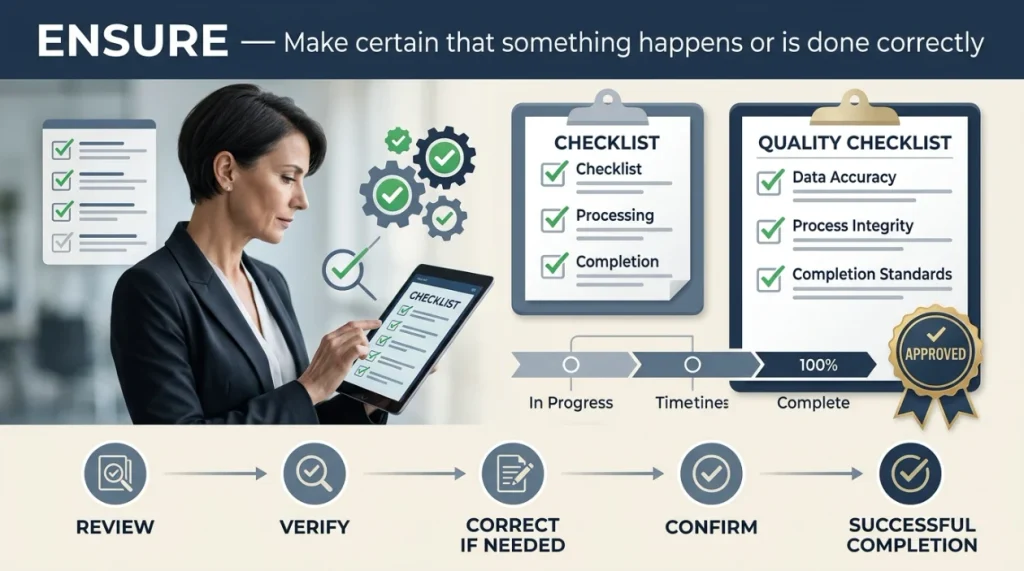
Ensure means to make certain that something occurs or that a specific outcome happens successfully. It describes proactive actions taken to guarantee quality, safety, or compliance in projects.
Native speakers use this word when discussing project milestones, quality checks, or regulatory compliance reviews. It carries a professional, authoritative, and reliable emotional tone. It usually suggests diligence, precision, and leadership accountability.
Connotative Meaning
- Positive tone: Associated with reliability, diligence, quality assurance, and professional excellence.
- Negative tone: Rare, but can occasionally imply micromanagement or rigid administrative control.
- Neutral tone: Used in standard operational checklists to denote required verification steps.
- Connotation definition: (The emotional or cultural feeling attached to a word beyond its strict dictionary definition).
Etymology
- Source Language: Latin, derived from securus meaning “safe” or “secure,” via Old French ensurer.
- Original Meaning: Originally meant to make safe, secure, or legally protected against risk.
- Old English (450–1100): Not used; native speakers relied on Germanic words for making things safe or firm.
- Middle English (1100–1500): Early administrative texts imported French legal terms for guaranteeing promises.
- Modern English (1500–Present): Fully established in professional writing to denote making an outcome certain.
Pronunciation (US & UK – IPA)
- US: /ɪnˈʃʊr/
- UK: /ɪnˈʃʊə/
Syllables & Affixation Pattern
- Syllables: en-sure
- Root: sure (certain or safe)
- Prefix: en- (meaning to put into or make)
- Suffix: None
Synonyms List
Guarantee (Verb) — US: /ˈɡærənˌtiː/ — UK: /ˌɡærənˈtiː/
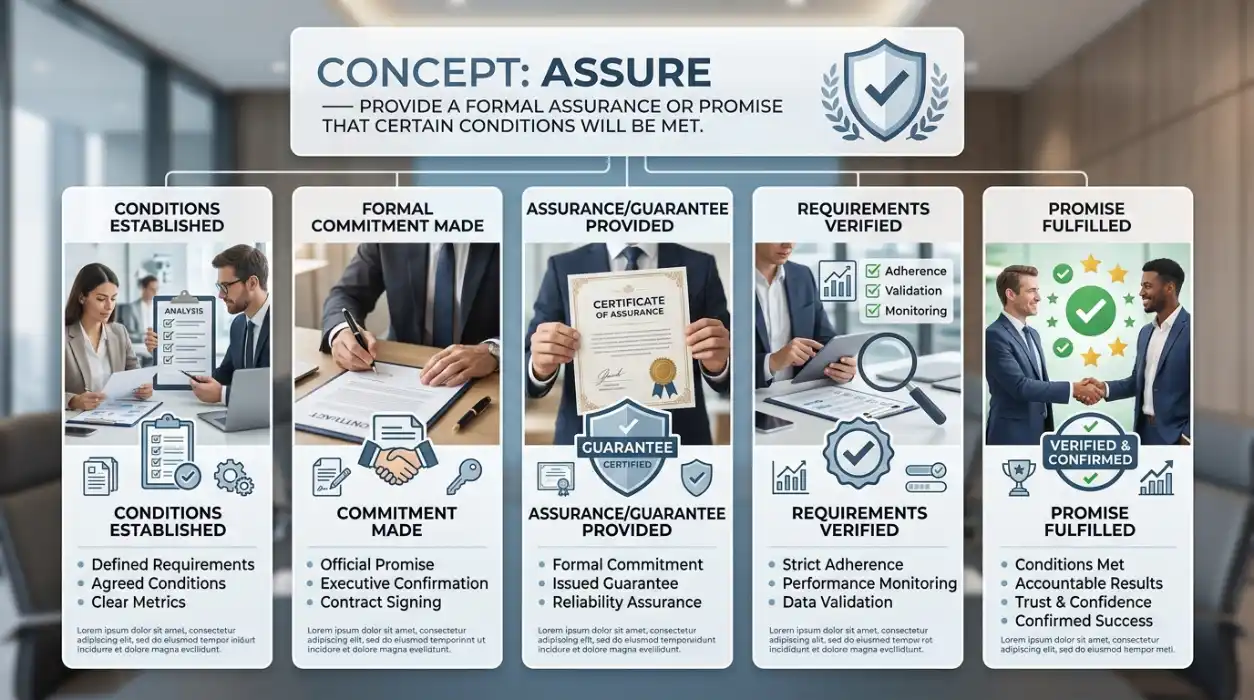
- Meaning: Provide a formal assurance or promise that certain conditions will be met.
- Tone/Register: Professional, authoritative.
- Example: Guarantee compliance with federal safety regulations across sites.
- Example: Guarantee timely delivery of software updates to clients.
Secure (Verb) — US: /sɪˈkjʊr/ — UK: /sɪˈkjʊə/
- Meaning: Protect or make certain the success of a project or asset.
- Tone/Register: Professional, executive.
- Example: Secure project funding through detailed investor presentations.
- Example: Secure network infrastructure against potential cyber threats.
Validate (Verb) — US: /ˈvæləˌdeɪt/ — UK: /ˈvalɪdeɪt/
- Meaning: Check or prove the validity or accuracy of data and systems.
- Tone/Register: Technical, formal.
- Example: Validate software builds before deploying to production servers.
- Example: Validate financial reports against historical audit logs.
Verify (Verb) — US: /ˈvɛrəˌfaɪ/ — UK: /ˈvɛrɪfaɪ/
- Meaning: Make sure or demonstrate that something is true, accurate, or justified.
- Tone/Register: Professional, precise.
- Example: Verify inventory counts during quarterly warehouse audits.
- Example: Verify user credentials before granting database access.
Confirm (Verb) — US: /kənˈfɜːrm/ — UK: /kənˈfɜːm/
- Meaning: Establish the truth or correctness of something previously believed.
- Tone/Register: Standard, professional.
- Example: Confirm customer shipping addresses prior to dispatch.
- Example: Confirm test results with independent laboratory findings.
Certify (Verb) — US: /ˈsɜːrtəˌfaɪ/ — UK: // /ˈsɜːtɪfaɪ/
- Meaning: Officially attest to certain standards or qualifications.
- Tone/Register: Formal, credentialed.
- Example: Certify compliance with ISO quality management standards.
- Example: Certify financial statements before board review meetings.
Warrant (Verb) — US: /ˈwɔːrənt/ — UK: /ˈwɒrənt/
- Meaning: Justify or necessitate a certain course of action or quality.
- Tone/Register: Formal, legal.
- Example: Warrant system uptime through redundant server backups.
- Example: Warrant product quality with extended customer warranties.
Safeguard (Verb) — US: /ˈseɪfɡɑːrd/ — UK: // /ˈseɪfɡɑːd/
- Meaning: Protect from harm or damage through preventive measures.
- Tone/Register: Protective, professional.
- Example: Safeguard confidential client data using encrypted databases.
- Example: Safeguard company assets during facility restructuring.
Protect (Verb) — US: /prəˈtɛkt/ — UK: /prəˈtɛkt/
- Meaning: Keep safe from harm, injury, or operational failure.
- Tone/Register: Standard, strong.
- Example: Protect intellectual property rights with strict NDAs.
- Example: Protect server arrays from unauthorized network breaches.
Sustain (Verb) — US: /səˈsteɪn/ — UK: /səˈsteɪn/
- Meaning: Strengthen or support physically or mentally over time.
- Tone/Register: Professional, steady.
- Example: Sustain high team productivity through agile sprint planning.
- Example: Sustain revenue growth via strategic account management.
Maintain (Verb) — US: /meɪnˈteɪn/ — UK: /meɪnˈteɪn/
- Meaning: Cause or enable a condition or state to continue unchanged.
- Tone/Register: Standard, operational.
- Example: Maintain strict quality standards across manufacturing lines.
- Example: Maintain accurate financial records for tax filings.
Preserve (Verb) — US: /prɪˈzɜːrv/ — UK: /prɪˈzɜːv/
- Meaning: Maintain something in its original or existing state.
- Tone/Register: Formal, careful.
- Example: Preserve data integrity during database migration projects.
- Example: Preserve brand reputation through transparent public relations.
Stabilize (Verb) — US: /ˈsteɪbəˌlaɪz/ — UK: /ˈsteɪbəlaɪz/
- Meaning: Make or become unlikely to change, fail, or decline.
- Tone/Register: Operational, technical.
- Example: Stabilize server response times under heavy user traffic.
- Example: Stabilize quarterly cash flows through budget controls.
Bolster (Verb) — US: /ˈboʊlstər/ — UK: /ˈbəʊlstə/
- Meaning: Support or strengthen weak areas in a system or plan.
- Tone/Register: Professional, dynamic.
- Example: Bolster system security by implementing multi-factor authentication.
- Example: Bolster marketing campaigns with targeted social media ads.
Reinforce (Verb) — US: /ˌriːɪnˈfɔːrs/ — UK: /ˌriːɪnˈfɔːs/
- Meaning: Strengthen or support an object, idea, or process.
- Tone/Register: Professional, strong.
- Example: Reinforce brand loyalty through exceptional customer service.
- Example: Reinforce data protection policies for remote workers.
Underpin (Verb) — US: /ˌʌndərˈpɪn/ — UK: /ˌʌndəˈpɪn/
- Meaning: Support, justify, or form the basis for a system or strategy.
- Tone/Register: Academic, executive.
- Example: Underpin financial models with rigorous market research data.
- Example: Underpin software architecture with scalable cloud databases.
Consolidate (Verb) — US: /kənˈsɑːlɪˌdeɪt/ — UK: /kənˈsɒlɪdeɪt/
- Meaning: Make something stronger or more secure by uniting elements.
- Tone/Register: Business, formal.
- Example: Consolidate regional supply chains to reduce operational waste.
- Example: Consolidate customer databases into a single CRM tool.
Streamline (Verb) — US: /ˈstriːmˌlaɪn/ — UK: /ˈstriːmˌlaɪn/
- Meaning: Make an organization or process more efficient and effective.
- Tone/Register: Business, modern.
- Example: Streamline onboarding workflows for new engineering hires.
- Example: Streamline invoice processing to reduce administrative costs.
Optimize (Verb) — US: /ˈɑːptɪˌmaɪz/ — UK: /ˈɒptɪmaɪz/
- Meaning: Make the best or most effective use of a situation or resource.
- Tone/Register: Technical, business.
- Example: Optimize database queries to speed up web application loads.
- Example: Optimize supply chain logistics for faster delivery times.
Maximize (Verb) — US: /ˈmæksɪˌmaɪz/ — UK: /ˈmaksɪmaɪz/
- Meaning: Make as large or great as possible; make the best use of.
- Tone/Register: Executive, aggressive.
- Example: Maximize advertising ROI through data-driven keyword bidding.
- Example: Maximize production efficiency across assembly plants.
Perfect (Verb) — US: /pərˈfɛkt/ — UK: /pəˈfɛkt/
- Meaning: Make completely free from faults or defects.
- Tone/Register: Professional, detailed.
- Example: Perfect user interface designs through rigorous usability testing.
- Example: Perfect code quality via automated peer review cycles.
Finalize (Verb) — US: /ˈfaɪnəˌlaɪz/ — UK: /ˈfaɪnəlaɪz/
- Meaning: Produce or agree on a finished and definitive version.
- Tone/Register: Business, administrative.
- Example: Finalize project scope documents with executive stakeholders.
- Example: Finalize annual corporate budgets ahead of fiscal quarters.
Institutionalize (Verb) — US: /ˌɪnstɪˈtuːʃənəˌlaɪz/ — UK: /ˌɪnstɪˈtjuːʃənəlaɪz/
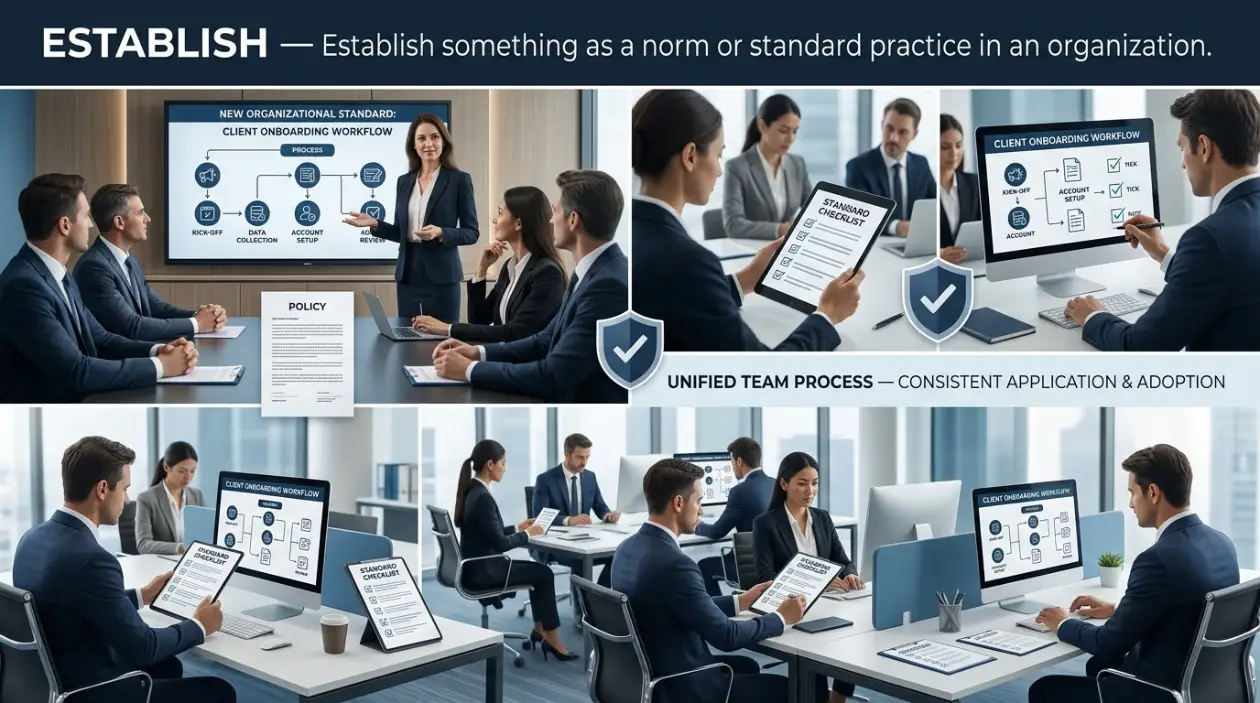
- Meaning: Establish something as a norm or standard practice in an organization.
- Tone/Register: Formal, corporate.
- Example: Institutionalize agile development practices across engineering teams.
- Example: Institutionalize compliance training for all incoming staff.
Standardize (Verb) — US: /ˈstændərdˌaɪz/ — UK: /ˈstændədaɪz/
- Meaning: Cause something to conform to a standard specification.
- Tone/Register: Technical, formal.
- Example: Standardize API documentation across all development squads.
- Example: Standardize customer support response protocols globally.
Ensure (Verb) — US: /ɪnˈʃʊr/ — UK: /ɪnˈʃʊə/
- Meaning: Make certain that something occurs or is achieved successfully.
- Tone/Register: Professional, standard.
- Example: Ensure project deliverables meet high client expectations.
- Example: Ensure regulatory compliance during corporate expansions.
Warrant (Verb) — US: /ˈwɔːrənt/ — UK: /ˈwɒrənt/
- Meaning: Justify or necessitate a certain course of action or quality standard.
- Tone/Register: Formal, professional.
- Example: Warrant system uptime through redundant server backups.
- Example: Warrant product quality with extended manufacturer guarantees.
Safeguard (Verb) — US: /ˈseɪfɡɑːrd/ — UK: /ˈseɪfɡɑːd/
- Meaning: Protect from harm or damage through preventive security measures.
- Tone/Register: Protective, professional.
- Example: Safeguard confidential client data using advanced encryption protocols.
- Example: Safeguard company assets during facility restructuring phases.
Protect (Verb) — US: /prəˈtɛkt/ — UK: /prəˈtɛkt/
- Meaning: Keep safe from operational harm, injury, or system failure.
- Tone/Register: Standard, strong.
- Example: Protect intellectual property rights with strict non-disclosure agreements.
- Example: Protect server arrays from unauthorized network security breaches.
Sustain (Verb) — US: /səˈsteɪn/ — UK: /səˈsteɪn/
- Meaning: Strengthen or support operational performance over time.
- Tone/Register: Professional, steady.
- Example: Sustain high team productivity through agile sprint planning sessions.
- Example: Sustain revenue growth via strategic key account management.
Maintain (Verb) — US: /meɪnˈteɪn/ — UK: /meɪnˈteɪn/
- Meaning: Cause or enable a standard condition to continue unchanged.
- Tone/Register: Standard, operational.
- Example: Maintain strict quality standards across all manufacturing lines.
- Example: Maintain accurate financial records for upcoming tax filings.
Preserve (Verb) — US: /prɪˈzɜːrv/ — UK: /prɪˈzɜːv/
- Meaning: Maintain system integrity in its original or secure state.
- Tone/Register: Formal, careful.
- Example: Preserve data integrity during complex database migration projects.
- Example: Preserve brand reputation through transparent public relations.
Stabilize (Verb) — US: /ˈsteɪbəˌlaɪz/ — UK: /ˈsteɪbəlaɪz/
- Meaning: Make or become unlikely to change, fail, or decline.
- Tone/Register: Operational, technical.
- Example: Stabilize server response times under heavy concurrent user traffic.
- Example: Stabilize quarterly cash flows through tight budget controls.
Bolster (Verb) — US: /ˈboʊlstər/ — UK: /ˈbəʊlstə/
- Meaning: Support or strengthen weak areas in a project plan.
- Tone/Register: Professional, dynamic.
- Example: Bolster system security by implementing multi-factor authentication.
- Example: Bolster marketing campaigns with targeted social media ads.
Reinforce (Verb) — US: /ˌriːɪnˈfɔːrs/ — UK: /ˌriːɪnˈfɔːs/
- Meaning: Strengthen or support an organizational process or standard.
- Tone/Register: Professional, strong.
- Example: Reinforce brand loyalty through exceptional customer service.
- Example: Reinforce data protection policies for remote workforce teams.
Underpin (Verb) — US: /ˌʌndərˈpɪn/ — UK: /ˌʌndəˈpɪn/
- Meaning: Support, justify, or form the core basis for a strategy.
- Tone/Register: Academic, executive.
- Example: Underpin financial models with rigorous market research data.
- Example: Underpin software architecture with scalable cloud databases.
Consolidate (Verb) — US: /kənˈsɑːlɪˌdeɪt/ — UK: /kənˈsɒlɪdeɪt/
- Meaning: Make something stronger or more secure by uniting elements.
- Tone/Register: Business, formal.
- Example: Consolidate regional supply chains to reduce operational waste.
- Example: Consolidate customer databases into a single CRM tool.
Streamline (Verb) — US: /ˈstriːmˌlaɪn/ — UK: /ˈstriːmˌlaɪn/
- Meaning: Make an organization or workflow more efficient and effective.
- Tone/Register: Business, modern.
- Example: Streamline onboarding workflows for new engineering hires.
- Example: Streamline invoice processing to reduce administrative overhead costs.
Optimize (Verb) — US: /ˈɑːptɪˌmaɪz/ — UK: /ˈɒptɪmaɪz/
- Meaning: Make the best or most effective use of a situation or resource.
- Tone/Register: Technical, business.
- Example: Optimize database queries to speed up web application load times.
- Example: Optimize supply chain logistics for faster delivery schedules.
Maximize (Verb) — US: /ˈmæksɪˌmaɪz/ — UK: /ˈmaksɪmaɪz/
- Meaning: Make as large or great as possible; make optimal use of.
- Tone/Register: Executive, aggressive.
- Example: Maximize advertising ROI through data-driven keyword bidding.
- Example: Maximize production efficiency across assembly plant floors.
Perfect (Verb) — US: /pərˈfɛkt/ — UK: /pəˈfɛkt/
- Meaning: Make completely free from faults, bugs, or defects.
- Tone/Register: Professional, detailed.
- Example: Perfect user interface designs through rigorous usability testing.
- Example: Perfect code quality via automated peer review cycles.
Finalize (Verb) — US: /ˈfaɪnəˌlaɪz/ — UK: /ˈfaɪnəlaɪz/
- Meaning: Produce or agree on a finished and definitive project version.
- Tone/Register: Business, administrative.
- Example: Finalize project scope documents with executive stakeholders.
- Example: Finalize annual corporate budgets ahead of fiscal quarters.
Institutionalize (Verb) — US: /ˌɪnstɪˈtuːʃənəˌlaɪz/ — UK: /ˌɪnstɪˈtjuːʃənəlaɪz/
- Meaning: Establish something as a permanent norm or standard practice.
- Tone/Register: Formal, corporate.
- Example: Institutionalize agile development practices across engineering teams.
- Example: Institutionalize compliance training for all incoming staff.
Standardize (Verb) — US: /ˈstændərdˌaɪz/ — UK: /ˈstændədaɪz/
- Meaning: Cause operational processes to conform to fixed specifications.
- Tone/Register: Technical, formal.
- Example: Standardize API documentation across all development squads.
- Example: Standardize customer support response protocols globally.
Anchor (Verb) — US: /ˈæŋkər/ — UK: /ˈæŋkə/
- Meaning: Secure or firmly fix a project or strategy in place.
- Tone/Register: Professional, steady.
- Example: Anchor financial forecasts on conservative market estimates.
- Example: Anchor brand identity around core customer values.

Proof (Verb) — US: /pruːf/ — UK: /pruːf/
- Meaning: Test or treat something to make it resistant to failure.
- Tone/Register: Technical, operational.
- Example: Proof software code against memory leak vulnerabilities.
- Example: Proof digital assets for cross-browser compatibility issues.
Lock (Verb) — US: /lɑːk/ — UK: /lɒk/
- Meaning: Secure firmly in a fixed position or state to prevent changes.
- Tone/Register: Business, technical.
- Example: Lock release schedules two weeks before deployment.
- Example: Lock database schemas before final staging reviews.
Seal (Verb) — US: /siːl/ — UK: /siːl/
- Meaning: Make secure or confirm an agreement definitively.
- Tone/Register: Formal, decisive.
- Example: Seal strategic vendor partnerships through signed contracts.
- Example: Seal code repositories during final security audits.
Clinch (Verb) — US: /klɪntʃ/ — UK: /klɪntʃ/
- Meaning: Confirm or settle a deal, contract, or objective successfully.
- Tone/Register: Business, dynamic.
- Example: Clinch high-value enterprise accounts through tailored pitches.
- Example: Clinch project funding via successful venture presentations.
Solidify (Verb) — US: /səˈlɪdɪˌfaɪ/ — UK: /səˈlɪdɪfaɪ/
- Meaning: Make an agreement, plan, or relationship strong and certain.
- Tone/Register: Business, professional.
- Example: Solidify strategic partnerships with key industry suppliers.
- Example: Solidify project timelines during initial planning phases.
Guarantee (Verb) — US: /ˈɡærənˌtiː/ — UK: /ˌɡærənˈtiː/
- Meaning: Provide a formal assurance that a specific outcome will occur.
- Tone/Register: Professional, authoritative.
- Example: Guarantee compliance with federal safety regulations across sites.
- Example: Guarantee timely delivery of software updates to clients.
Synonyms by Tone
Choosing the right verb synonym depends entirely on the professional tone you want to convey in your job application.
- Positive tone: Guarantee, secure, validate, verify, confirm.
- Neutral tone: Maintain, preserve, sustain, finalize, standardize.
- Negative tone: Rare, though overly aggressive verbs can sometimes sound demanding.
- Executive / Action-oriented tone: Optimize, streamline, maximize, bolster, institutionalize.
Tone matters because using a basic verb like made sure sounds weak on resumes, while dynamic action verbs like guarantee, optimize, or validate highlight accountability and leadership.
Mini Comparison: Guarantee vs. Verify vs. Optimize
- Guarantee emphasizes taking full accountability for delivering a specific positive result.
- Verify focuses specifically on checking facts, data, or system accuracy to prevent errors.
- Optimize highlights improving efficiency, speed, or performance to achieve peak outcomes.
Use guarantee for accountability metrics, verify for quality control checks, and optimize for performance improvements.
Context-Based Usage
- Daily conversation: In casual talk, native speakers say make sure, check, or double-check instead of formal resume verbs.
- Writing or blogging: Career coaches and resume writers use terms like guarantee, optimize, and streamline to make bullet points pop.
- Professional or academic tone: Job seekers rely on precise terms like validate, certify, and institutionalize.
- Creative or informal use: Resume summaries use words like bolster, stabilize, or safeguard to show problem-solving skills.
Common Mistakes & Native Usage
Common Mistakes Learners Make
- Misuse scenarios: Using passive phrases like was responsible for making sure instead of strong action verbs like guarantee or optimize.
- Confusing tone: Treating casual verbs like looked over as professional resume bullet points.
- Overuse warnings: Repeating ensure in every single resume bullet point makes your career history look repetitive and unpolished.
Register Notes
- Spoken interviews favor natural phrases like making sure our team stayed on track.
- Written resumes reward strong past-tense action verbs like guaranteed and optimized.
Related Resume Synonyms You May Need
While ensure is a useful resume verb, several related words may be better depending on the specific action you performed. Choosing the right verb is important because words such as provide, perform, supervise, and manage describe different types of professional contributions.
Performed Synonym for Resume
If you want an alternative to performed on your resume, choose a verb that describes the specific task or achievement. Strong alternatives include executed, conducted, completed, delivered, implemented, administered, and carried out.
- Executed: Used for plans, strategies, projects, or procedures.
- Conducted: Works well for research, audits, meetings, inspections, and assessments.
- Implemented: Best when you put a process, system, or strategy into action.
- Delivered: Useful when describing results, projects, presentations, or services.
- Administered: Appropriate for programs, systems, operations, or organizational responsibilities.
Resume example:
Instead of “Performed quality inspections,” write “Conducted quality inspections to identify and resolve production issues.”
Provide Synonym for Resume
The best synonym for provide depends on what you provided. Professional alternatives include deliver, supply, offer, facilitate, present, furnish, contribute, and administer.
- Deliver: Providing a service, result, presentation, or solution.
- Offer: Providing assistance, guidance, or services.
- Facilitate: Helping people or processes achieve a specific outcome.
- Present: Providing information, findings, recommendations, or reports.
- Contribute: Adding knowledge, resources, ideas, or expertise to a project.
- Administer: Providing or managing a formal service, program, or process.
Resume example:
Instead of “Provided technical support to customers,” write “Delivered technical support to customers, resolving complex issues and improving service efficiency.”
Providing Synonym for Resume
When replacing providing in a resume bullet, use a verb that shows exactly how you contributed. Good alternatives include delivering, offering, facilitating, supplying, presenting, coordinating, and administering.
For example:
- “Providing customer support” → “Delivering customer support”
- “Providing training to employees” → “Facilitating employee training”
- “Providing financial reports” → “Preparing and presenting financial reports”
- “Providing solutions to clients” → “Delivering tailored solutions to clients”
- “Providing administrative support” → “Coordinating administrative operations”
Specific verbs are generally stronger than simply replacing providing with another general-purpose word.
Responsible for Synonym for Resume
The phrase responsible for is common on resumes, but it can sound passive when repeated frequently. Depending on your actual role, stronger alternatives include managed, oversaw, supervised, directed, coordinated, administered, led, handled, and executed.
Choose the verb according to what you actually did:
- Managed: You were accountable for an activity, process, project, or team.
- Oversaw: You monitored and directed an operation or process.
- Supervised: You directly managed employees or team members.
- Directed: You provided leadership and strategic direction.
- Coordinated: You organized people, tasks, schedules, or resources.
- Administered: You managed a formal program, system, or process.
- Led: You guided a team, initiative, project, or organizational effort.
- Handled: You personally managed a specific responsibility or task.
Resume example:
Instead of “Responsible for managing customer accounts,” write “Managed a portfolio of customer accounts and strengthened client relationships.”
Responsible Synonym for Resume
If you need a synonym for responsible on a resume, focus on the action you performed rather than simply replacing the adjective. Useful alternatives include accountable, entrusted, assigned, authorized, and charged with in appropriate contexts.
However, action verbs are usually stronger in resume bullet points. For example:
- “Responsible for team performance” → “Led team performance initiatives”
- “Responsible for inventory” → “Managed inventory operations”
- “Responsible for compliance” → “Oversaw regulatory compliance”
- “Responsible for employee training” → “Coordinated employee training programs”
This approach makes your contribution clearer than relying on the phrase responsible for.
Supervised Synonym for Resume
Professional alternatives to supervised include managed, oversaw, directed, led, coordinated, guided, mentored, and administered.
The best choice depends on the type of supervision involved:
- Managed: Direct responsibility for people, projects, or operations.
- Oversaw: Monitoring and controlling activities or processes.
- Directed: Providing leadership and strategic guidance.
- Led: Guiding a team or initiative toward a goal.
- Coordinated: Organizing people and activities to achieve an objective.
- Guided: Providing direction, support, or professional assistance.
- Mentored: Developing employees through coaching and professional guidance.
Resume example:
Instead of “Supervised a team of 15 employees,” write “Led a team of 15 employees, coordinating daily operations and performance objectives.”
Maintain Synonyms for Resume
Maintain is already a strong resume verb, especially when you are responsible for keeping a system, standard, relationship, or process at a desired level. Depending on the context, alternatives include preserve, sustain, uphold, manage, monitor, safeguard, support, and stabilize.
Examples include:
- “Maintained quality standards” → “Upheld quality standards”
- “Maintained accurate records” → “Managed accurate financial records”
- “Maintained system security” → “Safeguarded system security”
- “Maintained customer relationships” → “Strengthened customer relationships”
- “Maintained operational efficiency” → “Sustained operational efficiency”
Maintained Synonym for Resume
When writing past-tense resume bullets, alternatives to maintained include upheld, preserved, sustained, managed, monitored, safeguarded, supported, and strengthened.
Choose the verb according to the result:
- Maintained compliance → Upheld compliance standards
- Maintained records → Managed accurate records
- Maintained security → Safeguarded sensitive information
- Maintained performance → Sustained operational performance
- Maintained relationships → Strengthened client relationships
Maintaining Synonym for Resume
For maintaining in a resume bullet, consider using managing, sustaining, upholding, monitoring, safeguarding, preserving, or strengthening.
For example:
- “Maintaining accurate databases” → “Managing accurate databases”
- “Maintaining compliance” → “Upholding regulatory compliance”
- “Maintaining system performance” → “Monitoring system performance”
- “Maintaining client relationships” → “Strengthening client relationships”
The strongest choice should describe the actual action rather than simply provide a more complicated synonym.
Formal Synonyms for “Make Sure” or “Making Sure”
Make sure and making sure are natural expressions in everyday English, but formal resume writing usually benefits from a more precise action verb. Depending on the context, use ensure, verify, confirm, validate, uphold, maintain, safeguard, oversee, or monitor.
For example:
- “Made sure all reports were accurate” → “Verified report accuracy”
- “Made sure deadlines were met” → “Monitored project deadlines”
- “Made sure employees followed procedures” → “Oversaw compliance with operational procedures”
- “Made sure customer requirements were met” → “Ensured customer requirements were met”
- “Made sure systems were secure” → “Safeguarded system security”
These alternatives make the specific action easier for recruiters to understand.
Synonym for Efficient on Resume
If you need an alternative to efficient or want to describe improving efficiency, consider streamlined, optimized, productive, effective, or cost-effective, depending on the context.
For example:
- “Improved efficient processes” → “Streamlined operational processes”
- “Made the system more efficient” → “Optimized system performance”
- “Created an efficient workflow” → “Developed a streamlined workflow”
- “Improved team efficiency” → “Enhanced team productivity”
- “Implemented efficient procedures” → “Implemented cost-effective procedures”
Use streamline when you remove unnecessary steps, optimize when you improve performance or resource use, and enhance when you improve an existing process or result.
Synonym for Oversee on Resume
Strong alternatives to oversee include manage, supervise, direct, lead, administer, coordinate, monitor, and control.
The appropriate choice depends on your level of authority:
- Manage: Direct responsibility for people, projects, or operations.
- Supervise: Direct oversight of employees or team members.
- Direct: Strategic or authoritative leadership.
- Lead: Guiding a team, project, or initiative.
- Administer: Managing a formal system, program, or process.
- Coordinate: Organizing multiple activities, teams, or resources.
- Monitor: Tracking progress, quality, compliance, or performance.
Resume example:
Instead of “Oversaw daily operations,” write “Managed daily operations across multiple departments, coordinating resources and workflow priorities.”
How to Choose the Right Resume Synonym
Do not replace a resume verb simply because another word sounds more powerful. The verb should accurately describe what you actually did.
Use:
- Ensure / guarantee when you made an outcome certain or met a defined requirement.
- Verify/validate/confirm when you checked accuracy or correctness.
- Maintain/sustain/uphold when you kept a standard or condition at the required level.
- Safeguard/protect when you prevented harm, loss, or unauthorized access.
- Manage/oversee/supervise when you had responsibility for people, projects, or operations.
- Perform/execute/conduct when you completed a task, procedure, or activity.
- Provide/deliver/facilitate when you supplied a service, solution, resource, or support.
- Streamline/optimize when you improved efficiency, performance, or resource use.
The most effective resume synonym is therefore not necessarily the most sophisticated word. It is the word that most precisely describes your action and connects that action to a measurable result.
Real-Life Mini Scenarios
- Workplace: The quality assurance manager guaranteed zero defects before software releases.
- Social situations: Professionals networked at local industry meetups to exchange career advice and contacts.
- Media/pop culture: Documentaries explored how rigorous quality controls prevented major industrial accidents.
- Writing or storytelling: Job applicants updated their resumes with dynamic action verbs to secure interviews.

Conclusion
Choosing the right synonym for ” ensure ” in a resume can make your professional experience sound clearer, stronger, and more results-focused. Words such as guarantee, secure, verify, maintain, and confirm can help you describe responsibilities with greater precision.
However, the best synonym for ensure for a resume depends on the context, industry, and achievement you want to highlight. Rather than replacing “ensure” automatically, choose an action verb that accurately reflects your contribution and shows recruiters the value you brought to your role.
Ultimately, using an effective ensure synonym for resume can help create a more polished and engaging application. Review your resume carefully, replace repetitive wording where appropriate, and select powerful verbs that communicate your skills and accomplishments with confidence.
Practice Exercise
- Which action verb best describes taking full accountability for delivering a result?
- A) Guarantee
- B) Sleep
- C) Wait
- D) Stand
- What tone does the word certify typically carry on a professional CV?
- A) Official compliance and formal standards
- B) Lazy and unmotivated work
- C) Commercial sales only
- D) Strictly manual labor
- Which term refers specifically to checking data accuracy before deployment?
- A) Validate
- B) Hammer
- C) Drill
- D) Plow
- If a systems engineer improves software speed and efficiency, the best verb is:
- A) Optimize
- B) Cement
- C) Bricklay
- D) Plumb
- The general everyday resume term for making sure facts are correct is:
- A) Verify
- B) Asphalt
- C) Concrete
- D) Gravel
- What part of speech is the word ensure on a resume?
- A) Verb (action word)
- B) Adverb only
- C) Interjection only
- D) Preposition only
- Which synonym describes protecting confidential client data with encryption?
- A) Safeguard
- B) Stumble
- C) Sink
- D) Fall
- Making processes more efficient to reduce administrative costs is called:
- A) Streamline
- B) Insulate
- C) Drywall
- D) Siding
- Uniting customer databases into a single CRM tool is known as:
- A) Consolidate
- B) Stumble
- C) Slip
- D) Fall
- Which word describes establishing standard practices across an organization?
- A) Institutionalize
- B) Pave
- C) Tile
- D) Plaster
Reflection Task
Write one short, original sentence using the word optimize to describe improved server performance.
Answer Key: 1: A | 2: A | 3: A | 4: A | 5: A | 6: A | 7: A | 8: A | 9: A | 10: A
Frequently Asked Questions
1. What is the best synonym for “ensure” on a resume?
The best synonym depends on the context of your resume statement. Strong alternatives include guarantee, secure, verify, maintain, confirm, oversee, and support. For example, instead of “Ensured customer satisfaction,” you could write “Maintained high customer satisfaction” or “Secured positive customer experiences.”
2. What are professional alternatives to “ensure” on a resume?
Professional alternatives to “ensure” include guarantee, verify, confirm, maintain, secure, oversee, facilitate, uphold, and safeguard. Choose the word that most accurately describes your responsibility. Using specific action verbs can make your resume sound more professional and demonstrate your impact more effectively.
3. Can I use “guarantee” instead of “ensure” on my resume?
Yes, you can use “guarantee” when your role involved making sure a particular result was achieved. However, avoid using it when you could not personally control the outcome. For example, “Guaranteed compliance with safety procedures” may work well when you were responsible for enforcing those procedures.
4. What is a strong synonym for “ensure” for a leadership resume?
For leadership resumes, strong alternatives include oversee, uphold, maintain, facilitate, safeguard, and drive. These words can better demonstrate leadership and responsibility. For example, “Oversaw compliance with company policies” sounds more specific and authoritative than simply saying “Ensured compliance.”
5. How can using synonyms for “ensure” improve my resume?
Using different synonyms can prevent repetitive language and make your accomplishments more specific. Instead of repeating “ensured” throughout your resume, select verbs such as verified, maintained, secured, monitored, or facilitated based on the actual action you performed. This creates a stronger and more engaging professional profile.

Hasnain Ali is an SEO Content Strategist and the founder of wordvora.com, a trusted vocabulary platform that helps writers, students, professionals, and English learners find accurate synonyms, antonyms, word meanings, and real-life usage examples. He specializes in keyword research, on-page SEO, topical authority, and creating search-first content that aligns with Google’s latest Search Quality and E-E-A-T guidelines. His work focuses on producing clear, well-structured, and reader-friendly resources that satisfy search intent while maintaining high editorial standards.
Through extensive hands-on experience with SEO tools such as Google Search Console, Google Analytics, SEMrush, and Ahrefs, Hasnain researches user search behavior and develops content that is both informative and easy to understand. Every article published on wordvora.com is carefully reviewed for accuracy, readability, and contextual relevance before publication. His mission is to build one of the web’s most reliable English vocabulary resources by providing practical language guidance, trustworthy explanations, and content that helps readers improve their writing, communication, and vocabulary with confidence.