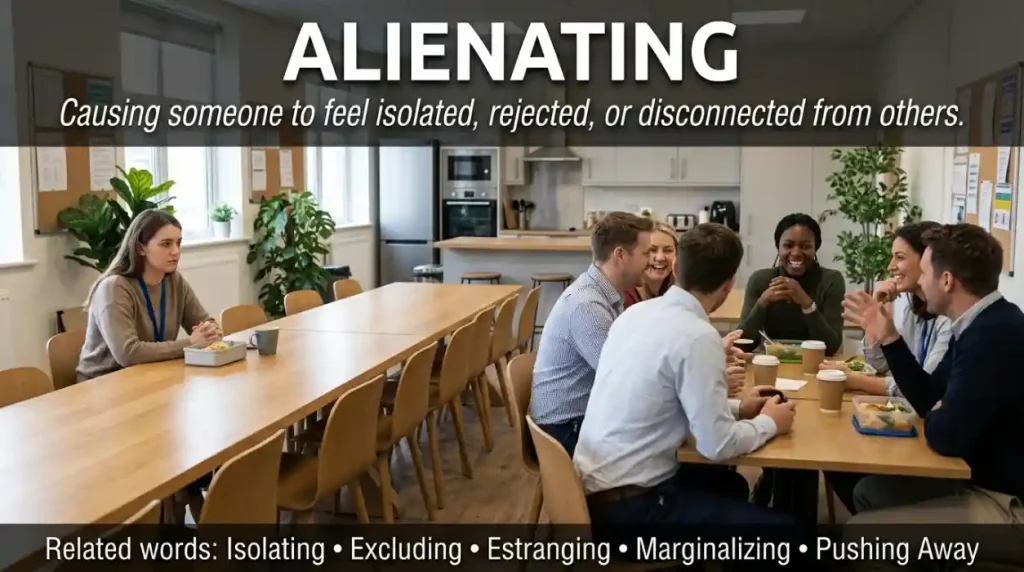
A synonym for alienating describes making someone feel excluded, unwelcome, distant, or disconnected. Common alternatives include isolating, estranging, distancing, excluding, and pushing away. The best choice depends on whether you mean emotional separation, social exclusion, or behavior that drives people apart.
Imagine a team meeting where one person dismisses every suggestion. Soon, other team members stop sharing ideas. That behavior can be described as alienating because it makes people feel unwelcome.
The word alienating often appears in discussions about relationships, leadership, politics, workplaces, and social behavior. It describes actions or experiences that create distance between people.
Finding the right synonym for alienating helps you explain these situations more precisely. Students can strengthen essays, bloggers can avoid repetitive wording, and content writers can communicate emotional nuance.
For example, excluding emphasizes leaving someone out, while estranging suggests a relationship becoming distant. Choosing the right word helps readers understand exactly what happened.
What Does “Alienating” Really Mean?
Alienating means causing someone to feel separated, unwelcome, misunderstood, or emotionally distant from another person or group. It can describe an action, attitude, policy, or experience that weakens a sense of connection.
For example, a manager who constantly criticizes employees in public may alienate the team. The employees might feel undervalued and become less willing to communicate openly.
Part of Speech and Simple Definition
- Part of speech: Verb form used as a present participle or gerund; it can also function as an adjective.
- Base verb: Alienate
- Simple definition: To make someone feel distant, excluded, or disconnected.
- Common forms: Alienate, alienates, alienated, and alienating.
As a verb form, alienating describes the process of creating distance. As an adjective, it describes something that makes people feel unwelcome.
Verb example: His dismissive attitude is alienating his coworkers.
Adjective example: The alienating atmosphere made new students reluctant to participate.
Native English speakers commonly use the word when discussing strained relationships, unwelcoming environments, divisive public messages, and decisions that weaken trust.
Connotative Meaning of Alienating
(Connotation is the emotional feeling or association a word carries beyond its literal definition.)
- Positive tone: The word itself rarely has a positive meaning. However, describing a behavior as less alienating can suggest greater inclusion and understanding.
- Negative tone: Alienating often suggests rejection, emotional hurt, exclusion, or a loss of trust.
- Neutral tone: In academic or social analysis, it can describe how a policy, environment, or experience creates distance without automatically assigning blame to one individual.
For example, “The technical language was alienating to new readers” identifies a communication problem. It does not necessarily suggest that the writer intended to exclude anyone.
Etymology
The word alienating comes from the verb alienate, which entered English through Latin alienare, meaning “to make another’s” or “to estrange.” The Latin root alienus means “belonging to another” or “foreign.”
Over time, the word shifted from transferring something away from its original owner to the broader idea of separating people emotionally, socially, or psychologically.
Old English Period (450–1100)
The modern word alienating was not an established Old English form. However, Old English had words for being foreign, separated, or apart from others. These related ideas provide historical context for the concept, but they are not direct forms of the modern word.
Middle English Period (1100–1500)
English vocabulary expanded through contact with French and Latin after the Norman Conquest. Forms related to alien and alienate entered English through this influence, carrying meanings connected with foreignness, transfer, and separation.
Modern English Period (1500–Present)
The word developed broader uses. Today, alienating can describe interpersonal behavior, social exclusion, political rhetoric, unfamiliar environments, and even complex writing that makes readers feel disconnected. In philosophy and sociology, related terms also describe a person’s sense of separation from work, society, or their own experience.
Pronunciation
- US IPA: /ˈeɪ.li.ə.neɪ.tɪŋ/
- UK IPA: /ˈeɪ.li.ə.neɪ.tɪŋ/
- Syllables: al-ien-ating
- Stress: The first syllable receives the main stress: AY-lee-uh-nay-ting.
Affixation Pattern
- Root/base: Alien
- Prefix: None in alienating
- Suffixes: -ate forms the verb alienate; -ing forms the present participle or gerund.
The word follows this pattern: alien → alienate → alienating. The historical root comes from Latin, although the modern English word has its own established grammatical forms.
Synonyms List
The alternatives below cover several related meanings. Some emphasize emotional distance, others focus on exclusion, and a few describe behavior that damages trust. They are not interchangeable in every sentence, so pay attention to each word’s specific meaning.
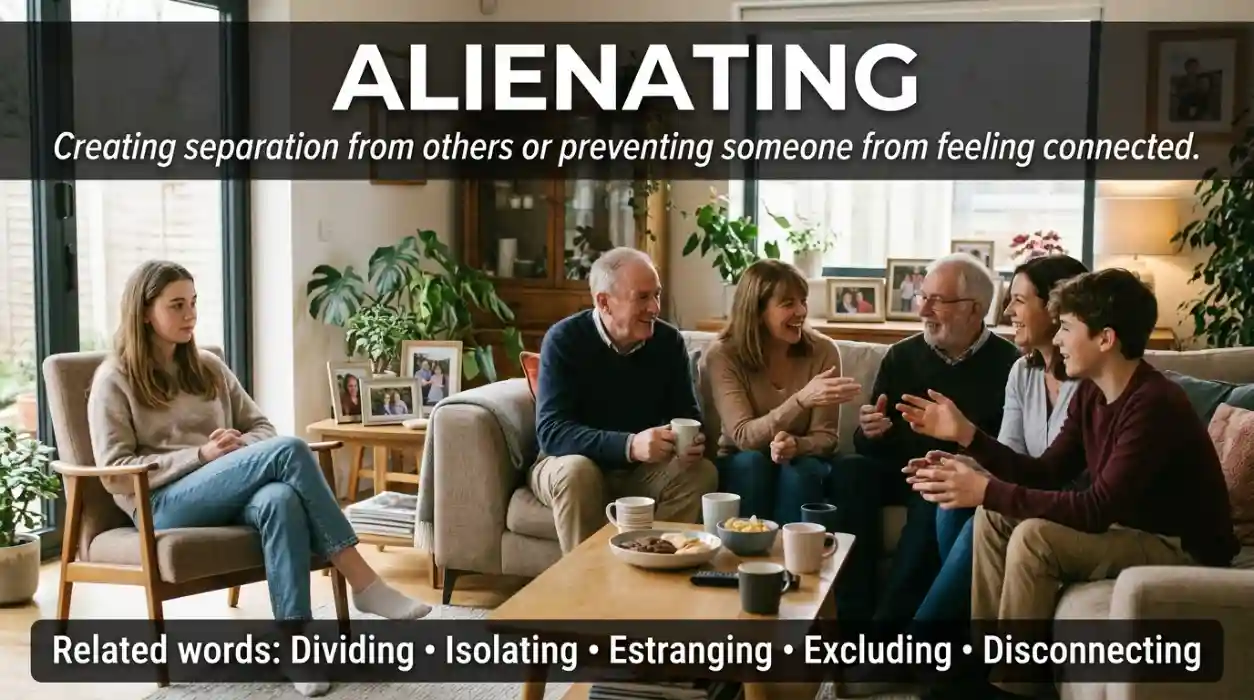
1. Isolating (Verb/Adjective) — US: /ˈaɪ.sə.leɪ.tɪŋ/; UK: /ˈaɪ.sə.leɪ.tɪŋ/
Meaning: Creating separation from other people or preventing someone from feeling connected.
Tone/Register: Neutral to negative; common in everyday, academic, and psychological contexts.
Examples:
Working remotely without social contact can feel isolating.
His decision to exclude the new employee was isolating her from the team.
2. Estranging (Verb) — US: /ɪˈstreɪn.dʒɪŋ/; UK: /ɪˈstreɪn.dʒɪŋ/
Meaning: Causing people who once had a relationship to become emotionally distant.
Tone/Register: Formal to neutral; often used for family or personal relationships.
Examples:
Their constant arguments were estranging the siblings.
She worried that the disagreement was estranging her from her closest friend.
3. Distancing (Verb) — US: /ˈdɪs.tæn.sɪŋ/; UK: /ˈdɪs.tɑːn.sɪŋ/
Meaning: Creating emotional, social, or physical distance between people.
Tone/Register: Neutral; common in professional and personal communication.
Examples:
His cold response was distancing him from his colleagues.
The public statement risked distancing the organization from its supporters.
4. Excluding (Verb) — US: /ɪkˈskluː.dɪŋ/; UK: /ɪkˈskluː.dɪŋ/
Meaning: Leaving someone out of a group, activity, decision, or opportunity.
Tone/Register: Neutral to negative; common in education, workplaces, and social settings.
Examples:
The club was excluding new members from important discussions.
Leaving her off the invitation list felt like excluding her deliberately.
5. Dividing (Verb/Adjective) — US: /dɪˈvaɪ.dɪŋ/; UK: /dɪˈvaɪ.dɪŋ/
Meaning: Creating disagreement or separation between people or groups.
Tone/Register: Neutral to negative; often used in politics, communities, and organizations.
Examples:
The controversial proposal was dividing the neighborhood.
His comments were dividing the team instead of bringing people together.
6. Alienating (Verb/Adjective) — US: /ˈeɪ.li.ə.neɪ.tɪŋ/; UK: /ˈeɪ.li.ə.neɪ.tɪŋ/
Meaning: Making someone feel unwelcome, disconnected, or emotionally separated.
Tone/Register: Neutral to negative; common in social analysis and relationship discussions.
Examples:
The manager’s sarcastic remarks were alienating the staff.
An alienating classroom can make students afraid to ask questions.
7. Marginalizing (Verb) — US: /ˈmɑːr.dʒə.nə.laɪ.zɪŋ/; UK: /ˈmɑː.dʒɪ.nəl.aɪ.zɪŋ/
Meaning: Treating a person or group as less important or pushing them to the edge of social participation.
Tone/Register: Formal, academic, or social and political discourse.
Examples:
The policy was marginalizing residents who lacked reliable internet access.
She challenged the practices that were marginalizing younger employees.
8. Disaffecting (Verb) — US: /ˌdɪs.əˈfek.tɪŋ/; UK: /ˌdɪs.əˈfek.tɪŋ/
Meaning: Causing someone to lose loyalty, confidence, or a sense of connection to a group or institution.
Tone/Register: Formal; often used in political or organizational contexts.
Examples:
The repeated broken promises were disaffecting longtime supporters.
Unfair treatment can disaffect employees who once trusted their leadership.
9. Repelling (Verb) — US: /rɪˈpel.ɪŋ/; UK: /rɪˈpel.ɪŋ/
Meaning: Causing someone to feel strong dislike or a desire to move away.
Tone/Register: Strong and negative; can describe behavior, attitudes, or physical reactions.
Examples:
His arrogant manner was repelling potential friends.
The hostile comments were repelling readers who initially supported the campaign.
10. Alienatingly (Adverb) — US: /ˈeɪ.li.ə.neɪ.tɪŋ.li/; UK: /ˈeɪ.li.ə.neɪ.tɪŋ.li/
Meaning: In a way that makes people feel disconnected or unwelcome.
Tone/Register: Formal and uncommon; most natural in analytical writing.
Examples:
The instructions were written alienatingly, with no explanation for beginners.
The speaker addressed the audience alienatingly, leaving little room for questions.
11. Divisive (Adjective) — US: /dɪˈvaɪ.sɪv/; UK: /dɪˈvaɪ.sɪv/
Meaning: Likely to create disagreement or deepen divisions within a group.
Tone/Register: Neutral to negative; common in news, politics, and workplace discussions.
Examples:
The divisive announcement split the community into opposing camps.
Her divisive remarks made cooperation much harder.
12. Exclusionary (Adjective) — US: /ɪkˈskluː.ʒəˌner.i/; UK: /ɪkˈskluː.ʒən.ər.i/
Meaning: Designed or likely to keep certain people out.
Tone/Register: Formal; often used in discussions of rules, systems, and social groups.
Examples:
The club’s exclusionary rules discouraged people from different backgrounds.
The application process felt exclusionary to first-time applicants.
13. Unwelcoming (Adjective) — US: /ʌnˈwel.kə.mɪŋ/; UK: /ʌnˈwel.kə.mɪŋ/
Meaning: Not making people feel accepted, comfortable, or invited.
Tone/Register: Neutral and widely used.
Examples:
The office seemed unwelcoming when nobody greeted the new staff member.
An unwelcoming tone can discourage readers from continuing an article.
14. Off-putting (Adjective) — US: /ˌɔːfˈpʊt̬.ɪŋ/; UK: /ˌɒfˈpʊt.ɪŋ/
Meaning: Making someone feel uncomfortable, dislike something, or lose interest.
Tone/Register: Informal to neutral; common in everyday English.
Examples:
His habit of interrupting people was off-putting.
The website’s aggressive pop-ups were off-putting to new visitors.
15. Alienated (Adjective/Past Participle) — US: /ˈeɪ.li.ə.neɪ.tɪd/; UK: /ˈeɪ.li.ə.neɪ.tɪd/
Meaning: Feeling separated, rejected, or disconnected from others.
Tone/Register: Neutral to negative; common in personal, social, and academic contexts.
Examples:
Several students felt alienated after the class groups were formed.
He became alienated from his former friends after the dispute.
16. Estranged (Adjective) — US: /ɪˈstreɪndʒd/; UK: /ɪˈstreɪndʒd/
Meaning: No longer emotionally close, often after conflict or a prolonged breakdown in a relationship.
Tone/Register: Neutral to formal; common in family and relationship contexts.
Examples:
She hoped to reconnect with her estranged brother.
The estranged colleagues had not spoken for months.
17. Detached (Adjective) — US: /dɪˈtætʃt/; UK: /dɪˈtætʃt/
Meaning: Emotionally distant or not strongly involved with other people.
Tone/Register: Neutral; can be positive in objective analysis but negative in relationships.
Examples:
His detached response made his friends think he did not care.
The presenter sounded detached from the audience’s concerns.
18. Disconnected (Adjective) — US: /ˌdɪs.kəˈnek.tɪd/; UK: /ˌdɪs.kəˈnek.tɪd/
Meaning: Lacking a strong connection, shared understanding, or sense of belonging.
Tone/Register: Neutral to negative; common in social, technical, and professional contexts.
Examples:
The new policy left frontline workers feeling disconnected from leadership.
I felt disconnected from the conversation because I had missed the background.
19. Estranging from Others (Verb Phrase) — US: /ɪˈstreɪn.dʒɪŋ frəm ˈʌð.ɚz/; UK: /ɪˈstreɪn.dʒɪŋ frəm ˈʌð.əz/
Meaning: Gradually weakening a person’s relationships with other people.
Tone/Register: Formal and explanatory.
Examples:
His refusal to listen was estranging him from others.
She noticed that constant competition was estranging her from her friends.
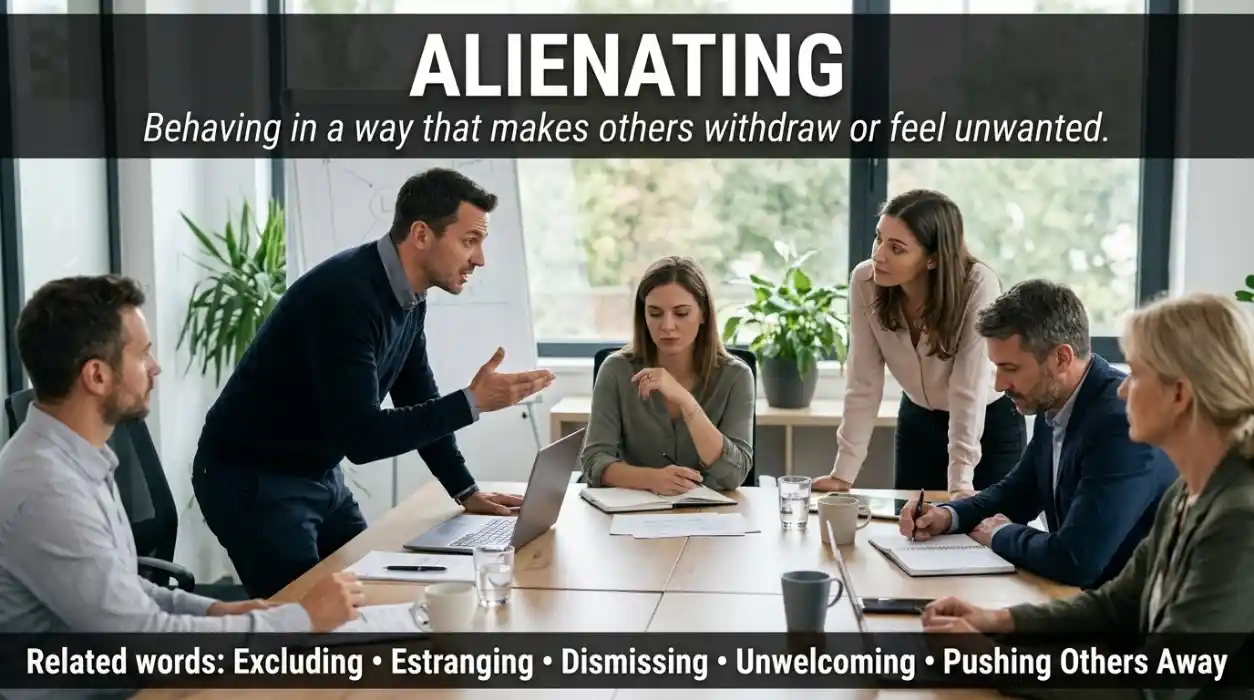
20. Pushing Away (Verb Phrase) — US: /ˌpʊʃ.ɪŋ əˈweɪ/; UK: /ˌpʊʃ.ɪŋ əˈweɪ/
Meaning: Behaving in a way that makes others withdraw or feel unwanted.
Tone/Register: Conversational and emotional.
Examples:
He kept pushing away the people who wanted to help him.
Her defensive jokes were pushing away new friends.
21. Shutting Out (Phrasal Verb) — US: /ˌʃʌt.ɪŋ ˈaʊt/; UK: /ˌʃʌt.ɪŋ ˈaʊt/
Meaning: Deliberately preventing someone from participating or sharing an experience.
Tone/Register: Conversational; often implies intentional exclusion.
Examples:
The group was shutting out anyone who disagreed with its leader.
Please stop shutting out your teammates during planning meetings.
22. Sidelining (Verb) — US: /ˈsaɪd.laɪ.nɪŋ/; UK: /ˈsaɪd.laɪ.nɪŋ/
Meaning: Pushing someone away from an important role, activity, or decision.
Tone/Register: Neutral to negative; common in workplace and political contexts.
Examples:
The director was sidelining experienced staff members.
Sidelining community voices can damage public trust.
23. Ostracizing (Verb) — US: /ˈɑː.strə.saɪ.zɪŋ/; UK: /ˈɒs.trə.saɪ.zɪŋ/
Meaning: Deliberately excluding someone from a social group or community.
Tone/Register: Formal and strongly negative.
Examples:
The students were ostracizing a classmate because of a rumor.
Employees should not fear being ostracized for asking reasonable questions.
24. Alienation-Producing (Adjective) — US: /ˌeɪ.li.əˈneɪ.ʃən prəˈduː.sɪŋ/; UK: /ˌeɪ.li.əˈneɪ.ʃən prəˈdjuː.sɪŋ/
Meaning: Causing or contributing to a feeling of separation or disconnection.
Tone/Register: Academic or analytical; less natural in everyday conversation.
Examples:
The researchers examined alienation-producing conditions in large organizations.
The report identified several alienation-producing features of the service.
25. Disheartening (Adjective) — US: /dɪsˈhɑːr.tən.ɪŋ/; UK: /dɪsˈhɑː.tən.ɪŋ/
Meaning: Causing someone to lose confidence, hope, or enthusiasm.
Tone/Register: Neutral to negative; common in personal and professional contexts.
Examples:
It was disheartening to have every suggestion dismissed.
The lack of feedback became disheartening for the volunteers.
26. Alienating in Effect (Adjective Phrase) — US: /ˈeɪ.li.ə.neɪ.tɪŋ ɪn ɪˈfekt/; UK: /ˈeɪ.li.ə.neɪ.tɪŋ ɪn ɪˈfekt/
Meaning: Producing a feeling of distance or exclusion, regardless of the original intention.
Tone/Register: Formal and analytical.
Examples:
The rule was intended to improve security but was alienating in effect.
The campaign’s language was alienating in effect, even though its goal was inclusion.
27. Unfriendly (Adjective) — US: /ʌnˈfrend.li/; UK: /ʌnˈfrend.li/
Meaning: Showing little warmth or kindness and making others less comfortable approaching you.
Tone/Register: Neutral to negative; common in everyday English.
Examples:
The receptionist’s unfriendly response made visitors hesitate to ask for help.
An unfriendly opening can discourage readers from exploring a website.
28. Hostile (Adjective) — US: /ˈhɑː.stəl/; UK: /ˈhɒs.taɪl/
Meaning: Showing opposition, anger, or aggression that can make others feel unwelcome.
Tone/Register: Strongly negative; common in conflict, workplace, and political contexts.
Examples:
The hostile exchange made future cooperation difficult.
New employees struggled in the team’s hostile atmosphere.
29. Antagonizing (Verb/Adjective) — US: /ænˈtæɡ.ə.naɪ.zɪŋ/; UK: /ænˈtæɡ.ə.naɪ.zɪŋ/
Meaning: Provoking irritation or opposition in a way that damages goodwill.
Tone/Register: Neutral to negative; common in interpersonal and professional discussions.
Examples:
His sarcastic replies were antagonizing the people he needed to persuade.
Try to explain the decision without antagonizing your audience.
30. Alienating People (Verb Phrase) — US: /ˈeɪ.li.ə.neɪ.tɪŋ ˈpiː.pəl/; UK: /ˈeɪ.li.ə.neɪ.tɪŋ ˈpiː.pəl/
Meaning: Causing people to feel unwelcome, distant, or less connected.
Tone/Register: Neutral; useful in general discussions.
Examples:
A leader risks alienating people by refusing to hear their concerns.
The writer revised the introduction to avoid alienating people unfamiliar with the topic.
31. Repulsing (Verb) — US: /rɪˈpʌl.sɪŋ/; UK: /rɪˈpʌl.sɪŋ/
Meaning: Causing strong dislike or an instinctive desire to withdraw.
Tone/Register: Strongly negative; often more intense than alienating.
Examples:
The cruel joke was repulsing people who had once admired him.
The campaign’s insulting language was repulsing undecided voters.
32. Alienating Others (Verb Phrase) — US: /ˈeɪ.li.ə.neɪ.tɪŋ ˈʌð.ɚz/; UK: /ˈeɪ.li.ə.neɪ.tɪŋ ˈʌð.əz/
Meaning: Acting in ways that make other people feel excluded or disconnected.
Tone/Register: Neutral to negative.
Examples:
She worried that her blunt feedback was alienating others.
He began asking questions instead of alienating others with assumptions.
33. Separating (Verb/Adjective) — US: /ˈsep.ə.reɪ.tɪŋ/; UK: /ˈsep.ə.reɪ.tɪŋ/
Meaning: Creating a division between people, groups, or ideas.
Tone/Register: Neutral; the context determines whether the division is harmful.
Examples:
The new seating arrangement was separating friends who had worked together for years.
The disagreement was separating the group into two camps.
34. Fragmenting (Verb) — US: /ˈfræɡ.men.tɪŋ/; UK: /ˈfræɡ.men.tɪŋ/
Meaning: Breaking a group or community into smaller, less connected parts.
Tone/Register: Formal; common in social, political, and organizational writing.
Examples:
Conflicting instructions were fragmenting the volunteer network.
The debate was fragmenting a team that once worked well together.
35. Polarizing (Verb/Adjective) — US: /ˈpoʊ.lə.raɪ.zɪŋ/; UK: /ˈpəʊ.lə.raɪ.zɪŋ/
Meaning: Driving people toward opposing sides and making agreement more difficult.
Tone/Register: Neutral to negative; common in media and political discussions.
Examples:
The candidate’s comments were polarizing the audience.
A polarizing headline can discourage constructive discussion.
36. Disenfranchising (Verb) — US: /ˌdɪs.ɪnˈfræn.tʃaɪ.zɪŋ/; UK: /ˌdɪs.ɪnˈfræn.tʃaɪ.zɪŋ/
Meaning: Depriving people of rights, influence, or meaningful participation.
Tone/Register: Formal, political, or legal.
Examples:
The proposed restrictions risked disenfranchising eligible voters.
A process can disenfranchise residents if they cannot access the required information.
37. Dehumanizing (Verb/Adjective) — US: /ˌdiːˈhjuː.mə.naɪ.zɪŋ/; UK: /ˌdiːˈhjuː.mə.naɪ.zɪŋ/
Meaning: Treating people as less than fully human, often undermining their dignity and belonging.
Tone/Register: Strongly negative; common in ethics, history, and social commentary.
Examples:
The article criticized language that was dehumanizing refugees.
Dehumanizing remarks can seem acceptable.
38. Depersonalizing (Verb/Adjective) — US: /ˌdiːˈpɝː.sən.ə.laɪ.zɪŋ/; UK: /ˌdiːˈpɜː.sən.ə.laɪ.zɪŋ/
Meaning: Removing the personal attention or human connection that helps someone feel recognized.
Tone/Register: Formal or professional; common in discussions of systems and services.
Examples:
The automated process felt depersonalizing to grieving families.
She added personal greetings to make the service less depersonalizing.
39. Alienating from the Group (Verb Phrase) — US: /ˈeɪ.li.ə.neɪ.tɪŋ frəm ðə ɡruːp/; UK: /ˈeɪ.li.ə.neɪ.tɪŋ frəm ðə ɡruːp/
Meaning: Causing someone to lose a sense of membership or connection within a group.
Tone/Register: Neutral to formal.
Examples:
The team’s inside jokes were alienating a new colleague from the group.
The policy risked alienating rural members from the wider organization.
40. Making Someone Feel Left Out (Verb Phrase) — US: /ˈmeɪ.kɪŋ ˈsʌm.wʌn fiːl left aʊt/; UK: /ˈmeɪ.kɪŋ ˈsʌm.wʌn fiːl left aʊt/
Meaning: Causing someone to feel that they do not belong or are not included.
Tone/Register: Conversational and clear.
Examples:
Planning the celebration without her made her feel left out.
Remember to include remote colleagues so they do not feel left out.
41. Discouraging (Verb/Adjective) — US: /dɪˈskɝː.ɪ.dʒɪŋ/; UK: /dɪˈskʌr.ɪ.dʒɪŋ/
Meaning: Reducing someone’s confidence or willingness to participate.
Tone/Register: Neutral; the context can make it negative.
Examples:
Mocking beginners is discouraging people from joining the class.
The repeated rejections were discouraging new volunteers.
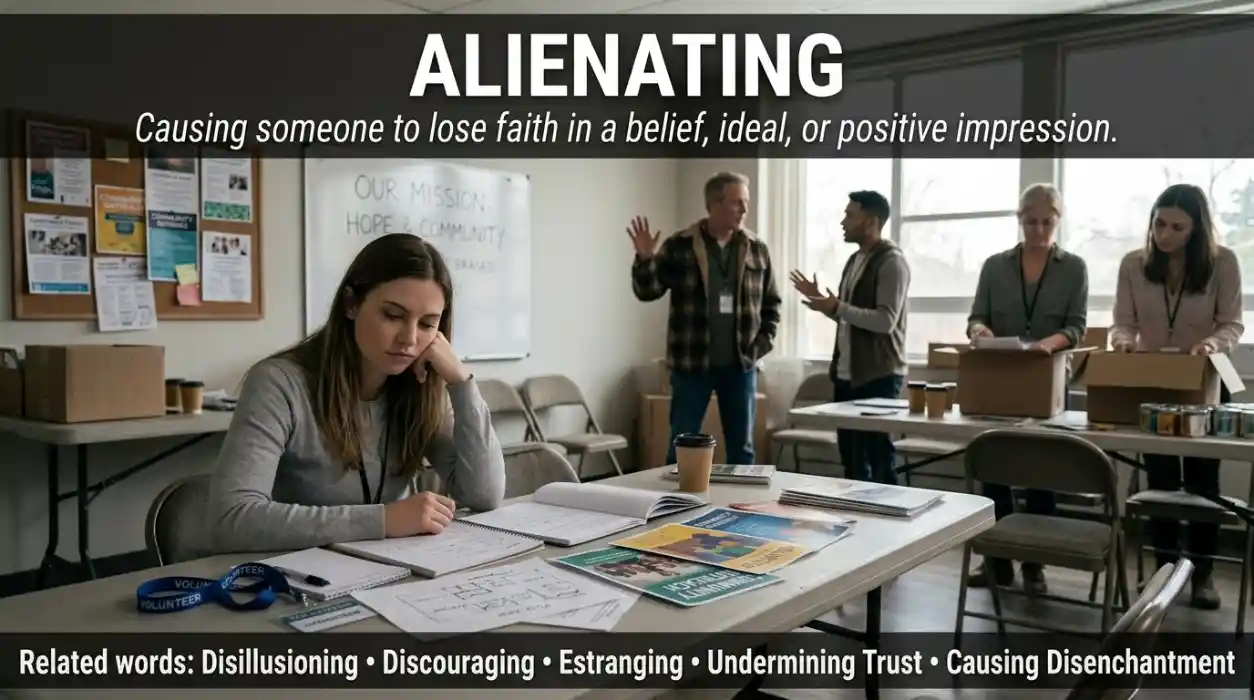
42. Disillusioning (Verb/Adjective) — US: /ˌdɪs.ɪˈluː.ʒən.ɪŋ/; UK: /ˌdɪs.ɪˈluː.ʒən.ɪŋ/
Meaning: Causing someone to lose a belief, ideal, or positive impression.
Tone/Register: Neutral to negative; common in reflective and professional writing.
Examples:
The lack of transparency was disillusioning longtime supporters.
It was disillusioning to discover that the promises had never been realistic.
43. Demoralizing (Adjective/Verb) — US: /dɪˈmɔːr.ə.laɪ.zɪŋ/; UK: /dɪˈmɒr.ə.laɪ.zɪŋ/
Meaning: Lowering someone’s confidence, morale, or motivation.
Tone/Register: Neutral to negative; common in workplace and educational settings.
Examples:
Public criticism was demoralizing the entire team.
Repeatedly ignoring student questions can be demoralizing.
44. Intimidating (Adjective/Verb) — US: /ɪnˈtɪm.ə.deɪ.tɪŋ/; UK: /ɪnˈtɪm.ɪ.deɪ.tɪŋ/
Meaning: Making someone feel afraid, nervous, or too uncertain to participate.
Tone/Register: Neutral to negative; common in social and professional contexts.
Examples:
The intimidating interview panel made the candidate struggle to speak.
A complicated application process can feel intimidating to newcomers.
45. Alienating in Tone (Adjective Phrase) — US: /ˈeɪ.li.ə.neɪ.tɪŋ ɪn toʊn/; UK: /ˈeɪ.li.ə.neɪ.tɪŋ ɪn təʊn/
Meaning: Communicating in a way that makes an audience feel judged, unwelcome, or distant.
Tone/Register: Formal and analytical.
Examples:
The email was alienating in tone, even though the request was reasonable.
Her draft sounded alienating in tone, so she softened its opening.
46. Condescending (Adjective) — US: /ˌkɑːn.dɪˈsen.dɪŋ/; UK: /ˌkɒn.dɪˈsen.dɪŋ/
Meaning: Speaking or behaving as if others are less intelligent or important.
Tone/Register: Negative; common in interpersonal and workplace discussions.
Examples:
His condescending explanation made the new staff member uncomfortable.
People may stop asking questions when a trainer sounds condescending.
47. Patronizing (Adjective/Verb) — US: /ˈpeɪ.trə.naɪ.zɪŋ/; UK: /ˈpæt.rə.naɪ.zɪŋ/
Meaning: Treating someone with an exaggerated or insincere kindness that implies superiority.
Tone/Register: Negative; common in discussions of communication and power.
Examples:
Her patronizing advice made the student feel underestimated.
Try to explain the process without patronizing your audience.
48. Alienatingly Cold (Adjective Phrase) — US: /ˈeɪ.li.ə.neɪ.tɪŋ.li koʊld/; UK: /ˈeɪ.li.ə.neɪ.tɪŋ.li kəʊld/
Meaning: Emotionally distant in a way that makes others feel unwelcome.
Tone/Register: Descriptive and expressive; useful in reviews and storytelling.
Examples:
The manager’s alienatingly cold response ended the conversation.
The character’s alienatingly cold manner concealed a deep fear of rejection.
49. Unapproachable (Adjective) — US: /ˌʌn.əˈproʊ.tʃə.bəl/; UK: /ˌʌn.əˈprəʊ.tʃə.bəl/
Meaning: Seeming difficult to approach, talk to, or ask for help.
Tone/Register: Neutral to negative; common in professional and social contexts.
Examples:
The director seemed unapproachable, so employees rarely shared concerns.
A friendly greeting can make a new teacher seem less unapproachable.
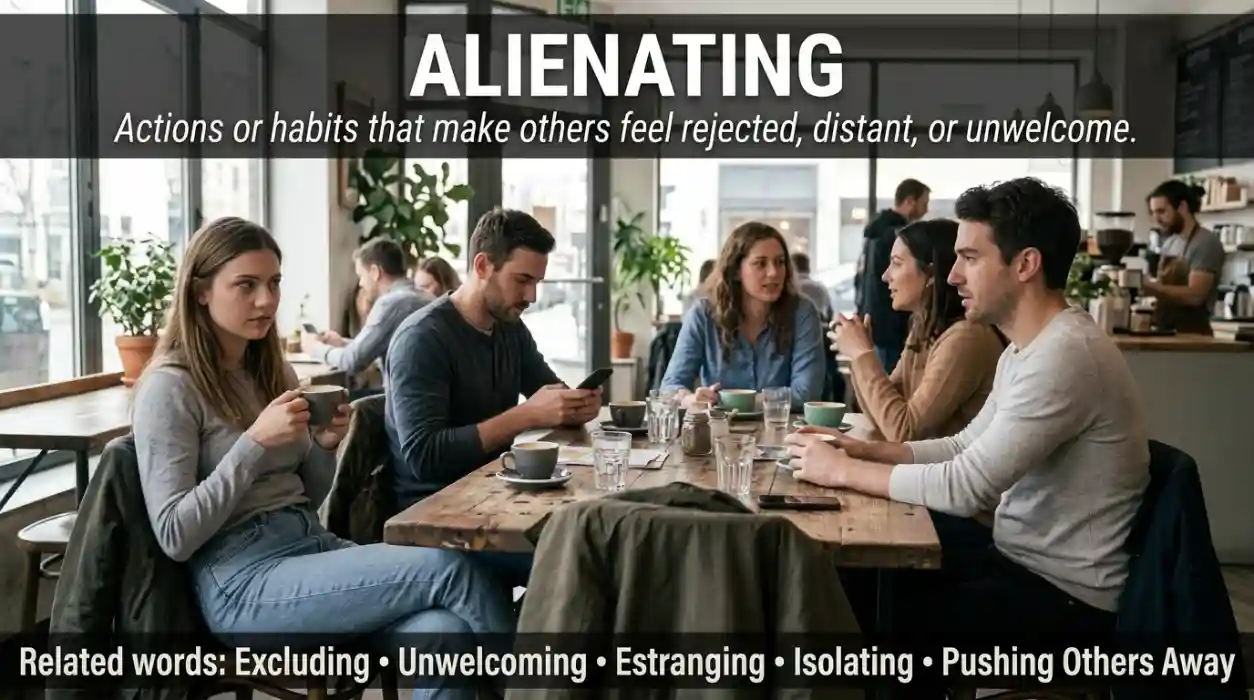
50. Alienating Behavior (Noun Phrase) — US: /ˈeɪ.li.ə.neɪ.tɪŋ bɪˈheɪ.vjɚ/; UK: /ˈeɪ.li.ə.neɪ.tɪŋ bɪˈheɪ.vjə/
Meaning: Actions or habits that cause other people to feel rejected, distant, or unwelcome.
Tone/Register: Neutral to formal; useful in analysis and reflective writing.
Examples:
Interrupting everyone became an alienating behavior that weakened the team’s trust.
He began noticing his alienating behavior and made an effort to listen more carefully.
Synonyms by Tone
Not every alternative to alienating carries the same emotional weight. Choose words that describe the actual behavior or effect rather than simply replacing one word with another.
Positive or Constructive Alternatives
There are few genuinely positive synonyms for alienating, because the word generally describes separation or disconnection. When you want to describe the opposite effect, use expressions such as:
- Welcoming: Making people feel accepted.
- Inclusive: Helping people participate and belong.
- Reassuring: Reducing worry and uncertainty.
- Connecting: Creating a sense of relationship or shared understanding.
- Bringing people together: Encouraging cooperation and closeness.
These are antonyms or contrasting expressions, not direct synonyms. They are useful when revising an alienating situation into a constructive one.
Neutral Alternatives
These words can describe separation without necessarily assigning blame:
- Distancing: Creating or maintaining distance.
- Separating: Dividing people or groups.
- Disconnected: Lacking a strong sense of connection.
- Detached: Emotionally uninvolved or distant.
- Dividing: Creating a separation or difference.
- Unapproachable: Seeming difficult to talk to.
Negative Alternatives
These choices communicate stronger exclusion, conflict, or emotional harm:
- Ostracizing: Deliberately excluding someone from a group.
- Marginalizing: Treating a person or group as less important.
- Exclusionary: Keeping certain people out.
- Hostile: Showing aggression or opposition.
- Antagonizing: Provoking anger or resistance.
- Condescending: Treating others as inferior.
- Dehumanizing: Denying or diminishing people’s humanity.
Informal and Conversational Alternatives
For everyday conversations, these phrases often sound more natural than alienating:
- Pushing people away
- Making someone feel left out
- Shutting people out
- Turning people off
- Making people uncomfortable
- Driving people away
Why tone matters: Ostracizing suggests strong social exclusion, while off-putting may describe something merely unpleasant or discouraging. Selecting the right intensity makes your writing more accurate and fair.
“Alienating” vs. Close Alternatives
| Word | Main difference | Best use |
|---|---|---|
| Alienating | Broadly describes causing disconnection or loss of belonging | Relationships, communication, policies, and environments |
| Isolating | Emphasizes separation from contact or support | Loneliness, limited social contact, or exclusion |
| Estranging | Emphasizes a relationship becoming distant over time | Family, friendship, or long-term relationships |
| Excluding | Emphasizes being left out of a group, event, or opportunity | Invitations, membership, access, and participation |
| Marginalizing | Emphasizes reduced status, influence, or participation | Social systems, workplace power, and public policy |
Consider these examples:
- “The manager’s attitude is alienating employees.” This highlights the loss of connection.
- “Working alone for weeks can be isolating.” This highlights separation from other people.
- “Years of conflict have estranged the sisters.” This highlights a damaged relationship.
- “The organizers are excluding residents.” This highlights being left out.
- “The policy is marginalizing smaller communities.” This highlights reduced influence or access.
The most accurate choice depends on the cause and effect you want to emphasize.
How “Alienating” Changes by Context
Daily Conversation
In everyday speech, people often prefer simple phrases such as pushing people away, making others feel left out, or being unfriendly. These expressions communicate emotional effects without sounding overly academic.
For example, “You’re pushing people away when you dismiss their ideas” sounds direct and conversational. “Your conduct is alienating your peers” sounds more formal.
Writing and Blogging
In articles, alienating can describe a tone, design choice, policy, or communication style that causes readers to disengage.
For example, a blog full of unexplained technical terms may feel alienating to beginners. A clearer introduction and practical examples can make the same topic more welcoming.
Writers can also use exclusionary, off-putting, or divisive when the context supports those meanings.
Professional and Academic English
In workplaces, alienating often describes behavior that weakens trust or makes employees feel disconnected from leadership.
Academic writing may use marginalizing to discuss unequal influence or participation. It may use ostracizing when a group deliberately excludes a person.
Choose a term that reflects the evidence. Do not label a decision discriminatory or ostracizing unless the situation supports that stronger claim.
Creative and Informal Writing
In fiction, the right word can reveal a character’s effect on others. Cold describes a lack of warmth, condescending suggests superiority, and off-putting captures a reaction of discomfort or dislike.
For example, “His clipped answers made him seem unapproachable” creates a different impression from “His cruel jokes were ostracizing his classmates.”
Common Mistakes Learners Make
Mistake 1: Treating Every Alternative as an Exact Synonym
Alienating, isolating, and excluding overlap, but they describe different effects. Someone can feel alienated without being physically isolated or formally excluded.
Use the word that matches the situation instead of swapping synonyms mechanically.
Mistake 2: Confusing “Alienated” With “Alienating”
Alienating usually describes the action or quality that causes disconnection. Alienated usually describes the person who feels disconnected.
- “The comments were alienating.” The comments caused distance.
- “The employees felt alienated.” The employees experienced that distance.
Mistake 3: Using “Ostracizing” for Every Unfriendly Action
Ostracism usually involves excluding someone from a group. A person who speaks abruptly may be unfriendly or off-putting, but that does not necessarily mean they are ostracizing anyone.
Reserve ostracizing for situations involving meaningful social exclusion.
Mistake 4: Overstating the Emotional Harm
Hostile, dehumanizing, and repulsing can convey stronger meanings than alienating. Using them without enough evidence can make a description sound exaggerated.
If a presentation is difficult to understand, calling it confusing may be more accurate than calling it hostile or dehumanizing.
Mistake 5: Confusing “Divisive” With “Alienating”
A divisive statement creates disagreement between people or groups. An alienating statement makes someone feel distant or unwelcome.
A remark can be both, but the terms highlight different effects.
Register Notes
- Formal: marginalizing, ostracizing, exclusionary, estranging.
- Neutral: alienating, distancing, disconnected, unfriendly.
- Conversational: pushing people away, shutting people out, making someone feel left out.
- Strongly negative: hostile, dehumanizing, repulsing.
In spoken English, straightforward phrases often sound more natural. In academic writing, precise terms can help explain complex social behavior.
For a related vocabulary exercise, you could also explore synonyms for exclusion or disconnection to understand the differences between these ideas.
Real-Life Mini Scenarios
Workplace Scenario
A supervisor criticizes employees in front of their colleagues. Staff members stop offering suggestions and begin avoiding discussions.
Best description: The supervisor’s behavior is alienating the team. If the supervisor deliberately removes certain employees from decisions, sidelining or excluding may be more precise.
Social Scenario
A group of friends repeatedly makes plans without inviting one member. That person begins to feel unwanted.
Best description: The group is excluding the friend and may be making them feel left out. If the group consistently rejects the person, ostracism could fit.
Media and Public Discussion
A public figure uses language that insults an entire community. Some listeners feel unwelcome, while others become more firmly opposed to the speaker.
Best description: The language may be alienating and divisive. If it drives the audience into opposing camps, polarizing captures that additional effect.
Writing and Storytelling
A novelist writes dialogue filled with obscure references. Readers who do not understand those references struggle to connect with the characters.
Best description: The dialogue may feel alienating or off-putting. Revising it with clearer context can help more readers engage with the story.
Practice Quiz:
1. A manager’s rude comments make employees feel disconnected from the team. Which word fits best?
A. Welcoming
B. Alienating
C. Reassuring
D. Encouraging
2. A school club deliberately refuses to let one student participate. Which verb is most accurate?
A. Ostracizing
B. Connecting
C. Reassuring
D. Welcoming
3. Two siblings become emotionally distant after years of arguments. Which word best describes their relationship?
A. Inclusive
B. Estranged
C. Encouraged
D. Approachable
4. A policy leaves a minority group with less influence in community decisions. Which term is most suitable?
A. Marginalizing
B. Welcoming
C. Reassuring
D. Connecting
5. A speaker’s comments make an audience feel uncomfortable and lose interest. Which adjective fits?
A. Off-putting
B. Inclusive
C. Reassuring
D. Supportive
6. A supervisor speaks to colleagues as if they are unintelligent. Which word describes this behavior?
A. Welcoming
B. Condescending
C. Inclusive
D. Reassuring
7. A political speech pushes people toward two opposing sides. Which adjective is most appropriate?
A. Polarizing
B. Reassuring
C. Approachable
D. Encouraging
8. A person stops inviting a friend to group activities. What is the clearest everyday description?
A. Making the friend feel left out
B. Bringing the friend together
C. Reassuring the friend
D. Welcoming the friend
9. A workplace environment makes staff members afraid to ask questions because people respond aggressively. Which word fits best?
A. Hostile
B. Welcoming
C. Inclusive
D. Reassuring
Answer Key
1-B | 2-A | 3-B | 4-A | 5-A | 6-B | 7-A | 8-A | 9-A
Reflection Task
Think of a real or fictional situation in which someone feels disconnected from a group. Write two sentences describing it. Use alienating in one sentence and a more precise alternative, such as excluding, isolating, or ostracizing, in the other.
External Sources
For further study, consult these established language references:
- Merriam-Webster Dictionary — definitions and usage information for alienate and related words.
- Cambridge Dictionary — learner-friendly meanings, pronunciation, and example sentences.
- Oxford Learner’s Dictionaries — grammatical patterns, pronunciation, and practical usage examples.
These sources can help you verify a word’s meaning and see how it functions in natural English.
Conclusion
Choosing the right synonym for alienating helps you describe exclusion, emotional distance, and strained relationships with greater accuracy. Small word choices can change how readers understand a situation.
A stronger vocabulary improves essays, blogs, workplace emails, and everyday conversations. Learning each word’s emotional tone helps you communicate honestly without exaggerating or repeating yourself.
You do not need to memorize all 50 alternatives at once. Start with three useful words, learn their differences, and try them in sentences that reflect real experiences.
Practice using these expressions in an email, an essay, or a daily conversation. With each attempt, you will become more confident at expressing complex feelings in simple English.
FAQs
1. What is the best synonym for alienating in an essay?
Isolating, estranging, excluding, and marginalizing can work well, depending on your argument. Use isolating when the focus is separation from others, estranging when a relationship becomes distant, and excluding when someone is left out. Choose marginalizing when the issue involves reduced influence or participation. The strongest academic word is the one that matches your evidence.
2. What is a synonym for alienating someone in a relationship?
Pushing someone away is a natural conversational alternative. Estranging is more formal and suggests that a relationship is becoming distant over time. Distancing yourself from someone emphasizes the creation of emotional space. The right phrase depends on whether someone is deliberately avoiding another person, behaving in an unwelcoming way, or experiencing a gradual breakdown in closeness.
3. What is the difference between alienating and marginalizing?
Alienating focuses on making people feel disconnected or unwelcome. Marginalizing focuses on reducing someone’s influence, status, or ability to participate. For example, dismissive comments may alienate a colleague. A workplace system that repeatedly excludes that colleague from important decisions may marginalize them. The same situation can involve both effects, but each word highlights a different problem.
4. What is a synonym for alienating in a political context?
Divisive and polarizing are useful when political language or decisions create conflict between groups. Exclusionary fits policies that keep certain people out, while marginalizing describes practices that reduce a group’s influence. These terms are related but not identical. Choose based on whether you are describing disagreement, opposing camps, restricted access, or reduced participation.
5. What is the opposite of alienating?
Common opposites include welcoming, inclusive, connecting, reassuring, and bringing people together. The best choice depends on the intended contrast. Welcoming describes making people feel accepted. Inclusive emphasizes participation and belonging. Connecting highlights the creation of relationships or shared understanding. These are antonyms or contrasting expressions rather than synonyms, since they describe the opposite effect.

Hasnain Ali is an SEO Content Strategist and the founder of wordvora.com, a trusted vocabulary platform that helps writers, students, professionals, and English learners find accurate synonyms, antonyms, word meanings, and real-life usage examples. He specializes in keyword research, on-page SEO, topical authority, and creating search-first content that aligns with Google’s latest Search Quality and E-E-A-T guidelines. His work focuses on producing clear, well-structured, and reader-friendly resources that satisfy search intent while maintaining high editorial standards.
Through extensive hands-on experience with SEO tools such as Google Search Console, Google Analytics, SEMrush, and Ahrefs, Hasnain researches user search behavior and develops content that is both informative and easy to understand. Every article published on wordvora.com is carefully reviewed for accuracy, readability, and contextual relevance before publication. His mission is to build one of the web’s most reliable English vocabulary resources by providing practical language guidance, trustworthy explanations, and content that helps readers improve their writing, communication, and vocabulary with confidence.