
A synonym for all over is a word or phrase that expresses the idea of being everywhere, covering an entire area, or extending throughout a place. Common alternatives include everywhere, throughout, all around, across the area, and from end to end. The best choice depends on the context and intended meaning.
Imagine walking into a room after a birthday party. Balloons hang from the ceiling, confetti covers the floor, and decorations fill every corner. You might say, “There are decorations all over the room.” Learning another way to express this idea makes your English more flexible.
The phrase synonym for all over is useful when you want to describe a place, explain how something spreads, or make your writing sound more precise. Small vocabulary changes can make everyday conversations more engaging.
Native English speakers use all over in conversations, messages, stories, and articles. Students can improve their essays with suitable alternatives. Bloggers and content writers can also avoid repetitive wording without changing their intended meaning.
In this guide, you’ll discover 50 alternatives to all over, learn their differences, and explore practical examples. You’ll also find pronunciation guidance, common mistakes, and a quiz to help you use each expression confidently.
What Does “All Over” Really Mean?
All over is a phrase that usually means everywhere within a particular place, throughout an area, or across the whole surface of something. Its exact meaning depends on the words around it.
Consider these examples:
- “Mud was all over the floor.” Mud covered many parts of the floor.
- “I searched all over the house.” I searched throughout the house.
- “Her photographs are all over social media.” Her photographs appear on many platforms or in many places.
- “Let’s start all over.” Let’s begin again from the beginning.
The phrase can describe physical locations, widespread distribution, repeated actions, and other ideas. Therefore, not every alternative fits every sentence.
Part of speech
All over generally functions as a prepositional phrase or an adverbial expression, depending on its grammatical construction.
In “all over the garden,” it introduces the area where something is located. In “I looked all over,” it modifies the verb looked by describing the extent of the search.
How native speakers understand it
Native speakers usually understand the phrase through context. They may interpret it as covering an area, appearing in many locations, or searching widely.
The expression sounds natural and conversational. It is suitable for informal speech and much everyday writing. More precise alternatives can work better in academic, professional, or technical contexts.
Connotative meaning
(Connotation is the feeling, association, or attitude a word or phrase suggests beyond its basic dictionary meaning.)
- Positive tone: “Flowers were blooming all over the garden.” This suggests abundance and beauty.
- Negative tone: “Dirty clothes were all over the bedroom.” This suggests untidiness.
- Neutral tone: “Branches were scattered all over the field.” This simply describes their distribution.
The phrase itself is not inherently positive or negative. The surrounding details create its emotional effect.
Etymology of “All Over”
The expression combines two Old English words: all and over.
All comes from Old English eall, meaning the whole amount or entirety. Over comes from Old English ofer, referring to a position above, across, or beyond something. Both words have Germanic roots.
The modern expression developed from these established meanings. Together, the words can communicate coverage across an entire area or extent beyond a single location.
A short history
- Old English (450–1100): Eall and ofer already expressed ideas of entirety, position, and movement across or above something. Their modern spellings developed later.
- Middle English (1100–1500): The words evolved in spelling and usage. English increasingly used combinations of common words to express spatial relationships and extent.
- Modern English (1500–present): All over became a familiar expression for widespread presence and coverage. It also developed other contextual uses, such as “start all over” and “be all over the news.”
These are the histories of the component words and their development in English, rather than a claim that the complete phrase appeared in its modern form during a specific year.

Pronunciation
US English: /ɔːl ˈoʊvər/ UK English: /ɔːl ˈəʊvə/
Pronunciation varies slightly by accent. In connected speech, the phrase often sounds smooth, with the stress falling mainly on over.
Syllables
all-o-ver — three syllables in total.
Affixation pattern
- Root or base words: all + over
- Prefix: None
- Suffix: None
- Word formation: A combination of two independent words forming a conventional expression.
Unlike a word such as everywhere, the phrase does not rely on a prefix or suffix to create its meaning.
Synonyms List
The following alternatives cover several closely related meanings: being everywhere, covering a surface, extending through a place, and appearing widely. Some are direct replacements; others work only in specific contexts.
1. Everywhere (Adverb) — US / UK: /ˈɛvriˌwɛr/ / /ˈɛvriweə/
Meaning: In every place or in all the places relevant to a situation.
Tone/Register: Neutral; everyday English.
Example:
I looked everywhere for my missing keys.
Wildflowers are growing everywhere this spring.
2. Throughout (Preposition/Adverb) — US / UK: /θruːˈaʊt/ / /θruːˈaʊt/
Meaning: In every part of a place or across the whole duration of something.
Tone/Register: Neutral to formal; academic and professional writing.
Example:
The new signs are displayed throughout the building.
She remained calm throughout the interview.
3. All Around (Adverbial Phrase) — US / UK: /ɔːl əˈraʊnd/ / /ɔːl əˈraʊnd/
Meaning: In many directions or on every side of a person or place.
Tone/Register: Neutral; conversational.
Example:
We could hear music all around us.
Tall trees stood all around the cabin.
4. Across the Area (Prepositional Phrase) — US / UK: /əˈkrɔːs ði ˈɛriə/ / /əˈkrɒs ði ˈeəriə/
Meaning: In different parts of a defined geographical or physical area.
Tone/Register: Neutral to formal.
Example:
Volunteers distributed food across the area.
Heavy rain caused delays across the area.
5. From End to End (Adverbial Phrase) — US / UK: /frəm ɛnd tə ɛnd/ / /frəm ɛnd tə ɛnd/
Meaning: Extending across the complete length of something.
Tone/Register: Neutral; descriptive.
Example:
The beach was crowded from end to end.
A colorful mural covered the hallway from end to end.
6. All Over the Place (Adverbial Phrase) — US / UK: /ɔːl ˈoʊvər ðə pleɪs/ / /ɔːl ˈəʊvə ðə pleɪs/
Meaning: In many different locations, often without an organized pattern.
Tone/Register: Informal; conversational.
Example:
The children left their toys all over the place.
My notes are all over the place today.
7. Here and There (Adverbial Phrase) — US / UK: /hɪr ən ðɛr/ / /hɪə ən ðeə/
Meaning: In several separate locations rather than everywhere continuously.
Tone/Register: Neutral; descriptive.
Example:
A few clouds floated here and there.
Small cafés appeared here and there along the road.
8. Far and Wide (Adverbial Phrase) — US / UK: /fɑːr ən waɪd/ / /fɑːr ən waɪd/
Meaning: Across a broad area or among many distant places.
Tone/Register: Neutral to literary.
Example:
The singer’s reputation spread far and wide.
We searched far and wide for a quiet campsite.
9. Across the Board (Adverbial Phrase) — US / UK: /əˈkrɔːs ðə bɔːrd/ / /əˈkrɒs ðə bɔːd/
Meaning: Affecting every category, group, or part of a defined system.
Tone/Register: Business, formal, and conversational.
Example:
The school improved its results across the board.
Customer satisfaction increased across the board.
10. From Top to Bottom (Adverbial Phrase) — US / UK: /frəm tɑːp tə ˈbɑːtəm/ / /frəm tɒp tə ˈbɒtəm/
Meaning: Covering or examining something completely, from its highest part to its lowest.
Tone/Register: Neutral; practical and descriptive.
Example:
We cleaned the apartment from top to bottom.
She read the report from top to bottom.
11. Wall to Wall (Adjective/Adverbial Phrase) — US / UK: /ˌwɔːl tə ˈwɔːl/ / /ˌwɔːl tə ˈwɔːl/
Meaning: Filling an entire space or extending continuously between its boundaries.
Tone/Register: Neutral; descriptive and informal.
Example:
The concert hall was wall-to-wall fans.
They installed wall-to-wall carpeting in the bedroom.
12. Everywhere You Look (Adverbial Phrase) — US / UK: /ˈɛvriwɛr juː lʊk/ / /ˈɛvriweə juː lʊk/
Meaning: In so many visible places that it seems impossible to overlook.
Tone/Register: Conversational; expressive.
Example:
You can see autumn colors everywhere you look.
Fresh construction is visible everywhere you look.
13. In Every Corner (Adverbial Phrase) — US / UK: /ɪn ˈɛvri ˈkɔːrnər/ / /ɪn ˈɛvri ˈkɔːnə/
Meaning: In all parts of a space, including its farthest or least noticeable areas.
Tone/Register: Neutral; descriptive or literary.
Example:
Dust had collected in every corner of the attic.
The festival brought excitement to every corner of town.
14. In Every Nook and Cranny (Idiom) — US / UK: /ɪn ˈɛvri nʊk ən ˈkræni/ / /ɪn ˈɛvri nʊk ən ˈkræni/
Meaning: In every small, hidden, or difficult-to-reach part of a place.
Tone/Register: Informal; vivid and expressive.
Example:
We searched every nook and cranny for the earring.
Tiny decorations filled every nook and cranny of the shop.
15. Across the Whole Area (Prepositional Phrase) — US / UK: /əˈkrɔːs ðə hoʊl ˈɛriə/ / /əˈkrɒs ðə həʊl ˈeəriə/
Meaning: Extending across the entire specified region rather than one section.
Tone/Register: Neutral; explanatory.
Example:
The signal is weak across the whole area.
Organizers placed recycling bins across the whole area.
16. All Over the World (Adverbial Phrase) — US / UK: /ɔːl ˈoʊvər ðə wɜːrld/ / /ɔːl ˈəʊvə ðə wɜːld/
Meaning: In many countries and regions around the globe.
Tone/Register: Neutral; global and informational.
Example:
People all over the world enjoy music.
The documentary attracted viewers all over the world.
17. Worldwide (Adverb/Adjective) — US / UK: /ˌwɜːrldˈwaɪd/ / /ˌwɜːldˈwaɪd/
Meaning: Extending across the world or involving many countries.
Tone/Register: Neutral to formal; news and business.
Example:
The campaign received worldwide attention.
The organization operates worldwide.
18. Globally (Adverb) — US / UK: /ˈɡloʊbəli/ / /ˈɡləʊbəli/
Meaning: On a global scale or in relation to the world as a whole.
Tone/Register: Formal; academic and professional.
Example:
The issue is discussed globally.
The company publishes its research globally.
19. Widely (Adverb) — US / UK: /ˈwaɪdli/ / /ˈwaɪdli/
Meaning: Across many places, groups, or people, often with a sense of broad reach.
Tone/Register: Neutral to formal.
Example:
Her research is widely respected.
The announcement was widely shared online.
20. Broadly (Adverb) — US / UK: /ˈbrɔːdli/ / /ˈbrɔːdli/
Meaning: Over a wide scope or across a broad range of subjects or groups.
Tone/Register: Formal; analytical.
Example:
The findings apply broadly to urban communities.
The proposal was broadly supported by staff.

21. Extensively (Adverb) — US / UK: /ɪkˈstɛnsɪvli/ / /ɪkˈstensɪvli/
Meaning: Over a large area or to a considerable degree.
Tone/Register: Formal; academic and professional.
Example:
The building was extensively renovated.
Researchers have studied the topic extensively.
22. Pervasively (Adverb) — US / UK: /pərˈveɪsɪvli/ / /pəˈveɪsɪvli/
Meaning: In a way that spreads throughout many parts of a place, system, or situation.
Tone/Register: Formal; analytical.
Example:
Digital technology is pervasively integrated into modern life.
The influence of the policy was felt pervasively throughout the organization.
23. Ubiquitous (Adjective) — US / UK: /juːˈbɪkwɪtəs/ / /juːˈbɪkwɪtəs/
Meaning: Seemingly present everywhere within a particular environment or context.
Tone/Register: Formal; academic and journalistic.
Example:
Smartphones are ubiquitous in modern cities.
Coffee shops have become ubiquitous near university campuses.
24. Omnipresent (Adjective) — US / UK: /ˌɑːmnɪˈprɛzənt/ / /ˌɒmnɪˈprezənt/
Meaning: Seeming to be present everywhere at the same time.
Tone/Register: Formal; emphatic or literary.
Example:
Advertising feels omnipresent during major sporting events.
The sound of traffic was an omnipresent feature of city life.
25. Prevalent (Adjective) — US / UK: /ˈprɛvələnt/ / /ˈprevələnt/
Meaning: Common or widespread among a population or within an area.
Tone/Register: Formal; academic and informational.
Example:
Remote work is prevalent in many technology companies.
This plant is prevalent throughout the region.
26. Commonplace (Adjective) — US / UK: /ˈkɑːmənˌpleɪs/ / /ˈkɒmənpleɪs/
Meaning: So common that something seems ordinary rather than unusual.
Tone/Register: Neutral to formal.
Example:
Video calls are commonplace in modern workplaces.
Solar panels are becoming commonplace in the neighborhood.
27. Widespread (Adjective) — US / UK: /ˈwaɪdspred/ / /ˈwaɪdspred/
Meaning: Found across a large area or among many people.
Tone/Register: Neutral to formal; news and academic writing.
Example:
The storm caused widespread damage.
There is widespread interest in the new exhibition.
28. Spread Across (Verb Phrase) — US / UK: /sprɛd əˈkrɔːs/ / /spred əˈkrɒs/
Meaning: Distributed over different parts of an area or surface.
Tone/Register: Neutral; descriptive.
Example:
Bright cushions were spread across the sofa.
The team is spread across three offices.
29. Distributed Throughout (Verb Phrase) — US / UK: /dɪˈstrɪbjətɪd θruːˈaʊt/ / /dɪˈstrɪbjʊtɪd θruːˈaʊt/
Meaning: Placed or shared across all parts of a specified place or system.
Tone/Register: Formal; logistical and technical.
Example:
Emergency supplies were distributed throughout the building.
The network has sensors distributed throughout the facility.
30. Dotted Around (Verb Phrase) — US / UK: /ˈdɑːtɪd əˈraʊnd/ / /ˈdɒtɪd əˈraʊnd/
Meaning: Positioned at separate points across an area, like small dots on a map.
Tone/Register: Neutral; descriptive.
Example:
Colorful cafés are dotted around the square.
Small islands are dotted around the coastline.
31. Scattered Throughout (Verb Phrase) — US / UK: /ˈskætərd θruːˈaʊt/ / /ˈskætəd θruːˈaʊt/
Meaning: Spread irregularly through all or many parts of an area.
Tone/Register: Neutral; descriptive.
Example:
Notes were scattered throughout the manuscript.
Pine trees are scattered throughout the valley.
32. Strewn About (Verb Phrase) — US / UK: /struːn əˈbaʊt/ / /struːn əˈbaʊt/
Meaning: Left spread across a space, usually messily or carelessly.
Tone/Register: Neutral to negative; descriptive.
Example:
Wet towels were strewn about the bathroom.
Empty boxes lay strewn about the storeroom.
33. Dispersed (Verb/Adjective) — US / UK: /dɪˈspɜːrst/ / /dɪˈspɜːst/
Meaning: Spread apart or distributed over a wide area instead of remaining concentrated.
Tone/Register: Formal; scientific and descriptive.
Example:
The crowd dispersed across the park.
The seeds were dispersed by the wind.
34. Diffused (Verb/Adjective) — US / UK: /dɪˈfjuːzd/ / /dɪˈfjuːzd/
Meaning: Spread gradually through a space, substance, or environment.
Tone/Register: Formal; scientific and descriptive.
Example:
Soft light diffused throughout the room.
The fragrance diffused through the air.
35. Disseminated (Verb) — US / UK: /dɪˈsɛmɪneɪtɪd/ / /dɪˈsemɪneɪtɪd/
Meaning: Distributed information, knowledge, or material widely among people or places.
Tone/Register: Formal; academic and professional.
Example:
The findings were disseminated among local health workers.
The agency disseminated guidance throughout the region.
36. Rife (Adjective) — US / UK: /raɪf/ / /raɪf/
Meaning: Filled with something undesirable that occurs frequently or in large amounts.
Tone/Register: Formal; usually negative.
Example:
The online discussion was rife with misinformation.
The report found that the process was rife with errors.
37. Rampant (Adjective) — US / UK: /ˈræmpənt/ / /ˈræmpənt/
Meaning: Spreading or increasing in an uncontrolled way, usually with negative consequences.
Tone/Register: Neutral to formal; usually negative.
Example:
Rumors became rampant after the announcement.
The invasive plant has grown rampant across the field.
38. All Across (Prepositional Phrase) — US / UK: /ɔːl əˈkrɔːs/ / /ɔːl əˈkrɒs/
Meaning: Across a broad or complete area, often emphasizing the extent of something.
Tone/Register: Neutral; conversational and journalistic.
Example:
Fans celebrated all across the city.
Power outages affected homes all across the region.
39. Over the Entire Surface (Prepositional Phrase) — US / UK: /ˈoʊvər ði ɪnˈtaɪər ˈsɜːrfɪs/ / /ˈəʊvə ði ɪnˈtaɪə ˈsɜːfɪs/
Meaning: Covering every part of the outer area of an object.
Tone/Register: Neutral; technical and descriptive.
Example:
A thin layer of frost formed over the entire surface.
Apply the paint evenly over the entire surface.
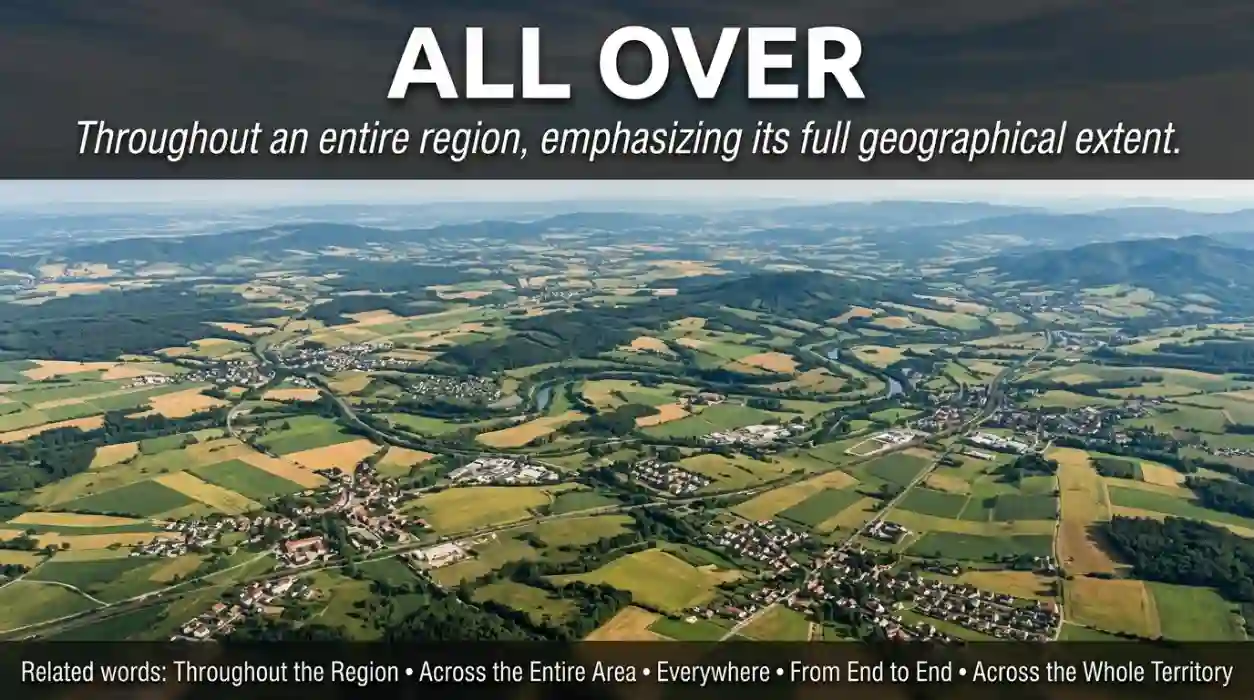
40. Across the Length and Breadth (Adverbial Phrase) — US / UK: /əˈkrɔːs ðə lɛŋθ ən brɛdθ/ / /əˈkrɒs ðə leŋθ ən bredθ/
Meaning: Throughout a region, emphasizing its full geographical extent.
Tone/Register: Formal or literary.
Example:
The festival is celebrated across the length and breadth of the country.
The campaign reached communities across the length and breadth of the province.
41. In All Parts (Adverbial Phrase) — US / UK: /ɪn ɔːl pɑːrts/ / /ɪn ɔːl pɑːts/
Meaning: In every section of a specified place or object.
Tone/Register: Neutral; explanatory.
Example:
The renovation improved lighting in all parts of the library.
Security cameras were installed in all parts of the facility.
42. From One End to the Other (Adverbial Phrase) — US / UK: /frəm wʌn ɛnd tə ði ˈʌðər/ / /frəm wʌn ɛnd tə ði ˈʌðə/
Meaning: Across the complete distance between two opposite ends.
Tone/Register: Neutral; conversational.
Example:
We walked from one end of the market to the other.
The bridge was decorated from one end to the other.
43. Throughout the Region (Prepositional Phrase) — US / UK: /θruːˈaʊt ðə ˈriːdʒən/ / /θruːˈaʊt ðə ˈriːdʒən/
Meaning: In every or many parts of a particular geographical region.
Tone/Register: Formal; news and public information.
Example:
Heavy snowfall continued throughout the region.
Clinics throughout the region adopted the new guidelines.
44. All Over the City (Adverbial Phrase) — US / UK: /ɔːl ˈoʊvər ðə ˈsɪti/ / /ɔːl ˈəʊvə ðə ˈsɪti/
Meaning: In many locations throughout a city.
Tone/Register: Neutral; conversational and journalistic.
Example:
Street musicians performed all over the city.
The new café chain has branches all over the city.
45. Throughout the Country (Prepositional Phrase) — US / UK: /θruːˈaʊt ðə ˈkʌntri/ / /θruːˈaʊt ðə ˈkʌntri/
Meaning: In many or all parts of a country.
Tone/Register: Neutral to formal.
Example:
Schools throughout the country observed the holiday.
The announcement received attention throughout the country.
46. Everywhere Around (Adverbial Phrase) — US / UK: /ˈɛvriwɛr əˈraʊnd/ / /ˈɛvriweə əˈraʊnd/
Meaning: In numerous nearby locations or on many sides of a reference point.
Tone/Register: Conversational; context-dependent.
Example:
We noticed signs of spring everywhere around us.
Little shops stood everywhere around the old station.
47. All Over the Internet (Adverbial Phrase) — US / UK: /ɔːl ˈoʊvər ði ˈɪntərnɛt/ / /ɔːl ˈəʊvə ði ˈɪntənet/
Meaning: Published, shared, or discussed across many online platforms and websites.
Tone/Register: Informal; digital communication and media.
Example:
The funny clip is all over the internet.
Photos from the concert appeared all over the internet.
48. Throughout the House (Prepositional Phrase) — US / UK: /θruːˈaʊt ðə haʊs/ / /θruːˈaʊt ðə haʊs/
Meaning: In many or all rooms and parts of a house.
Tone/Register: Neutral; everyday English.
Example:
The smell of fresh bread spread throughout the house.
We installed energy-efficient bulbs throughout the house.
49. From Place to Place (Adverbial Phrase) — US / UK: /frəm pleɪs tə pleɪs/ / /frəm pleɪs tə pleɪs/
Meaning: Moving between different locations rather than remaining in one spot.
Tone/Register: Neutral; conversational and narrative.
Example:
The traveling exhibition moves from place to place.
They wandered from place to place without a fixed plan.
50. Over and Around (Prepositional/Adverbial Phrase) — US / UK: /ˈoʊvər ən əˈraʊnd/ / /ˈəʊvə ən əˈraʊnd/
Meaning: Across or around several parts of an area, depending on the sentence.
Tone/Register: Informal; context-dependent.
Example:
We looked over and around the garden for the cat.
The children ran over and around the playground equipment.
Important language note: These 50 entries are useful alternatives and related expressions, not 50 perfect replacements. Words such as ubiquitous, rife, and disseminated carry specific meanings and grammatical requirements. Always choose an expression that preserves the original sentence’s meaning.
Synonyms by Tone
The most effective synonym depends on what you want readers to feel or understand. A phrase that works in a casual conversation may sound awkward in a research paper.
Positive alternatives
Use these choices when describing abundance, popularity, beauty, or successful reach.
- Everywhere: “Fresh flowers were everywhere at the wedding.”
- Far and wide: “Her kindness became known far and wide.”
- Worldwide: “The campaign inspired people worldwide.”
- Ubiquitous: “The brand’s colorful murals are ubiquitous in the neighborhood.”
- All around: “Laughter echoed all around the garden.”
Neutral alternatives
These expressions describe locations or coverage without adding a strong emotional judgment.
- Throughout: “Emergency exits are marked throughout the building.”
- Across the area: “Survey teams worked across the area.”
- Widely: “The article was widely shared.”
- Distributed throughout: “First-aid kits are distributed throughout the school.”
- In every corner: “Books filled every corner of the study.”
Negative alternatives
These options suggest mess, excessive spread, or an undesirable situation.
- All over the place: “The papers were all over the place.”
- Strewn about: “Empty bottles were strewn about the campsite.”
- Rife: “The comment section was rife with insults.”
- Rampant: “Speculation became rampant after the announcement.”
- Scattered throughout: “Broken branches were scattered throughout the garden.”
Remember that the context determines the tone. Scattered throughout can describe beautiful autumn leaves just as easily as it can describe unwanted debris.
Playful and informal alternatives
Casual speech often benefits from expressions that sound vivid and natural.
- All over the place: “My thoughts are all over the place before an exam.”
- Here and there: “We stopped here and there for snacks.”
- Everywhere you look: “There are cute dogs everywhere you look.”
- All over the internet: “That dance is all over the internet.”
- All around: “Kids were running all around the playground.”
“All Over” vs. Close Alternatives
These expressions overlap, but they do not always communicate the same thing.
| Expression | Main meaning | Best use |
|---|---|---|
| All over | Present in many parts of a place or covering a surface | Everyday conversation |
| Everywhere | In every relevant location | General statements about presence |
| Throughout | Extending through every part or across a period | Formal, academic, and professional writing |
| Scattered throughout | Distributed irregularly across an area | Describing separate objects or locations |
| Widespread | Found across a large area or among many people | News, reports, and research |
| From end to end | Extending across the complete length | Physical distances and continuous coverage |
Which one should you choose?
Use everywhere when you want a simple, broad expression. For example, “I searched everywhere.”
Choose throughout when you want to emphasize complete coverage or a defined scope. For example, “The rules apply throughout the organization.”
Use scattered throughout when objects appear in separate, irregular positions. For example, “Wildflowers were scattered throughout the meadow.”
Use widespread when describing a large-scale situation. For example, “The storm caused widespread disruption.”
How “All Over” Changes by Context
Daily conversation
In everyday speech, all over is natural, direct, and easy to understand.
You might say, “The kids left toys all over the living room.” You could also say, “There are toys everywhere in the living room.”
Both versions communicate the same general idea. The first feels especially conversational, while the second makes the sense of widespread presence explicit.
Writing and blogging
Writers often need alternatives to avoid using the same phrase repeatedly. However, replacing a familiar expression with a more complicated word does not automatically improve the writing.
Instead of repeating “all over the internet,” consider widely shared online, circulating across social media, or popular on multiple platforms. Each expression emphasizes a slightly different aspect of online reach.
Choose the phrase that communicates your point most accurately.
Professional and academic writing
Professional documents often benefit from specific, measurable language.
For example, “The policy applies throughout the department” is more precise than “The policy applies all over the department.”
Similarly, distributed throughout, widespread, and across the region can work well in reports when they match the evidence.
Avoid using ubiquitous or omnipresent simply to sound sophisticated. A familiar word is often the clearer choice.
Creative and informal writing
Stories, captions, and dialogue can benefit from vivid descriptions.
“The room was filled with golden light” creates a different image from “Golden light spread throughout the room.”
Likewise, “Leaves were strewn about the path” gives a stronger sense of disorder than “Leaves were all over the path.”
Creative writing works best when vocabulary supports the mood, movement, and imagery of the scene.
Common Mistakes Learners Make
Mistake 1: Treating every synonym as interchangeable
Incorrect replacements can change the meaning of a sentence.
For example, “I searched all over the house” describes an extensive search. “I searched the house widely” is not natural English.
Better: “I searched throughout the house.”
Mistake 2: Confusing location with popularity
“Her name is all over the internet” usually means her name appears on many online platforms.
“Her name is ubiquitous” may sound awkward without a clear context. A better choice could be “Her name is widely recognized.”
Mistake 3: Using formal vocabulary in casual situations
Saying “Your shoes are distributed throughout the hallway” sounds unnecessarily technical.
In conversation, say “Your shoes are all over the hallway” or “Your shoes are scattered around the hallway.”
Mistake 4: Ignoring grammatical differences
Everywhere is an adverb. Widespread is an adjective. Disseminate is a verb.
Compare:
- Natural: “The information spread everywhere.”
- Natural: “The information became widespread.”
- Natural: “The organization disseminated the information widely.”
The words may express related ideas, but their grammatical roles differ.
Mistake 5: Confusing “all over” with “all over again”
These expressions are not equivalent.
- “Paint was all over the floor” means paint covered parts of the floor.
- “We had to start all over again” means we had to restart from the beginning.
Check the complete phrase before choosing a replacement.
Native usage and register notes
All over is especially common in spoken English, informal messages, and general descriptions. Throughout is often suitable for both speech and formal writing.
Widespread usually describes something that affects or reaches many places or people. Ubiquitous emphasizes how commonly something appears. Rife generally introduces something undesirable.
Real-Life Mini Scenarios
Workplace
A manager notices printed reports across several desks. Instead of saying, “Documents are all over the office,” she writes, “Documents are scattered throughout the office.”
Why it works: The alternative is descriptive and appropriate for a workplace report.
Social situations
Friends visit a garden filled with flowers. One says, “Flowers are everywhere!” Another replies, “They’re blooming throughout the garden.”
Why it works: Both phrases sound natural and emphasize the abundance of flowers.
Media and pop culture
A short dance video suddenly appears on multiple social platforms. A natural description is, “The dance is all over the internet.”
A more formal alternative is, “The dance has become widely popular online.”
Why it works: The second version emphasizes popularity rather than literal location.
Writing and storytelling
A novelist describes a stormy landscape: “Broken branches lay strewn about the road.”
This creates a stronger image than simply saying branches were all over the road.
Why it works: The verb phrase conveys disorder and helps readers visualize the scene.
Practice Exercise:
1. You searched every room for your passport. Which phrase fits best?
A. Across the board
B. Everywhere
C. Universally
D. Broadly
2. You want to say that a policy applies to every department in a company.
A. Throughout the company
B. From place to place
C. Here and there
D. Far and wide
3. Which phrase suggests that objects are scattered messily?
A. Worldwide
B. Across the globe
C. All over the place
D. Throughout
4. A layer of snow covers an entire hillside. Which expression is most vivid?
A. Blanketed with snow
B. Across the board
C. Universally snowy
D. From place to place
5. You are writing a formal report about employees in different locations.
A. Here, there, and everywhere
B. Distributed across several locations
C. All over the place
D. In every nook and cranny
6. Which phrase describes something happening during the whole night?
A. Across the country
B. Throughout the night
C. All around the room
D. From end to end
7. A beach is covered in unwanted plastic bottles. Which phrase communicates the negative meaning?
A. Littered with plastic bottles
B. Dotted around plastic bottles
C. Far and wide plastic bottles
D. Universally plastic bottles
8. You want to describe a tradition celebrated in many countries. Which phrase is suitable?
A. From side to side
B. Worldwide
C. All over the carpet
D. From top to bottom
Answer Key
1-B | 2-A | 3-C | 4-A | 5-B | 6-B | 7-A | 8-B
Reflection Task
Write three original sentences using three different alternatives to all over. Use one sentence for a physical location, one for a professional or academic context, and one for a casual conversation.
External Learning Sources
For reliable dictionary definitions and pronunciation guidance, consult:
- Cambridge Dictionary — definitions, example sentences, and UK and US pronunciation.
- Oxford Learner’s Dictionaries — learner-friendly meanings, grammar patterns, and pronunciation.
- Merriam-Webster Dictionary — definitions, usage information, and American English guidance.
Conclusion
Learning alternatives to all over helps you describe places, surfaces, and widespread events with greater precision. Small vocabulary choices can make ordinary sentences clearer and more memorable.
For students, bloggers, and everyday English users, varied vocabulary improves essays, articles, emails, and conversations. The goal is not to use the fanciest word, but the most accurate one.
Start by practicing everywhere, throughout, across, and spread across in your own sentences. Notice how each expression changes the meaning and tone of your message.
Keep practicing these alternatives in daily conversations, emails, and essays. Choose three expressions from this list today and write a sentence with each to build confidence naturally.
Frequently Asked Questions
1. What is the closest synonym for “all over” in everyday English?
Everywhere is often the closest everyday alternative when all over means that something exists or can be found in many places. For example, “I looked all over for my wallet” can become “I looked everywhere for my wallet.” However, when describing a surface, covered with or spread across may be more precise.
2. Is “all over” formal or informal English?
All over is a common expression used in both speech and writing, but it often sounds conversational. In a formal report, throughout, across, or distributed across may communicate the same idea more precisely. The right choice depends on the sentence, the audience, and whether you are describing a location, a surface, or a broad distribution.
3. What is another way to say “all over the place” without sounding informal?
Try scattered throughout, spread across, or distributed across. These expressions work well in professional and academic writing. For example, instead of saying “The files are all over the place,” you could write, “The files are distributed across several folders.” Choose the phrase that reflects whether the items are scattered, organized, or spread widely.
4. What is a synonym for “all over” when describing a surface?
Covered with, covered in, and spread across are useful choices when describing a surface. For example, “The table was covered with papers” sounds natural. Blanketed with can be more vivid when describing a broad layer, such as snow across a field. The best alternative depends on the material and how completely it covers the surface.
5. Can “throughout” replace “all over” in every sentence?
No. Throughout often emphasizes every part of a place or the whole duration of a period. It works in “throughout the building” and “throughout the day.” It does not always fit sentences about movement or surface coverage. For example, “We traveled from place to place” describes movement more accurately than “We traveled throughout.”

Hasnain Ali is an SEO Content Strategist and the founder of wordvora.com, a trusted vocabulary platform that helps writers, students, professionals, and English learners find accurate synonyms, antonyms, word meanings, and real-life usage examples. He specializes in keyword research, on-page SEO, topical authority, and creating search-first content that aligns with Google’s latest Search Quality and E-E-A-T guidelines. His work focuses on producing clear, well-structured, and reader-friendly resources that satisfy search intent while maintaining high editorial standards.
Through extensive hands-on experience with SEO tools such as Google Search Console, Google Analytics, SEMrush, and Ahrefs, Hasnain researches user search behavior and develops content that is both informative and easy to understand. Every article published on wordvora.com is carefully reviewed for accuracy, readability, and contextual relevance before publication. His mission is to build one of the web’s most reliable English vocabulary resources by providing practical language guidance, trustworthy explanations, and content that helps readers improve their writing, communication, and vocabulary with confidence.