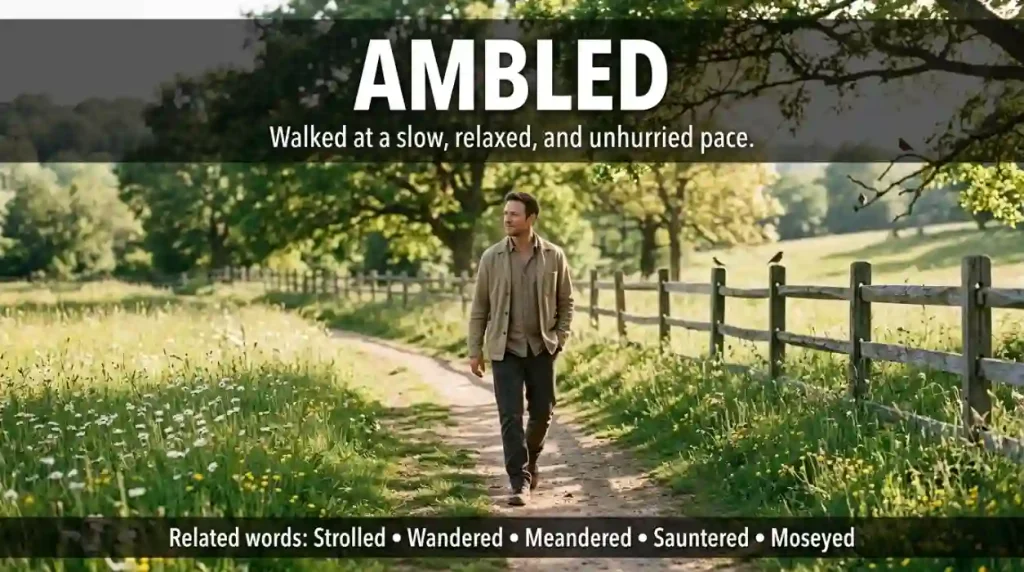
A synonym for ambled is a word that describes walking slowly, casually, and without hurry. Common alternatives include strolled, sauntered, wandered, meandered, and ambled along. Each word suggests a slightly different pace, mood, or direction, so the best choice depends on the scene you want to describe.
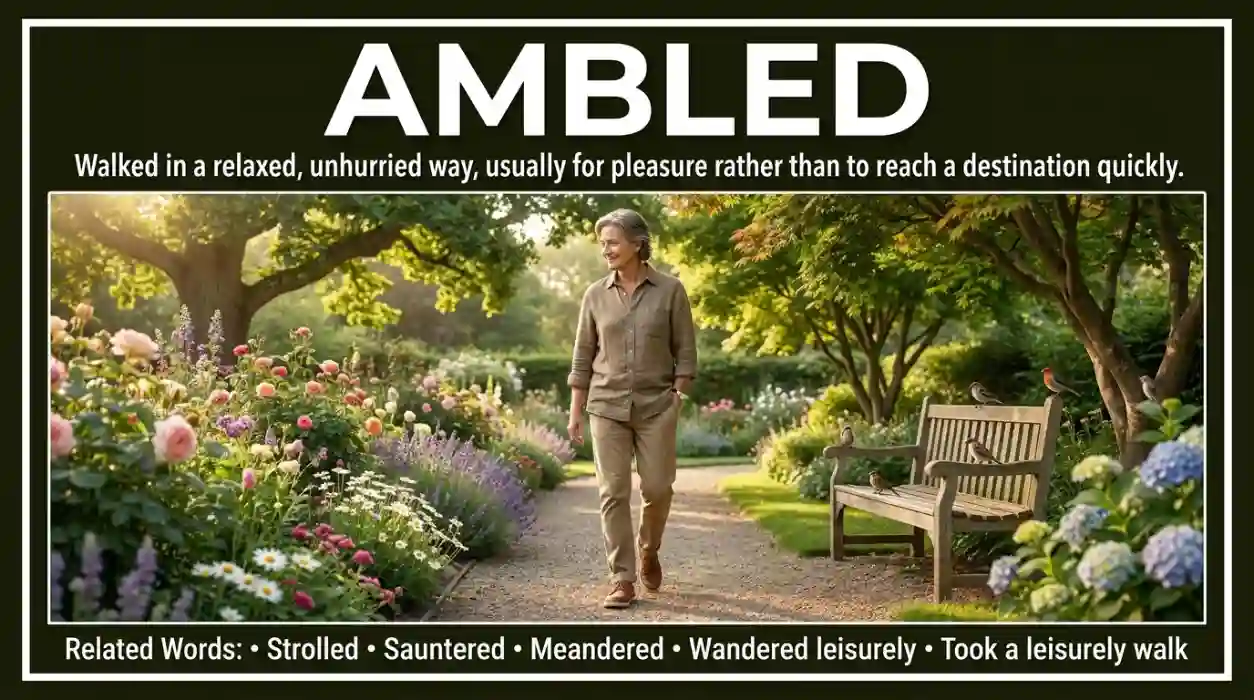
Imagine walking through a quiet park on a sunny afternoon. You have nowhere to be, so you take your time and enjoy the flowers.
The word ambled often appears in stories, travel writing, and everyday descriptions of relaxed movement. It helps readers picture an easy, unhurried walk without suggesting a particular destination or urgent purpose.
For students, bloggers, and content writers, choosing a suitable synonym makes descriptions more vivid. Daily English users can also use these words to express mood, pace, and movement more precisely.
If you want to describe a peaceful walk, a leisurely journey, or a character moving casually through a scene, learning a synonym for ambled can make your English more natural and expressive.
What Does “Ambled” Really Mean?
Ambled is the past tense and past participle of the verb amble. It means walked at a relaxed, steady pace without appearing to hurry.
Native English speakers usually associate ambled with casual movement. It often suggests comfort, ease, and a lack of urgency. Unlike marched, which can imply purpose and discipline, ambled creates a gentler impression.
Common contexts include:
- Nature: “We ambled along the woodland path.”
- Travel: “The visitors ambled through the old town.”
- Daily life: “He ambled over to the kitchen.”
- Fiction: “The detective ambled into the room.”
- Animals: “The horse ambled across the field.”
Part of speech: Verb, specifically the simple past tense and past participle of amble.
Simple definition: To walk slowly and casually, without rushing.
The word often carries a pleasant or neutral tone. However, a writer can use it humorously to suggest that someone is taking their time when others expect them to act quickly.
🧠 Connotative Meaning of “Ambled”
(Connotation is the feeling, attitude, or association a word carries beyond its literal meaning.)
Positive tone: Ambled can suggest peace, relaxation, and enjoyment.
Example: “They ambled through the garden, enjoying the fresh air.”
Negative tone: It can suggest a lack of urgency when quick action is needed.
Example: “While everyone prepared for the storm, he ambled toward the door.”
Neutral tone: It can simply describe slow, relaxed walking.
Example: “She ambled down the street after lunch.”
The word does not automatically imply laziness. Context determines whether the slow pace feels pleasant, amusing, or inappropriate.
📖 Etymology: Where Does “Ambled” Come From?
The word ambled comes from the verb amble, which entered English through Old French ambler. The French word developed from Latin ambulāre, meaning “to walk” or “to go about.”
The word’s history reflects its central idea: moving on foot. Its modern meaning emphasizes an easy, unhurried gait rather than walking in general.
A Brief History Through English
- Old English (450–1100): The modern verb amble was not an established everyday Old English term. English used other words to describe walking and movement.
- Middle English (1100–1500): The verb entered English through Anglo-French and Old French forms related to Latin ambulāre. It became associated with a particular kind of relaxed gait.
- Modern English (1500–present): Amble developed into a familiar descriptive verb. Writers have used it to portray leisurely human movement and the characteristic easy gait of certain animals.
Pronunciation, Syllables, and Affixation
Pronunciation of “ambled”
- US IPA: /ˈæm.bəld/
- UK IPA: /ˈæm.bəld/
Syllables: am-bled — two syllables.
Affixation pattern
- Root: amble
- Prefix: None
- Suffix: -ed, marking the simple past tense or past participle
- Word formation: amble + -ed = ambled
The spelling changes slightly from the pronunciation of the base verb. The final -ed is pronounced /d/, not as a separate syllable.
📚 Synonyms List
Not every alternative to ambled means the same thing. Some emphasize a relaxed pace, while others suggest wandering, gentle movement, or a particular walking style. The following list includes close synonyms and useful context-dependent alternatives.
1. Strolled (verb) — US / UK: /stroʊld/ /strəʊld/
Meaning: Walked in a relaxed way, usually for pleasure rather than a specific urgent purpose.
Tone/Register: Neutral, conversational, descriptive.
Examples:
We strolled along the river after dinner.
She strolled through the market and admired the handmade gifts.
2. Sauntered (verb) — US / UK: /ˈsɔn.tɚd/ /ˈsɔːn.təd/
Meaning: Walked slowly and casually, often with a confident or carefree attitude.
Tone/Register: Descriptive, informal, sometimes playful.
Examples:
He sauntered into class as if he had all day.
They sauntered down the beach beneath the evening sky.
3. Wandered (verb) — US / UK: /ˈwɑːn.dɚd/ /ˈwɒn.dəd/
Meaning: Walked without a fixed route or clear destination.
Tone/Register: Neutral, literary, conversational.
Examples:
We wandered around the old neighborhood for an hour.
She wandered through the museum until closing time.
4. Meandered (verb) — US / UK: /miˈæn.dɚd/ /miˈæn.dəd/
Meaning: Followed a winding route or moved slowly without a direct path.
Tone/Register: Literary, descriptive, neutral.
Examples:
The couple meandered along the narrow country lane.
We meandered through the gardens and stopped by the pond.
5. Ambled along (verb phrase) — US / UK: /ˈæm.bəld əˈlɔːŋ/
Meaning: Continued walking at a gentle, unhurried pace.
Tone/Register: Neutral, conversational, descriptive.
Examples:
The old dog ambled along beside its owner.
We ambled along the waterfront, enjoying the breeze.
6. Loitered (verb) — US / UK: /ˈlɔɪ.tɚd/ /ˈlɔɪ.təd/
Meaning: Stayed in or around a place without an obvious purpose, sometimes moving very slowly.
Tone/Register: Neutral to negative; often implies lingering rather than simply walking.
Examples:
A few teenagers loitered outside the convenience store.
He loitered near the entrance while waiting for his friend.
7. Tramped (verb) — US / UK: /træmpt/
Meaning: Walked for a long distance, often with heavy or firm steps.
Tone/Register: Informal, descriptive, sometimes rugged.
Examples:
We tramped across the muddy field to reach the farmhouse.
The hikers tramped through the forest all morning.
8. Plodded (verb) — US / UK: /ˈplɑː.dɪd/ /ˈplɒd.ɪd/
Meaning: Walked slowly and heavily, often because the journey was tiring or difficult.
Tone/Register: Neutral to negative, descriptive.
Examples:
He plodded home through the heavy snow.
The tired students plodded toward the bus stop.
9. Shuffled (verb) — US / UK: /ˈʃʌf.əld/
Meaning: Walked with small steps, often dragging the feet slightly.
Tone/Register: Neutral, descriptive.
Examples:
She shuffled across the room in her slippers.
The sleepy child shuffled into the kitchen.
10. Roamed (verb) — US / UK: /roʊmd/ /rəʊmd/
Meaning: Moved around a large area freely, often without a fixed destination.
Tone/Register: Neutral, literary, adventurous.
Examples:
We roamed the historic district until sunset.
The horses roamed freely across the open meadow.
11. Rambled (verb) — US / UK: /ˈræm.bəld/
Meaning: Walked over an area in a leisurely way, often through the countryside.
Tone/Register: Informal, literary, British-leaning in some walking contexts.
Examples:
They rambled through the hills on Sunday morning.
We rambled along the coastal path for hours.
12. Perambulated (verb) — US / UK: /pəˈræm.bjəˌleɪ.tɪd/ /pəˈræm.bjʊˌleɪ.tɪd/
Meaning: Walked around an area, especially in a formal, deliberate, or somewhat old-fashioned way.
Tone/Register: Formal, humorous, literary.
Examples:
The professor perambulated around the courtyard after lunch.
They perambulated through the estate’s extensive gardens.
13. Ambled over (verb phrase) — US / UK: /ˈæm.bəld ˈoʊ.vɚ/ /ˈæm.bəld ˈəʊ.və/
Meaning: Walked casually toward a nearby person or place.
Tone/Register: Neutral, conversational.
Examples:
My neighbor ambled over to ask about the garden.
He ambled over to the window and opened the curtains.
14. Strolled along (verb phrase) — US / UK: /stroʊld əˈlɔːŋ/ /strəʊld əˈlɒŋ/
Meaning: Walked in a relaxed way along a particular route.
Tone/Register: Neutral, descriptive.
Examples:
We strolled along the canal after breakfast.
She strolled along the tree-lined avenue without checking her phone.
15. Sauntered over (verb phrase) — US / UK: /ˈsɔn.tɚd ˈoʊ.vɚ/ /ˈsɔːn.təd ˈəʊ.və/
Meaning: Approached someone or something in a casual, sometimes self-assured manner.
Tone/Register: Informal, descriptive, occasionally playful.
Examples:
He sauntered over to the group and joined the conversation.
She sauntered over to the counter to order a coffee.
16. Sashayed (verb) — US / UK: /sæˈʃeɪd/
Meaning: Walked in a showy, confident, or stylish manner, often with a swaying movement.
Tone/Register: Playful, theatrical, expressive.
Examples:
The performer sashayed across the stage in a glittering jacket.
She sashayed into the party as if she owned the place.
17. Ambled off (verb phrase) — US / UK: /ˈæm.bəld ɔːf/
Meaning: Walked away slowly and casually.
Tone/Register: Neutral, conversational.
Examples:
After the picnic, he ambled off toward the lake.
The cat ambled off into the garden.
18. Wandered off (verb phrase) — US / UK: /ˈwɑːn.dɚd ɔːf/ /ˈwɒn.dəd ɒf/
Meaning: Walked away from a person or place without a clear plan or announcement.
Tone/Register: Neutral, sometimes disapproving.
Examples:
The child wandered off to look at the colorful balloons.
I wandered off from the group and found a quiet bench.
19. Drifted (verb) — US / UK: /ˈdrɪf.tɪd/
Meaning: Moved slowly and gently, sometimes without a clear direction or strong intention.
Tone/Register: Literary, neutral, reflective.
Examples:
She drifted across the courtyard toward her friends.
We drifted through the bookshop until we found the travel section.
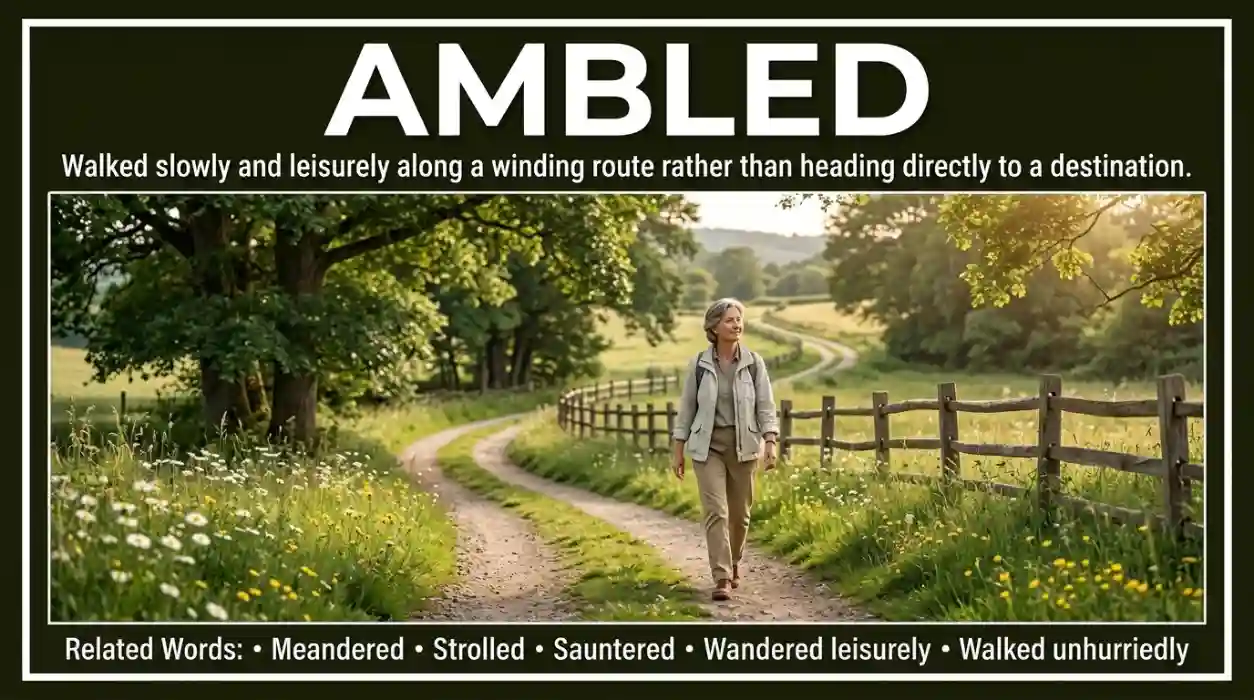
20. Meandered along (verb phrase) — US / UK: /miˈæn.dɚd əˈlɔːŋ/ /miˈæn.dəd əˈlɒŋ/
Meaning: Walked slowly along a winding route instead of heading straight to a destination.
Tone/Register: Descriptive, literary.
Examples:
They meandered along the riverbank, taking photos of birds.
The visitors meandered along the narrow lanes of the village.
21. Ambled around (verb phrase) — US / UK: /ˈæm.bəld əˈraʊnd/
Meaning: Walked casually around an area without rushing to leave.
Tone/Register: Conversational, neutral.
Examples:
We ambled around the botanical garden all afternoon.
He ambled around the yard while his coffee cooled.
22. Roamed around (verb phrase) — US / UK: /roʊmd əˈraʊnd/ /rəʊmd əˈraʊnd/
Meaning: Moved freely around a place, exploring different areas.
Tone/Register: Neutral, adventurous, informal.
Examples:
The tourists roamed around the old fort with their cameras.
We roamed around the neighborhood looking for a bakery.
23. Wandered about (verb phrase) — US / UK: /ˈwɑːn.dɚd əˈbaʊt/ /ˈwɒn.dəd əˈbaʊt/
Meaning: Walked around without a fixed destination or precise plan.
Tone/Register: Neutral, conversational; more common in some varieties of British English.
Examples:
I wandered about the town while waiting for my train.
The children wandered about the playground after lunch.
24. Moseyed (verb) — US / UK: /ˈmoʊ.ziːd/
Meaning: Walked or moved along slowly and casually.
Tone/Register: Informal, folksy, especially associated with American English.
Examples:
We moseyed down to the diner after the game.
He moseyed over to the porch and sat in a rocking chair.
25. Took a leisurely walk (verb phrase) — US / UK: /tʊk ə ˈliː.ʒɚ.li wɔːk/ /tʊk ə ˈleʒ.ə.li wɔːk/
Meaning: Walked at a comfortable pace without feeling pressed for time.
Tone/Register: Neutral, descriptive, polished.
Examples:
We took a leisurely walk through the botanical gardens.
She took a leisurely walk before starting her afternoon work.
26. Took a stroll (verb phrase) — US / UK: /tʊk ə stroʊl/ /tʊk ə strəʊl/
Meaning: Went for a relaxed walk, often for pleasure or fresh air.
Tone/Register: Neutral, conversational.
Examples:
Dad took a stroll around the block after dinner.
We took a stroll through the seaside village.
27. Took a wander (verb phrase) — US / UK: /tʊk ə ˈwɑːn.dɚ/ /tʊk ə ˈwɒn.də/
Meaning: Went for a walk without deciding on an exact route or destination.
Tone/Register: Informal, conversational; particularly natural in British English.
Examples:
Let’s take a wander through the weekend market.
I took a wander around the campus before my lecture.
28. Amble (verb) — US / UK: /ˈæm.bəl/
Meaning: Walk at a relaxed pace without hurry; this is the base form of ambled, rather than a different synonym.
Tone/Register: Neutral, descriptive, literary.
Examples:
We often amble beside the river on quiet evenings.
The horse began to amble toward the stable.
29. Saunter (verb) — US / UK: /ˈsɔn.tɚ/ /ˈsɔːn.tə/
Meaning: Walk slowly and casually, often with a confident air; this is the base form of sauntered.
Tone/Register: Descriptive, informal.
Examples:
I like to saunter through the old town on Sundays.
He tends to saunter into meetings a few minutes early.
30. Stroll (verb) — US / UK: /stroʊl/ /strəʊl/
Meaning: Walk slowly and comfortably for pleasure; this is the base form of strolled.
Tone/Register: Neutral, common in everyday English.
Examples:
We stroll along the promenade every evening.
They plan to stroll around the campus before the ceremony.
31. Loped (verb) — US / UK: /loʊpt/ /ləʊpt/
Meaning: Moved with long, easy strides, often at a relaxed but steady pace.
Tone/Register: Descriptive, neutral; often used for people or animals.
Examples:
The dog loped across the grassy field toward its owner.
He loped down the path with his hands in his pockets.
32. Amble slowly (verb phrase) — US / UK: /ˈæm.bəl ˈsloʊ.li/ /ˈæm.bəl ˈsləʊ.li/
Meaning: Walk at a particularly unhurried pace; the phrase emphasizes the slowness already implied by amble.
Tone/Register: Neutral, descriptive.
Examples:
We ambled past the cottages and gardens.
The older man ambled toward the bus stop.
33. Wandered leisurely (verb phrase) — US / UK: /ˈwɑːn.dɚd ˈliː.ʒɚ.li/ /ˈwɒn.dəd ˈleʒ.ə.li/
Meaning: Explored or walked around at an easy pace without following a strict plan.
Tone/Register: Neutral, descriptive.
Examples:
The visitors wandered leisurely through the sculpture park.
We wandered leisurely around the village square.
34. Walked casually (verb phrase) — US / UK: /wɔːkt ˈkæʒ.u.ə.li/
Meaning: Walked without formality, visible tension, or a sense of urgency.
Tone/Register: Neutral, conversational.
Examples:
She walked casually toward the café to meet her friend.
He walked casually across the lobby, looking for the elevators.
35. Walked at an easy pace (verb phrase) — US / UK: /wɔːkt æt ən ˈiː.zi peɪs/
Meaning: Walked comfortably without exertion or pressure to move faster.
Tone/Register: Neutral, clear, descriptive.
Examples:
We walked at an easy pace through the park.
The group walked at an easy pace to enjoy the scenery.
36. Strolled (verb phrase) — US / UK: /stroʊld ˈliː.ʒɚ.li/ /strəʊld ˈleʒ.ə.li/
Meaning: Walked for pleasure at an especially relaxed pace.
Tone/Register: Descriptive, neutral.
Examples:
They strolled beside the harbor.
I strolled through the art fair, stopping at each stall.
37. Sauntered casually (verb phrase) — US / UK: /ˈsɔn.tɚd ˈkæʒ.u.ə.li/ /ˈsɔːn.təd ˈkæʒ.ju.ə.li/
Meaning: Walked slowly and informally, with little sign of concern or urgency.
Tone/Register: Informal, descriptive.
Examples:
He sauntered casually across the courtyard after class.
She sauntered casually toward the group and waved.
38. Ambled leisurely (verb phrase) — US / UK: /ˈæm.bəld ˈliː.ʒɚ.li/ /ˈæm.bəld ˈleʒ.ə.li/
Meaning: Walked at a gentle pace, with extra emphasis on comfort and lack of urgency.
Tone/Register: Literary, descriptive.
Examples:
The couple ambled through the autumn leaves.
We ambled down the quiet country road.
39. Took a slow walk (verb phrase) — US / UK: /tʊk ə sloʊ wɔːk/ /tʊk ə sləʊ wɔːk/
Meaning: Walked slowly, whether for relaxation, recovery, or simple enjoyment.
Tone/Register: Neutral and accessible.
Examples:
I took a slow walk to clear my head after work.
She took a slow walk along the beach at sunrise.
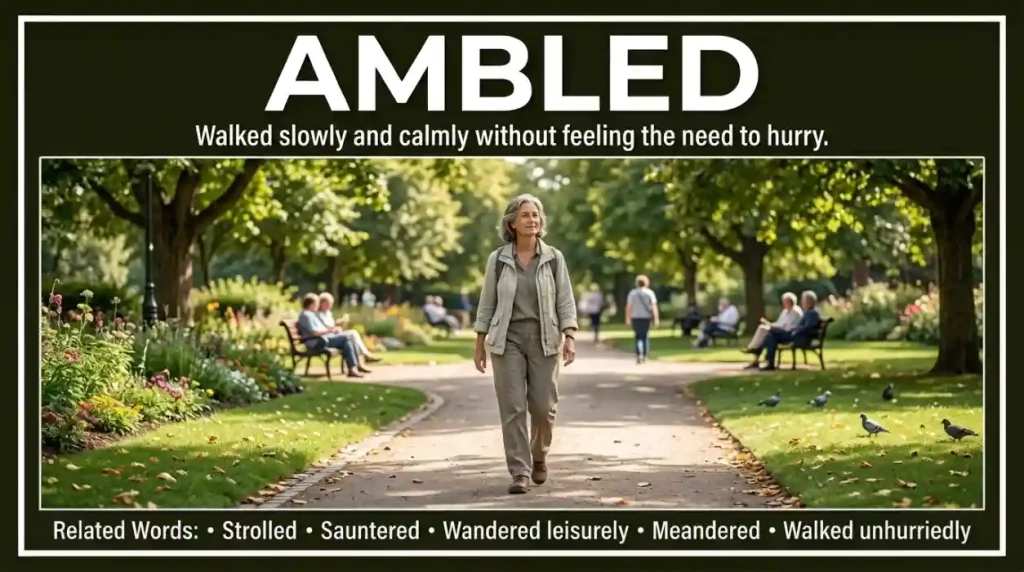
40. Walked unhurriedly (verb phrase) — US / UK: /wɔːkt ʌnˈhɝː.id.li/ /wɔːkt ʌnˈhʌr.id.li/
Meaning: Walked without feeling the need to hurry.
Tone/Register: Neutral, formal, descriptive.
Examples:
He walked unhurriedly toward the station.
The visitors walked unhurriedly through the exhibition.
41. Walked at a leisurely pace (verb phrase) — US / UK: /wɔːkt æt ə ˈliː.ʒɚ.li peɪs/ /wɔːkt æt ə ˈleʒ.ə.li peɪs/
Meaning: Walked comfortably and without time pressure.
Tone/Register: Neutral, formal, descriptive.
Examples:
The guide walked at a leisurely pace so everyone could keep up.
They walked at a leisurely pace along the coastal path.
42. Proceeded slowly (verb phrase) — US / UK: /prəˈsiː.dɪd ˈsloʊ.li/ /prəˈsiː.dɪd ˈsləʊ.li/
Meaning: Continued moving forward at a low speed; unlike ambled, this expression does not necessarily imply pleasure or relaxation.
Tone/Register: Formal, neutral, procedural.
Examples:
The group proceeded slowly through the narrow passage.
We proceeded slowly along the icy road.
43. Made one’s way leisurely (verb phrase) — US / UK: /meɪd wʌnz weɪ ˈliː.ʒɚ.li/ /meɪd wʌnz weɪ ˈleʒ.ə.li/
Meaning: Traveled toward a destination without rushing.
Tone/Register: Neutral, descriptive, literary.
Examples:
She made her way leisurely toward the village square.
We made our way leisurely through the shaded garden.
44. Wandered aimlessly (verb phrase) — US / UK: /ˈwɑːn.dɚd ˈeɪm.ləs.li/ /ˈwɒn.dəd ˈeɪm.ləs.li/
Meaning: Walked without a clear destination or purpose; this may suggest uncertainty rather than the relaxed enjoyment associated with ambled.
Tone/Register: Neutral to negative, literary.
Examples:
He wandered around the station while waiting for news.
We wandered through the unfamiliar streets.
45. Moved at a snail’s pace (idiom) — US / UK: /muːvd æt ə sneɪlz peɪs/
Meaning: Moved extremely slowly, often slower than expected or desired.
Tone/Register: Informal, humorous, often negative.
Examples:
The queue moved at a snail’s pace all morning.
Traffic moved at a snail’s pace after the accident.
46. Took one’s time (idiom) — US / UK: /tʊk wʌnz taɪm/
Meaning: Did something without hurrying; when applied to walking, it can suggest a relaxed pace.
Tone/Register: Conversational, neutral.
Examples:
She took her time walking through the antique shop.
We took our time getting back to the hotel.
47. Plodded along (verb phrase) — US / UK: /ˈplɑː.dɪd əˈlɔːŋ/ /ˈplɒd.ɪd əˈlɒŋ/
Meaning: Continued moving forward slowly and steadily, often with a sense of effort.
Tone/Register: Neutral to negative, descriptive.
Examples:
We plodded along the muddy trail in our heavy boots.
He plodded along the pavement after a tiring shift.
48. Shuffled along (verb phrase) — US / UK: /ˈʃʌf.əld əˈlɔːŋ/
Meaning: Moved forward with short, dragging steps.
Tone/Register: Neutral, descriptive.
Examples:
The passengers shuffled along the platform toward the exit.
Grandpa shuffled along the hallway in his warm socks.
49. Trundled along (verb phrase) — US / UK: /ˈtrʌn.dəld əˈlɔːŋ/
Meaning: Moved forward slowly and steadily, often with a rolling or slightly cumbersome quality.
Tone/Register: Informal, descriptive; often used for vehicles, objects, and sometimes people.
Examples:
The old bicycle trundled along the quiet lane.
The little cart trundled along behind the gardener.
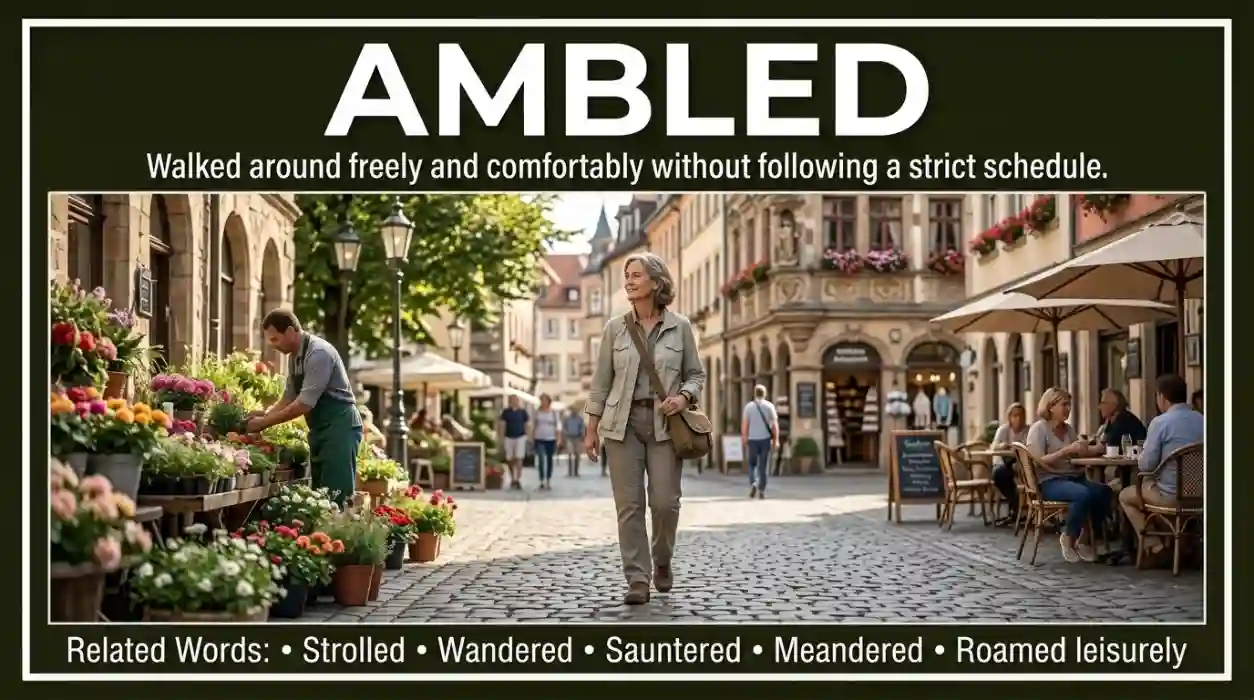
50. Wandered at leisure (verb phrase) — US / UK: /ˈwɑːn.dɚd æt ˈliː.ʒɚ/ /ˈwɒn.dəd æt ˈleʒ.ə/
Meaning: Walked around freely and comfortably, without a strict schedule.
Tone/Register: Literary, neutral, descriptive.
Examples:
The travelers wandered at leisure through the historic quarter.
We wandered at leisure around the gardens before lunch.
Synonyms by Tone
The tone of a synonym shapes how readers imagine the person, setting, or action. A relaxed word can make a scene feel peaceful. A heavier or more negative word can suggest fatigue, delay, or a lack of purpose.
Positive and Relaxed
These expressions emphasize comfort, enjoyment, and unhurried movement.
- Strolled: suggests an enjoyable walk.
- Sauntered: adds a carefree or confident quality.
- Meandered: creates an image of a winding, scenic route.
- Rambled: often evokes a pleasant walk in the countryside.
- Took a leisurely walk: clearly communicates comfort and a lack of urgency.
- Walked at an easy pace: emphasizes a comfortable speed.
Example: “They strolled through the garden, taking in the fragrance of the flowers.”
Neutral and Descriptive
Use these when the main goal is to describe movement without adding a strong emotional judgment.
- Wandered: emphasizes an uncertain or flexible route.
- Roamed: suggests free movement over a wider area.
- Drifted: conveys gentle movement without much direction.
- Walked casually: focuses on the relaxed manner of walking.
- Walked unhurriedly: emphasizes the absence of time pressure.
- Made one’s way leisurely: describes a relaxed journey toward a destination.
Example: “She wandered through the museum until she found the room she wanted.”
Negative or Slow-Moving
These choices can suggest delay, fatigue, or movement that seems too slow for the situation.
- Plodded: suggests effort or heaviness.
- Shuffled: describes short, dragging steps.
- Loitered: often implies lingering without a clear purpose.
- Wandered: suggests a lack of direction.
- Moved at a snail’s pace: emphasizes extreme slowness.
- Plodded along: suggests steady movement with some effort.
Example: “He plodded toward the bus stop after a long day at work.”
Playful and Informal
These words and expressions add personality or a conversational flavor.
- Moseyed: sounds relaxed and folksy.
- Sashayed: suggests a showy or stylish walk.
- Took one’s time: can sound reassuring or mildly critical.
- Trundled along: creates an image of slow, steady movement.
- Sauntered over: can give a character a casual, confident manner.
Example: “He moseyed over to the barbecue as soon as he smelled the food.”
“Ambled” vs. Close Alternatives
| Word | Main difference | Best context |
|---|---|---|
| Ambled | Walked at a relaxed, steady pace without hurry | Gentle movement with no strong emphasis on direction |
| Strolled | Walked casually, often for pleasure | Parks, streets, shops, and pleasant outings |
| Sauntered | Walked slowly with a carefree or confident manner | Character descriptions and expressive storytelling |
| Wandered | Walked without a fixed route or destination | Exploring unfamiliar places |
| Meandered | Followed a winding or indirect route | Scenic walks and descriptive writing |
| Plodded | Walked slowly with heavy steps or effort | Tiredness, difficult conditions, or reluctant movement |
Consider these sentences:
- “He ambled toward the gate.” The focus is on his relaxed pace.
- “He strolled through the garden.” The walk sounds pleasant and purposeful enough to enjoy.
- “He sauntered into the room.” The movement may suggest confidence or casual self-assurance.
- “He wandered through the garden.” His route may be uncertain or spontaneous.
- “He plodded toward the gate.” He may feel tired or weighed down.
These differences matter because the most accurate word is not always the one that simply means “walked slowly.”
How to Use “Ambled” in Different Contexts
Daily Conversation
In everyday speech, ambled sounds slightly more descriptive than the simple verb walked. It is useful when telling a story about a relaxed outing or describing someone’s casual movement.
“We ambled around the shopping district before choosing a place to eat.”
For very casual conversations, strolled or took a walk may sound more familiar to some speakers.
Writing and Blogging
In travel blogs and lifestyle articles, ambled helps readers picture a relaxed experience. It works well when describing parks, quiet streets, gardens, and scenic destinations.
“We ambled through the old quarter, stopping whenever a colorful shop caught our attention.”
Avoid using it when the action requires urgency or intense physical effort. Raced, hurried, or marched may fit those situations better.
Professional or Academic Writing
In formal writing, ambled is usually more suitable for describing observed movement than for explaining a process. It can work in literary analysis, behavioral observation, or narrative reporting.
For a neutral report, walked slowly may be clearer. For a scientific description of movement, choose terminology that accurately reflects the observed gait.
Creative and Informal Writing
In fiction, ambled can reveal a character’s attitude without explaining it directly. A person who ambles into a room may seem comfortable, unconcerned, or unaware of the tension around them.
“The guard ambled down the corridor, humming softly, while everyone else waited anxiously.”
That contrast makes the scene more vivid without adding a long explanation.
Common Mistakes and Native Usage
1. Assuming Every Synonym Means the Same Thing
Strolled often suggests pleasure. Sauntered can suggest confidence. Wandered emphasizes an uncertain route. Plodded may imply fatigue.
Choose a word that matches both the movement and the mood.
2. Using “Ambled” for Fast Movement
Ambled does not mean rushed, sprinted, or hurried. Those verbs describe greater speed or urgency.
Incorrect: “She ambled to catch the train before the doors closed.”
More natural: “She hurried to catch the train before the doors closed.”
3. Confusing “Loitered” With “Ambled”
Loitered often describes remaining in a place without a clear purpose. Ambled describes the act of walking slowly and casually.
“The tourists ambled through the square” describes relaxed movement.
“The teenagers loitered outside the closed shop” suggests that they remained there without an obvious reason.
4. Overusing Fancy Vocabulary
Using perambulated or sashayed in every paragraph can make ordinary descriptions feel unnatural. These words have specific shades of meaning and registers.
In most everyday contexts, strolled, wandered, and walked slowly are clearer.
Register Notes
- Everyday and neutral: strolled, wandered, walked casually.
- Descriptive and literary: ambled, meandered, drifted.
- Informal: moseyed, took a wander, took one’s time.
- Potentially negative: loitered, plodded, wandered.
- Formal or old-fashioned: perambulated.
One useful way to expand your vocabulary is to compare these expressions with synonyms for wandered. That comparison helps clarify the difference between a relaxed pace and an uncertain destination.
Real-Life Mini Scenarios
Workplace
A colleague finishes a break and walks casually back to the office. You could write, “He ambled back to his desk.” If the person is late for an important meeting, ambled might imply that they are not taking the deadline seriously.
Social Situations
Two friends visit a weekend market with no fixed plan. “They wandered through the stalls” highlights exploration, while “They ambled between the stalls” focuses more on their relaxed pace.
Media and Pop Culture
A film may show a character sauntering into a party to suggest confidence. If the same character ambles into a quiet café, the scene may feel more peaceful and ordinary. Small word choices can influence how viewers imagine a character.
Writing and Storytelling
Imagine a tired traveler walking toward a small inn at dusk. “He plodded toward the inn” suggests exhaustion. “He ambled toward the inn” suggests that he is taking his time.
Practice Exercise
1. Two friends take a relaxed walk through a park for pleasure. Which word fits best?
A. Strolled
B. Sprinted
C. Marched
D. Rushed
2. A character walks into a room with a carefree, confident air. Which word is most expressive?
A. Shuffled
B. Sauntered
C. Plodded
D. Tramped
3. A tourist walks around a city without choosing a route. Which word fits best?
A. Perambulated
B. Marched
C. Wandered
D. Hurried
4. A tired hiker walks with heavy, slow steps. Which verb is most suitable?
A. Sashayed
B. Drifted
C. Sauntered
D. Plodded
5. A person stays outside a shop without an obvious purpose. Which word may suggest this behavior?
A. Loitered
B. Strolled
C. Amble
D. Meandered
6. A river path curves through a beautiful landscape, and the walkers follow its bends. Which verb fits?
A. Rushed
B. Meandered
C. Marched
D. Shuffled
7. Which word is associated with a relaxed, folksy style of walking in American English?
A. Perambulated
B. Loitered
C. Moseyed
D. Plodded
8. A dancer walks across the stage with a showy, swaying style. Which word fits?
A. Wandered
B. Tramped
C. Shuffled
D. Sashayed
9. Which expression emphasizes walking without feeling any time pressure?
A. Walked unhurriedly
B. Raced ahead
C. Hurried along
D. Darted away
10. A child moves forward with small steps, dragging their feet slightly. Which word fits?
A. Loped
B. Shuffled
C. Sauntered
D. Roamed
Reflection Task
Write two sentences about a walk you remember. Use ambled in one sentence and a different synonym in the other. Notice how the second word changes the mood, pace, or direction of the scene.
Answer key: 1-A, 2-B, 3-C, 4-D, 5-A, 6-B, 7-C, 8-D, 9-A, 10-B,
Suggested External Source
For dictionary definitions, pronunciations, and usage examples, consult the Cambridge Dictionary entry for amble. You can also compare stroll, saunter, and meander to explore their subtle differences.
Conclusion
Learning a synonym for ambled helps you describe movement with greater precision. Words such as strolled, sauntered, and meandered give readers a clearer picture of a scene.
For students, bloggers, and creative writers, varied vocabulary makes descriptions more engaging. In daily conversation, a well-chosen word can express mood without adding extra explanation.
Remember that synonyms carry different shades of meaning. Choose a word that fits the pace, purpose, and feeling you want to communicate.
Practise using three new alternatives in an email, essay, or short story this week. A little daily practice can make your English more vivid and natural.
FAQs
1. What is the closest synonym for “ambled” in a sentence?
Strolled is often the closest everyday alternative to ambled. Both describe walking at a relaxed pace without rushing. However, strolled can emphasize enjoyment, while ambled often focuses on the easy, unhurried manner of movement. For example, “She ambled toward the café” and “She strolled toward the café” are both natural, with slightly different descriptive emphasis.
2. Is “ambled” a positive or negative word?
Ambled is usually neutral or positive. It can create a peaceful image of someone enjoying a walk without time pressure. However, the context may make the action seem inappropriate or frustrating. If someone ambles toward an urgent appointment, the word may suggest a lack of urgency. The surrounding sentence determines the overall impression.
3. What is the difference between “ambled” and “wandered”?
Ambled emphasizes a relaxed walking pace. Wandered emphasizes moving without a fixed route or destination. Someone can amble directly toward a café, but someone who wanders may explore several streets without deciding where to go. Use ambled to highlight pace and wandered to highlight uncertainty or exploration.
4. Can I use “ambled” in academic or formal writing?
Yes, especially in literary analysis, narrative writing, or descriptions of observed movement. However, ambled may sound too descriptive for a concise scientific report. In that setting, walked slowly or a precise description of the person’s gait may be clearer. Always choose language that suits your audience and purpose.
5. What is a good synonym for “ambled” when describing an animal?
Strolled, wandered, and moved at an easy pace may work, depending on the animal and scene. For example, “The horse ambled across the field” suggests a relaxed gait. Loped may fit a dog moving with long strides, while trundled can describe slow, steady movement with a heavier or rolling quality.

Hasnain Ali is an SEO Content Strategist and the founder of wordvora.com, a trusted vocabulary platform that helps writers, students, professionals, and English learners find accurate synonyms, antonyms, word meanings, and real-life usage examples. He specializes in keyword research, on-page SEO, topical authority, and creating search-first content that aligns with Google’s latest Search Quality and E-E-A-T guidelines. His work focuses on producing clear, well-structured, and reader-friendly resources that satisfy search intent while maintaining high editorial standards.
Through extensive hands-on experience with SEO tools such as Google Search Console, Google Analytics, SEMrush, and Ahrefs, Hasnain researches user search behavior and develops content that is both informative and easy to understand. Every article published on wordvora.com is carefully reviewed for accuracy, readability, and contextual relevance before publication. His mission is to build one of the web’s most reliable English vocabulary resources by providing practical language guidance, trustworthy explanations, and content that helps readers improve their writing, communication, and vocabulary with confidence.