
A synonym for anxiety 1 syllable is a short word that expresses worry, fear, or emotional tension. Common options include fear, dread, stress, fright, and angst. Each has a slightly different meaning, so the best choice depends on the feeling and situation you want to describe.
Imagine waiting outside an interview room. Your heart races, and you wonder whether you will answer each question well. You might describe that feeling as stress, fear, or dread.
Searching for a synonym for anxiety 1 syllable can help you find concise language for essays, poems, captions, and everyday conversations. A precise word often communicates more than a long explanation.
Students can use these alternatives to improve vocabulary and avoid repetition. Bloggers and content writers can create more engaging sentences, while everyday English learners can express their feelings with greater confidence.
One important detail: English has only a limited number of genuine one-syllable synonyms for anxiety. This guide distinguishes close synonyms from related words, so you can build vocabulary without learning inaccurate substitutions.
What Does “Anxiety” Really Mean?
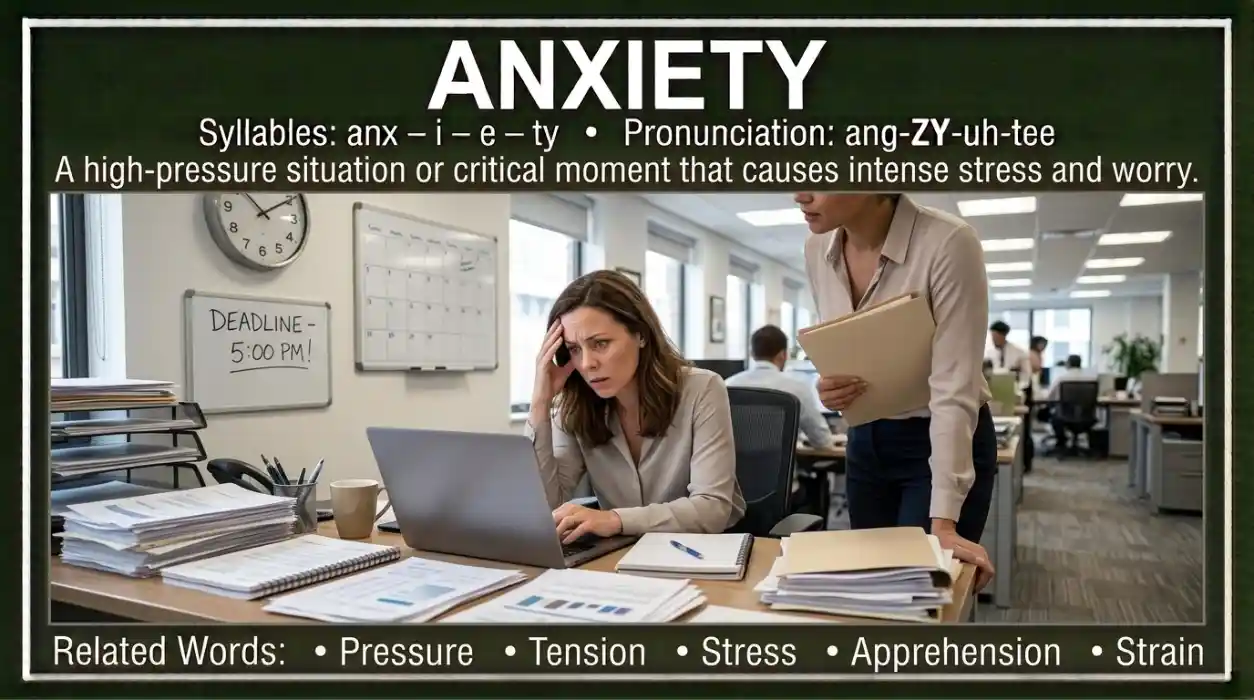
Anxiety refers to an unpleasant state of inner turmoil, mental distress, or nervous apprehension about potential future events. It represents a state of worry, fear, or uneasiness rather than immediate physical danger.
Native speakers view anxiety as a complex mental and physiological state. It ranges from mild nervousness before a test to deep emotional distress.
You will see this word in medical articles, daily news reports, literature, and casual conversations about mental health.
Part of Speech: Noun
Simple Definition: A feeling of worry, nervousness, or unease about something with an uncertain outcome.
Connotative Meaning
(Connotation refers to the cultural, emotional, or associative meaning that a word carries beyond its literal definition.)
- Positive tone: In rare contexts, it shows eager anticipation or intense focus (e.g., “anxiety to excel”).
- Negative tone: It usually describes distressing fear, panic, mental strain, and painful emotional dread.
- Neutral tone: It appears in clinical or scientific discussions to describe psychological arousal levels.
Etymology
The word originates from the Latin word anxietas, which stems from anxius (meaning solicitous or fearful) and the verb angere (meaning to choke, strangle, or distress).
- Old English (450–1100): The word was not present; Old English speakers used terms like geornnes (eagerness/anxiety) or cearu (care/sorrow).
- Middle English (1100–1500): Borrowed from Old French anxiete, referring to painful distress or uneasy feeling.
- Modern English (1500–Present): Evolved into its present medical and psychological usage to signify nervous emotional apprehension.
Pronunciation & Syllables
- US IPA: /æŋˈzaɪ.ə.ti/
- UK IPA: /æŋˈzaɪ.ə.ti/
Syllable Breakdown: anx-i-e-ty (4 Syllables)
Affixation Pattern:
- Root: Anx- (from Latin anxius, anxious)
- Prefix: None
- Suffix: -ty (noun-forming suffix indicating state or quality)
Synonyms List
1. Dread (Noun) — US /drɛd/ | UK /drɛd/
Meaning: A profound sense of fear or apprehension regarding a future event.
Tone/Register: Neutral to Formal
Examples:
She felt a cold dread as the final exam results appeared on the screen.
He faced the upcoming medical surgery with unspoken dread.
2. Fret (Noun) — US /frɛt/ | UK /frɛt/
Meaning: A state of visible anxiety, worry, or restless irritation.
Tone/Register: Informal / General
Examples:
Her mother was in a constant fret over the storm warnings.
Try not to get into a fret about things you cannot control.
3. Fear (Noun) — US /fɪr/ | UK /fɪə/
Meaning: An unpleasant emotion caused by the belief that someone or something is dangerous.
Tone/Register: General
Examples:
The sudden silence in the dark forest filled them with raw fear.
She overcame her fear of public speaking through daily practice.
4. Stress (Noun) — US /strɛs/ | UK /strɛs/
Meaning: Mental or emotional strain resulting from adverse or demanding circumstances.
Tone/Register: General / Workplace
Examples:
Workplace stress can cause long-term health issues if left unchecked.
He takes long evening walks to clear his mind of daily stress.
5. Stew (Noun) — US /stu/ | UK /stjuː/
Meaning: A state of worry, agitation, or mental confusion over a problem.
Tone/Register: Informal
Examples:
Mark was in a complete stew after losing his keys before the flight.
She sat in a stew all afternoon waiting for his phone call.
6. Angst (Noun) — US /ɑːŋkst/ | UK /æŋst/
Meaning: A deep feeling of anxiety, dread, or insecurity, often about life.
Tone/Register: Literary / Informal
Examples:
Teenage angst is a common theme in modern coming-of-age novels.
The film perfectly captures the quiet angst of urban living.
7. Doubt (Noun) — US /daʊt/ | UK /daʊt/
Meaning: A feeling of uncertainty or lack of conviction that creates mild anxiety.
Tone/Register: General
Examples:
A seed of doubt crept into her mind as the night went on.
His persistent doubt prevented him from taking the job offer.
8. Qualm (Noun) — US /kwɑːm/ | UK /kwɑːm/
Meaning: An uneasy feeling of doubt, worry, or misgiving.
Tone/Register: Formal
Examples:
He felt a sudden qualm before signing the binding contract.
She had no qualm about telling the strict truth to her boss.
9. Nerves (Noun) — US /nɜːrvz/ | UK /nɜːvz/
Meaning: A state of feeling anxious, fearful, or agitated.
Tone/Register: Informal
Examples:
Pre-interview nerves are completely natural for job applicants.
A cup of warm tea helped soothe her frayed nerves before the show.
10. Funk (Noun) — US /fʌŋk/ | UK /fʌŋk/
Meaning: A state of nervous depression, fear, or anxiety.
Tone/Register: Informal / Casual
Examples:
He fell into a deep funk after reading the rejection email.
She tried to shake off her gloomy funk by going for a run.
11. Scared (Noun/Adj) — US /skɛrd/ | UK /skeəd/
Meaning: A state or feeling of being frightened or anxious.
Tone/Register: Informal
Examples:
The sudden loud crash gave everyone in the building a real scare.
She had a bad scare when her young daughter briefly wandered off.
12. Strain (Noun) — US /streɪn/ | UK /streɪn/
Meaning: Severe or tiring demand on mental or emotional strength that produces anxiety.
Tone/Register: Formal / Academic
Examples:
The ongoing emotional strain began to show on his tired face.
Working double shifts places immense strain on any employee.
13. Sweat (Noun) — US /swɛt/ | UK /swɛt/
Meaning: An informal state of intense worry, stress, or nervous agitation.
Tone/Register: Informal / Casual
Examples:
He was in a total sweat over the impending tax audit.
Don’t break into a sweat over such a small, minor mistake.
14. Chagrin (Noun) — US /ʃəˈɡrɪn/ | UK /ˈʃæɡ.rɪn/
Meaning: Distress or embarrassment caused by failure or disappointment.
Tone/Register: Formal
Examples:
To his great chagrin, he forgot the keynote speech notes.
She concealed her deep chagrin with a quiet, graceful smile.
15. Tiff (Noun) — US /tɪf/ | UK /tɪf/
Meaning: A petty state of nervous annoyance or emotional irritation.
Tone/Register: Informal
Examples:
Their brief tiff left a lingering tension in the quiet room.
She got into a small tiff with her colleague over deadlines.
16. Churn (Noun) — US /ʧɜːrn/ | UK /ʧɜːn/
Meaning: An internal agitation or feeling of stomach upset caused by anxiety.
Tone/Register: Literary / Informal
Examples:
He felt a sickening churn in his stomach before the speech.
The constant churn of bad news created widespread social worry.
17. Pang (Noun) — US /pæŋ/ | UK /pæŋ/
Meaning: A sudden sharp feeling of emotional distress or anxious pain.
Tone/Register: Literary / General
Examples:
She felt a sharp pang of anxiety when she checked her bank balance.
A sudden pang of guilt washed over him after the argument.
18. Twitch (Noun) — US /twɪʧ/ | UK /twɪʧ/
Meaning: A sudden nervous movement or state of physical restlessness.
Tone/Register: General / Informal
Examples:
A subtle nervous twitch revealed his inner state of extreme worry.
Her eye developed a minor twitch under the heavy workload stress.
19. Shake (Noun) — US /ʃeɪk/ | UK /ʃeɪk/
Meaning: A state of trembling caused by fear, nervousness, or severe anxiety.
Tone/Register: Informal
Examples:
He got a severe case of the shakes right before stepping onstage.
Her hands had a noticeable shake while holding the micro-instrument.
20. Fright (Noun) — US /fraɪt/ | UK /fraɪt/
Meaning: A sudden intense feeling of fear or anxious alarm.
Tone/Register: General
Examples:
The sudden thunderclap gave the young sleeping child a sharp fright.
She was pale white from fright after seeing the near-collision.
21. Grip (Noun) — US /ɡrɪp/ | UK /ɡrɪp/
Meaning: The suffocating or controlling feeling of intense fear and anxiety.
Tone/Register: Literary / General
Examples:
The small town was held in the firm grip of panic and fear.
He struggled to break free from the icy grip of his phobia.
22. Clutter (Noun) — US /ˈklʌt.ər/ | UK /ˈklʌt.ə/
Meaning: A crowded, disorganized mental state filled with anxious thoughts.
Tone/Register: General
Examples:
Meditation helps clear the noisy mental clutter from a busy week.
His mind was trapped in clutter and overwhelming modern worries.
23. Pinch (Noun) — US /pɪnʧ/ | UK /pɪnʧ/
Meaning: A painful, acute stress or uncomfortable pressure in a difficult moment.
Tone/Register: Informal
Examples:
They really felt the economic pinch as living expenses surged.
He stepped in to help his team when they were in a tight pinch.
24. Awe (Noun) — US /ɔː/ | UK /ɔː/
Meaning: An overwhelming feeling of reverential fear or anxious veneration.
Tone/Register: Formal / Literary
Examples:
They stood in quiet awe before the vast, towering ancient ruins.
A sense of mysterious awe mixed with apprehension filled the room.
25. Snarl (Noun) — US /snɑːrl/ | UK /snɑːl/
Meaning: A chaotic state of mental tension or confused, anxious complication.
Tone/Register: General / Informal
Examples:
The sudden flight cancellation created a huge logistical snarl.
Her thoughts were in a tight snarl after hearing the sudden news.
26. Heebs (Noun) — US /hiːbz/ | UK /hiːbz/
Meaning: Slang term for a feeling of intense nervousness or creepiness.
Tone/Register: Informal / Slang
Examples:
Walking through the abandoned hallway gave him the complete heebs.
That horror movie trailer gave her a severe case of the heebs.
27. Squeak (Noun) — US /skwiːk/ | UK /skwiːk/
Meaning: A narrow escape or tense situation that induces acute anxiety.
Tone/Register: Informal
Examples:
Passing that difficult board exam was a very close squeak for him.
She let out a tiny nervous squeak when the lights suddenly went out.
28. Heat (Noun) — US /hiːt/ | UK /hiːt/
Meaning: Intense pressure, stress, or urgency applied by external circumstances.
Tone/Register: Informal / Workplace
Examples:
The manager put the heat on the sales team to meet the deadline.
He could feel the intense heat during the final investigative interview.
29. Thrill (Noun) — US /θrɪl/ | UK /θrɪl/
Meaning: A sudden wave of intense emotion, blending nervous fear and excitement.
Tone/Register: General
Examples:
A thrill of nervous anticipation ran down her spine on stage.
Riding the tall roller coaster provided an intense emotional thrill.
30. Hitch (Noun) — US /hɪʧ/ | UK /hɪʧ/
Meaning: A temporary snag or unexpected difficulty causing sudden worry.
Tone/Register: General
Examples:
The software launch went smoothly without a single technical hitch.
A sudden hitch in their travel plans caused widespread team anxiety.
31. Rush (Noun) — US /rʌʃ/ | UK /rʌʃ/
Meaning: A sudden surge of intense feeling or overwhelming internal pressure.
Tone/Register: General / Informal
Examples:
She felt a sudden adrenaline rush when the alarm siren sounded.
The holiday rush created immense stress for retail warehouse workers.
32. Shock (Noun) — US /ʃɑːk/ | UK /ʃɒk/
Meaning: A sudden distressing event that causes intense mental paralysis or worry.
Tone/Register: General
Examples:
The sudden company restructuring came as a huge shock to everyone.
She was in a state of quiet shock after reading the urgent letter.
33. Chill (Noun) — US /ʧɪl/ | UK /ʧɪl/
Meaning: A sudden cold feeling of fear or uneasy apprehension.
Tone/Register: General / Literary
Examples:
A dark chill went through the crowd as the news was announced.
His harsh, ominous words sent an immediate chill across the room.
34. Slump (Noun) — US /slʌmp/ | UK /slʌmp/
Meaning: A period of emotional depression, low energy, and low-level anxiety.
Tone/Register: Informal / Business
Examples:
The entire sales department entered a mid-year economic slump.
He tried to break out of his mental slump by exercising daily.
35. Snag (Noun) — US /snæɡ/ | UK /snæɡ/
Meaning: An unforeseen obstacle that halts progress and creates acute worry.
Tone/Register: Informal
Examples:
We hit a minor snag with the legal paperwork this afternoon.
Any unexpected snag in production triggers immediate executive stress.
36. Weight (Noun) — US /weɪt/ | UK /weɪt/
Meaning: A heavy burden of responsibility or worry that depresses the mind.
Tone/Register: Literary / General
Examples:
The heavy weight of financial responsibility rested entirely on her.
He felt a massive weight lift off his shoulders after passing the test.
37. Cloud (Noun) — US /klaʊd/ | UK /klaʊd/
Meaning: A state of lingering gloom, mental confusion, or dark suspicion.
Tone/Register: Literary
Examples:
A heavy cloud of worry hung over the entire family that evening.
His past mistakes left a dark cloud over his professional reputation.
38. Pain (Noun) — US /peɪn/ | UK /peɪn/
Meaning: Emotional suffering, mental distress, or acute internal anguish.
Tone/Register: General
Examples:
You could see the deep emotional pain reflected in her tired eyes.
He suffered great mental pain trying to keep the business solvent.
39. Pressure (Noun) — US /ˈprɛʃ.ər/ | UK /ˈprɛʃ.ə/
Meaning: Continuous psychological strain or urgency causing extreme anxiety.
Tone/Register: General / Workplace
Examples:
High workplace pressure often leads to burnout and health issues.
She performs remarkably well under intense competitive pressure.
40. Agony (Noun) — US /ˈæɡ.ə.ni/ | UK /ˈæɡ.ə.ni/
Meaning: Extreme physical or mental suffering and severe emotional anxiety.
Tone/Register: Formal / Literary
Examples:
Waiting for the critical medical diagnosis was pure agony for him.
She went through agony wondering if her family was safe after the storm.
41. Alarm (Noun) — US /əˈlɑːrm/ | UK /əˈlɑːm/
Meaning: An anxious feeling of impending danger or sudden fearful panic.
Tone/Register: General / Formal
Examples:
The sudden unexpected drop in revenue raised immediate corporate alarm.
She felt a sharp sense of alarm when the child did not answer.
42. Panic (Noun) — US /ˈpæn.ɪk/ | UK /ˈpæn.ɪk/
Meaning: Sudden uncontrollable fear or anxiety that causes irrational behavior.
Tone/Register: General
Examples:
A sudden wave of blind panic seized the crowd during the power outage.
Try to remain calm and avoid spreading unnecessary panic today.
43. Horror (Noun) — US /ˈhɔːr.ər/ | UK /ˈhɒr.ə/
Meaning: An intense feeling of fear, shock, disgust, or severe distress.
Tone/Register: General / Literary
Examples:
She watched in frozen horror as the vase slipped from her hands.
The documentary exposed the true human horror of the natural disaster.
44. Terror (Noun) — US /ˈtɛr.ər/ | UK /ˈtɛr.ə/
Meaning: Extreme fear or overwhelming anxiety that paralyzes the mind.
Tone/Register: Formal / General
Examples:
The sudden violent earthquake struck terror into the hearts of residents.
He admitted to experiencing sheer terror before his first parachute jump.
45. Tremor (Noun) — US /ˈtrɛm.ər/ | UK /ˈtrɛm.ə/
Meaning: An involuntary quiver or state of nervous shakiness caused by fear.
Tone/Register: Formal / Scientific
Examples:
You could hear a subtle tremor of anxiety in her unsteady voice.
His hands developed a slight tremor under extreme interrogation pressure.
46. Tension (Noun) — US /ˈtɛn.ʃən/ | UK /ˈtɛn.ʃən/
Meaning: Mental or emotional strain that creates an atmosphere of anxiety.
Tone/Register: General / Workplace
Examples:
Unresolved office arguments created uncomfortable workplace tension.
She does deep breathing exercises to relieve built-up physical tension.
47. Unrest (Noun) — US /ʌnˈrɛst/ | UK /ʌnˈrɛst/
Meaning: A state of nervous dissatisfaction, disturbance, or internal turmoil.
Tone/Register: Formal / Media
Examples:
Political instability led to widespread social unrest across the nation.
An uneasy inner unrest kept her tossing and turning all night.
48. Bluster (Noun) — US /ˈblʌs.tər/ | UK /ˈblʌs.tə/
Meaning: Loud, aggressive talk used to mask hidden fear or internal anxiety.
Tone/Register: General / Informal
Examples:
Behind all his loud bravado and bluster lay deep personal insecurity.
His aggressive response was mere political bluster to hide his mistake.
49. Cold (Noun) — US /koʊld/ | UK /kəʊld/
Meaning: An uncomfortable emotional sensation of fear, isolation, or anxiety.
Tone/Register: Literary
Examples:
A sudden cold settled over his heart as he realized the truth.
She felt left out in the cold during the tense team meeting.
50. Crunch (Noun) — US /krʌnʧ/ | UK /krʌnʧ/
Meaning: A crucial, high-pressure moment that induces acute stress and anxiety.
Tone/Register: Informal / Business
Examples:
When the financial crunch came, the company had to cut costs fast.
He always manages to stay focused and effective during a time crunch.
Synonyms by Tone
Positive or Hopeful
Anxiety is usually uncomfortable, but nervous feelings can accompany positive anticipation. Phrases such as nervous excitement describe a mix of tension and enthusiasm. They are useful when someone looks forward to an event but still feels apprehensive.
Neutral
- Stress: Pressure from demands or responsibilities.
- Fear: A response to a perceived threat.
- Strain: Pressure that makes a situation difficult.
- Doubt: Uncertainty about an outcome.
- Nerves: Informal nervousness before an event.
These choices suit everyday conversations, schoolwork, and many professional settings.
Negative or Intense
- Dread: Strong worry about an unpleasant future event.
- Angst: Deep inner distress.
- Fright: Sudden fear.
- Pang: A sharp, brief emotional feeling.
- Qualm: A moment of doubt or unease.
Use these when their specific emotional shade matches the situation.
Playful or Informal
Expressions such as “on edge,” “a nervous wreck,” and “get the jitters” sound natural in casual conversation. They are not all one-syllable synonyms, but they can communicate nervousness vividly.
Tone matters because the wrong word can exaggerate a feeling or change a sentence’s meaning. A moment of doubt is not necessarily dread, and pressure at work is not always fear.
“Anxiety” vs. Close Alternatives
| Word | Meaning | Best use |
|---|---|---|
| Anxiety | Unease or worry, often about uncertainty | General emotional description |
| Stress | Pressure caused by demands | Workload, exams, responsibilities |
| Fear | Response to a perceived threat | Danger or a specific feared outcome |
| Dread | Strong worry about an unpleasant future event | Anticipating something difficult |
| Angst | Deep inner distress or uncertainty | Personal, existential, or literary themes |
Quick rule: Choose stress when pressure is central, fear when danger feels present, and dread when you expect something unpleasant. Use anxiety when you mean a broader feeling of unease.
How One-Syllable Alternatives Change by Context
Daily Conversation
Short words make everyday speech direct. “I’m stressed about the exam” emphasizes pressure. “I’m on edge” suggests nervous tension.
Writing and Blogging
Writers can use precise alternatives to avoid repeating anxiety. Dread can create suspense, while strain can describe pressure in a family or workplace. Check whether your chosen word describes the feeling, its cause, or its effect.
Professional or Academic Writing
In formal work, choose terms based on context. Stress and strain often suit discussions of workload. Fear and dread can sound more subjective. In health-related writing, retain anxiety when it is the exact concept being discussed.
Creative or Informal Writing
In stories, pang can describe a sudden feeling, while chill can create an eerie mood. Informal expressions such as “a nervous wreck” can make dialogue sound natural, but may feel exaggerated in a report.
Common Mistakes and Native Usage
Mistake 1: Treating related emotions as exact synonyms.
Grief means deep sorrow, rage means anger, and doubt means uncertainty. They may occur alongside anxiety, but they are not interchangeable.
Mistake 2: Forgetting syllable counts.
Worry, panic, alarm, wary, and jitters have more than one syllable. If a task requires exactly one syllable, count the spoken beats.
Mistake 3: Choosing an overly strong word.
Dread can sound intense. For ordinary pressure before a meeting, stress may be more accurate.
Mistake 4: Confusing a cause with an emotion.
A deadline can cause stress, but the deadline itself is not anxiety.
Register notes:
Stress, fear, and doubt work in many settings. Angst is more literary or informal. Expressions such as “on edge” suit conversation, while academic writing benefits from precise terminology.
Real-Life Mini Scenarios
- Workplace:
- Three deadlines fall on the same day. “I’m under stress” describes the pressure better than “I’m in dread.”
- Social situation:
- You are about to meet someone new. “I’m tense” describes nervousness, while “I’m on edge” emphasizes unease.
- Media and entertainment:
- A thriller builds dread before a character opens a mysterious door.
- Writing or storytelling:
- A character receives an unexpected message and feels a pang of fear. This describes a sudden feeling rather than a lasting state.
Practice Exercise
1. You have too much work and several deadlines. Which word best describes the pressure?
A. Stress
B. Grief
C. Rage
2. A character expects terrible news and feels strong worry beforehand. Which word fits best?
A. Dread
B. Joy
C. Care
3. Someone sees a car speeding toward them. Which word best describes the immediate emotion?
A. Fear
B. Gloom
C. Strain
4. You are uncertain whether your answer is correct. Which word best fits that uncertainty?
A. Doubt
B. Fright
C. Woe
5. A loud bang makes someone jump suddenly. Which word best describes the reaction?
A. Flinch
B. Angst
C. Stress
6. Which word usually describes deep inner distress about life’s meaning?
A. Angst
B. Shock
C. Pain
7. You want to describe a sudden, sharp feeling of worry. Which word is most suitable?
A. Pang
B. Strife
C. Gloom
8. Which phrase means feeling nervous and unable to relax?
A. On edge
B. In bloom
C. At ease
9. Which word mainly describes pressure from responsibilities?
A. Strain
B. Wail
C. Grief
10. Which word describes sudden fear or alarm?
A. Fright
B. Doubt
C. Woe
Answer key: 1-A, 2-A, 3-A, 4-A, 5-A, 6-A, 7-A, 8-A, 9-A, 10
Reflection Task
Think of a real moment when you felt worried, pressured, or afraid. Write one sentence using stress, fear, dread, doubt, or pang. Then explain why that word fits better than anxiety.
External Learning Sources
- Cambridge Dictionary: https://dictionary.cambridge.org/ — definitions, British and American pronunciation, and examples.
- Merriam-Webster: https://www.merriam-webster.com/ — word meanings, pronunciation, and usage notes.
- Oxford Learner’s Dictionaries: https://www.oxfordlearnersdictionaries.com/ — learner-friendly definitions and common grammatical patterns.
Conclusion
Learning a 1-syllable synonym for anxiety helps you describe emotions with greater precision. Short words such as stress, fear, and dread can make sentences clear and expressive.
For essays and blogs, vary your vocabulary only when the meaning stays accurate. In conversation, the right word helps people understand whether you feel pressure, uncertainty, or fear.
Practice these alternatives in emails, journal entries, school assignments, and daily conversations. Notice how each word changes the feeling of a sentence, even when the words seem similar.
Choose five words from this guide and write one original sentence for each. Regular practice can make your English more natural, confident, and precise.
FAQs
1. What is the best one-syllable word for anxiety in an essay?
Stress is often useful when the feeling comes from pressure, such as exams or deadlines. Use fear when the person perceives a threat, and dread when they anticipate something unpleasant. There is no perfect replacement for every sentence, so choose the word that matches the precise meaning you want to express.
2. Is “stress” the same as “anxiety”?
No. Stress usually refers to pressure or demands, while anxiety refers to unease or worry, often about uncertainty or possible future events. The two can occur together, but they are not identical. A heavy workload may cause stress, while worry about failing because of that workload may be described as anxiety.
3. Which one-syllable synonym for anxiety is strongest?
Dread can express strong worry about an expected unpleasant event, while fear can be intense when a threat seems immediate. Neither is always stronger than anxiety; context determines intensity. If you want to describe sudden alarm, fright may be more accurate than either word.
4. Can I use “angst” instead of “anxiety” in formal writing?
Sometimes, but the words have different shades of meaning. Angst often suggests deep inner distress, personal conflict, or uncertainty about life. It can sound literary or less clinical than anxiety. In formal research or health-related writing, use anxiety when it is the precise concept you mean.
5. What is a one-syllable synonym for anxiety before an exam?
Stress is a natural option if you feel pressure from preparation, time, or performance expectations. Fear fits if you are afraid of a specific outcome, such as failing. Dread works when you strongly anticipate an unpleasant experience. Choose the word that best explains what is troubling you.

Hasnain Ali is an SEO Content Strategist and the founder of wordvora.com, a trusted vocabulary platform that helps writers, students, professionals, and English learners find accurate synonyms, antonyms, word meanings, and real-life usage examples. He specializes in keyword research, on-page SEO, topical authority, and creating search-first content that aligns with Google’s latest Search Quality and E-E-A-T guidelines. His work focuses on producing clear, well-structured, and reader-friendly resources that satisfy search intent while maintaining high editorial standards.
Through extensive hands-on experience with SEO tools such as Google Search Console, Google Analytics, SEMrush, and Ahrefs, Hasnain researches user search behavior and develops content that is both informative and easy to understand. Every article published on wordvora.com is carefully reviewed for accuracy, readability, and contextual relevance before publication. His mission is to build one of the web’s most reliable English vocabulary resources by providing practical language guidance, trustworthy explanations, and content that helps readers improve their writing, communication, and vocabulary with confidence.