

Synonyms for freaky in bed can make conversations about intimacy sound more natural, precise, and respectful. The best choice depends on context, tone, and personal boundaries.
Imagine someone describing a relationship as exciting but wanting a softer word. Instead of “freaky,” terms like adventurous or playful may fit better.
Synonyms for freaky in bed are useful because the original phrase is informal slang. It can sound playful in one conversation but unusual or judgmental in another.
Learning synonyms for freaky in bed helps students, bloggers, writers, and everyday English users understand subtle differences and choose words that communicate their meaning clearly.
What Does “Freaky in Bed” Really Mean?
“Freaky in bed” is an informal expression describing someone or something unconventional, adventurous, uninhibited, or open to unusual forms of intimacy.
The exact meaning depends strongly on context. Native speakers generally understand “freaky” as a slang term, so it can sound playful, teasing, bold, or slightly provocative.
The phrase is commonly used in casual conversations, relationship discussions, social media, entertainment, and popular culture. It is less suitable for formal academic or professional writing.
Part of speech: The word freaky is an adjective.
Simple definition: Unusual, unconventional, or adventurous in an intimate context.
Connotative Meaning
Connotation (the feeling or association a word carries beyond its basic dictionary meaning) can change how “freaky” sounds.
Positive tone: It may suggest excitement, confidence, openness, or adventurousness.
Negative tone: It can sometimes suggest behavior that seems strange, excessive, or uncomfortable.
Neutral tone: In a neutral description, it may simply indicate that something differs from conventional expectations.
Therefore, choosing a synonym carefully matters. A writer may want to describe openness without making the person sound strange or extreme.

Etymology
The adjective freaky comes from freak, with the suffix -y added to create an adjective meaning “characterized by” or “having the quality of.”
The history is slightly complex because the modern adjective freaky did not exist in Old English in its current form.
Old English: 450–1100
The modern word freak is not an Old English word in the form used today. English vocabulary at this stage developed from Germanic roots, while the later history of freak followed a different path.
Middle English: 1100–1500
Forms related to freak developed through later English usage. The word eventually acquired meanings connected with unusual people, events, or occurrences.
Modern English: 1500–Present
Over time, freak developed several meanings involving unusualness or unconventional behavior. The adjective freaky later became common in informal English.
In modern slang, freaky can describe something unusually bold, strange, or unconventional, including intimate behavior.
Pronunciation
US: /ˈfriːki/
UK: /ˈfriːki/
Syllables
freak-y
Affixation Pattern of “Freaky”
Root: freak
Prefix: None
Suffix: -y
The suffix -y changes freak into an adjective describing something associated with or characterized by unusual qualities.
Synonyms List
Adventurous (Adjective) — US /ədˈvɛntʃərəs/ | UK /ədˈvɛntʃərəs/
Meaning: Willing to explore new and unconventional experiences in intimacy.
Tone/Register: Positive, informal, relationship-focused.
Example:
They described their relationship as adventurous and exciting.
They enjoy keeping their private life interesting.
Uninhibited (Adjective) — US /ˌʌnɪnˈhɪbɪtɪd/ | UK /ˌʌnɪnˈhɪbɪtɪd/
Meaning: Free from excessive embarrassment or self-consciousness.
Tone/Register: Neutral, mature, descriptive.
Example:
She has an uninhibited approach to romance.
He feels comfortable expressing himself openly.
Playful (Adjective) — US /ˈpleɪfəl/ | UK /ˈpleɪfəl/
Meaning: Fun, lighthearted, and teasing rather than serious or intense.
Tone/Register: Positive, informal.
Example:
Their chemistry is playful and relaxed.
They often make each other laugh.
Daring (Adjective) — US /ˈderɪŋ/ | UK /ˈdeərɪŋ/
Meaning: Willing to go beyond ordinary expectations.
Tone/Register: Informal, expressive.
Example:
Their romance has a daring side.
They are comfortable trying something different.
Experimental (Adjective) — US /ɪkˌspɛrəˈmɛntl/ | UK /ɪkˌsperɪˈmentl/
Meaning: Open to exploring unfamiliar approaches or ideas.
Tone/Register: Neutral, mature, descriptive.
Example:
They take an experimental approach to intimacy.
Both partners enjoy discovering what works for them.
Open-Minded (Adjective) — US /ˌoʊpənˈmaɪndɪd/ | UK /ˌəʊpənˈmaɪndɪd/
Meaning: Willing to consider experiences outside conventional expectations.
Tone/Register: Positive, neutral.
Example:
He is open-minded about relationships.
She appreciates honest conversations without judgment.
Unconventional (Adjective) — US /ˌʌnkənˈvɛnʃənəl/ | UK /ˌʌnkənˈvenʃənəl/
Meaning: Different from what is normally expected or considered traditional.
Tone/Register: Formal, neutral.
Example:
Their relationship has an unconventional style.
They prefer to define romance in their own way.
Nonconformist (Adjective) — US /ˌnɑːnkənˈfɔːrmɪst/ | UK /ˌnɒnkənˈfɔːmɪst/
Meaning: Not strongly influenced by traditional expectations.
Tone/Register: Formal, descriptive.
Example:
Their approach to relationships is nonconformist.
They do not worry much about social expectations.
Free-Spirited (Adjective) — US /ˌfriː ˈspɪrɪtɪd/ | UK /ˌfriː ˈspɪrɪtɪd/
Meaning: Independent, spontaneous, and less restricted by convention.
Tone/Register: Positive, informal.
Example:
She has a free-spirited attitude toward romance.
He admires her confidence.
Bold (Adjective) — US /boʊld/ | UK /bəʊld/
Meaning: Confident and willing to move beyond ordinary expectations.
Tone/Register: Positive, informal.
Example:
His romantic style is bold.
She likes his confidence.
Spontaneous (Adjective) — US /spɑːnˈteɪniəs/ | UK /spɒnˈteɪniəs/
Meaning: Happening naturally without being carefully planned.
Tone/Register: Positive, everyday.
Example:
Their relationship feels spontaneous.
They enjoy unexpected romantic moments.
Exciting (Adjective) — US /ɪkˈsaɪtɪŋ/ | UK /ɪkˈsaɪtɪŋ/
Meaning: Creating strong interest, energy, or anticipation.
Tone/Register: Positive, everyday.
Example:
They find their relationship exciting.
There is always a sense of curiosity.
Thrilling (Adjective) — US /ˈθrɪlɪŋ/ | UK /ˈθrɪlɪŋ/
Meaning: Producing an especially strong feeling of excitement.
Tone/Register: Expressive, informal.
Example:
The couple described their connection as thrilling.
Their chemistry feels fresh.
Unusual (Adjective) — US /ʌnˈjuːʒuəl/ | UK /ʌnˈjuːʒuəl/
Meaning: Different from what is common or expected.
Tone/Register: Neutral.
Example:
Their romantic preferences are unusual.
They are comfortable being different.
Quirky (Adjective) — US /ˈkwɜːrki/ | UK /ˈkwɜːki/
Meaning: Noticeably unusual amusingly or distinctive.
Tone/Register: Playful, informal.
Example:
Their relationship has a quirky sense of humor.
They enjoy keeping things fun.
Saucy (Adjective) — US /ˈsɔːsi/ | UK /ˈsɔːsi/
Meaning: Playfully bold or slightly provocative.
Tone/Register: Playful, informal.
Example:
She made a saucy joke during dinner.
Everyone laughed at her confidence.
Cheeky (Adjective) — US /ˈtʃiːki/ | UK /ˈtʃiːki/
Meaning: Playfully bold, teasing, or slightly mischievous.
Tone/Register: Informal, especially British English.
Example:
He gave her a cheeky smile.
Their flirting stayed lighthearted.
Flirty (Adjective) — US /ˈflɜːrti/ | UK /ˈflɜːti/
Meaning: Showing playful romantic or sexual interest.
Tone/Register: Informal, everyday.
Example:
Their messages became increasingly flirty.
Both seemed comfortable with the playful mood.
Provocative (Adjective) — US /prəˈvɑːkətɪv/ | UK /prəˈvɒkətɪv/
Meaning: Intended to attract attention or challenge conventional expectations.
Tone/Register: Formal, media, descriptive.
Example:
The character has a provocative personality.
The story explores unconventional romance.
Suggestive (Adjective) — US /səˈdʒestɪv/ | UK /səˈdʒestɪv/
Meaning: Indirectly hinting at romantic or intimate ideas.
Tone/Register: Neutral, media, descriptive.
Example:
The dialogue becomes suggestive without being explicit.
The scene relies on subtle hints.
Risqué (Adjective) — US /rɪˈskeɪ/ | UK /rɪˈskeɪ/
Meaning: Slightly shocking or daring because it approaches accepted social boundaries.
Tone/Register: Informal, literary, media.
Example:
The comedian made a risqué remark.
The humor was deliberately bold.
Edgy (Adjective) — US /ˈɛdʒi/ | UK /ˈedʒi/
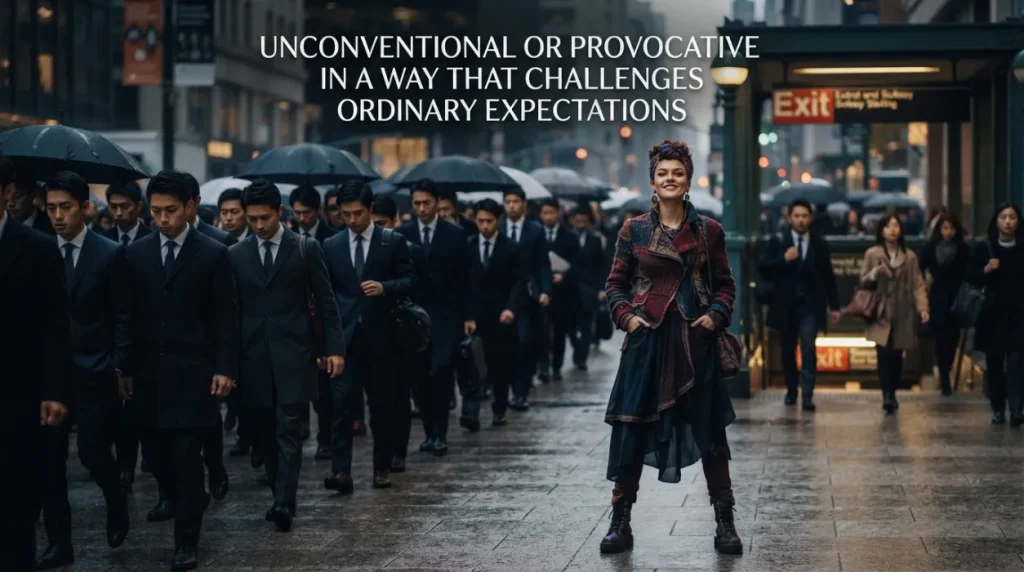
Meaning: Unconventional or provocative in a way that challenges ordinary expectations.
Tone/Register: Informal, contemporary.
Example:
The character has an edgy romantic style.
The story feels modern and unconventional.
Intense (Adjective) — US /ɪnˈtɛns/ | UK /ɪnˈtens/
Meaning: Emotionally or physically powerful rather than simply playful.
Tone/Register: Neutral, mature.
Example:
Their connection is intense.
They share a strong emotional bond.
Passionate (Adjective) — US /ˈpæʃənət/ | UK /ˈpæʃənət/
Meaning: Showing strong romantic feeling and emotional energy.
Tone/Register: Positive, mature.
Example:
They have a passionate relationship.
Their connection is deeply emotional.
Sensual (Adjective) — US /ˈsɛnʃuəl/ | UK /ˈsɛnʃuəl/
Meaning: Relating to physical attraction and the senses in a romantic context.
Tone/Register: Mature, descriptive.
Example:
The novel uses sensual language.
Its romantic scenes focus on atmosphere and emotion.
Erotic (Adjective) — US /ɪˈrɑːtɪk/ | UK /ɪˈrɒtɪk/
Meaning: Relating directly to sexual attraction or desire.
Tone/Register: Adult, literary, descriptive.
Example:
The film has an erotic undertone.
The author uses the term in a literary context.
Kinky (Adjective) — US /ˈkɪŋki/ | UK /ˈkɪŋki/
Meaning: Informally describing intimate preferences considered outside conventional sexual norms.
Tone/Register: Adult, informal.
Example:
The character openly describes himself as kinky.
The term appears frequently in casual relationship discussions.
Experimental-Minded (Adjective) — US /ɪkˈspɛrɪmɛntl ˈmaɪndɪd/ | UK /ɪkˈsperɪmentl ˈmaɪndɪd/
Meaning: Having a willingness to explore different possibilities.
Tone/Register: Informal, descriptive.
Example:
They are experimental-minded as a couple.
Communication helps them understand each other.
Boundary-Pushing (Adjective) — US /ˈbaʊndəri ˌpʊʃɪŋ/ | UK /ˈbaʊndəri ˌpʊʃɪŋ/
Meaning: Going beyond familiar social or personal expectations.
Tone/Register: Modern, informal.
Example:
The novel presents a boundary-pushing romance.
Its characters reject traditional expectations.
Adventurous-Minded (Adjective) — US /ədˈvɛntʃərəs ˈmaɪndɪd/ | UK /ədˈvɛntʃərəs ˈmaɪndɪd/
Meaning: Having a strong interest in exploring new romantic experiences.
Tone/Register: Informal, positive.
Example:
She is adventurous-minded in relationships.
He appreciates her openness.
Curious (Adjective) — US /ˈkjʊriəs/ | UK /ˈkjʊəriəs/
Meaning: Interested in discovering unfamiliar experiences or possibilities.
Tone/Register: Neutral, positive.
Example:
They are curious about different relationship styles.
They prefer honest discussion before making decisions.
Exploratory (Adjective) — US /ɪkˈsplɔːrəˌtɔːri/ | UK /ɪkˈsplɒrətəri/
Meaning: Focused on discovering possibilities rather than following a fixed pattern.
Tone/Register: Formal, mature.
Example:
Their relationship has an exploratory quality.
They communicate openly about preferences.
Unrestrained (Adjective) — US /ˌʌnrɪˈstreɪnd/ | UK /ˌʌnrɪˈstreɪnd/
Meaning: Not strongly limited by conventional restraint.
Tone/Register: Literary, mature.
Example:
The novel portrays an unrestrained romance.
The characters are confident in their choices.
Liberated (Adjective) — US /ˈlɪbəreɪtɪd/ | UK /ˈlɪbəreɪtɪd/
Meaning: Feeling free from restrictive social expectations.
Tone/Register: Positive, mature.
Example:
She describes herself as liberated in relationships.
Her choices reflect personal confidence.
Open (Adjective) — US /oʊpən/ | UK /ˈəʊpən/
Meaning: Willing to discuss or consider intimate preferences honestly.
Tone/Register: Neutral, everyday.
Example:
They maintain an open relationship discussion.
Clear communication makes them comfortable.
Flexible (Adjective) — US /ˈflɛksəbəl/ | UK /ˈfleksəbəl/
Meaning: Willing to consider different approaches instead of following one fixed pattern.
Tone/Register: Neutral, everyday.
Example:
Their approach to romance is flexible.
They focus on mutual comfort.
Free (Adjective) — US /friː/ | UK /friː/
Meaning: Not heavily restricted by conventional expectations.
Tone/Register: Informal, broad.
Example:
He has a free approach to romance.
She values personal choice.
Imaginative (Adjective) — US /ɪˈmædʒənətɪv/ | UK /ɪˈmædʒɪnətɪv/
Meaning: Using creativity to make romantic experiences feel distinctive.
Tone/Register: Positive, descriptive.
Example:
Their relationship is imaginative and playful.
They enjoy creating memorable moments together.
Creative (Adjective) — US /kriˈeɪtɪv/ | UK /kriˈeɪtɪv/
Meaning: Involving original ideas or approaches.
Tone/Register: Neutral, positive.
Example:
They have a creative approach to romance.
Their communication is thoughtful and relaxed.
Expressive (Adjective) — US /ɪkˈsprɛsɪv/ | UK /ɪkˈsprɛsɪv/
Meaning: Comfortable showing feelings, attraction, or preferences openly.
Tone/Register: Positive, mature.
Example:
She is expressive about her feelings.
He appreciates her honesty.
Confident (Adjective) — US /ˈkɑːnfɪdənt/ | UK /ˈkɒnfɪdənt/
Meaning: Comfortable with personal desires and relationship choices.
Tone/Register: Positive, everyday.
Example:
He seems confident in romantic situations.
She respects his direct communication.
Fearless (Adjective) — US /ˈfɪrləs/ | UK /ˈfɪələs/
Meaning: Showing little fear of judgment when expressing romantic preferences.
Tone/Register: Positive, expressive.
Example:
Her fearless attitude impressed her partner.
She speaks honestly about what she wants.
Spicy (Adjective) — US /ˈspaɪsi/ | UK /ˈspaɪsi/
Meaning: Informally describing something more exciting, playful, or provocative than usual.
Tone/Register: Playful, informal.
Example:
The couple joked about having a spicy relationship.
The phrase sounded light and humorous.
Wild (Adjective) — US /waɪld/ | UK /waɪld/
Meaning: Informally describing behavior that is unusually energetic or unconventional.
Tone/Register: Informal, playful.
Example:
Their friends call their romance wild.
They simply enjoy doing things differently.
Risqué-Minded (Adjective) — US /rɪˈskeɪ ˈmaɪndɪd/ | UK /rɪˈskeɪ ˈmaɪndɪd/
Meaning: Inclined toward humor or ideas that are slightly daring.
Tone/Register: Playful, informal.
Example:
He has a risqué-minded sense of humor.
She enjoys his cheeky jokes.
Mischievous (Adjective) — US /ˈmɪstʃəvəs/ | UK /ˈmɪstʃɪvəs/
Meaning: Playfully naughty or teasing without necessarily being serious.
Tone/Register: Playful, informal.
Example:
She gave him a mischievous grin.
Their flirting often has a teasing quality.
Saucy-Minded (Adjective) — US /ˈsɔːsi ˈmaɪndɪd/ | UK /ˈsɔːsi ˈmaɪndɪd/
Meaning: Having a playful tendency toward bold or teasing romantic humor.
Tone/Register: Playful, informal.
Example:
He has a saucy-minded sense of humor.
His jokes are usually playful rather than serious.
Bold-Spirited (Adjective) — US /boʊld ˈspɪrɪtɪd/ | UK /bəʊld ˈspɪrɪtɪd/
Meaning: Confidently willing to move beyond ordinary expectations.
Tone/Register: Expressive, informal.
Example:
Her bold-spirited personality stands out.
She approaches relationships with confidence.
Nontraditional (Adjective) — US /ˌnɑːntrəˈdɪʃənəl/ | UK /ˌnɒntrəˈdɪʃənəl/
Meaning: Different from established or traditional relationship expectations.
Tone/Register: Neutral, formal.
Example:
They prefer a nontraditional relationship style.
They make decisions based on mutual agreement.
Unorthodox (Adjective) — US /ʌnˈɔːrθədɑːks/ | UK /ʌnˈɔːθədɒks/
Meaning: Departing noticeably from conventional practices or ideas.
Tone/Register: Formal, descriptive.
Example:
Their romance follows an unorthodox path.
The story presents their choices without judgment.

Alternative (Adjective) — US /ɔːlˈtɜːrnətɪv/ | UK /ɔːlˈtɜːnətɪv/
Meaning: Different from the conventional approach.
Tone/Register: Neutral, contemporary.
Example:
They prefer an alternative approach to dating.
Their relationship does not follow a typical pattern.
Eclectic (Adjective) — US /ɪˈklɛktɪk/ | UK /ɪˈklektɪk/
Meaning: Combining ideas or preferences from different styles.
Tone/Register: Formal, descriptive.
Example:
Their romantic style is eclectic.
They draw inspiration from different experiences.
Dynamic (Adjective) — US /daɪˈnæmɪk/ | UK /daɪˈnæmɪk/
Meaning: Energetic, changing, and not limited to one fixed pattern.
Tone/Register: Neutral, modern.
Example:
Their relationship has a dynamic quality.
They keep communicating as their needs change.
Experimental (Adjective) — US /ɪkˌspɛrəˈmɛntl/ | UK /ɪkˌsperɪˈmentl/
Meaning: Willing to explore unfamiliar possibilities.
Tone/Register: Neutral, mature.
Example:
The writer describes their relationship as experimental.
Both characters are open to change.
Novel (Adjective) — US /ˈnɑːvəl/ | UK /ˈnɒvəl/
Meaning: New, unfamiliar, or different from what is normally experienced.
Tone/Register: Formal, academic, descriptive.
Example:
They explored a novel approach to romance.
The idea felt new to both partners.
Boundary-Aware (Adjective) — US /ˈbaʊndəri əˈwer/ | UK /ˈbaʊndəri əˈweə/
Meaning: Open to exploration while remaining attentive to personal limits and consent.
Tone/Register: Modern, respectful, relationship-focused.
Example:
A boundary-aware approach creates trust.
Both people feel comfortable discussing preferences.
Consent-Focused (Adjective) — US /kənˈsɛnt ˈfoʊkəst/ | UK /kənˈsent ˈfəʊkəst/
Meaning: Centered on mutual agreement, communication, and comfort.
Tone/Register: Formal, educational.
Example:
A consent-focused relationship values honest communication.
Both partners can express their boundaries clearly.
Respectful (Adjective) — US /rɪˈspɛktfəl/ | UK /rɪˈspektfəl/
Meaning: Showing consideration for another person’s wishes and boundaries.
Tone/Register: Neutral, mature.
Example:
Their intimate communication is respectful.
They listen carefully to one another.
Intimate (Adjective) — US /ˈɪntəmət/ | UK /ˈɪntɪmət/
Meaning: Closely connected with private romantic or personal experiences.
Tone/Register: Neutral, mature.
Example:
The novel explores intimate relationships.
Its language remains thoughtful and emotional.
Playfully Provocative (Adjective) — US /ˈpleɪfəli prəˈvɑːkətɪv/ | UK /ˈpleɪfəli prəˈvɒkətɪv/
Meaning: Bold or suggestive while maintaining a lighthearted quality.
Tone/Register: Informal, expressive.
Example:
Her humor is playfully provocative.
The teasing keeps the conversation lively.
Context-Dependent Alternatives
Not every word above should replace “freaky” in every sentence. Some describe personality, while others describe attitude, romance, or communication.
For example, adventurous usually sounds positive, while unorthodox sounds more analytical. Meanwhile, kinky is much more specific and informal.
Therefore, the best synonym depends on what you actually want to communicate.
Related Meanings and Common Search Queries
People often use “freaky” in different phrases, so its meaning can change depending on the words around it. The following explanations clarify common expressions related to “freaky,” “freaky in bed,” relationships, sex, mood, and everyday conversation.
What Does “Sex Freaky” Mean?
“Sex freaky” is an informal expression that usually refers to sexual behavior, preferences, or attitudes that are more unconventional, adventurous, or provocative than usual. The exact meaning depends on context.
The phrase can describe someone comfortable exploring different forms of intimacy, but it does not automatically mean that a person has a particular sexual preference. Context and personal boundaries matter.
What Does “Freaky Sexual” Mean?
“Freaky sexual” is not a standard formal expression. In casual conversation, it may be used to describe something that seems unusually sexual, provocative, adventurous, or unconventional.
Depending on the context, words such as sensual, erotic, adventurous, provocative, kinky, or uninhibited may communicate a similar idea more clearly.
What Does “Freaks in Bed” Mean?
“Freaks in bed” is an informal phrase that can describe people who are considered unusually adventurous, uninhibited, or unconventional in intimate situations.
The expression is slang and can sound playful, teasing, or judgmental depending on how it is used. It should not be assumed to describe a person’s exact preferences without context.
What Does “Freaky Couple” Mean?
A “freaky couple” generally refers to a couple whose romantic or intimate behavior is considered unconventional, adventurous, playful, or provocative.
The phrase is informal, so its meaning can vary between speakers. In some situations, it may simply suggest that a couple has a playful or adventurous relationship.
What Does “Bed Freak” Mean?
“Bed freak” is an informal phrase that may refer to someone perceived as especially adventurous or unconventional in intimate situations.
It is slang rather than a formal relationship term. Because the phrase can carry different connotations, alternatives such as adventurous, uninhibited, open-minded, or sexually adventurous may be clearer in descriptive writing.
What Does “Freaky Guy” Mean?
“Freaky guy” is an informal expression whose meaning depends on context. It may describe a man who behaves in an unusual, unconventional, playful, provocative, or sexually adventurous way.
The word “freaky” does not always have a sexual meaning. In ordinary conversation, it can simply mean strange or unusual.
What Does “Freaky Mood” Mean?
“Freaky mood” is an informal expression that can describe a mood that feels playful, unusual, bold, mischievous, or sexually suggestive.
The intended meaning depends on the surrounding conversation. In a romantic context, it may suggest a desire for a more playful or adventurous atmosphere. In a non-romantic context, it can simply mean feeling unusual or playful.
What Does “Freaky Side” Mean?
“Freaky side” usually refers to a less conventional, more adventurous, playful, bold, or uninhibited aspect of someone’s personality or behavior.
For example, saying that someone is “showing their freaky side” may suggest that they are expressing a more playful or unconventional part of themselves.
What Is Considered Freaky?
What is considered “freaky” varies from person to person and depends heavily on social, cultural, and personal expectations.
In an intimate context, “freaky” may refer to behavior that someone considers unusually adventurous, unconventional, provocative, or uninhibited. There is no single universal list of behaviors that qualify as freaky.
A behavior may seem adventurous to one person but completely ordinary to another. Therefore, context, communication, mutual comfort, and personal boundaries are important when using the term.
What Does “Freaky” Mean in Sex?
In a sexual context, “freaky” is informal slang that can describe someone or something as unusually adventurous, unconventional, provocative, or open to experiences outside ordinary expectations.
It is a broad term rather than a precise description. For a more specific meaning, words such as sensual, erotic, kinky, adventurous, uninhibited, or experimental may be more appropriate.
What Does “Freaky” Mean in a Relationship?
In a relationship, “freaky” can describe a person, couple, or relationship that seems more adventurous, playful, unconventional, or uninhibited than usual.
The expression can have a positive, neutral, or negative tone depending on the speaker. For respectful communication, alternatives such as adventurous, open-minded, playful, or unconventional may sound clearer.
What Is a “Good in Bed” Synonym?
“Good in bed” is different from “freaky in bed.” While “freaky in bed” usually emphasizes unconventional or adventurous behavior, “good in bed” generally refers to being considered skilled, attentive, responsive, or satisfying as an intimate partner.
Depending on the intended meaning, alternatives can include sexually skilled, attentive, passionate, sensual, or intimate. These words emphasize different qualities rather than simply meaning “freaky.”
What Does “Nasty in Bed” Mean?
“Nasty in bed” is informal slang and can have different meanings depending on context. It may describe someone who is sexually bold, uninhibited, provocative, or adventurous.
Because “nasty” can sound negative or judgmental, more neutral alternatives such as adventurous, uninhibited, provocative, or sexually adventurous may be preferable in educational or respectful writing.
What Does “Freaky” Mean by Itself?
“Freaky” is an informal adjective that can mean unusual, strange, unconventional, bold, or sexually adventurous depending on context.
It does not always refer to sex. For example, something unusual or strange may be described as “freaky” in everyday conversation, while the same word can have an intimate meaning in a relationship discussion.
What Does “Freak” Mean?
“Freak” has several meanings in English and should not automatically be interpreted as a sexual term.
It can refer informally to someone or something considered unusual or different. In some contexts, it can also be used as slang for someone perceived as extremely interested in a particular activity or behavior. The meaning depends on the sentence and situation.
What Does “Freaky Friday” Mean?
“Freaky Friday” is primarily a phrase associated with the idea of two people unexpectedly switching bodies or lives. It is not normally a synonym for “freaky in bed.”
The expression is therefore context-specific, and the word “freaky” in this phrase should not automatically be interpreted as sexual.
What Does “Freaky ” Mean as a Slang Term?
As slang, “freaky” can describe something that seems unusually bold, strange, unconventional, provocative, or sexually adventurous.
Its meaning depends on context and tone. Among friends, it may be playful or humorous, while in another situation it may sound judgmental or critical.
Is “Freaky” Always Sexual?
No. “Freaky” does not always have a sexual meaning.
In everyday English, it can describe something strange, unusual, or unsettling. In relationship or intimate conversations, however, it may refer to adventurous, unconventional, provocative, or uninhibited behavior.
Therefore, the surrounding words and context are important for understanding what the speaker means.
Freaky vs. Sexually Adventurous
“Freaky” is broad and informal, while sexually adventurous is more specific. Someone described as sexually adventurous is generally understood to be open to exploring different intimate experiences.
“Freaky” can communicate a similar idea in casual conversation, but it may also carry additional meanings such as strange, provocative, or unusual.
Nasty vs. Freaky
“Freaky” and “nasty” can overlap in informal sexual slang, but they are not identical.
“Freaky” can emphasize unusual, adventurous, or unconventional behavior. “Nasty” may sound stronger and can imply sexually bold or provocative behavior. Because both terms are informal, their exact meaning depends on context.
Freaky vs. Good in Bed
These expressions describe different qualities.
Freaky in bed usually focuses on being unconventional, adventurous, or uninhibited. Good in bed generally focuses on being skilled, attentive, responsive, or satisfying.
Therefore, a person can be good in bed without being described as freaky, and someone described as freaky is not necessarily being described as skilled.
Freaky vs. Kinky
“Freaky” is a broad slang term that can mean unusual, bold, adventurous, or unconventional. Kinky has a more specific sexual meaning and generally refers to intimate preferences outside conventional sexual norms.
The two words can overlap, but they should not be treated as exact synonyms.
How Do People Use “Freaky” in Conversation?
In casual conversation, people may use “freaky” to describe unusual behavior, playful behavior, unconventional romantic preferences, or something that feels strange.
The word can be positive, humorous, neutral, or negative depending on tone. When the intended meaning is unclear, a more precise word such as adventurous, unusual, playful, provocative, or unconventional can make the meaning easier to understand.
Important Note About Context
There is no single definition of “freaky” that works in every sentence. The word can describe strangeness, unusual behavior, adventurousness, playfulness, unconventional relationships, or sexual behavior.
For this reason, readers should consider the surrounding words before deciding what “freaky” means. In respectful or educational writing, more precise alternatives are often preferable because they communicate the intended idea without unnecessary judgment.
Synonyms by Tone
Positive
Adventurous, uninhibited, playful, daring, open-minded, free-spirited, bold, spontaneous, exciting, thrilling, passionate, sensual, liberated, expressive, confident, fearless, imaginative, creative, dynamic
These words generally create a positive or accepting impression. They are useful when the writer wants to describe confidence, excitement, openness, or connection.
Neutral
Unconventional, unusual, nontraditional, alternative, experimental, exploratory, flexible, open, intimate, novel, boundary-aware, consent-focused, respectful
These terms are useful when emotional judgment should be minimized. They work particularly well in educational, descriptive, or thoughtful writing.
Negative or Potentially Negative
Edgy, boundary-pushing, provocative, unrestrained, wild
These can sound stronger depending on the sentence. Therefore, use them carefully when describing another person’s behavior.
Playful or Informal
Saucy, cheeky, flirty, risqué, quirky, spicy, mischievous, playful, kinky
These expressions are more conversational. They can sound humorous, teasing, or suggestive.
“Freaky in Bed” vs Close Alternatives
Freaky vs adventurous: Freaky is slang and can sound provocative. Adventurous is usually more positive and respectful.
Freaky vs unconventional: Freaky is casual and emotionally loaded. Unconventional simply means different from the norm.
Freaky vs kinky: Kinky is more specific. It refers to sexual preferences outside conventional expectations, while freaky can have a broader meaning.
Thus, when writing for a broad audience, adventurous or unconventional is often easier to understand.
How the Expression Changes by Context
Daily Conversation
In casual speech, “freaky” is often used jokingly or playfully. Friends may use it when discussing dating, attraction, or fictional characters.
However, the word can feel judgmental if it is used to label someone rather than describe a specific situation.
Writing and Blogging
Bloggers can use softer alternatives such as adventurous, playful, open-minded, or unconventional.
These words make relationship writing more polished while preserving the intended meaning.
Professional or Academic Tone
In academic or educational writing, slang should generally be avoided. Instead, use terms such as unconventional, nontraditional, exploratory, or consent-focused.
These choices sound clearer and more objective.
Creative or Informal Use
Fiction, dialogue, entertainment writing, and social posts may allow more playful vocabulary.
Words such as saucy, cheeky, spicy, and risqué can create a lighter voice when the context supports them.
Common Mistakes Learners Make
Treating Every Synonym as Identical
The biggest mistake is assuming every alternative has the same meaning.
For example, passionate focuses on strong emotion, while unconventional focuses on difference from tradition.
Using Slang in Formal Writing
“Freaky” is casual. Therefore, it may sound unsuitable in an academic essay, professional report, or formal discussion.
Choose a neutral alternative instead.
Confusing “Kinky” With “Freaky”
These words overlap, but they are not identical.
Kinky has a more specific sexual meaning. Freaky can describe something strange, bold, unusual, or unconventional more generally.
Forgetting Tone
A word can change how the reader judges the subject. Therefore, respectful sounds very different from wild or provocative.
Always consider the emotional effect before choosing a synonym.
Native Usage Notes
Native speakers usually choose these expressions according to the situation.
For casual conversation, spicy, playful, or adventurous may sound natural. For descriptive writing, unconventional, uninhibited, or exploratory can work better.
In sensitive discussions, respectful language is especially important. Terms such as open-minded, boundary-aware, and consent-focused can communicate the idea without unnecessary judgment.
One useful vocabulary exercise is to compare these alternatives in short sentences and notice how the tone changes.
Real-Life Mini Scenarios
Workplace Scenario
A relationship columnist wants a professional phrase. Instead of slang, the writer chooses unconventional or nontraditional.
Social Scenario
Friends are joking about a fictional couple with unusual chemistry. Playful, cheeky, or spicy may fit the relaxed conversation.
Media and Pop Culture
A reviewer describing a daring romantic character may choose provocative, edgy, or risqué.
Storytelling
A novelist describing a confident relationship may use passionate, uninhibited, or adventurous.
These choices give the reader more information than simply repeating “freaky.”

Practice Quiz
1. A writer wants a positive word for someone willing to explore new romantic experiences.
A) Adventurous
B) Strange
C) Ordinary
D) Dull
2. An academic article needs a neutral word for a relationship that differs from tradition.
A) Spicy
B) Unconventional
C) Saucy
D) Cheeky
3. Someone describes a person’s playful teasing style.
A) Cheeky
B) Formal
C) Restrained
D) Conventional
4. A writer wants to emphasize mutual agreement and personal limits.
A) Wild
B) Consent-focused
C) Edgy
D) Risqué
5. Which word suggests strong romantic emotion?
A) Passionate
B) Unusual
C) Alternative
D) Novel
6. Which term is especially informal and slang-like?
A) Unconventional
B) Kinky
C) Exploratory
D) Respectful
7. A blogger wants a playful alternative to “freaky.”
A) Spicy
B) Academic
C) Neutral
D) Conventional
8. Which word focuses on freedom from self-consciousness?
A) Uninhibited
B) Ordinary
C) Reserved
D) Traditional
9. A reviewer wants to describe something slightly shocking or daring.
A) Risqué
B) Respectful
C) Flexible
D) Intimate
10. Which word emphasizes creativity?
A) Imaginative
B) Negative
C) Conventional
D) Restrained
Reflection Task :
Write one sentence using a synonym such as adventurous, unconventional, playful, uninhibited, open-minded, or spicy. Then change the synonym and notice how the tone changes.
Answer Key: 1-A | 2-B | 3-A | 4-B | 5-A | 6-B | 7-A | 8-A | 9-A | 10-A
Conclusion
Learning synonyms for freaky in bed gives you greater control over tone and meaning. Instead of relying on one slang expression, you can choose a clearer alternative.
Synonyms for freaky in bed range from positive words such as adventurous and passionate to neutral terms such as unconventional and exploratory.
Understanding these distinctions can improve writing, blogging, speaking, and everyday communication. More importantly, precise vocabulary helps you express ideas without accidentally sounding judgmental.
Synonyms for freaky in bed are easiest to remember through practice. Try using a few alternatives in your own sentences, emails, essays, or conversations to build confidence.
FAQs
1. What is a softer synonym for freaky in bed?
A softer synonym is adventurous. It suggests openness to new experiences without implying that someone is strange or extreme. Playful, open-minded, and unconventional are also useful choices. The best option depends on whether you want to emphasize excitement, personality, or a difference from traditional expectations.
2. What is a polite way to say freaky in bed?
For polite conversation, adventurous, open-minded, or unconventional usually works well. These terms sound less judgmental and are easier to use with different audiences. If the discussion is educational, exploratory, or consent-focused may be even more appropriate because they emphasize communication and personal choice.
3. Is adventurous the same as freaky in a relationship?
Not exactly. Freaky is informal slang that can suggest unusual or provocative behavior, while adventurous generally has a more positive meaning. Someone can be adventurous without being described as freaky. Therefore, adventurous is often the better choice when you want to communicate excitement without sounding provocative or judgmental.
4. What is a synonym for freaky that sounds more romantic?
Passionate, sensual, and intimate can sound more romantic. They shift attention away from unusual behavior and toward attraction, emotion, or closeness. For example, a romantic writer might describe a relationship as passionate rather than freaky. The choice depends on whether emotional connection or physical attraction is the main idea.
5. What does freaky mean in slang?
In slang, freaky can describe someone or something as unusually bold, unconventional, strange, or sexually adventurous. Its meaning changes according to context. Among friends, it may be playful. In another situation, it can sound judgmental. Therefore, understanding the surrounding conversation is important before choosing an equivalent expression.

Hasnain Ali is an SEO Content Strategist and the founder of wordvora.com, a trusted vocabulary platform that helps writers, students, professionals, and English learners find accurate synonyms, antonyms, word meanings, and real-life usage examples. He specializes in keyword research, on-page SEO, topical authority, and creating search-first content that aligns with Google’s latest Search Quality and E-E-A-T guidelines. His work focuses on producing clear, well-structured, and reader-friendly resources that satisfy search intent while maintaining high editorial standards.
Through extensive hands-on experience with SEO tools such as Google Search Console, Google Analytics, SEMrush, and Ahrefs, Hasnain researches user search behavior and develops content that is both informative and easy to understand. Every article published on wordvora.com is carefully reviewed for accuracy, readability, and contextual relevance before publication. His mission is to build one of the web’s most reliable English vocabulary resources by providing practical language guidance, trustworthy explanations, and content that helps readers improve their writing, communication, and vocabulary with confidence.