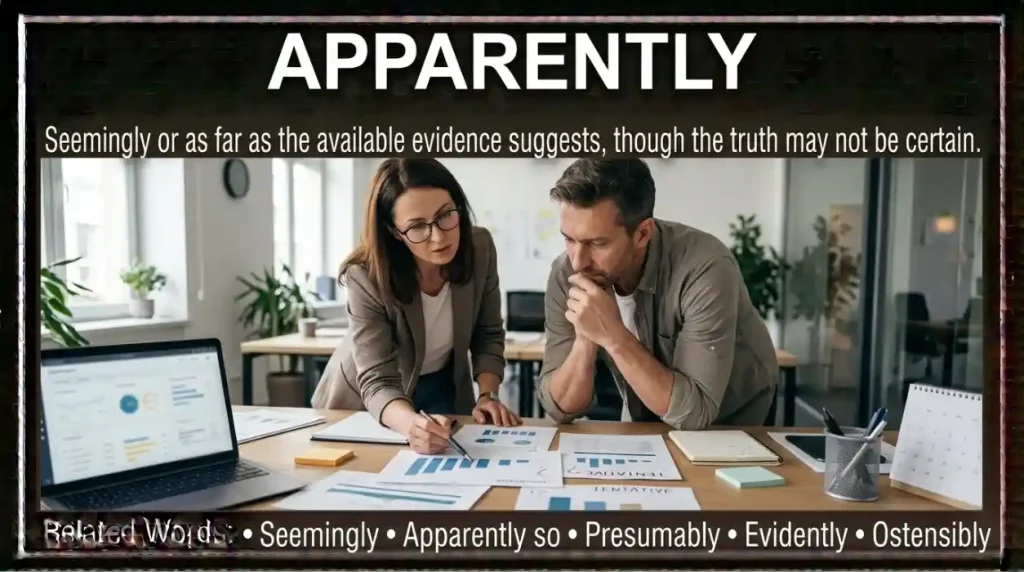
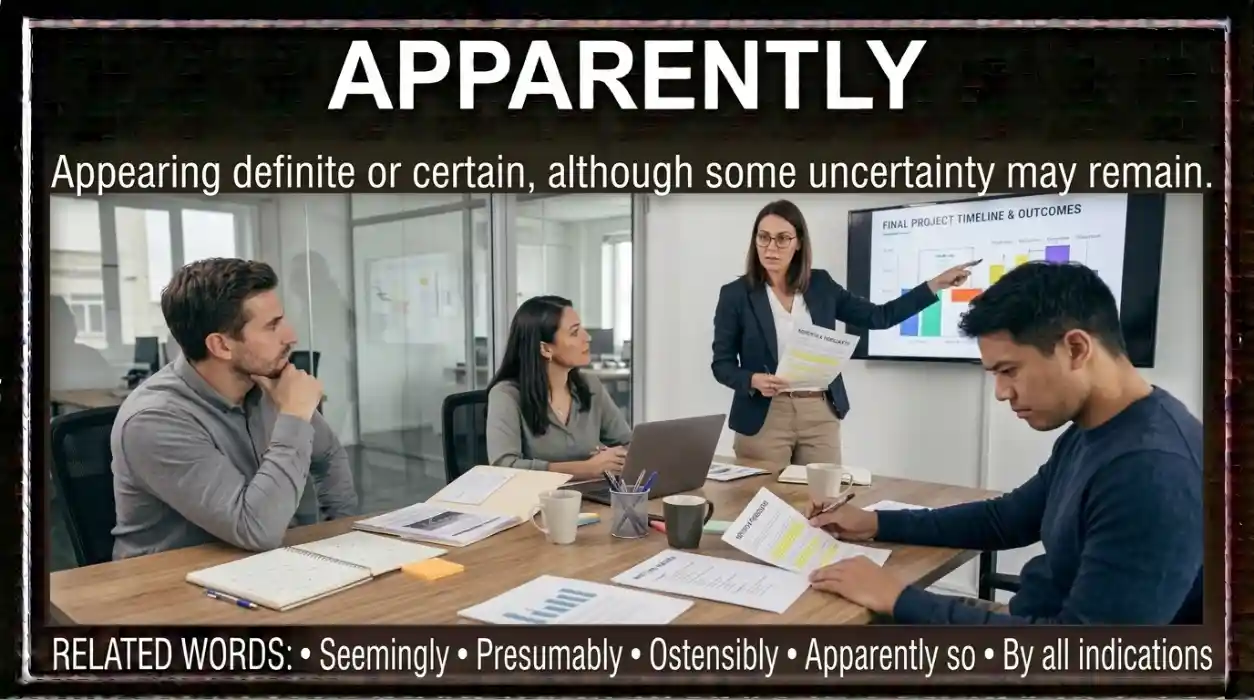
A synonym for apparently is seemingly, evidently, seemingly, reportedly, or ostensibly, depending on the context. These words describe something that appears to be true, is suggested by available evidence, or has been reported but may not be fully confirmed.
Imagine your colleague arrives late and says, “Apparently, the meeting time changed.” The word apparently signals that they have heard or discovered something, but they may not know every detail.
People use apparently in everyday conversations, news reports, emails, academic writing, and online discussions. It helps speakers share information without always claiming complete certainty.
Learning alternatives gives you more control over your message. Students can write clearer essays, bloggers can avoid repetitive wording, and content writers can express uncertainty more accurately.
Daily English users also benefit from understanding the difference between seemingly, reportedly, and evidently. Each word communicates a slightly different relationship between evidence, appearance, and certainty.
What Does “Apparently” Really Mean?
Apparently is an adverb meaning as far as one can tell, based on what seems true or what has been reported. It often indicates that information is plausible or appears correct, but the speaker may not have verified every detail.
For example:
- “Apparently, the train is delayed.” The speaker has some reason to believe this is true.
- “She was apparently upset.” Her behaviour suggested that she was upset.
- “Apparently, the policy changed last week.” The speaker has received information about the change.
Native English speakers use apparently to report information, draw a cautious conclusion, or highlight a difference between appearance and reality. Its exact meaning depends on context, tone, and the evidence available.
Part of speech: Adverb.
Common contexts: Everyday speech, workplace conversations, journalism, storytelling, academic discussion, and social media.
Connotative Meaning of Apparently
(Connotation is the feeling, attitude, or association a word carries beyond its basic dictionary meaning.)
- Positive tone: Apparently can introduce encouraging information, such as “Apparently, we passed the first review.”
- Negative tone: It can suggest doubt, irritation, or mild sarcasm, as in “Apparently, nobody remembered to book the room.”
- Neutral tone: It can simply report information without strong emotion, as in “Apparently, the library closes at six.”
The word does not automatically express doubt or sarcasm. Voice, context, and sentence structure determine how listeners interpret it.
Etymology
The word apparently comes from apparent plus the adverb-forming suffix -ly. Apparent entered English through French from Latin apparent-, the stem of apparens, meaning “appearing” or “being visible.” The Latin verb apparēre means “to appear” or “to become visible.”
The word gradually developed from the idea of something being visible to the modern adverb meaning “as it seems” or “according to what is known.”
Apparently in Old English (450–1100)
Apparently was not an established Old English word in its modern form. Old English used other expressions to convey ideas such as seeming, appearing, and being evident. These earlier expressions are part of the broader history of how English communicates appearance and certainty.
Apparently in Middle English (1100–1500)
After the Norman Conquest, French and Latin vocabulary strongly influenced English. Forms related to apparent entered English through this linguistic contact. Apparently developed from the use of apparent and the productive English suffix -ly.
Apparently in Modern English (1500–Present)
In Modern English, apparently became a common way to describe what seems true or what information suggests. Today, it appears in casual speech, reporting, professional communication, and online writing. Speakers often use it to avoid presenting uncertain information as an absolute fact.
Pronunciation of Apparently
- US IPA: /əˈpærəntli/
- UK IPA: /əˈpærəntli/
Syllables: ap-par-ent-ly
Affixation pattern
- Root/base: apparent
- Prefix: None in the modern word
- Suffix: -ly, which forms an adverb from the adjective apparent
The main stress falls on par: uh-PAIR-uhnt-lee. Practise the word slowly, then use it in a complete sentence.
Synonyms List
Not every alternative can replace apparently in every sentence. Some suggest visible evidence, others introduce reported information, and a few convey a formal or deliberate tone. Choose the word that matches the evidence and tone.
1. Seemingly (Adverb) — US /ˈsiːmɪŋli/ | UK /ˈsiːmɪŋli/
Meaning: Seemingly describes something that appears to be true, although the reality may be different.
Tone/Register: Neutral; suitable for speech and writing.
Examples:
The seemingly simple task took two hours.
He was seemingly calm before the announcement.
2. Evidently (Adverb) — US /ˈɛvɪdəntli/ | UK /ˈɛvɪdəntli/
Meaning: Evidently suggests that something appears true because the available signs or evidence point to it.
Tone/Register: Neutral to formal.
Examples:
Evidently, someone left the office window open.
She evidently understood the instructions.
3. Reportedly (Adverb) — US /rɪˈpɔrtɪdli/ | UK /rɪˈpɔːtɪdli/
Meaning: Reportedly indicates that information has been reported by a source but may not be independently confirmed by the speaker.
Tone/Register: Journalistic and formal.
Examples:
The company will reportedly open a new office next year.
The actor reportedly missed the event because of a flight delay.
4. Ostensibly (Adverb) — US /ɑˈstɛnsəbli/ | UK /ɒˈstɛnsəbli/
Meaning: Ostensibly means that something is presented as true or as the reason for an action, although the real situation may be different.
Tone/Register: Formal; often implies a hidden motive.
Examples:
Ostensibly, the meeting was about the new schedule.
He visited ostensibly to offer help, but he had another reason.
5. Seemingly So (Adverbial Phrase) — US /ˈsiːmɪŋli soʊ/ | UK /ˈsiːmɪŋli səʊ/
Meaning: Seemingly so confirms that something appears to be the case without claiming absolute certainty.
Tone/Register: Conversational.
Examples:
“Is the shop closed?” “Seemingly so.”
The plan looked risky, and seemingly so it proved to be.
6. By All Appearances (Adverbial Phrase) — US /baɪ ɔːl əˈpɪrənsɪz/ | UK /baɪ ɔːl əˈpɪərənsɪz/
Meaning: By all appearances means that everything visible or known suggests a particular conclusion.
Tone/Register: Neutral to formal.
Examples:
By all appearances, the repairs were successful.
The house was, by all appearances, empty.
7. To All Appearances (Adverbial Phrase) — US /tu ɔːl əˈpɪrənsɪz/ | UK /tuː ɔːl əˈpɪərənsɪz/
Meaning: To all appearances describes what seems to be true based on the visible situation.
Tone/Register: Formal or literary.
Examples:
To all appearances, the two neighbours were on good terms.
The project was, to all appearances, complete.
8. It Seems (Phrase) — US /ɪt siːmz/ | UK /ɪt siːmz/
Meaning: It seems introduces a conclusion that the speaker considers likely based on current information.
Tone/Register: Neutral and conversational.
Examples:
It seems the bus is running late.
It seems we need another day to finish the report.
9. It Appears (Phrase) — US /ɪt əˈpɪrz/ | UK /ɪt əˈpɪəz/
Meaning: It appears introduces a cautious conclusion based on observations or available facts.
Tone/Register: Neutral to formal.
Examples:
It appears the file was saved in the wrong folder.
It appears that everyone has received the updated schedule.
10. By the Looks of It (Phrase) — US /baɪ ðə lʊks əv ɪt/ | UK /baɪ ðə lʊks əv ɪt/
Meaning: By the looks of it means that the visible evidence suggests a particular outcome or situation.
Tone/Register: Informal.
Examples:
By the looks of it, we will need umbrellas today.
By the looks of it, the team is ready to leave.
11. From All Indications (Phrase) — US /frəm ɔːl ˌɪndɪˈkeɪʃənz/ | UK /frəm ɔːl ˌɪndɪˈkeɪʃənz/
Meaning: From all indications means that the available signs point toward a particular conclusion.
Tone/Register: Formal and professional.
Examples:
From all indications, the launch is on schedule.
From all indications, customer satisfaction has improved.
12. Apparently So (Phrase) — US /əˈpærəntli soʊ/ | UK /əˈpærəntli səʊ/
Meaning: Apparently so means that the available information suggests an affirmative answer, though the speaker may not be fully certain.
Tone/Register: Conversational.
Examples:
“Did the deadline change?” “Apparently so.”
“Is Nina joining us?” “Apparently so, according to the message.”
13. Presumably (Adverb) — US /prɪˈzuːməbli/ | UK /prɪˈzjuːməbli/
Meaning: Presumably indicates that something is believed to be true because it is reasonable to assume it.
Tone/Register: Neutral to formal.
Examples:
Presumably, the manager has already seen the email.
The keys are presumably still in the reception area.
14. Supposedly (Adverb) — US /səˈpoʊzɪdli/ | UK /səˈpəʊzɪdli/
Meaning: Supposedly reports something claimed or believed to be true, sometimes with a hint of doubt.
Tone/Register: Informal to neutral; can sound skeptical.
Examples:
The café is supposedly the best breakfast place.
He supposedly finished the assignment last night.
15. In All Likelihood (Phrase) — US /ɪn ɔːl ˈlaɪkliˌhʊd/ | UK /ɪn ɔːl ˈlaɪklihʊd/
Meaning: In all likelihood means that something is very likely to happen or be true.
Tone/Register: Neutral to formal.
Examples:
In all likelihood, the delivery will arrive tomorrow.
In all likelihood, we will need to revise the draft.
16. Likely (Adverb) — US /ˈlaɪkli/ | UK /ˈlaɪkli/
Meaning: Likely indicates that something probably will happen or is probably true.
Tone/Register: Neutral; common in everyday English.
Examples:
The roads will likely be busy after work.
She will likely call when she reaches home.
17. Probably (Adverb) — US /ˈprɑːbəbli/ | UK /ˈprɒbəbli/
Meaning: Probably means that something is more likely to be true than not, based on what is known.
Tone/Register: Neutral and conversational.
Examples:
I will probably take the earlier train.
They are probably waiting outside the building.
18. It Would Seem (Phrase) — US /ɪt wʊd siːm/ | UK /ɪt wʊd siːm/
Meaning: It would seem introduces a cautious interpretation of the available facts.
Tone/Register: Formal or measured.
Examples:
It would seem that the original plan is no longer practical.
It would seem the team needs additional support.
19. As Far as One Can Tell (Phrase) — US /æz fɑr æz wʌn kæn tɛl/ | UK /æz fɑː əz wʌn kæn tɛl/
Meaning: This phrase describes a conclusion based on the information currently available, while acknowledging possible limits.
Tone/Register: Neutral and explanatory.
Examples:
As far as I can tell, the website is working normally.
As far as we can tell, no files are missing.
20. On the Face of It (Phrase) — US /ɑn ðə feɪs əv ɪt/ | UK /ɒn ðə feɪs əv ɪt/
Meaning: On the face of it means that something seems true when considered at first, before deeper examination.
Tone/Register: Formal, especially in British English.
Examples:
On the face of it, the proposal looks reasonable.
On the face of it, the two accounts contradict each other.
21. At First Glance (Phrase) — US /æt fɜrst ɡlæns/ | UK /ət fɜːst ɡlɑːns/
Meaning: At first glance refers to what seems true during an initial or quick examination.
Tone/Register: Neutral.
Examples:
At first glance, the instructions look complicated.
At first glance, both designs seem equally effective.
22. On the Surface (Phrase) — US /ɑn ðə ˈsɜrfɪs/ | UK /ɒn ðə ˈsɜːfɪs/
Meaning: On the surface describes how something appears outwardly, without considering deeper details.
Tone/Register: Neutral; often suggests that more lies beneath.
Examples:
On the surface, their disagreement seemed minor.
The plan looked simple on the surface.
23. Seemingly Enough (Adverbial Phrase) — US /ˈsiːmɪŋli ɪˈnʌf/ | UK /ˈsiːmɪŋli ɪˈnʌf/
Meaning: This phrase is occasionally possible when describing something that appears sufficient, but it is not a standard direct synonym for apparently.
Tone/Register: Context-dependent; use sparingly.
Examples:
The explanation was seemingly enough to settle the question.
The evidence was seemingly enough for the first review.
24. Clearly (Adverb) — US /ˈklɪrli/ | UK /ˈklɪəli/
Meaning: Clearly presents something as easy to understand or strongly supported by evidence, often with more confidence than apparently.
Tone/Register: Neutral to formal.
Examples:
Clearly, the instructions need to be updated.
She clearly understood the main point.
25. Obviously (Adverb) — US /ˈɑbviəsli/ | UK /ˈɒbviəsli/
Meaning: Obviously indicates that something seems easy to recognize or understand, often with a stronger sense of certainty.
Tone/Register: Informal to neutral; may sound impatient.
Examples:
Obviously, we should check the figures before sending the report.
He was obviously pleased with the result.
26. Undoubtedly (Adverb) — US /ʌnˈdaʊtɪdli/ | UK /ʌnˈdaʊtɪdli/
Meaning: Undoubtedly means that something is believed to be true with little or no doubt, so it is stronger than apparently.
Tone/Register: Formal and emphatic.
Examples:
She is undoubtedly one of the most experienced people on the team.
The delay was undoubtedly frustrating for everyone.
27. Indubitably (Adverb) — US /ɪnˈduːbɪtəbli/ | UK /ɪnˈdjuːbɪtəbli/
Meaning: Indubitably means unquestionably or without doubt, and it is much more formal than apparently.
Tone/Register: Very formal, literary, or deliberately playful.
Examples:
The discovery was indubitably important to the research team.
He declared, with a smile, that the cake was indubitably delicious.
28. In All Probability (Phrase) — US /ɪn ɔːl ˌprɑːbəˈbɪləti/ | UK /ɪn ɔːl ˌprɒbəˈbɪləti/
Meaning: In all probability means that something is very likely, although it is not presented as certain.
Tone/Register: Formal.
Examples:
In all probability, the office will reopen on Monday.
In all probability, the revised schedule will be approved.
29. As It Seems (Phrase) — US /æz ɪt siːmz/ | UK /æz ɪt siːmz/
Meaning: As it seems can describe a situation according to how it appears, although it is less idiomatic than apparently in many sentences.
Tone/Register: Context-dependent.
Examples:
The situation is not as simple as it seems.
Things are moving more slowly than they seem.
30. By the Evidence (Phrase) — US /baɪ ði ˈɛvɪdəns/ | UK /baɪ ði ˈɛvɪdəns/
Meaning: By the evidence points to evidence as the basis for a conclusion, but it is not a natural replacement for apparently in every sentence.
Tone/Register: Analytical; often better phrased as “judging by the evidence.”
Examples:
Judging by the evidence, the damage happened overnight.
The conclusion should follow from the evidence rather than assumption.
31. Judging by Appearances (Phrase) — US /ˈdʒʌdʒɪŋ baɪ əˈpɪrənsɪz/ | UK /ˈdʒʌdʒɪŋ baɪ əˈpɪərənsɪz/
Meaning: This phrase means forming an opinion based on what can be observed outwardly.
Tone/Register: Neutral to formal.
Examples:
Judging by appearances, the building has recently been renovated.
Judging by appearances, the guests are enjoying the event.
32. From What I Can See (Phrase) — US /frəm wʌt aɪ kæn siː/ | UK /frəm wɒt aɪ kæn siː/
Meaning: From what I can see limits a conclusion to the speaker’s current observations or available information.
Tone/Register: Conversational and cautious.
Examples:
From what I can see, the room is ready for the meeting.
From what I can see, your changes have been saved.
33. As Far as I Know (Phrase) — US /æz fɑr æz aɪ noʊ/ | UK /æz fɑː əz aɪ nəʊ/
Meaning: As far as I know signals that a statement is based on the speaker’s knowledge, which may be incomplete.
Tone/Register: Neutral and conversational.
Examples:
As far as I know, the office is open today.
As far as I know, nobody has changed the password.
34. According to Reports (Phrase) — US /əˈkɔrdɪŋ tə rɪˈpɔrts/ | UK /əˈkɔːdɪŋ tə rɪˈpɔːts/
Meaning: According to reports attributes information to reports instead of presenting it as the speaker’s independently verified knowledge.
Tone/Register: Journalistic and formal.
Examples:
According to reports, the airport will add two new routes.
According to reports, the investigation is still ongoing.
35. By Some Accounts (Phrase) — US /baɪ sʌm əˈkaʊnts/ | UK /baɪ sʌm əˈkaʊnts/
Meaning: By some accounts introduces information or an interpretation attributed to certain people or sources, not necessarily everyone.
Tone/Register: Formal and journalistic.
Examples:
By some accounts, the meeting lasted nearly six hours.
By some accounts, the writer began the novel while travelling.
36. Allegedly (Adverb) — US /əˈlɛdʒɪdli/ | UK /əˈlɛdʒɪdli/
Meaning: Allegedly means that something has been claimed but has not necessarily been proven, especially in legal or controversial situations.
Tone/Register: Formal and journalistic; use carefully.
Examples:
The official allegedly shared confidential information.
The device was allegedly sold without the required approval.
37. Supposedly So (Phrase) — US /səˈpoʊzɪdli soʊ/ | UK /səˈpəʊzɪdli səʊ/
Meaning: Supposedly so affirms a claim that the speaker understands to be reported or assumed, sometimes with skepticism.
Tone/Register: Informal.
Examples:
“Is this the fastest route?” “Supposedly so.”
“Has the problem been fixed?” “Supposedly so, but I would test it first.”
38. Reportedly So (Phrase) — US /rɪˈpɔrtɪdli soʊ/ | UK /rɪˈpɔːtɪdli səʊ/
Meaning: Reportedly so indicates that a statement is supported by reports, rather than necessarily by the speaker’s direct knowledge.
Tone/Register: Formal or journalistic.
Examples:
“Will the station reopen?” “Reportedly so.”
The venue is reportedly so popular that bookings fill quickly.
39. By All Accounts (Phrase) — US /baɪ ɔːl əˈkaʊnts/ | UK /baɪ ɔːl əˈkaʊnts/
Meaning: By all accounts means that different reports or people generally agree about a situation.
Tone/Register: Neutral to formal.
Examples:
By all accounts, the new teacher is patient and helpful.
The event was, by all accounts, a success.
40. Apparently Enough (Adverbial Phrase) — US /əˈpærəntli ɪˈnʌf/ | UK /əˈpærəntli ɪˈnʌf/
Meaning: This phrase can mean “enough, as it seems,” but it is not a general synonym for apparently and should only be used when the surrounding sentence supports it.
Tone/Register: Context-dependent.
Examples:
The explanation was apparently enough to satisfy the panel.
The warning was apparently enough to make them reconsider.
41. As Things Stand (Phrase) — US /æz θɪŋz stænd/ | UK /æz θɪŋz stænd/
Meaning: As things stand describes the current situation, rather than simply indicating that something seems true.
Tone/Register: Neutral to formal.
Examples:
As things stand, we cannot confirm the delivery date.
As things stand, the proposal still needs approval.
42. For All We Know (Phrase) — US /fɔr ɔːl wi noʊ/ | UK /fə ɔːl wi nəʊ/
Meaning: For all we know emphasizes that a possibility remains open because the speaker lacks complete information.
Tone/Register: Conversational; sometimes skeptical.
Examples:
For all we know, the package is still at the depot.
For all we know, they may have changed their plans.
43. It Is Believed (Phrase) — US /ɪt ɪz bɪˈliːvd/ | UK /ɪt ɪz bɪˈliːvd/
Meaning: It is believed presents an idea as a belief held by people or authorities without identifying every person who holds it.
Tone/Register: Formal, academic, or journalistic.
Examples:
It is believed that the building dates back to the nineteenth century.
It is believed the species migrated through the valley.
44. It Is Thought (Phrase) — US /ɪt ɪz θɔt/ | UK /ɪt ɪz θɔːt/
Meaning: It is thought introduces an explanation or conclusion that people consider likely but have not necessarily proved.
Tone/Register: Formal and academic.
Examples:
It is thought that the painting was completed around 1920.
It is thought the storm weakened before reaching the coast.
45. Presumably So (Phrase) — US /prɪˈzuːməbli soʊ/ | UK /prɪˈzjuːməbli səʊ/
Meaning: Presumably so means that an affirmative answer seems reasonable based on what is known.
Tone/Register: Neutral to formal.
Examples:
“Does the ticket include the return journey?” “Presumably so, but check the details.”
“Will they send a confirmation?” “Presumably so.”
46. In Appearance (Phrase) — US /ɪn əˈpɪrəns/ | UK /ɪn əˈpɪərəns/
Meaning: In appearance describes how something looks, rather than confirming its true nature.
Tone/Register: Formal or descriptive.
Examples:
The two buildings were similar in appearance.
The solution was simple in appearance but difficult to implement.
47. Seemingly Certain (Adjective Phrase) — US /ˈsiːmɪŋli ˈsɜrtən/ | UK /ˈsiːmɪŋli ˈsɜːtən/
Meaning: Seemingly certain describes something that looks definite but may still contain uncertainty.
Tone/Register: Neutral and descriptive.
Examples:
The result seemed seemingly certain until the final vote.
The outcome, seemingly certain at first, changed after the review.
48. To All Intents and Purposes (Phrase) — US /tu ɔːl ɪnˈtɛnts ænd ˈpɜrpəsɪz/ | UK /tuː ɔːl ɪnˈtɛnts ənd ˈpɜːpəsɪz/
Meaning: This phrase means “for practical purposes” or “in effect,” so it overlaps with apparently only in limited contexts.
Tone/Register: Formal or neutral.
Examples:
To all intents and purposes, the old system has been replaced.
The building was, to all intents and purposes, empty.
49. Seemingly Evident (Adjective Phrase) — US /ˈsiːmɪŋli ˈɛvɪdənt/ | UK /ˈsiːmɪŋli ˈɛvɪdənt/
Meaning: Seemingly evident describes something that appears clear, though further evidence may change the interpretation.
Tone/Register: Formal; often more natural as “apparently evident” or “seems evident.”
Examples:
The connection was seemingly evident from the first set of results.
The pattern seemed evident, but the researchers checked it again.
50. As It Turns Out (Phrase) — US /æz ɪt tɜrnz aʊt/ | UK /æz ɪt tɜːnz aʊt/
Meaning: As it turns out introduces information that becomes clear after events unfold; it is not a direct synonym for apparently in every context.
Tone/Register: Conversational and narrative.
Examples:
As it turns out, we booked the wrong room.
The task looked difficult, but as it turns out, it was quite manageable.
Synonyms by Tone
The best substitute depends on how certain you are and what you want readers to infer.
Positive or Reassuring
- Evidently
- Clearly
- By all accounts
- In all likelihood
- From all indications
These expressions can introduce encouraging or favourable information. Remember that clearly is stronger than apparently and should not be used when the evidence is weak.
Neutral
- Seemingly
- It seems
- It appears
- Presumably
- As far as I know
- From what I can see
- Reportedly
These are useful when you want to share an observation or report without adding much emotional judgment.
Negative or Skeptical
- Supposedly
- Allegedly
- Ostensibly
- For all we know
- On the surface
These can introduce uncertainty, challenge a claim, or hint that appearances may be misleading. Allegedly is especially important when discussing accusations that have not been proven.
Playful or Informal
- By the looks of it
- Apparently so
- It seems
- As it turns out
- By the looks of things
These phrases fit casual conversation and storytelling. They can make your writing sound natural, provided they match the situation.
Why tone matters: Replacing apparently with obviously can make you sound more certain. Replacing it with supposedly can make you sound skeptical. Choose a phrase that reflects your actual confidence.
Apparently vs. Close Alternatives
Apparently vs. Seemingly
Both words describe how something appears to be. Seemingly often focuses on an impression, while apparently can refer to an inference or information the speaker has received.
- Use apparently when reporting something you have heard or inferred.
- Use seemingly when describing an appearance that may not match reality.
Apparently vs. Evidently
Evidently usually suggests that the evidence strongly supports a conclusion. Apparently leaves more room for uncertainty or second-hand information.
- “Apparently, the train is delayed” may reflect an announcement or message.
- “Evidently, the train has been delayed” suggests that the available signs make the conclusion clear.
Apparently vs. Supposedly
Supposedly often signals doubt about a claim. Apparently is more neutral, although it can sound skeptical in the right context.
Use supposedly when you want to distance yourself from a claim. Use apparently when you want to report what seems true without necessarily challenging it.
How Apparently Changes by Context
Daily Conversation
In conversation, apparently, it seems, probably, and by the looks of it are common choices. They help you share information while showing that you may not know everything.
For example: “Apparently, the café closes early on Sundays.” This sounds natural and leaves room for correction.
Writing and Blogging
In blog posts, choose a synonym based on the source of the information. Use reportedly when referring to reports, seemingly for appearances, and evidently when evidence supports the conclusion.
Avoid using apparently repeatedly in neighbouring sentences. Better word choice improves flow, but only when each alternative preserves the intended meaning.
Professional or Academic Tone
In professional writing, it appears, presumably, according to reports, and it is believed can help communicate uncertainty carefully.
In academic writing, distinguish observation from evidence and established findings. Do not use undoubtedly or clearly to make a claim sound stronger than the evidence allows.
Creative or Informal Use
In stories, ostensibly can hint at hidden motives, while as it turns out helps reveal new information. By the looks of it gives dialogue a casual, natural voice.
For example, a character might say, “Apparently, the key was in my pocket the whole time.” The sentence can convey surprise without a long explanation.
Common Mistakes Learners Make
Confusing Appearance With Proof
Apparently does not always mean that something has been proven. It often signals an inference, a report, or incomplete information.
Better: “Apparently, the office is closed today.”
Avoid: “Apparently, this proves the theory,” unless the evidence truly establishes the claim.
Using “Obviously” Too Freely
Obviously can sound impatient or dismissive because it suggests that something should be easy for everyone to understand.
Better: Use apparently, or it seems when you want to sound cautious and polite.
Treating “Allegedly” as a General Substitute
Allegedly is often used for claims or accusations that have not been proven. It may carry legal or reputational implications.
Better: Use reportedly for information attributed to reports and allegedly when a claim remains an allegation.
Overusing “Apparently” in SEO Writing
Repeating the focus keyword in every paragraph can make a page sound mechanical. Search-focused writing still needs clear explanations and natural vocabulary.
Better: Use the target phrase in relevant headings and explanations. Add alternatives only when they fit the intended meaning.
Register Notes
- Formal: ostensibly, reportedly, evidently, presumably
- Neutral: apparently, seemingly, it appears, it seems
- Informal: by the looks of it, probably, as it turns out
- Potentially skeptical: supposedly, allegedly
For related vocabulary practice, explore other lessons about English adverbs, uncertainty, and precise word choice in your vocabulary notes.
Real-Life Examples Using
Workplace
A colleague says, “Apparently, the client needs the revised document by noon.” The word signals that the information has been received, but the speaker may not have confirmed every detail personally.
Social Situations
A friend texts, “Apparently, everyone is meeting at the park.” The phrase shares a plan while leaving room for the possibility that the details may change.
Media and Pop Culture
A news presenter may say that a public figure has reportedly joined a new project. Reportedly makes clear that the information comes from reports rather than direct confirmation by the presenter.
Writing and Storytelling
A mystery writer might begin with, “Apparently, the door had been locked all night.” Later evidence could reveal that the initial impression was wrong. The word creates uncertainty without giving away the twist.
Practice Quiz
1. You heard from a colleague that the meeting time changed, but you have not checked the calendar. What fits best?
A. Undoubtedly
B. Apparently
C. Indubitably
D. Obviously
2. A newspaper is sharing a claim attributed to unnamed sources. Which word is most suitable?
A. Reportedly
B. Clearly
C. Undoubtedly
D. Certainly
3. You want to describe a conclusion strongly supported by visible evidence. Which word fits best?
A. Allegedly
B. Evidently
C. Supposedly
D. Ostensibly
4. Someone claims a restaurant is excellent, but you doubt the claim. Which word may signal skepticism?
A. Supposedly
B. Evidently
C. Undoubtedly
D. Clearly
5. A formal report explains that a stated reason may hide the real motive. Which word is suitable?
A. Probably
B. Ostensibly
C. By the looks of it
D. Apparently so
6. You want to say that the weather will probably improve tomorrow. Which expression fits?
A. Allegedly
B. Presumably
C. In all likelihood
D. On the face of it
7. A friend asks whether the shop is closed. You can see its lights are off and the door is locked. What is a natural response?
A. By the looks of it, yes
B. Indubitably, allegedly
C. Ostensibly so, reportedly
D. To all intents and purposes, allegedly
8. You are writing an academic report and need to state a cautious conclusion based on observations. Which phrase is suitable?
A. It appears
B. Obviously
C. Supposedly
D. For all we know
9. You want to report an accusation without presenting it as proven. Which word is most appropriate?
A. Clearly
B. Allegedly
C. Undoubtedly
D. Evidently
10. You discover that the missing document was in the folder all along. Which phrase introduces the discovery naturally?
A. As it turns out
B. By all appearances
C. It is believed
D. Ostensibly
Reflection Task
Write two sentences about a recent event. In one, use apparently. In the other, replace it with seemingly, reportedly, or presumably. Explain how the meaning changes.
Answer Key
1-B, 2-A, 3-B, 4-A, 5-B, 6-C, 7-A, 8-A, 9-B, 10-A
External Sources
For definitions, pronunciation, and historical details, consult these established references:
- Merriam-Webster Dictionary — definitions and examples for apparently, seemingly, and related adverbs.
- Oxford English Dictionary — historical development and etymology of apparent and apparently.
- Cambridge Dictionary — learner-friendly definitions, pronunciation, and usage examples.
Use dictionary entries to confirm exact meanings and grammar. When reporting uncertain information, identify its source and avoid presenting unverified claims as facts.
Conclusion
Choosing the right synonym for apparently helps you express what you know, what you suspect, and what you have heard. Small differences in wording can make your message more accurate and natural.
A wider vocabulary improves essays, blog posts, emails, and everyday conversations. It also helps you communicate uncertainty without sounding vague or overly confident.
Start with familiar alternatives such as seemingly, evidently, and presumably. Practise each one in a sentence so you understand how its meaning changes with context.
Try using three alternatives in your next email, essay, or conversation. Notice which word best matches your evidence and tone, and keep practising until the choice feels natural.
FAQs
1. What is the best synonym for apparently in an academic essay?
Evidently, presumably, and it appears can work in academic writing, but they communicate different levels of confidence. Use evidently when evidence strongly supports a conclusion. Choose presumably when the conclusion is a reasonable assumption. Use it appears for a cautious interpretation of findings.
2. Can apparently mean allegedly?
Sometimes, but the two words are not interchangeable in every situation. Apparently indicates that something seems true or follows from available information. Allegedly introduces a claim that has not necessarily been proven, especially an accusation. In legal or reputational contexts, use allegedly carefully and make the source of the claim clear.
3. Is apparently formal or informal English?
Apparently is suitable for both spoken and written English. It appears in casual conversations, workplace emails, news reporting, and formal explanations. In an academic paper, a phrase such as the evidence suggests may be more precise if you are discussing research results rather than reporting an impression.
4. What can I use instead of apparently in a professional email?
Try it appears, reportedly, or as far as I can tell, depending on your meaning. For example, “It appears the attachment was missing” sounds measured and professional. If you received information from another person, identify that source rather than implying that you verified the information yourself.
5. Does apparently always show uncertainty?
No. It often signals that a conclusion is based on appearances or indirect information, but it can also introduce something the speaker considers likely or well supported. Tone matters. In a sentence such as “Apparently, the system is down again,” it may even convey frustration or sarcasm.

Hasnain Ali is an SEO Content Strategist and the founder of wordvora.com, a trusted vocabulary platform that helps writers, students, professionals, and English learners find accurate synonyms, antonyms, word meanings, and real-life usage examples. He specializes in keyword research, on-page SEO, topical authority, and creating search-first content that aligns with Google’s latest Search Quality and E-E-A-T guidelines. His work focuses on producing clear, well-structured, and reader-friendly resources that satisfy search intent while maintaining high editorial standards.
Through extensive hands-on experience with SEO tools such as Google Search Console, Google Analytics, SEMrush, and Ahrefs, Hasnain researches user search behavior and develops content that is both informative and easy to understand. Every article published on wordvora.com is carefully reviewed for accuracy, readability, and contextual relevance before publication. His mission is to build one of the web’s most reliable English vocabulary resources by providing practical language guidance, trustworthy explanations, and content that helps readers improve their writing, communication, and vocabulary with confidence.