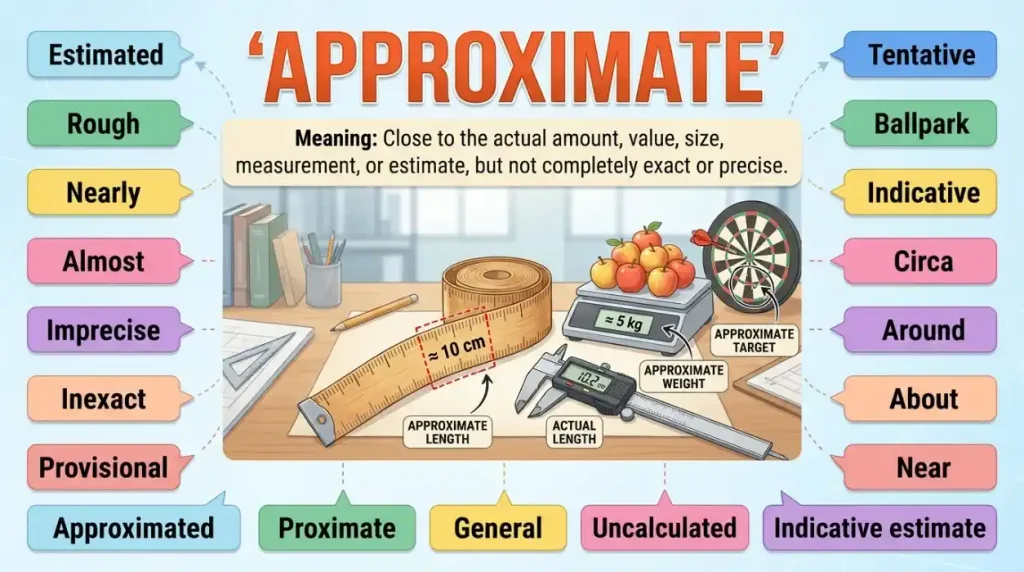
A synonym for approximate is a word or phrase that expresses closeness to an exact number, amount, time, or measurement. Common alternatives include estimated, rough, about, around, nearly, and inexact. The best choice depends on the sentence and the level of precision you want to communicate.
Imagine someone asks how far your home is from the nearest station. You might say it is approximately two kilometres away. You could also say it is about two kilometres away.
The word approximate is common in conversations, reports, measurements, and academic writing. Finding a suitable synonym for approximate helps you explain estimates without repeating the same expression.
Students can use these alternatives in essays and assignments. Bloggers and content writers can make information easier to read, while everyday English users can communicate estimates more naturally.
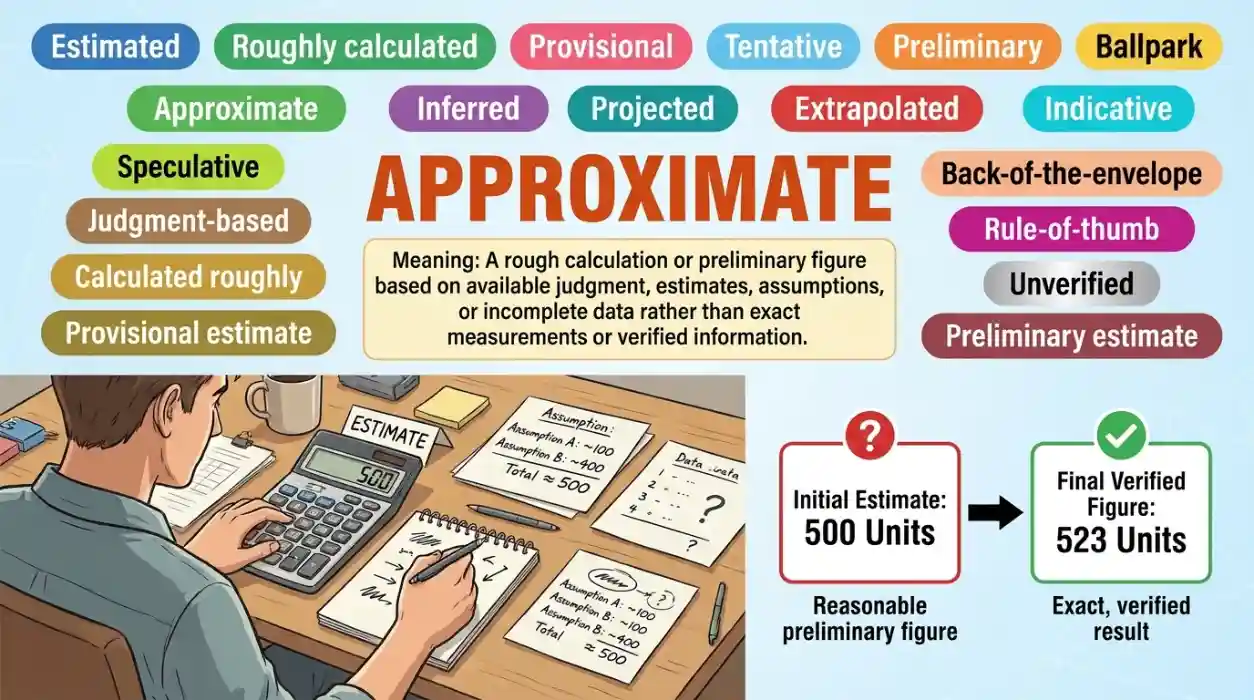
Learning different alternatives also helps you express accuracy more clearly. A rough figure suggests a general estimate, while an estimated figure often suggests a considered calculation.
What Does “Approximate” Really Mean?
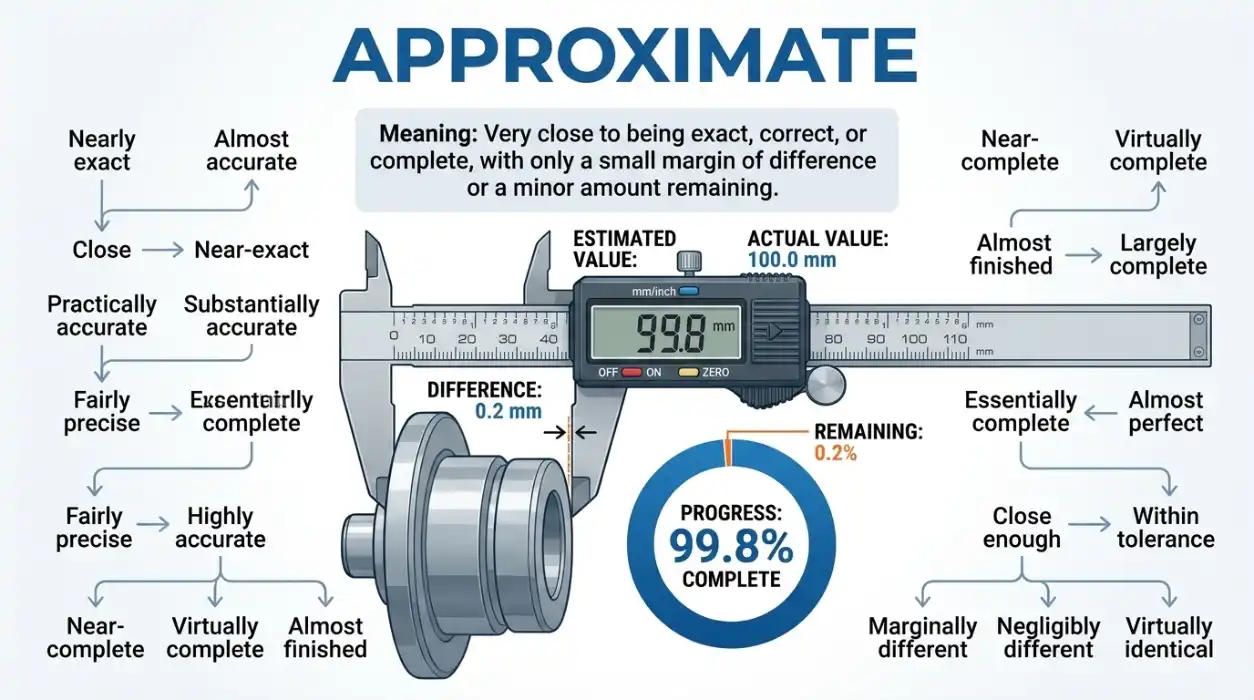
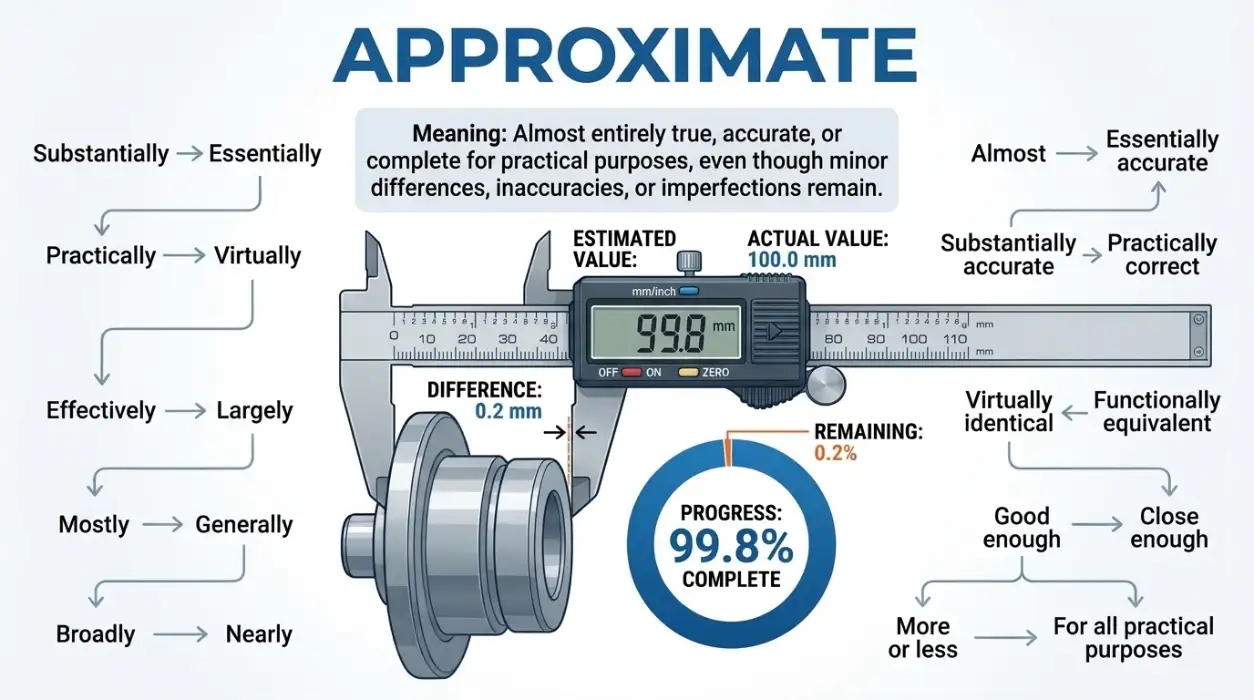
Approximate means close to an exact number, amount, value, time, or description, but not completely accurate.
In simple English, something approximate is nearly correct rather than perfectly exact.
Consider these examples:
- The approximate distance is five kilometres.
- The meeting will take approximately 30 minutes.
- The building is about 20 metres tall.
Each sentence gives useful information without claiming complete precision.
Part of Speech
The word approximate has two main grammatical uses.
1. Adjective
As an adjective, it describes something close to an exact value.
Example: The approximate population is 50,000.
2. Verb
As a verb, it means to come close to a particular value, result, or condition.
Example: This calculation approximates the actual cost.
The related adverb is approximately.
Example: The journey takes approximately two hours.
How Native Speakers Understand Approximate
Native English speakers generally understand approximate as a neutral way to describe something that is not completely exact.
It does not automatically mean that information is unreliable. It simply tells readers that the figure or description is close to the truth.
The word commonly appears in:
- Measurements and distances
- Time estimates and schedules
- Scientific calculations
- Population statistics
- Business reports
- Everyday conversations
- Educational explanations
Connotative Meaning of Approximate
(Connotation means the feeling, attitude, or association that a word communicates beyond its basic dictionary meaning.)
Positive tone
The word can suggest a useful and practical estimate when exact information is unavailable.
Example: An approximate schedule helped everyone prepare.
Negative tone
It can suggest insufficient accuracy when a situation requires precise information.
Example: The report contained approximate figures instead of verified results.
Neutral tone
It can simply describe something close to an exact value.
Example: The approximate height of the wall is three metres.
Overall, approximate is usually neutral. Its emotional effect depends on the situation and the words surrounding it.
Etymology of Approximate
The word approximate comes from Latin approximare, meaning “to come near” or “to approach.”
It combines the Latin element ad-, meaning “toward,” with a form related to proximus, meaning “nearest.”
The word entered English through French and Latin-influenced vocabulary. Its central meaning has remained connected to closeness and nearness.
Historical Development
Old English (450–1100)
The modern word approximate did not exist in Old English. English speakers used other words to describe nearness, similarity, and closeness.
Middle English (1100–1500)
French and Latin influenced English vocabulary significantly during this period. Words and expressions related to approaching and coming near became more common.
Modern English (1500–present)
Approximate became an established English adjective and verb. Its use expanded in mathematics, science, measurement, business, and everyday communication.
Pronunciation, Syllables, and Affixation
Pronunciation (US and UK IPA)
- US: /əˈprɑːksɪmət/ — adjective; /əˈprɑːksɪmeɪt/ — verb
- UK: /əˈprɒksɪmət/ — adjective; /əˈprɒksɪmeɪt/ — verb
Syllables
ap-prox-i-mate
The word has four syllables.
Affixation Pattern
- Root: Related to Latin proximus, meaning nearest.
- Prefix: The historical Latin element ad- means toward. It appears in a modified form.
- Suffix: -ate forms the English adjective and verb.
Related Word Forms
- Approximately (adverb): The journey takes approximately 40 minutes.
- Approximation (noun): This answer is only an approximation.
- Approximated (verb form): The final result was approximated using a simple calculation.
- Approximating (verb form): We are approximating the expected value.
H3 List of Synonyms for Approximate
1. Estimated (adj) — US: /ˈes.tə.meɪ.t̬ɪd/ | UK: /ˈes.tɪ.meɪ.tɪd/
- Meaning: Calculated roughly based on available judgment or preliminary data.
- Tone/Register: Business, Professional, Formal
- Example 1: The manager presented an estimated budget during the morning briefing.
- Example 2: Our estimated arrival time is set for three in the afternoon.
2. Rough (adj) — US: /rʌf/ | UK: /rʌf/
- Meaning: Basic, preliminary, and not detailed or exact.
- Tone/Register: Everyday, General, Casual
- Example 1: He gave a rough draft of the speech to his editor.
- Example 2: She made a rough calculation of our total travel expenses.
3. Imprecise (adj) — US: /ˌɪm.prəˈsaɪs/ | UK: /ˌɪm.prɪˈsaɪs/
- Meaning: Lacking exact details, exactness, or sharp accuracy.
- Tone/Register: Academic, Formal, Technical
- Example 1: The lab report received criticism for using imprecise measurements.
- Example 2: Her description of the event was vague and imprecise.
4. Inexact (adj) — US: /ˌɪn.ɪɡˈzækt/ | UK: /ˌɪn.ɪɡˈzækt/
- Meaning: Not strictly accurate or completely correct in detail.
- Tone/Register: Formal, Scientific
- Example 1: History relies on somewhat inexact dates for ancient events.
- Example 2: The survey gave an inexact count of local wildlife.
5. Near (adj) — US: /nɪr/ | UK: /nɪə/
- Meaning: Close to a specific value, time, quality, or physical position.
- Tone/Register: General, Everyday
- Example 1: The team achieved a near-perfect score on the final exam.
- Example 2: We watched the plane make a near landing on the runway.
6. Close (adj) — US: /kloʊs/ | UK: /kləʊs/
- Meaning: Very similar to an actual figure, target, or quality.
- Tone/Register: Casual, Common
- Example 1: His guess on the final score was remarkably close.
- Example 2: The shade of paint was a close match to our wall.
7. About (prep/adv) — US: /əˈbaʊt/ | UK: /əˈbaʊt/
- Meaning: Used before a number to indicate an estimated amount.
- Tone/Register: Conversational, Everyday
- Example 1: There were about twenty people waiting in line.
- Example 2: The movie will start in about ten minutes.
8. Around (prep/adv) — US: /əˈraʊnd/ | UK: /əˈraʊnd/
- Meaning: Approximately at or near a specified time, date, or number.
- Tone/Register: Casual, Everyday
- Example 1: We plan to leave the house around noon.
- Example 2: The total repair cost will run around fifty dollars.
9. Loose (adj) — US: /luːs/ | UK: /luːs/
- Meaning: Not strictly fixed, detailed, or tightly defined.
- Tone/Register: General, Casual
- Example 1: The author gave a loose translation of the Latin poem.
- Example 2: They worked out a loose agreement over lunch.
10. Broad (adj) — US: /brɑːd/ | UK: /brɔːd/
- Meaning: General and covering main points without focusing on exact details.
- Tone/Register: Business, Academic
- Example 1: The director gave a broad outline of the new policy.
- Example 2: We have a broad idea of what the client wants.
11. General (adj) — US: /ˈdʒen.ər.əl/ | UK: /ˈdʒen.ər.əl/
- Meaning: Affecting or concerning the main parts without being exact.
- Tone/Register: Standard, Universal
- Example 1: She provided a general overview of the quarterly results.
- Example 2: The public consensus showed general agreement on the topic.
12. Ballpark (adj/n) — US: /ˈbɑːl.pɑːrk/ | UK: /ˈbɔːl.pɑːk/
- Meaning: Falling within a reasonable range of estimation.
- Tone/Register: Business, Informal, Idiomatic
- Example 1: Can you give me a ballpark figure for the renovation?
- Example 2: The contractor offered a ballpark estimate for the roof.
13. Fuzzy (adj) — US: /ˈfʌz.i/ | UK: /ˈfʌz.i/
- Meaning: Unclear, blurred, or lacking precise boundaries.
- Tone/Register: Informal, Descriptive
- Example 1: My memory of that rainy evening is a bit fuzzy.
- Example 2: The accounting report had some fuzzy numbers at the end.
14. Vague (adj) — US: /veɪɡ/ | UK: /veɪɡ/
- Meaning: Not clearly expressed, defined, or specified in detail.
- Tone/Register: General, Critical
- Example 1: He gave a vague answer when asked about his plans.
- Example 2: The directions were too vague to follow easily.
15. Approximative (adj) — US: /əˈprɑːk.sə.mə.t̬ɪv/ | UK: /əˈprɒk.sɪ.mə.tɪv/
- Meaning: Serving to estimate or approach an exact figure.
- Tone/Register: High Academic, Rare
- Example 1: The researcher used an approximative model to predict weather.
- Example 2: The chart offers an approximate view of global trends.
16. Round (adj) — US: /raʊnd/ | UK: /raʊnd/
- Meaning: Expressed as a convenient whole number without fractions.
- Tone/Register: General, Business
- Example 1: Let us use round numbers to simplify our math problem.
- Example 2: He gave a round estimate of one hundred attendees.
17. Calculated (adj) — US: /ˈkæl.kjə.leɪ.t̬ɪd/ | UK: /ˈkæl.kjə.leɪ.tɪd/
- Meaning: Determined through mathematical assessment or careful reasoning.
- Tone/Register: Professional, Technical
- Example 1: The engineers took a calculated risk during structural design.
- Example 2: She shared her calculated projections for next year.
18. Projected (adj) — US: /prəˈdʒek.tɪd/ | UK: /prəˈdʒek.tɪd/
- Meaning: Forecasted or estimated for a future point in time based on trends.
- Tone/Register: Business, Financial
- Example 1: The company released its projected earnings for the quarter.
- Example 2: Projected population growth requires new city infrastructure.
19. Relative (adj) — US: /ˈrel.ə.t̬ɪv/ | UK: /ˈrel.ə.tɪv/
- Meaning: Considered in relation or comparison to something else.
- Tone/Register: Academic, Formal
- Example 1: We evaluated the relative cost of living in both cities.
- Example 2: The experiment achieved relative success despite small delays.
20. Comparative (adj) — US: /kəmˈpær.ə.t̬ɪv/ | UK: /kəmˈpær.ə.tɪv/
- Meaning: Measured or judged by estimating against a standard.
- Tone/Register: Academic, Scientific
- Example 1: She conducted a comparative study of regional dialects.
- Example 2: The new vehicle offered comparative fuel savings.
21. Provisional (adj) — US: /prəˈvɪʒ.ən.əl/ | UK: /prəˈvɪʒ.ən.əl/
- Meaning: Arranged or existing for the present time, subject to change.
- Tone/Register: Formal, Legal, Business
- Example 1: The board shared a provisional schedule for the conference.
- Example 2: He received a provisional driver’s license while waiting for processing.
22. Tentative (adj) — US: /ˈten.t̬ə.t̬ɪv/ | UK: /ˈten.tə.tɪv/
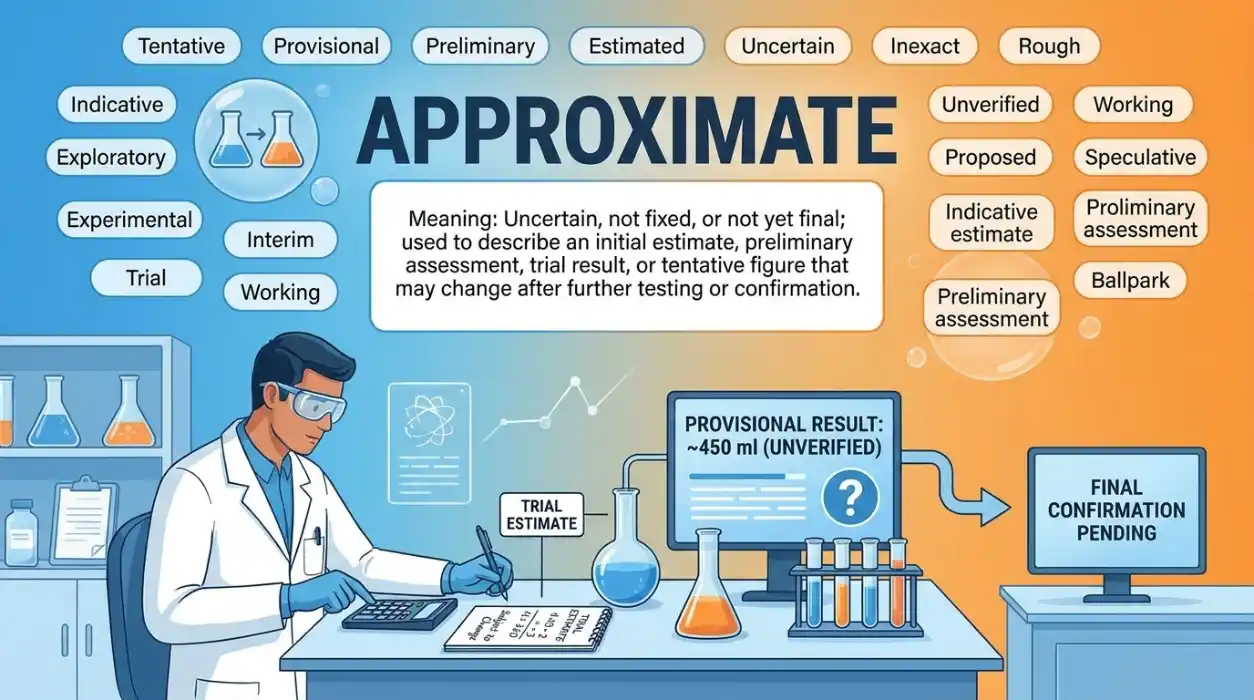
- Meaning: Not certain or fixed; done as a preliminary test or estimate.
- Tone/Register: Professional, Business
- Example 1: We agreed on a tentative date for our next team meeting.
- Example 2: She made a tentative plan to travel during summer.
23. Hazy (adj) — US: /ˈheɪ.zi/ | UK: /ˈheɪ.zi/
- Meaning: Lacking clarity, certainty, or sharp definition.
- Tone/Register: Informal, Descriptive
- Example 1: The long-term financial outlook remains hazy for small firms.
- Example 2: He had a hazy recollection of the details.
24. Indefinite (adj) — US: /ɪnˈdef.ə.nət/ | UK: /ɪnˈdef.ɪ.nət/
- Meaning: Not clearly specified, limited, or determined in advance.
- Tone/Register: General, Formal
- Example 1: The project was placed on an indefinite hold yesterday.
- Example 2: She gave an indefinite timeframe for her return.
25. Bordering on (v phrase) — US: /ˈbɔːr.dɚ.ɪŋ ɑːn/ | UK: /ˈbɔː.dər.ɪŋ ɒn/
- Meaning: Coming very close to a specific state, quality, or number.
- Tone/Register: Descriptive, General
- Example 1: His energetic speech was bordering on pure inspiration.
- Example 2: The cold morning air was bordering on freezing temperatures.
26. Verging on (v phrase) — US: /ˈvɝː.dʒɪŋ ɑːn/ | UK: /ˈvɜː.dʒɪŋ ɒn/
- Meaning: Approaching near to a specified quality, limit, or condition.
- Tone/Register: Expressive, Literary
- Example 1: Her artistic style was verging on complete abstraction.
- Example 2: The local weather was verging on severe rainstorms.
27. Resembling (v/adj) — US: /rɪˈzem.blɪŋ/ | UK: /rɪˈzem.blɪŋ/
- Meaning: Looking like or being similar to another thing or figure.
- Tone/Register: Descriptive, General
- Example 1: The cloud pattern took a shape resembling a soaring eagle.
- Example 2: She wore a ring resembling an antique royal family jewel.
28. Simulating (v/adj) — US: /ˈsɪm.jə.leɪ.t̬ɪŋ/ | UK: /ˈsɪm.jʊ.leɪ.tɪŋ/
- Meaning: Recreating or imitating the conditions or appearance of something.
- Tone/Register: Technical, Scientific
- Example 1: Flight software was simulating storm conditions for the pilot.
- Example 2: The lab model succeeded in simulating natural ocean currents.
29. Mimicking (v/adj) — US: /ˈmɪm.ɪ.kɪŋ/ | UK: /ˈmɪm.ɪ.kɪŋ/
- Meaning: Imitating or copying the characteristics of something closely.
- Tone/Register: Descriptive, General
- Example 1: Synthetic materials were mimicking the texture of real leather.
- Example 2: The robot was mimicking basic human arm movements.
30. Paralleling (v/adj) — US: /ˈpær.ə.lel.ɪŋ/ | UK: /ˈpær.ə.lel.ɪŋ/
- Meaning: Running close to or matching another trend or figure closely.
- Tone/Register: Academic, Formal
- Example 1: Sales figures were paralleling our best projections from last year.
- Example 2: Her career trajectory was paralleling her mentor’s achievements.
31. Approaching (v/adj) — US: /əˈproʊ.tʃɪŋ/ | UK: /əˈprəʊ.tʃɪŋ/
- Meaning: Coming near in time, amount, quality, or physical distance.
- Tone/Register: General, Everyday
- Example 1: Temperatures are approaching record highs this summer.
- Example 2: We noticed the delivery truck approaching our driveway.
32. Nearing (v/adj) — US: /ˈnɪr.ɪŋ/ | UK: /ˈnɪə.rɪŋ/
- Meaning: Getting close to a particular point, completion stage, or figure.
- Tone/Register: Common, General
- Example 1: The construction crew is nearing completion on the bridge.
- Example 2: The evening clock was nearing midnight when we landed.
33. Impinging on (v phrase) — US: /ɪmˈpɪn.dʒɪŋ ɑːn/ | UK: /ɪmˈpɪn.dʒɪŋ ɒn/
- Meaning: Coming close to or encroaching upon a boundary or limit.
- Tone/Register: Formal, Legal
- Example 1: New building plans were impinging on protected parkland.
- Example 2: Loud noise began impinging on quiet library hours.
34. Touching (v/adj) — US: /ˈtʌtʃ.ɪŋ/ | UK: /ˈtʌtʃ.ɪŋ/
- Meaning: Coming so close as to reach or border a specific limit.
- Tone/Register: Descriptive, General
- Example 1: Prices were touching historic levels during peak summer demand.
- Example 2: Branches were touching the top of the cottage roof.
35. Reaching (v/adj) — US: /ˈriː.tʃɪŋ/ | UK: /ˈriː.tʃɪŋ/
- Meaning: Arriving at or coming near to a specified point or figure.
- Tone/Register: Common, Neutral
- Example 1: Attendance figures were reaching record numbers at the expo.
- Example 2: Water levels were reaching dangerous levels at the dam.
36. Equaling (v/adj) — US: /ˈiː.kwəl.ɪŋ/ | UK: /ˈiː.kwəl.ɪŋ/
- Meaning: Coming to the same value or matching closely in measure.
- Tone/Register: Mathematical, Formal
- Example 1: The final output was equal to our highest factory records.
- Example 2: Her time on the track was equal to the regional mark.
37. Matchable (adj) — US: /ˈmætʃ.ə.bəl/ | UK: /ˈmætʃ.ə.bəl/
- Meaning: Able to come close to or equal something in quality or value.
- Tone/Register: Technical, Business
- Example 1: Their customer service standard was hardly matchable in the region.
- Example 2: The two fabric samples offered matchable color tones.
38. Comparable (adj) — US: /ˈkɑːm.pɚ.ə.bəl/ | UK: /ˈkɒm.pər.ə.bəl/
- Meaning: Similar enough to be estimated or judged alongside another thing.
- Tone/Register: Business, Academic
- Example 1: Both luxury sedans offer comparable safety features.
- Example 2: Salary levels remained comparable across both regions.
39. Analogous (adj) — US: /əˈnæl.ə.ɡəs/ | UK: /əˈnæl.ə.ɡəs/
- Meaning: Similar or corresponding in certain key respects.
- Tone/Register: High Academic, Scientific
- Example 1: The structure of an atom is analogous to a solar system.
- Example 2: Her situation was analogous to what happened last year.
40. Kind of (adv phrase) — US: /kaɪnd ʌv/ | UK: /kaɪnd ɒv/
- Meaning: Used informally to indicate an approximate or imprecise state.
- Tone/Register: Informal, Spoken
- Example 1: The movie was kind of long, but still enjoyable.
- Example 2: I feel kind of tired after the long drive home.
41. Sort of (adv phrase) — US: /sɔːrt ʌv/ | UK: /sɔːt ɒv/
- Meaning: Used to describe an estimated or incomplete quality informally.
- Tone/Register: Informal, Conversational
- Example 1: The paint color was sort of green with a blue tint.
- Example 2: He was sort of hoping to catch the early train.
42. More or less (adv phrase) — US: /mɔːr ɔːr les/ | UK: /mɔːr ɔː les/
- Meaning: Approximately; almost completely or within a small margin.
- Tone/Register: Everyday, General
- Example 1: The job is more or less finished for the afternoon.
- Example 2: The total cost came out more or less as we expected.
43. Give or take (adv phrase) — US: /ɡɪv ɔːr teɪk/ | UK: /ɡɪv ɔː teɪk/
- Meaning: Plus or minus a small estimated amount.
- Tone/Register: Informal, Idiomatic
- Example 1: The drive takes three hours, give or take ten minutes.
- Example 2: There were fifty guests at the party, give or take a few.
44. Roughly (adv) — US: /ˈrʌf.li/ | UK: /ˈrʌf.li/
- Meaning: Approximately; without giving exact details or numbers.
- Tone/Register: General, Universal
- Example 1: The project will take roughly two weeks to finish.
- Example 2: He calculated roughly how much lumber we needed.
45. In the neighborhood of (phrase) — US: /ɪn ðə ˈneɪ.bɚ.hʊd ʌv/ | UK: /ɪn ðə ˈneɪ.bə.hʊd ɒv/
- Meaning: Approximately equal to a specified financial figure or amount.
- Tone/Register: Business, Idiomatic
- Example 1: The house price was in the neighborhood of half a million dollars.
- Example 2: They spent an amount in the neighborhood of ten thousand for repairs.
46. Somewhere around (phrase) — US: /ˈsʌm.hwer əˈraʊnd/ | UK: /ˈsʌm.weər əˈraʊnd/
- Meaning: Estimated to be near a specific time, date, or total.
- Tone/Register: Casual, Spoken
- Example 1: We should arrive somewhere around six in the evening.
- Example 2: The cost will land somewhere around fifty bucks.
47. Close upon (prep phrase) — US: /kloʊs əˈpɑːn/ | UK: /kləʊs əˈpɒn/
- Meaning: Nearly or almost reaching a specified time or number.
- Tone/Register: Formal, Literary
- Example 1: It was close upon midnight when the storm finally passed.
- Example 2: The old monarch was close upon eighty years of age.
48. In the region of (phrase) — US: /ɪn ðə ˈriː.dʒən ʌv/ | UK: /ɪn ðə ˈriː.dʒən ɒv/
- Meaning: Approximately matching a given numerical quantity.
- Tone/Register: Business, Formal, British English
- Example 1: The repair invoice was in the region of two hundred pounds.
- Example 2: Annual sales were in the region of five million dollars.
49. As good as (phrase) — US: /æz ɡʊd æz/ | UK: /æz ɡʊd æz/
- Meaning: Virtually or practically equal to a state or figure.
- Tone/Register: Everyday, Informal
- Example 1: The project is as good as finished after today’s work.
- Example 2: He was as good as gold during the long flight.
50. Virtually (adv) — US: /ˈvɝː.tʃu.ə.li/ | UK: /ˈvɜː.tʃu.ə.li/
- Meaning: Almost entirely; for all practical purposes without complete exactness.
- Tone/Register: General, Academic
- Example 1: The hall was virtually empty by the time we arrived.
- Example 2: Her proposal was virtually identical to the original draft.
Synonyms by Tone
The tone of a synonym changes how a reader understands your estimate. A casual conversation needs different language from a research paper or business report.
Positive or Reassuring
These alternatives can make an estimate sound practical and helpful:
- Estimated: Suggests a considered calculation.
- Indicative: Suggests useful guidance.
- Close: Emphasises similarity to an expected result.
- Near: Highlights proximity to a target.
- Ballpark: Makes an early estimate sound approachable.
Neutral
These words communicate approximation without a strong emotional judgment:
- Approximately
- About
- Around
- Roughly
- Nearly
- Almost
- More or less
- Thereabouts
- Circa
- Close to
Negative or Critical
These words can highlight a lack of accuracy:
- Inexact
- Imprecise
- Rough
- General
- Broad
They are not always negative. Their effect depends on whether the situation requires exact information.
Playful or Informal
These expressions work well in relaxed conversation:
- Ballpark
- Give or take
- About
- Around
- More or less
- Nearabout
Approximate vs. Close Alternatives
Three particularly useful alternatives are estimated, rough, and about. They overlap with approximate, but they do not communicate the same thing.
| Word | Meaning difference | Tone | Best use |
|---|---|---|---|
| Approximate | Close to an exact value | Neutral, slightly formal | Measurements and descriptions |
| Estimated | Based on calculation or judgment | Neutral, professional | Costs, time, population figures |
| Rough | General and not highly precise | Informal, neutral | Early plans and broad figures |
| About | Close to a stated amount | Conversational | Everyday speech |
Compare these examples:
- The approximate distance is 10 kilometres. This sounds neutral and slightly formal.
- The estimated distance is 10 kilometres. This suggests someone calculated or judged the distance.
- The rough distance is 10 kilometres. This emphasises that the figure is not exact.
- The distance is about 10 kilometres. This sounds natural in everyday conversation.
How Approximate Changes by Context
Daily Conversation
In everyday English, people usually prefer simple alternatives such as about, around, roughly, and nearly.
Instead of saying, “The journey takes approximately 45 minutes,” you can say, “The journey takes about 45 minutes.” Both are correct, but the second sounds more conversational.
Writing and Blogging
Writers use approximate, estimated, and roughly to communicate figures without claiming exact knowledge.
A travel blogger might write, “The walk takes approximately 30 minutes.” A more relaxed style might say, “The walk takes around half an hour.”
Choose the word that suits your audience. Avoid repeating approximately in every paragraph.
Professional and Academic Writing
Reports, research papers, and business documents often require careful language.
- Use estimated when a figure comes from a calculation. Use approximate when describing a value close to the actual result. Use inexact or imprecise when explaining limitations.
For example: “The estimated sample size was 250 participants.” This tells readers that the number is a considered estimate, not necessarily a confirmed count.
Creative and Informal Use
Stories and informal posts can use flexible expressions such as more or less, give or take, and thereabouts.
For example: “We reached the village at six, give or take a few minutes.” This sounds natural and relaxed.
Common Mistakes Learners Make
1. Treating Every Synonym as Interchangeable
Approximate, estimated, and rough overlap, but they do not mean the same thing.
An estimated cost suggests a calculation. A rough cost suggests a less detailed figure. Choose according to the information you want to communicate.
2. Confusing Almost With About
These words express different relationships to a number.
- Almost 100: Usually suggests a figure below 100.
- About 100: May mean slightly below or above 100.
This difference matters when reporting statistics or measurements.
3. Using Informal Words in Formal Reports
Expressions such as ballpark and give or take are natural in conversation. However, estimated, approximately, or indicative may be more suitable for academic and professional writing.
4. Using Approximate When Exactness Is Required
If a legal document, scientific result, or financial record requires a verified figure, an approximation may not be sufficient.
Clearly identify estimates and distinguish them from confirmed measurements.
5. Overusing Approximately
Repeating the same word can make writing sound dull.
Vary your language naturally with around, roughly, estimated, or about. Do not replace a word simply to avoid repetition if the meaning changes.
Register Notes: Formal vs. Informal English
| Register | Useful alternatives |
|---|---|
| Formal | Approximately, estimated, indicative, inexact |
| Academic | Approximation, estimated, imprecise, circa |
| Business | Ballpark figure, provisional, estimated, in the region of |
| Informal | About, around, roughly, give or take |
| Technical | Approximate value, approximate measure, model, simulate |
Spoken English: People often choose about, around, and roughly because they are quick and natural.
Written English: Formal documents may use approximately, estimated, or indicative to communicate the status of a figure more carefully.
For additional vocabulary practice, explore related lessons about synonyms for accurate, precise, and estimated.
Real-Life Mini Scenarios
Workplace
A manager asks how long a task will take. You have not finished checking the details, so you reply, “My rough estimate is two days.”
This gives your manager a useful planning figure without promising an exact deadline.
Social Situations
A friend asks when you will arrive. You say, “I’ll be there around seven.”
This is friendly and natural because you do not need to give an exact arrival time.
Media and News
A news report may describe an estimated number of people at a public event.
The word estimated signals that the number is based on available information rather than a confirmed count.
Writing and Storytelling
A travel writer might describe a village as being about 20 kilometres from the city.
This gives readers a helpful sense of distance without interrupting the story with unnecessary detail.
Practice Quiz:
1. Your friend asks how long the bus journey takes. You are not sure of the exact time. What sounds most natural?
A. In exactly 40 minutes
B. About 40 minutes
C. Provisional 40 minutes
D. Indicative 40 minutes
2. A business report needs a figure based on a careful calculation. Which word fits best?
A. Estimated
B. Playful
C. Thereabouts
D. Broadly
3. You are giving an early, informal idea of a renovation cost. Which expression works best?
A. Circa figure
B. Ballpark figure
C. Inexact figure
D. Provisional amount
4. A researcher wants to explain that a measurement lacks precision. Which adjective is most suitable?
A. Nearly
B. Around
C. Imprecise
D. About
5. You want to say that 98 people attended, but you do not have an exact count. Which sentence sounds natural?
A. Almost 100 people attended.
B. Approximately 100 people attended.
C. Indicative 100 people attended.
D. Exactly 100 people attended.
6. A colleague asks when the meeting will finish. You expect it to end at 3 p.m., but the time may vary slightly. What could you say?
A. It will finish circa.
B. It will finish around 3 p.m.
C. It will finish inexact.
D. It will finish estimated.
7. A historical article gives an uncertain date from the nineteenth century. Which term is commonly used before an approximate year?
A. Roughly
B. Circa
C. Give or take
D. Near about
Reflection task:
Write one sentence about a distance, cost, time, or quantity using a synonym for approximate. Then rewrite it using a different synonym. Notice how the tone changes.
Answer key: 1-B | 2-A | 3-B | 4-C | 5-A | 6-B | 7-B
External Sources for Further Reading
For reliable definitions, pronunciation, word forms, and usage examples, consult:
- Oxford Learner’s Dictionaries: Oxford Learner’s Dictionaries
- Cambridge Dictionary: Cambridge Dictionary
- Merriam-Webster Dictionary: Merriam-Webster
- Online Etymology Dictionary: Online Etymology Dictionary
These references are useful for checking differences between synonyms, listening to pronunciation, and exploring the history of English words.
Conclusion
A good synonym for approximate helps you describe numbers, times, and measurements without pretending to know more than you do. The right word makes your meaning clear.
Learning alternatives such as estimated, roughly, nearly, and about improves writing, blogging, speaking, and everyday communication. Each offers a slightly different shade of meaning.
Try these words in emails, essays, reports, and daily conversations. Pay attention to whether your situation needs a casual estimate or a more formal expression.
Keep practising by writing your own examples and comparing similar words. A little vocabulary practice can make your English more natural, confident, and precise.
Frequently Asked Questions
1. What is the best synonym for approximate in formal writing?
Estimated is often the best choice when a number comes from a calculation or informed judgment. Approximately is also suitable when introducing a figure that is close to exact. For example, “The estimated population is 20,000” suggests a calculated figure, while “The population is approximately 20,000” simply communicates that the number is not exact.
2. Is approximate the same as average?
No. Approximate means close to an exact value but not perfectly precise. Average describes a central or typical value calculated from a group of numbers or observations. For example, an approximate cost might be $100, while an average cost of $100 is calculated from several costs. The words describe different ideas.
3. What is the difference between approximate and estimated?
Approximate describes something close to the exact value. Estimated usually suggests that someone has calculated or judged what the value is likely to be. An approximate measurement may be the result of an estimate, but the two words do not always carry the same emphasis.
4. Can I use roughly in academic writing?
Yes, but use it when the context allows a general figure rather than a precise measurement. For example, “Roughly 300 participants completed the survey” is understandable. In highly formal research writing, approximately or an estimated 300 participants may sound more appropriate, especially when explaining how the figure was obtained.
5. What is the difference between approximately, nearly, and almost?
Approximately means close to a stated value and can be above or below it. Nearly and almost usually suggest that something has not quite reached a particular number or condition. “Approximately 100 people” could mean slightly more or less than 100, while “nearly 100 people” generally suggests a figure below 100.

Hasnain Ali is an SEO Content Strategist and the founder of wordvora.com, a trusted vocabulary platform that helps writers, students, professionals, and English learners find accurate synonyms, antonyms, word meanings, and real-life usage examples. He specializes in keyword research, on-page SEO, topical authority, and creating search-first content that aligns with Google’s latest Search Quality and E-E-A-T guidelines. His work focuses on producing clear, well-structured, and reader-friendly resources that satisfy search intent while maintaining high editorial standards.
Through extensive hands-on experience with SEO tools such as Google Search Console, Google Analytics, SEMrush, and Ahrefs, Hasnain researches user search behavior and develops content that is both informative and easy to understand. Every article published on wordvora.com is carefully reviewed for accuracy, readability, and contextual relevance before publication. His mission is to build one of the web’s most reliable English vocabulary resources by providing practical language guidance, trustworthy explanations, and content that helps readers improve their writing, communication, and vocabulary with confidence.