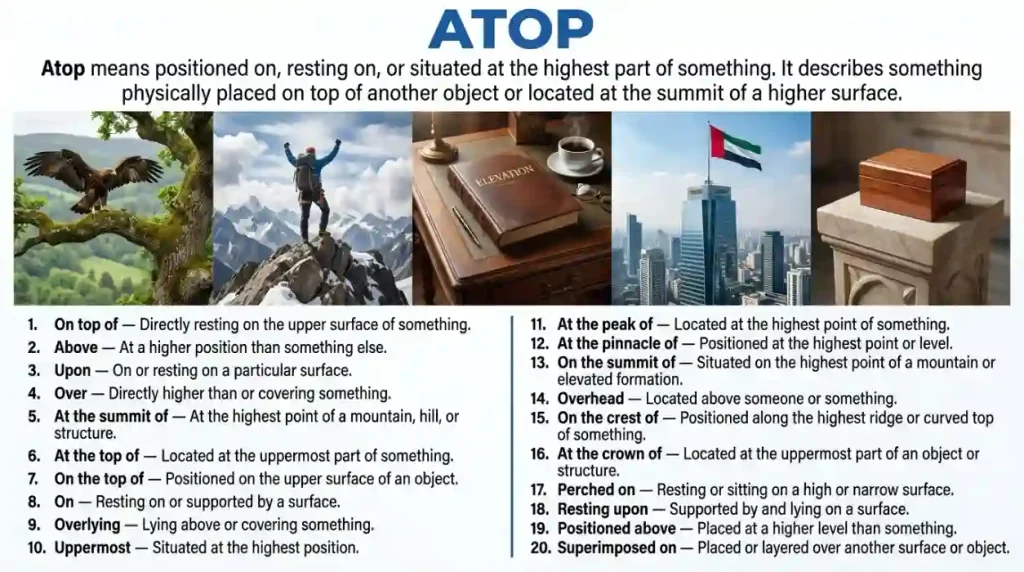
A synonym for atop is on top of, meaning positioned on or over the highest part of something. Other alternatives include upon, on, at the top of, above, and over. The best choice depends on whether you describe physical position, height, or something resting on a surface.
A synonym for atop is a useful search when you want to describe something resting on the highest part of another object. Imagine a cat sitting atop a garden wall.
You might write, “The cat sat atop the wall,” or choose “The cat sat on top of the wall.” Both express the same basic position.
Atop appears in books, news reports, travel writing, and everyday descriptions. It gives a sentence a concise, sometimes slightly formal feel.
Learning alternatives helps students, bloggers, content writers, and everyday English users express location more naturally. It also prevents repeated wording.
What Does “Atop” Really Mean?
Atop is a preposition and, less commonly, an adverb. It means on top of something or at its highest point.
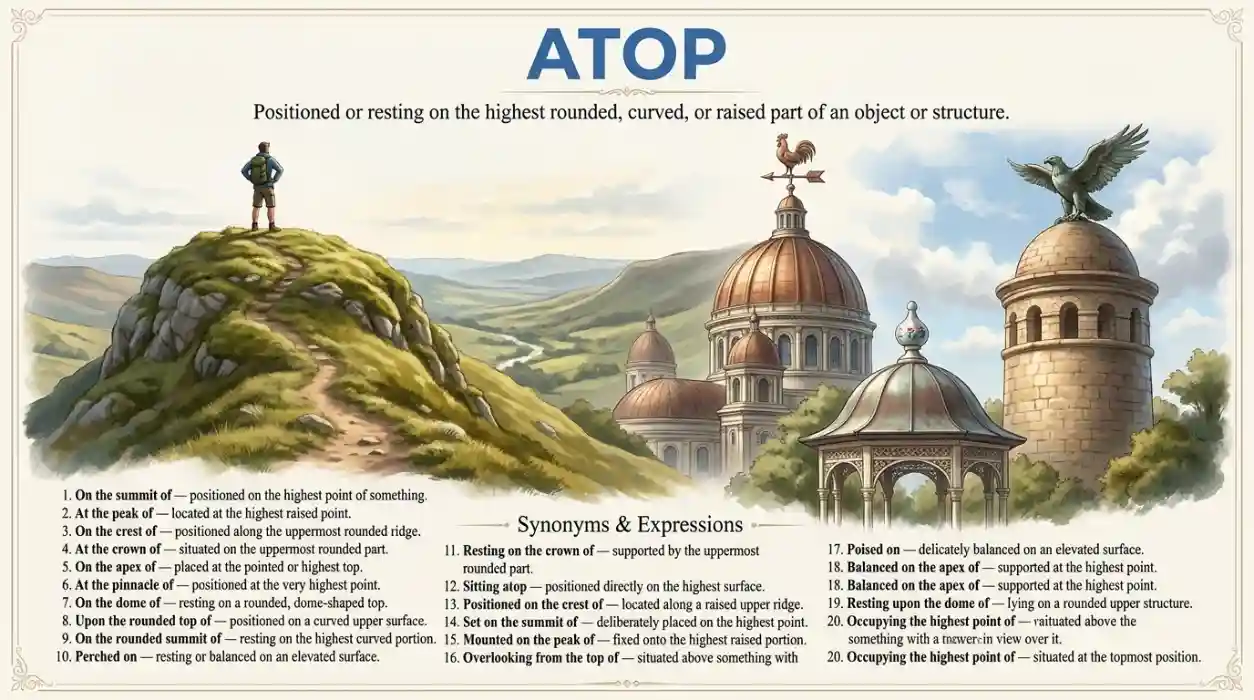
In simple English, if an object is atop another object, it is positioned on its upper surface or highest part.
Examples:
- A flag stood atop the building.
- She placed her bag atop the cupboard.
- A small village sits atop the hill.
Native English speakers generally understand atop as a concise way to say on top of. It often appears in descriptive, literary, journalistic, and formal writing.
The word usually describes physical position. It can also suggest prominence or a leading position in figurative expressions, such as “atop the rankings.”
Part of Speech
- Preposition: “A bird landed atop the fence.”
- Adverb: “The tower rose high, with a statue atop.”
Connotative Meaning
(Connotation means the feeling or association a word carries beyond its basic dictionary meaning.)
- Positive tone: Can suggest height, achievement, prominence, or an impressive position.
- Negative tone: Has no inherently negative meaning, although the surrounding sentence may create one.
- Neutral tone: Usually describes a simple physical position.
Etymology of Atop
The word atop developed from the combination of a- and top. The element a- historically functioned in expressions meaning “on” or “in a particular position.”
A Short History
- Old English (450–1100): English already used forms of top to refer to the highest point or summit. The modern compound atop was not yet established in its present form.
- Middle English (1100–1500): The word top continued to describe the highest part of an object. Expressions involving a- also helped form words that described position.
- Modern English (1500–Present): Atop became established as a compact way to express “on top of.” It remains common in descriptive and literary writing.
Pronunciation
- US: /əˈtɑːp/
- UK: /əˈtɒp/
Syllables
a-top — 2 syllables.
Affixation Pattern
- Root: top
- Prefix: a- (a historical word-forming element)
- Suffix: None
Synonyms List
The alternatives below include direct substitutes and context-specific phrases. Some work best for physical surfaces, while others describe height, position, or prominence. Choose the expression that fits your sentence.
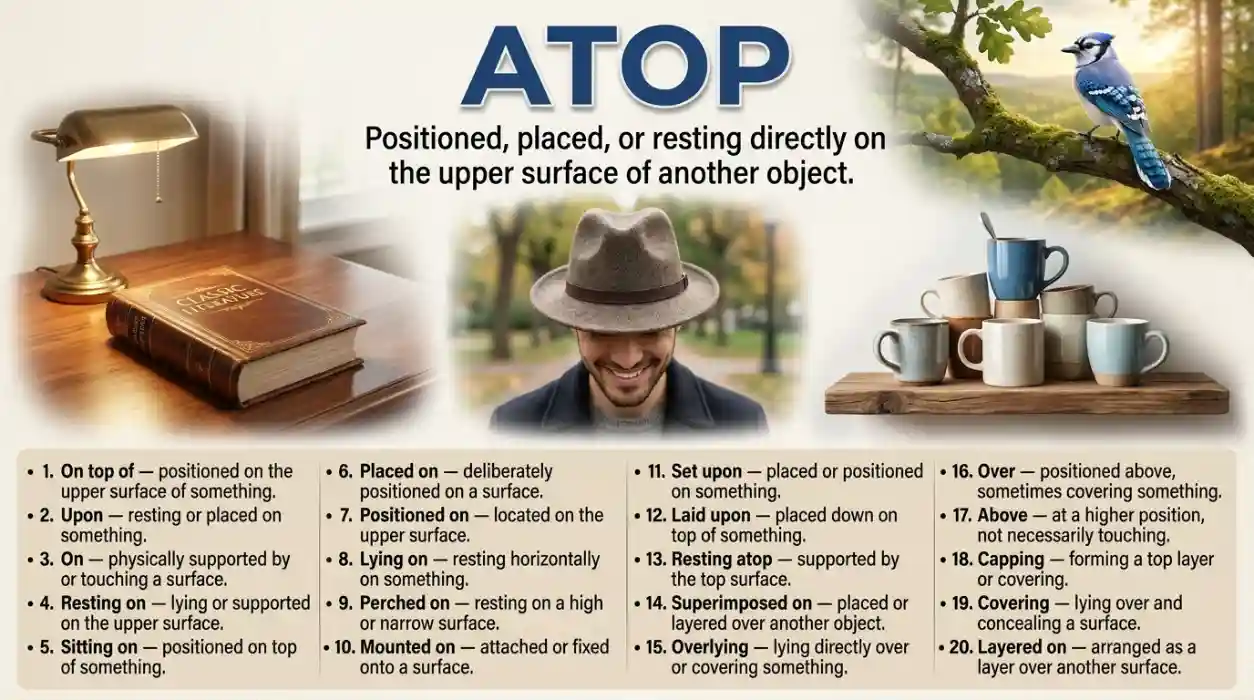
1. On top of (Prepositional phrase) — US: /ɑːn tɑːp əv/ | UK: /ɒn tɒp əv/
Meaning: Positioned on the upper surface of something.
Tone/Register: Neutral; common in everyday speech and writing.
Examples:
- Your keys are on top of the refrigerator.
- A blanket was spread on top of the bed.
2. Upon (Preposition) — US: /əˈpɑːn/ | UK: /əˈpɒn/
Meaning: Resting or positioned on a surface, often with a more formal or literary feel.
Tone/Register: Formal, literary.
Examples:
- The crown rested upon a velvet cushion.
- Snow settled upon the rooftops overnight.
3. On (Preposition) — US: /ɑːn/ | UK: /ɒn/
Meaning: In contact with or supported by a surface.
Tone/Register: Neutral; extremely common.
Examples:
- There is a cup on the counter.
- He left his phone on the desk.
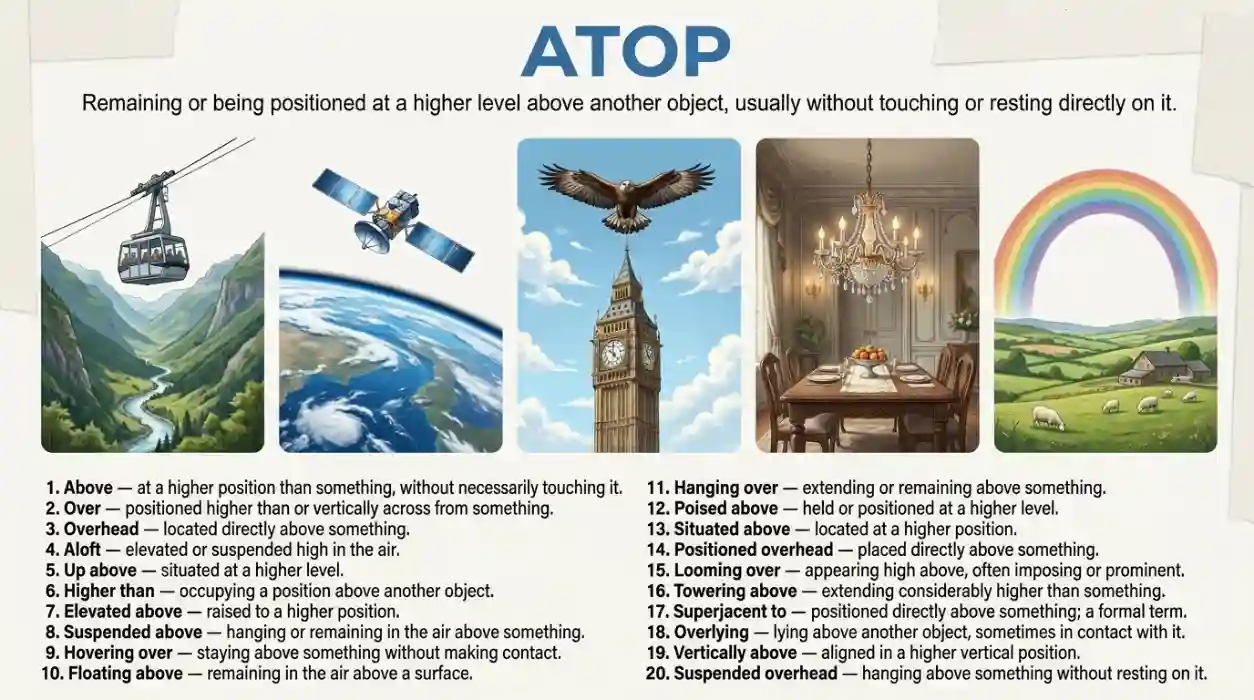
4. Above (Preposition or adverb) — US: /əˈbʌv/ | UK: /əˈbʌv/
Meaning: At a higher position than something, without necessarily touching it.
Tone/Register: Neutral, formal, academic.
Examples:
- A bright lamp hangs above the table.
- The apartment above ours is empty.
5. Over (Preposition or adverb) — US: /ˈoʊvər/ | UK: /ˈəʊvə/
Meaning: Higher than or directly covering something, depending on context.
Tone/Register: Neutral.
Examples:
- Dark clouds gathered over the mountain.
- She placed a cloth over the basket.
6. At the top of (Prepositional phrase) — US: /ət ðə tɑːp əv/ | UK: /ət ðə tɒp əv/
Meaning: At the highest part or point of something.
Tone/Register: Neutral; useful in explanations.
Examples:
- A flag flies at the top of the tower.
- Write your name at the top of the page.
7. On the summit of (Prepositional phrase) — US: /ɑːn ðə ˈsʌmɪt əv/ | UK: /ɒn ðə ˈsʌmɪt əv/
Meaning: Positioned on the highest point of a mountain or hill.
Tone/Register: Descriptive, formal.
Examples:
- A small shelter stands on the summit of the mountain.
- They took a photograph on the summit of the peak.
8. At the summit of (Prepositional phrase) — US: /ət ðə ˈsʌmɪt əv/ | UK: /ət ðə ˈsʌmɪt əv/
Meaning: Located at the highest point of a mountain or elevated structure.
Tone/Register: Formal, descriptive.
Examples:
- A stone marker sits at the summit of the hill.
- We stopped at the summit of the trail.
9. On the peak of (Prepositional phrase) — US: /ɑːn ðə piːk əv/ | UK: /ɒn ðə piːk əv/
Meaning: Located on the pointed or highest part of a mountain or raised area.
Tone/Register: Descriptive, neutral.
Examples:
- A lone tree grows on the peak of the ridge.
- The climbers rested on the peak of the mountain.
10. At the peak of (Prepositional phrase) — US: /ət ðə piːk əv/ | UK: /ət ðə piːk əv/
Meaning: At the highest point of a physical object or at the most successful stage of something.
Tone/Register: Neutral, figurative, formal.
Examples:
- A weather station stands at the peak of the hill.
- She was at the peak of her career.
11. At the pinnacle of (Prepositional phrase) — US: /ət ðə ˈpɪnəkəl əv/ | UK: /ət ðə ˈpɪnəkəl əv/
Meaning: At the highest point, often used figuratively for achievement or status.
Tone/Register: Formal, literary.
Examples:
- The monument stands at the pinnacle of the estate.
- He reached the pinnacle of professional success.
12. On the pinnacle of (Prepositional phrase) — US: /ɑːn ðə ˈpɪnəkəl əv/ | UK: /ɒn ðə ˈpɪnəkəl əv/
Meaning: Physically positioned on a narrow or pointed highest part.
Tone/Register: Literary, descriptive.
Examples:
- A small statue rests on the pinnacle of the roof.
- An eagle perched on the pinnacle of the rock.
13. Perched on (Prepositional phrase) — US: /pɝːtʃt ɑːn/ | UK: /pɜːtʃt ɒn/
Meaning: Sitting or resting in a raised, often narrow or exposed position.
Tone/Register: Descriptive, conversational.
Examples:
- A sparrow perched on the garden gate.
- The cottage is perched on a steep hillside.
14. Resting on (Prepositional phrase) — US: /ˈrestɪŋ ɑːn/ | UK: /ˈrestɪŋ ɒn/
Meaning: Supported by or lying on a surface.
Tone/Register: Neutral.
Examples:
- Her glasses were resting on the book.
- A wooden box was resting on the shelf.
15. Positioned on (Prepositional phrase) — US: /pəˈzɪʃənd ɑːn/ | UK: /pəˈzɪʃənd ɒn/
Meaning: Deliberately or specifically placed on a surface.
Tone/Register: Formal, technical.
Examples:
- The camera is positioned on the upper platform.
- A sensor was positioned on the roof.
16. Situated on (Prepositional phrase) — US: /ˈsɪtʃueɪtɪd ɑːn/ | UK: /ˈsɪtʃueɪtɪd ɒn/
Meaning: Located on a particular surface, area, or elevated place.
Tone/Register: Formal, academic, descriptive.
Examples:
- The hotel is situated on a rocky hill.
- Their home is situated on the edge of the valley.
17. Placed on (Prepositional phrase) — US: /pleɪst ɑːn/ | UK: /pleɪst ɒn/
Meaning: Put onto a surface by someone.
Tone/Register: Neutral.
Examples:
- The parcel was placed on the counter.
- She placed a flower on the windowsill.
18. Lying on (Prepositional phrase) — US: /ˈlaɪɪŋ ɑːn/ | UK: /ˈlaɪɪŋ ɒn/
Meaning: Resting horizontally on a surface.
Tone/Register: Neutral, conversational.
Examples:
- A notebook was lying on the sofa.
- The fallen branch was lying on the roof.
19. Standing on (Prepositional phrase) — US: /ˈstændɪŋ ɑːn/ | UK: /ˈstændɪŋ ɒn/
Meaning: Supported upright by a surface.
Tone/Register: Neutral.
Examples:
- A vase is standing on the mantelpiece.
- The child was standing on a wooden stool.
20. Mounted on (Prepositional phrase) — US: /ˈmaʊntɪd ɑːn/ | UK: /ˈmaʊntɪd ɒn/
Meaning: Attached or fixed to a supporting surface or structure.
Tone/Register: Technical, professional.
Examples:
- A security camera is mounted on the ceiling.
- The sign was mounted on the entrance wall.
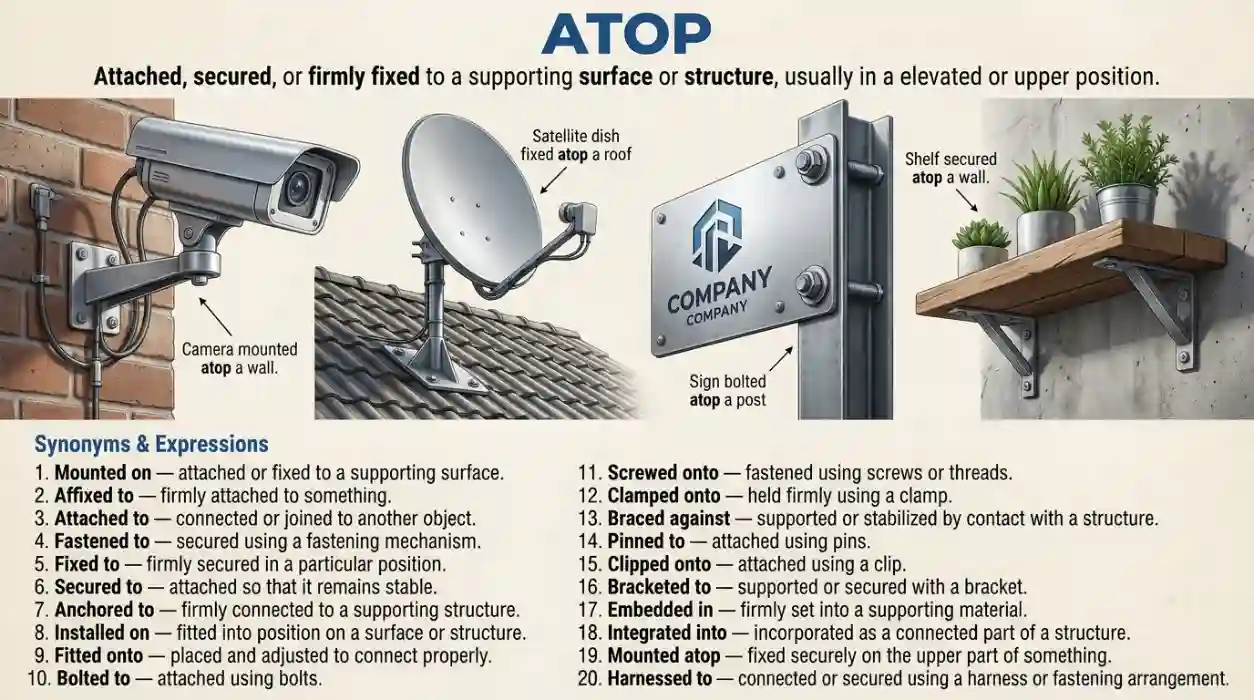
21. Affixed to (Prepositional phrase) — US: /əˈfɪkst tuː/ | UK: /əˈfɪkst tuː/
Meaning: Firmly attached to another object or surface.
Tone/Register: Formal, technical.
Examples:
- A label was affixed to the upper panel.
- The notice is affixed to the front door.
22. Fixed to (Prepositional phrase) — US: /fɪkst tuː/ | UK: /fɪkst tuː/
Meaning: Secured or attached to a particular surface.
Tone/Register: Neutral, technical.
Examples:
- The bracket is fixed to the top of the frame.
- A small light was fixed to the ceiling.
23. Covering (Preposition or participle) — US: /ˈkʌvərɪŋ/ | UK: /ˈkʌvərɪŋ/
Meaning: Lying over or spreading across a surface.
Tone/Register: Neutral.
Examples:
- A thick layer of snow was covering the roof.
- The cloth was covering the top of the table.
24. Overlying (Adjective or participle) — US: /ˌoʊvərˈlaɪɪŋ/ | UK: /ˌəʊvəˈlaɪɪŋ/
Meaning: Lying over or above another layer or structure.
Tone/Register: Technical, scientific.
Examples:
- The overlying rock layer was unusually thin.
- Researchers examined the soil overlying the ancient wall.
25. Crowning (Adjective or participle) — US: /ˈkraʊnɪŋ/ | UK: /ˈkraʊnɪŋ/
Meaning: Forming or occupying the top of something, often as a decorative or final feature.
Tone/Register: Literary, descriptive.
Examples:
- A golden ornament was crowning the monument.
- A glass dome formed the crowning feature of the building.
26. Topping (Preposition-like participle) — US: /ˈtɑːpɪŋ/ | UK: /ˈtɒpɪŋ/
Meaning: Being at the uppermost part of something or forming its top layer.
Tone/Register: Neutral, informal.
Examples:
- Fresh cream was topping the dessert.
- A bright red flag was topping the pole.
27. Uppermost on (Prepositional phrase) — US: /ˈʌpərmoʊst ɑːn/ | UK: /ˈʌpəməʊst ɒn/
Meaning: Located at the highest position on a particular object or arrangement.
Tone/Register: Formal, descriptive.
Examples:
- The uppermost book on the pile is mine.
- A small box sat uppermost on the stack.
28. Highest on (Prepositional phrase) — US: /ˈhaɪɪst ɑːn/ | UK: /ˈhaɪɪst ɒn/
Meaning: At a greater height than the other items on the same structure.
Tone/Register: Neutral.
Examples:
- The red flag is highest on the pole.
- That ornament sits highest on the display shelf.
29. At the head of (Prepositional phrase) — US: /ət ðə hed əv/ | UK: /ət ðə hed əv/
Meaning: At the front or leading position of a group or arrangement; not usually a physical substitute for atop.
Tone/Register: Neutral, formal.
Examples:
- The principal stood at the head of the procession.
- A portrait hangs at the head of the staircase.
30. On the roof of (Prepositional phrase) — US: /ɑːn ðə ruːf əv/ | UK: /ɒn ðə ruːf əv/
Meaning: Located on the upper covering of a building.
Tone/Register: Neutral.
Examples:
- Solar panels are installed on the roof of the school.
- A cat was sleeping on the roof of the garage.
31. On the surface of (Prepositional phrase) — US: /ɑːn ðə ˈsɝːfɪs əv/ | UK: /ɒn ðə ˈsɜːfɪs əv/
Meaning: In contact with the outer or upper layer of something.
Tone/Register: Neutral, scientific.
Examples:
- Tiny bubbles appeared on the surface of the water.
- Dust had collected on the surface of the cabinet.
32. On the upper part of (Prepositional phrase) — US: /ɑːn ði ˈʌpər pɑːrt əv/ | UK: /ɒn ði ˈʌpə pɑːt əv/
Meaning: Located on the upper section of an object.
Tone/Register: Neutral, explanatory.
Examples:
- The handle is on the upper part of the suitcase.
- A crack appeared on the upper part of the wall.
33. At the highest point of (Prepositional phrase) — US: /ət ðə ˈhaɪɪst pɔɪnt əv/ | UK: /ət ðə ˈhaɪɪst pɔɪnt əv/
Meaning: Located at the greatest height of a structure or place.
Tone/Register: Formal, descriptive.
Examples:
- A viewing platform stands at the highest point of the tower.
- We paused at the highest point of the trail.
34. On the highest point of (Prepositional phrase) — US: /ɑːn ðə ˈhaɪɪst pɔɪnt əv/ | UK: /ɒn ðə ˈhaɪɪst pɔɪnt əv/
Meaning: Physically resting on the very top of something.
Tone/Register: Neutral, descriptive.
Examples:
- A beacon sits on the highest point of the island.
- They planted a flag on the highest point of the ridge.
35. At the topmost part of (Prepositional phrase) — US: /ət ðə ˈtɑːpmoʊst pɑːrt əv/ | UK: /ət ðə ˈtɒpməʊst pɑːt əv/
Meaning: At the very uppermost section of an object.
Tone/Register: Formal, technical.
Examples:
- The switch is at the topmost part of the panel.
- A small window sits at the topmost part of the tower.
36. On the upper surface of (Prepositional phrase) — US: /ɑːn ði ˈʌpər ˈsɝːfɪs əv/ | UK: /ɒn ði ˈʌpə ˈsɜːfɪs əv/
Meaning: Resting directly on the top-facing surface of an object.
Tone/Register: Technical, explanatory.
Examples:
- Place the sample on the upper surface of the platform.
- A thin film formed on the upper surface of the liquid.
37. At the crest of (Prepositional phrase) — US: /ət ðə krest əv/ | UK: /ət ðə krest əv/
Meaning: At the top or highest ridge of a hill, wave, or raised shape.
Tone/Register: Literary, descriptive.
Examples:
- A farmhouse stands at the crest of the hill.
- The hikers stopped at the crest of the ridge.
38. On the crest of (Prepositional phrase) — US: /ɑːn ðə krest əv/ | UK: /ɒn ðə krest əv/
Meaning: Located directly on the highest ridge or raised line of something.
Tone/Register: Descriptive.
Examples:
- A tree stood on the crest of the grassy hill.
- The old chapel sits on the crest of the ridge.
39. At the crown of (Prepositional phrase) — US: /ət ðə kraʊn əv/ | UK: /ət ðə kraʊn əv/
Meaning: At the top or rounded upper part of something.
Tone/Register: Literary, descriptive.
Examples:
- A decorative stone sits at the crown of the arch.
- The sculpture is placed at the crown of the fountain.
40. On the crown of (Prepositional phrase) — US: /ɑːn ðə kraʊn əv/ | UK: /ɒn ðə kraʊn əv/
Meaning: Positioned on the uppermost rounded or raised part of an object.
Tone/Register: Descriptive, specialized.
Examples:
- A bird landed on the crown of the statue.
- A small ornament was fixed on the helmet’s crown.
41. At the top of the pile (Prepositional phrase) — US: /ət ðə tɑːp əv ðə paɪl/ | UK: /ət ðə tɒp əv ðə paɪl/
Meaning: In the highest position within a stack of objects.
Tone/Register: Conversational.
Examples:
- Your application is at the top of the pile.
- The blue folder was at the top of the pile.
42. On the topmost layer of (Prepositional phrase) — US: /ɑːn ðə ˈtɑːpmoʊst ˈleɪər əv/ | UK: /ɒn ðə ˈtɒpməʊst ˈleɪə əv/
Meaning: Resting on the highest layer of a collection or material.
Tone/Register: Technical, descriptive.
Examples:
- The seeds were scattered on the topmost layer of soil.
- Place the decoration on the cake’s top layer.
43. Over the top of (Prepositional phrase) — US: /ˈoʊvər ðə tɑːp əv/ | UK: /ˈəʊvə ðə tɒp əv/
Meaning: Directly above or across the highest part of something; it does not always imply contact.
Tone/Register: Neutral, conversational.
Examples:
- A cable runs over the top of the cabinet.
- She draped a towel over the top of the chair.
44. Directly on (Prepositional phrase) — US: /dəˈrektli ɑːn/ | UK: /dəˈrektli ɒn/
Meaning: In immediate contact with a surface, without anything in between.
Tone/Register: Neutral, instructional.
Examples:
- Set the warm dish directly on the table.
- The label is attached directly to the outer cover.
45. Resting atop (Prepositional phrase) — US: /ˈrestɪŋ əˈtɑːp/ | UK: /ˈrestɪŋ əˈtɒp/
Meaning: Lying or supported on the upper surface of something.
Tone/Register: Descriptive, slightly formal.
Examples:
- A silver tray was resting atop the cabinet.
- The old photograph was resting atop a stack of letters.
46. Sitting on (Prepositional phrase) — US: /ˈsɪtɪŋ ɑːn/ | UK: /ˈsɪtɪŋ ɒn/
Meaning: Resting on a surface, often in a stable position.
Tone/Register: Informal, conversational.
Examples:
- A teddy bear is sitting on the bookshelf.
- The helmet was sitting on the bench.
47. Set on (Prepositional phrase) — US: /set ɑːn/ | UK: /set ɒn/
Meaning: Deliberately placed on a surface.
Tone/Register: Neutral.
Examples:
- The tray was set on the kitchen island.
- A glass was set on the bedside table.
48. Laid on (Prepositional phrase) — US: /leɪd ɑːn/ | UK: /leɪd ɒn/
Meaning: Placed in a flat or horizontal position on a surface.
Tone/Register: Neutral.
Examples:
- The documents were laid on the conference table.
- Fresh flowers were laid on the memorial stone.
49. Draped over (Prepositional phrase) — US: /dreɪpt ˈoʊvər/ | UK: /dreɪpt ˈəʊvə/
Meaning: Hanging loosely over an object or its upper surface.
Tone/Register: Descriptive, literary.
Examples:
- A scarf was draped over the back of the chair.
- A colorful cloth was draped over the balcony railing.
50. Resting above (Prepositional phrase) — US: /ˈrestɪŋ əˈbʌv/ | UK: /ˈrestɪŋ əˈbʌv/
Meaning: Remaining in a higher position than something, usually without direct contact.
Tone/Register: Neutral, descriptive.
Examples:
- A cloud was resting above the mountain peak.
- The shelf is resting above the desk.
Synonyms by Tone
The tone of a word affects how readers understand your sentence. These groups can help you choose an expression that fits your purpose.
Positive or Impressive
- At the pinnacle of
- At the peak of
- At the summit of
- Crowning
- At the crown of
These expressions can suggest achievement, beauty, height, or distinction. They are especially useful in descriptive and figurative writing.
Neutral
- On top of
- On
- Upon
- Above
- Over
- At the top of
- Resting on
- Positioned on
- Situated on
- Placed on
These are suitable for everyday communication, schoolwork, and general writing.
Formal or Technical
- Affixed to
- Mounted on
- Overlying
- On the upper surface of
- At the highest point of
- At the topmost part of
These expressions suit reports, instructions, academic writing, and technical descriptions.
Playful or Informal
- Perched on
- Sitting on
- Lying on
These can make descriptions feel relaxed and conversational, especially when describing animals, people, or everyday objects.
Why Does Tone Matter?
A word may be grammatically correct but still sound unnatural in a particular situation. For example, perched on creates a visual image, while positioned on sounds more technical. Match the expression to your audience and purpose.
“Atop” vs. Close Alternatives
| Word or phrase | Main difference | Best use |
|---|---|---|
| Atop | Concise way to say on the upper surface of something | Descriptive and literary writing |
| On top of | Direct, everyday equivalent | Conversation and general writing |
| Above | Indicates a higher position but not necessarily contact | Describing height or location |
| Upon | Means on, with a more formal or literary feel | Formal and creative writing |
Example comparison:
- “A bird landed atop the roof.” The wording is concise and descriptive.
- “A bird landed on top of the roof.” The wording is natural and conversational.
- “A bird flew above the roof.” The bird may not have touched the roof.
- “A bird settled upon the roof.” The sentence has a more literary tone.
Remember that above and over are not always exact replacements. They can describe something higher without saying that it touches the surface.
How “Atop” Changes by Context
Daily Conversation
In everyday speech, on top of is usually more natural than atop. People commonly say, “Your bag is on top of the wardrobe.” The shorter alternative sounds clear and familiar.
Writing and Blogging
Atop can make descriptive writing concise. It works well when describing buildings, landscapes, objects, or scenes. However, repeating it too often can make an article sound stiff.
Professional or Academic Writing
Choose the wording that communicates the exact relationship. Mounted on, positioned on, and located at the top of can be more precise in reports and technical explanations.
Creative or Informal Writing
Words such as perched on can add personality to a scene. A writer might describe a cat perched on a fence or a cottage sitting atop a hill.
Common Mistakes Learners Make
1. Confusing “Atop” With “Above”
Atop generally suggests that something is on an upper surface. Above only means that something is higher.
- Correct: The bird landed atop the wall.
- Different meaning: The bird flew above the wall.
2. Using “Atop” When “On” Sounds Better
Atop is correct in many situations, but it can sound overly formal in casual conversation.
Instead of “Put the cup atop the table,” most speakers would say, “Put the cup on the table.”
3. Forgetting the Difference Between Position and Movement
Atop describes a position. It does not usually describe movement toward a surface.
- Position: The cat sat atop the cupboard.
- Movement: The cat jumped onto the cupboard.
4. Treating Every Alternative as an Exact Synonym
Perched on suggests a raised or narrow position. Mounted on suggests attachment. Above does not necessarily mean contact. Check the specific meaning before replacing atop.
Register Notes
- Formal: Atop, upon, at the pinnacle of.
- Neutral: On, on top of, at the top of.
- Technical: Mounted on, affixed to, overlying.
- Spoken English: On top of, sitting on, resting on.
- Written English: Atop, upon, situated on, at the summit of.
For more vocabulary practice, explore related English lessons on prepositions of place and words that describe position.
Real-Life Examples
Workplace
A manager might say, “The report is on top of the file cabinet.” In a formal written update, “The report rests atop the cabinet” may sound more descriptive.
Social Situations
Imagine a friend looking for a phone. You could say, “It’s on top of the fridge.” This is clearer in conversation than using atop.
Media and Pop Culture
A news report might describe a statue atop a historic building. The word helps readers picture the structure without adding a long phrase.
Writing and Storytelling
A novelist might write, “A lonely lighthouse stood atop the cliffs.” The word gives the setting a concise, dramatic quality.
Practice Exercise
1. You see a book resting on a desk. Which sentence sounds most natural?
A. The book is above the desk.
B. The book is on top of the desk.
C. The book is beyond the desk.
2. A bird is sitting on a narrow branch. Which phrase creates the clearest image?
A. Perched on
B. Affixed to
C. Overlying
3. A camera is securely attached to a ceiling. Which phrase fits best?
A. Sitting on
B. Mounted on
C. At the summit of
4. A plane is flying higher than a building without touching it. Which word works best?
A. Above
B. Upon
C. Resting on
5. Which alternative sounds more natural in casual conversation?
A. Atop the table
B. On top of the table
C. At the pinnacle of the table
6. A climber reaches the highest point of a mountain. Which phrase is most suitable?
A. At the summit of
B. Fixed to
C. Covering
7. A label is firmly attached to a box. Which expression is most accurate?
A. Affixed to
B. Perched on
C. At the peak of
8. Which sentence uses atop correctly?
A. She walked atop the room yesterday.
B. A statue stands atop the monument.
C. He arrived atop the station.
9. You are writing a technical report about a layer of rock above another layer. Which word is suitable?
A. Overlying
B. Sitting on
C. Perched on
Reflection Task
Write two short sentences describing an object in your room. Use atop in one sentence and a different alternative in the other. Check whether your chosen words express contact with a surface or simply a higher position.
Answer key: 1-B, 2-A, 3-B, 4-A, 5-B, 6-A, 7-A, 8-B, 9-A,
External Learning Sources
For further study, consult these trusted dictionaries and language references:
- Merriam-Webster Dictionary: https://www.merriam-webster.com/
- Cambridge Dictionary:
- Oxford Learner’s Dictionaries:
- Online Etymology Dictionary:
Use dictionaries to check pronunciation, grammatical patterns, and example sentences before choosing an alternative for a particular context.
Conclusion
Learning a synonym for atop gives you more ways to describe height, position, and location. Expressions such as upon, on top of, and at the summit of add useful variety.
A wider vocabulary also helps you write clearer essays, engaging blog posts, and natural everyday messages. The key is choosing words that match the meaning you want to express.
Practice these alternatives in emails, essays, and daily conversations. Try writing a few original sentences today, and notice how each expression changes the tone.
FAQs
1. Is “atop” one word or two words?
Atop is one word. It combines the historical element a- with top. It means “on top of” or “at the top of.” Although the phrase on top of has the same basic meaning in many sentences, it is written as three separate words.
2. Can I use “atop” in academic writing?
Yes. Atop is grammatically acceptable in academic writing, particularly when describing physical locations or structures. However, clarity matters more than choosing an unusual word. In technical explanations, phrases such as positioned on, located at the top of, or mounted on may communicate the relationship more precisely.
3. What is the opposite of “atop”?
There is no single opposite that works in every sentence. Depending on the context, possible opposites include beneath, under, underneath, below, and at the bottom of. For example, “The bird sat atop the roof” contrasts with “The bird sheltered beneath the roof.”
4. Is “atop” interchangeable with “onto”?
No. Atop describes a position, while onto usually describes movement toward a surface. For example, “The cat sat atop the wall” describes where the cat was. “The cat jumped onto the wall” describes the movement that brought it there.
5. Is “atop” commonly used in American and British English?
Yes. Both American and British English speakers recognize and use atop. However, it often sounds more formal or literary than on top of. In relaxed conversation, speakers in both varieties generally prefer the longer everyday phrase.

Hasnain Ali is an SEO Content Strategist and the founder of wordvora.com, a trusted vocabulary platform that helps writers, students, professionals, and English learners find accurate synonyms, antonyms, word meanings, and real-life usage examples. He specializes in keyword research, on-page SEO, topical authority, and creating search-first content that aligns with Google’s latest Search Quality and E-E-A-T guidelines. His work focuses on producing clear, well-structured, and reader-friendly resources that satisfy search intent while maintaining high editorial standards.
Through extensive hands-on experience with SEO tools such as Google Search Console, Google Analytics, SEMrush, and Ahrefs, Hasnain researches user search behavior and develops content that is both informative and easy to understand. Every article published on wordvora.com is carefully reviewed for accuracy, readability, and contextual relevance before publication. His mission is to build one of the web’s most reliable English vocabulary resources by providing practical language guidance, trustworthy explanations, and content that helps readers improve their writing, communication, and vocabulary with confidence.