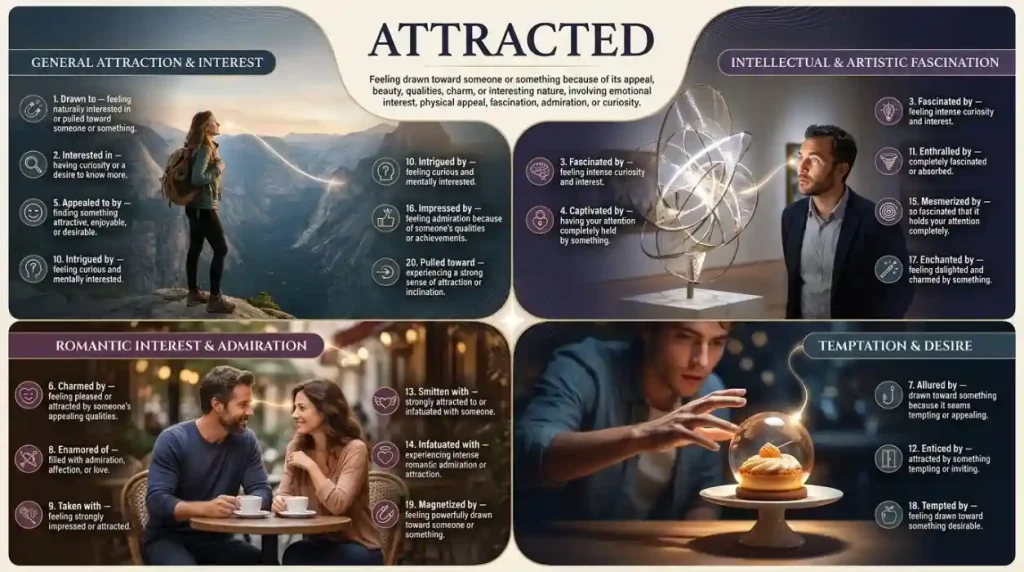

A synonym for attracted is a word or phrase that expresses being drawn toward someone or something. Common alternatives include interested, drawn to, appealing to, captivated, fascinated, charmed, and allured. The best choice depends on whether you mean romantic interest, physical attraction, curiosity, or general appeal.
Synonym for attracted is a useful phrase to explore when you want to describe interest, admiration, or a feeling of being drawn toward someone or something.
Imagine meeting someone whose kindness immediately catches your attention. You might say, “I’m attracted to her,” or “I’m drawn to her personality.”
The word attracted appears in everyday conversations, relationships, psychology, science, and professional writing. Its meaning changes slightly with context.
Learning alternatives helps students, bloggers, content writers, and everyday English users express feelings with greater accuracy and avoid repeating the same word.
What Does “Attracted” Really Mean?
Attracted means feeling drawn toward someone or something because of interest, appeal, admiration, desire, or a particular quality.
In simple English, when you are attracted to something, you like it, find it appealing, or feel a desire to move closer to it.
For example:
- She is attracted to his confidence.
- I’m attracted to the idea of studying abroad.
- Many tourists are attracted to the city’s historic architecture.
Native English speakers use attracted in several ways. It can describe romantic feelings, physical appeal, intellectual interest, or even a force that pulls objects together.
Part of Speech
Attracted is the past tense and past participle of the verb attract. It also works as an adjective.
- Verb: The bright colors attracted my attention.
- Adjective: He is attracted to creative people.
- Passive construction: The exhibition was attracted to thousands of visitors. (This is not natural; say “The exhibition attracted thousands of visitors.”)
Common Contexts
- Romantic: Feeling interested in someone as a potential partner.
- Physical: Finding someone’s appearance appealing.
- Intellectual: Feeling interested in an idea or subject.
- General: Being drawn toward a place, activity, or experience.
- Scientific: Experiencing a force that pulls objects together.
Connotative Meaning
(Connotation means the emotional associations or feelings connected with a word beyond its basic dictionary definition.)
- Positive tone: Attracted can suggest admiration, affection, fascination, or appreciation.
- Negative tone: It may suggest temptation, obsession, or an unhealthy attachment when the surrounding context is critical.
- Neutral tone: It can simply describe interest or a natural pull toward something.
The word itself is generally neutral. The situation determines whether the attraction feels romantic, positive, scientific, or concerning.
Etymology of Attracted
The word attracted comes from the verb attract. Its history traces back to Latin attrahere, meaning “to draw toward” or “to pull.”
The Latin word combines ad- (toward) and trahere (to pull or draw). English adopted the verb through French and Latin influences.
A Short History
- Old English (450–1100): The modern word attract was not yet part of everyday Old English vocabulary. Speakers used native words and expressions to describe pulling, drawing, or bringing something closer.
- Middle English (1100–1500): French and Latin vocabulary increasingly influenced English. Forms related to attract entered English through scholarly and literary language.
- Modern English (1500–Present): Attract became widely established. Its meanings expanded from physical pulling to interest, beauty, emotional appeal, and romantic desire. Attracted developed as its regular past tense and past participle.

Pronunciation
- US: /əˈtræk.tɪd/
- UK: /əˈtræk.tɪd/
Syllables
at-tract-ed — 3 syllables.
Affixation Pattern of Attracted
- Root: tract (from Latin trahere, meaning to pull or draw)
- Prefix: at- (historically connected to Latin ad-, meaning toward)
- Suffix: -ed (marks the past tense or past participle)
The word follows the pattern attract + -ed = attracted.
Synonyms List
The following alternatives cover different shades of attraction. Some describe romantic interest, while others express admiration, curiosity, or general appeal. They are not all interchangeable, so consider the context before choosing one.
1. Drawn To (Adjective phrase) — US: /drɔn tuː/ | UK: /drɔːn tuː/
Meaning: Feeling naturally interested in or emotionally connected to someone or something.
Tone/Register: Neutral, conversational, reflective.
Examples:
- I’ve always been drawn to creative people.
- She feels drawn to quiet places near the sea.
2. Interested In (Adjective phrase) — US: /ˈɪn.trə.stɪd ɪn/ | UK: /ˈɪn.trə.stɪd ɪn/
Meaning: Wanting to know more about or become involved with someone or something.
Tone/Register: Neutral, everyday, professional.
Examples:
- He wants to learn about photography.
- I want to join the local book club.
3. Fascinated By (Adjective phrase) — US: /ˈfæs.əˌneɪ.tɪd baɪ/ | UK: /ˈfæs.ɪ.neɪ.tɪd baɪ/
Meaning: Extremely interested in something because it seems exciting, unusual, or impressive.
Tone/Register: Positive, expressive.
Examples:
- The science experiment fascinated the children.
- How languages change over time fascinates me.
4. Captivated By (Adjective phrase) — US: /ˈkæp.təˌveɪ.tɪd baɪ/ | UK: /ˈkæp.tɪ.veɪ.tɪd baɪ/
Meaning: So interested or impressed that your attention is completely held.
Tone/Register: Descriptive, literary, positive.
Examples:
- We were captivated by the singer’s performance.
- She felt captivated by the novel’s opening chapter.
5. Charmed By (Adjective phrase) — US: /tʃɑːrmd baɪ/ | UK: /tʃɑːmd baɪ/
Meaning: Feeling warmly attracted because of someone’s pleasant personality or behavior.
Tone/Register: Warm, romantic, conversational.
Examples:
- His thoughtful manners charmed me.
- The little town’s friendly atmosphere charmed them.
6. Enamored Of (Adjective phrase) — US: /ɪˈnæm.ərd əv/ | UK: /ɪˈnæm.əd əv/
Meaning: Filled with strong admiration, affection, or love for someone or something.
Tone/Register: Literary, formal, romantic.
Examples:
- She became enamored of the coastal village.
- He is enamored of her confidence and humor.
7. Smitten With (Adjective phrase) — US: /ˈsmɪt.ən wɪð/ | UK: /ˈsmɪt.ən wɪð/
Meaning: Strongly attracted to someone, often romantically or affectionately.
Tone/Register: Playful, informal, romantic.
Examples:
- He’s completely smitten with his new partner.
- She looked smitten after their first conversation.
8. Infatuated With (Adjective phrase) — US: /ɪnˈfætʃ.uˌeɪ.tɪd wɪð/ | UK: /ɪnˈfætʃ.u.eɪ.tɪd wɪð/
Meaning: Experiencing intense romantic admiration that may be temporary or idealized.
Tone/Register: Romantic, descriptive, sometimes critical.
Examples:
- He became infatuated with a singer he admired.
- She was infatuated with the idea of a perfect relationship.
9. Allured By (Adjective phrase) — US: /əˈlʊrd baɪ/ | UK: /əˈlʊəd baɪ/
Meaning: Attracted by something appealing, tempting, or fascinating.
Tone/Register: Formal, literary.
Examples:
- The island’s natural beauty allured travelers.
- The promise of adventure allured him.
10. Tempted By (Adjective phrase) — US: /ˈtemp.tɪd baɪ/ | UK: /ˈtemp.tɪd baɪ/
Meaning: Feeling a desire to do or experience something appealing, even when you may hesitate.
Tone/Register: Neutral, conversational.
Examples:
- The idea of taking a long break tempts me.
- The delicious smell of fresh bread tempted her.
11. Taken With (Adjective phrase) — US: /ˈteɪ.kən wɪð/ | UK: /ˈteɪ.kən wɪð/
Meaning: Strongly impressed by or attracted to someone or something.
Tone/Register: Neutral, slightly old-fashioned.
Examples:
- Your new design quite takes me.
- Her cheerful personality took him.
12. Impressed By (Adjective phrase) — US: /ɪmˈprest baɪ/ | UK: /ɪmˈprest baɪ/
Meaning: Feeling admiration because someone or something shows an excellent quality.
Tone/Register: Neutral, professional.
Examples:
- The manager was impressed by her presentation.
- I was impressed by the restaurant’s attention to detail.
13. Intrigued By (Adjective phrase) — US: /ɪnˈtriːɡd baɪ/ | UK: /ɪnˈtriːɡd baɪ/
Meaning: Curious and interested because something is unusual or mysterious.
Tone/Register: Thoughtful, neutral, slightly formal.
Examples:
- I’m intrigued by the history behind this building.
- The unusual title left readers intrigued.
14. Mesmerized By (Adjective phrase) — US: /ˈmez.məˌraɪzd baɪ/ | UK: /ˈmez.mə.raɪzd baɪ/
Meaning: So fascinated that it is difficult to look away or stop paying attention.
Tone/Register: Expressive, descriptive.
Examples:
- The audience was mesmerized by the dancer.
- We were mesmerized by the colors of the sunset.
15. Enthralled By (Adjective phrase) — US: /ɪnˈθrɔːld baɪ/ | UK: /ɪnˈθrɔːld baɪ/
Meaning: Deeply fascinated, delighted, or emotionally absorbed by something.
Tone/Register: Literary, formal, positive.
Examples:
- The students were enthralled by the guest speaker.
- She felt enthralled by the orchestra’s performance.
16. Attracted To (Adjective phrase) — US: /əˈtræk.tɪd tuː/ | UK: /əˈtræk.tɪd tuː/
Meaning: Feeling interest, appeal, or desire toward a person or thing.
Tone/Register: Neutral, romantic, general.
Examples:
- She’s attracted to people who make her laugh.
- I’m attracted to the idea of working overseas.
17. Appealed To (Verb phrase) — US: /əˈpiːld tuː/ | UK: /əˈpiːld tuː/
Meaning: Seemed attractive, interesting, or suitable to someone.
Tone/Register: Neutral, professional.
Examples:
- The flexible schedule appealed to new employees.
- That style of music has always appealed to me.
18. Fascinated With (Adjective phrase) — US: /ˈfæs.əˌneɪ.tɪd wɪð/ | UK: /ˈfæs.ɪ.neɪ.tɪd wɪð/
Meaning: Having a strong and lasting interest in a subject or activity.
Tone/Register: Positive, conversational.
Examples:
- He’s fascinated with ancient civilizations.
- My sister is fascinated with marine animals.
19. Enthusiastic About (Adjective phrase) — US: /ɪnˌθuː.ziˈæs.tɪk əˈbaʊt/ | UK: /ɪnˌθjuː.ziˈæs.tɪk əˈbaʊt/
Meaning: Showing strong excitement and interest in something.
Tone/Register: Positive, professional, everyday.
Examples:
- The students are enthusiastic about the school trip.
- She’s enthusiastic about her new business idea.
20. Keen On (Adjective phrase) — US: /kiːn ɑːn/ | UK: /kiːn ɒn/
Meaning: Very interested in or fond of someone or something.
Tone/Register: Informal, neutral; especially common in British English.
Examples:
- He’s keen on outdoor photography.
- I’m keen on trying the new café downtown.
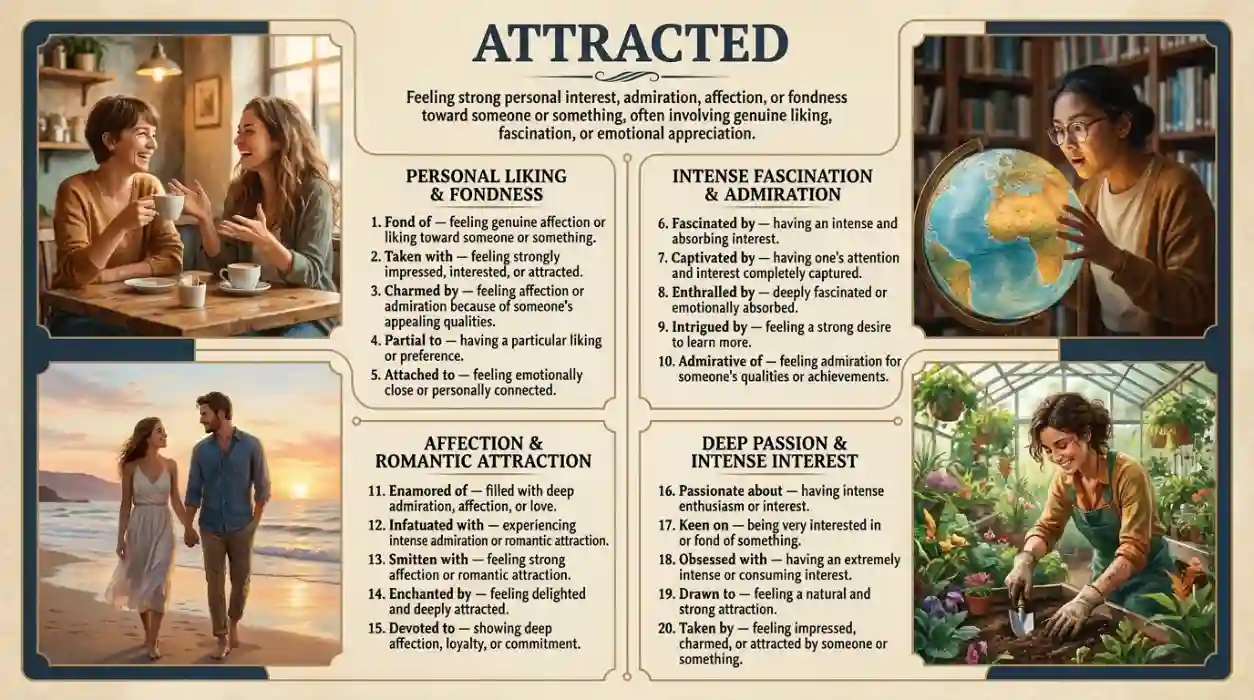
21. Fond Of (Adjective phrase) — US: /fɑːnd əv/ | UK: /fɒnd əv/
Meaning: Having affection or liking for someone or something.
Tone/Register: Warm, neutral, conversational.
Examples:
- She’s fond of her childhood neighborhood.
- My grandfather is fond of classical music.
22. Partial To (Adjective phrase) — US: /ˈpɑːr.ʃəl tuː/ | UK: /ˈpɑː.ʃəl tuː/
Meaning: Having a particular liking or preference for something.
Tone/Register: Neutral, conversational.
Examples:
- I’m partial to dark chocolate.
- He is partial to historical novels.
23. Inclined Toward (Adjective phrase) — US: /ɪnˈklaɪnd təˈwɔːrd/ | UK: /ɪnˈklaɪnd təˈwɔːd/
Meaning: Having a tendency or preference for a particular choice or direction.
Tone/Register: Formal, thoughtful.
Examples:
- She’s inclined toward creative careers.
- I’m inclined toward the simpler design.
24. Receptive To (Adjective phrase) — US: /rɪˈsep.tɪv tuː/ | UK: /rɪˈsep.tɪv tuː/
Meaning: Open and willing to consider an idea, suggestion, or experience.
Tone/Register: Professional, academic.
Examples:
- The director was receptive to our suggestions.
- Students are more receptive to feedback when it is constructive.
25. Open To (Adjective phrase) — US: /ˈoʊ.pən tuː/ | UK: /ˈəʊ.pən tuː/
Meaning: Willing to consider, accept, or explore something.
Tone/Register: Neutral, professional.
Examples:
- I’m open to trying a different approach.
- She is open to meeting new people.
26. Fascinated By the Idea Of (Adjective phrase) — US: /ˈfæs.əˌneɪ.tɪd baɪ ði aɪˈdiː.ə əv/ | UK: /ˈfæs.ɪ.neɪ.tɪd baɪ ði aɪˈdɪə əv/
Meaning: Strongly interested in a possibility or concept.
Tone/Register: Reflective, positive.
Examples:
- He’s fascinated by the idea of living abroad.
- I’m fascinated by the idea of designing my own home.
27. Compelled By (Adjective phrase) — US: /kəmˈpeld baɪ/ | UK: /kəmˈpeld baɪ/
Meaning: Feeling strongly moved or driven by something.
Tone/Register: Formal, literary.
Examples:
- She felt compelled by the speaker’s message.
- I was compelled by the film’s emotional story.
28. Seduced By (Adjective phrase) — US: /sɪˈduːst baɪ/ | UK: /sɪˈdjuːst baɪ/
Meaning: Drawn toward something through charm, temptation, or persuasive appeal.
Tone/Register: Literary, romantic, sometimes negative.
Examples:
- He was seduced by the promise of easy success.
- She felt seduced by the beauty of the old city.
29. Bewitched By (Adjective phrase) — US: /bɪˈwɪtʃt baɪ/ | UK: /bɪˈwɪtʃt baɪ/
Meaning: Completely charmed or fascinated, almost as if under a spell.
Tone/Register: Literary, playful, romantic.
Examples:
- The child was bewitched by the puppet show.
- He seemed bewitched by her graceful dancing.
30. Spellbound By (Adjective phrase) — US: /ˈspel.baʊnd baɪ/ | UK: /ˈspel.baʊnd baɪ/
Meaning: So fascinated that you give something your complete attention.
Tone/Register: Descriptive, literary.
Examples:
- We sat spellbound during the storyteller’s performance.
- The documentary left viewers spellbound.
31. Admiring (Adjective) — US: /ədˈmaɪrɪŋ/ | UK: /ədˈmaɪərɪŋ/
Meaning: Showing respect or appreciation for someone’s qualities or achievements.
Tone/Register: Positive, neutral.
Examples:
- She gave him an admiring smile.
- His colleagues were admiring of his patience.
32. Appreciative Of (Adjective phrase) — US: /əˈpriː.ʃi.ə.tɪv əv/ | UK: /əˈpriː.ʃi.ə.tɪv əv/
Meaning: Recognizing and valuing the good qualities of someone or something.
Tone/Register: Positive, professional.
Examples:
- I’m appreciative of your honest advice.
- The audience was appreciative of the musicians’ effort.
33. Taken Aback By (Adjective phrase) — US: /ˌteɪ.kən əˈbæk baɪ/ | UK: /ˌteɪ.kən əˈbæk baɪ/
Meaning: Surprised or startled by something; not a direct synonym for attraction, but sometimes describes an unexpectedly powerful impression.
Tone/Register: Neutral, conversational.
Examples:
- I was taken aback by her unexpected kindness.
- He was taken aback by the beautiful view.
34. enamored With (Adjective phrase) — US: /ɪˈnæm.ərd wɪð/ | UK: /ɪˈnæm.əd wɪð/
Meaning: Filled with strong affection or admiration for someone or something.
Tone/Register: Literary, romantic.
Examples:
- The visitors were enamored with the historic palace.
- She became enamored with his sense of humor.
35. Hung Up On (Adjective phrase) — US: /hʌŋ ʌp ɑːn/ | UK: /hʌŋ ʌp ɒn/
Meaning: Emotionally preoccupied with or unable to stop thinking about someone or something.
Tone/Register: Informal, sometimes negative.
Examples:
- He’s still hung up on his first relationship.
- Don’t get hung up on one small mistake.
36. Obsessed With (Adjective phrase) — US: /əbˈsest wɪð/ | UK: /əbˈsest wɪð/
Meaning: Thinking about or focusing on someone or something excessively.
Tone/Register: Informal, strong, sometimes negative.
Examples:
- She’s obsessed with vintage fashion.
- He became obsessed with solving the puzzle.
37. Infatuated By (Adjective phrase) — US: /ɪnˈfætʃ.uˌeɪ.tɪd baɪ/ | UK: /ɪnˈfætʃ.u.eɪ.tɪd baɪ/
Meaning: Strongly captivated by someone or something, often in an idealized way.
Tone/Register: Romantic, descriptive.
Examples:
- He was infatuated by her confidence.
- The young artist was infatuated by the glamour of city life.
38. Seduced By the Appeal Of (Adjective phrase) — US: /sɪˈduːst baɪ ði əˈpiːl əv/ | UK: /sɪˈdjuːst baɪ ði əˈpiːl əv/
Meaning: Tempted or drawn toward something because of its attractive qualities.
Tone/Register: Literary, persuasive, sometimes critical.
Examples:
- They were seduced by the appeal of a simpler lifestyle.
- She was seduced by the appeal of a new adventure.
39. Lured By (Adjective phrase) — US: /lʊrd baɪ/ | UK: /lʊəd baɪ/
Meaning: Attracted or persuaded toward something, sometimes through a tempting offer.
Tone/Register: Neutral to negative, descriptive.
Examples:
- Tourists were lured by the promise of peaceful beaches.
- He was lured by the chance to work overseas.
40. Tempted Toward (Adjective phrase) — US: /ˈtemp.tɪd təˈwɔːrd/ | UK: /ˈtemp.tɪd təˈwɔːd/
Meaning: Feeling drawn toward a particular choice or action.
Tone/Register: Neutral, reflective.
Examples:
- I’m tempted toward the more colorful option.
- She felt tempted toward a career in design.

41. Magnetized By (Adjective phrase) — US: /ˈmæɡ.nəˌtaɪzd baɪ/ | UK: /ˈmæɡ.nə.taɪzd baɪ/
Meaning: Drawn toward something as if by a magnet; often used figuratively.
Tone/Register: Descriptive, scientific, literary.
Examples:
- The children seemed magnetized by the glowing display.
- He felt magnetized by the city’s energy.
42. Pulled Toward (Verb phrase) — US: /pʊld təˈwɔːrd/ | UK: /pʊld təˈwɔːd/
Meaning: Feeling an emotional or physical force that draws you in a particular direction.
Tone/Register: Neutral, descriptive.
Examples:
- I feel pulled toward a more creative career.
- She was pulled toward the sound of live music.
43. Liked (Verb/adjective) — US: /laɪkt/ | UK: /laɪkt/
Meaning: Found pleasant, enjoyable, or appealing.
Tone/Register: Neutral, everyday.
Examples:
- I liked his calm way of explaining things.
- She liked the look of the small apartment.
44. Appealing (Adjective) — US: /əˈpiː.lɪŋ/ | UK: /əˈpiː.lɪŋ/
Meaning: Having qualities that make someone want or enjoy it.
Tone/Register: Neutral, professional.
Examples:
- The flexible hours sound appealing.
- The restaurant’s outdoor seating is especially appealing.
45. Alluring (Adjective) — US: /əˈlʊr.ɪŋ/ | UK: /əˈlʊə.rɪŋ/
Meaning: Attractive in a mysterious, charming, or tempting way.
Tone/Register: Literary, expressive.
Examples:
- The old mansion had an alluring atmosphere.
- The advertisement featured an alluring seaside view.
46. Desirable (Adjective) — US: /dɪˈzaɪr.ə.bəl/ | UK: /dɪˈzaɪə.rə.bəl/
Meaning: Worth wanting or considered attractive because of its qualities.
Tone/Register: Neutral, formal, professional.
Examples:
- Good communication skills are desirable in this role.
- The apartment is in a highly desirable location.
47. Magnetic (Adjective) — US: /mæɡˈnet.ɪk/ | UK: /mæɡˈnet.ɪk/
Meaning: Having a powerful quality that naturally attracts attention or interest.
Tone/Register: Descriptive, positive.
Examples:
- Her magnetic personality made everyone feel welcome.
- The actor has a magnetic presence on screen.
48. Irresistibly Drawn To (Adjective phrase) — US: /ˌɪr.ɪˈzɪs.tə.bli drɔn tuː/ | UK: /ˌɪr.ɪˈzɪs.tə.bli drɔːn tuː/
Meaning: Feeling an extremely strong attraction that is difficult to ignore.
Tone/Register: Expressive, romantic, literary.
Examples:
- He felt irresistibly drawn to the music.
- She was irresistibly drawn to the artist’s unusual style.
49. Taken By (Adjective phrase) — US: /ˈteɪ.kən baɪ/ | UK: /ˈteɪ.kən baɪ/
Meaning: Strongly impressed or charmed by someone or something.
Tone/Register: Neutral, conversational.
Examples:
- I was taken by the warmth of the local people.
- They were taken by the building’s elegant design.
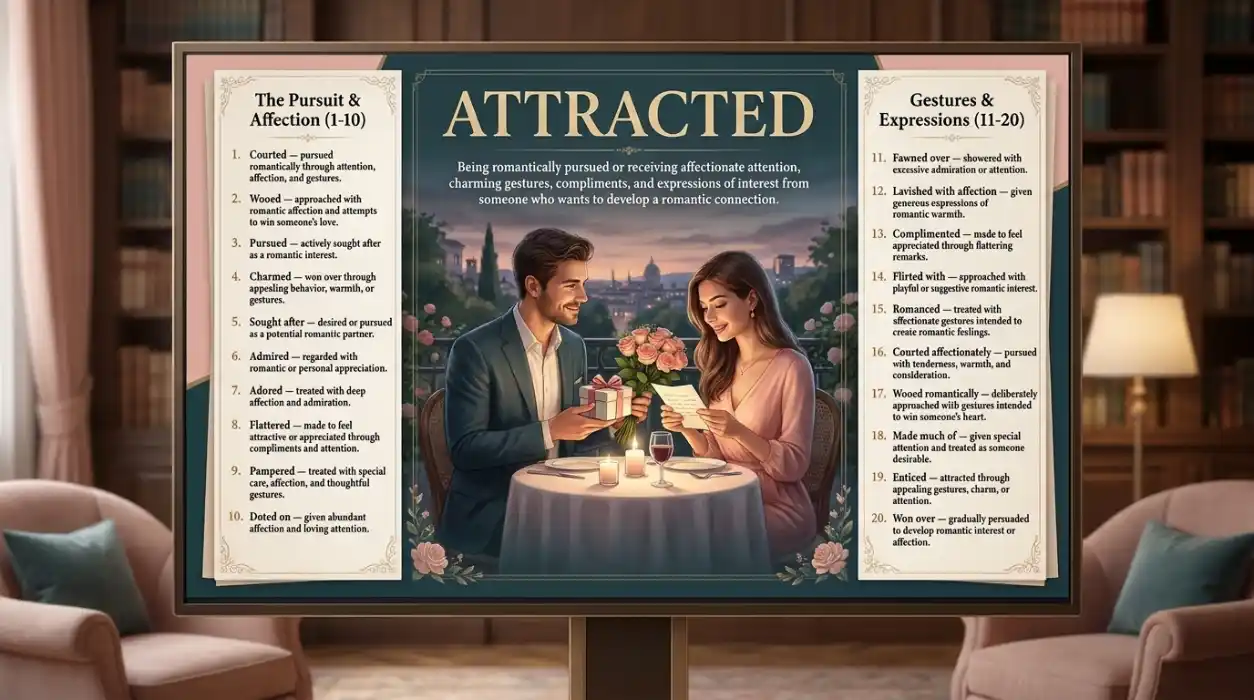
50. Wooed By (Verb phrase) — US: /wuːd baɪ/ | UK: /wuːd baɪ/
Meaning: Courted or deliberately pursued through romantic attention or appealing gestures.
Tone/Register: Romantic, literary, sometimes playful.
Examples:
- She was wooed by his thoughtful letters.
- The company was wooed by several potential partners.
Synonyms by Tone
Different alternatives communicate different emotional shades. Choose a word that fits your relationship, subject, and audience.
Positive
These words express admiration, interest, affection, or appreciation:
- Charmed by
- Captivated by
- Fascinated by
- Enthralled by
- Impressed by
- Enamored of
- Smitten with
- Enthusiastic about
- Magnetic
- Appealing
Neutral
These expressions describe interest or preference without adding a strong emotional judgment:
- Drawn to
- Interested in
- Attracted to
- Appealed to
- Keen on
- Fond of
- Partial to
- Open to
- Receptive to
- Liked
Negative or Cautionary
These words can suggest excessive attachment, manipulation, or an unwanted temptation:
- Obsessed with
- Hung up on
- Lured by
- Seduced by
- Tempted by
They are not always negative. For example, someone can be tempted by a good opportunity. The surrounding sentence determines the tone.
Playful or Informal
These alternatives can make casual conversation more expressive:
- Smitten with
- Taken with
- Keen on
- Hooked on
- Drawn to
- Hung up on
Why Does Tone Matter?
Imagine telling a colleague, “I’m obsessed with your proposal.” You may intend to show excitement, but the word obsessed can sound excessive.
“I’m impressed by your proposal” is more measured and professional. Choosing the right synonym helps you express the correct level of interest.
“Attracted” vs. Close Alternatives
| Word | Main meaning | Tone | Best use |
|---|---|---|---|
| Attracted | Feeling drawn toward someone or something | Neutral | General or romantic interest |
| Drawn to | Feeling a natural pull or connection | Reflective | Personal preferences and emotional interest |
| Interested | Wanting to know more or become involved | Neutral | Topics, activities, and opportunities |
| Fascinated | Having an unusually strong interest | Expressive | Subjects, ideas, and experiences |
| Infatuated | Experiencing intense, often idealized romantic feelings | Romantic | Strong personal attraction |
Which Alternative Should You Choose?
- Attracted vs. drawn to: Attracted can suggest physical or romantic interest. Drawn to often sounds more emotional or instinctive.
- Attracted vs. interested: Interested is broader and less intense. It does not necessarily suggest physical or romantic appeal.
- Attracted vs. infatuated: Infatuated suggests stronger, sometimes idealized feelings. It is not suitable for every situation involving attraction.
How “Attracted” Changes by Context
Daily Conversation
In everyday speech, people often say they are attracted to someone’s personality, appearance, or sense of humor. Drawn to, fond of, and interested in are useful alternatives.
For example, “I’m drawn to people who are kind” sounds natural and friendly.
Writing and Blogging
Writers can use alternatives to make descriptions more precise. Captivated works for an engaging story, while appealing describes something that seems desirable.
Use different words according to the subject. This improves readability and prevents repetitive sentences.
Professional or Academic Tone
In professional writing, interested in, receptive to, appealed to, and impressed by often work better than emotionally intense words.
For example, “The proposal appealed to the committee” sounds measured and appropriate for a report.
Creative or Informal Use
Creative writing can benefit from expressive terms such as smitten, spellbound, and bewitched. These words help create a stronger emotional picture.
In casual conversation, keen on and taken with can sound natural, depending on the speaker’s dialect.
Common Mistakes and Native Usage
1. Confusing “Attracted To” With “Attracted By”
Both forms are correct, but they often emphasize different things.
- Attracted to: Identifies the person or thing receiving your interest. “She’s attracted to his personality.”
- Attracted by: Emphasizes the quality or feature that creates the interest. “She’s attracted by his confidence.”
The difference is not absolute, but it can help make your meaning clearer.
2. Using “Infatuated” for Ordinary Interest
Infatuated describes intense romantic admiration. It is stronger than simply being interested.
If you enjoy a subject, say you are interested in it or fascinated by it. Do not use infatuated unless the emotional intensity fits.
3. Confusing “Appealing” With “Attracted”
Appealing describes the quality of something that makes it attractive. Attracted describes the person experiencing the interest.
- Natural: “The design is appealing.”
- Natural: “I’m attracted to the design.”
4. Using “Obsessed” Too Casually
Obsessed can sound intense or unhealthy. It is common in informal speech, but very interested in or passionate about may be more suitable in formal situations.
5. Forgetting the Correct Preposition
Some expressions usually take specific prepositions:
- Attracted to someone
- Drawn to something
- Fascinated by something
- Keen on something
- Fond of someone
- Interested in something
- Impressed by something
Learning the complete phrase helps you avoid common grammar mistakes.
Register Notes
- Formal: Enamored of, receptive to, compelled by, desirable.
- Neutral: Attracted to, interested in, drawn to, appealed to.
- Informal: Smitten with, keen on, taken with, hung up on.
- Literary: Bewitched by, spellbound by, allured by, enthralled by.
- Professional: Impressed by, receptive to, enthusiastic about, appealing.
For additional vocabulary practice, explore related lessons on adjectives for feelings, romantic expressions, and words for describing personality.
Real-Life Mini Scenarios
Workplace
A recruiter might say, “We were impressed by her experience.” A manager could explain, “The flexible working arrangement appealed to the candidates.” Both phrases express interest in a professional context.
Social Situations
You meet someone who shares your interests. You might say, “I’m drawn to people who enjoy meaningful conversations.” This sounds natural without making the statement overly romantic.
Media and Pop Culture
A film review might say, “The audience was captivated by the lead actor.” This describes the audience’s attention and admiration.
Writing and Storytelling
A writer might describe a character as smitten after a first meeting. Another character might feel intrigued by a mysterious stranger. These choices create different emotional effects.
Practice Exercise
1. You feel naturally interested in someone because of their kindness. Which phrase fits best?
A. Drawn to
B. Activated by
C. Receptive to
2. A student wants to learn more about an unusual scientific discovery. Which word is most suitable?
A. Infatuated
B. Intrigued
C. Tempted
3. Someone has intense romantic feelings for a person they barely know. Which word describes this feeling?
A. Operational
B. Infatuated
C. Receptive
4. A company likes a candidate’s experience and communication skills. Which phrase works best?
A. Impressed by
B. Bewitched by
C. Hung up on
5. You want to describe a person who is warmly attracted to someone’s pleasant manners. Which phrase is appropriate?
A. Charmed by
B. Lured by
C. Compelled by
6. A new job opportunity seems interesting and suitable to you. Which phrase is most natural?
A. Appealed to
B. Spellbound by
C. Smitten with
7. A person cannot stop thinking about a former partner. Which informal phrase fits?
A. Open to
B. Hung up on
C. Appreciative of
8. You are writing a formal report about people who are willing to consider a new proposal. Which phrase is best?
A. Receptive to
B. Smitten with
C. Bewitched by
9. A person feels strong affection for a city after visiting it. Which expression works well?
A. Enamored of
B. Operating
C. Activated
10. A crowd cannot look away from an amazing performance. Which word describes their reaction?
A. Mesmerized
B. Tempted
C. Partial
Reflection Task
Write three original sentences using different alternatives for attracted:
- Describe a person whose personality you admire.
- Describe an activity or subject that interests you.
- Describe a place or opportunity that appeals to you.
Answer key: 1-A, 2-B, 3-B, 4-A, 5-A, 6-A, 7-B, 8-A, 9-A, 10-A
External Learning Sources
Explore these established dictionary and language references for definitions, pronunciation, word origins, and example sentences:
- Cambridge Dictionary:
- Merriam-Webster Dictionary:
- Oxford Learner’s Dictionaries: https://www.oxfordlearnersdictionaries.com/
- Online Etymology Dictionary:
Use these references to compare shades of meaning and confirm which expressions sound natural in different contexts
Conclusion
Learning a synonym for attracted helps you describe admiration, curiosity, affection, and interest with greater precision. Each alternative adds a slightly different shade of meaning.
A richer vocabulary strengthens essays, blog posts, professional writing, and everyday conversations. It also helps you communicate feelings without relying on the same expression repeatedly.
Practice these alternatives in emails, essays, and daily conversations. Write a few original sentences today, and notice how the right word makes your meaning clearer.
Frequently Asked Questions
1. What is a synonym for attracted to someone romantically?
Common alternatives include drawn to, interested in, smitten with, enamored with, and infatuated with. The best choice depends on the strength of the feeling. Interested in is mild, drawn to suggests a natural connection, and infatuated with describes intense romantic admiration that may be idealized.
2. What is a professional way to say “attracted to”?
In professional writing, use expressions such as interested in, drawn to, appealed to, or impressed by, depending on the meaning. For example, “The organization was attracted to her experience” could become “The organization was impressed by her experience.” This sounds more precise and appropriate in a workplace context.
3. What is the difference between being attracted to someone and liking them?
Being attracted to someone means feeling drawn toward them, often because of physical appearance, personality, or romantic appeal. Liking someone is broader. You can like a person as a friend without experiencing romantic or physical attraction. Attraction may be one part of liking, but the two feelings are not identical.
4. Can you be attracted to someone’s personality rather than appearance?
Yes. Attraction can come from someone’s kindness, confidence, humor, intelligence, or values. You might say, “I’m drawn to her personality” or “I’m attracted to his sense of humor.” These expressions make it clear that you appreciate personal qualities rather than focusing on physical appearance.
5. What is a stronger word than “attracted”?
The strongest alternative depends on the type of attraction. Infatuated suggests intense romantic admiration, while captivated and mesmerized express powerful fascination. Obsessed with is even more intense, but it can suggest an unhealthy level of attention. Choose a word that reflects the actual feeling.