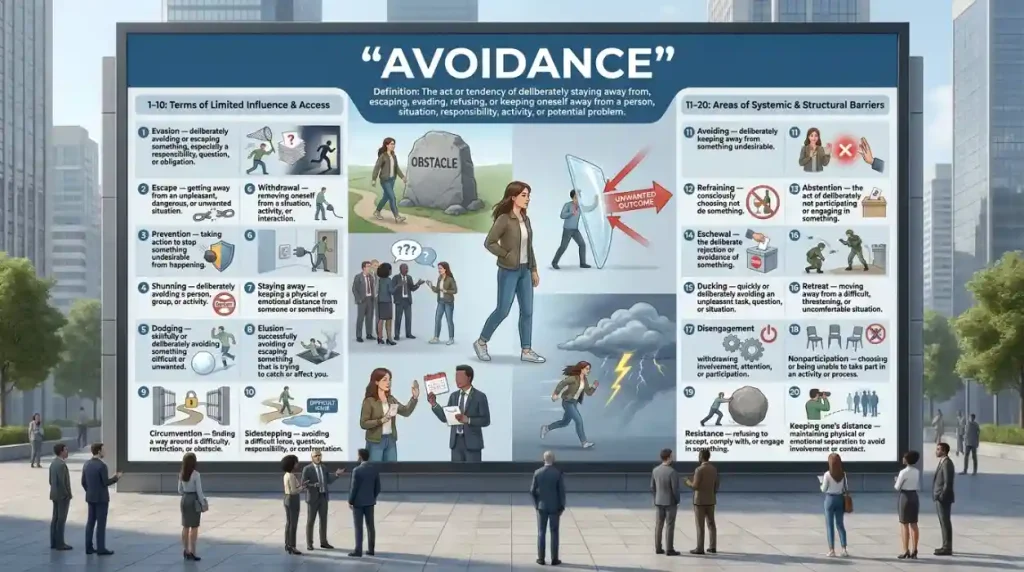
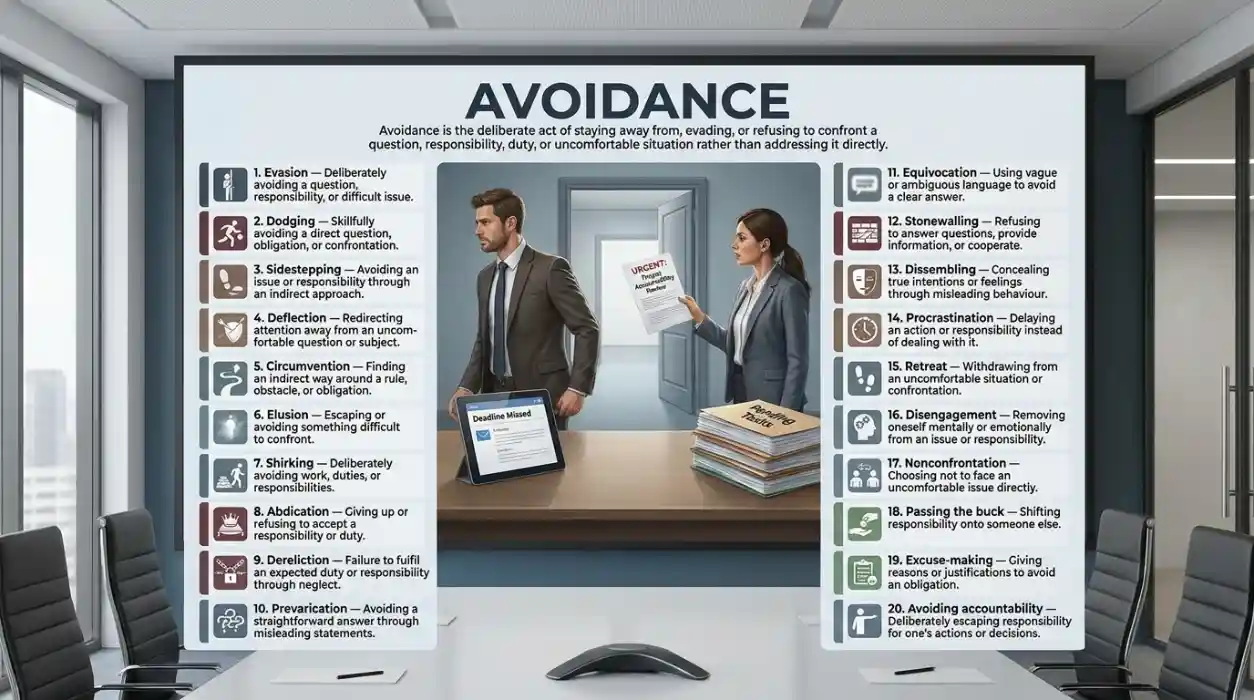
A synonym for avoidance is a word or phrase that expresses staying away from something, preventing contact, or choosing not to deal with a situation. Common alternatives include evasion, prevention, shunning, abstention, and evading.
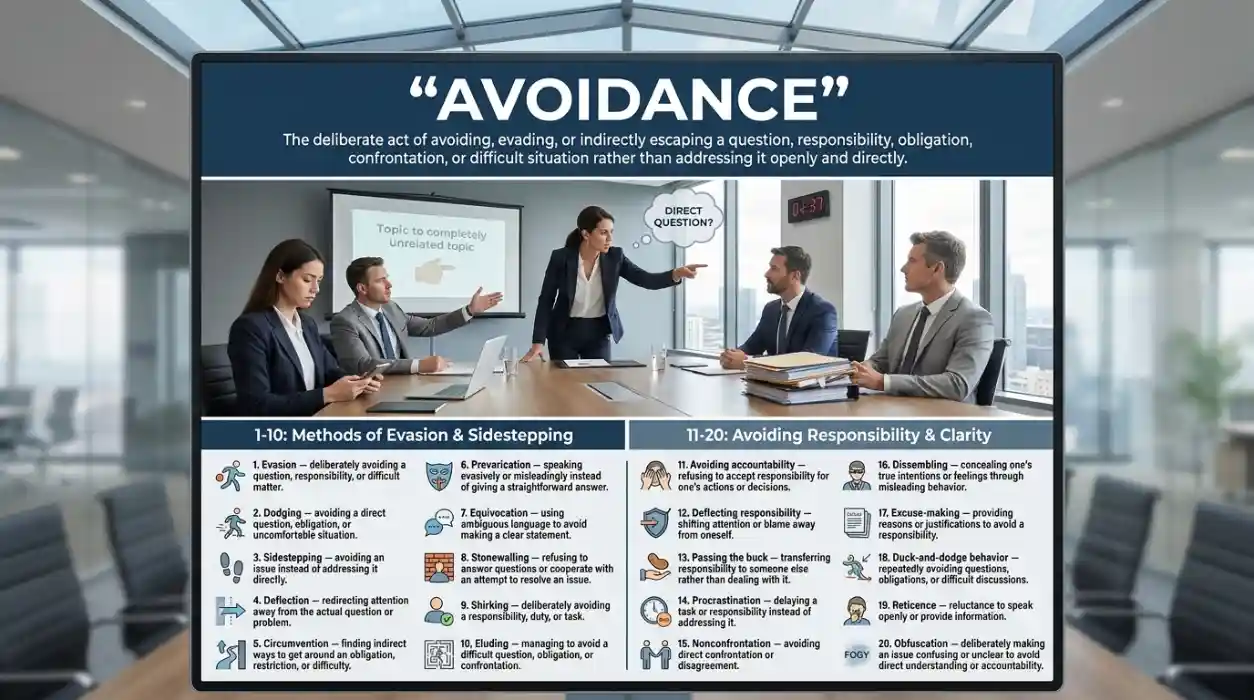
Imagine receiving an uncomfortable question during a meeting. Instead of answering directly, you change the subject. This behavior is an example of evasion or avoidance.
The word avoidance appears in everyday conversations, psychology, business, education, and formal writing. It describes actions taken to escape something unwanted or unpleasant.
Learning synonyms for avoidance helps you express your thoughts more precisely. Students can improve essays, while bloggers and content writers can make their articles more engaging.
Daily English users also benefit from these alternatives. They help explain personal choices, difficult situations, safety measures, and communication habits naturally.
What Does “Avoidance” Really Mean?
Avoidance means the act of staying away from something, preventing contact with it, or deliberately choosing not to face or deal with it.
In simple English, avoidance happens when someone tries not to experience, encounter, or become involved in something.
For example:
- Avoidance of difficult conversations can damage relationships.
- Wearing protective clothing helps with the avoidance of unnecessary risks.
- His avoidance of responsibility frustrated his colleagues.
Part of Speech
Avoidance is a noun.
It describes an action, behavior, or strategy involving the act of avoiding something.
The related verb is avoid, while avoidant is an adjective used to describe someone or something characterized by avoidance.
Simple definition: The act of keeping away from something or choosing not to face it.
How Native English Speakers Understand It
Native English speakers use avoidance in several situations.
It can describe a deliberate decision to stay away from danger. It can also describe an unwillingness to face responsibilities, emotions, or uncomfortable conversations.
The meaning depends heavily on context.
For example, avoiding a dangerous road is sensible. Avoiding every difficult conversation may indicate an unhealthy communication habit.
The word frequently appears in psychology, relationships, workplace communication, health, law, safety, and academic writing.
Connotative Meaning
(Connotation means the feelings, associations, or emotional suggestions connected with a word beyond its literal dictionary meaning.)
Positive tone: Avoidance can suggest caution, prevention, self-protection, and sensible decision-making.
Negative tone: It can suggest fear, dishonesty, irresponsibility, procrastination, or unwillingness to face a problem.
Neutral tone: In technical and academic contexts, avoidance can simply describe a strategy for preventing contact with a particular condition or situation.
Etymology
The word avoidance comes from the verb avoid combined with the noun-forming suffix -ance.
The verb avoid entered English through Anglo-French and Old French forms related to the idea of making something empty, clearing away, or escaping an obligation.
Its deeper historical roots are connected to Latin vacuus, meaning empty or vacant.
Historical Development
Old English (450–1100)
The modern word avoidance did not exist in its present form in Old English. However, Old English had different expressions for escaping, departing, shunning, and keeping away from something.
Middle English (1100–1500)
The verb avoid developed through Anglo-French and Old French influences. It was associated with clearing away, removing, and escaping. Its meaning gradually expanded to include staying away from unwanted situations.
Modern English (1500–Present)
Avoidance developed into an established noun describing the act or practice of avoiding something.
Modern English uses the word in everyday conversation and specialized fields. Psychology uses it to discuss behavioral patterns, while law and business use it in discussions about preventing obligations, risks, or unwanted outcomes.
Pronunciation
- US IPA: /əˈvɔɪdəns/
- UK IPA: /əˈvɔɪdəns/
Syllables: a-void-ance
Affixation Pattern of Avoidance
- Root: Avoid
- Prefix: None
- Suffix: -ance
The suffix -ance transforms the verb avoid into a noun. It describes the action or state of avoiding something.
Synonyms List
The following alternatives cover different shades of meaning. Some describe staying away, others suggest escaping responsibility, and some focus on preventing an unwanted event.
Choose according to the situation rather than treating every word as a perfect replacement.
1. Evasion (Noun) — US: /ɪˈveɪʒən/ | UK: /ɪˈveɪʒən/
Meaning: The act of escaping a question, responsibility, or difficult situation instead of addressing it directly.
Tone/Register: Formal, professional, negative.
Example:
His constant evasion of difficult questions annoyed the interviewer.
The manager noticed her evasion during the discussion.
2. Elusion (Noun) — US: /ɪˈluːʒən/ | UK: /ɪˈluːʒən/
Meaning: The act of escaping or avoiding capture, detection, or understanding.
Tone/Register: Formal, literary.
Example:
The suspect’s elusion of the authorities surprised everyone.
The meaning of the mysterious message remained an enigma.
3. Shunning (Noun) — US: /ˈʃʌnɪŋ/ | UK: /ˈʃʌnɪŋ/
Meaning: The deliberate act of avoiding someone or something, often because of disapproval.
Tone/Register: Social, formal, negative.
Example:
His shunning of former colleagues damaged his reputation.
The community’s shunning of outsiders created tension.
4. Abstention (Noun) — US: /əbˈstɛnʃən/ | UK: /əbˈstenʃən/
Meaning: The decision not to participate in an activity or take part in a particular action.
Tone/Register: Formal, political, academic.
Example:
Her abstention from the vote surprised the committee.
The doctor recommended abstention from alcohol during treatment.
5. Nonparticipation (Noun) — US: /ˌnɑːnpɑːrˌtɪsɪˈpeɪʃən/ | UK: /ˌnɒnpɑːˌtɪsɪˈpeɪʃən/
Meaning: The state or action of choosing not to participate in an activity or event.
Tone/Register: Formal, academic, professional.
Example:
Nonparticipation in the survey affected the final results.
The school investigated the reasons for student nonparticipation.
6. Withdrawal (Noun) — US: /wɪðˈdrɔːəl/ | UK: /wɪðˈdrɔːəl/
Meaning: The act of removing yourself from a situation, activity, or relationship.
Tone/Register: Neutral, formal, psychological.
Example:
His withdrawal from the competition disappointed his teammates.
Social withdrawal can affect a person’s relationships.
7. Reticence (Noun) — US: /ˈrɛtɪsəns/ | UK: /ˈretɪsəns/
Meaning: An unwillingness to speak openly or reveal personal thoughts and information.
Tone/Register: Formal, literary, professional.
Example:
Her reticence about the incident raised questions.
The witness showed considerable reticence during the interview.
8. Circumvention (Noun) — US: /ˌsɜːrkəmˈvɛnʃən/ | UK: /ˌsɜːkəmˈvenʃən/
Meaning: The act of finding a way around a rule, obstacle, or restriction.
Tone/Register: Formal, legal, technical.
Example:
The company introduced measures to prevent tax circumvention.
Circumvention of safety rules can create serious risks.
9. Dodge (Noun) — US: /dɑːdʒ/ | UK: /dɒdʒ/
Meaning: An attempt to avoid a responsibility, question, or unwanted situation.
Tone/Register: Informal, conversational.
Example:
His answer sounded like a clever dodge.
She used a last-minute excuse to dodge the meeting.
10. Escape (Noun) — US: /ɪˈskeɪp/ | UK: /ɪˈskeɪp/
Meaning: The act of getting away from an unpleasant, dangerous, or restrictive situation.
Tone/Register: Neutral, conversational, literary.
Example:
Reading became her escape from daily stress.
The prisoner planned an escape from the facility.
11. Flight (Noun) — US: /flaɪt/ | UK: /flaɪt/
Meaning: The act of running away from danger, conflict, or an uncomfortable situation.
Tone/Register: Formal, literary, psychological.
Example:
His first response to conflict was flight rather than discussion.
The animals displayed a natural flight response.
12. Retreat (Noun) — US: /rɪˈtriːt/ | UK: /rɪˈtriːt/
Meaning: The act of moving away from a difficult situation or withdrawing from confrontation.
Tone/Register: Neutral, professional, military.
Example:
Her retreat from the argument prevented further tension.
The team made a strategic retreat after the setback.
13. Avoiding (Gerund/Noun) — US: /əˈvɔɪdɪŋ/ | UK: /əˈvɔɪdɪŋ/
Meaning: The act of deliberately staying away from someone, something, or a particular activity.
Tone/Register: Neutral, conversational.
Example:
Avoiding unnecessary arguments can improve relationships.
He is avoiding difficult conversations at work.
14. Prevention (Noun) — US: /prɪˈvɛnʃən/ | UK: /prɪˈvenʃən/
Meaning: The act of stopping something unwanted from happening.
Tone/Register: Formal, professional, medical.
Example:
Regular exercise supports the prevention of certain health problems.
The school introduced measures for accident prevention.
15. Abstinence (Noun) — US: /ˈæbstɪnəns/ | UK: /ˈæbstɪnəns/
Meaning: The practice of deliberately not participating in or consuming something.
Tone/Register: Formal, medical, religious.
Example:
The program encourages abstinence from addictive substances.
His abstinence from social media lasted several months.
16. Noninvolvement (Noun) — US: /ˌnɑːnɪnˈvɑːlvmənt/ | UK: /ˌnɒnɪnˈvɒlvmənt/
Meaning: The condition of not becoming involved in a particular situation or activity.
Tone/Register: Formal, neutral, professional.
Example:
She preferred noninvolvement in the office dispute.
The report confirmed his noninvolvement in the incident.
17. Disengagement (Noun) — US: /ˌdɪsɪnˈɡeɪdʒmənt/ | UK: /ˌdɪsɪnˈɡeɪdʒmənt/
Meaning: The process of withdrawing attention, interest, or participation from something.
Tone/Register: Professional, psychological, academic.
Example:
Employee disengagement can affect workplace productivity.
His disengagement from the conversation was noticeable.
18. Reluctance (Noun) — US: /rɪˈlʌktəns/ | UK: /rɪˈlʌktəns/
Meaning: An unwillingness or hesitation to do something.
Tone/Register: Neutral, formal, conversational.
Example:
Her reluctance to discuss the issue was understandable.
He showed reluctance to accept the new responsibility.
19. Resistance (Noun) — US: /rɪˈzɪstəns/ | UK: /rɪˈzɪstəns/
Meaning: The act of opposing, refusing, or preventing something from happening.
Tone/Register: Neutral, professional, political.
Example:
There was strong resistance to the proposed changes.
The treatment helps build resistance to infection.
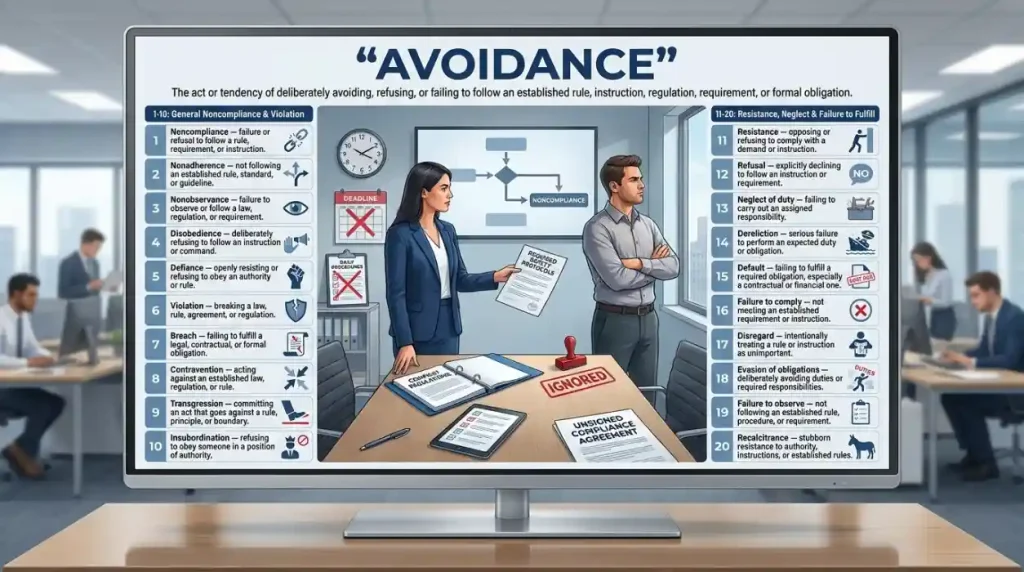
20. Noncompliance (Noun) — US: /ˌnɑːnkəmˈplaɪəns/ | UK: /ˌnɒnkəmˈplaɪəns/
Meaning: The failure or refusal to follow a rule, instruction, or requirement.
Tone/Register: Formal, legal, medical.
Example:
Noncompliance with safety regulations can lead to penalties.
The doctor discussed the reasons behind medication noncompliance.
21. Sidestepping (Noun/Gerund) — US: /ˈsaɪdˌstɛpɪŋ/ | UK: /ˈsaɪdˌstepɪŋ/
Meaning: The act of deliberately avoiding a difficult issue or responsibility.
Tone/Register: Conversational, professional.
Example:
The politician was accused of sidestepping the main question.
Sidestepping the problem will not solve it.
22. Circumvention of Responsibility (Phrase) — US: /ˌsɜːrkəmˈvɛnʃən əv rɪˌspɑːnsəˈbɪləti/ | UK: /ˌsɜːkəmˈvenʃən əv rɪˌspɒnsəˈbɪləti/
Meaning: The act of finding indirect ways to escape an obligation or duty.
Tone/Register: Formal, business, critical.
Example:
The investigation revealed circumvention of responsibility by senior staff.
The policy aims to prevent circumvention of legal duties.
23. Evasion of Responsibility (Phrase) — US: /ɪˈveɪʒən əv rɪˌspɑːnsəˈbɪləti/ | UK: /ɪˈveɪʒən əv rɪˌspɒnsəˈbɪləti/
Meaning: The act of refusing to accept or fulfill an expected responsibility.
Tone/Register: Formal, professional, negative.
Example:
The manager criticized his evasion of responsibility.
Evasion of responsibility can weaken team trust.
24. Nonattendance (Noun) — US: /ˌnɑːnəˈtɛndəns/ | UK: /ˌnɒnəˈtendəns/
Meaning: The state of not attending an event, class, meeting, or appointment.
Tone/Register: Formal, educational, administrative.
Example:
Repeated nonattendance affected her academic performance.
The school contacted parents about student nonattendance.
25. Absence (Noun) — US: /ˈæbsəns/ | UK: /ˈæbsəns/
Meaning: The state of being away from a place or not being present.
Tone/Register: Neutral, formal, conversational.
Example:
His absence from the meeting created confusion.
The report noted an absence of clear communication.
26. Seclusion (Noun) — US: /sɪˈkluːʒən/ | UK: /sɪˈkluːʒən/
Meaning: The state of staying away from other people or being kept apart from them.
Tone/Register: Formal, literary, psychological.
Example:
She enjoyed the seclusion of her countryside home.
Prolonged seclusion can affect social well-being.
27. Isolation (Noun) — US: /ˌaɪsəˈleɪʃən/ | UK: /ˌaɪsəˈleɪʃən/
Meaning: The condition of being separated from others or kept apart from a particular environment.
Tone/Register: Neutral, psychological, medical.
Example:
Social isolation can affect emotional health.
The patient remained in isolation during recovery.
28. Concealment (Noun) — US: /kənˈsiːlmənt/ | UK: /kənˈsiːlmənt/
Meaning: The act of hiding something to prevent others from seeing or discovering it.
Tone/Register: Formal, legal, negative.
Example:
The concealment of important evidence raised concerns.
She questioned his concealment of the financial details.
29. Suppression (Noun) — US: /səˈprɛʃən/ | UK: /səˈpreʃən/
Meaning: The act of preventing something from being expressed, revealed, or allowed to develop.
Tone/Register: Formal, psychological, political.
Example:
The suppression of honest feedback harmed the organization.
Emotional suppression can make communication difficult.
30. Inhibition (Noun) — US: /ˌɪnhəˈbɪʃən/ | UK: /ˌɪnhɪˈbɪʃən/
Meaning: A psychological or behavioral restriction that prevents someone from expressing or doing something freely.
Tone/Register: Academic, psychological, formal.
Example:
Social inhibition made it difficult for him to speak publicly.
Fear can create inhibition during important conversations.
31. Deflection (Noun) — US: /dɪˈflɛkʃən/ | UK: /dɪˈflekʃən/
Meaning: The act of redirecting attention away from an uncomfortable subject or question.
Tone/Register: Professional, conversational, critical.
Example:
Her deflection of the question frustrated the audience.
The interview revealed a pattern of blame deflection.
32. Preclusion (Noun) — US: /prɪˈkluːʒən/ | UK: /prɪˈkluːʒən/
Meaning: The act of preventing something from happening or making it impossible.
Tone/Register: Formal, legal, academic.
Example:
Early planning supports the preclusion of unnecessary delays.
The agreement allows the preclusion of certain risks.
33. Deterrence (Noun) — US: /dɪˈtɜːrəns/ | UK: /dɪˈterəns/
Meaning: The use of fear, consequences, or warnings to discourage an unwanted action.
Tone/Register: Formal, legal, political.
Example:
Strict penalties may provide deterrence against fraud.
The policy focuses on deterrence rather than punishment.
34. Refraining (Gerund/Noun) — US: /rɪˈfreɪnɪŋ/ | UK: /rɪˈfreɪnɪŋ/
Meaning: The act of choosing not to do something.
Tone/Register: Formal, neutral.
Example:
Refraining from unnecessary criticism can improve teamwork.
She is refraining from making a final decision.
35. Forbearance (Noun) — US: /fɔːrˈbɛrəns/ | UK: /fɔːˈbeərəns/
Meaning: The act of patiently holding back from doing something, especially when responding to provocation.
Tone/Register: Formal, literary, professional.
Example:
His forbearance during the disagreement impressed everyone.
The situation required patience and forbearance.
36. Avoidance Behavior (Noun Phrase) — US: /əˈvɔɪdəns bɪˈheɪvjər/ | UK: /əˈvɔɪdəns bɪˈheɪvjə/
Meaning: A pattern of actions intended to escape uncomfortable thoughts, emotions, people, or situations.
Tone/Register: Psychological, academic, clinical.
Example:
Avoidance behavior can prevent people from addressing their fears.
The therapist discussed healthier responses to stress.
37. Conflict Avoidance (Noun Phrase) — US: /ˈkɑːnflɪkt əˈvɔɪdəns/ | UK: /ˈkɒnflɪkt əˈvɔɪdəns/
Meaning: The tendency to stay away from disagreements or situations that may lead to confrontation.
Tone/Register: Psychological, professional, conversational.
Example:
Conflict avoidance can make workplace problems harder to resolve.
Her conflict avoidance affected team communication.
38. Risk Avoidance (Noun Phrase) — US: /rɪsk əˈvɔɪdəns/ | UK: /rɪsk əˈvɔɪdəns/
Meaning: The practice of staying away from activities or decisions that may produce harmful outcomes.
Tone/Register: Business, financial, professional.
Example:
Risk avoidance influenced the company’s investment decisions.
The safety plan emphasizes risk avoidance.
39. Evasion of Detection (Noun Phrase) — US: /ɪˈveɪʒən əv dɪˈtɛkʃən/ | UK: /ɪˈveɪʒən əv dɪˈtekʃən/
Meaning: The act of hiding an action or activity to prevent it from being discovered.
Tone/Register: Formal, legal, technical.
Example:
The investigation examined the evasion of detection.
Security systems help reduce opportunities for concealment.
40. Dodging (Gerund/Noun) — US: /ˈdɑːdʒɪŋ/ | UK: /ˈdɒdʒɪŋ/
Meaning: The act of deliberately escaping a question, duty, or uncomfortable situation.
Tone/Register: Informal, conversational.
Example:
He kept dodging questions about the missing documents.
Dodging responsibility rarely improves a difficult situation.
41. Ducking (Gerund/Noun) — US: /ˈdʌkɪŋ/ | UK: /ˈdʌkɪŋ/
Meaning: The informal act of avoiding an obligation, encounter, or difficult situation.
Tone/Register: Informal, conversational.
Example:
She was ducking calls from the insurance company.
Ducking an important conversation can create more problems.
42. Eluding (Gerund) — US: /ɪˈluːdɪŋ/ | UK: /ɪˈluːdɪŋ/
Meaning: The act of successfully escaping someone or something that is trying to catch, identify, or understand you.
Tone/Register: Formal, literary.
Example:
The suspect continued eluding the police.
The answer kept eluding the researchers.
43. Shying Away (Phrase) — US: /ˌʃaɪɪŋ əˈweɪ/ | UK: /ˌʃaɪɪŋ əˈweɪ/
Meaning: The act of avoiding something because of fear, uncertainty, or discomfort.
Tone/Register: Conversational, neutral.
Example:
She is not shying away from difficult challenges.
Many students shy away from speaking in public.
44. Steering Clear (Phrase) — US: /ˌstɪrɪŋ ˈklɪr/ | UK: /ˌstɪərɪŋ ˈklɪə/
Meaning: The act of deliberately staying away from someone or something considered unpleasant or risky.
Tone/Register: Informal, conversational.
Example:
He is steering clear of unnecessary office gossip.
We should steer clear of unreliable information.
45. Keeping Away (Phrase) — US: /ˌkiːpɪŋ əˈweɪ/ | UK: /ˌkiːpɪŋ əˈweɪ/
Meaning: The act of maintaining distance from a person, place, or situation.
Tone/Register: Informal, neutral.
Example:
Keeping away from harmful influences can be beneficial.
She is keeping away from crowded places this week.
46. Staying Clear (Phrase) — US: /ˌsteɪɪŋ ˈklɪr/ | UK: /ˌsteɪɪŋ ˈklɪə/
Meaning: The act of avoiding a potentially dangerous, unpleasant, or problematic situation.
Tone/Register: Informal, conversational.
Example:
Staying clear of unnecessary arguments can save time.
The driver was advised to stay clear of the damaged road.
47. Nonexposure (Noun) — US: /ˌnɑːnɪkˈspoʊʒər/ | UK: /ˌnɒnɪkˈspəʊʒə/
Meaning: The condition of not being exposed to a particular substance, experience, or influence.
Tone/Register: Technical, medical, scientific.
Example:
Nonexposure to the chemical reduced the immediate health risk.
The research examined nonexposure to environmental pollutants.
48. Precaution (Noun) — US: /prɪˈkɔːʃən/ | UK: /prɪˈkɔːʃən/
Meaning: An action taken beforehand to prevent danger, damage, or an unwanted outcome.
Tone/Register: Neutral, professional, formal.
Example:
Wearing a helmet is an important safety precaution.
The company introduced extra precautions during construction.
49. Prevention Strategy (Noun Phrase) — US: /prɪˈvɛnʃən ˈstrætədʒi/ | UK: /prɪˈvenʃən ˈstrætədʒi/
Meaning: A planned approach designed to stop an unwanted event or problem from occurring.
Tone/Register: Academic, professional, business.
Example:
The school developed a prevention strategy for bullying.
The healthcare team introduced a prevention strategy for infection.
50. Protective Withdrawal (Noun Phrase) — US: /prəˈtɛktɪv wɪðˈdrɔːəl/ | UK: /prəˈtektɪv wɪðˈdrɔːəl/
Meaning: The act of deliberately removing yourself from a situation to protect your safety or emotional well-being.
Tone/Register: Psychological, formal, professional.
Example:
Protective withdrawal helped her leave an unhealthy relationship.
The counselor explained when taking a break becomes protective withdrawal.
Synonyms by Tone
The right synonym depends on the message you want to communicate. Some words sound neutral, while others suggest fear, dishonesty, caution, or deliberate withdrawal.
1. Positive or Protective Tone
These expressions can describe sensible decisions to prevent harm or protect personal well-being.
- Prevention
- Precaution
- Risk avoidance
- Protective withdrawal
- Forbearance
- Abstention
- Steering clear
Example:
Taking precautions is a sensible way to reduce unnecessary risks.
2. Neutral Tone
These alternatives describe staying away or not participating without necessarily criticizing the action.
- Withdrawal
- Absence
- Nonparticipation
- Noninvolvement
- Refraining
- Seclusion
- Nonattendance
- Disengagement
Example:
Her withdrawal from the competition was a personal decision.
3. Negative or Critical Tone
These words often suggest dishonesty, irresponsibility, fear, or unwillingness to address an issue.
- Evasion
- Shunning
- Circumvention
- Dodging
- Deflection
- Concealment
- Suppression
- Noncompliance
Example:
His evasion of responsibility affected the entire team.
4. Playful and Informal Tone
These expressions are common in casual conversations. They make everyday communication sound more natural.
- Dodging
- Ducking
- Steering clear
- Keeping away
- Staying clear
- Shying away
Example:
I’m steering clear of office gossip today.
Why Does Tone Matter in Word Choice?
A synonym can change the emotional meaning of a sentence.
For example, withdrawal may describe a neutral personal decision. However, evasion can suggest that someone is deliberately hiding the truth.
Choose vocabulary that accurately reflects the situation. This is especially important in professional communication, academic writing, and sensitive conversations.
Avoidance vs. Close Alternatives
Some alternatives have similar meanings but are not interchangeable. Understanding their differences helps you choose the right expression.
Avoidance vs. Evasion
Avoidance: A general decision or action of staying away from something.
Evasion: An attempt to escape a question, responsibility, rule, or difficult situation.
Tone difference: Avoidance can be neutral or negative. Evasion usually sounds more critical.
When to use each: Use avoidance for general behavior. Choose evasion when someone avoids giving a direct answer or accepting responsibility.
Avoidance vs. Prevention
Avoidance: Keeping away from something or choosing not to experience it.
Prevention: Taking action to stop something from happening.
Tone difference: Avoidance is descriptive, while prevention often suggests planning and positive action.
When to use each: Use avoidance when describing a person’s behavior. Use prevention when discussing safety, healthcare, or solutions to problems.
Avoidance vs. Abstention
Avoidance: Staying away from an unwanted situation, person, or activity.
Abstention: Deliberately choosing not to participate in an activity or consume something.
Tone difference: Abstention is more formal and often relates to personal discipline, voting, or medical recommendations.
When to use each: Use avoidance for general situations. Choose abstention when describing a conscious decision not to participate.
How Avoidance Changes by Context
The meaning of avoidance can change depending on the subject. Native English speakers select different alternatives for personal conversations, academic discussions, and professional situations.
1. Daily Conversation
In everyday conversations, people often use simple expressions rather than formal vocabulary.
For example, someone might say:
- “I’m staying away from unnecessary arguments.”
- “He’s been dodging my calls.”
- “She keeps shying away from difficult conversations.”
These expressions sound natural and easy to understand.
2. Writing and Blogging
Writers can use avoidance when discussing habits, relationships, personal development, or social behavior.
For example, a blog about communication might discuss conflict avoidance. An article about productivity might explore task avoidance.
Alternatives such as evasion, withdrawal, and reluctance help explain different behaviors without repeating the same word.
3. Professional and Academic Writing
Formal writing requires greater precision.
- Use prevention when discussing strategies to stop problems. Use noncompliance when discussing failure to follow requirements. Use circumvention when someone attempts to bypass rules.
In psychological research, avoidance behavior is a useful established term.
4. Creative and Informal Writing
Creative writers can use expressions such as shying away, ducking, dodging, and steering clear.
These phrases create natural dialogue and help readers understand a character’s emotions.
For example:
“He kept dodging her questions because he was afraid of the truth.”
This sentence communicates avoidance through behavior rather than directly explaining the character’s feelings.
Common Mistakes Learners Make
Even advanced English learners sometimes confuse avoidance with related vocabulary. Here are common mistakes worth remembering.
1. Confusing Avoidance with Prevention
Avoidance means staying away from something. Prevention means stopping something from happening.
Incorrect: “Prevention of the difficult conversation made him uncomfortable.”
Better: “Avoidance of the difficult conversation made him uncomfortable.”
2. Using Evasion for Every Situation
Evasion usually suggests avoiding an obligation, question, or responsibility.
It does not always work when describing ordinary physical distance.
Better: “She avoided the crowded street.”
Less natural: “She used evasion of the crowded street.”
3. Confusing Abstinence with Withdrawal
Abstinence usually means deliberately not consuming or participating in something.
Withdrawal describes removing yourself from a situation or activity.
For example, abstinence from alcohol and withdrawal from a competition communicate different actions.
4. Treating Reluctance as a Complete Synonym
Reluctance means hesitation or unwillingness. It does not necessarily mean someone has actually avoided something.
For example, a person may feel reluctant to attend a meeting but still attend it.
5. Using Formal Words in Casual Conversations
Words such as circumvention, preclusion, and noninvolvement may sound unnecessarily complicated in everyday speech.
Use simple expressions when they communicate your meaning more naturally.
Register Notes: Formal vs. Informal English
Formal vocabulary:
- Evasion
- Circumvention
- Abstention
- Noncompliance
- Preclusion
- Disengagement
Informal vocabulary:
- Dodging
- Ducking
- Keeping away
- Steering clear
- Shying away
Academic vocabulary:
- Avoidance behavior
- Conflict avoidance
- Risk avoidance
- Inhibition
- Suppression
Professional vocabulary:
- Prevention
- Withdrawal
- Noninvolvement
- Precaution
- Deterrence
In spoken English, short expressions often sound more natural. In written English, formal alternatives can improve precision when they match the subject.
Real-Life Examples
Workplace Scenario
An employee repeatedly changes the subject whenever a manager asks about an unfinished project.
This behavior may be described as evasion or avoidance of responsibility.
Social Situation
Someone stops attending gatherings because they feel uncomfortable around a particular group.
You could describe this behavior as social withdrawal or avoidance.
Media and Pop Culture
A character refuses to discuss a controversial event during an interview.
A journalist might describe the response as deflection or evasion.
Writing and Storytelling
A novelist creates a character who avoids emotional conversations because of a painful experience.
The writer might describe this behavior as emotional avoidance or shying away from confrontation.
External Learning Sources
For additional vocabulary practice, pronunciation guidance, and reliable definitions, explore these established English-language references:
- Cambridge Dictionary – Definitions, pronunciation, and usage examples.
- Merriam-Webster – Word origins, meanings, and related vocabulary.
- Oxford Learner’s Dictionaries – Learner-friendly explanations and grammatical information.
- Collins Dictionary – Synonyms, contextual meanings, and examples.

Practice Exercise
1. A politician refuses to answer an uncomfortable question directly. What is this behavior?
A. Prevention
B. Evasion
C. Precaution
D. Abstinence
2. Someone decides not to vote in an election. Which word describes this decision?
A. Withdrawal
B. Abstention
C. Deflection
D. Isolation
3. A person deliberately stays away from dangerous situations. Which expression fits?
A. Steering clear
B. Concealment
C. Suppression
D. Nonattendance
4. A company takes steps to stop workplace accidents. Which word is most appropriate?
A. Evasion
B. Retreat
C. Prevention
D. Reticence
5. An employee refuses to follow workplace safety rules. What is this called?
A. Forbearance
B. Noncompliance
C. Seclusion
D. Reluctance
6. Someone avoids difficult conversations because they feel nervous. Which expression fits?
A. Shying away
B. Deterrence
C. Preclusion
D. Nonexposure
7. A person removes themselves from an argument. Which word is appropriate?
A. Concealment
B. Withdrawal
C. Circumvention
D. Suppression
8. A student chooses not to attend an important class. Which word describes this?
A. Nonattendance
B. Forbearance
C. Prevention
D. Deflection
9. Someone redirects attention away from an uncomfortable question. Which word fits?
A. Abstinence
B. Retreat
C. Deflection
D. Precaution
10. A person patiently chooses not to respond to an insult. Which word describes this quality?
A. Dodging
B. Forbearance
C. Nonparticipation
D. Elusion
Answer key: 1-B | 2-B | 3-A | 4-C | 5-B | 6-A | 7-B | 8-A | 9-C | 10-B
Reflection and application task
Write one original sentence using any synonym for avoidance.
Conclusion
Understanding a synonym for avoidance helps you describe actions, decisions, and behavior more accurately. Different alternatives communicate different feelings and intentions.
A wider vocabulary improves your writing, blogging, speaking, and everyday communication. It also helps you explain complicated situations in clear and natural English.
Remember that the best synonym is not always the most advanced word. Choose an expression that fits your meaning, audience, and situation.
Practice these alternatives in emails, essays, and daily conversations. Try creating original sentences to build confidence and make new vocabulary part of your everyday English.
FAQs
1. What is the best synonym for avoidance in academic writing?
The best academic alternative depends on the subject. Use evasion when discussing avoiding responsibility or questions. Choose abstention when describing a decision not to participate. Use prevention when discussing actions that stop unwanted events. In psychological research, avoidance behavior is often the most accurate expression.
2. What is a synonym for avoidance of responsibility?
Evasion of responsibility is one of the closest alternatives. Other expressions include shirking responsibility, dodging accountability, and circumvention of responsibility. These expressions describe situations in which someone attempts to escape an obligation instead of accepting it. Evasion and shirking usually communicate a critical or negative attitude.
3. What is the opposite of avoidance?
Common antonyms include confrontation, engagement, participation, involvement, and acceptance. The appropriate opposite depends on the context. For example, engagement contrasts with social withdrawal, while confrontation contrasts with avoiding a difficult discussion. In professional writing, involvement or direct engagement may communicate the intended opposite more clearly.
4. What is a synonym for avoidance in psychology?
In psychology, commonly used related expressions include avoidance behavior, experiential avoidance, emotional avoidance, and withdrawal. These terms describe different ways people respond to uncomfortable thoughts, feelings, or situations. They are not identical. For example, experiential avoidance specifically concerns attempts to escape unwanted internal experiences, such as difficult emotions or memories.
5. How do you describe someone who avoids difficult situations?
You can describe someone as avoidant, evasive, reluctant, withdrawn, or conflict-avoidant. The best expression depends on their behavior. Someone who refuses to answer questions may be evasive, while someone who consistently stays away from disagreements may demonstrate conflict avoidance. Avoid making psychological judgments without sufficient context.

Hasnain Ali is an SEO Content Strategist and the founder of wordvora.com, a trusted vocabulary platform that helps writers, students, professionals, and English learners find accurate synonyms, antonyms, word meanings, and real-life usage examples. He specializes in keyword research, on-page SEO, topical authority, and creating search-first content that aligns with Google’s latest Search Quality and E-E-A-T guidelines. His work focuses on producing clear, well-structured, and reader-friendly resources that satisfy search intent while maintaining high editorial standards.
Through extensive hands-on experience with SEO tools such as Google Search Console, Google Analytics, SEMrush, and Ahrefs, Hasnain researches user search behavior and develops content that is both informative and easy to understand. Every article published on wordvora.com is carefully reviewed for accuracy, readability, and contextual relevance before publication. His mission is to build one of the web’s most reliable English vocabulary resources by providing practical language guidance, trustworthy explanations, and content that helps readers improve their writing, communication, and vocabulary with confidence.