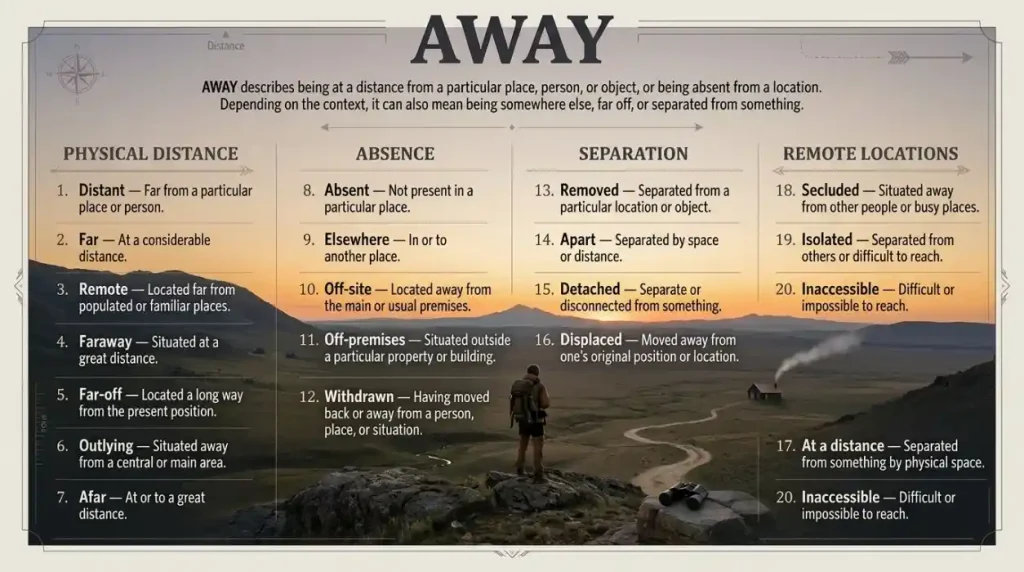
A synonym for away is a word or phrase that expresses distance, absence, departure, or movement to another place. Common alternatives include elsewhere, absent, distant, far, off, and gone. The best choice depends on the sentence and intended meaning.
Imagine telling a friend, “My brother is away.” Your message is clear, but you could also say that he is absent, out of town, or somewhere else.
The word away appears in everyday English. We use it when discussing travel, distance, work, relationships, and personal experiences.
Learning a synonym for away helps you express ideas more naturally. It also makes your sentences more interesting and reduces unnecessary repetition.
Students, bloggers, content writers, and everyday English speakers can all benefit from understanding these alternatives. The right vocabulary makes communication clearer and more engaging.
What Does “Away” Really Mean?
Away means at a distance from a particular place, person, or starting point. It can also describe someone absent or something that has been removed.
For example:
- She walked away from the building.
- My parents are away this weekend.
- Please put your toys away.
In these sentences, away communicates three slightly different ideas: movement, absence, and removal.
Part of Speech
The word away functions mainly as an adverb. It can also appear in adjective-like expressions, particularly in sports and informal descriptions.
Simple definition: Away means not here, not present, or at some distance from a particular place.
How Native English Speakers Understand It
Native speakers understand away through context. They usually identify whether it refers to physical distance, temporary absence, departure, or removal.
It is a flexible word. Its meaning changes slightly depending on the verb and surrounding sentence.
Common Contexts
- Travel: She is away on vacation.
- Distance: The airport is five miles away.
- Departure: He walked away.
- Absence: The manager is away today.
- Removal: Put your phone away.
- Time: The holidays are only a week away.
Connotative Meaning of Away
(Connotation means the emotional feeling or association that a word creates beyond its basic dictionary definition.)
Positive tone: Away can suggest freedom, relaxation, adventure, and a refreshing change of environment.
Example: We escaped away from the busy city for a peaceful weekend.
Negative tone: It can suggest separation, loneliness, loss, or emotional distance.
Example: Her closest friend moved away.
Neutral tone: It can simply describe physical distance or someone’s absence.
Example: The library is two streets away.
The word itself is generally neutral. The situation determines its emotional effect.
Etymology
The English word away developed from Old English expressions associated with movement or direction.
It is historically connected to the Old English phrase on weg, meaning “on the way” or “on one’s way.”
Historical Development
Old English (450–1100)
The expression on weg was used to communicate movement along a road or departure from a particular location. Its components were associated with direction and a path.
Middle English (1100–1500)
The expression gradually developed into forms such as awei and awey. Its spelling and pronunciation changed as English evolved.
Modern English (1500–Present)
The modern spelling away became established. Its meanings expanded beyond physical departure to include absence, removal, distance, and figurative expressions.

Pronunciation
- US: /əˈweɪ/
- UK: /əˈweɪ/
Syllables: a-way
Stress pattern: The second syllable receives the main stress.
Affixation Pattern of Away
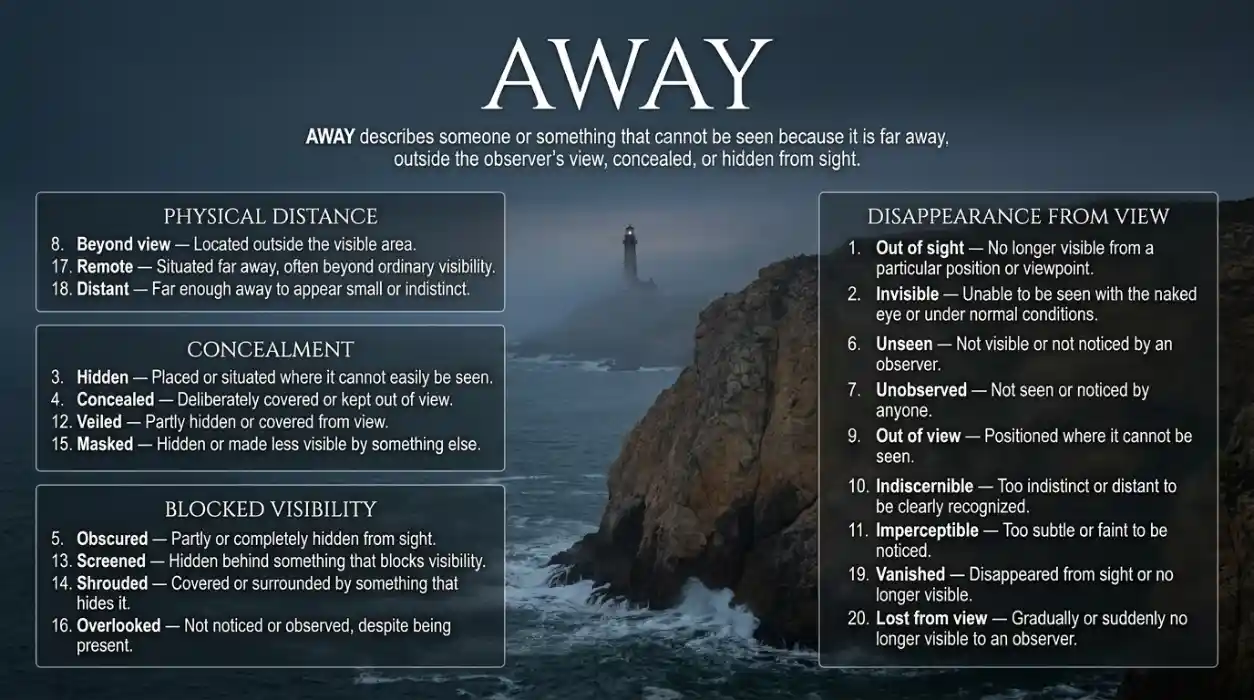
- Root: Away (historically related to way).
- Prefix: None in modern English.
- Suffix: None.
- Word formation: A lexicalized adverb developed from an older prepositional expression.
Away is not normally formed by adding a productive English prefix or suffix.
Synonyms List
The following alternatives cover the main meanings of away. Some describe physical distance, while others express absence, departure, separation, or removal.
Important vocabulary note: These words are not interchangeable in every sentence. Always consider the context before replacing away with another expression.
1. Absent (Adjective) — US /ˈæb.sənt/ | UK /ˈæb.sənt/
Meaning: Not present in a particular place or situation.
Tone/Register: Neutral, formal, academic.
Examples:
The teacher is absent today.
Three students were absent from the meeting.
2. Elsewhere (Adverb) — US /ˈels.wer/ | UK /ˌelsˈweər/
Meaning: In, at, or toward another place.
Tone/Register: Neutral, formal, written.
Examples:
Let’s find a quieter place elsewhere.
My parents are staying elsewhere tonight.
3. Distant (Adjective) — US /ˈdɪs.tənt/ | UK /ˈdɪs.tənt/
Meaning: Far from a particular location or point of reference.
Tone/Register: Neutral, descriptive, academic.
Examples:
We could see distant mountains.
Her office is distant from the city center.
4. Far (Adverb/Adjective) — US /fɑːr/ | UK /fɑː/
Meaning: At or toward a considerable distance.
Tone/Register: Neutral, conversational.
Examples:
The supermarket isn’t far.
How far is your school from here?
5. Remote (Adjective) — US /rɪˈmoʊt/ | UK /rɪˈməʊt/
Meaning: Situated far from populated places or ordinary activity.
Tone/Register: Formal, descriptive, professional.
Examples:
They live in a remote village.
We explored a remote part of the island.
6. Off (Adverb) — US /ɔːf/ | UK /ɒf/
Meaning: Away from a particular place or position, often suggesting departure.
Tone/Register: Informal, conversational.
Examples:
The children ran off after lunch.
He drove off without saying goodbye.
7. Out (Adverb) — US /aʊt/ | UK /aʊt/
Meaning: Outside a particular place or no longer inside it.
Tone/Register: Neutral, informal.
Examples:
She stepped out for some fresh air.
My father is out at the moment.
8. Gone (Adjective) — US /ɡɔːn/ | UK /ɡɒn/
Meaning: No longer present in a particular place.
Tone/Register: Neutral, conversational.
Examples:
The guests are gone now.
My headache is finally gone.
9. Departed (Adjective/Verb) — US /dɪˈpɑːr.tɪd/ | UK /dɪˈpɑː.tɪd/
Meaning: Having left a particular place or location.
Tone/Register: Formal, professional.
Examples:
The departed passengers left their luggage behind.
Our train has already departed.
10. Faraway (Adjective/Adverb) — US /ˈfɑːr.əˌweɪ/ | UK /ˈfɑː.rəˌweɪ/
Meaning: Located at a great distance from the speaker or reference point.
Tone/Register: Descriptive, literary, conversational.
Examples:
She dreamed of visiting a faraway country.
A faraway island appeared on the horizon.
11. Far-off (Adjective) — US /ˌfɑːrˈɔːf/ | UK /ˌfɑːˈɒf/
Meaning: Situated a long distance away.
Tone/Register: Literary, descriptive.
Examples:
We heard music from a far-off village.
A far-off mountain looked beautiful.
12. Abroad (Adverb) — US /əˈbrɔːd/ | UK /əˈbrɔːd/
Meaning: In or to another country, especially one separated by an international border.
Tone/Register: Neutral, formal, conversational.
Examples:
My sister is studying abroad.
They moved abroad last year.
13. Overseas (Adverb/Adjective) — US /ˌoʊ.vɚˈsiːz/ | UK /ˌəʊ.vəˈsiːz/
Meaning: In or to a foreign country, particularly across the sea.
Tone/Register: Professional, neutral.
Examples:
Our relatives live overseas.
The company opened an overseas office.
14. Out of Town (Phrase) — US /ˌaʊt əv ˈtaʊn/ | UK /ˌaʊt əv ˈtaʊn/
Meaning: Temporarily away from one’s usual town or city.
Tone/Register: Informal, everyday English.
Examples:
I’m out of town this weekend.
Our manager is out of town for a conference.
15. Away from (Prepositional Phrase) — US /əˈweɪ frəm/ | UK /əˈweɪ frəm/
Meaning: At a distance from a particular person, place, or object.
Tone/Register: Neutral, everyday English.
Examples:
Please keep away from the edge.
The hotel is away from the main road.
16. Apart (Adverb/Adjective) — US /əˈpɑːrt/ | UK /əˈpɑːt/
Meaning: Separated by space, distance, or difference.
Tone/Register: Neutral, descriptive.
Examples:
Their houses are several miles apart.
The two friends spent a year apart.
17. Aside (Adverb) — US /əˈsaɪd/ | UK /əˈsaɪd/
Meaning: To or toward one side, usually to create space or separation.
Tone/Register: Neutral, conversational.
Examples:
She moved aside to let me pass.
Put your worries aside for a moment.
18. Separate (Adjective/Verb) — US /ˈsep.ər.ət/ | UK /ˈsep.ər.ət/
Meaning: Kept apart from another person or thing.
Tone/Register: Neutral, formal, academic.
Examples:
We sat at separate tables.
Keep the clean clothes separate from the dirty ones.
19. Removed (Adjective) — US /rɪˈmuːvd/ | UK /rɪˈmuːvd/
Meaning: Located at a distance or separated from something.
Tone/Register: Formal, descriptive.
Examples:
The village is far removed from the capital.
The two events were several years removed from each other.
20. Withdrawn (Adjective) — US /wɪðˈdrɔːn/ | UK /wɪðˈdrɔːn/
Meaning: Having moved back or been taken away from a situation.
Tone/Register: Formal, professional.
Examples:
The candidate has withdrawn from the competition.
He became withdrawn after the argument.

21. Detached (Adjective) — US /dɪˈtætʃt/ | UK /dɪˈtætʃt/
Meaning: Physically or emotionally separated from something.
Tone/Register: Formal, descriptive.
Examples:
The garage is detached from the house.
She sounded detached during the conversation.
22. Isolated (Adjective) — US /ˈaɪ.səˌleɪ.tɪd/ | UK /ˈaɪ.sə.leɪ.tɪd/
Meaning: Separated from other people or places.
Tone/Register: Neutral, academic, descriptive.
Examples:
They stayed in an isolated cabin.
The village is isolated during winter.
23. Secluded (Adjective) — US /sɪˈkluː.dɪd/ | UK /sɪˈkluː.dɪd/
Meaning: Located away from crowds, noise, or public attention.
Tone/Register: Descriptive, slightly literary.
Examples:
We found a secluded beach.
They booked a secluded cottage for their holiday.
24. Missing (Adjective) — US /ˈmɪs.ɪŋ/ | UK /ˈmɪs.ɪŋ/
Meaning: Not present where someone or something is expected.
Tone/Register: Neutral, sometimes serious.
Examples:
One document is missing from the folder.
The child has been missing since yesterday.
25. Vanished (Verb) — US /ˈvæn.ɪʃt/ | UK /ˈvæn.ɪʃt/
Meaning: Disappeared suddenly or completely.
Tone/Register: Descriptive, dramatic, literary.
Examples:
The rainbow vanished after the rain.
My phone mysteriously vanished from the table.
26. Disappeared (Verb) — US /ˌdɪs.əˈpɪrd/ | UK /ˌdɪs.əˈpɪəd/
Meaning: Became impossible to see or find.
Tone/Register: Neutral, descriptive.
Examples:
The clouds disappeared by noon.
The old building disappeared from the skyline.
27. Depart (Verb) — US /dɪˈpɑːrt/ | UK /dɪˈpɑːt/
Meaning: To leave a place or begin a journey.
Tone/Register: Formal, professional.
Examples:
Our flight will depart at six.
Please depart through the main entrance.
28. Leave (Verb) — US /liːv/ | UK /liːv/
Meaning: To go away from a place or person.
Tone/Register: Neutral, everyday English.
Examples:
I need to leave before sunset.
She left the office early yesterday.
29. Exit (Verb/Noun) — US /ˈeɡ.zɪt/ | UK /ˈeɡ.zɪt/
Meaning: To go out of or leave a particular place.
Tone/Register: Formal, instructional.
Examples:
Please exit the building calmly.
We used the rear exit.
30. Retreat (Verb/Noun) — US /rɪˈtriːt/ | UK /rɪˈtriːt/
Meaning: To move backward or away from a difficult or dangerous situation.
Tone/Register: Formal, descriptive.
Examples:
The hikers retreated before the storm.
The soldiers moved back toward safety.
31. Escape (Verb/Noun) — US /ɪˈskeɪp/ | UK /ɪˈskeɪp/
Meaning: To get away from danger, confinement, or an unpleasant situation.
Tone/Register: Neutral, dramatic.
Examples:
The dog escaped through the open gate.
She wanted to escape the city’s noise.
32. Flee (Verb) — US /fliː/ | UK /fliː/
Meaning: To run away from danger or an unpleasant situation.
Tone/Register: Formal, dramatic, journalistic.
Examples:
Residents fled the area after the warning.
The family fled the conflict.
33. Head Off (Phrasal Verb) — US /ˌhed ˈɔːf/ | UK /ˌhed ˈɒf/
Meaning: To leave and travel toward a particular destination.
Tone/Register: Informal, conversational.
Examples:
We should head off before traffic gets worse.
They headed off toward the beach.
34. Take Off (Phrasal Verb) — US /ˌteɪk ˈɔːf/ | UK /ˌteɪk ˈɒf/
Meaning: To leave suddenly or begin moving, especially by aircraft.
Tone/Register: Informal, everyday English.
Examples:
The plane will take off shortly.
He took off without telling anyone.
35. Set Off (Phrasal Verb) — US /ˌset ˈɔːf/ | UK /ˌset ˈɒf/
Meaning: To begin a journey or travel away from a starting point.
Tone/Register: Neutral, conversational.
Examples:
We set off early in the morning.
The cyclists set off together.
36. Move Away (Phrasal Verb) — US /ˌmuːv əˈweɪ/ | UK /ˌmuːv əˈweɪ/
Meaning: To change location by going farther from a particular place.
Tone/Register: Neutral, conversational.
Examples:
My best friend will move away next month.
Please move away from the door.
37. Clear Out (Phrasal Verb) — US /ˌklɪr ˈaʊt/ | UK /ˌklɪə ˈaʊt/
Meaning: To leave a place or remove unwanted things from it.
Tone/Register: Informal.
Examples:
We need to clear out before the building closes.
They cleared out the old storage room.
38. Get Away (Phrasal Verb) — US /ˌɡet əˈweɪ/ | UK /ˌɡet əˈweɪ/
Meaning: To escape, leave, or take a break from an ordinary environment.
Tone/Register: Informal, conversational.
Examples:
We hope to get away this summer.
The thief managed to get away.
39. Move On (Phrasal Verb) — US /ˌmuːv ˈɑːn/ | UK /ˌmuːv ˈɒn/
Meaning: To leave a situation or continue after something has ended.
Tone/Register: Neutral, informal.
Examples:
It’s time to move on from the argument.
The audience moved on to the next activity.
40. Recede (Verb) — US /rɪˈsiːd/ | UK /rɪˈsiːd/
Meaning: To move gradually farther away or become less noticeable.
Tone/Register: Formal, descriptive.
Examples:
The floodwater began to recede.
The sound of the train slowly receded.

41. Fade (Verb) — US /feɪd/ | UK /feɪd/
Meaning: To gradually become weaker, less visible, or less noticeable.
Tone/Register: Neutral, literary.
Examples:
The music began to fade.
Her memories of that summer slowly faded.
42. Dwindle (Verb) — US /ˈdwɪn.dəl/ | UK /ˈdwɪn.dəl/
Meaning: To gradually become smaller or fewer.
Tone/Register: Neutral, formal.
Examples:
Our supplies began to dwindle.
The crowd dwindled after the concert.
43. Dissipate (Verb) — US /ˈdɪs.əˌpeɪt/ | UK /ˈdɪs.ɪ.peɪt/
Meaning: To gradually disappear or spread until something is no longer concentrated.
Tone/Register: Formal, academic.
Examples:
The morning fog began to dissipate.
Her nervousness gradually disappeared.
44. Vanish (Verb) — US /ˈvæn.ɪʃ/ | UK /ˈvæn.ɪʃ/
Meaning: To disappear completely or suddenly.
Tone/Register: Neutral, dramatic.
Examples:
The magician made the coin vanish.
My excitement vanished after the announcement.
45. Clear (Adjective/Verb) — US /klɪr/ | UK /klɪə/
Meaning: Free from obstruction or something unwanted; in certain expressions, it can mean moving away from danger or an obstacle.
Tone/Register: Neutral, instructional.
Examples:
Keep clear of the moving machinery.
The road is finally clear.
46. Beyond (Preposition/Adverb) — US /bɪˈjɑːnd/ | UK /bɪˈjɒnd/
Meaning: At or on the farther side of a particular point or limit.
Tone/Register: Neutral, formal, descriptive.
Examples:
The village lies beyond the hills.
The truth was beyond our understanding.
47. Afar (Adverb) — US /əˈfɑːr/ | UK /əˈfɑː/
Meaning: At or from a considerable distance.
Tone/Register: Literary, poetic.
Examples:
We could see the lighthouse from afar.
A familiar voice called from afar.
48. Out of Reach (Phrase) — US /ˌaʊt əv ˈriːtʃ/ | UK /ˌaʊt əv ˈriːtʃ/
Meaning: Too far away to be touched, obtained, or accessed.
Tone/Register: Neutral, conversational.
Examples:
Keep the medicine out of reach of children.
Her dream seemed out of reach.
49. At a Distance (Phrase) — US /ət ə ˈdɪs.təns/ | UK /ət ə ˈdɪs.təns/
Meaning: Separated from something by a measurable or noticeable space.
Tone/Register: Neutral, formal.
Examples:
We watched the fireworks at a distance.
Please stand at a safe distance.
50. Out of Sight (Phrase) — US /ˌaʊt əv ˈsaɪt/ | UK /ˌaʊt əv ˈsaɪt/
Meaning: No longer visible because something is too far away or hidden.
Tone/Register: Neutral, conversational.
Examples:
The ship disappeared out of sight.
Keep your personal documents out of sight.
Synonyms by Tone
The emotional tone of a synonym can change how a sentence feels. Choose an alternative that matches your situation.
Positive Synonyms
These expressions can suggest freedom, relaxation, or a welcome change:
- Escape
- Get away
- Secluded
- Abroad
- Faraway
Example: We decided to get away for a peaceful weekend.
Neutral Synonyms
These words communicate distance or absence without adding strong emotions:
- Absent
- Elsewhere
- Distant
- Far
- Remote
- Out
- Apart
- Separate
- Overseas
- Out of town
- Away from
- At a distance
Example: The nearest hospital is several miles away.
Negative Synonyms
These alternatives can suggest loss, separation, or an unwanted departure:
- Missing
- Vanished
- Disappeared
- Withdrawn
- Isolated
- Flee
- Retreat
- Gone
Example: Her closest friend moved away unexpectedly.
Playful and Informal Synonyms
These expressions are common in casual conversation:
- Off
- Out
- Head off
- Take off
- Set off
- Clear out
- Get away
- Move on
Example: Let’s head off before it gets too late.
“Away” vs. Close Alternatives
Some words appear similar but communicate different meanings. Understanding these distinctions helps you sound more natural.
| Word | Main difference | Example |
|---|---|---|
| Away | General distance or absence | She is away today. |
| Absent | Specifically not present | She is absent from class. |
| Elsewhere | In another location | She is staying elsewhere. |
| Far | A considerable distance | The station is far. |
| Gone | No longer present | The guests are gone. |
| Departed | Has left a location | The train has departed. |
When should you use each word?
- Use away for general distance or temporary absence.
- Use absent when someone is not present at an expected place.
- Use elsewhere when you mean another location.
- Use far when describing physical distance.
- Use gone when someone or something is no longer there.
- Use departed in more formal travel or professional contexts.
How “Away” Changes by Context
The best synonym depends on where and how you use the word. A suitable alternative in conversation may sound unusual in academic writing.
1. Daily Conversation
In everyday speech, people frequently use away, out, gone, and off. These expressions are simple and easy to understand.
For example:
- “I’m away this weekend.”
- “I’m out for lunch.”
- “My brother has gone to work.”
Use familiar expressions when speaking with friends, relatives, or colleagues.
2. Writing and Blogging
Writers often use elsewhere, distant, faraway, and secluded to make descriptions more engaging.
For example:
“Travelers often search for secluded destinations away from crowded tourist attractions.”
Choosing different words prevents repetitive writing. It also helps readers understand the exact meaning of a sentence.
3. Professional and Academic English
Professional writing generally benefits from precise vocabulary.
Consider these alternatives:
- Absent from a meeting
- Departed from the office
- Located at a distance
- Temporarily unavailable
- Removed from the original position
For example:
“The director is temporarily unavailable and will respond tomorrow.”
This sounds more appropriate in a professional email than an unnecessarily casual expression.
4. Creative and Informal English
Stories, poems, and casual conversations allow more expressive vocabulary.
Words such as afar, vanished, faraway, and receded can create stronger imagery.
For example:
“The distant lights slowly vanished into the darkness.”
Such expressions help readers imagine a scene instead of simply receiving information.
Common Mistakes Learners Make
Even advanced English learners sometimes choose an incorrect synonym because they focus on dictionary meanings rather than sentence context.
Here are some mistakes to avoid.
1. Using “absent” for every meaning of away
Incorrect: The supermarket is absent from my house.
Better: The supermarket is far from my house.
Absent generally describes someone or something that is not present where expected.
2. Confusing “gone” with “departed”
Both can describe leaving, but they have different grammatical uses.
Natural: My friends are gone.
Natural: The train has departed.
3. Using “abroad” for every distant location
Abroad normally refers to another country. It does not simply mean somewhere far away.
4. Treating “off” and “away” as identical
You can say “The dog ran away” or “The dog ran off.”
However, off does not replace away in every expression.
5. Overusing synonyms
Replacing every occurrence of away can make writing sound unnatural. Sometimes the original word is the clearest choice.
Native Usage: Formal vs. Informal
Native English speakers select vocabulary according to the situation.
| Situation | Natural expression |
|---|---|
| Casual conversation | I’m out. |
| Workplace email | I am currently unavailable. |
| Academic writing | The subjects were absent. |
| Travel discussion | We are going abroad. |
| Creative writing | The village lies afar. |
| Everyday directions | The station is far away. |
Register note: Spoken English commonly uses short expressions such as out, off, and gone. Written English may use absent, elsewhere, distant, and departed when greater precision is needed.
For additional vocabulary practice, you can explore related topics such as synonyms for near, distant, and far in a broader English vocabulary guide.
Real-Life Mini Scenarios
Here are four practical situations showing how different alternatives work in real communication.
Workplace Scenario
Your colleague asks why the manager is not responding.
You can say:
“The manager is absent today.”
Or:
“She is currently out of the office.”
Both expressions communicate that the manager is not available.
Social Situation
Your friend asks where your family is spending the weekend.
You can answer:
“They are away on vacation.”
Or:
“They have gone abroad for a few days.”
The second sentence provides more information about their destination.
Media and Pop Culture
Imagine a movie scene where a character leaves a dangerous situation.
The narrator might say:
“He escaped before the building collapsed.”
Alternatively:
“He fled the area before the building collapsed.”
The word fled creates a stronger sense of urgency.
Writing and Storytelling
A travel blogger wants to describe a peaceful destination.
Instead of writing:
“We found a quiet place away from the city.”
The blogger could write:
“We discovered a secluded retreat beyond the busy city streets.”
The alternative creates a more vivid picture for readers.
Practice Exercise
1. Your teacher is not present in class today. Which word fits best?
A. Distant
B. Absent
C. Afar
D. Beyond
2. Your family is staying in another country. Which expression is correct?
A. Apart
B. Aside
C. Abroad
D. Off
3. The supermarket is five miles from your home. Which word describes its location?
A. Far
B. Missing
C. Gone
D. Withdrawn
4. You want to tell a friend that you are leaving for the airport. Which phrase sounds natural?
A. Head off
B. Dwindle
C. Dissipate
D. Absent
5. A train has already left the station. Which word is most appropriate?
A. Secluded
B. Departed
C. Separate
D. Elsewhere
6. You want to describe a quiet beach with very few visitors. Which word fits?
A. Missing
B. Secluded
C. Gone
D. Off
7. A person runs away from immediate danger. Which verb is strongest?
A. Flee
B. Dwindle
C. Fade
D. Recede
8. Your friend is temporarily not at home. Which expression is most natural?
A. Out
B. Afar
C. Removed
D. Beyond
9. You cannot see a ship because it has moved beyond the horizon. Which phrase fits?
A. Out of sight
B. Out of town
C. Out of reach
D. Apart
10. The morning fog slowly disappears. Which verb is suitable?
A. Depart
B. Dissipate
C. Escape
D. Withdraw
Answer Key
1-B | 2-C | 3-A | 4-A | 5-B | 6-B | 7-A | 8-A | 9-A | 10-B | 11-B | 12-A
Short Reflection Task
Write one original sentence using any three synonyms from this article.
For example:
“My sister moved abroad, while my best friend stayed in a secluded village.”
Try using your sentences in an email, journal entry, or everyday conversation. This helps you remember vocabulary through practical application.
Reference sources for further vocabulary research:
- Merriam-Webster Dictionary – Away
- Oxford English Dictionary – Historical Word Origins
- Cambridge Dictionary – Away
Conclusion
Learning a synonym for away gives you more ways to express distance, absence, movement, and separation. Small vocabulary improvements can make everyday English clearer and more natural.
Different alternatives serve different purposes. Words such as absent, elsewhere, distant, and departed help you communicate with greater accuracy in various situations.
For students, bloggers, and content writers, learning synonyms improves vocabulary, writing quality, and communication. It also makes essays, articles, and conversations more engaging.
Start practicing these alternatives in your emails, essays, and daily conversations. Choose one new word each day and create your own sentences to build lasting confidence.
FAQs
1. What is the best synonym for away in everyday English?
The best everyday alternatives include out, gone, elsewhere, and far. Your choice depends on the sentence. For example, “I am away” can mean “I am out” when discussing temporary absence. However, “The school is far away” describes physical distance. Always consider the intended meaning before choosing a replacement.
2. What is a formal synonym for away in professional writing?
Formal alternatives include absent, unavailable, departed, distant, and elsewhere. For example, instead of writing “The manager is away,” you could write “The manager is currently unavailable.” Use absent when discussing attendance and departed when describing someone who has left a location.
3. What is the opposite of away?
The most common opposite of away is here or near, depending on the context. If someone is away from home, they may be home when they return. If something is far away, it may be nearby. Other possible opposites include present, close, and here.
4. What is another word for far away in descriptive writing?
Useful alternatives include distant, remote, faraway, far-off, and afar. These words help writers describe locations, landscapes, and people more vividly. For example, “A faraway island appeared on the horizon” creates a descriptive image without repeating the phrase “far away.”
5. Can away and absent be used interchangeably?
Sometimes, but not always. Both words can describe someone’s absence from a location. However, absent usually refers to someone not being present where expected. Away has broader meanings, including physical distance, departure, and removal. Therefore, “She is absent from class” is more specific than “She is away.”

Hasnain Ali is an SEO Content Strategist and the founder of wordvora.com, a trusted vocabulary platform that helps writers, students, professionals, and English learners find accurate synonyms, antonyms, word meanings, and real-life usage examples. He specializes in keyword research, on-page SEO, topical authority, and creating search-first content that aligns with Google’s latest Search Quality and E-E-A-T guidelines. His work focuses on producing clear, well-structured, and reader-friendly resources that satisfy search intent while maintaining high editorial standards.
Through extensive hands-on experience with SEO tools such as Google Search Console, Google Analytics, SEMrush, and Ahrefs, Hasnain researches user search behavior and develops content that is both informative and easy to understand. Every article published on wordvora.com is carefully reviewed for accuracy, readability, and contextual relevance before publication. His mission is to build one of the web’s most reliable English vocabulary resources by providing practical language guidance, trustworthy explanations, and content that helps readers improve their writing, communication, and vocabulary with confidence.