
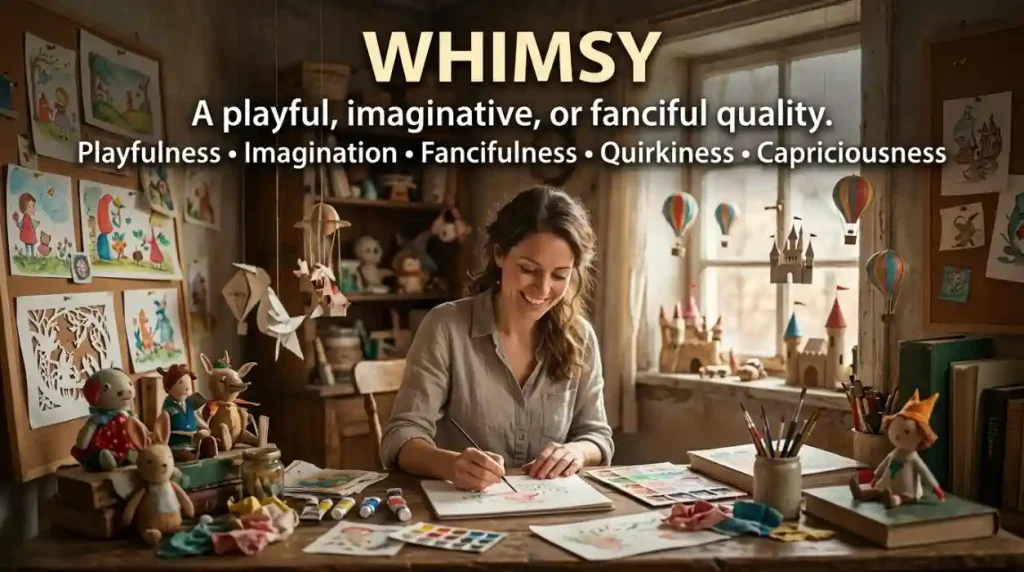
synonym for whimsy usually means a word that expresses playful, fanciful, unusual, or unpredictable thinking or behavior. Depending on context, close choices include caprice, fancy, quirk, playfulness, eccentricity, and fancifulness.
synonym for whimsy can make ordinary writing more colorful. Imagine a blogger describing a café with tiny moon-shaped lamps. Calling the design “whimsical” instantly suggests something playful and charming.
A good synonym for whimsy adds precision. “Fanciful” highlights imagination, while “quirky” emphasizes unusual character. The best choice depends on the feeling you want.
Students can use these alternatives to strengthen essays. Bloggers and content writers can avoid repetition. Daily English users can also sound more natural and expressive.
Learning a synonym for whimsy is useful because “whimsy” appears in reviews, storytelling, design, films, fashion, humor, and everyday descriptions. Its meaning can shift with context.
What Does “Whimsy” Really Mean?
Whimsy is a noun that describes something playful, fanciful, unusual, or driven by a sudden and often unexplained idea.
In simple English, whimsy means playful or imaginative oddness.
For example:
The garden has a touch of whimsy.
This suggests that the garden contains charming, unusual, or imaginative details.
Another example is:
Her stories are full of whimsy.
Here, whimsy suggests imaginative, playful, and slightly unusual qualities.
Cambridge defines whimsy as unusual, funny, and pleasant ideas or qualities. It also records a US sense referring to a sudden wish or idea that may not have a reasonable explanation.
Collins similarly describes whimsy as unusual, playful, and unpredictable behavior without a serious practical purpose.
Part of Speech
Whimsy is primarily a noun.
It can describe:
- a playful quality
- a fanciful idea
- an unusual artistic feature
- a capricious notion
- charmingly strange humor
The related adjective is whimsical.
For example:
The story has plenty of whimsy.
The story has a whimsical style.
How Native Speakers Understand “Whimsy”
Native speakers usually hear whimsy as more positive than words such as strangeness or absurdity.
It often suggests creativity, charm, imagination, and light humor.
However, context can make it mildly negative. A person may call something “whimsy” when they think it is silly, impractical, or unnecessarily strange.
That distinction matters when choosing a synonym.
Connotative Meaning of Whimsy
Connotation (the emotional or cultural feeling associated with a word beyond its basic dictionary meaning) helps explain why synonyms are not always interchangeable.
Positive Tone
In positive contexts, whimsy suggests:
- charm
- imagination
- creativity
- light humor
- playfulness
- delightful unusualness
Example:
The illustrator added whimsy to the children’s book.
Negative Tone
In negative contexts, whimsy can suggest:
- impracticality
- pointless oddness
- excessive silliness
- unpredictability
Example:
The committee cannot make decisions based on whimsy alone.
Neutral Tone
In neutral contexts, whimsy simply describes an unusual or fanciful quality.
Example:
The designer is known for adding whimsy to traditional furniture.
The surrounding words usually tell readers whether the quality is charming or excessive.
Etymology
Whimsy entered English around the late 16th or early 17th century. Etymonline dates the noun to about 1600 and describes it as meaning “capricious notion or fancy.” Its origin is probably connected with whimwham, an older word for a fanciful object, trifle, plaything, or curious device. The deeper origin of whimwham remains uncertain.
Old English: 450–1100
There is no established Old English form of “whimsy.” The modern word had not yet entered English.
Therefore, it would be inaccurate to invent an Old English origin for the word.
Middle English: 1100–1500
There is also no established Middle English form of “whimsy.” The documented history becomes clearer in the early modern period.
A possible precursor is whimwham, recorded before whimsy and referring to a fanciful object or trifle.
Modern English: 1500–Present
By around 1600, whimsy referred to a capricious notion or fancy. Its meaning later developed toward fanciful humor, playful oddness, and unusual artistic expression.
Today, the word is especially common in descriptions of art, design, literature, films, fashion, humor, and personality.
Pronunciation
US: /ˈhwɪmzi/ or /ˈwɪmzi/
UK: /ˈwɪmzi/
Cambridge gives /ˈwɪm.zi/ for both British and American English, while Collins records the common American pronunciation with an initial /hw/ variant.
Syllables
whim-sy
Affixation Pattern of “Whimsy”
Root/base: whim
Prefix: none
Suffix: -sy
The historical development is more complicated than a simple modern prefix-plus-root construction. Dictionaries connect whimsy with whim and the older whimwham family.
Synonyms List
1. Caprice (Noun) — US /kəˈpriːs/; UK /kəˈpriːs/
Meaning: A sudden change of mind or an unpredictable idea or desire.
Tone/Register: Formal, literary.
Examples:
Her sudden decision to leave was a caprice.
The character acts according to every passing caprice.
2. Fancy (Noun) — US /ˈfænsi/; UK /ˈfænsi/
Meaning: An imaginative idea, liking, or desire that may be temporary.
Tone/Register: Neutral, literary.
Examples:
He had a fancy for brightly colored shoes.
The garden began as a simple fancy.
3. Whim (Noun) — US /wɪm/; UK /wɪm/
Meaning: A sudden desire or idea with little practical explanation.
Tone/Register: Neutral, everyday.
Examples:
We booked the trip on a whim.
Buying that tiny painting was a whim.
4. Fancifulness (Noun) — US /ˈfænsɪfəlnəs/; UK /ˈfænsɪfəlnəs/
Meaning: The quality of being imaginative, unrealistic, or playfully inventive.
Tone/Register: Neutral, descriptive.
Examples:
The novel is admired for its fancifulness.
Her designs have a gentle fancifulness.
5. Playfulness (Noun) — US /ˈpleɪfəlnəs/; UK /ˈpleɪfəlnəs/
Meaning: A light, fun-loving quality that often overlaps with positive whimsy.
Tone/Register: Neutral, positive.
Examples:
The logo has a sense of playfulness.
His playfulness made the lesson memorable.
6. Eccentricity (Noun) — US /ˌeksɛnˈtrɪsəti/; UK /ˌeksɛnˈtrɪsəti/
Meaning: Unusual behavior or personality that differs from conventional expectations.
Tone/Register: Neutral to mildly negative.
Examples:
Her eccentricity became part of her public image.
The house reflects his artistic eccentricity.
7. Quirk (Noun) — US /kwɜrk/; UK /kwɜːk/
Meaning: A small unusual habit, feature, or characteristic.
Tone/Register: Informal, neutral.
Examples:
One of his quirks is collecting old maps.
The app has a few charming quirks.
8. Peculiarity (Noun) — US /pɪˌkjuːliˈærəti/; UK /pɪˌkjuːliˈærəti/
Meaning: A quality or feature that is noticeably unusual.
Tone/Register: Formal, neutral.
Examples:
The building has several architectural peculiarities.
Her peculiarities make the character memorable.
9. Oddity (Noun) — US /ˈɑdəti/; UK /ˈɒdəti/
Meaning: A person, thing, or feature that seems unusual or strange.
Tone/Register: Neutral.
Examples:
The shop sells historical oddities.
That strange sculpture became a local oddity.
10. Quirkiness (Noun) — US /ˈkwɜrkɪnəs/; UK /ˈkwɜːkɪnəs/
Meaning: The quality of being attractively or noticeably unusual.
Tone/Register: Informal, positive.
Examples:
The café is famous for its quirkiness.
Her writing has a warm sense of quirkiness.
11. Fanciful (Adjective) — US /ˈfænsɪfəl/; UK /ˈfænsɪfəl/
Meaning: Imaginative and unusual, sometimes without practical limits.
Tone/Register: Neutral, literary.
Examples:
He created a fanciful world for the story.
The artist uses fanciful shapes.
12. Whimsical (Adjective) — US /ˈhwɪmzɪkəl/; UK /ˈwɪmzɪkəl/
Meaning: Playfully unusual, imaginative, or unpredictable.
Tone/Register: Neutral to positive.
Examples:
The hotel has a whimsical interior.
She wrote a whimsical children’s story.
13. Playful (Adjective) — US /ˈpleɪfəl/; UK /ˈpleɪfəl/
Meaning: Light-hearted, fun, and not overly serious.
Tone/Register: Neutral, everyday.
Examples:
The campaign uses a playful tone.
His playful joke relaxed the room.
14. Eccentric (Adjective) — US /ɪkˈsɛntrɪk/; UK /ɪkˈsɛntrɪk/
Meaning: Unconventional in behavior, appearance, or ideas.
Tone/Register: Neutral to informal.
Examples:
She has an eccentric fashion sense.
His eccentric ideas attracted attention.
15. Capricious (Adjective) — US /kəˈprɪʃəs/; UK /kəˈprɪʃəs/
Meaning: Likely to change suddenly and unpredictably.
Tone/Register: Formal.
Examples:
The weather is famously capricious here.
His capricious decisions confused the team.
16. Quirky (Adjective) — US /ˈkwɜrki/; UK /ˈkwɜːki/
Meaning: Unusually different, interestingly or amusingly.
Tone/Register: Informal, positive.
Examples:
She owns a quirky little bookstore.
The film has a quirky sense of humor.
17. Quaint (Adjective) — US /kweɪnt/; UK /kweɪnt/
Meaning: Attractively old-fashioned, unusual, or charming.
Tone/Register: Neutral, descriptive.
Examples:
We stayed in a quaint village.
The room has a quaint charm.
18. Droll (Adjective) — US /droʊl/; UK /drəʊl/
Meaning: Amusing in an unusual, dry, or understated way.
Tone/Register: Literary, somewhat old-fashioned.
Examples:
His droll comments made everyone laugh.
The story has a droll sense of humor.
19. Mischievous (Adjective) — US /ˈmɪstʃəvəs/; UK /ˈmɪstʃɪvəs/
Meaning: Playfully troublesome or inclined to cause harmless trouble.
Tone/Register: Neutral, informal.
Examples:
The child gave a mischievous grin.
Her mischievous humor kept the conversation lively.
20. Fantastical (Adjective) — US /fænˈtæstɪkəl/; UK /fænˈtæstɪkəl/
Meaning: Highly imaginative and seemingly unreal.
Tone/Register: Literary, creative.
Examples:
The movie creates a fantastical universe.
He filled the book with fantastical creatures.

21. Odd (Adjective) — US /ɑd/; UK /ɒd/
Meaning: Different from what is normal or expected.
Tone/Register: Everyday, neutral.
Examples:
There is something odd about the painting.
She has an odd but charming habit.
22. Peculiar (Adjective) — US /pɪˈkjuːljər/; UK /pɪˈkjuːliə/
Meaning: Noticeably strange or unusual.
Tone/Register: Neutral to formal.
Examples:
The story has a peculiar charm.
He heard a peculiar sound outside.
23. Offbeat (Adjective) — US /ˈɔfbiːt/; UK /ˈɒfbiːt/
Meaning: Unconventional, unusual, or outside ordinary expectations.
Tone/Register: Informal.
Examples:
She enjoys offbeat comedy.
The restaurant has an offbeat atmosphere.
24. Unconventional (Adjective) — US /ˌʌnkənˈvɛnʃənəl/; UK /ˌʌnkənˈvenʃənəl/
Meaning: Different from customary or traditional practice.
Tone/Register: Formal, professional.
Examples:
He chose an unconventional design.
Her unconventional approach worked well.
25. Imaginative (Adjective) — US /ɪˈmædʒənətɪv/; UK /ɪˈmædʒɪnətɪv/
Meaning: Showing creativity and the ability to form original ideas.
Tone/Register: Neutral, positive.
Examples:
The teacher uses imaginative activities.
Her imaginative writing feels fresh.
26. Inventive (Adjective) — US /ɪnˈvɛntɪv/; UK /ɪnˈventɪv/
Meaning: Skilled at creating new or original ideas.
Tone/Register: Neutral, positive.
Examples:
The designer found an inventive solution.
His inventive stories surprise readers.
27. Creative (Adjective) — US /kriˈeɪtɪv/; UK /kriˈeɪtɪv/
Meaning: Involving original ideas or artistic imagination.
Tone/Register: Neutral, widely used.
Examples:
The campaign has a creative concept.
She takes a creative approach to teaching.
28. Playfulness (Noun) — US /ˈpleɪfəlnəs/; UK /ˈpleɪfəlnəs/
Meaning: A cheerful quality involving fun, humor, or lightness.
Tone/Register: Neutral.
Examples:
The poem gains energy from its playfulness.
Her playfulness makes difficult topics easier.
29. Frolic (Noun) — US /ˈfrɑlɪk/; UK /ˈfrɒlɪk/
Meaning: Energetic, carefree play or movement.
Tone/Register: Literary, playful.
Examples:
The puppies ran in a joyful frolic.
The story ends with a seaside frolic.
30. Merriment (Noun) — US /ˈmerimənt/; UK /ˈmerimənt/
Meaning: Cheerful enjoyment, laughter, and fun.
Tone/Register: Literary.
Examples:
The room was filled with merriment.
Their songs brought merriment to the celebration.
31. Jest (Noun) — US /dʒɛst/; UK /dʒest/
Meaning: A joke or playful remark.
Tone/Register: Literary, formal.
Examples:
He commented in jest.
Her jest lightened the mood.
32. Jape (Noun) — US /dʒeɪp/; UK /dʒeɪp/
Meaning: A playful joke or practical trick.
Tone/Register: Literary, old-fashioned.
Examples:
The prank was intended as a harmless jape.
His latest jape amused the audience.
33. Jocularity (Noun) — US /ˌdʒɑkəˈlærəti/; UK /ˌdʒɒkjʊˈlærəti/
Meaning: A cheerful tendency toward joking or humorous behavior.
Tone/Register: Formal, literary.
Examples:
His jocularity changed the mood of the meeting.
The speech was marked by gentle jocularity.
34. Waggishness (Noun) — US /ˈwæɡɪʃnəs/; UK /ˈwæɡɪʃnəs/
Meaning: Playful humor, especially humor involving teasing or jokes.
Tone/Register: Literary, old-fashioned.
Examples:
His waggishness was obvious during the interview.
The character is remembered for his waggishness.
35. Humor (Noun) — US /ˈhjuːmər/; UK /ˈhjuːmə/
Meaning: The quality of being amusing or expressing amusement.
Tone/Register: Neutral.
Examples:
The design has a gentle sense of humor.
Her humor makes the article more approachable.
36. Amusement (Noun) — US /əˈmjuːzmənt/; UK /əˈmjuːzmənt/
Meaning: Pleasure or entertainment caused by something funny or enjoyable.
Tone/Register: Neutral.
Examples:
The unusual sign provided some amusement.
He watched the scene with amusement.
37. Comical (Adjective) — US /ˈkɑmɪkəl/; UK /ˈkɒmɪkəl/
Meaning: Funny because something is unusual, ridiculous, or amusing.
Tone/Register: Neutral.
Examples:
The character has a comical appearance.
His reaction was unexpectedly comical.
38. Drollness (Noun) — US /ˈdroʊlnəs/; UK /ˈdrəʊlnəs/
Meaning: The quality of being oddly or dryly amusing.
Tone/Register: Literary.
Examples:
The film succeeds through quiet drollness.
Her drollness adds depth to the dialogue.
39. Freakishness (Noun) — US /ˈfriːkɪʃnəs/; UK /ˈfriːkɪʃnəs/
Meaning: A quality of being unusually strange or extraordinary.
Tone/Register: Informal, potentially negative.
Examples:
The sculpture has a deliberate freakishness.
The character’s freakishness unsettles the audience.
40. Chimerical (Adjective) — US /kaɪˈmerɪkəl/; UK /kaɪˈmɪərɪkəl/
Meaning: Imaginative or dreamlike, often in a way that seems unrealistic.
Tone/Register: Formal, literary.
Examples:
His chimerical plan never reached reality.
The poem describes a chimerical landscape.
41. Visionary (Adjective) — US /ˈvɪʒəneri/; UK /ˈvɪʒənəri/
Meaning: Showing imaginative ideas about a possible future.
Tone/Register: Formal, positive.
Examples:
The architect proposed a visionary design.
Her visionary ideas changed the project.
42. Fantastic (Adjective) — US /fænˈtæstɪk/; UK /fænˈtæstɪk/
Meaning: Highly imaginative or extraordinary; context determines whether it means unrealistic or excellent.
Tone/Register: Neutral, informal.
Examples:
The children’s book has fantastic creatures.
The artist created a fantastic landscape.
43. Bizarre (Adjective) — US /bɪˈzɑr/; UK /bɪˈzɑː/
Meaning: Very strange or unusual in a way that attracts attention.
Tone/Register: Neutral to negative.
Examples:
The film contains several bizarre scenes.
He wore a bizarre but memorable costume.
44. Strange (Adjective) — US /streɪndʒ/; UK /streɪndʒ/
Meaning: Unusual or unfamiliar compared with what is expected.
Tone/Register: Everyday, neutral.
Examples:
The story takes a strange turn.
She has a strange sense of humor.
45. Unexpected (Adjective) — US /ˌʌnɪkˈspɛktɪd/; UK /ˌʌnɪkˈspektɪd/
Meaning: Different from what someone anticipated.
Tone/Register: Neutral.
Examples:
The ending has an unexpected twist.
His unexpected joke made everyone smile.
46. Unpredictability (Noun) — US /ˌʌnprɪˌdɪktəˈbɪləti/; UK /ˌʌnprɪˌdɪktəˈbɪləti/
Meaning: The quality of being difficult to anticipate.
Tone/Register: Formal, neutral.
Examples:
The character’s unpredictability keeps readers interested.
Weather adds unpredictability to the event.
47. Vagary (Noun) — US /ˈveɪɡəri/; UK /ˈveɪɡəri/
Meaning: An unpredictable idea, action, or change.
Tone/Register: Formal, literary.
Examples:
We cannot plan around every vagary of the market.
His latest decision was another vagary.
48. Idiosyncrasy (Noun) — US /ˌɪdiəˈsɪŋkrəsi/; UK /ˌɪdiəˈsɪŋkrəsi/
Meaning: A distinctive personal habit or characteristic.
Tone/Register: Formal, academic.
Examples:
One idiosyncrasy of hers is writing with purple ink.
The character’s idiosyncrasies make him memorable.
49. Frolicsome (Adjective) — US /ˈfrɑlɪksəm/; UK /ˈfrɒlɪksəm/
Meaning: Full of lively, carefree playfulness.
Tone/Register: Literary, playful.
Examples:
The poem has a frolicsome rhythm.
The children created a frolicsome atmosphere.
50. Off-the-wall (Adjective) — US /ˌɔf ðə ˈwɔl/; UK /ˌɒf ðə ˈwɔːl/
Meaning: Extremely unconventional, surprising, or eccentric.
Tone/Register: Informal.
Examples:
The comedian has an off-the-wall style.
She suggested an off-the-wall idea.
Synonyms by Tone
Positive
Use these when you want to emphasize charm, creativity, imagination, or lightness:
playfulness, quirkiness, fancifulness, imaginative, inventive, creative, whimsical, whimsicality, quaint, frolicsome, visionary
These words usually make the unusual quality sound appealing.
Neutral
These work when you want to describe unusual or unpredictable qualities without strongly praising or criticizing them:
fancy, whim, peculiarity, oddity, quirk, unusual, strange, unexpected, eccentricity, idiosyncrasy
Negative or Critical
These words can imply that the unusual quality has gone too far or lacks practicality:
capricious, bizarre, freakishness, chimerical, vagary, unpredictability
The context still matters. A word such as bizarre can be humorous, admiring, or critical depending on the sentence.
Playful or Informal
For casual writing and conversation, consider:
quirky, offbeat, playful, off-the-wall, mischievous, odd, whim, fancy
Tone matters because the wrong synonym can change the emotional message.
Calling a children’s illustration whimsical sounds warm.
Calling the same illustration bizarre sounds much more critical.
“Whimsy” vs Close Alternatives
Whim vs. Whimsy
Whimsy often describes a quality of playful or fanciful unusualness.
Whim usually describes a particular sudden desire or decision.
Use whimsy for an atmosphere, style, or quality:
The movie is full of whimsy.
Use whim for a sudden personal choice:
I bought the ticket on a whim.
Whimsy vs. Quirk
A quirk is usually one unusual characteristic, habit, or feature.
Whimsy is broader and often includes imagination or playful charm.
Her habit of naming plants is a quirk.
Her entire garden is filled with whimsy.
Whimsy vs. Eccentricity
Eccentricity focuses on behavior or personality that differs from social norms.
Whimsy more often suggests playful imagination.
His eccentricity was obvious in his unusual clothes.
His paintings are filled with whimsy.
How “Whimsy” Changes by Context
Daily Conversation
In everyday English, whimsy often describes something charmingly unusual.
You might talk about a restaurant, gift, hairstyle, joke, or decoration.
I love the whimsy in this café.
For casual speech, quirky, playful, or fun may sound more natural.
Writing or Blogging
Writers often use whimsy when discussing design, books, movies, travel, fashion, or creative work.
It gives readers a quick sense of personality.
The author adds whimsy through talking animals and unexpected jokes.
A synonym such as fancifulness can sound more literary, while quirkiness feels more conversational.
Professional or Academic Tone
Professional writing often benefits from precision.
Instead of saying a business decision was “whimsical,” you might say it was capricious, unpredictable, or unconventional, depending on the evidence.
For design analysis, playful, inventive, or fanciful may be more precise.
Creative or Informal Use
Creative writing gives whimsy plenty of room.
The word can describe magical settings, unusual characters, humorous details, imaginative dialogue, and unexpected visual elements.
The old house seemed to have a little whimsy in every room.
Common Mistakes Learners Make
Mistake 1: Treating Every Synonym as Identical
Whimsy, whim, quirk, and caprice overlap, but they are not interchangeable in every sentence.
A whim is often a sudden desire.
A quirk is often a distinctive habit.
Whimsy usually describes a playful or fanciful quality.
Mistake 2: Assuming “Whimsy” Is Always Positive
It often has a positive feeling, but not always.
A reviewer might criticize a design for having “too much whimsy.”
The context can make the word mildly dismissive.
Mistake 3: Using “Bizarre” as a Perfect Replacement
Bizarre means very strange.
It does not automatically communicate charm or playfulness.
Therefore:
a whimsical children’s book
and
a bizarre children’s book
create very different impressions.
Mistake 4: Confusing “Whimsy” With “Whimsical”
Whimsy is a noun.
Whimsical is an adjective.
Correct:
The story has whimsy.
The story is whimsical.
Incorrect:
The story is whimsy.
Register Notes
Whimsy works well in both speech and writing, especially in cultural, creative, and descriptive contexts.
Some alternatives have narrower registers.
Formal: capricious, idiosyncratic, chimerical, vagary
Informal: quirky, offbeat, off-the-wall
Literary: droll, jape, waggishness, frolicsome
Everyday: odd, strange, playful, whim
For additional vocabulary practice, compare these words with related terms for humor, creativity, personality, and imagination.
Real-Life Mini Scenarios Using
Workplace
A creative director may describe a children’s campaign as having “a touch of whimsy.”
Here, the word suggests imagination without implying that the campaign lacks purpose.
Social Situation
Someone may say:
I like her sense of whimsy.
This usually means the person enjoys her playful, imaginative, slightly unusual personality.
Media and Pop Culture
A reviewer might describe a film as “full of whimsy.”
This usually points to unusual characters, imaginative visuals, playful humor, or surprising ideas.
Writing and Storytelling
An author can use whimsy to make a serious setting feel warmer.
A single funny detail, strange character, or imaginative image can add that quality without changing the entire tone.
How to Choose the Right Synonym for Whimsy
- Ask yourself what you actually want to communicate.
- If you mean creative imagination, choose fanciful, imaginative, or inventive.
- If you mean unusual personality, choose quirky, eccentric, or idiosyncratic.
- If you mean a sudden decision, choose whim, fancy, or caprice.
- If you mean playful humor, choose playfulness, jocularity, jest, or drollness.
- If you mean unpredictable behavior, choose capricious, unpredictable, or wayward.
- This approach is more useful than memorizing a long synonym list without context.

Practice Quiz
1. A designer adds funny, imaginative details to a children’s bedroom. Which word fits best?
A. Caprice
B. Whimsy
C. Vagary
D. Idiosyncrasy
2. You suddenly decide to buy a train ticket without planning it. Which word fits?
A. Whim
B. Quirkiness
C. Drollness
D. Eccentricity
3. A person always wears unusual combinations of clothing. Which word best describes this personal quality?
A. Merriment
B. Eccentricity
C. Jest
D. Fancy
4. A novelist creates an imaginative world with talking animals and impossible landscapes. Which word fits best?
A. Fanciful
B. Capricious
C. Peculiar
D. Unpredictable
5. A comedian uses unusual, unconventional humor. Which informal word could describe the style?
A. Offbeat
B. Formal
C. Ordinary
D. Conventional
6. A character’s decisions change suddenly for no clear reason. Which word is most precise?
A. Capricious
B. Quaint
C. Playful
D. Inventive
7. Someone has a small, unusual habit of arranging books by color. Which noun fits?
A. Quirk
B. Merriment
C. Jest
D. Frolic
8. A traditional village looks attractively old-fashioned. Which adjective fits?
A. Bizarre
B. Quaint
C. Capricious
D. Chimerical
9. A story contains dry, unusual humor. Which literary adjective fits?
A. Droll
B. Strange
C. Visionary
D. Creative
10. A filmmaker creates a magical world that seems almost unreal. Which word fits?
A. Fantastical
B. Conventional
C. Predictable
D. Formal
Reflection task:
Write one sentence about a person, place, story, film, or design using a synonym for whimsy. Then replace that synonym with a second choice and notice how the tone changes.
Answer key: 1-B, 2-A, 3-B, 4-A, 5-A, 6-A, 7-A, 8-B, 9-A, 10-A,
External reference sources:
Cambridge Dictionary — “whimsy” · Collins Dictionary — “whimsy” · Online Etymology Dictionary — “whimsy
Final Takeaway
Learning a synonym for whimsy is not about replacing one word with another. It is about choosing the exact shade of meaning your sentence needs.
Use playful for lightness, fanciful for imagination, quirky for unusual character, and capricious for unpredictability. Precision makes writing stronger.
These distinctions help students, bloggers, writers, and everyday speakers communicate with greater confidence. A richer vocabulary also makes descriptions feel more natural and expressive.
Start practicing today. Use two or three of these words in an email, essay, journal entry, or daily conversation, and notice how each one changes your meaning.
Frequently Asked Questions
1. What is the best synonym for whimsy in formal writing?
There is no single best synonym for every formal sentence. Caprice works when you mean an unpredictable desire or decision. Fancifulness suits imaginative ideas, while eccentricity describes unusual behavior. For academic writing, choose the word that identifies the specific quality you mean rather than replacing whimsy automatically.
2. What is a positive synonym for whimsy?
Good positive alternatives include playfulness, quirkiness, fancifulness, imagination, inventiveness, and whimsicality. The best choice depends on the context. Playfulness emphasizes fun, fancifulness emphasizes imagination, and quirkiness emphasizes unusual character. These alternatives can make descriptions sound more precise and avoid repeating whimsy.
3. Is “whimsical” the same as “whimsy”?
They are closely related but have different grammatical roles. Whimsy is a noun that names a quality or idea. Whimsical is an adjective that describes something possessing that quality. You can say, “The story has whimsy” or “The story is whimsical.” You should not normally use whimsy as the adjective.
4. What is the difference between whimsy and quirkiness?
Whimsy usually combines unusualness with imagination, playfulness, or fanciful humor. Quirkiness focuses more strongly on unusual habits, features, or personality traits. A colorful café can have whimsy, while a person’s habit of speaking to their plants might be called a quirk. The two overlap, but their emphasis differs.
5. Can “whimsy” have a negative meaning?
Yes. Although whimsy is frequently positive, it can sound critical when someone suggests that an idea is overly playful, impractical, or lacking serious purpose. The surrounding context determines the tone. A reviewer might praise “a touch of whimsy” but criticize a project for relying on “whimsy instead of practicality.”
6. What is a synonym for whimsy in creative writing?
For creative writing, fanciful, whimsical, imaginative, fantastical, playful, quirky, and inventive are useful choices. Select one according to the effect you want. Fantastical emphasizes an unreal world, playful emphasizes lightness, and quirky emphasizes unusual details or behavior.
7. Is “caprice” a synonym for whimsy?
Caprice is a close synonym in one important sense, but it is not identical to whimsy. Both can describe unpredictable or sudden ideas. However, caprice often focuses on an unexplained change of desire or decision, while whimsy more often suggests a playful or fanciful character. This difference is important in precise writing.

Hasnain Ali is an SEO Content Strategist and the founder of wordvora.com, a trusted vocabulary platform that helps writers, students, professionals, and English learners find accurate synonyms, antonyms, word meanings, and real-life usage examples. He specializes in keyword research, on-page SEO, topical authority, and creating search-first content that aligns with Google’s latest Search Quality and E-E-A-T guidelines. His work focuses on producing clear, well-structured, and reader-friendly resources that satisfy search intent while maintaining high editorial standards.
Through extensive hands-on experience with SEO tools such as Google Search Console, Google Analytics, SEMrush, and Ahrefs, Hasnain researches user search behavior and develops content that is both informative and easy to understand. Every article published on wordvora.com is carefully reviewed for accuracy, readability, and contextual relevance before publication. His mission is to build one of the web’s most reliable English vocabulary resources by providing practical language guidance, trustworthy explanations, and content that helps readers improve their writing, communication, and vocabulary with confidence.