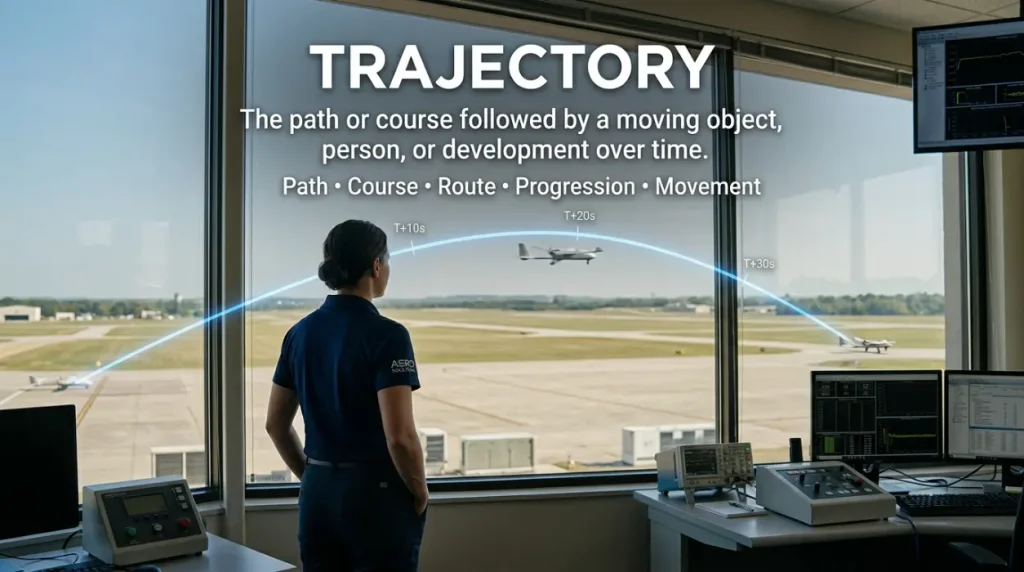
A useful synonym for trajectory is path, but the best alternative depends on context. Other choices include course, route, progression, direction, development, trend, movement, and evolution. In physics, flight path or path may fit best. In career or life writing, progression, course, or development is often more natural.
Imagine a student whose grades improve each semester. You might describe this as an upward trajectory.
For a physical object, trajectory means the path something follows through space. For a career, project, or trend, it can describe how something develops over time.
The phrase synonym for trajectory is useful when you want more precise vocabulary instead of repeating trajectory in every sentence.
Students can use these alternatives in essays, while bloggers and content writers can make explanations more varied. Daily English users can also choose words that sound more natural in conversation.
What Does “Synonym for Trajectory” Really Mean?
The word trajectory usually describes the path, direction, or course followed by something as it moves or develops.
It has two major uses.
The first is physical. In science and mathematics, a trajectory is the path followed by a moving object.
“The satellite followed a predictable trajectory.”
The second is figurative. It describes how something such as a career, business, relationship, project, or social trend develops over time.
“Her career has taken an impressive trajectory.”
Native speakers often understand trajectory as more than a simple route. It can suggest movement plus direction plus change over time.
Part of Speech
Trajectory is a noun.
Simple Definition
Trajectory means the path or direction that something follows as it moves or develops.
It is common in physics, mathematics, journalism, business, education, career discussions, sports analysis, and personal-development writing.
Connotative Meaning
Connotation (the feeling or association a word can carry beyond its basic dictionary meaning) changes slightly depending on context.
Positive Tone
In phrases such as “a successful trajectory” or “an upward trajectory,” the word can suggest growth, progress, achievement, or improvement.
Negative Tone
Expressions such as “a downward trajectory” or “a dangerous trajectory” can suggest decline, failure, risk, or worsening conditions.
Neutral Tone
In science and technical writing, trajectory is usually neutral. It simply describes the path or course of movement.
Etymology
Trajectory ultimately comes from New Latin trajectoria, meaning “a path of movement,” from Latin traicere, meaning “to throw or carry across.”
The word is related to the Latin idea of moving something from one place across to another.
Old English: 450–1100
The modern word trajectory was not part of Old English vocabulary.
Old English used native terms for ideas such as paths, roads, movement, and travel.
Middle English: 1100–1500
French and Latin strongly influenced English vocabulary during this period. Scientific terminology was still developing, while everyday words such as path, way, and course remained common.
Modern English: 1500–Present
The scientific sense of trajectory became established as mathematics and physics developed.
Later, English speakers extended the word metaphorically. Today, we can discuss the trajectory of a career, economy, relationship, story, political movement, or project.

Pronunciation
US: /trəˈdʒektəri/
UK: /trəˈdʒektəri/
Syllables
tra-ject-o-ry
Affixation Pattern
Root: related to Latin iacere, “to throw”
Prefix: tra-, historically connected with the idea of crossing or moving across
Suffix: -ory, forming a noun or adjective-related form in English
The modern English word is ultimately derived from Latin and New Latin rather than being built directly from modern English roots.
Synonyms List
The terms below are grouped by their actual semantic use. Some are close dictionary synonyms, while others are precise alternatives for a particular sense of trajectory.
Path (Noun) — US /pæθ/ — UK /pɑːθ/
Meaning: A path is the route or line along which something moves or develops.
Tone/Register: Neutral and extremely common.
Examples:
The ball followed a curved path through the air.
Her career has taken an unexpected path.
Course (Noun) — US /kɔːrs/ — UK /kɔːs/
Meaning: Course describes the direction or route followed by something.
Tone/Register: Neutral, academic, and professional.
Examples:
The ship changed course during the storm.
His career changed course after graduation.
Route (Noun) — US /ruːt, raʊt/ — UK /ruːt/
Meaning: Route refers to a specific way from one point or stage to another.
Tone/Register: Neutral and practical.
Examples:
The pilot selected a safer route.
She chose a different route into the industry.
Direction (Noun) — US /dəˈrekʃən/ — UK /daɪˈrekʃən/
Meaning: Direction describes the way something is moving or developing.
Tone/Register: Neutral and widely used.
Examples:
The rocket changed direction.
The company is moving in a promising direction.
Pathway (Noun) — US /ˈpæθweɪ/ — UK /ˈpɑːθweɪ/
Meaning: Pathway describes a route or process leading toward a destination or outcome.
Tone/Register: Academic, professional, and figurative.
Examples:
Scientists studied the pathway of the particles.
Education can create a pathway to new opportunities.
Course of Movement (Noun Phrase) — US /kɔːrs əv ˈmuːvmənt/ — UK /kɔːs əv ˈmuːvmənt/
Meaning: Course of movement describes the direction and route followed by a moving object.
Tone/Register: Technical.
Examples:
The researchers recorded the object’s course of movement.
The diagram shows its course of movement clearly.
Flight Path (Noun Phrase) — US /flaɪt pæθ/ — UK /flaɪt pɑːθ/
Meaning: Flight path describes the route taken by an aircraft or airborne object.
Tone/Register: Technical and aviation-related.
Examples:
The aircraft changed its flight path.
The system calculates the missile’s flight path.
Orbit (Noun) — US /ˈɔːrbɪt/ — UK /ˈɔːbɪt/
Meaning: Orbit describes the curved path of an object moving around another object in space.
Tone/Register: Scientific.
Examples:
The satellite entered a stable orbit.
The planet follows an elliptical orbit.
Course Line (Noun Phrase) — US /kɔːrs laɪn/ — UK /kɔːs laɪn/
Meaning: Course line refers to the line indicating the direction of travel.
Tone/Register: Technical.
Examples:
The navigator checked the course line.
The chart shows the object’s projected course line.
Track (Noun) — US /træk/ — UK /træk/
Meaning: Track describes the line or route followed by a moving object or process.
Tone/Register: Neutral and technical.
Examples:
Radar showed the aircraft’s track.
We monitored the storm’s track overnight.
Progression (Noun) — US /prəˈɡreʃən/ — UK /prəˈɡreʃən/
Meaning: Progression describes the way something develops from one stage to another.
Tone/Register: Academic and professional.
Examples:
The progression of her career has been steady.
The course follows a logical progression.
Development (Noun) — US /dɪˈveləpmənt/ — UK /dɪˈveləpmənt/
Meaning: Development describes change and growth over time.
Tone/Register: Neutral, academic, and professional.
Examples:
The project’s development was carefully monitored.
His professional development continued throughout the year.
Evolution (Noun) — US /ˌevəˈluːʃən/ — UK /ˌiːvəˈluːʃən/
Meaning: Evolution describes gradual change from one state to another.
Tone/Register: Academic, professional, and figurative.
Examples:
The technology’s evolution has been rapid.
Her writing shows a clear evolution over time.
Progress (Noun) — US /ˈprɑːɡres/ — UK /ˈprəʊɡres/
Meaning: Progress describes movement toward a desired or later stage.
Tone/Register: Neutral and very common.
Examples:
The project is making good progress.
His academic progress has been impressive.
Advance (Noun) — US /ədˈvæns/ — UK /ədˈvɑːns/
Meaning: Advance describes movement or development toward a more advanced stage.
Tone/Register: Formal to neutral.
Examples:
Scientific advances changed the field.
Her career advancement came after years of study.
Growth (Noun) — US /ɡroʊθ/ — UK /ɡrəʊθ/
Meaning: Growth describes an increase or positive development over time.
Tone/Register: Neutral and professional.
Examples:
The company experienced strong growth.
His skills showed steady growth.
Trend (Noun) — US /trend/ — UK /trend/
Meaning: Trend describes a general direction in which something is changing.
Tone/Register: Neutral, journalistic, and professional.
Examples:
The data shows an upward trend.
The trend continued throughout the year.
Pattern (Noun) — US /ˈpætərn/ — UK /ˈpætən/
Meaning: Pattern describes a repeated or recognizable way in which something develops or behaves.
Tone/Register: Neutral and academic.
Examples:
Researchers noticed a pattern in the data.
Her career shows a pattern of steady advancement.
Movement (Noun) — US /ˈmuːvmənt/ — UK /ˈmuːvmənt/
Meaning: Movement describes the act or process of changing position, direction, or state.
Tone/Register: Neutral and versatile.
Examples:
The camera captured the ball’s movement.
The movement of the market was difficult to predict.
Flow (Noun) — US /floʊ/ — UK /fləʊ/
Meaning: Flow describes the continuous way something moves from one stage or place to another.
Tone/Register: Neutral and figurative.
Examples:
The river’s flow changed after the storm.
The story has a smooth flow from beginning to end.
Passage (Noun) — US /ˈpæsɪdʒ/ — UK /ˈpæsɪdʒ/
Meaning: Passage describes movement from one point, stage, or condition to another.
Tone/Register: Formal and literary.
Examples:
The passage of the spacecraft was tracked carefully.
The novel follows her passage into adulthood.
Journey (Noun) — US /ˈdʒɝːni/ — UK /ˈdʒɜːni/
Meaning: Journey describes movement through a series of stages toward a destination or outcome.
Tone/Register: Neutral, personal, and expressive.
Examples:
The athlete’s journey took years of training.
The book follows his journey from student to teacher.
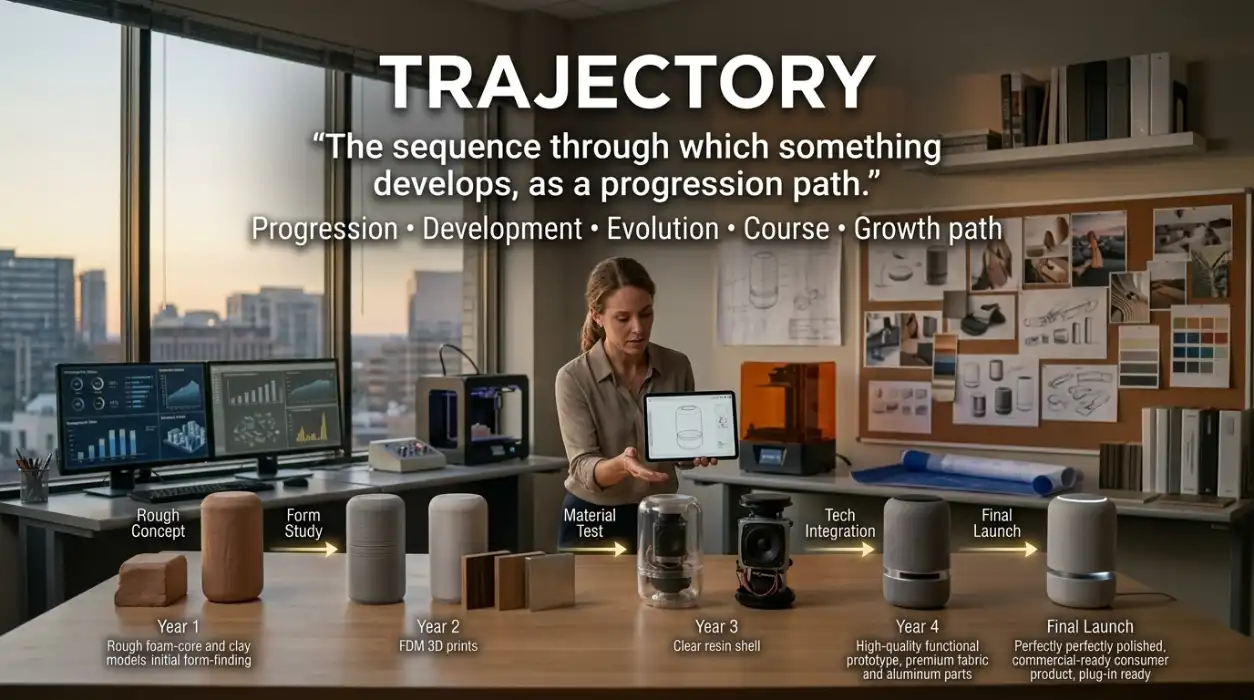
Progression Path (Noun Phrase) — US /prəˈɡreʃən pæθ/ — UK /prəˈɡreʃən pɑːθ/
Meaning: Progression path describes the sequence through which something develops.
Tone/Register: Professional and academic.
Examples:
The program offers a clear progression path.
Her career progression path changed after the promotion.
Developmental Course (Noun Phrase) — US /dɪˈveləpməntl kɔːrs/ — UK /dɪˈveləpməntl kɔːs/
Meaning: Developmental course describes the way a person, system, or idea changes over time.
Tone/Register: Academic and formal.
Examples:
The study examined the developmental course of the condition.
The project followed a predictable developmental course.
Career Path (Noun Phrase) — US /kəˈrɪr pæθ/ — UK /kəˈrɪə pɑːθ/
Meaning: Career path describes the sequence of jobs, roles, or professional stages someone follows.
Tone/Register: Professional and common.
Examples:
She chose a career path in education.
His career path changed after he moved abroad.
Career Course (Noun Phrase) — US /kəˈrɪr kɔːrs/ — UK /kəˈrɪə kɔːs/
Meaning: Career course describes the overall direction of someone’s professional development.
Tone/Register: Formal and professional.
Examples:
The decision changed her career course.
His career course became more specialized over time.
Professional Progression (Noun Phrase) — US /prəˈfeʃənəl prəˈɡreʃən/ — UK /prəˈfeʃənəl prəˈɡreʃən/
Meaning: Professional progression describes advancement through stages of a career.
Tone/Register: Formal and workplace-oriented.
Examples:
Professional progression often requires new skills.
Her professional progression was steady.
Career Development (Noun Phrase) — US /kəˈrɪr dɪˈveləpmənt/ — UK /kəˈrɪə dɪˈveləpmənt/
Meaning: Career development describes the process through which someone’s professional life grows and changes.
Tone/Register: Professional and educational.
Examples:
Career development takes time and planning.
The program supported his career development.
Life Path (Noun Phrase) — US /laɪf pæθ/ — UK /laɪf pɑːθ/
Meaning: Life path describes the direction and sequence of experiences in a person’s life.
Tone/Register: Personal and reflective.
Examples:
Moving abroad changed her life path.
His life path was different from what he expected.
Life Course (Noun Phrase) — US /laɪf kɔːrs/ — UK /laɪf kɔːs/
Meaning: Life course describes the stages and changes that occur throughout a person’s life.
Tone/Register: Academic and sociological.
Examples:
Researchers examined health across the life course.
Education can influence a person’s life course.
Course of Development (Noun Phrase) — US /kɔːrs əv dɪˈveləpmənt/ — UK /kɔːs əv dɪˈveləpmənt/
Meaning: Course of development describes how something changes through successive stages.
Tone/Register: Formal and academic.
Examples:
The researchers tracked the course of development.
The project’s course of development changed after testing.
Direction of Travel (Noun Phrase) — US /dəˈrekʃən əv ˈtrævəl/ — UK /daɪˈrekʃən əv ˈtrævəl/
Meaning: Direction of travel describes the way something is generally moving or developing.
Tone/Register: Professional and figurative.
Examples:
The vehicle’s direction of travel was clear.
The policy suggests a new direction of travel.
Overall Direction (Noun Phrase) — US /ˈoʊvərɔːl dəˈrekʃən/ — UK /ˈəʊvərɔːl daɪˈrekʃən/
Meaning: Overall direction describes the broad way in which something is changing.
Tone/Register: Professional and analytical.
Examples:
The report explains the project’s overall direction.
The team’s overall direction has changed.
Long-Term Course (Noun Phrase) — US /ˌlɔːŋ ˈtɝːm kɔːrs/ — UK /ˌlɒŋ ˈtɜːm kɔːs/
Meaning: Long-term course describes the general direction something follows over an extended period.
Tone/Register: Professional and analytical.
Examples:
The study examines the disease’s long-term course.
We need to understand the project’s long-term course.
Overall Path (Noun Phrase) — US /ˈoʊvərɔːl pæθ/ — UK /ˈəʊvərɔːl pɑːθ/
Meaning: Overall path describes the broad sequence or direction of development.
Tone/Register: Neutral and reflective.
Examples:
The book follows the character’s overall path.
The team’s overall path became clearer after the review.
Sequence (Noun) — US /ˈsiːkwəns/ — UK /ˈsiːkwəns/
Meaning: Sequence describes the order in which stages or events occur.
Tone/Register: Academic and technical.
Examples:
The experiment followed a fixed sequence.
The events form a clear sequence of development.
Continuum (Noun) — US /kənˈtɪnjuəm/ — UK /kənˈtɪnjuəm/
Meaning: Continuum describes a continuous range in which change occurs gradually rather than in separate steps.
Tone/Register: Academic and formal.
Examples:
Development exists on a broad continuum.
The results show movement along a social continuum.
Arc (Noun) — US /ɑːrk/ — UK /ɑːk/
Meaning: Arc describes the overall shape or progression of a story, career, or development.
Tone/Register: Literary, media, and informal.
Examples:
The character’s emotional arc is compelling.
The documentary follows his career arc.
Story Arc (Noun Phrase) — US /ˈstɔːri ɑːrk/ — UK /ˈstɔːri ɑːk/
Meaning: Story arc describes the progression of events and character development across a narrative.
Tone/Register: Creative and media-related.
Examples:
The second season has a darker story arc.
Her character arc feels natural and believable.
Narrative Arc (Noun Phrase) — US /ˈnærətɪv ɑːrk/ — UK /ˈnærətɪv ɑːk/
Meaning: Narrative arc describes the overall progression of a story from beginning through development to an outcome.
Tone/Register: Literary and academic.
Examples:
The narrative arc builds toward a strong ending.
The writer revised the narrative arc.
Upward Trend (Noun Phrase) — US /ˈʌpwərd trend/ — UK /ˈʌpwəd trend/
Meaning: Upward trend describes movement toward higher levels or better results.
Tone/Register: Business, analytical, and neutral-positive.
Examples:
The data shows an upward trend.
Her performance followed an upward trend.
Downward Trend (Noun Phrase) — US /ˈdaʊnwərd trend/ — UK /ˈdaʊnwəd trend/
Meaning: Downward trend describes movement toward lower levels or weaker results.
Tone/Register: Analytical and potentially negative.
Examples:
The report identifies a downward trend.
Sales followed a downward trend during the quarter.
Rise (Noun) — US /raɪz/ — UK /raɪz/
Meaning: Rise describes upward movement or development.
Tone/Register: Neutral and common.
Examples:
The graph shows a sharp rise.
Her career saw a rapid rise after the award.
Decline (Noun) — US /dɪˈklaɪn/ — UK /dɪˈklaɪn/
Meaning: Decline describes movement toward a lower or weaker state.
Tone/Register: Neutral to negative.
Examples:
The data shows a gradual decline.
The company entered a period of decline.
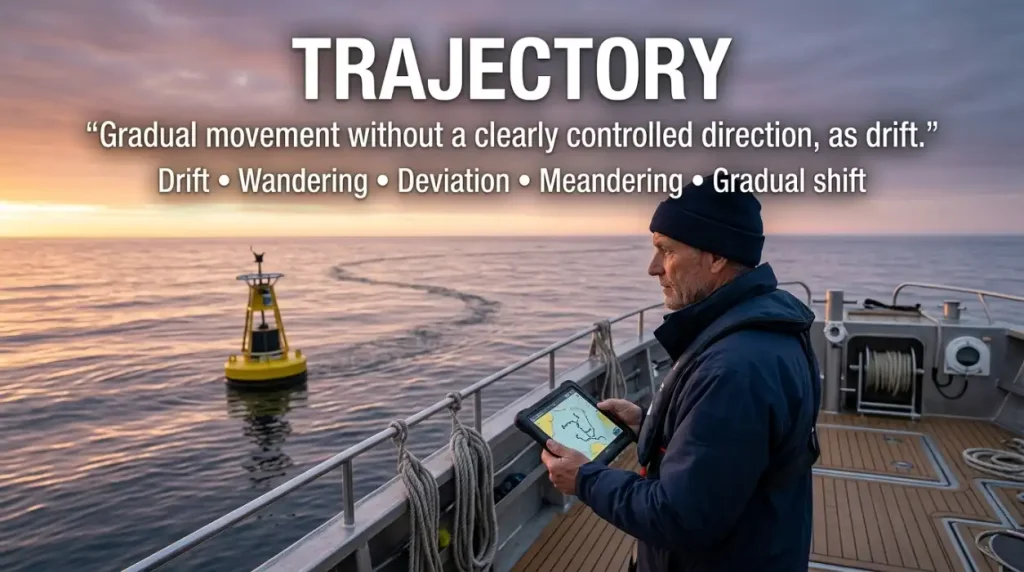
Drift (Noun) — US /drɪft/ — UK /drɪft/
Meaning: Drift describes gradual movement without a clearly controlled direction.
Tone/Register: Informal, figurative, and sometimes negative.
Examples:
The boat began a slow drift toward shore.
The project experienced a drift away from its original goal.
Course of Action (Noun Phrase) — US /kɔːrs əv ˈækʃən/ — UK /kɔːs əv ˈækʃən/
Meaning: Course of action describes the direction or plan chosen for future development.
Tone/Register: Professional and formal.
Examples:
The team agreed on a new course of action.
That decision changed the project’s course of action.
Heading (Noun) — US /ˈhedɪŋ/ — UK /ˈhedɪŋ/
Meaning: Heading describes the direction in which a person, vehicle, or project is moving.
Tone/Register: Neutral and practical.
Examples:
The ship was heading north.
The company is heading toward a new market.
Vector (Noun) — US /ˈvektər/ — UK /ˈvektə/
Meaning: Vector describes a quantity with both magnitude and direction, and can describe direction of movement mathematically or figuratively.
Tone/Register: Scientific and technical.
Examples:
The force acts along a specific vector.
The research points in a new strategic vector.
Line of Progress (Noun Phrase) — US /laɪn əv ˈprɑːɡres/ — UK /laɪn əv ˈprəʊɡres/
Meaning: Line of progress describes the general sequence and direction of advancement.
Tone/Register: Formal and analytical.
Examples:
The chart shows the line of progress.
Her results reveal a steady line of progress.
Developmental Path (Noun Phrase) — US /dɪˌveləpˈmentəl pæθ/ — UK /dɪˌveləpˈmentəl pɑːθ/
Meaning: Developmental path describes the way a person, system, or idea develops through stages.
Tone/Register: Academic and professional.
Examples:
Children can follow different developmental paths.
The technology took an unexpected developmental path.
Growth Path (Noun Phrase) — US /ɡroʊθ pæθ/ — UK /ɡrəʊθ pɑːθ/
Meaning: Growth path describes the direction and stages of increasing development or capability.
Tone/Register: Professional and business-oriented.
Examples:
The company is following a steady growth path.
Her skills show a strong growth path.
Evolutionary Path (Noun Phrase) — US /ˌevəˈluːʃəneri pæθ/ — UK /ˌiːvəˈluːʃənəri pɑːθ/
Meaning: Evolutionary path describes the way something gradually changes from an earlier form.
Tone/Register: Academic and formal.
Examples:
The species followed a complex evolutionary path.
The technology took an unusual evolutionary path.
Trend Line (Noun) — US /trend laɪn/ — UK /trend laɪn/
Meaning: A trend line describes a line showing the general direction of change in data.
Tone/Register: Statistical and analytical.
Examples:
The trend line rises steadily.
The analyst studied the trend line before concluding.
Synonyms by Tone
Positive
Progress, growth, advance, upward trend, growth path, and career development often suggest improvement or forward movement.
Use these when the context emphasizes achievement or constructive change.
Neutral
Path, course, route, direction, progression, development, movement, track, sequence, and overall path usually describe movement without strongly judging it.
These are useful when you want factual language.
Negative
Decline, downward trend, drift, and some uses of downward course can suggest deterioration or loss of direction.
Choose them when the context genuinely involves decline or unwanted change.
Playful or Informal
Journey, arc, story arc, and heading can sound more conversational or expressive.
These are especially natural in personal writing, storytelling, sports commentary, and media discussions.
Tone matters because trajectory itself is relatively neutral. Replacing it with decline adds a negative meaning, while growth adds a positive one.
“Trajectory” vs Close Alternatives
| Word | Main meaning | Best context |
|---|---|---|
| Trajectory | Path or direction of movement or development | Science, careers, trends |
| Path | Route or way something follows | General and figurative use |
| Course | Direction or route over time | Travel, careers, projects |
| Progression | Movement through stages | Academic and professional writing |
| Trend | General direction of change | Data, society, markets |
Trajectory vs Path
Path is broader and more everyday.
Trajectory sounds more analytical and often suggests movement through time or space.
“Her career path changed.”
“Her career trajectory changed.”
Both are correct, but trajectory sounds more focused on the direction and pattern of development.
Trajectory vs Course
Course emphasizes the direction being followed.
Trajectory often emphasizes the shape or direction of movement over time.
A ship can change its course, while a career can have an unexpected trajectory.
Trajectory vs Progression
Progression emphasizes movement from one stage to another.
Trajectory emphasizes the overall direction or pattern.
Use progression when stages matter. Use trajectory when the broader direction matters.
How “Trajectory” Changes by Context
Daily Conversation
In ordinary conversation, path, direction, course, journey, and way forward often sound more natural than trajectory.
For example:
“I’m not sure what direction my career is taking.”
This sounds more conversational than:
“I’m unsure about my career trajectory.”
Both work, but the second is more analytical.
Writing and Blogging
Bloggers can use trajectory, path, progression, direction, evolution, and journey depending on the intended tone.
Trajectory works particularly well in articles about careers, technology, social change, education, and personal development.
Avoid replacing it with a simpler word just for variety. The alternative should preserve the intended meaning.
Professional and Academic Writing
Professional and academic contexts often favor trajectory, progression, development, course, trend, evolutionary path, and direction.
For a person’s professional development, career trajectory or career progression may be appropriate.
For a physical object, trajectory or flight path is usually more accurate.
Creative and Informal Use
Creative writing can use journey, arc, path, direction, story arc, and evolution.
These words can make prose feel more personal or vivid.
For example, a writer may describe a character’s emotional arc rather than an emotional trajectory.
Common Mistakes and Native Usage
Mistake 1: Treating every synonym as interchangeable
Trajectory can describe physical movement and figurative development.
Journey works well figuratively but is not always suitable for physics.
Orbit is much narrower because it describes movement around another body.
Mistake 2: Using “trend” for every trajectory
A trend describes a general direction of change, especially in data.
A trajectory can be more specific and can describe a physical path.
“The rocket’s trend” is not a natural replacement for “the rocket’s trajectory.”
Mistake 3: Confusing trajectory with destination
A trajectory is the path or direction, not necessarily the final destination.
Someone can have a successful trajectory without having reached a final goal.
Mistake 4: Assuming trajectory always means improvement
It does not.
A trajectory can be upward, downward, stable, unpredictable, changing, or uncertain.
Mistake 5: Overusing the word
Trajectory is useful, but repeating it in every paragraph can make professional writing sound mechanical.
Switch to path, course, progression, direction, or development when the meaning remains accurate.
Register Notes
Everyday speech: path, direction, route, journey, way.
Professional writing: trajectory, progression, course, development, career path.
Academic writing: trajectory, progression, developmental path, evolutionary path, continuum.
Scientific writing: trajectory, flight path, orbit, track, vector.
Creative writing: journey, arc, story arc, path, evolution.
For related vocabulary practice, an internal article about synonyms for progress can help you distinguish movement, growth, and development more precisely.
Real-Life Mini Scenarios
Workplace
A manager discusses an employee’s professional growth.
“Her career trajectory has changed since she moved into leadership.”
A more everyday version is:
“Her career path has changed since she moved into leadership.”
Social Situation
A friend talks about changing careers.
“I’m still figuring out which direction I want my life to take.”
Here, direction sounds more natural and personal than the formal trajectory.
Media and Pop Culture
A reviewer discusses a character’s development.
“The character’s story arc becomes darker in the second half.”
Here, story arc is more precise than trajectory because the subject is narrative structure.
Science and Technology
A researcher describes an airborne object.
“The instrument recorded the object’s trajectory.”
In this setting, trajectory is more precise than journey or progression.
These examples show why choosing a synonym is not simply about finding a different word. The right alternative depends on meaning, subject, and register.

Practice Quiz
1. A scientist describes the path of a ball moving through the air. Which word fits best?
A. Trajectory
B. Journey
C. Career
D. Growth
2. Someone discusses the direction of their professional life. Which phrase is most natural?
A. Career path
B. Flight path
C. Orbit
D. Trend line
3. A graph shows that unemployment is gradually decreasing. Which phrase fits best?
A. Downward trend
B. Story arc
C. Life journey
D. Flight path
4. A novelist discusses how a character changes throughout a book. Which term fits best?
A. Character arc
B. Orbit
C. Route
D. Vector
5. A ship changes its direction while traveling. Which word is most natural?
A. Course
B. Career
C. Evolution
D. Progression
6. A company gradually changes its products and identity over many years. Which word fits?
A. Evolution
B. Orbit
C. Route
D. Track
7. A person describes their experiences from childhood to adulthood. Which phrase sounds natural and reflective?
A. Life journey
B. Flight path
C. Trend line
D. Course line
8. Researchers describe gradual movement from one developmental stage to another. Which term is appropriate?
A. Progression
B. Destination
C. Route
D. Heading
9. Radar records the route taken by an aircraft. Which phrase is most precise?
A. Flight path
B. Life path
C. Career course
D. Story arc
10. A project slowly moves away from its original purpose without clear control. Which word fits?
A. Drift
B. Growth
C. Advance
D. Rise
Reflection Task
Write one sentence about your own studies, career, hobby, or personal growth. Replace trajectory with a suitable alternative such as path, progression, direction, course, or journey. Notice how the tone changes.
Answer key: 1-A | 2-A | 3-A | 4-A | 5-A | 6-A | 7-A | 8-A | 9-A | 10-A
Frequently Asked Questions
What is the best synonym for trajectory in academic writing?
In academic writing, useful alternatives include course, progression, development, direction, trend, and evolution. The right choice depends on the subject. Progression works well for stages, trend suits data, and evolution suggests gradual change. For a scientific object moving through space, trajectory or path is usually more precise.
What is another word for career trajectory?
Common alternatives include career path, career progression, career development, professional progression, and career course. Career path is the most natural everyday choice. Career progression emphasizes advancement through professional stages, while career development focuses more broadly on skills, experience, and professional growth.
What is a synonym for trajectory in physics?
In physics, path, flight path, track, orbit, and course may work depending on the situation. Trajectory is often the most precise general term for the path of a moving object. Orbit should only be used when the object follows an orbital path around another body.
Can “path” replace “trajectory” in a sentence?
Often, yes. Path is a broader and more common word, so it works in many physical and figurative contexts. However, trajectory can emphasize direction and development over time. For example, “career path” sounds natural in everyday English, while “career trajectory” can sound more analytical.
External Learning Sources
For dictionary definitions, pronunciation, usage examples, and etymology, useful reference sources include:
Conclusion
Learning a synonym for trajectory helps you describe movement and change with greater precision. Words such as path, course, and direction make everyday English natural.
For essays and blogs, progression, development, trend, and evolution can express different kinds of change. The key is choosing the word that fits your meaning.
In professional and scientific writing, precise vocabulary matters. Trajectory, flight path, career progression, and trend each carry a specific shade that improves communication.
Try using three new alternatives this week. Practice them in emails, essays, stories, or daily conversations, and notice how each word changes your message.

Hasnain Ali is an SEO Content Strategist and the founder of wordvora.com, a trusted vocabulary platform that helps writers, students, professionals, and English learners find accurate synonyms, antonyms, word meanings, and real-life usage examples. He specializes in keyword research, on-page SEO, topical authority, and creating search-first content that aligns with Google’s latest Search Quality and E-E-A-T guidelines. His work focuses on producing clear, well-structured, and reader-friendly resources that satisfy search intent while maintaining high editorial standards.
Through extensive hands-on experience with SEO tools such as Google Search Console, Google Analytics, SEMrush, and Ahrefs, Hasnain researches user search behavior and develops content that is both informative and easy to understand. Every article published on wordvora.com is carefully reviewed for accuracy, readability, and contextual relevance before publication. His mission is to build one of the web’s most reliable English vocabulary resources by providing practical language guidance, trustworthy explanations, and content that helps readers improve their writing, communication, and vocabulary with confidence.