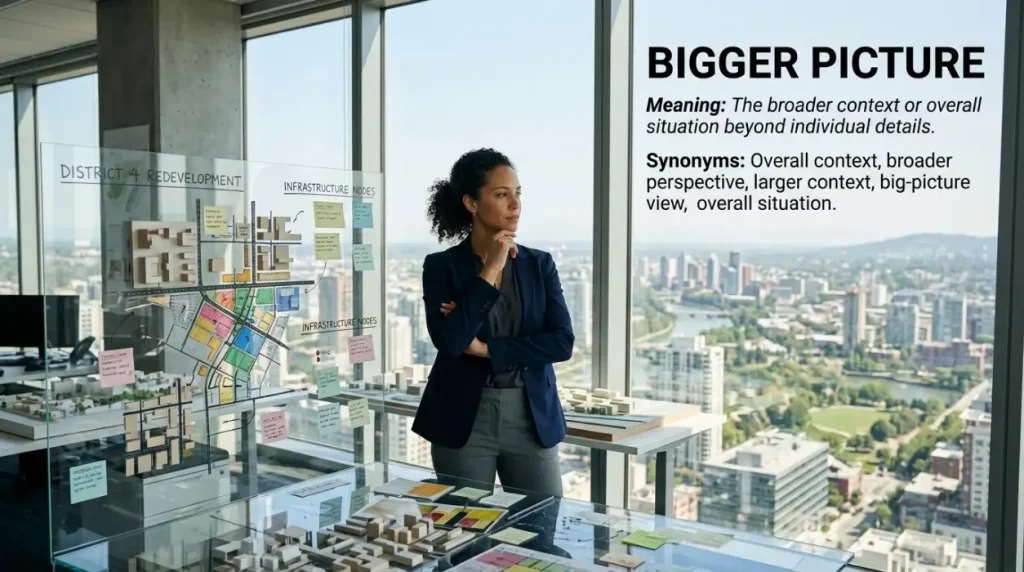
Synonyms for bigger picture can be useful when you want to describe the full situation rather than one small detail. Imagine a team debating one delayed task while the manager asks everyone to consider the entire project.
For example, “look at the bigger picture” means to step back and consider all the important facts, goals, and consequences. Similarly, alternatives can make your English more precise.
Learning a synonym for bigger picture also improves vocabulary because each alternative carries a slightly different shade of meaning. As a result, students, bloggers, content writers, and daily English users can communicate more naturally.
For students, bloggers, content writers, and daily English users, learning a synonym for bigger picture can make ideas clearer and communication more natural.
What Does “Bigger Picture” Really Mean?
Bigger picture is an informal noun phrase. It means the complete situation, wider context, or overall view of something rather than one isolated detail.
The most common expression is “look at the bigger picture.” Native speakers use it when someone needs to move beyond immediate details and consider the broader situation.
For example:
“We lost one customer, but let’s look at the bigger picture.”
Here, the speaker is saying that one event should not define the whole situation.
The phrase commonly appears in:
- Everyday conversation
- Business meetings
- Academic writing
- Essays
- Journalism
- Blogging
- Personal development
- Strategic planning
- Storytelling
Part of Speech
Bigger picture is a noun phrase.
Simple definition: the whole situation viewed with its important surrounding facts, relationships, goals, and consequences.
What Does “Bigger” Add?
“Bigger” is the comparative form of big. In this expression, it suggests a view that is broader than the immediate or narrow view.
What Does “Picture” Mean Here?
“Picture” is being used figuratively. It does not mean a physical image. Instead, it means an understanding or representation of a situation.
Connotative Meaning
Connotation (the feeling or association a word carries beyond its basic dictionary meaning) can affect how an alternative sounds.
Positive Tone
“Bigger picture” can suggest wisdom, maturity, perspective, patience, and strategic thinking.
“She encouraged us to see the bigger picture before making a decision.”
Negative Tone
In some situations, it can sound dismissive.
“You keep talking about the bigger picture, but this problem still needs fixing.”
The phrase may imply that someone is ignoring an immediate concern.
Neutral Tone
Most uses are neutral. The expression simply means considering the wider situation.
“The report helps readers understand the bigger picture.”
Etymology
The expression combines two ordinary English words with much older histories.
Old English: 450–1100
Big was not the normal Old English word for “large.” Old English commonly used words such as micel for large or great. The modern word big became established later.
The noun picture has a different history. It ultimately comes from Latin pictura, meaning a painting or representation, through French and Middle English.
Middle English: 1100–1500
During Middle English, vocabulary from French and Latin entered English in large numbers. Picture developed as a word for an image or representation.
The figurative use of “picture” gradually expanded. People could describe a mental or verbal representation of a situation.
Modern English: 1500–Present
Modern English developed many figurative expressions involving picture, such as “the whole picture” and “put things into perspective.”
The modern expression “the bigger picture” became especially common in everyday, professional, and motivational English.
Today, it usually means the broader situation rather than a literal picture.
Pronunciation
Bigger
US: /ˈbɪɡɚ/
UK: /ˈbɪɡə/
Picture
US: /ˈpɪktʃɚ/
UK: /ˈpɪktʃə/
Bigger Picture
US: /ˈbɪɡɚ ˈpɪktʃɚ/
UK: /ˈbɪɡə ˈpɪktʃə/
Syllables
big-ger pic-ture
Affixation Pattern
Bigger is formed through inflection rather than ordinary derivational affixation.
Root: big
Prefix: none
Suffix: comparative -er
Picture: historically derived through French from Latin pictura.
55 Synonyms for “Bigger Picture”
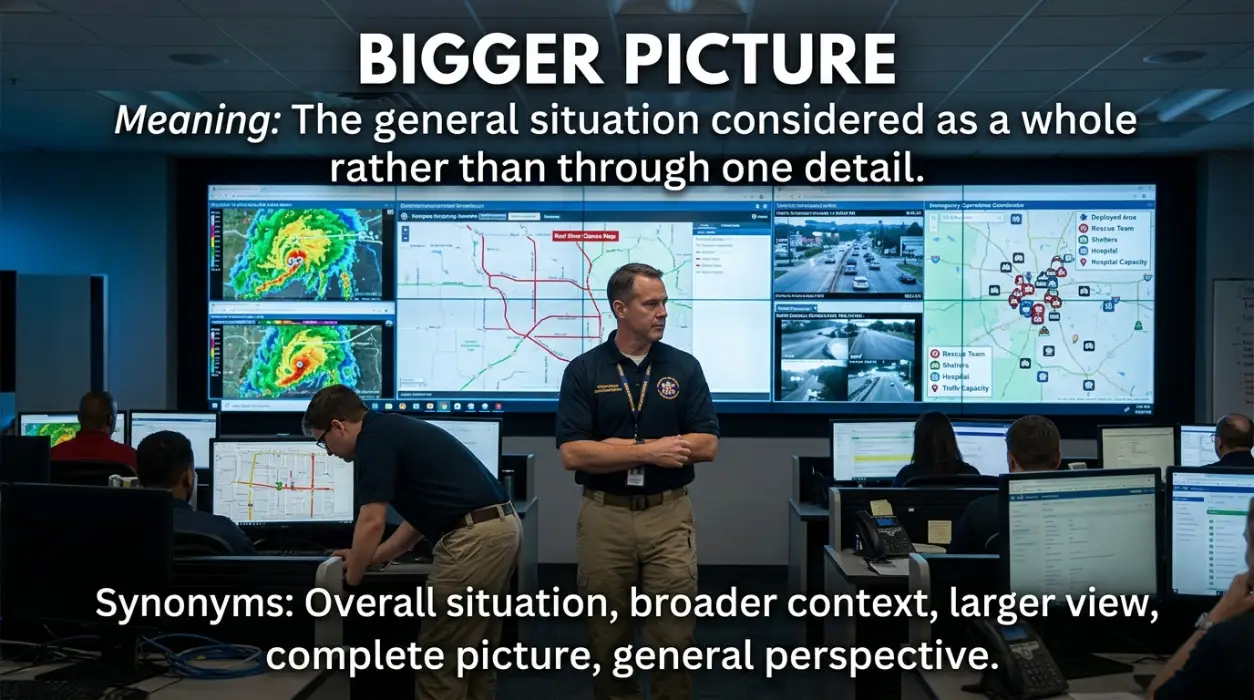
Big Picture (Noun Phrase) — US /ˌbɪɡ ˈpɪktʃɚ/ — UK /ˌbɪɡ ˈpɪktʃə/
Meaning: The general situation considered as a whole rather than through one detail.
Tone/Register: Informal, neutral, conversational
Example:
Try to focus on the big picture.
One difficult meeting does not define the project.
Whole Picture (Noun Phrase) — US /hoʊl ˈpɪktʃɚ/ — UK /həʊl ˈpɪktʃə/
Meaning: All the important parts of a situation considered together.
Tone/Register: Neutral, conversational
Example:
We do not know the whole picture yet.
The missing information could change our understanding.
Full Picture (Noun Phrase) — US /fʊl ˈpɪktʃɚ/ — UK /fʊl ˈpɪktʃə/
Meaning: All relevant facts and information needed to understand something properly.
Tone/Register: Neutral, professional
Example:
We need the full picture before deciding.
The new report gives us more useful evidence.
Complete Picture (Noun Phrase) — US /kəmˈpliːt ˈpɪktʃɚ/ — UK /kəmˈpliːt ˈpɪktʃə/
Meaning: A comprehensive understanding that includes the major parts of a situation.
Tone/Register: Formal, academic
Example:
Several interviews created a complete picture.
The results cannot be understood from one survey alone.
Overall Picture (Noun Phrase) — US /ˌoʊvərˈɔːl ˈpɪktʃɚ/ — UK /ˌəʊvərˈɔːl ˈpɪktʃə/
Meaning: A general understanding of a situation based on its main features.
Tone/Register: Neutral, professional
Example:
The figures give an overall picture of demand.
The overall picture looks more positive this month.
Overall View (Noun Phrase) — US /ˌoʊvərˈɔːl vjuː/ — UK /ˌəʊvərˈɔːl vjuː/
Meaning: A general view that considers the subject as a whole.
Tone/Register: Neutral, professional
Example:
The introduction gives an overall view of the topic.
I want an overall view before reading the details.
Full View (Noun Phrase) — US /fʊl vjuː/ — UK /fʊl vjuː/
Meaning: A complete perspective that includes the significant elements.
Tone/Register: Neutral, formal
Example:
The report gives us a full view of the issue.
We need a full view before changing the policy.
Complete View (Noun Phrase) — US /kəmˈpliːt vjuː/ — UK /kəmˈpliːt vjuː/
Meaning: An understanding that covers the important parts of a subject.
Tone/Register: Formal, academic
Example:
The documentary offers a complete view of the event.
The final chapter adds several missing details.
Broad View (Noun Phrase) — US /brɔːd vjuː/ — UK /brɔːd vjuː/
Meaning: A perspective that includes many relevant factors rather than one narrow concern.
Tone/Register: Neutral, academic
Example:
A broad view can reveal useful connections.
The professor encouraged a broad view of history.
Broader View (Noun Phrase) — US /ˌbrɔːdɚ vjuː/ — UK /ˌbrɔːdə vjuː/
Meaning: A more extensive perspective than the immediate or narrow view.
Tone/Register: Academic, professional
Example:
Travel gave him a broader view of culture.
The new evidence supports a broader view.
General View (Noun Phrase) — US /ˈdʒɛnərəl vjuː/ — UK /ˈdʒenərəl vjuː/
Meaning: A basic understanding without focusing heavily on details.
Tone/Register: Neutral
Example:
Here is a general view of the proposal.
The summary gives readers the main idea quickly.
Overall Perspective (Noun Phrase) — US /ˌoʊvərˈɔːl pɚˈspɛktɪv/ — UK /ˌəʊvərˈɔːl pəˈspektɪv/
Meaning: A general understanding formed by considering the situation as a whole.
Tone/Register: Formal, academic
Example:
The discussion changed my overall perspective.
The report presents an overall perspective on the issue.
Broader Perspective (Noun Phrase) — US /ˌbrɔːdɚ pɚˈspɛktɪv/ — UK /ˌbrɔːdə pəˈspektɪv/
Meaning: A wider way of interpreting a situation or subject.
Tone/Register: Academic, professional
Example:
The experience gave her a broader perspective.
A broader perspective can prevent quick judgments.
Wider Perspective (Noun Phrase) — US /ˌwaɪdɚ pɚˈspɛktɪv/ — UK /ˌwaɪdə pəˈspektɪv/
Meaning: A viewpoint that takes additional circumstances and factors into account.
Tone/Register: Professional, academic
Example:
The debate needs a wider perspective.
The article provides a wider perspective on migration.
Broad Perspective (Noun Phrase) — US /brɔːd pɚˈspɛktɪv/ — UK /brɔːd pəˈspɛktɪv/
Meaning: A viewpoint that considers several sides or dimensions of a subject.
Tone/Register: Academic, neutral
Example:
Students need a broad perspective on history.
The course encourages independent thinking.
Broader Viewpoint (Noun Phrase) — US /ˌbrɔːdɚ ˈvjuˌpɔɪnt/ — UK /ˌbrɔːdə ˈvjuˌpɔɪnt/
Meaning: A wider position from which an issue can be considered.
Tone/Register: Academic, professional
Example:
The discussion needs a broader viewpoint.
Different experiences can provide that viewpoint.
Wider Viewpoint (Noun Phrase) — US /ˌwaɪdɚ ˈvjuˌpɔɪnt/ — UK /ˌwaɪdə ˈvjuˌpɔɪnt/
Meaning: A viewpoint that moves beyond the immediate issue.
Tone/Register: Neutral, professional
Example:
Try considering the problem from a wider viewpoint.
The change may look different from another angle.
Broader Context (Noun Phrase) — US /ˌbrɔːdɚ ˈkɑːntɛkst/ — UK /ˌbrɔːdə ˈkɒntekst/
Meaning: The wider circumstances that help explain a fact or event.
Tone/Register: Academic, formal
Example:
The quote needs a broader context.
Historical events provide that context.
Wider Context (Noun Phrase) — US /ˌwaɪdɚ ˈkɑːntɛkst/ — UK /ˌwaɪdə ˈkɒntekst/
Meaning: Additional surrounding information that helps explain something.
Tone/Register: Academic, professional
Example:
The statistic needs a wider context.
The article supplies several useful details.
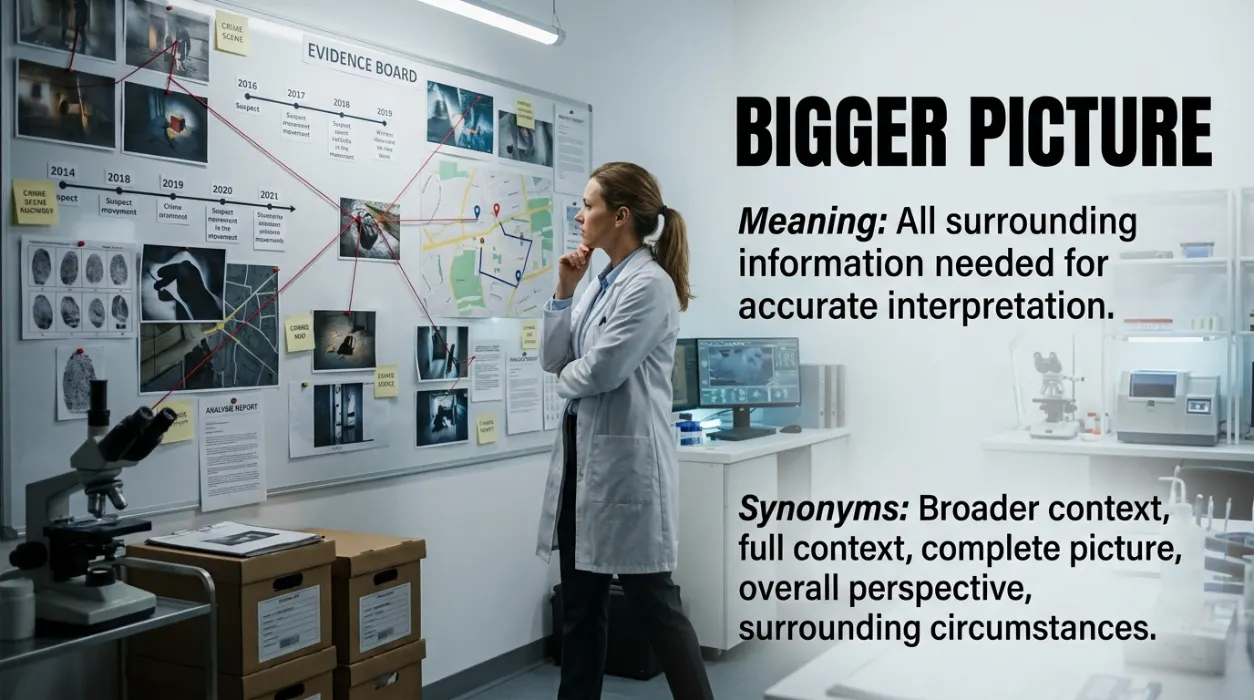
Full Context (Noun Phrase) — US /fʊl ˈkɑːntɛkst/ — UK /fʊl ˈkɒntekst/
Meaning: All surrounding information needed for accurate interpretation.
Tone/Register: Academic, neutral
Example:
Read the sentence in its full context.
The surrounding paragraph changes its meaning.
Overall Context (Noun Phrase) — US /ˌoʊvərˈɔːl ˈkɑːntɛkst/ — UK /ˌəʊvərˈɔːl ˈkɒntekst/
Meaning: The complete background surrounding a subject or event.
Tone/Register: Formal, academic
Example:
The decision makes sense in the overall context.
The report explains that context clearly.
General Context (Noun Phrase) — US /ˈdʒɛnərəl ˈkɑːntɛkst/ — UK /ˈdʒenərəl ˈkɒntekst/
Meaning: The broad background surrounding an issue.
Tone/Register: Neutral, academic
Example:
The introduction provides general context.
New readers need this background.
Larger Context (Noun Phrase) — US /ˌlɑːrdʒɚ ˈkɑːntɛkst/ — UK /ˌlɑːdʒə ˈkɒntekst/
Meaning: The more extensive circumstances surrounding a particular detail.
Tone/Register: Academic, analytical
Example:
The event becomes clearer in its larger context.
The historical background is important here.
Broader Scope (Noun Phrase) — US /ˌbrɔːdɚ skoʊp/ — UK /ˌbrɔːdə skəʊp/
Meaning: A wider range of topics, factors, or activities included in consideration.
Tone/Register: Professional, academic
Example:
The revised study has a broader scope.
It now includes several age groups.
Wider Scope (Noun Phrase) — US /ˌwaɪdɚ skoʊp/ — UK /ˌwaɪdə skəʊp/
Meaning: A larger range of matters covered by a project or discussion.
Tone/Register: Professional, academic
Example:
The project now has a wider scope.
The researchers added two new areas.
Larger Scope (Noun Phrase) — US /ˌlɑːrdʒɚ skoʊp/ — UK /ˌlɑːdʒə skəʊp/
Meaning: A more extensive range than originally included.
Tone/Register: Business, academic
Example:
The investigation has a larger scope now.
The change requires more careful planning.
Overall Scope (Noun Phrase) — US /ˌoʊvərˈɔːl skoʊp/ — UK /ˌəʊvərˈɔːl skəʊp/
Meaning: The complete range covered by a subject, project, or activity.
Tone/Register: Professional
Example:
Let’s define the overall scope first.
The overall scope includes research and testing.
Broader Understanding (Noun Phrase) — US /ˌbrɔːdɚ ˌʌndɚˈstændɪŋ/ — UK /ˌbrɔːdə ˌʌndəˈstændɪŋ/
Meaning: Knowledge that covers more aspects of a subject.
Tone/Register: Academic, educational
Example:
Reading widely develops a broader understanding.
Practice also improves your confidence.
Overall Understanding (Noun Phrase) — US /ˌoʊvərˈɔːl ˌʌndɚˈstændɪŋ/ — UK /ˌəʊvərˈɔːl ˌʌndəˈstændɪŋ/
Meaning: A general understanding based on the main facts and ideas.
Tone/Register: Neutral, academic
Example:
The examples improved my overall understanding.
The final lesson brought the ideas together.
Holistic View (Noun Phrase) — US /hoʊˈlɪstɪk vjuː/ — UK /həʊˈlɪstɪk vjuː/
Meaning: A view that considers connected parts as one complete whole.
Tone/Register: Academic, professional
Example:
The team took a holistic view of the problem.
They considered technical and human factors.
Holistic Perspective (Noun Phrase) — US /hoʊˈlɪstɪk pɚˈspɛktɪv/ — UK /həʊˈlɪstɪk pəˈspektɪv/
Meaning: An approach that considers several connected aspects together.
Tone/Register: Academic, professional
Example:
A holistic perspective can reveal hidden connections.
The approach includes social and economic factors.
Comprehensive View (Noun Phrase) — US /ˌkɑːmprɪˈhɛnsɪv vjuː/ — UK /ˌkɒmprɪˈhensɪv vjuː/
Meaning: A view that covers all or nearly all important aspects.
Tone/Register: Formal, academic
Example:
The report provides a comprehensive view.
Researchers considered several sources of evidence.
Comprehensive Perspective (Noun Phrase) — US /ˌkɑːmprɪˈhɛnsɪv pɚˈspɛktɪv/ — UK /ˌkɒmprɪˈhensɪv pəˈspektɪv/
Meaning: A wide-ranging perspective that considers many relevant dimensions.
Tone/Register: Formal, academic
Example:
The study offers a comprehensive perspective.
It considers both benefits and limitations.
Complete Perspective (Noun Phrase) — US /kəmˈpliːt pɚˈspɛktɪv/ — UK /kəmˈpliːt pəˈspektɪv/
Meaning: A perspective that attempts to include all major sides of a situation.
Tone/Register: Formal, professional
Example:
The panel considered a complete perspective.
Every participant added useful information.
Long-Term View (Noun Phrase) — US /ˌlɔːŋ ˈtɝːm vjuː/ — UK /ˌlɒŋ ˈtɜːm vjuː/
Meaning: A perspective that considers effects over an extended period.
Tone/Register: Business, professional
Example:
We need a long-term view of the investment.
Today’s choice may affect next year’s results.
Long-Range View (Noun Phrase) — US /ˌlɔːŋ ˈreɪndʒ vjuː/ — UK /ˌlɒŋ ˈreɪndʒ vjuː/
Meaning: A perspective focused on distant future goals and consequences.
Tone/Register: Strategic, professional
Example:
The board adopted a long-range view.
They focused on future development.
Strategic View (Noun Phrase) — US /strəˈtiːdʒɪk vjuː/ — UK /strəˈtiːdʒɪk vjuː/
Meaning: A perspective focused on major goals, priorities, and consequences.
Tone/Register: Business, professional
Example:
Managers need a strategic view of the market.
The approach helped the team set priorities.
Strategic Perspective (Noun Phrase) — US /strəˈtiːdʒɪk pɚˈspɛktɪv/ — UK /strəˈtiːdʒɪk pəˈspektɪv/
Meaning: A way of thinking that emphasizes goals and long-term consequences.
Tone/Register: Business, professional
Example:
The meeting required a strategic perspective.
The team reviewed its future objectives.
High-Level View (Noun Phrase) — US /ˌhaɪ ˈlɛvəl vjuː/ — UK /ˌhaɪ ˈlevəl vjuː/
Meaning: A general overview that avoids detailed information.
Tone/Register: Business, technical
Example:
Give me a high-level view of the proposal.
We can examine the details afterward.
High-Level Perspective (Noun Phrase) — US /ˌhaɪ ˈlɛvəl pɚˈspɛktɪv/ — UK /ˌhaɪ ˈlevəl pəˈspektɪv/
Meaning: A general perspective focused on major themes instead of small details.
Tone/Register: Professional, technical
Example:
The summary offers a high-level perspective.
The director needs the main points first.

Bird’s-Eye View (Noun Phrase) — US /ˈbɝːdz aɪ vjuː/ — UK /ˈbɜːdz aɪ vjuː/
Meaning: A broad view that resembles seeing something from above.
Tone/Register: Figurative, neutral
Example:
The map gives a bird’s-eye view of the city.
The overview gives us a bird’s-eye view of the process.
Panoramic View (Noun Phrase) — US /ˌpænəˈræmɪk vjuː/ — UK /ˌpænəˈræmɪk vjuː/
Meaning: A wide view that covers many parts of a subject or scene.
Tone/Register: Descriptive, formal
Example:
The essay gives a panoramic view of society.
The documentary covers several generations.
Contextual View (Noun Phrase) — US /kənˈtɛkstʃuəl vjuː/ — UK /kənˈtekstʃuəl vjuː/
Meaning: A view that interprets something through its surrounding circumstances.
Tone/Register: Academic, formal
Example:
The historian takes a contextual view of the event.
The background changes its interpretation.
Contextual Perspective (Noun Phrase) — US /kənˈtɛkstʃuəl pɚˈspɛktɪv/ — UK /kənˈtekstʃuəl pəˈspektɪv/
Meaning: An approach that explains something according to its surrounding conditions.
Tone/Register: Academic
Example:
The paper uses a contextual perspective.
The author considers the period in which it happened.
Systems View (Noun Phrase) — US /ˈsɪstəmz vjuː/ — UK /ˈsɪstəmz vjuː/
Meaning: A way of examining how different parts of a system interact.
Tone/Register: Technical, academic
Example:
The engineer used a systems view.
The approach revealed several connected problems.
Systems Perspective (Noun Phrase) — US /ˈsɪstəmz pɚˈspɛktɪv/ — UK /ˈsɪstəmz pəˈspektɪv/
Meaning: A perspective that examines relationships between connected parts.
Tone/Register: Academic, professional
Example:
A systems perspective is useful in complex projects.
It shows how one change affects another.
Global View (Noun Phrase) — US /ˈɡloʊbəl vjuː/ — UK /ˈɡləʊbəl vjuː/
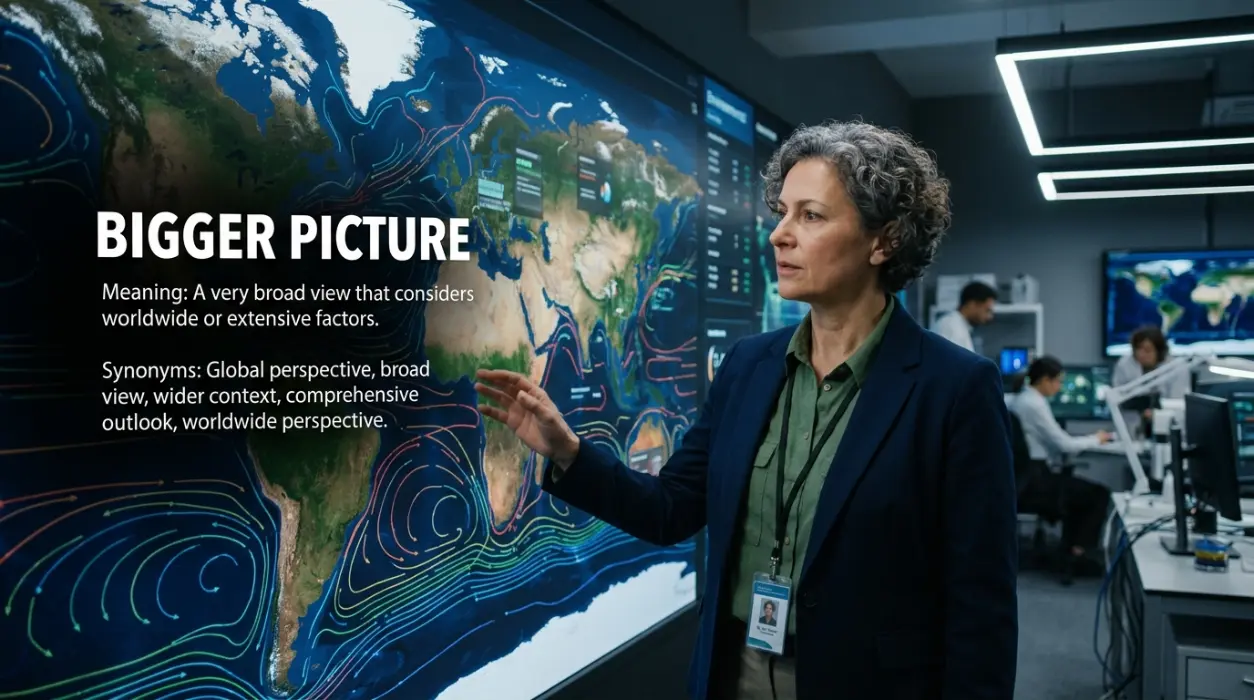
Meaning: A very broad view that considers worldwide or extensive factors.
Tone/Register: Formal, international
Example:
The report takes a global view of education.
Regional differences are discussed later.
Synonyms by Tone
Tone matters because two expressions can communicate a similar idea while creating different impressions.
Positive
Useful positive or constructive alternatives include:
- Broader perspective
- Wider perspective
- Holistic view
- Holistic perspective
- Broader understanding
- Broader outlook
- Strategic perspective
- Global perspective
These expressions can suggest awareness, maturity, and thoughtful reasoning.
Neutral
Common neutral alternatives include:
- Big picture
- Whole picture
- Full picture
- Complete picture
- Overall picture
- Overall view
- Full view
- General view
- Wider picture
These are suitable for everyday conversations and general writing.
Formal or Academic
For essays, reports, and research, consider:
- Broader context
- Wider context
- Comprehensive view
- Comprehensive perspective
- Contextual perspective
- Overall framework
- Broader framework
- Systems perspective
These choices can provide greater precision.
Playful or Informal
For relaxed communication, these can work well:
- Big picture
- Overall take
- Bird’s-eye view
- Whole picture
The right choice depends on your audience. A phrase that sounds natural in conversation may feel too casual in a research paper.
“Bigger Picture” vs Close Alternatives
Full Picture vs Bigger Picture
Bigger picture emphasizes moving beyond a narrow detail.
Full picture emphasizes having all relevant information.
Use bigger picture when perspective is the main idea. Use full picture when missing facts are the main concern.
Bigger Picture vs Broader Perspective
Bigger picture is more conversational.
Broader perspective sounds more analytical and often fits academic or professional writing.
For example, a friend might say, “Look at the bigger picture.”
An academic writer might say, “The findings require a broader perspective.”
Bigger Picture vs Broader Context
Bigger picture refers to the wider situation.
Broader context focuses on the circumstances surrounding a specific fact or event.
Therefore, “broader context” is particularly useful in history, journalism, research, and critical analysis.
How “Bigger Picture” Changes by Context
Daily Conversation
In everyday speech, bigger picture is usually the easiest choice.
“Don’t worry about one small mistake. Look at the bigger picture.”
It sounds natural, friendly, and direct.
You can also use whole picture or full picture when the context calls for them.
Writing and Blogging
Bloggers often use the expression to move from a specific example toward a general lesson.
For example:
“One missed deadline may feel serious. However, the bigger picture shows steady progress.”
To avoid repetition, writers can switch to a broader perspective, overall view, or wider context.
Professional and Academic English
Professional writing often benefits from more specific vocabulary.
Instead of repeatedly writing “bigger picture,” consider strategic perspective when discussing goals.
Use a comprehensive view when emphasizing coverage.
Use a high-level view when detailed information is intentionally excluded.
Creative and Informal Writing
Creative writing can benefit from visual alternatives.
“From a bird’s-eye view, the entire town looked peaceful.”
Similarly, a panoramic view can create a sense of breadth.
These expressions add imagery instead of simply repeating “bigger picture.”
Common Mistakes Learners Make
Mistake 1: Assuming Every Synonym Is Identical
A synonym can share the central idea without fitting every sentence.
For example, strategic perspective focuses on goals and consequences.
Broader context focuses on surrounding circumstances.
They overlap, but they are not interchangeable in every situation.
Mistake 2: Using “Bigger Picture” Too Often
The phrase is useful, but repeated use can make an article sound predictable.
Instead, rotate carefully between:
- Bigger picture
- Full picture
- Broader perspective
- Overall view
- Wider context
- Comprehensive view
Mistake 3: Making the Phrase Literal
In most expressions, “picture” is figurative.
“Look at the bigger picture.”
This means “consider the wider situation,” not “look at a larger photograph.”
Mistake 4: Choosing Formal Words Just to Sound Intelligent
More complicated vocabulary is not automatically better.
“Broader perspective” may suit an essay.
“Big picture” may sound much more natural in a conversation.
Clarity should come first.
Mistake 5: Confusing Scope With Perspective
Scope concerns the range covered by something.
Perspective concerns the way something is viewed or understood.
Therefore, choose broader scope when you mean “covering more areas.”
Choose broader perspective when you mean “thinking about something in a wider way.”
Native Usage Patterns
Native speakers commonly use bigger picture in several patterns.
Look at the bigger picture
“Let’s look at the bigger picture before we decide.”
See the bigger picture
“She can usually see the bigger picture.”
Understand the bigger picture
“The report helped us understand the bigger picture.”
Keep the bigger picture in mind
“Keep the bigger picture in mind while solving the problem.”
Miss the bigger picture
“We may be missing the bigger picture.”
These patterns are especially natural in spoken English.
Real-Life Mini Scenarios
Workplace
A team is worried about one late task.
The manager says:
“Let’s look at the bigger picture. The project is still moving forward.”
In a formal report, the same idea might become:
“The overall situation remains stable.”
Social Situation
A friend receives one negative comment and feels discouraged.
You might say:
“Don’t let one comment change how you see the whole picture.”
This sounds supportive without dismissing the person’s feelings.
Media and Pop Culture
A reviewer may discuss one controversial scene.
Instead of judging the entire film from that moment, the reviewer can consider the broader context of the story.
Writing and Storytelling
A mystery writer may reveal small clues throughout a story.
Near the end, the reader finally sees the full picture.
That change in perspective can make earlier events feel more meaningful.
Practice Quiz
1. Your friend is upset about one small mistake. You want to encourage wider thinking.
A. Strategic scope
B. Bigger picture
C. Contextual framework
D. Total view
2. An academic essay needs to explain the historical circumstances around an event.
A. Broader context
B. Overall take
C. Big picture
D. High-level view
3. A company is planning for the next ten years.
A. Whole picture
B. Long-term view
C. General context
D. Full picture
4. You want a casual way to ask someone for their general opinion.
A. Comprehensive perspective
B. Overall take
C. Broader framework
D. Holistic view
5. A report covers nearly every important aspect of a subject.
A. Comprehensive view
B. Overall take
C. Bigger picture
D. General view
6. A manager wants to focus on major goals rather than tiny details.
A. Strategic perspective
B. Whole context
C. General view
D. Full picture
7. A map shows a city from above.
A. Broader perspective
B. Bird’s-eye view
C. Overall situation
D. Broader outlook
8. A researcher examines how different parts of a system interact.
A. Systems perspective
B. Overall take
C. Big picture
D. Long-range view
9. You are talking casually with a friend about a difficult decision.
A. Comprehensive perspective
B. Bigger picture
C. Contextual perspective
D. Overall framework
10. You want to explain that a statistic needs surrounding information.
A. Broader context
B. Overall take
C. Long-range view
D. Panoramic view
Answer key: 1-B | 2-A | 3-B | 4-B | 5-A | 6-A | 7-B | 8-A | 9-B | 10-A
Reflection Task
Choose one synonym from this article and write a sentence about your own life.
Try using it in an email, essay, workplace message, or everyday conversation. Then ask yourself whether the tone feels natural for your audience.
Conclusion
Understanding the bigger picture can help you look beyond individual details and consider the overall situation, idea, or goal. Learning its synonyms, meaning, and examples can improve your English vocabulary and help you communicate ideas more clearly.
The phrase bigger picture is commonly used in everyday conversations, professional discussions, education, and problem-solving. Knowing its related synonyms can help you express ideas about the overall view, broader perspective, general situation, or larger context in different ways.
By practicing the bigger picture in sentences and exploring related expressions, you can strengthen your vocabulary and writing skills. A clear understanding of this phrase will help you use it naturally, accurately, and confidently in different English contexts.
FAQs
1. What is the best synonym for “bigger picture” in formal writing?
There is no single replacement that works in every formal sentence. Broader perspective, broader context, overall perspective, and comprehensive view are useful choices. Select the phrase according to your intended meaning. “Broader context” works well for surrounding circumstances, while “broader perspective” focuses more on a wider way of thinking.
2. What can I say instead of “look at the bigger picture”?
You can say consider the broader context, look at the whole picture, consider the overall situation, take a wider perspective, or look at the full picture. In casual conversation, “look at the bigger picture” remains highly natural. In formal writing, a more specific alternative may communicate your idea more precisely.
3. Is “broader perspective” the same as “bigger picture”?
Not quite. The expressions overlap, but bigger picture usually refers to the wider situation itself. Broader perspective emphasizes the way someone thinks about or interprets that situation. Consequently, “bigger picture” often sounds more conversational, while “broader perspective” is frequently preferred in academic and professional contexts.
4. What is a professional synonym for “bigger picture”?
Useful professional alternatives include strategic perspective, overall perspective, broader context, comprehensive view, and high-level view. The correct choice depends on the situation. Use “strategic perspective” for goals and future consequences, “broader context” for surrounding circumstances, and “high-level view” for a concise overview without detailed information.
5. What is a good synonym for “bigger picture” in an essay?
For an essay, broader perspective, broader context, overall perspective, and comprehensive view are useful options. However, do not replace “bigger picture” simply to make your writing sound more sophisticated. Instead, choose the expression that matches your exact meaning and the level of formality required by your assignment.

Hasnain Ali is an SEO Content Strategist and the founder of wordvora.com, a trusted vocabulary platform that helps writers, students, professionals, and English learners find accurate synonyms, antonyms, word meanings, and real-life usage examples. He specializes in keyword research, on-page SEO, topical authority, and creating search-first content that aligns with Google’s latest Search Quality and E-E-A-T guidelines. His work focuses on producing clear, well-structured, and reader-friendly resources that satisfy search intent while maintaining high editorial standards.
Through extensive hands-on experience with SEO tools such as Google Search Console, Google Analytics, SEMrush, and Ahrefs, Hasnain researches user search behavior and develops content that is both informative and easy to understand. Every article published on wordvora.com is carefully reviewed for accuracy, readability, and contextual relevance before publication. His mission is to build one of the web’s most reliable English vocabulary resources by providing practical language guidance, trustworthy explanations, and content that helps readers improve their writing, communication, and vocabulary with confidence.