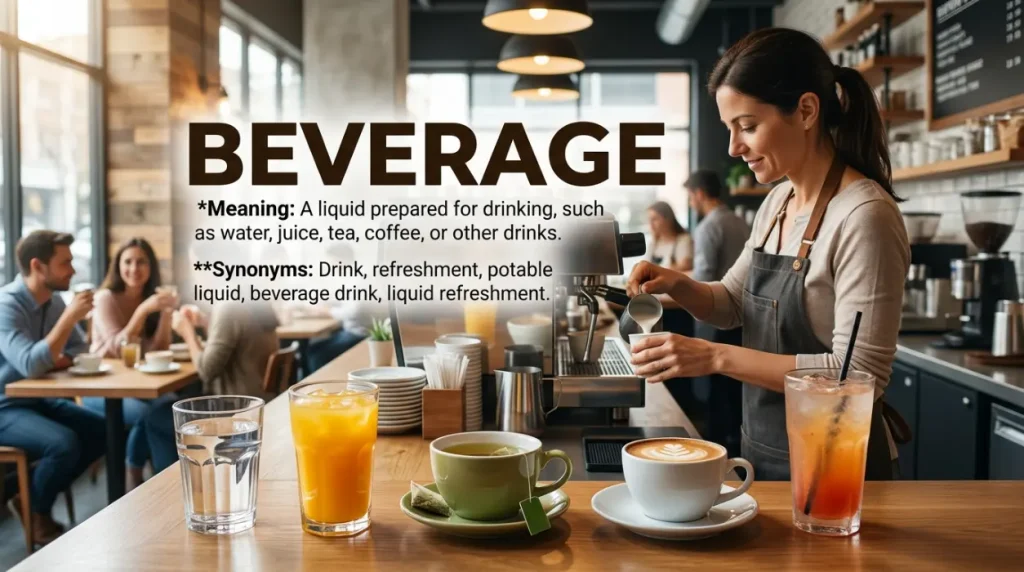
Synonyms for beverage can make a simple drink sound more precise, natural, or interesting. Imagine choosing words for a menu, essay, blog, or everyday conversation.
At breakfast, you might ask for a drink, order a coffee, or offer a refreshing beverage. The right synonym makes your English sound natural and suits the situation.
A synonym for beverage is useful because “beverage” is common, but it can sound formal. Students, bloggers, writers, and daily speakers need flexible choices.
Learning alternatives also prevents repetition. Knowing which words fit formal, casual, social, or creative contexts makes your English clearer, richer, and more confident.
What Does “Synonym for Beverage” Really Mean?
A beverage is a liquid meant to be drunk.
In simple English, a beverage is something you drink, such as water, tea, coffee, juice, milk, or a soft drink.
Beverage is primarily a noun. It is commonly used when talking about drinks as a category rather than one particular drink.
For example:
“The hotel provides complimentary beverages.”
Native speakers understand beverage immediately. However, the word often has a slightly more formal or polished feeling than drink.
In everyday speech, someone is more likely to say, “Would you like a drink?” In a restaurant description, report, advertisement, menu, or formal notice, beverage may sound more appropriate.
The word can describe both alcoholic and non-alcoholic drinks, although the exact meaning depends on context.
Common contexts include:
- Restaurants and cafés
- Hotels and hospitality
- Menus
- Food writing
- Academic writing
- Health discussions
- Product descriptions
- Everyday conversations
- Travel writing
- Business communication
Therefore, when searching for a synonym for beverage, you should consider more than the dictionary meaning. Tone, audience, formality, and context all matter.
Connotative Meaning of “Beverage”
Connotation (the feeling, association, or attitude a word may suggest beyond its basic dictionary meaning) can change how a word sounds.
Positive Tone
Beverage can sound polished, refreshing, sophisticated, or professional.
For example, “a refreshing beverage” creates a pleasant image. Similarly, “premium beverages” can suggest quality or variety.
Negative Tone
The word itself is not normally negative.
However, it can sound overly formal or impersonal in a very casual conversation. Saying “Please pass me a beverage” may sound unnecessarily stiff among friends.
Neutral Tone
The most common tone is neutral and descriptive.
For example, “The event offers hot and cold beverages” simply provides information without showing strong emotion.
Etymology
The history of beverage is connected to the idea of drinking.
The modern English word came through Middle French and Old French, especially forms related to beivre or boivre, meaning “to drink.” These forms ultimately trace back to the Latin verb bibere, meaning “to drink.”
Old English: 450–1100
The modern word beverage was not an established Old English term. Old English used native words and expressions connected with drinking and liquids.
Words such as drincan, meaning “to drink,” were part of the language.
Middle English: 1100–1500
After the Norman Conquest, French vocabulary strongly influenced English.
Forms related to beverage entered Middle English through French. The word referred to something drunk or a drink.
Modern English: 1500–Present
Over time, beverage became a standard English noun.
Today, it is especially common in formal, commercial, hospitality, culinary, and professional language. In everyday speech, drink remains more common.
Pronunciation
US: /ˈbɛvərɪdʒ/
UK: /ˈbɛvərɪdʒ/
Syllables
bev-er-age
Affixation Pattern of “Beverage”
Root: related historically to French beivre/boivre and Latin bibere, “to drink”
Prefix: None in modern English
Suffix: -age, forming a noun associated with an action, result, or thing
Synonyms List
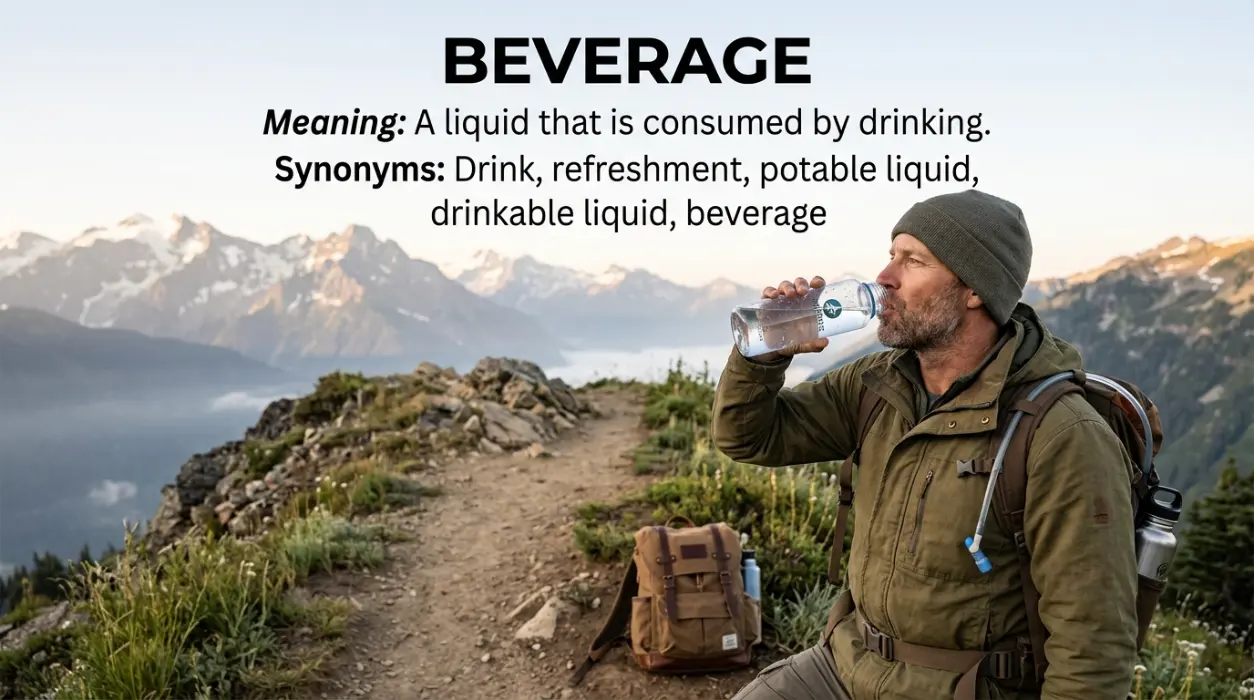
Drink (Noun) — US /drɪŋk/ — UK /drɪŋk/
Meaning: A liquid that is consumed by drinking.
Tone/Register: Neutral, extremely common, everyday.
Example:
“Would you like a drink before dinner?”
“I ordered a cold drink for the train ride.”
Drinking Water (Noun) — US /ˈdrɪŋkɪŋ ˈwɔːtər/ — UK /ˈdrɪŋkɪŋ ˈwɔːtə/
Meaning: Water that is safe and intended for people to drink.
Tone/Register: Neutral, practical.
Example:
“The campsite has fresh drinking water.”
“Always carry drinking water on a long hike.”
Refreshment (Noun) — US /rɪˈfrɛʃmənt/ — UK /rɪˈfrɛʃmənt/
Meaning: A drink or light food served to refresh someone.
Tone/Register: Formal, hospitality, event-related.
Example:
“Refreshments will be served after the meeting.”
“Guests were offered refreshments in the lobby.”
Libation (Noun) — US /laɪˈbeɪʃən/ — UK /laɪˈbeɪʃən/
Meaning: A drink, especially an alcoholic drink, often used humorously or ceremonially.
Tone/Register: Formal, literary, playful.
Example:
“They raised a libation to celebrate the victory.”
“He joked about enjoying a well-earned libation.”
Potation (Noun) — US /poʊˈteɪʃən/ — UK /pəˈteɪʃən/
Meaning: A drink or act of drinking, especially in formal or historical language.
Tone/Register: Literary, archaic, specialized.
Example:
“The old text describes a ceremonial potation.”
“The word is rarely heard in modern conversation.”
Tipple (Noun) — US /ˈtɪpəl/ — UK /ˈtɪpəl/
Meaning: An alcoholic drink, especially one enjoyed regularly.
Tone/Register: Informal, British, playful.
Example:
“What’s your usual tipple?”
“He ordered his favorite tipple after work.”
Draught (Noun) — US /dræft/ — UK /drɑːft/
Meaning: A drink, especially beer, poured from a barrel or tap.
Tone/Register: Informal, British, beverage-specific.
Example:
“The pub serves several draught beers.”
“She ordered a cold draught after the game.”
Draft (Noun) — US /dræft/ — UK /drɑːft/
Meaning: The American spelling commonly used for beer served from a tap.
Tone/Register: Informal, American, beverage-specific.
Example:
“He asked for a draft beer.”
“The bar has several beers on draft.”
Brew (Noun) — US /bruː/ — UK /bruː/
Meaning: A drink produced by brewing, especially tea, coffee, or beer.
Tone/Register: Informal, conversational.
Example:
“I need a strong brew this morning.”
“She made a fresh brew before class.”
Infusion (Noun) — US /ɪnˈfjuːʒən/ — UK /ɪnˈfjuːʒən/
Meaning: A drink made by soaking an ingredient in hot or cold liquid.
Tone/Register: Culinary, formal, descriptive.
Example:
“The café serves a ginger infusion.”
“This herbal infusion has a gentle flavor.”
Tea (Noun) — US /tiː/ — UK /tiː/
Meaning: A beverage made by infusing tea leaves or other herbs in water.
Tone/Register: Neutral, everyday.
Example:
“I usually drink tea after lunch.”
“She prepared a cup of green tea.”
Coffee (Noun) — US /ˈkɔːfi/ — UK /ˈkɒfi/
Meaning: A beverage made from roasted coffee beans and water.
Tone/Register: Neutral, everyday.
Example:
“I grabbed a coffee before work.”
“He drinks coffee without sugar.”
Juice (Noun) — US /dʒuːs/ — UK /dʒuːs/
Meaning: A drink made from the liquid of fruit or vegetables.
Tone/Register: Neutral, everyday.
Example:
“She packed orange juice for breakfast.”
“The children chose apple juice.”
Milk (Noun) — US /mɪlk/ — UK /mɪlk/
Meaning: A white nutritious liquid commonly consumed as a drink or used in food.
Tone/Register: Neutral.
Example:
“He drinks milk with breakfast.”
“We need more milk for the recipe.”
Smoothie (Noun) — US /ˈsmuːði/ — UK /ˈsmuːði/
Meaning: A thick cold drink made by blending fruit, vegetables, or other ingredients.
Tone/Register: Informal, modern.
Example:
“She made a banana smoothie after exercising.”
“I ordered a berry smoothie.”
Shake (Noun) — US /ʃeɪk/ — UK /ʃeɪk/
Meaning: A thick blended drink, often made with milk, ice cream, fruit, or flavorings.
Tone/Register: Informal, everyday.
Example:
“He treated himself to a chocolate shake.”
“The café makes a creamy vanilla shake.”
Soda (Noun) — US /ˈsoʊdə/ — UK /ˈsəʊdə/
Meaning: A carbonated soft drink.
Tone/Register: Informal, American.
Example:
“She ordered a soda with lunch.”
“I rarely drink soda now.”
Pop (Noun) — US /pɑːp/ — UK /pɒp/
Meaning: A carbonated soft drink, especially in parts of North America.
Tone/Register: Informal, regional.
Example:
“Do you want a can of pop?”
“Pop is especially common in some northern regions.”
Soft Drink (Noun) — US /ˌsɔːft ˈdrɪŋk/ — UK /ˌsɒft ˈdrɪŋk/
Meaning: A non-alcoholic drink, especially a carbonated one.
Tone/Register: Neutral, common.
Example:
“The restaurant offers several soft drinks.”
“I chose a soft drink instead of alcohol.”
Fizzy Drink (Noun) — US /ˈfɪzi drɪŋk/ — UK /ˈfɪzi drɪŋk/
Meaning: A carbonated drink containing bubbles.
Tone/Register: Informal, British.
Example:
“My nephew asked for a fizzy drink.”
“She prefers water to fizzy drinks.”
Carbonated Drink (Noun) — US /ˈkɑːrbəneɪtɪd drɪŋk/ — UK /ˈkɑːbəneɪtɪd drɪŋk/
Meaning: A drink containing dissolved carbon dioxide that creates bubbles.
Tone/Register: Formal, technical, descriptive.
Example:
“The study examined consumption of carbonated drinks.”
“He avoided carbonated drinks during the trip.”
Cold Drink (Noun) — US /koʊld drɪŋk/ — UK /kəʊld drɪŋk/
Meaning: A drink served cold rather than hot.
Tone/Register: Neutral.
Example:
“I need a cold drink after that walk.”
“She brought cold drinks for everyone.”
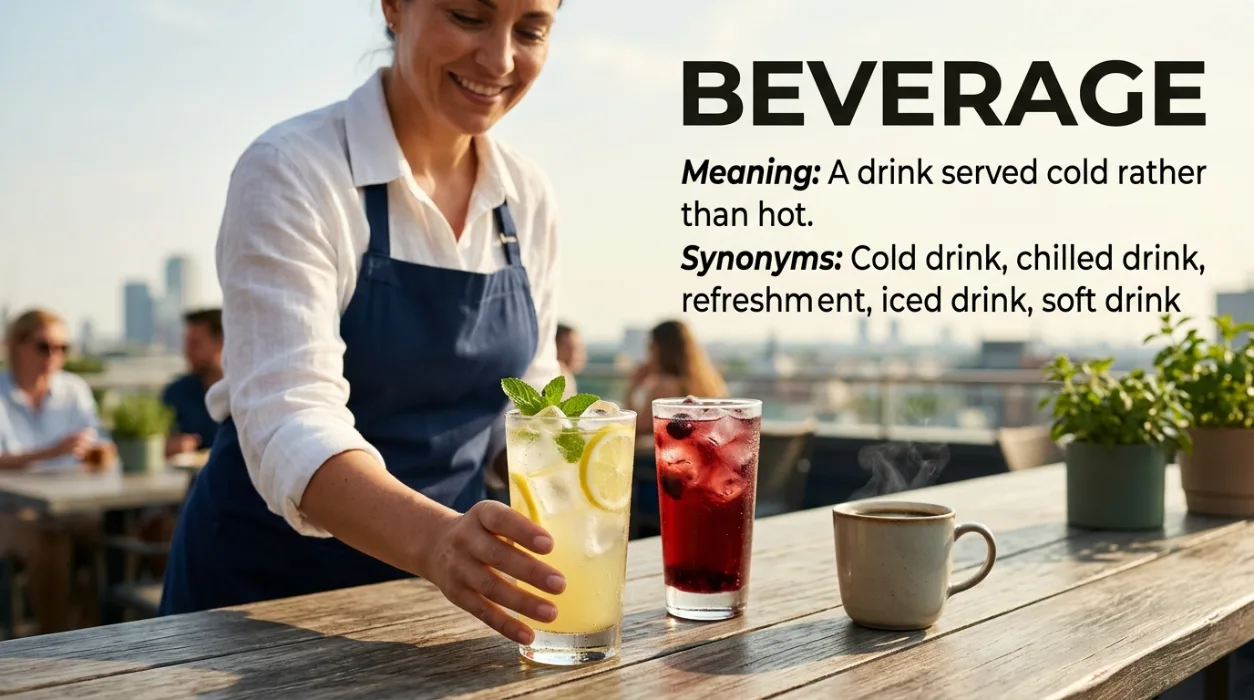
Hot Drink (Noun) — US /hɑːt drɪŋk/ — UK /hɒt drɪŋk/
Meaning: A drink normally served hot, such as tea or coffee.
Tone/Register: Neutral.
Example:
“I always have a hot drink before bed.”
“The café serves several hot drinks.”
Tonic (Noun) — US /ˈtɑːnɪk/ — UK /ˈtɒnɪk/
Meaning: A drink traditionally associated with improving health or energy.
Tone/Register: Traditional, descriptive.
Example:
“Her grandmother recommended a herbal tonic.”
“The old recipe calls the drink a tonic.”
Elixir (Noun) — US /ɪˈlɪksər/ — UK /ɪˈlɪksə/
Meaning: A special drink believed to have beneficial or magical qualities.
Tone/Register: Literary, historical, playful.
Example:
“The fantasy novel describes a healing elixir.”
“The café gave its new drink a playful elixir-like name.”
Potion (Noun) — US /ˈpoʊʃən/ — UK /ˈpəʊʃən/
Meaning: A liquid preparation, especially one associated with magic or medicine.
Tone/Register: Literary, fantasy, playful.
Example:
“The wizard mixed a glowing potion.”
“The children pretended their fruit drink was a magic potion.”
Concoction (Noun) — US /kənˈkɑːkʃən/ — UK /kənˈkɒkʃən/
Meaning: A drink or mixture made from several ingredients, often in an unusual way.
Tone/Register: Informal, humorous.
Example:
“He created a strange fruit concoction.”
“Her homemade drink was an unexpected concoction.”
Mixture (Noun) — US /ˈmɪkstʃər/ — UK /ˈmɪkstʃə/
Meaning: A combination of substances, which can include ingredients in a drink.
Tone/Register: Neutral, technical.
Example:
“Stir the mixture before serving.”
“The drink is a mixture of citrus and herbs.”
Blend (Noun) — US /blɛnd/ — UK /blend/
Meaning: A drink made by combining different ingredients or flavors.
Tone/Register: Neutral, culinary, modern.
Example:
“This blend combines peach and mint.”
“She created a smooth coffee blend.”
Infused Drink (Noun) — US /ɪnˈfjuːzd drɪŋk/ — UK /ɪnˈfjuːzd drɪŋk/
Meaning: A drink whose flavor comes from ingredients soaked in the liquid.
Tone/Register: Culinary, descriptive.
Example:
“I made an infused drink with lemon and mint.”
“The hotel serves several fruit-infused drinks.”
Herbal Drink (Noun) — US /ˈɜːrbəl drɪŋk/ — UK /ˈhɜːbəl drɪŋk/
Meaning: A drink prepared from herbs rather than conventional tea leaves.
Tone/Register: Neutral, health and culinary contexts.
Example:
“She enjoys a warm herbal drink at night.”
“The café serves several herbal drinks.”
Energy Drink (Noun) — US /ˈɛnərdʒi drɪŋk/ — UK /ˈenədʒi drɪŋk/
Meaning: A beverage marketed as providing increased alertness or energy.
Tone/Register: Neutral, modern.
Example:
“He bought an energy drink before the late shift.”
“She rarely chooses energy drinks.”
Sports Drink (Noun) — US /spɔːrts drɪŋk/ — UK /spɔːts drɪŋk/
Meaning: A drink formulated for people during or after physical activity.
Tone/Register: Neutral, fitness-related.
Example:
“The runners carried sports drinks.”
“He packed one for the long training session.”
Nutritional Drink (Noun) — US /nuːˈtrɪʃənəl drɪŋk/ — UK /njuːˈtrɪʃənəl drɪŋk/
Meaning: A drink designed to provide nutrients as part of a diet.
Tone/Register: Formal, health-related.
Example:
“The label describes it as a nutritional drink.”
“She included a nutritional drink with breakfast.”
Refreshing Drink (Noun) — US /rɪˈfrɛʃɪŋ drɪŋk/ — UK /rɪˈfreʃɪŋ drɪŋk/
Meaning: A drink perceived as pleasantly cooling or revitalizing.
Tone/Register: Positive, descriptive.
Example:
“We stopped for a refreshing drink.”
“Lemon water makes a refreshing drink on hot days.”
Coolant (Noun) — US /ˈkuːlənt/ — UK /ˈkuːlənt/
Meaning: A liquid used to reduce temperature, not normally a synonym for a human drink.
Tone/Register: Technical.
Example:
“The engine requires a specific coolant.”
“Do not use the word coolant for an ordinary beverage.”
Water (Noun) — US /ˈwɔːtər/ — UK /ˈwɔːtə/
Meaning: A clear liquid commonly consumed to maintain hydration.
Tone/Register: Neutral, universal.
Example:
“Can I have some water?”
“She carries a bottle of water every day.”
Mineral Water (Noun) — US /ˈmɪnərəl ˈwɔːtər/ — UK /ˈmɪnərəl ˈwɔːtə/
Meaning: Water containing naturally occurring minerals.
Tone/Register: Neutral, culinary, hospitality.
Example:
“The restaurant serves mineral water.”
“He prefers sparkling mineral water.”
Sparkling Water (Noun) — US /ˈspɑːrklɪŋ ˈwɔːtər/ — UK /ˈspɑːklɪŋ ˈwɔːtə/
Meaning: Water containing carbon dioxide bubbles.
Tone/Register: Neutral, modern.
Example:
“She ordered sparkling water with dinner.”
“I usually choose sparkling water at restaurants.”
Still Water (Noun) — US /stɪl ˈwɔːtər/ — UK /stɪl ˈwɔːtə/
Meaning: Water without carbonation.
Tone/Register: Neutral, hospitality.
Example:
“Would you like still or sparkling water?”
“He asked for a bottle of still water.”
Nectar (Noun) — US /ˈnɛktər/ — UK /ˈnɛktə/
Meaning: A sweet liquid, often fruit-based, or a poetic term for a delightful drink.
Tone/Register: Literary, poetic, descriptive.
Example:
“The poem compares the juice to nectar.”
“The ripe fruit produced a sweet nectar.”
Cordial (Noun) — US /ˈkɔːrdʒəl/ — UK /ˈkɔːdiəl/
Meaning: A sweet concentrated drink that is usually diluted with water, especially in British English.
Tone/Register: Neutral, British.
Example:
“She mixed the berry cordial with water.”
“Elderflower cordial is popular in summer.”
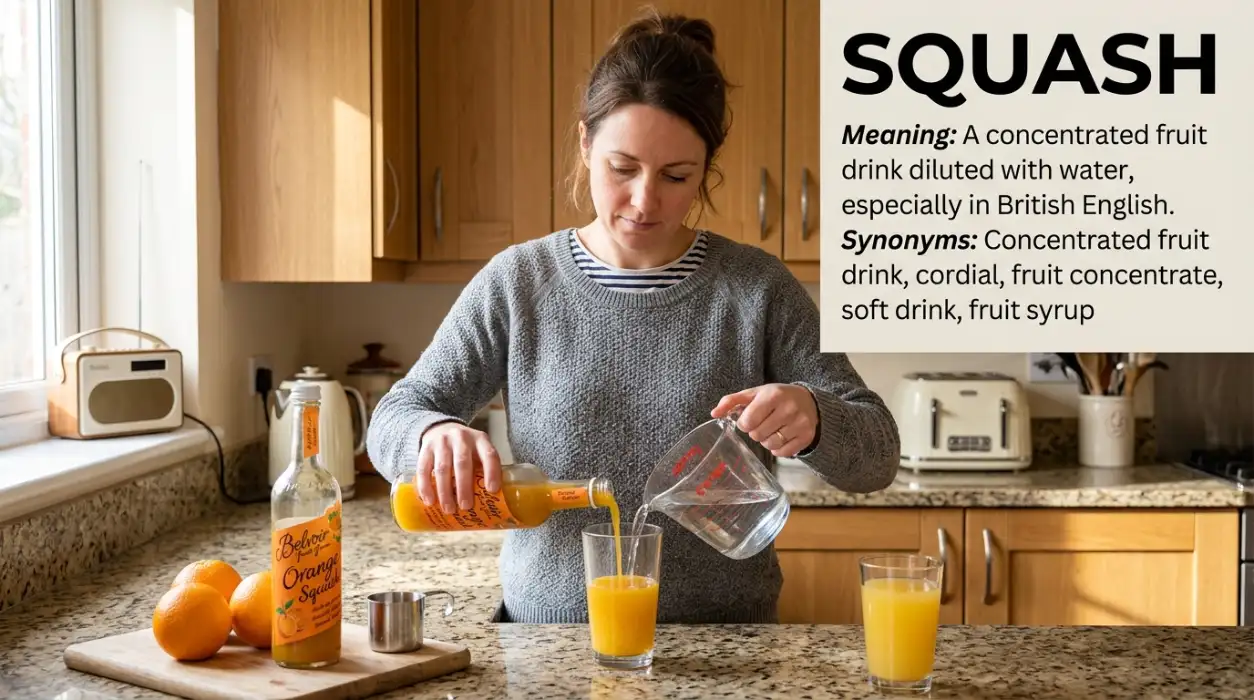
Squash (Noun) — US /skwɑːʃ/ — UK /skwɒʃ/
Meaning: A concentrated fruit drink that is diluted with water, especially in British English.
Tone/Register: Informal, British.
Example:
“Would you like orange squash?”
“The children had fruit squash after school.”
Syrup (Noun) — US /ˈsɪrəp/ — UK /ˈsɪrəp/
Meaning: A thick sweet liquid used as an ingredient or base for some drinks.
Tone/Register: Neutral, culinary.
Example:
“The bartender added a little syrup.”
“Maple syrup can be used in some drink recipes.”
Broth (Noun) — US /brɔːθ/ — UK /brɒθ/
Meaning: A savory liquid prepared from meat, vegetables, or other ingredients and sometimes consumed as a drink.
Tone/Register: Culinary, neutral.
Example:
“She sipped warm broth during the cold evening.”
“The chef prepared a vegetable broth.”
Soup (Noun) — US /suːp/ — UK /suːp/
Meaning: A liquid food containing ingredients such as vegetables, meat, or grains.
Tone/Register: Neutral, culinary.
Example:
“He had a bowl of soup for lunch.”
“The warm soup was comforting.”
Malt (Noun) — US /mɔːlt/ — UK /mɔːlt/
Meaning: A drink or ingredient made using malted grain, depending on context.
Tone/Register: Neutral, beverage-specific.
Example:
“She ordered a chocolate malt.”
“The recipe uses malt for a deeper flavor.”
Cider (Noun) — US /ˈsaɪdər/ — UK /ˈsaɪdə/
Meaning: A fermented drink made primarily from apple juice, with regional differences in usage.
Tone/Register: Neutral, beverage-specific.
Example:
“They served local cider at the gathering.”
“He chose apple cider with his meal.”
Cocktail (Noun) — US /ˈkɑːkteɪl/ — UK /ˈkɒkteɪl/
Meaning: A mixed drink usually made from several ingredients.
Tone/Register: Neutral, social, hospitality.
Example:
“She ordered a fruit cocktail.”
“The menu includes several classic cocktails.”
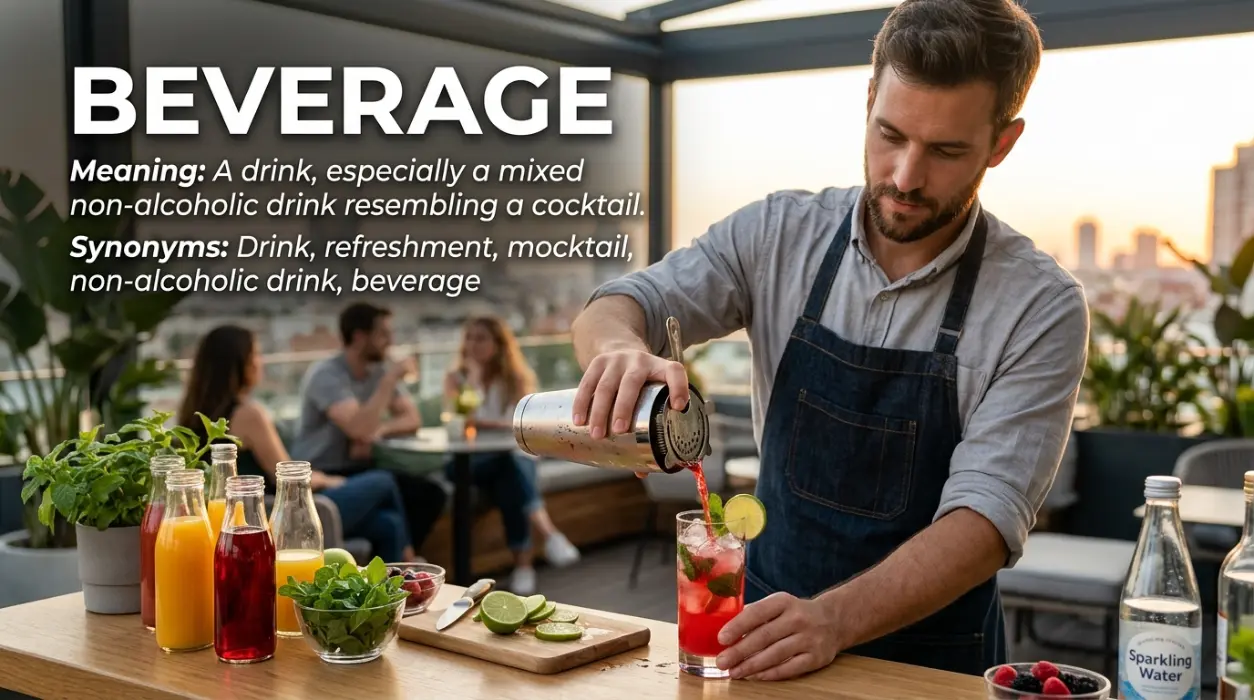
Mocktail (Noun) — US /ˈmɑːkteɪl/ — UK /ˈmɒkteɪl/
Meaning: A mixed non-alcoholic drink designed to resemble a cocktail.
Tone/Register: Informal, modern.
Example:
“He chose a citrus mocktail.”
“The party offered colorful mocktails.
Synonyms by Tone
Not every alternative should be used in the same situation. Therefore, tone matters as much as dictionary meaning.
Positive
Useful positive or pleasant choices include:
- Refreshment
- Refreshing drink
- Nectar
- Elixir
- Brew
- Smoothie
- Cordial
These words can make a drink sound enjoyable, comforting, special, or flavorful.
Neutral
The most flexible choices include:
- Drink
- Beverage
- Water
- Tea
- Coffee
- Juice
- Milk
- Soft drink
- Cold drink
- Hot drink
- Blend
- Mixture
These are generally safe when you want clear communication.
Negative
There are few genuinely negative synonyms for beverage.
Instead, negative meaning usually comes from the surrounding adjective or sentence. For example, “unhealthy drink,” “sugary drink,” “cheap concoction,” or “questionable mixture” can create a negative impression.
This distinction is important. A synonym itself does not always carry the emotional meaning.
Playful or Informal
For casual or humorous writing, consider:
- Tipple
- Brew
- Pop
- Potion
- Concoction
- Shake
- Draft
- Mocktail
These choices can make writing sound more conversational or expressive.
Why Tone Matters in Word Choice
Imagine writing the sentence, “The guests were offered a beverage.”
It sounds professional.
Now compare it with, “The guests were offered a drink.”
That sounds simpler and more conversational.
Finally, consider, “The guests were offered a refreshing herbal infusion.”
This version feels more descriptive and specific.
Therefore, choosing a synonym is not simply about avoiding repetition. It is about matching the word to your audience and purpose.
“Beverage” vs Close Alternatives
Drink vs Beverage
Beverage is more formal and category-focused.
Drink is more common in everyday English.
Use beverage in formal descriptions, hospitality writing, reports, and menus. Use drink in ordinary conversation.
Beverage vs Refreshment
Beverage refers broadly to something consumed as a drink.
Refreshment can refer to a drink or a light snack served to guests.
Therefore, refreshment has a stronger connection with hospitality and social events.
Beverage vs Liquid
Beverage specifically suggests something intended for drinking.
Liquid is much broader.
For example, water, milk, and juice can be beverages. However, engine oil is a liquid but not a beverage.
How “Beverage” Changes by Context
Daily Conversation
In casual conversation, drink is normally the easiest choice.
You might say, “Can I get a drink?” rather than “Can I get a beverage?”
Still, beverage is perfectly understandable. It simply sounds more formal.
Writing and Blogging
Bloggers often benefit from switching between drink, beverage, refreshment, brew, and specific drink names.
For example, a food article can mention “a refreshing beverage” once, then naturally use “iced tea,” “drink,” or “infusion.”
This creates variety without forcing unusual vocabulary.
Professional or Academic Writing
Beverage works particularly well in reports, research writing, hospitality documents, menus, and formal descriptions.
Specific terms can be even better when precision matters.
For example, “carbonated drink” gives more information than the broad word beverage.
Creative and Informal Use
Creative writing gives you more freedom.
Words such as potion, nectar, brew, tipple, and concoction can create mood and personality.
However, the word should match the character and setting. A fantasy character might call a drink a potion, while a scientist would probably not.
Common Mistakes Learners Make
Mistake 1: Using “Beverage” Everywhere
Repeating beverage in every sentence can make writing sound mechanical.
Instead, vary the word naturally.
Mistake 2: Treating Every Liquid as a Beverage
A beverage is intended to be consumed as a drink.
Therefore, oil, fuel, detergent, and coolant are liquids but are not beverages.
Mistake 3: Using “Refreshment” as a Perfect Replacement
Refreshment can mean a drink, but it can also include light food.
So, context matters.
Mistake 4: Using Very Formal Words in Casual Speech
Words such as potation and libation are not normal replacements for drink in most everyday conversations.
They may sound humorous, literary, or deliberately formal.
Mistake 5: Confusing “Drinkable” With “Drink”
Drinkable is an adjective.
For example, “The water is drinkable.”
It does not mean the same thing as the noun drink.
Register Notes
For formal English, use:
- Beverage
- Refreshment
- Potable
- Carbonated drink
- Nutritional drink
- Liquid refreshment
For everyday English, use:
- Drink
- Water
- Tea
- Coffee
- Juice
- Soda
- Smoothie
If you are learning related vocabulary, an internal guide on synonyms and register can help you understand when a word sounds formal, neutral, or informal.
Real-Life Mini Scenarios
Workplace
A manager might write:
“Tea, coffee, and other beverages will be available during the meeting.”
In a casual message, the same person might say:
“Drinks will be available at the meeting.”
Social Situation
A friend may ask:
“Do you want a drink?”
That is much more natural than:
“Would you like a beverage?”
The second version is grammatical, but it sounds more formal.
Media and Pop Culture
A movie character might jokingly say:
“This mysterious potion will solve everything.”
Here, potion creates personality and humor rather than simply naming a drink.
Writing and Storytelling
A food blogger might write:
“The café serves a refreshing blend of citrus, mint, and sparkling water.”
The word blend adds detail and avoids repeating beverage.
Practice Exercise
1. Which word sounds most natural in a casual question?
A. Beverage
B. Drink
C. Potation
D. Libation
2. Which word is especially suitable for a formal hotel notice?
A. Tipple
B. Brew
C. Beverage
D. Pop
3. Which term describes water that is safe to drink?
A. Potable
B. Potion
C. Cordial
D. Draft
4. Which word can describe a mixed non-alcoholic drink?
A. Mocktail
B. Digestif
C. Broth
D. Tipple
5. Which British term can describe a concentrated fruit drink diluted with water?
A. Squash
B. Soda
C. Shake
D. Malt
6. Which word can have a humorous or literary feeling?
A. Water
B. Potion
C. Milk
D. Juice
7. Which term usually describes a drink served before a meal?
A. Aperitif
B. Digestif
C. Broth
D. Smoothie
8. Which word is most suitable for everyday American English when referring to a carbonated soft drink?
A. Soda
B. Cordial
C. Squash
D. Aperitif
9. Which word can describe a thick blended fruit drink?
A. Smoothie
B. Potation
C. Draught
D. Tonic
10. Which word is broader than “beverage”?
A. Drink
B. Liquid
C. Tea
D. Juice
Answer Key: 1-B, 2-C, 3-A, 4-A, 5-A, 6-B, 7-A, 8-A, 9-A, 10-B
Reflection Task
Choose one synonym from this article and write your own sentence using it. Then rewrite the sentence with drink and decide which version sounds more natural for your intended audience.
Conclusion
Choosing a synonym for beverage is about more than replacing one word. It helps you match your English to the audience, setting, purpose, and feeling you want to create.
The simplest choice is often drink, while beverage works well in formal contexts. More specific words add precision, while creative alternatives can add personality and color.
When you learn these distinctions, your writing becomes smoother, and your speaking becomes more flexible. You can sound professional in a report and relaxed with friends.
FAQs
1. What is the best synonym for beverage in everyday English?
The best everyday synonym for beverage is drink. It is short, natural, and widely understood by native speakers. For example, “Would you like a drink?” sounds more conversational than “Would you like a beverage?” However, beverage remains useful in formal writing, hospitality, menus, reports, and category descriptions.
2. What is a formal synonym for beverage?
Refreshment and beverage are common formal choices, depending on the sentence. Beverage is especially useful when discussing drinks as a category. Refreshment is often used for drinks or light food served during meetings, events, or hospitality situations. For technical writing, a more specific term may be better.
3. Are “drink” and “beverage” the same thing?
They are very close, but they are not identical in every context. Drink is more common and flexible in everyday English. Beverage sounds more formal and often refers to a drink as a category. Also, “drink” can function as both a noun and a verb, while beverage is normally a noun.
4. What is another word for beverage in formal writing?
For formal writing, beverage, refreshment, carbonated drink, nutritional drink, and non-alcoholic drink can work depending on meaning. The most accurate choice depends on what you want to describe. Rather than replacing the word automatically, choose the alternative that gives your reader the exact information needed.
5. What is a British English synonym for beverage?
In British English, drink is still the most common general term. Depending on the context, words such as squash, cordial, fizzy drink, draught, and tipple may be appropriate. These are not universal replacements, though. Each describes a particular type, style, or social use of drink.

Hasnain Ali is an SEO Content Strategist and the founder of wordvora.com, a trusted vocabulary platform that helps writers, students, professionals, and English learners find accurate synonyms, antonyms, word meanings, and real-life usage examples. He specializes in keyword research, on-page SEO, topical authority, and creating search-first content that aligns with Google’s latest Search Quality and E-E-A-T guidelines. His work focuses on producing clear, well-structured, and reader-friendly resources that satisfy search intent while maintaining high editorial standards.
Through extensive hands-on experience with SEO tools such as Google Search Console, Google Analytics, SEMrush, and Ahrefs, Hasnain researches user search behavior and develops content that is both informative and easy to understand. Every article published on wordvora.com is carefully reviewed for accuracy, readability, and contextual relevance before publication. His mission is to build one of the web’s most reliable English vocabulary resources by providing practical language guidance, trustworthy explanations, and content that helps readers improve their writing, communication, and vocabulary with confidence.