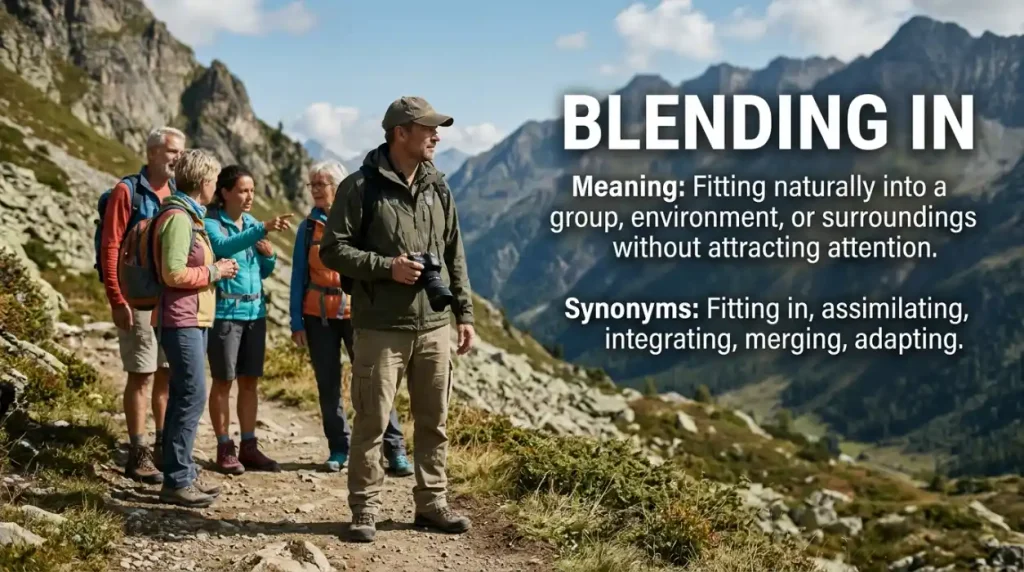
The synonym for blending in became useful to Maya when she entered a crowded café alone. She wanted to look natural, not attract attention, and simply fit in.
A simple example is joining a new class and matching the group’s usual style. You are not hiding completely; you are making yourself less noticeable.
Knowing a synonym for blending in helps you avoid repeating the same phrase. It also lets you choose words that sound more natural in each situation.
Students, bloggers, content writers, and daily English users can all benefit. Instead of repeating “blending in,” you can say “fitting in,” “merging,” or “going unnoticed.”
What Does “Synonym for Blending In” Really Mean?
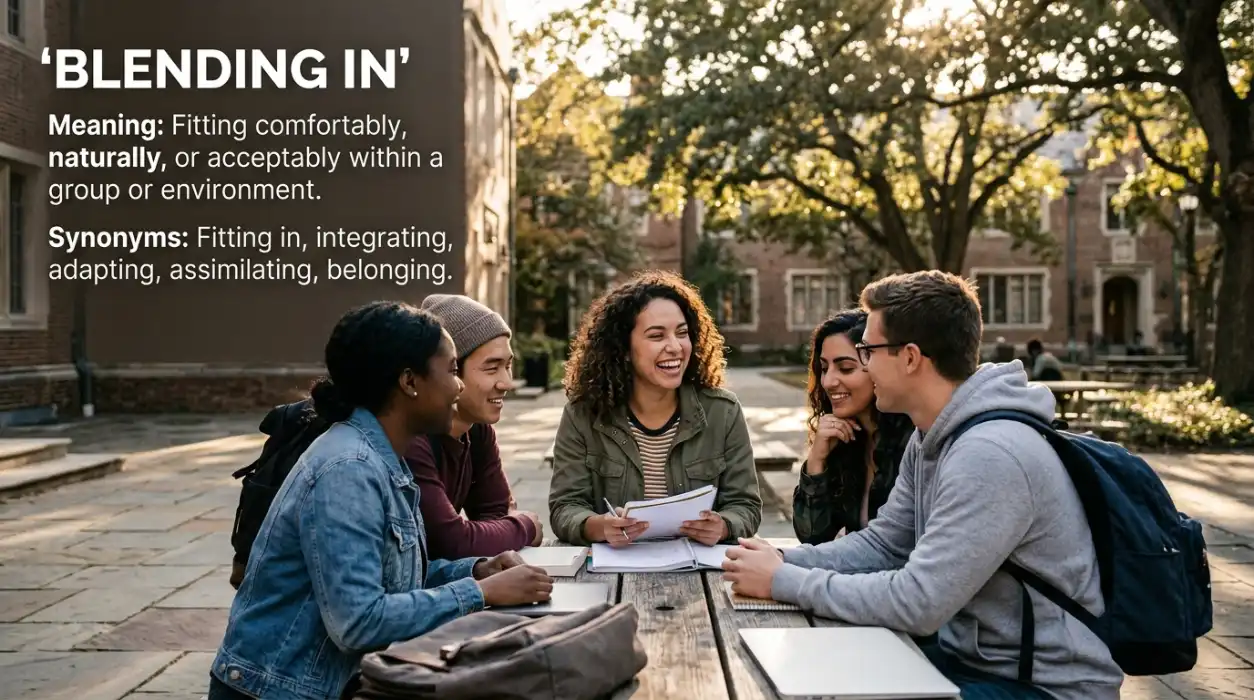
The phrase blending in usually means becoming similar enough to your surroundings, group, or environment that you do not stand out.
For example:
She wore neutral colors to blend in with the crowd.
In another context, it can mean behaving like other people so that you appear to belong.
He moved to the new city and slowly learned how to blend in.
The expression is a phrasal verb, formed from the verb blend and the particle in. Dictionaries describe blend in as looking or seeming similar to surrounding people or things and therefore not being easily noticed.
Native speakers use it in several common situations. These include social groups, clothing, architecture, nature, workplaces, neighborhoods, photography, storytelling, and everyday conversation.
The phrase can describe people, animals, objects, colors, sounds, designs, or ideas.
Simple Definition
Blending in means looking, behaving, or appearing similar to your surroundings so that you do not strongly stand out.
What Does “Blending In” Suggest?
The meaning depends on context.
Someone may blend in because they want to feel comfortable in a new group. Someone else may blend in because they want to avoid attention.
Likewise, a building can blend in with its surroundings without any social meaning. A color can blend into a background because it matches nearby colors.
Therefore, blending in does not always mean changing who you are. It often simply means appearing compatible with the surrounding environment.
Connotative Meaning
Connotation (the emotional or cultural feeling associated with a word beyond its basic dictionary meaning) matters when choosing a synonym.
Positive Tone
Blending in can suggest adaptability, harmony, belonging, comfort, and social awareness.
She quickly blended in with her new classmates.
Here, the phrase suggests successful social adjustment.
Negative Tone
In some contexts, blending in can suggest conformity, invisibility, lack of individuality, or excessive concern about fitting in.
He was tired of blending in and wanted to express his own style.
Neutral Tone
The phrase can also be completely neutral.
The gray wall blends in with the surrounding buildings.
There is no emotional judgment in this sentence. The wall simply matches its environment.
Etymology of “Blending In”
The history of blending in begins with the verb blend.
The English verb blend appeared in Middle English as forms such as blenden, meaning “to mix.” Its deeper history is connected with Old English blandan and Old Norse blanda, both associated with mixing. The word is ultimately linked to a Proto-Germanic root associated with mixing.
Old English: 450–1100
Old English had forms related to blandan, meaning “to mix.” The original idea focused on combining things rather than specifically disappearing into a social group.
Middle English: 1100–1500
During Middle English, blenden developed with the meaning “to mix” or “mingle.” The figurative idea of mingling closely also developed during this period.
Modern English: 1500–Present
Modern English expanded the idea. Today, blend can describe physical mixtures, colors, sounds, styles, people, and surroundings.
The phrasal verb blend in developed the familiar idea of becoming visually or socially unobtrusive.
Pronunciation
Blend in
- US: /blɛnd ɪn/
- UK: /blend ɪn/
The pronunciation is essentially the same in both varieties of English. Cambridge gives the base pronunciation as /blend/, while the phrase adds the particle in.
Syllables
blend-in
There are two spoken syllables:
blend — in
Affixation Pattern of “Blending In”
The expression is built from:
- Root: blend
- Prefix: none
- Suffix: -ing in blending
- Particle: in
The -ing ending creates the present participle form.
So:
blend → blending → blending in
Synonyms List
Fit In (Phrasal Verb) — US / UK: /fɪt ɪn/ /fɪt ɪn/
Meaning: To fit in means to seem comfortable, accepted, or compatible with a group or environment.
Tone/Register: Neutral, conversational
Example:
I was nervous on my first day, but I soon fit in.
Her personality helped her fit in with the team.
Mingle (Verb) — US / UK: /ˈmɪŋɡəl/ /ˈmɪŋɡəl/
Meaning: To mingle means to move among people and interact with them socially.
Tone/Register: Neutral, social
Example:
Guests mingled after the ceremony.
He mingled with the locals at the festival.
Merge (Verb) — US / UK: /mɝːdʒ/ /mɜːdʒ/
Meaning: To merge means to become combined with something else so that the separate parts become less distinct.
Tone/Register: Neutral, formal
Example:
The blue line merges with the dark background.
The two groups gradually merged into one community.
Integrate (Verb) — US / UK: /ˈɪntəɡreɪt/ /ˈɪntɪɡreɪt/
Meaning: To integrate means to become part of a group or system while functioning within it.
Tone/Register: Formal, academic
Example:
The new students integrated quickly.
She worked hard to integrate into the local community.
Assimilate (Verb) — US / UK: /əˈsɪməleɪt/ /əˈsɪməleɪt/
Meaning: To assimilate means to become culturally or socially similar to a surrounding group.
Tone/Register: Formal, academic
Example:
The family gradually assimilated into the community.
Some newcomers choose to assimilate, while others retain distinct traditions.
Adapt (Verb) — US / UK: /əˈdæpt/ /əˈdæpt/
Meaning: To adapt means to change your behavior or approach so that you function successfully in a new environment.
Tone/Register: Neutral, academic
Example:
She adapted quickly to office culture.
Animals often adapt to changing environments.
Conform (Verb) — US / UK: /kənˈfɔːrm/ /kənˈfɔːm/
Meaning: To conform means to behave according to accepted group standards or expectations.
Tone/Register: Formal, often negative
Example:
He refused to conform to the group’s style.
Many teenagers feel pressure to conform.
Harmonize (Verb) — US / UK: /ˈhɑːrmənaɪz/ /ˈhɑːmənaɪz/
Meaning: To harmonize means to match or work pleasantly with surrounding elements.
Tone/Register: Formal, descriptive
Example:
The new building harmonizes with the historic street.
Her colors harmonize beautifully with the room.
Match (Verb) — US / UK: /mætʃ/ /mætʃ/
Meaning: To match means to be similar to or visually compatible with something nearby.
Tone/Register: Neutral
Example:
The curtains match the walls.
His jacket matched the relaxed dress code.
Conform to (Phrasal Verb) — US / UK: /kənˈfɔːrm tuː/ /kənˈfɔːm tuː/
Meaning: To conform to something means to behave according to a rule, expectation, or standard.
Tone/Register: Formal
Example:
The design conforms to local standards.
She did not want to conform to every social expectation.
Become Part of (Phrase) — US / UK: /bɪˈkʌm pɑːrt əv/ /bɪˈkʌm pɑːt əv/
Meaning: This phrase means to join something so that you are regarded as one of its members or elements.
Tone/Register: Neutral
Example:
He became part of the neighborhood quickly.
The new tradition became part of school life.
Join In (Phrasal Verb) — US / UK: /dʒɔɪn ɪn/ /dʒɔɪn ɪn/
Meaning: To join in means to participate in an activity with other people.
Tone/Register: Informal, conversational
Example:
Everyone was dancing, so I joined in.
She smiled and joined in the conversation.
Belong (Verb) — US / UK: /bɪˈlɔːŋ/ /bɪˈlɒŋ/
Meaning: To belong means to feel or be accepted as a natural member of a group or place.
Tone/Register: Neutral, emotional
Example:
He finally felt that he belonged.
The club gave her a place where she could belong.
Settle In (Phrasal Verb) — US / UK: /ˈsetəl ɪn/ /ˈsetəl ɪn/
Meaning: To settle in means to become comfortable and familiar with a new place or situation.
Tone/Register: Informal, conversational
Example:
It took me a week to settle in.
The new employee settled in surprisingly fast.
Acclimate (Verb) — US / UK: /ˈækləmeɪt/ /ˈækləmeɪt/
Meaning: To acclimate means to become accustomed to a new environment or situation.
Tone/Register: Formal, academic
Example:
It took time to acclimate to the new climate.
She needed several days to acclimate to campus life.
Acclimatize (Verb) — US / UK: /əˈklaɪmətaɪz/ /əˈklaɪmətaɪz/
Meaning: To acclimatize means to gradually become comfortable with unfamiliar environmental conditions.
Tone/Register: Formal, British/academic
Example:
The hikers stopped to acclimatize to the altitude.
New residents often need time to acclimatize.
Disappear Into the Crowd (Phrase) — US / UK: /ˌdɪsəˈpɪr ɪntuː ðə kraʊd/ /ˌdɪsəˈpɪə ɪntuː ðə kraʊd/
Meaning: This phrase means becoming difficult to distinguish from other people in a crowd.
Tone/Register: Neutral, descriptive
Example:
The actor disappeared into the crowd after the show.
She slipped away and disappeared into the crowd.
Fade Into the Background (Phrase) — US / UK: /feɪd ˈɪntuː ðə ˈbækɡraʊnd/ /feɪd ˈɪntuː ðə ˈbækɡraʊnd/
Meaning: To fade into the background means to become less noticeable than the surrounding people or things.
Tone/Register: Neutral, figurative
Example:
He prefers to fade into the background at parties.
The pale furniture fades into the background.
Go Unnoticed (Phrase) — US / UK: /ɡoʊ ʌnˈnoʊtɪst/ /ɡəʊ ʌnˈnəʊtɪst/
Meaning: To go unnoticed means to avoid attracting attention.
Tone/Register: Neutral
Example:
She hoped her mistake would go unnoticed.
The small bird went unnoticed among the leaves.
Remain Unnoticed (Phrase) — US / UK: /rɪˈmeɪn ʌnˈnoʊtɪst/ /rɪˈmeɪn ʌnˈnəʊtɪst/
Meaning: To remain unnoticed means to continue without being observed or recognized.
Tone/Register: Formal, neutral
Example:
The tiny detail remained unnoticed for years.
He stayed quiet and remained unnoticed.
Be Inconspicuous (Phrase) — US / UK: /biː ˌɪnkənˈspɪkjuəs/ /biː ˌɪnkənˈspɪkjuəs/
Meaning: To be inconspicuous means not to attract attention because you are not easily noticeable.
Tone/Register: Formal
Example:
She chose an inconspicuous seat near the door.
The camera was small and inconspicuous.
Be Unobtrusive (Phrase) — US / UK: /biː ˌʌnəbˈtruːsɪv/ /biː ˌʌnəbˈtruːsɪv/
Meaning: To be unobtrusive means to avoid drawing attention or interfering with others.
Tone/Register: Formal
Example:
The microphone was small and unobtrusive.
He remained unobtrusive during the discussion.

Keep a Low Profile (Phrase) — US / UK: /kiːp ə loʊ ˈproʊfaɪl/ /kiːp ə ləʊ ˈprəʊfaɪl/
Meaning: To keep a low profile means deliberately avoiding attention.
Tone/Register: Informal, common
Example:
After the interview, she kept a low profile.
He prefers to keep a low profile online.
Stay Under the Radar (Idiom) — US / UK: /steɪ ˈʌndər ðə ˈreɪdɑːr/ /steɪ ˈʌndə ðə ˈreɪdɑː/
Meaning: To stay under the radar means to avoid notice, scrutiny, or unwanted attention.
Tone/Register: Informal, idiomatic
Example:
The small startup stayed under the radar for years.
He likes to stay under the radar at work.
Hide in Plain Sight (Idiom) — US / UK: /haɪd ɪn pleɪn saɪt/ /haɪd ɪn pleɪn saɪt/
Meaning: To hide in plain sight means to remain visible while looking ordinary enough not to attract suspicion.
Tone/Register: Idiomatic, dramatic
Example:
The clue was hiding in plain sight.
The character hid in plain sight among the tourists.
Camouflage (Verb) — US / UK: /ˈkæməflɑːʒ/ /ˈkæməflɑːʒ/
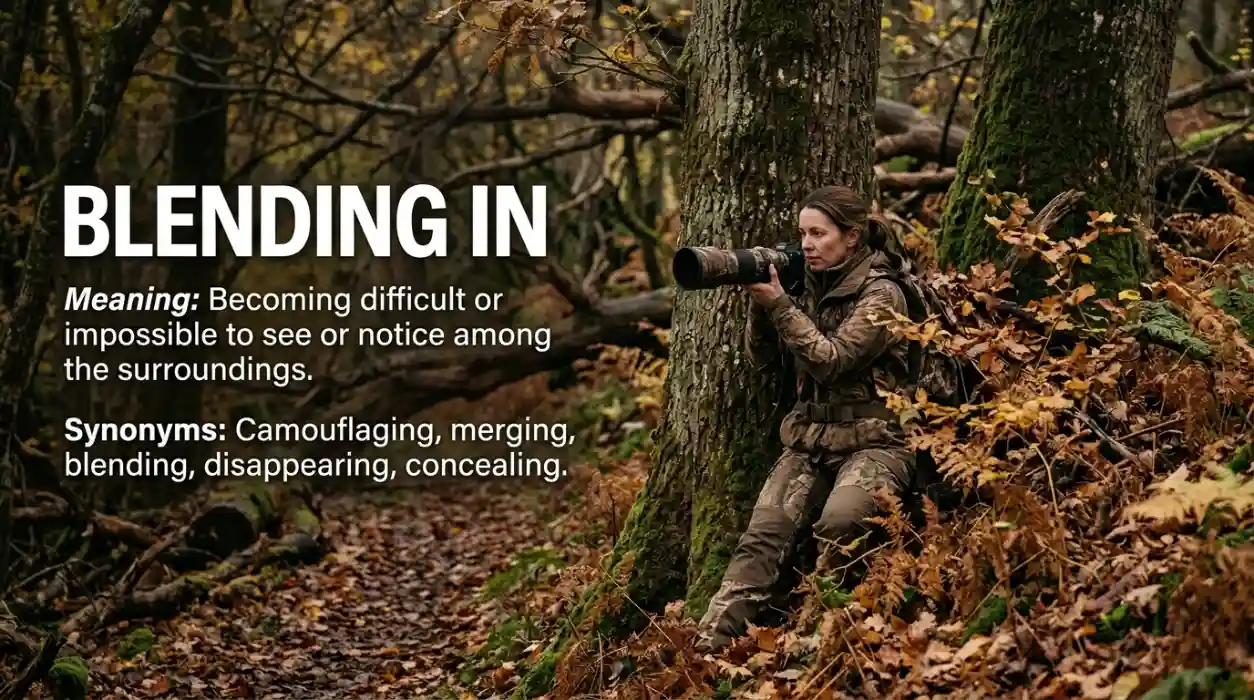
Meaning: To camouflage means to make someone or something difficult to see by matching its surroundings.
Tone/Register: Neutral, technical
Example:
The insect camouflaged itself among the leaves.
The jacket was designed to camouflage the wearer.
Conceal Yourself (Phrase) — US / UK: /kənˈsiːl jərˈself/ /kənˈsiːl jəˈself/
Meaning: To conceal yourself means to deliberately prevent others from seeing or recognizing you.
Tone/Register: Formal, serious
Example:
The photographer concealed himself behind a tree.
She concealed herself among the visitors.
Mask Yourself (Phrase) — US / UK: /mæsk jərˈself/ /mɑːsk jəˈself/
Meaning: To mask yourself means to hide your identity, appearance, or noticeable characteristics.
Tone/Register: Neutral, figurative
Example:
He masked his accent during the performance.
The character masked himself as an ordinary traveler.
Disguise Yourself (Phrase) — US / UK: /dɪsˈɡaɪz jərˈself/ /dɪsˈɡaɪz jəˈself/
Meaning: To disguise yourself means to deliberately alter your appearance so others do not recognize you.
Tone/Register: Neutral, narrative
Example:
The character disguised himself as a waiter.
She disguised herself with a hat and glasses.
Inconspicuous (Adjective) — US / UK: /ˌɪnkənˈspɪkjuəs/ /ˌɪnkənˈspɪkjuəs/
Meaning: Inconspicuous describes something that does not attract attention.
Tone/Register: Formal
Example:
He chose an inconspicuous backpack.
The small sign was almost inconspicuous.
Unobtrusive (Adjective) — US / UK: /ˌʌnəbˈtruːsɪv/ /ˌʌnəbˈtruːsɪv/
Meaning: Unobtrusive describes something that remains noticeable only to a small degree.
Tone/Register: Formal
Example:
The decoration is simple and unobtrusive.
Her presence was quiet and unobtrusive.
Indistinguishable (Adjective) — US / UK: /ˌɪndɪˈstɪŋɡwɪʃəbəl/ /ˌɪndɪˈstɪŋɡwɪʃəbəl/
Meaning: Indistinguishable describes things that cannot easily be told apart.
Tone/Register: Formal, academic
Example:
The copies were almost indistinguishable.
The bird became indistinguishable from the branches.
Unremarkable (Adjective) — US / UK: /ˌʌnrɪˈmɑːrkəbəl/ /ˌʌnrɪˈmɑːkəbəl/
Meaning: Unremarkable describes something ordinary enough not to attract special attention.
Tone/Register: Neutral, slightly negative
Example:
He wore an unremarkable gray coat.
The building looked completely unremarkable.
Ordinary (Adjective) — US / UK: /ˈɔːrdəneri/ /ˈɔːdənəri/
Meaning: Ordinary describes something typical and therefore unlikely to stand out.
Tone/Register: Neutral
Example:
She chose an ordinary outfit for the event.
The room looked ordinary from the outside.
Typical (Adjective) — US / UK: /ˈtɪpɪkəl/ /ˈtɪpɪkəl/
Meaning: Typical describes something that has the usual qualities of a group or environment.
Tone/Register: Neutral
Example:
His clothes were typical for the neighborhood.
The design looked typical of the period.
Familiar (Adjective) — US / UK: /fəˈmɪljər/ /fəˈmɪliə/
Meaning: Familiar describes something recognized as normal or known within a particular environment.
Tone/Register: Neutral
Example:
The local customs soon became familiar.
Her voice sounded familiar to everyone.
Compatible (Adjective) — US / UK: /kəmˈpætəbəl/ /kəmˈpætəbəl/
Meaning: Compatible describes things that can exist or work together without conflict.
Tone/Register: Formal, professional
Example:
The new design is compatible with the old building.
Her communication style was compatible with the team.
Aligned (Adjective) — US / UK: /əˈlaɪnd/ /əˈlaɪnd/
Meaning: Aligned describes something that matches or agrees with surrounding expectations, goals, or features.
Tone/Register: Professional, academic
Example:
The campaign is aligned with the brand’s message.
His values were closely aligned with the group.
Integrated (Adjective) — US / UK: /ˈɪntəɡreɪtɪd/ /ˈɪntɪɡreɪtɪd/
Meaning: Integrated describes someone or something that has become a functioning part of a larger whole.
Tone/Register: Formal, academic
Example:
She is now fully integrated into the department.
The garden feels integrated with the architecture.
Assimilated (Adjective) — US / UK: /əˈsɪməleɪtɪd/ /əˈsɪməleɪtɪd/
Meaning: Assimilated describes someone who has adopted many characteristics of the surrounding culture or group.
Tone/Register: Formal, academic
Example:
The family became well assimilated into the community.
His accent became less noticeable after he assimilated.
Adapted (Adjective) — US / UK: /əˈdæptɪd/ /əˈdæptɪd/
Meaning: Adapted describes someone or something changed to function successfully in a particular environment.
Tone/Register: Neutral, academic
Example:
She is well adapted to city life.
The design was adapted to the local climate.
Acculturated (Adjective) — US / UK: /əˈkʌltʃəreɪtɪd/ /əˈkʌltʃəreɪtɪd/
Meaning: Acculturated describes someone who has learned or adopted aspects of another culture.
Tone/Register: Academic, sociological
Example:
The students became increasingly acculturated to their new environment.
His habits became more acculturated over time.
Socialized (Adjective/Verb) — US / UK: /ˈsoʊʃəlaɪzd/ /ˈsəʊʃəlaɪzd/
Meaning: Socialized can describe someone who has learned how to behave comfortably within a social group.
Tone/Register: Neutral, academic
Example:
The children became well socialized at school.
She socialized easily with her new colleagues.
Intermingle (Verb) — US / UK: /ˌɪntərˈmɪŋɡəl/ /ˌɪntəˈmɪŋɡəl/
Meaning: To intermingle means to mix closely with other people or things.
Tone/Register: Formal, literary
Example:
Guests intermingled during the reception.
Warm and cool colors intermingle across the painting.

Interweave (Verb) — US / UK: /ˌɪntərˈwiːv/ /ˌɪntəˈwiːv/
Meaning: To interweave means to combine different elements closely so they become connected.
Tone/Register: Literary, formal
Example:
The novel interweaves several family stories.
Traditional patterns are interwoven with modern details.
Commingle (Verb) — US / UK: /kəˈmɪŋɡəl/ /kəˈmɪŋɡəl/
Meaning: To commingle means to mix or combine people, things, or qualities.
Tone/Register: Formal
Example:
The two cultures commingled over generations.
Different musical styles commingle throughout the album.
Coalesce (Verb) — US / UK: /ˌkoʊəˈles/ /ˌkəʊəˈles/
Meaning: To coalesce means to come together and form a unified whole.
Tone/Register: Formal, academic
Example:
Several small groups coalesced into one community.
The colors slowly coalesced into a soft pattern.
Conjoin (Verb) — US / UK: /kənˈdʒɔɪn/ /kənˈdʒɔɪn/
Meaning: To conjoin means to join two or more things together.
Tone/Register: Formal
Example:
The design conjoins modern and traditional elements.
The two paths conjoin near the river.
Combine (Verb) — US / UK: /kəmˈbaɪn/ /kəmˈbaɪn/
Meaning: To combine means to put different elements together into a unified result.
Tone/Register: Neutral, academic
Example:
The colors combine beautifully.
She combined local customs with her own traditions.
Mix In (Phrasal Verb) — US / UK: /mɪks ɪn/ /mɪks ɪn/
Meaning: To mix in means to join an existing group or mixture without remaining separate.
Tone/Register: Informal
Example:
He mixed in with the other students.
The new ingredients mixed in easily.
Mingle With (Phrasal Verb) — US / UK: /ˈmɪŋɡəl wɪð/ /ˈmɪŋɡəl wɪð/
Meaning: To mingle with means to spend time among people while becoming part of the social setting.
Tone/Register: Neutral, social
Example:
She mingled with guests after dinner.
He enjoys mingling with people from different backgrounds.
Merge Into (Phrasal Verb) — US / UK: /mɜːrdʒ ˈɪntuː/ /mɜːdʒ ˈɪntuː/
Meaning: To merge into means to become visually, physically, or conceptually difficult to separate from something else.
Tone/Register: Neutral, descriptive
Example:
The road merges into the forest.
Her voice merged into the background music.
Melt Into (Phrasal Verb) — US / UK: /melt ˈɪntuː/ /melt ˈɪntuː/
Meaning: To melt into means to gradually become visually or socially indistinguishable from the surroundings.
Tone/Register: Figurative, literary
Example:
The dancer seemed to melt into the darkness.
He melted into the crowd after the speech.
Sink Into the Crowd (Phrase) — US / UK: /sɪŋk ˈɪntuː ðə kraʊd/ /sɪŋk ˈɪntuː ðə kraʊd/
Meaning: To sink into the crowd means to become difficult to notice among many other people.
Tone/Register: Informal, descriptive
Example:
She sank into the crowd near the entrance.
He wanted to sink into the crowd and observe quietly.
Fade Away (Phrasal Verb) — US / UK: /feɪd əˈweɪ/ /feɪd əˈweɪ/
Meaning: To fade away means to gradually become less visible, noticeable, or prominent.
Tone/Register: Neutral, literary
Example:
The sound faded away behind the traffic.
His presence slowly faded away from public attention.
Disappear (Verb) — US / UK: /ˌdɪsəˈpɪr/ /ˌdɪsəˈpɪə/
Meaning: To disappear means to become impossible or difficult to see or notice.
Tone/Register: Neutral
Example:
The rabbit disappeared into the tall grass.
She disappeared among the shoppers.
Synonyms by Tone
Choosing a synonym is not only about meaning. Tone matters. The wrong alternative can make a simple sentence sound academic, negative, dramatic, or overly formal.
Positive
These alternatives can suggest belonging, harmony, or successful adjustment:
- fit in
- belong
- integrate
- harmonize
- adapt
- settle in
- become part of
- join in
For example, fit in usually sounds warmer than conform.
Neutral
These options work well when you simply want to describe similarity or reduced visibility:
- match
- merge
- mingle
- blend
- go unnoticed
- fade into the background
- be inconspicuous
- intermingle
- combine
- disappear into the crowd
Negative
Some alternatives can imply pressure, loss of individuality, or obedience:
- conform
- follow the crowd
- fall into line
- conformity
- assimilate
- go along with
These should be chosen carefully because they may carry a stronger judgment.
Playful or Informal
For casual conversation, these expressions sound natural:
- fit in
- mix in
- go with the flow
- keep a low profile
- stay under the radar
- hide in plain sight
- sink into the crowd
“Blending In” vs Close Alternatives
Fitting In vs Blending In
Blending in emphasizes looking or behaving like the surrounding people or things.
Fitting in emphasizes belonging or being socially accepted.
Her clothes helped her blend in with the crowd.
She quickly fit in with her new classmates.
Therefore, use blending in when visibility or similarity matters. Use fitting in when social belonging matters.
Blending In vs Merging
Blending in often suggests reduced visibility.
Merging emphasizes joining or combining.
The building blends in with the neighborhood.
The two companies merged.
The two expressions overlap, but they are not always interchangeable.
Blending In vs Conforming
Blending in can be neutral.
Conforming often suggests following rules, expectations, or group behavior.
He blended in at the party.
He conformed to the company dress code.
The second sentence focuses more strongly on compliance.
How “Blending In” Changes by Context
Daily Conversation
In everyday speech, blend in, fit in, mingle, and go with the flow are especially natural.
I was worried about moving, but I fit in quickly.
Here, native speakers usually prefer simple vocabulary over formal alternatives such as acculturate.
Writing and Blogging
Bloggers can use more vivid alternatives to avoid repetition.
Instead of writing:
The character blended in with the crowd.
You might write:
The character disappeared into the crowd.
Or:
The character faded into the background.
This makes descriptive writing more varied.
Professional or Academic English
Professional writing may favor words such as integrate, adapt, align, conform, or assimilate, depending on the subject.
For example:
New employees often need time to integrate into an organization.
Academic writing requires precision. Therefore, do not use assimilate if you only mean “become comfortable.”
Creative and Informal English
Creative writing gives you more freedom.
Phrases such as melt into the crowd, hide in plain sight, and sink into the background can create stronger imagery.
For example:
She melted into the crowd before anyone could recognize her.
The expression creates a visual impression rather than simply stating that she was unnoticed.
Common Mistakes Learners Make
Mistake 1: Using “Assimilate” for Every Situation
Assimilate often involves culture, identity, or social practices.
It is usually too strong for a sentence about clothing.
Incorrect:
My black shirt assimilates with the crowd.
Better:
My black shirt blends in with the crowd.
Mistake 2: Confusing “Fit In” and “Blend In”
These expressions overlap, but their focus differs.
Fit in often relates to acceptance.
Blend in often relates to similarity and visibility.
Mistake 3: Using “Conform” as a Friendly Synonym
Conform can sound critical.
She conformed to the group.
This may suggest pressure or obedience.
If you simply mean that she became comfortable socially, she fit in sounds more natural.
Mistake 4: Forgetting the Preposition
A common structure is:
blend in with the crowd
You can also use:
blend into the crowd
However, blend in with and blend into have slightly different grammatical patterns.
Mistake 5: Using Formal Words in Casual Speech
Words such as coalesce, acculturate, and conjoin are valid, but they may sound unnatural in ordinary conversation.
Instead, say:
I finally fit in.
rather than:
I finally integrated into the social environment.
Register Notes
Formal: integrate, assimilate, conform, acclimatize, coalesce, commingle
Neutral: blend in, fit in, adapt, match, merge, mingle, belong
Informal: mix in, go with the flow, keep a low profile, stay under the radar
Literary: melt into the crowd, fade into the background, disappear into the crowd
Academic: assimilation, integration, adaptation, acculturation, conformity
A useful rule is simple: choose the synonym that matches both the meaning and the situation.
For further vocabulary learning, an internal article about synonyms for “fit in” would naturally support this topic.
Real-Life Mini Scenarios
Workplace
A new employee may want to fit in with colleagues.
If the goal is avoiding attention, the employee may keep a low profile.
If the discussion concerns organizational participation, integrate may be more appropriate.
Social Situations
At a party, people mingle and join in conversations.
Someone who does not want attention may blend in with the crowd.
Someone who feels accepted may say:
I finally feel like I belong.
Media and Pop Culture
Actors often disappear into a role through costume, voice, and behavior.
A fictional spy might hide in plain sight.
A background character may fade into the background.
Writing and Storytelling
Writers use these alternatives to create different images.
He blended in with the crowd.
is straightforward.
He melted into the crowd.
is more visual.
He kept a low profile.
suggests deliberate avoidance of attention.
Quick Native-Usage Guide
When speaking casually, try these first:
blend in → fit in → mingle → mix in → go with the flow
When writing formally, consider:
integrate → adapt → conform → assimilate → align
When creating vivid descriptions, consider:
melt into the crowd → fade into the background → disappear into the crowd → hide in plain sight
When describing visual design, prefer:
blend in → harmonize → match → merge into → complement
This distinction prevents unnatural synonym swapping.
Practice Quiz.
1. You move to a new school and quickly feel accepted by your classmates. Which phrase fits best?
A. Camouflage
B. Fit in
C. Conceal yourself
D. Fade away
2. A gray wall looks natural beside several older gray buildings. Which word works best?
A. Harmonize
B. Conform
C. Withdraw
D. Socialize
3. A person wants to avoid attention at a public event. Which expression sounds natural?
A. Keep a low profile
B. Conjoin
C. Acculturate
D. Interweave
4. A new employee becomes a functioning part of the organization. Which term is most suitable?
A. Integrate
B. Disappear
C. Hide
D. Fade
5. A person follows the group because they feel social pressure. Which word is strongest?
A. Match
B. Conform
C. Mingle
D. Belong
6. An insect looks almost identical to the leaves around it. Which word is most precise?
A. Camouflage
B. Belong
C. Socialize
D. Join in
7. A guest moves around a party and talks with different people. Which verb fits best?
A. Mingle
B. Assimilate
C. Withdraw
D. Conform
8. A person gradually becomes comfortable in a new apartment. Which phrase sounds most natural?
A. Settle in
B. Hide in plain sight
C. Fall into line
D. Commingle
9. A writer wants a poetic alternative to “blend in with the darkness.” Which phrase works best?
A. Melt into the darkness
B. Conform to the darkness
C. Socialize with the darkness
D. Belong to the darkness
Reflection task:
Choose one synonym from this article and write one original sentence about your school, workplace, neighborhood, family, or daily life.
Answer key: 1-B | 2-A | 3-A | 4-A | 5-B | 6-A | 7-A | 8-A | 9-A
Conclusion
Understanding blending in can help you describe the act of fitting naturally into a group, environment, or situation without attracting unnecessary attention. Learning its synonyms, meaning, and examples can improve your English vocabulary and make your communication more precise.
The phrase blending in is commonly used when talking about social situations, appearances, surroundings, and adapting to different environments. Knowing its related synonyms can help you express ideas about fitting in, adapting, matching, or becoming less noticeable in different ways.
By practicing blending in in sentences and exploring related expressions, you can strengthen your vocabulary and writing skills. A clear understanding of this phrase will help you use it naturally, accurately, and confidently in different English contexts.
Frequently Asked Questions
1. What is the best synonym for blending in when talking about people?
The most natural synonym depends on the intended meaning. Fit in is usually best when you mean social acceptance or belonging. Mingle works when someone interacts with others. Keep a low profile works when avoiding attention is the main idea. Therefore, context matters more than choosing one universal replacement.
2. What is a synonym for blending in with the crowd?
Useful alternatives include disappear into the crowd, melt into the crowd, fade into the background, go unnoticed, and stay under the radar. For ordinary conversation, blend in with the crowd and disappear into the crowd sound especially natural. The more figurative options create stronger imagery.
3. What is the difference between blending in and fitting in?
Blending in usually focuses on similarity or avoiding attention. Fitting in usually focuses on social acceptance and belonging. For example, neutral clothing can help someone blend in, while friendly behavior can help someone fit in. The expressions overlap, but their emphasis is different.
4. What is a formal synonym for blending in?
Several formal alternatives are available. Integrate, assimilate, conform, acclimatize, and harmonize may work depending on context. However, they are not interchangeable. For example, integrate often concerns becoming part of a system, while conform emphasizes following expectations.
5. What is a positive word for blending in?
Fit in, belong, integrate, adapt, and harmonize can carry positive meanings. The best choice depends on the situation. If you want to emphasize social acceptance, belong is particularly useful. If you want to emphasize successful adjustment, adapt may be more precise.

Hasnain Ali is an SEO Content Strategist and the founder of wordvora.com, a trusted vocabulary platform that helps writers, students, professionals, and English learners find accurate synonyms, antonyms, word meanings, and real-life usage examples. He specializes in keyword research, on-page SEO, topical authority, and creating search-first content that aligns with Google’s latest Search Quality and E-E-A-T guidelines. His work focuses on producing clear, well-structured, and reader-friendly resources that satisfy search intent while maintaining high editorial standards.
Through extensive hands-on experience with SEO tools such as Google Search Console, Google Analytics, SEMrush, and Ahrefs, Hasnain researches user search behavior and develops content that is both informative and easy to understand. Every article published on wordvora.com is carefully reviewed for accuracy, readability, and contextual relevance before publication. His mission is to build one of the web’s most reliable English vocabulary resources by providing practical language guidance, trustworthy explanations, and content that helps readers improve their writing, communication, and vocabulary with confidence.