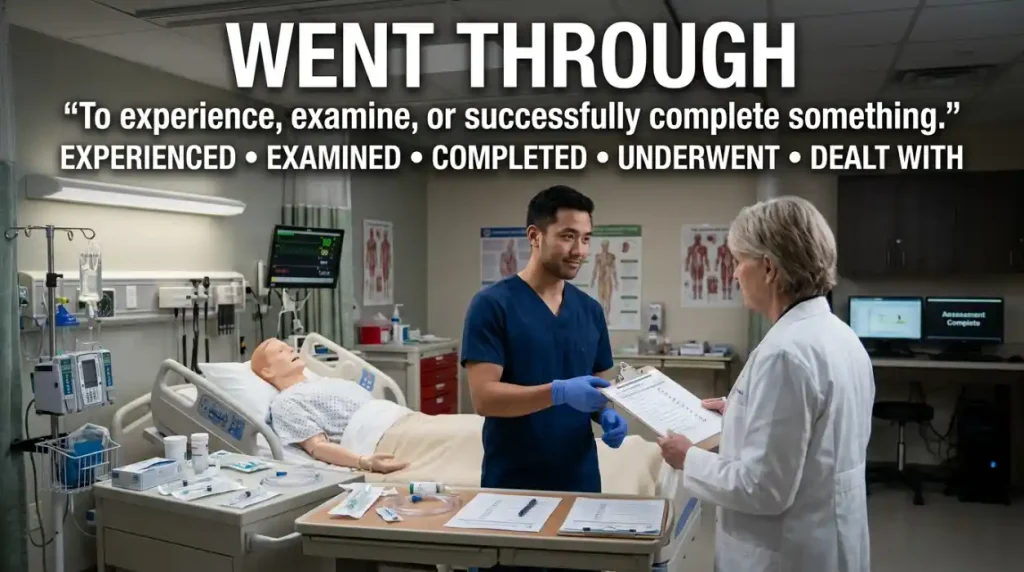
Synonym for went through depends on the context. For experiencing something difficult, use experienced, endured, faced, underwent, or lived through. For examining something, use reviewed, checked, inspected, or searched. The right synonym changes with the intended meaning.
Synonyms for “went through” matter when you are telling a personal story. Imagine saying, “I went through a hard time.” A more precise choice can make the feeling much clearer.
A student might write, “She went through many changes,” while “She experienced many changes” sounds more direct and polished in formal writing.
The phrase is common because it works for difficult experiences, careful examination, spending, practice, and physical movement. That flexibility makes it useful in daily English.
For students, bloggers, content writers, and everyday speakers, learning alternatives to went through helps avoid repetition and makes communication more precise, natural, and expressive.
What Does “Went Through” Really Mean?
Went through is the past-tense form of the phrasal verb go through.
Its meaning changes according to the words around it.
The most common meaning is to experience or endure a situation, especially something difficult, stressful, painful, or challenging.
For example:
She went through a difficult period after losing her job.
Here, went through means experienced or endured.
But the phrase has several other meanings. You can go through money when you use or spend it. You can go through a rehearsal when you practice something step by step.
Cambridge identifies these major uses, including experiencing something difficult, examining a collection, practicing, and using a large amount of something.
Part of Speech
Went through is a phrasal verb in the past tense.
- Base form: go through
- Past tense: went through
- Past participle: gone through
- Present participle: going through
Simple Definition
Went through means experienced, endured, examined, used, practiced, or passed through something, depending on context.
How Native Speakers Understand It
Native speakers usually understand the meaning quickly from the object that follows.
Compare:
- “I went through a difficult year.” → I experienced it.
- “I went through the report.” → I examined it.
- “I went through all my savings.” → I used them.
- “We went through the tunnel.” → We passed through it.
- “She went through the presentation twice.” → She practiced or reviewed it.
That is why replacing went through requires attention to context.
Connotative Meaning
Connotation (the feeling, attitude, or association a word carries beyond its basic dictionary meaning) varies with the situation.
Positive Tone
In a positive context, went through can describe growth, learning, or achievement.
She went through a challenging training program and became more confident.
Negative Tone
The phrase often has a negative or emotional tone when it describes hardship.
He went through a painful breakup last year.
Neutral Tone
It can also be completely neutral.
We went through the files before the meeting.
The phrase itself is not automatically negative. The surrounding words create the emotional effect.
Etymology of “Went Through”
The phrase comes from the combination of go and through.
The verb go comes from Old English gān, meaning “to advance,” “walk,” “depart,” or “go away.” Its history reaches back to West Germanic and an older Indo-European root. Interestingly, the modern past tense went did not originally belong to go. It came from wend, an older verb meaning “to direct one’s way” or “proceed.” It replaced the Old English past form eode during the Middle English period.
The word through comes from Old English þurh, meaning movement from one side or end to another. It developed through Middle English forms before reaching its modern spelling.
Old English: 450–1100
Old English had gān for the idea of going or moving. The modern word went was not yet the normal past tense of go.
The ancestor of through, þurh, expressed the idea of passing from one side to another.
Middle English: 1100–1500
During Middle English, forms related to go and through continued to change.
The past form went, originally connected with wend, gradually became the past tense of go. This unusual historical development is one reason English has the irregular pair go → went.
Modern English: 1500–Present
The combination go through developed several figurative meanings over time.
Etymonline dates the meaning “carry to completion” to the 1560s, “examine” to the 1660s, and “endure, suffer, undergo” to around 1712.
Today, went through is a highly flexible expression used in conversation, storytelling, business, education, and everyday writing.

Pronunciation
Went
- US: /wɛnt/
- UK: /went/
Cambridge gives /went/ for both standard US and UK pronunciation.
Through
- US: /θruː/
- UK: /θruː/
Syllables
- went — 1 syllable
- through — 1 syllable
- went-through — 2 syllables
Affixation Pattern
Root:
- go has an Old English Germanic history.
- went comes historically from wend.
Prefix:
- None.
Suffix:
- None.
The phrase is therefore best understood as a phrasal verb, rather than as one word formed by prefixes and suffixes.
Synonyms List
Some alternatives below are close synonyms. Others work only for a particular meaning of went through. This distinction matters because there is no single replacement that works in every sentence.
1. Experienced (verb) — US /ɪkˈspɪriənst/ — UK /ɪkˈspɪəriənst/
Meaning: Experienced means personally encountered or lived through an event, situation, or period.
Tone/Register: Neutral; common in formal and everyday English.
Examples:
She experienced a difficult transition after moving abroad.
I experienced a lot of personal growth that year.
2. Endured (verb) — US /ɪnˈdʊrd/ — UK /ɪnˈdjʊəd/
Meaning: Endured means continued through something painful, difficult, or unpleasant.
Tone/Register: Formal to neutral.
Examples:
He endured months of uncertainty.
She endured the long recovery with patience.
3. Underwent (verb) — US /ˌʌndərˈwɛnt/ — UK /ˌʌndəˈwent/
Meaning: Underwent means experienced a process, treatment, change, or procedure.
Tone/Register: Formal; academic and professional.
Examples:
The building underwent major repairs.
She underwent extensive training before starting the job.
4. Lived through (verb phrase) — US /lɪvd θruː/ — UK /lɪvd θruː/
Meaning: Lived through means personally experienced a difficult or important period.
Tone/Register: Emotional; conversational.
Examples:
My grandparents lived through a major economic crisis.
She lived through an incredibly stressful year.
5. Faced (verb) — US /feɪst/ — UK /feɪst/
Meaning: Faced means confronted a problem, challenge, or difficult situation.
Tone/Register: Neutral; strong and direct.
Examples:
The team faced several unexpected problems.
He faced a difficult decision alone.
6. Suffered (verb) — US /ˈsʌfərd/ — UK /ˈsʌfəd/
Meaning: Suffered means experienced pain, loss, damage, or hardship.
Tone/Register: Emotional; neutral to formal.
Examples:
The family suffered a major loss.
She suffered through a difficult period at work.
7. Survived (verb) — US /sərˈvaɪvd/ — UK /səˈvaɪvd/
Meaning: Survived emphasizes successfully getting through a dangerous, painful, or extremely difficult experience.
Tone/Register: Strong; emotional.
Examples:
He survived a very difficult year.
They survived the crisis and rebuilt their business.
8. Encountered (verb) — US /ɪnˈkaʊntərd/ — UK /ɪnˈkaʊntəd/
Meaning: Encountered means came into contact with a situation, problem, person, or experience.
Tone/Register: Formal and neutral.
Examples:
We encountered several technical problems.
She encountered unexpected delays during the trip.
9. Experienced firsthand (verb phrase) — US /ˈfaɪrstˌhænd/ — UK /ˌfɜːstˈhænd/
Meaning: Experienced firsthand emphasizes direct personal experience.
Tone/Register: Neutral; useful in academic and journalistic writing.
Examples:
He experienced the effects of the storm firsthand.
I experienced the pressure of the job firsthand.
10. Dealt with (phrasal verb) — US /dɛlt wɪð/ — UK /delt wɪð/
Meaning: Dealt with means handled or managed a problem or situation.
Tone/Register: Neutral; very common in professional English.
Examples:
She dealt with several complaints yesterday.
Our manager dealt with the issue quickly.
11. Handled (verb) — US /ˈhændəld/ — UK /ˈhændəld/
Meaning: Handled means managed a situation or problem successfully.
Tone/Register: Neutral; professional.
Examples:
He handled the difficult conversation calmly.
The team handled the pressure well.
12. Faced up to (phrasal verb) — US /feɪst ʌp tuː/ — UK /feɪst ʌp tə/
Meaning: Faced up to means accepted and confronted an unpleasant reality.
Tone/Register: Conversational.
Examples:
She finally faced up to the problem.
He faced up to his mistakes.
13. Got through (phrasal verb) — US /ɡɑːt θruː/ — UK /ɡɒt θruː/
Meaning: Got through means successfully survived or completed a difficult period.
Tone/Register: Informal and conversational.
Examples:
We got through the busiest week of the year.
She got through the exam despite being nervous.
14. Made it through (phrase) — US /meɪd ɪt θruː/ — UK /meɪd ɪt θruː/
Meaning: Made it through means successfully reached the end of a difficult experience.
Tone/Register: Conversational; encouraging.
Examples:
You made it through the first semester.
We made it through a very stressful month.
15. Pulled through (phrasal verb) — US /pʊld θruː/ — UK /pʊld θruː/
Meaning: Pulled through means recovered from or survived a serious difficulty.
Tone/Register: Informal; often emotional.
Examples:
The patient pulled through after the operation.
Our team pulled through when the deadline became tight.
16. Weathered (verb) — US /ˈwɛðərd/ — UK /ˈweðəd/
Meaning: Weathered means successfully endured a difficult period or challenge.
Tone/Register: Neutral to formal.
Examples:
The company weathered the financial crisis.
She weathered several setbacks during her career.
17. Withstood (verb) — US /wɪðˈstʊd/ — UK /wɪðˈstʊd/
Meaning: Withstood means remained strong despite pressure, force, or difficulty.
Tone/Register: Formal.
Examples:
The old bridge withstood the storm.
He withstood intense criticism.
18. Contended with (phrase) — US /kənˈtendɪd wɪð/ — UK /kənˈtendɪd wɪð/
Meaning: Contended with means dealt with something difficult or challenging.
Tone/Register: Formal; academic and professional.
Examples:
The researchers contended with limited data.
The city contended with severe traffic problems.
19. Struggled through (phrase) — US /ˈstrʌɡəld θruː/ — UK /ˈstrʌɡəld θruː/
Meaning: Struggled through emphasizes difficulty while completing or surviving something.
Tone/Register: Emotional and conversational.
Examples:
She struggled through her first semester.
He struggled through the final weeks of the project.
20. Battled through (phrase) — US /ˈbætəld θruː/ — UK /ˈbætəld θruː/
Meaning: Battled through presents a difficult experience as a determined fight against obstacles.
Tone/Register: Strong; informal to journalistic.
Examples:
They battled through a series of setbacks.
She battled through exhaustion to finish the race.

21. Persisted through (phrase) — US /pərˈsɪstɪd θruː/ — UK /pəˈsɪstɪd θruː/
Meaning: Persisted through means continued despite difficulties.
Tone/Register: Formal and motivational.
Examples:
He persisted through repeated failures.
She persisted through the difficult training period.
22. Surmounted (verb) — US /sərˈmaʊntɪd/ — UK /səˈmaʊntɪd/
Meaning: Surmounted means successfully overcame a difficulty or obstacle.
Tone/Register: Formal.
Examples:
The team surmounted several major obstacles.
She surmounted the challenges through careful planning.
23. Overcame (verb) — US /ˌoʊvərˈkeɪm/ — UK /ˌəʊvəˈkeɪm/
Meaning: Overcame means successfully defeated or recovered from a problem, fear, or obstacle.
Tone/Register: Neutral to formal.
Examples:
He overcame his fear of public speaking.
The community overcame enormous challenges.
24. Confronted (verb) — US /kənˈfrʌntɪd/ — UK /kənˈfrʌntɪd/
Meaning: Confronted means directly faced a difficult person, fact, problem, or situation.
Tone/Register: Formal and neutral.
Examples:
She confronted the problem immediately.
The report confronts several uncomfortable facts.
25. Navigated (verb) — US /ˈnævəɡeɪtɪd/ — UK /ˈnævɪɡeɪtɪd/
Meaning: Navigated means successfully managed a complicated situation or process.
Tone/Register: Professional; modern business English.
Examples:
He navigated a difficult career transition.
She navigated the complicated application process.
26. Negotiated (verb) — US /nɪˈɡoʊʃieɪtɪd/ — UK /nɪˈɡəʊʃieɪtɪd/
Meaning: Negotiated means managed a difficult situation through discussion or compromise.
Tone/Register: Professional and formal.
Examples:
They negotiated several difficult changes.
She negotiated the transition with patience.
27. Processed (verb) — US /ˈprɑːsest/ — UK /ˈprəʊsest/
Meaning: Processed means mentally worked through an emotional event or experience.
Tone/Register: Psychological and conversational.
Examples:
He needed time to process the loss.
She processed the experience slowly.
28. Grappled with (phrase) — US /ˈɡræpəld wɪð/ — UK /ˈɡræpəld wɪð/
Meaning: Grappled with means struggled to understand, solve, or accept something difficult.
Tone/Register: Formal to expressive.
Examples:
The writer grappled with questions of identity.
I grappled with the decision for weeks.
29. Wrestled with (phrase) — US /ˈrɛsəld wɪð/ — UK /ˈresəld wɪð/
Meaning: Wrestled with means struggled emotionally or intellectually with an issue.
Tone/Register: Expressive; often written.
Examples:
She wrestled with whether to leave her job.
He wrestled with a difficult moral question.
30. Came through (phrasal verb) — US /keɪm θruː/ — UK /keɪm θruː/
Meaning: Came through means survived a difficult experience successfully.
Tone/Register: Conversational.
Examples:
She came through the crisis stronger.
He came through the experience with a new perspective.
31. Passed through (phrasal verb) — US /pæst θruː/ — UK /pɑːst θruː/
Meaning: Passed through means physically moved through a place or temporarily experienced a stage or condition.
Tone/Register: Neutral.
Examples:
We passed through three small towns.
The storm passed through the region overnight.
32. Moved through (phrase) — US /muːvd θruː/ — UK /muːvd θruː/
Meaning: Moved through means physically traveled through something or progressed through a process.
Tone/Register: Neutral.
Examples:
The students moved through the exhibition quietly.
She moved through each stage of the project.
33. Traversed (verb) — US /trəˈvɜːrst/ — UK /trəˈvɜːst/
Meaning: Traversed means traveled across or through an area.
Tone/Register: Formal; literary.
Examples:
The hikers traversed the mountain pass.
They traversed the desert during the expedition.
34. Crossed (verb) — US /krɔːst/ — UK /krɒst/
Meaning: Crossed means moved from one side of something to another.
Tone/Register: Neutral and everyday.
Examples:
We crossed the bridge before sunset.
She crossed the street carefully.
35. Inspected (verb) — US /ɪnˈspɛktɪd/ — UK /ɪnˈspektɪd/
Meaning: Inspected means examined something carefully, especially to check its condition.
Tone/Register: Formal and professional.
Examples:
The engineer inspected the equipment.
The officer inspected the documents.
36. Reviewed (verb) — US /rɪˈvjuːd/ — UK /rɪˈvjuːd/
Meaning: Reviewed means examined information carefully, often to understand, check, or evaluate it.
Tone/Register: Professional and academic.
Examples:
I reviewed the report before the meeting.
The professor reviewed our final drafts.
37. Examined (verb) — US /ɪɡˈzæmɪnd/ — UK /ɪɡˈzæmɪnd/
Meaning: Examined means looked at something carefully to understand or assess it.
Tone/Register: Formal and academic.
Examples:
The researchers examined the evidence.
She examined every page of the contract.
38. Checked (verb) — US /tʃɛkt/ — UK /tʃekt/
Meaning: Checked means looked at something to verify information or find a problem.
Tone/Register: Neutral; very common.
Examples:
I checked my emails before leaving.
She checked the figures twice.
39. Searched (verb) — US /sɜːrtʃt/ — UK /sɜːtʃt/
Meaning: Searched means looked through places or objects carefully to find something.
Tone/Register: Neutral.
Examples:
He searched every drawer for the key.
We searched the room before calling for help.
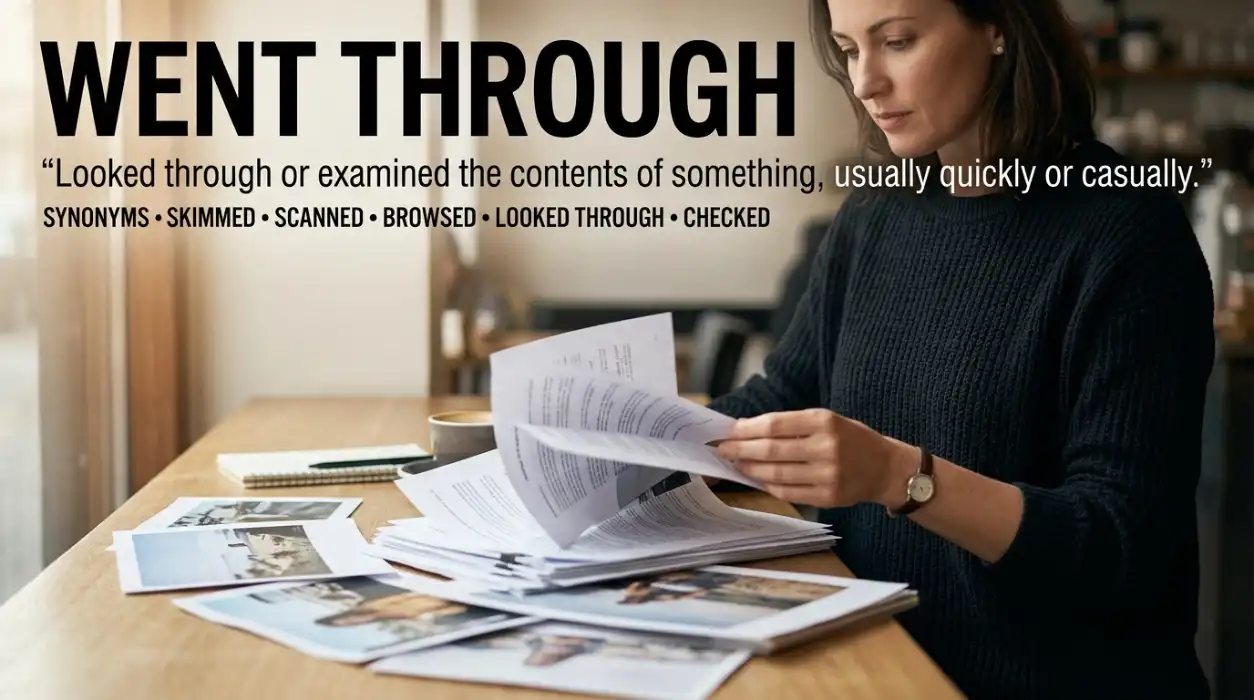
40. Looked through (phrasal verb) — US /lʊkt θruː/ — UK /lʊkt θruː/
Meaning: Looked through means examined the contents of something, usually quickly or casually.
Tone/Register: Informal and everyday.
Examples:
I looked through the photos last night.
She looked through the magazine while waiting.
41. Went over (phrasal verb) — US /wɛnt ˈoʊvər/ — UK /went ˈəʊvə/
Meaning: Went over means reviewed or discussed something carefully.
Tone/Register: Conversational and professional.
Examples:
We went over the plan together.
The teacher went over the answers again.
42. Used up (phrasal verb) — US /juːzd ʌp/ — UK /juːzd ʌp/
Meaning: Used up means consumed something completely.
Tone/Register: Neutral and informal.
Examples:
We used up all the printer paper.
She used up the last of the milk.
43. Spent (verb) — US /spɛnt/ — UK /spent/
Meaning: Spent means used money, time, energy, or another limited resource.
Tone/Register: Neutral.
Examples:
He spent all his savings on the move.
I spent three hours on the assignment.
44. Consumed (verb) — US /kənˈsuːmd/ — UK /kənˈsjuːmd/
Meaning: Consumed means used or taken up completely, especially resources, food, energy, or time.
Tone/Register: Formal.
Examples:
The project consumed most of our time.
The machine consumed too much energy.
45. Exhausted (verb) — US /ɪɡˈzɔːstɪd/ — UK /ɪɡˈzɔːstɪd/
Meaning: Exhausted means used something completely until little or none remained.
Tone/Register: Formal and neutral.
Examples:
The repairs exhausted our budget.
The long process exhausted her patience.
46. Depleted (verb) — US /dɪˈpliːtɪd/ — UK /dɪˈpliːtɪd/
Meaning: Depleted means greatly reduced or almost completely used up.
Tone/Register: Formal; academic and professional.
Examples:
The drought depleted the water supply.
Months of spending depleted the emergency fund.
47. Completed (verb) — US /kəmˈpliːtɪd/ — UK /kəmˈpliːtɪd/
Meaning: Completed means successfully finished a task, process, or activity.
Tone/Register: Formal and neutral.
Examples:
She completed the training program.
We completed the final stage yesterday.
48. Carried out (phrasal verb) — US /ˈkærid aʊt/ — UK /ˈkærid aʊt/
Meaning: Carried out means performed or completed a planned action, task, or procedure.
Tone/Register: Formal and professional.
Examples:
The researchers carried out several tests.
The company carried out a safety review.
49. Conducted (verb) — US /kənˈdʌktɪd/ — UK /kənˈdʌktɪd/
Meaning: Conducted means organized and performed a formal activity such as research, an interview, or an investigation.
Tone/Register: Formal; academic and professional.
Examples:
The university conducted a detailed study.
The journalist conducted several interviews.
50. Completed the process (phrase) — US /kəmˈpliːtɪd ðə ˈprɑːses/ — UK /kəmˈpliːtɪd ðə ˈprəʊses/
Meaning: This phrase emphasizes reaching the end of a procedure or series of steps.
Tone/Register: Formal and professional.
Examples:
She completed the process without any delays.
We completed the process before the deadline.

Synonyms for “Went Through” by Tone
Positive
These alternatives often emphasize growth, strength, achievement, or successful progress:
- overcame
- survived
- got through
- made it through
- pulled through
- came through
- navigated
- surmounted
For example, “She went through a difficult year” focuses on the experience. “She overcame a difficult year” focuses more strongly on the successful result.
Neutral
These work well when you want to describe an experience without adding strong emotion:
- experienced
- encountered
- faced
- underwent
- dealt with
- reviewed
- examined
- checked
- completed
- passed through
Negative or Heavy
These choices can emphasize pain, struggle, pressure, or hardship:
- endured
- suffered
- struggled through
- battled through
- grappled with
- wrestled with
- contended with
- weathered
Playful or Informal
These are more conversational:
- got through
- made it through
- looked through
- went over
- dealt with
- came through
Why Tone Matters
Choosing a synonym is not just about replacing one word.
It is about choosing the feeling you want your reader to receive.
“Experienced” sounds neutral.
“Endured” sounds harder.
“Overcame” suggests success.
“Grappled with” suggests an ongoing struggle.
“Processed” often suggests emotional reflection.
Good vocabulary gives you control over that difference.
“Went Through” vs Close Alternatives
Experienced vs Went Through
Went through is broader and more conversational.
Experienced is more direct and often more suitable for formal writing.
- “She went through a difficult period.”
- “She experienced a difficult period.”
Both work, but the second sounds slightly more polished in an academic or professional context.
Went Through vs Endured
Endured strongly suggests suffering or difficulty.
- “He went through a difficult recovery.”
- “He endured a difficult recovery.”
The second sentence gives the experience a stronger sense of hardship.
Went Through vs Underwent
Underwent is best for a process, procedure, treatment, transformation, or formal experience.
- “She went through extensive training.”
- “She underwent extensive training.”
The second version sounds more formal and professional.
How “Went Through” Changes by Context
Daily Conversation
In everyday speech, went through is extremely natural.
I went through a rough week.
We went through a lot together.
You do not always need a more sophisticated synonym. Native speakers commonly use simple phrasal verbs because they sound relaxed and natural.
Writing and Blogging
In blogs, repeated use of went through can become noticeable.
Instead of:
She went through many challenges.
She went through a difficult transition.
She went through several changes.
You can write:
She faced many challenges.
She navigated a difficult transition.
She experienced several changes.
This creates variety without making the writing sound unnatural.
Professional and Academic English
Formal contexts often favor:
- underwent
- encountered
- experienced
- examined
- reviewed
- conducted
- completed
- endured
- navigated
For example:
The organization underwent significant changes.
This is more professional than:
The organization went through significant changes.
Both are correct, but the first fits formal writing more comfortably.
Creative and Informal English
Storytelling often benefits from emotionally specific choices.
She lived through the hardest winter of her life.
This feels more personal than:
She went through the hardest winter of her life.
Likewise:
He wrestled with the decision for months.
creates more emotional detail than:
He went through a difficult decision.
Common Mistakes Learners Make
Mistake 1: Using One Synonym Everywhere
There is no universal replacement for went through.
I went through the report.
Here, experienced would be wrong.
The correct alternatives are reviewed, examined, checked, or looked through.
Mistake 2: Confusing “Endured” With “Experienced”
Not every experience is painful.
I experienced a wonderful vacation.
But:
I endured a wonderful vacation.
sounds strange because endure normally suggests something difficult or unpleasant.
Mistake 3: Using “Underwent” Too Casually
Underwent is formal.
The company underwent restructuring.
Works well.
But:
I underwent a funny conversation with my friend.
Sounds unnecessarily formal.
Use had, experienced, or went through instead.
Mistake 4: Confusing “Went Through” With “Went Over”
Went through can mean examined something.
Went over can also mean reviewed something.
However, they are not identical in every context.
We went through all the documents.
Suggests a detailed examination of a collection.
We went over the main points.
Often suggests reviewing or discussing specific information.
Mistake 5: Ignoring the Object
Look at what comes after the phrase.
- difficult experience → experienced, endured, faced
- treatment → underwent
- documents → reviewed, examined
- money → spent, used up
- place → passed through, crossed
- task → completed, carried out
- emotional event → processed, lived through
The object usually tells you which synonym fits.
Register Notes
Formal
Use:
- underwent
- endured
- encountered
- examined
- conducted
- depleted
- surmounted
- contended with
Neutral
Use:
- experienced
- faced
- dealt with
- handled
- reviewed
- checked
- completed
- passed through
Informal
Use:
- got through
- made it through
- looked through
- went over
- pulled through
Spoken English
Went through, got through, dealt with, and faced are highly natural in conversation.
Written English
Academic, professional, and polished writing may benefit from more specific verbs such as underwent, examined, encountered, navigated, conducted, or completed.
For more vocabulary practice, an internal article about synonyms for experience would pair naturally with this topic.
Real-Life Mini Scenarios
Workplace
Your manager says:
“We went through several changes this year.”
A professional rewrite could be:
“The company underwent several changes this year.”
The second version is more concise and formal.
Social Situation
A friend says:
“I went through a really hard breakup.”
A sympathetic response might use:
“You endured a lot.”
Or:
“You went through something really difficult.”
Here, emotional sensitivity matters more than vocabulary complexity.
Media and Pop Culture
A celebrity interview may describe someone as having lived through a difficult period.
That expression sounds personal and reflective. Experienced would sound more neutral.
Writing and Storytelling
Instead of:
The hero went through many challenges.
A storyteller might write:
The hero battled through every setback.
That choice makes the story feel more dramatic.
Practice Exercise
1. Which synonym best fits a formal sentence about medical treatment?
A. Got through
B. Underwent
C. Looked through
D. Crossed
2. “I ___ the report before the meeting” needs a synonym meaning examined.
A. endured
B. survived
C. reviewed
D. suffered
3. Which option best emphasizes successfully surviving a difficult period?
A. Made it through
B. Inspected
C. Consumed
D. Conducted
4. Which word is strongest for describing painful hardship?
A. Endured
B. Checked
C. Completed
D. Reviewed
5. “The hikers ___ the mountain pass” needs a physical movement verb.
A. processed
B. traversed
C. conducted
D. endured
6. Which option best fits academic writing?
A. Got through
B. Underwent
C. Made it through
D. Looked through
7. “The drought ___ the region’s water supply” needs a word meaning greatly reduced.
A. depleted
B. experienced
C. crossed
D. faced
8. Which phrase best describes mental work after an emotional event?
A. Processed
B. Traversed
C. Checked
D. Conducted
9. Which alternative sounds most conversational?
A. Surmounted
B. Contended with
C. Got through
D. Depleted
10. “The researchers ___ a detailed study” needs a formal verb meaning performed.
A. conducted
B. suffered
C. survived
D. crossed
Answer key: 1-B | 2-C | 3-A | 4-A | 5-B | 6-B | 7-A | 8-A | 9-C | 10-A
Reflection Task
Write one sentence using experienced, endured, underwent, overcame, reviewed, or navigated.
Then rewrite the sentence using went through.
External Reference Sources
For deeper dictionary and historical study, consult Cambridge Dictionary for current meanings and pronunciation, and Etymonline for the historical development of go, went, and through.
Conclusion
Learning a good synonym for went through helps you describe experiences with greater accuracy. The right word can make a simple sentence feel clearer and more human.
For students and bloggers, varied vocabulary reduces repetition. For speakers and writers, it makes everyday communication more precise without sounding forced.
Start with a simple choice: use experienced for neutral meaning, endured for hardship, and overcame when the focus is on success after difficulty.
Practice one new alternative today in an email, essay, story, or daily conversation. Notice how the word changes the tone, then keep the ones that feel natural to you.
Frequently Asked Questions
1. What is the best synonym for “went through” when talking about a difficult experience?
Experienced is usually the safest neutral synonym. If the situation was painful, endured may be stronger. If the person successfully overcame the difficulty, got through, survived, or overcame may fit better. The best choice depends on whether you want to emphasize the experience itself, the suffering involved, or the successful result.
2. What is a formal synonym for “went through” in academic writing?
Underwent is often a strong formal alternative when discussing a process, procedure, treatment, training, or major change. Experienced, encountered, and examined can also work depending on context. For example, “The organization underwent significant changes” sounds more formal than “The organization went through significant changes.”
3. What can I say instead of “went through a hard time”?
Natural alternatives include experienced a difficult period, endured a difficult period, faced a difficult time, struggled through a difficult period, or lived through a challenging experience. Choose based on tone. “Experienced” is neutral, while “endured” and “struggled through” make the hardship more prominent.
4. Is “experienced” always interchangeable with “went through”?
No. Experienced is a close alternative when went through means personally encountered an event or situation. It does not replace every meaning. For example, “I went through the documents” means “I reviewed or examined the documents,” not “I experienced the documents.” Always check the context before substituting a synonym.
5. What is the difference between “went through” and “underwent”?
Underwent is more formal and usually describes a process, treatment, procedure, training program, or significant change. Went through is more conversational and flexible. You might say, “She underwent surgery” in formal writing, while “She went through a difficult recovery” sounds more natural in everyday conversation.

Hasnain Ali is an SEO Content Strategist and the founder of wordvora.com, a trusted vocabulary platform that helps writers, students, professionals, and English learners find accurate synonyms, antonyms, word meanings, and real-life usage examples. He specializes in keyword research, on-page SEO, topical authority, and creating search-first content that aligns with Google’s latest Search Quality and E-E-A-T guidelines. His work focuses on producing clear, well-structured, and reader-friendly resources that satisfy search intent while maintaining high editorial standards.
Through extensive hands-on experience with SEO tools such as Google Search Console, Google Analytics, SEMrush, and Ahrefs, Hasnain researches user search behavior and develops content that is both informative and easy to understand. Every article published on wordvora.com is carefully reviewed for accuracy, readability, and contextual relevance before publication. His mission is to build one of the web’s most reliable English vocabulary resources by providing practical language guidance, trustworthy explanations, and content that helps readers improve their writing, communication, and vocabulary with confidence.