
Synonyms for bitterness can suddenly matter when an old argument still hurts years later. The right word can describe that lingering feeling far more precisely.
Think about someone who says, “I still feel bitter about what happened.” You could instead describe their resentment, rancor, hurt, or lingering anger.
A synonym for bitterness gives your English more range. Students, bloggers, writers, and everyday speakers can choose a word that fits the exact emotion or taste.
The word is common because bitterness describes both difficult feelings and sharp flavors. Learning its alternatives makes essays, conversations, and stories clearer.
What Does “Bitterness” Really Mean?
Bitterness is a noun with two major meanings.
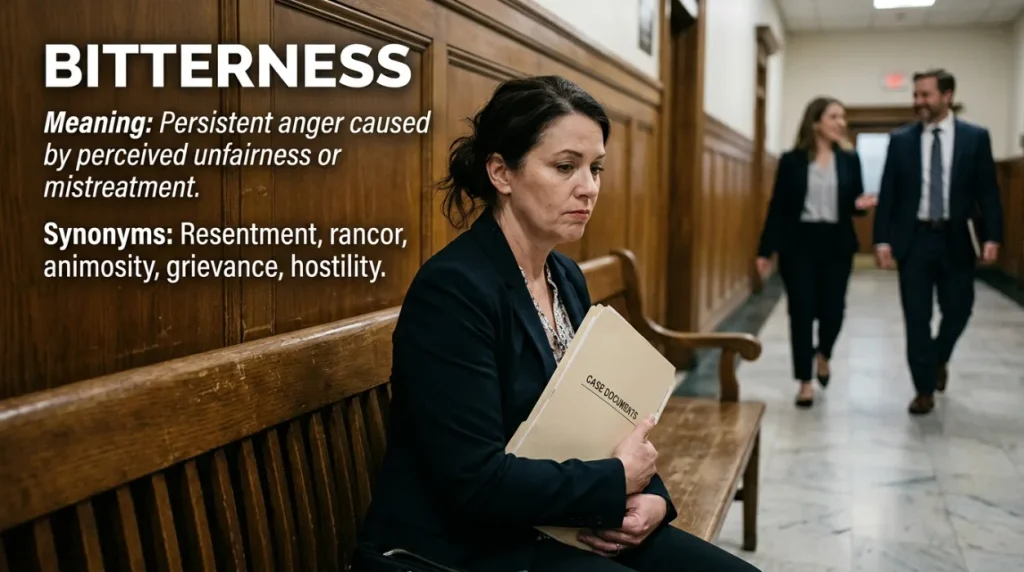
First, it describes a strong negative emotional state. It can involve resentment, anger, disappointment, hostility, or hurt that continues after an unpleasant experience.
She spoke with bitterness about the unfair decision.
Second, bitterness describes a sharp, unpleasant taste.
The medicine left a bitter taste in his mouth.
Therefore, the intended meaning depends heavily on context.
Simple Definition
Bitterness means a strong unpleasant feeling caused by anger, disappointment, or resentment, or an unpleasant sharp taste.
Native speakers usually understand the emotional meaning when the word appears with verbs such as feel, express, show, speak, hold, harbor, or carry.
For example:
He still carries bitterness toward his former employer.
When food or drink is being discussed, the meaning usually relates to taste.
Dark chocolate can have noticeable bitterness.
Part of Speech
Bitterness is a noun.
Its related forms include:
- bitter — adjective
- bitterly — adverb
- bitterness — noun
- embitter — verb
- embittered — adjective
The adjective bitter is particularly common in everyday English.
She became bitter after the experience.
The noun focuses on the quality or state of being bitter.
Years of bitterness affected their relationship.
Connotative Meaning
Connotation (the emotional or cultural feeling associated with a word beyond its basic dictionary meaning) is especially important with bitterness.
Positive Tone
Bitterness itself is rarely positive when it describes emotion.
However, a related expression can sometimes appear in a constructive context. For example, someone may acknowledge bitterness and then overcome it.
He turned his bitterness into motivation.
The positive meaning comes from the action that follows, not usually from the word itself.
Negative Tone
The emotional sense of bitterness is strongly negative.
It can suggest:
- resentment
- hostility
- disappointment
- anger
- hurt
- unforgiveness
- cynicism
Her bitterness made it difficult to trust people again.
Neutral Tone
The taste sense can be neutral.
The bitterness of coffee depends on the beans and preparation.
In this context, the word does not necessarily express an emotional judgment.
Etymology
The word bitterness comes from bitter + -ness.
The adjective bitter has very old Germanic roots. Old English used biter, meaning “bitter, sharp, biting,” especially in relation to taste. The word is related to cognates in other Germanic languages.
Old English: 450–1100
Old English had biter, which referred primarily to a sharp or unpleasant taste. It could also develop figurative associations with painful or severe experiences.
Middle English: 1100–1500
During Middle English, forms such as biter and bitter continued to describe sharp taste and unpleasant qualities. The figurative emotional sense became increasingly established.
Modern English: 1500–Present
Modern English uses bitter and bitterness for both physical taste and emotional experience.
Today, the emotional sense is extremely common in phrases such as:
- bitterness toward someone
- bitterness about the past
- bitterness after failure
- bitterness and resentment
- a bitter argument
The same metaphor connects physical sharpness with emotional pain.

Pronunciation
Bitterness
- US: /ˈbɪtərnəs/
- UK: /ˈbɪtənəs/
The main stress falls on the first syllable.
Syllables
bit-ter-ness
Three syllables:
BIT — ter — ness
Affixation Pattern of “Bitterness”
Root: bitter
Prefix: none
Suffix: -ness
The suffix -ness turns an adjective into a noun describing a quality or state.
bitter → bitterness
Similar formations include:
kind → kindness
dark → darkness
weak → weakness
Synonyms List
Resentment (Noun) — US / UK: /rɪˈzentmənt/ /rɪˈzentmənt/
Meaning: Resentment is a lasting feeling of anger or unfairness toward someone or something.
Tone/Register: Neutral, formal
Example:
She still felt resentment after being overlooked for promotion.
His resentment grew over several years.
Rancor (Noun) — US / UK: /ˈræŋkər/ /ˈræŋkə/
Meaning: Rancor is deep and continuing bitterness or hostility toward another person.
Tone/Register: Formal, literary
Example:
The former teammates spoke without rancor.
Years of rancor divided the two families.
Acrimony (Noun) — US / UK: /ˈækrɪmoʊni/ /ˈækrɪməni/
Meaning: Acrimony is bitter anger expressed through harsh or hostile words.
Tone/Register: Formal
Example:
The divorce proceedings were filled with acrimony.
Their debate ended in surprising acrimony.
Animosity (Noun) — US / UK: /ˌænɪˈmɑːsəti/ /ˌænɪˈmɒsəti/
Meaning: Animosity is strong dislike or hostility toward someone.
Tone/Register: Formal, neutral
Example:
There was obvious animosity between the rivals.
The teams put their animosity aside for the event.
Hostility (Noun) — US / UK: /hɑːˈstɪləti/ /hɒˈstɪləti/
Meaning: Hostility is an unfriendly or antagonistic feeling or behavior toward someone.
Tone/Register: Neutral, formal
Example:
He sensed hostility in the room.
The conversation quickly became hostile.
Antagonism (Noun) — US / UK: /ænˈtæɡənɪzəm/ /ænˈtæɡənɪzəm/
Meaning: Antagonism is active opposition or strong negative feeling between people or groups.
Tone/Register: Formal, academic
Example:
Years of antagonism made cooperation difficult.
The two groups have a history of antagonism.
Ill Will (Noun Phrase) — US / UK: /ˌɪl ˈwɪl/ /ˌɪl ˈwɪl/
Meaning: Ill will is an unfriendly or resentful attitude toward another person.
Tone/Register: Neutral
Example:
She left the company without any ill will.
There was no ill will between the neighbors.
Spite (Noun) — US / UK: /spaɪt/ /spaɪt/
Meaning: Spite is a desire to hurt or annoy someone because of anger or resentment.
Tone/Register: Informal, neutral
Example:
He deleted the files out of spite.
She refused to apologize, partly from spite.
Malice (Noun) — US / UK: /ˈmælɪs/ /ˈmælɪs/
Meaning: Malice is an intention or desire to cause harm.
Tone/Register: Formal
Example:
The comment was made without malice.
He believed the rumor had been spread with malice.
Enmity (Noun) — US / UK: /ˈenməti/ /ˈenməti/
Meaning: Enmity is deep hostility that exists between people or groups.
Tone/Register: Formal, literary
Example:
The families had lived with enmity for decades.
The agreement helped reduce their long-standing enmity.
Fury (Noun) — US / UK: /ˈfjʊri/ /ˈfjʊəri/
Meaning: Fury is extremely intense anger that can accompany bitterness.
Tone/Register: Strong, dramatic
Example:
She reacted with fury to the accusation.
His fury lasted long after the meeting.
Anger (Noun) — US / UK: /ˈæŋɡər/ /ˈæŋɡə/
Meaning: Anger is a strong feeling of displeasure or hostility, often underlying bitterness.
Tone/Register: Neutral
Example:
His anger slowly turned into resentment.
She expressed her anger calmly.
Rage (Noun) — US / UK: /reɪdʒ/ /reɪdʒ/
Meaning: Rage is an extremely powerful form of anger.
Tone/Register: Strong, dramatic
Example:
He struggled to control his rage.
The decision sparked public rage.
Ire (Noun) — US / UK: /aɪər/ /aɪə/
Meaning: Ire is intense anger, especially anger directed at a person or situation.
Tone/Register: Formal, literary
Example:
The new policy drew the ire of residents.
Her remarks attracted considerable ire.
Indignation (Noun) — US / UK: /ˌɪndɪɡˈneɪʃən/ /ˌɪndɪɡˈneɪʃən/
Meaning: Indignation is anger caused by something considered unfair or wrong.
Tone/Register: Formal
Example:
The decision caused widespread indignation.
He spoke with indignation about the unfair treatment.
Chagrin (Noun) — US / UK: /ˈʃæɡrɪn/ /ˈʃæɡrɪn/
Meaning: Chagrin is distress or embarrassment caused by disappointment or failure.
Tone/Register: Formal
Example:
To her chagrin, she missed the final deadline.
His chagrin was obvious after the mistake.
Disappointment (Noun) — US / UK: /ˌdɪsəˈpɔɪntmənt/ /ˌdɪsəˈpɔɪntmənt/
Meaning: Disappointment is sadness or frustration caused when expectations are not met.
Tone/Register: Neutral
Example:
His disappointment remained after the rejection.
She expressed her disappointment honestly.
Frustration (Noun) — US / UK: /frʌˈstreɪʃən/ /frʌˈstreɪʃən/
Meaning: Frustration is irritation caused by obstacles, failure, or an inability to achieve something.
Tone/Register: Neutral
Example:
Months of delays caused growing frustration.
She spoke openly about her frustration.
Grievance (Noun) — US / UK: /ˈɡriːvəns/ /ˈɡriːvəns/
Meaning: A grievance is a complaint about unfair treatment that may contribute to resentment.
Tone/Register: Formal, professional
Example:
The employee filed a formal grievance.
He explained his grievances during the meeting.
Grudge (Noun) — US / UK: /ɡrʌdʒ/ /ɡrʌdʒ/
Meaning: A grudge is a lasting feeling of resentment toward someone because of a past wrong.
Tone/Register: Informal, common
Example:
She held a grudge for years.
He finally decided to let go of the grudge.
Hard Feelings (Noun Phrase) — US / UK: /ˌhɑːrd ˈfiːlɪŋz/ /ˌhɑːd ˈfiːlɪŋz/
Meaning: Hard feelings are lingering resentment or hurt after disagreement or conflict.
Tone/Register: Informal
Example:
I hope there are no hard feelings.
They argued, but there were no hard feelings afterward.
Bitterness of Feeling (Noun Phrase) — US / UK: /ˈbɪtərnəs əv ˈfiːlɪŋ/ /ˈbɪtənəs əv ˈfiːlɪŋ/
Meaning: This phrase emphasizes the intense unpleasantness of a person’s emotional response.
Tone/Register: Literary, formal
Example:
The bitterness of feeling surprised everyone.
Years later, the bitterness of feeling remained.
Resentfulness (Noun) — US / UK: /rɪˈzentfəlnəs/ /rɪˈzentfəlnəs/
Meaning: Resentfulness is the quality of continuing to feel annoyed or wronged.
Tone/Register: Formal, less common
Example:
His resentfulness affected team discussions.
She recognized her own growing resentfulness.

Sourness (Noun) — US / UK: /ˈsaʊrnəs/ /ˈsaʊənəs/
Meaning: Sourness can describe an unpleasant emotional attitude or a sharp acidic taste.
Tone/Register: Neutral, figurative
Example:
There was a noticeable sourness in his reply.
The lemon added pleasant sourness to the dish.
Sharpness (Noun) — US / UK: /ˈʃɑːrpnəs/ /ˈʃɑːpnəs/
Meaning: Sharpness can describe a biting quality in taste, speech, or emotional expression.
Tone/Register: Neutral
Example:
The coffee had a surprising sharpness.
Her response had an unusual sharpness.
Astringency (Noun) — US / UK: /əˈstrɪndʒənsi/ /əˈstrɪndʒənsi/
Meaning: Astringency is a dry, puckering sensation often associated with tea, wine, or certain fruits.
Tone/Register: Technical, culinary
Example:
The tea has noticeable astringency.
Astringency can become stronger when tea is over-brewed.
Tartness (Noun) — US / UK: /ˈtɑːrtnəs/ /ˈtɑːtnəs/
Meaning: Tartness is a sharp, acidic taste that can overlap with unpleasant bitterness.
Tone/Register: Neutral, culinary
Example:
The berries add tartness to the dessert.
A little tartness balances the sweetness.
Acridity (Noun) — US / UK: /əˈkrɪdəti/ /əˈkrɪdəti/
Meaning: Acridity is a harsh, irritating, or pungent quality in taste or smell.
Tone/Register: Formal, technical
Example:
The burnt food had an unpleasant acridity.
The acridity of the smoke was difficult to ignore.
Pungency (Noun) — US / UK: /ˈpʌndʒənsi/ /ˈpʌndʒənsi/
Meaning: Pungency is a strong, sharp quality in taste or smell that may accompany bitterness.
Tone/Register: Technical, culinary
Example:
The spice adds pungency to the sauce.
The pungency of the mustard was intense.
Tang (Noun) — US / UK: /tæŋ/ /tæŋ/
Meaning: Tang is a noticeable sharp or acidic taste.
Tone/Register: Informal, culinary
Example:
The yogurt has a pleasant tang.
Fresh herbs added a bright tang to the salad.
Sharp Taste (Noun Phrase) — US / UK: /ʃɑːrp teɪst/ /ʃɑːp teɪst/
Meaning: A sharp taste is a strong, biting flavor that can resemble bitterness or acidity.
Tone/Register: Neutral
Example:
The drink has a sharp taste.
The sharp taste faded after a few seconds.
Bitter Taste (Noun Phrase) — US / UK: /ˈbɪtər teɪst/ /ˈbɪtə teɪst/
Meaning: A bitter taste is a sharp, unpleasant flavor often found in coffee, medicine, dark chocolate, and some vegetables.
Tone/Register: Neutral
Example:
The medicine has a bitter taste.
The bitter taste disappeared after dinner.
Harshness (Noun) — US / UK: /ˈhɑːrʃnəs/ /ˈhɑːʃnəs/
Meaning: Harshness can describe an unpleasantly strong quality in taste, speech, or emotional expression.
Tone/Register: Neutral, descriptive
Example:
Milk softened the harshness of the coffee.
The harshness in his voice surprised everyone.
Severity (Noun) — US / UK: /səˈverəti/ /sɪˈverəti/
Meaning: Severity describes extreme seriousness or harshness and can overlap with figurative bitterness.
Tone/Register: Formal
Example:
The severity of her criticism was unexpected.
He later regretted the severity of his words.
Hostile Feeling (Noun Phrase) — US / UK: /ˈhɑːstaɪl ˈfiːlɪŋ/ /ˈhɒstaɪl ˈfiːlɪŋ/
Meaning: A hostile feeling is an unfriendly emotional response toward another person.
Tone/Register: Neutral, formal
Example:
He tried to hide his hostile feelings.
The hostile feeling between them was obvious.
Negative Feeling (Noun Phrase) — US / UK: /ˈneɡətɪv ˈfiːlɪŋ/ /ˈneɡətɪv ˈfiːlɪŋ/
Meaning: A negative feeling is an unpleasant emotional response that may include resentment or anger.
Tone/Register: Neutral
Example:
She carried negative feelings after the dispute.
Talking helped reduce some negative feelings.
Resentment Toward (Noun Phrase) — US / UK: /rɪˈzentmənt təˈwɔːrd/ /rɪˈzentmənt təˈwɔːd/
Meaning: This phrase specifically identifies bitterness directed at a person, group, or situation.
Tone/Register: Neutral, formal
Example:
He developed resentment toward his manager.
Her resentment toward the organization slowly faded.
Bitterness Toward (Noun Phrase) — US / UK: /ˈbɪtərnəs təˈwɔːrd/ /ˈbɪtənəs təˈwɔːd/
Meaning: This phrase describes continuing negative feelings directed at a particular target.
Tone/Register: Neutral
Example:
She felt bitterness toward her former friend.
His bitterness toward the decision remained.
Bitterness About (Noun Phrase) — US / UK: /ˈbɪtərnəs əˈbaʊt/ /ˈbɪtənəs əˈbaʊt/
Meaning: This phrase describes resentment or anger concerning a particular event or circumstance.
Tone/Register: Neutral
Example:
There was bitterness about the failed agreement.
He expressed bitterness about the outcome.
Emotional Harshness (Noun Phrase) — US / UK: /ɪˈmoʊʃənəl ˈhɑːrʃnəs/ /ɪˈməʊʃənəl ˈhɑːʃnəs/
Meaning: Emotional harshness describes a severe, unfriendly quality in someone’s feelings or expression.
Tone/Register: Formal, descriptive
Example:
The letter contained unusual emotional harshness.
Her later apology softened that harshness.
Cynicism (Noun) — US / UK: /ˈsɪnɪsɪzəm/ /ˈsɪnɪsɪzəm/
Meaning: Cynicism is a distrustful attitude that assumes people are often selfish or insincere.
Tone/Register: Neutral, academic
Example:
Years of disappointment led to cynicism.
His cynicism made it hard to trust new promises.
Disillusionment (Noun) — US / UK: /ˌdɪsɪˈluːʒənmənt/ /ˌdɪsɪˈluːʒənmənt/
Meaning: Disillusionment is disappointment caused by discovering that something is less ideal than expected.
Tone/Register: Formal
Example:
The experience left her with deep disillusionment.
His disillusionment changed how he viewed the industry.
Alienation (Noun) — US / UK: /ˌeɪliəˈneɪʃən/ /ˌeɪliəˈneɪʃən/
Meaning: Alienation is a feeling of separation or disconnection that can develop alongside bitterness.
Tone/Register: Academic, formal
Example:
Social alienation contributed to his resentment.
The policy created feelings of alienation.
Displeasure (Noun) — US / UK: /dɪsˈpleʒər/ /dɪsˈpleʒə/
Meaning: Displeasure is a feeling of annoyance or dissatisfaction that may develop into bitterness.
Tone/Register: Formal, polite
Example:
She expressed her displeasure calmly.
His displeasure was clear from his response.
Dissatisfaction (Noun) — US / UK: /ˌdɪssætɪsˈfækʃən/ /ˌdɪssætɪsˈfækʃən/
Meaning: Dissatisfaction is an unhappy feeling caused by something that fails to meet expectations.
Tone/Register: Formal, professional
Example:
Employee dissatisfaction increased during the changes.
Customer dissatisfaction was discussed at the meeting.
Offense (Noun) — US / UK: /əˈfens/ /əˈfens/
Meaning: Offense is hurt or resentment caused by something considered insulting or inappropriate.
Tone/Register: Neutral
Example:
She took offense at his comment.
He apologized if his words offended.
Resent (Verb) — US / UK: /rɪˈzent/ /rɪˈzent/
Meaning: To resent means to feel persistent anger because of perceived unfairness or mistreatment.
Tone/Register: Neutral
Example:
He resented being excluded from the project.
She resented the way her work was treated.
Embitterment (Noun) — US / UK: /ɪmˈbɪtərmənt/ /ɪmˈbɪtəm(ə)nt/
Meaning: Embitterment is the process or state of becoming deeply bitter because of painful experiences.
Tone/Register: Formal, less common
Example:
Years of rejection caused embitterment.
The story explores grief and embitterment.
Sullenness (Noun) — US / UK: /ˈsʌlənəs/ /ˈsʌlənəs/
Meaning: Sullenness is a quiet, gloomy, resentful mood that may accompany bitterness.
Tone/Register: Literary, descriptive
Example:
His sullenness was obvious at dinner.
She answered with unusual sullenness.
Sour Mood (Noun Phrase) — US / UK: /saʊr muːd/ /saʊə muːd/
Meaning: A sour mood is an unpleasant or irritable emotional state.
Tone/Register: Informal
Example:
He was in a sour mood after the meeting.
A good joke helped lift her sour mood.
Vinegary (Adjective) — US / UK: /ˈvɪnɪɡəri/ /ˈvɪnɪɡəri/
Meaning: Vinegary describes a sharp acidic taste and can sometimes describe an unpleasantly sharp manner.
Tone/Register: Informal, descriptive
Example:
The dressing tasted vinegary.
Her vinegary reply ended the conversation.
Astringent (Adjective) — US / UK: /əˈstrɪndʒənt/ /əˈstrɪndʒənt/
Meaning: Astringent describes a dry, puckering taste or a sharply critical style of expression.
Tone/Register: Formal, culinary
Example:
The young wine tasted astringent.
His astringent criticism surprised the audience.
Acerbic (Adjective) — US / UK: /əˈsɜːrbɪk/ /əˈsɜːbɪk/
Meaning: Acerbic describes speech or writing that is sharp, biting, and often bitterly critical.
Tone/Register: Formal, literary
Example:
Her acerbic review attracted attention.
He is known for his acerbic sense of humor.
Sour (Adjective) — US / UK: /saʊr/ /saʊə/
Meaning: Sour can describe an acidic taste or an unpleasant, resentful emotional attitude.
Tone/Register: Neutral, informal
Example:
The fruit tasted sour.
The disagreement left a sour feeling between them.
Bitter (Adjective) — US / UK: /ˈbɪtər/ /ˈbɪtə/
Meaning: Bitter describes an unpleasant taste or a deeply resentful emotional attitude.
Tone/Register: Neutral
Example:
The coffee tastes bitter without sugar.
He sounded bitter after losing the opportunity.
Acerbity (Noun) — US / UK: /əˈsɜːrbəti/ /əˈsɜːbəti/
Meaning: Acerbity is a sharp, biting quality in speech or manner.
Tone/Register: Formal, literary
Example:
She delivered the criticism with acerbity.
His acerbity made the discussion uncomfortable.
Synonyms by Tone
Tone matters because two words can describe similar feelings while creating very different impressions.
Positive or Constructive Context
Bitterness itself is negative, but these terms can describe emotions that are later handled constructively:
- disappointment
- frustration
- dissatisfaction
- displeasure
- grievance
These words can sound less aggressive than rancor or malice.
Neutral
These alternatives work well in ordinary descriptions:
- resentment
- anger
- hostility
- animosity
- grudge
- hard feelings
- sourness
- displeasure
Negative or Strong
These words usually create a stronger emotional impression:
- rancor
- acrimony
- malice
- enmity
- spite
- rage
- fury
- antagonism
- acerbity
- embitterment
Playful or Informal
For casual speech, consider:
- sour mood
- hard feelings
- grudge
- sourness
However, even informal words can carry serious emotional meaning depending on context.
“Bitterness” vs Close Alternatives
Resentment vs. Bitterness
Bitterness can describe a broad emotional quality.
Resentment focuses more specifically on anger caused by perceived unfairness or mistreatment.
He spoke with bitterness.
This describes his overall emotional tone.
He felt resentment toward his manager.
This identifies a particular negative feeling and target.
Bitterness vs Rancor
Both words describe strong negative feelings that can last for a long time.
However, rancor sounds more intense and formal.
Use bitterness in everyday writing.
Use rancor when you want a stronger literary or formal effect.
Bitterness vs Acrimony
Acrimony is especially useful when people argue or communicate with harsh hostility.
The disagreement ended in bitterness.
The divorce was marked by acrimony.
The second sentence strongly suggests hostile exchanges.
How “Bitterness” Changes by Context
Daily Conversation
In ordinary conversation, bitterness, resentment, anger, and grudge are common choices.
I don’t want to hold a grudge.
She still feels bitter about it.
These expressions sound natural and conversational.
Writing and Blogging
Writers can choose more precise words depending on the emotional shade.
Resentment works for quiet, lasting anger.
Rancor creates a stronger sense of hostility.
Disappointment sounds softer.
Cynicism suggests distrust rather than simple anger.
Therefore, good vocabulary selection can make personal essays and blog writing much more expressive.
Professional or Academic Tone
Professional writing usually benefits from precision.
For example:
Employee dissatisfaction increased after the policy change.
This sounds more objective than:
Employees became bitter.
Similarly, grievance, dissatisfaction, antagonism, and indignation can work well in formal contexts.
However, the choice should reflect the evidence. Do not describe someone as malicious unless the context actually supports that meaning.
Creative or Informal Use
Creative writing gives you greater freedom.
A novelist might write:
Years of rancor had hardened his voice.
A casual speaker might simply say:
He’s still upset about it.
Both can communicate a similar emotional situation, but the style is completely different.
Common Mistakes Learners Make
Mistake 1: Treating Every Synonym as Identical
Words such as anger, resentment, rancor, and malice overlap, but they are not identical.
Anger can be temporary.
Resentment tends to last.
Rancor suggests deep hostility.
Malice focuses on an intention to harm.
Therefore, replacing one with another can change the meaning.
Mistake 2: Confusing Bitterness and Sourness
Bitterness and sourness are both taste words, but they describe different sensations.
Coffee can be bitter.
Lemon is usually sour.
Some foods may have both qualities.
The drink was bitter.
does not automatically mean:
The drink was sour.
Mistake 3: Using “Acrimony” in Casual Situations
Acrimony is correct, but it can sound formal.
Instead of:
There was acrimony between me and my brother.
a casual speaker might say:
My brother and I still have hard feelings.
The second option sounds more conversational.
Mistake 4: Confusing Resentment With Malice
Resentment means you feel wronged.
Malice suggests a desire to cause harm.
Someone can resent another person without wanting to hurt them.
Mistake 5: Overusing “Bitter”
Writers sometimes use bitter repeatedly:
He was bitter.
His bitter voice showed his bitterness.
The bitter argument became bitter.
This sounds repetitive.
Instead, vary the vocabulary:
He felt resentful.
His voice carried rancor.
The discussion became increasingly hostile.
Register Notes
Formal
- acrimony
- rancor
- enmity
- antagonism
- indignation
- grievance
- acerbity
- astringency
Neutral
- bitterness
- resentment
- anger
- hostility
- disappointment
- frustration
- dissatisfaction
- displeasure
Informal
- grudge
- hard feelings
- sour mood
- spite
Literary
- rancor
- enmity
- acerbity
- sullenness
- embitterment
Culinary
- astringency
- tartness
- tang
- pungency
- sharpness
- sourness
Real-Life Mini Scenarios
Workplace
Imagine an employee who expected a promotion but was passed over.
They may initially feel disappointment.
If the feeling continues, it may become resentment.
If the relationship becomes openly hostile, animosity or acrimony may describe the situation more accurately.
Social Situations
Two friends may argue.
One person may hold a grudge afterward.
If they eventually resolve the issue, there may be no hard feelings.
However, if the conflict continues for years, bitterness or rancor may be more appropriate.
Media and Pop Culture
News reports and reviews often use stronger vocabulary.
A hostile political debate may be described as having acrimony.
A fictional character may be portrayed as embittered after betrayal.
A critic may use acerbic to describe particularly sharp commentary.
Writing and Storytelling
A novelist can use vocabulary to show emotional progression.
For example:
First came disappointment. Then came resentment. Over time, resentment hardened into bitterness.
This sequence is effective because each word adds a slightly different emotional stage.

Practice Exercise
1. Someone continues feeling angry about unfair treatment for several years. Which word fits best?
A. Tang
B. Resentment
C. Tartness
D. Pungency
2. Two families have disliked each other for decades. Which formal word fits best?
A. Enmity
B. Frustration
C. Sourness
D. Tang
3. A person wants to hurt someone because they are angry. Which word is most precise?
A. Malice
B. Disappointment
C. Grievance
D. Indignation
4. A workplace disagreement involves harsh and hostile exchanges. Which word fits best?
A. Acrimony
B. Tartness
C. Astringency
D. Chagrin
5. Someone is unhappy because they were not promoted. Which word sounds relatively neutral?
A. Rancor
B. Disappointment
C. Malice
D. Enmity
6. A person refuses to forgive someone for an old argument. Which word is natural?
A. Grudge
B. Pungency
C. Astringency
D. Severity
7. A cup of tea leaves your mouth feeling dry and puckered. Which word is most precise?
A. Rancor
B. Astringency
C. Hostility
D. Resentment
8. A lemon gives a dish a sharp acidic quality. Which word fits best?
A. Tartness
B. Enmity
C. Acrimony
D. Grudge
9. A writer describes criticism that is sharp and biting. Which adjective fits?
A. Acerbic
B. Ordinary
C. Friendly
D. Neutral
10. Someone distrusts promises because past experiences disappointed them. Which word may fit?
A. Cynicism
B. Tang
C. Tartness
D. Grievance
Reflection task:
Choose one synonym from this article and write an original sentence about a person, situation, food, drink, workplace experience, or story.
Answer key: 1-B | 2-A | 3-A | 4-A | 5-B | 6-A | 7-B | 8-A | 9-A | 10-A
Conclusion
Understanding bitterness can help you describe a strong feeling of resentment, anger, disappointment, or unpleasantness. It can also refer to a sharp or unpleasant taste, depending on the context. Learning its synonyms, meaning, and examples can improve your English vocabulary and communication skills.
The word bitterness is commonly used when discussing emotions, experiences, relationships, and flavors. Knowing its related synonyms can help you express ideas about resentment, hostility, harshness, sourness, or displeasure in different ways.
By practicing bitterness in sentences and exploring related words, you can strengthen your vocabulary and writing skills. A clear understanding of this word will help you use it naturally, accurately, and confidently in different English contexts.
FAQs
1. What is the best synonym for bitterness in a relationship?
Resentment is often the closest choice when bitterness describes continuing anger caused by feeling hurt or treated unfairly. Rancor works when the feeling is especially deep and hostile. Grudge sounds more conversational and usually refers to a specific past wrong. The best option depends on whether you want to emphasize lasting anger, hostility, or a personal grievance.
2. What is a good synonym for bitterness in taste?
For taste, useful alternatives include sourness, astringency, tartness, sharpness, pungency, and tang, but they are not exact equivalents. Coffee and dark chocolate are commonly described as bitter, while lemons are usually sour or tart. Tea and some wines can have noticeable astringency, which creates a dry or puckering sensation.
3. What is the difference between bitterness and resentment?
Bitterness describes a broader negative emotional quality that may include anger, disappointment, and resentment. Resentment is more specific. It usually develops when someone feels wronged, treated unfairly, or deprived of something they deserved. Therefore, resentment can be one source or component of bitterness, but the two words are not always interchangeable.
4. What is a strong word for bitterness and anger?
Rancor, acrimony, enmity, and hostility can express strong forms of negative feeling. Rancor suggests deep, lasting bitterness. Acrimony is especially useful for hostile arguments or exchanges. Enmity describes deep hostility between people or groups. Rage and fury are stronger for intense anger but do not necessarily imply long-term bitterness.
5. What is a formal synonym for bitterness?
In formal writing, resentment, rancor, acrimony, antagonism, enmity, indignation, dissatisfaction, and grievance can work depending on context. However, each word has a different emphasis. For example, grievance focuses on a complaint, while indignation emphasizes anger about something considered unjust. Formal vocabulary should be selected for precision rather than complexity.

Hasnain Ali is an SEO Content Strategist and the founder of wordvora.com, a trusted vocabulary platform that helps writers, students, professionals, and English learners find accurate synonyms, antonyms, word meanings, and real-life usage examples. He specializes in keyword research, on-page SEO, topical authority, and creating search-first content that aligns with Google’s latest Search Quality and E-E-A-T guidelines. His work focuses on producing clear, well-structured, and reader-friendly resources that satisfy search intent while maintaining high editorial standards.
Through extensive hands-on experience with SEO tools such as Google Search Console, Google Analytics, SEMrush, and Ahrefs, Hasnain researches user search behavior and develops content that is both informative and easy to understand. Every article published on wordvora.com is carefully reviewed for accuracy, readability, and contextual relevance before publication. His mission is to build one of the web’s most reliable English vocabulary resources by providing practical language guidance, trustworthy explanations, and content that helps readers improve their writing, communication, and vocabulary with confidence.