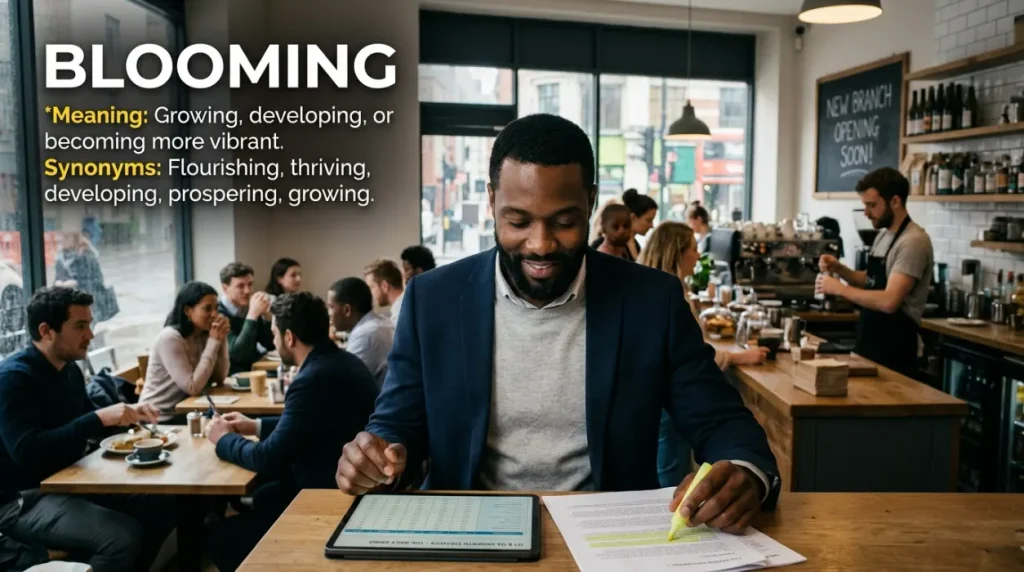
synonym for blooming can change the feel of a sentence. Imagine a garden opening at sunrise: “blooming” sounds fresh, vivid, and full of life.
A student may write “the roses are blooming,” while a writer chooses “blossoming” for a softer image. That small change can make English feel richer.
Learning a synonym for blooming also helps bloggers, content writers, and daily speakers avoid repetition while choosing words that match mood, context, and meaning.
Because blooming is common in descriptions of flowers, people, talent, and growth, its alternatives are useful in essays, captions, stories, emails, and conversation.
What Does “Blooming” Really Mean?
Blooming is most commonly the present participle of bloom, and it can work as an adjective as well.
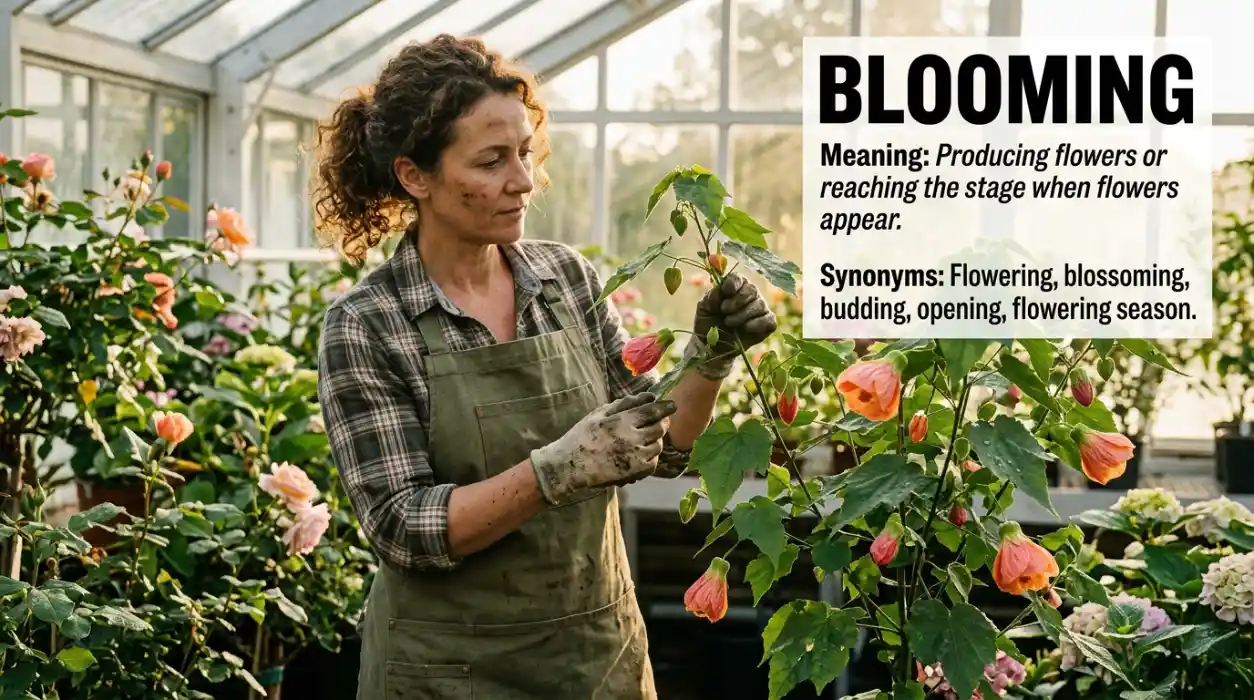
In its literal sense, blooming means producing flowers or opening into flower.
For example:
The roses are blooming in the garden.
It can also describe something that is developing successfully, becoming attractive, or reaching a healthy and lively state.
For example:
Her confidence is blooming after months of practice.
Cambridge defines bloom as producing flowers and also as developing successfully. The word can therefore move naturally from plants to people, talents, ideas, relationships, and other forms of growth.
Native speakers usually understand blooming through context. When it modifies flowers, the meaning is literal. When it describes a person, talent, or project, the meaning is usually figurative.
Part of Speech
Blooming can function as:
- Present participle: The roses are blooming.
- Adjective: She has a blooming garden.
- Descriptive modifier: His blooming confidence was obvious.
- Informal British intensifier: That blooming alarm woke everyone.
The last use is different. In British informal English, blooming can be used before an adjective, noun, or adverb for emphasis. It may express irritation, much like a mild swear substitute.
Connotative Meaning of “Blooming”
Connotation (the feeling or association a word carries beyond its basic dictionary meaning) is especially important with blooming.
Positive Tone
The most common figurative sense is positive.
Blooming can suggest:
- beauty
- health
- freshness
- growth
- vitality
- confidence
- success
- natural development
For example:
Her blooming talent impressed the entire class.
Neutral Tone
In a botanical context, blooming can be completely neutral.
The plants are blooming earlier this year.
There is no strong emotional judgment in that sentence.
Negative Tone
The word itself is rarely negative when it describes flowers or development.
However, British informal blooming can carry annoyance:
That blooming printer has stopped again!
Here, blooming does not mean “flowering.” It is an informal intensifier.
Etymology
The history of blooming begins with bloom.
Etymonline traces bloom as a noun meaning the blossom of a plant to around 1200, from a Scandinavian source related to Old Norse blomi, meaning “flower” or “blossom.” The deeper Germanic history connects it with a root associated with thriving and blooming.
The verb bloom appeared in Middle English around the 13th century, meaning to bear flowers, blossom, or be in flower. Blooming developed as the present participle and adjective.
Old English: 450–1100
Old English did have related Germanic vocabulary connected with flowers and flowering. However, the modern word bloom was not the principal everyday word for a flower in Old English.
The native Old English word blostm/blostma developed into modern blossom. Etymonline notes that bloom is related to Old English blowan, meaning “to flower.”
Middle English: 1100–1500
During Middle English, bloom entered and developed in English through Scandinavian influence. The verb became established for the process of producing flowers.
By the late Middle English period, blooming was developing as a descriptive form meaning “in flower” or “flourishing.”
Modern English: 1500–Present
Modern English expanded bloom beyond plants.
It came to describe beauty, health, youth, achievement, and successful development. That figurative expansion explains why modern speakers can say that a person’s confidence, talent, or career is “blooming.”
Pronunciation of “Blooming”
US: /ˈbluː.mɪŋ/
UK: /ˈbluː.mɪŋ/
The US and UK pronunciations are essentially the same. Cambridge gives /ˈbluː.mɪŋ/ for both varieties.
Syllables
Bloom-ing
Affixation Pattern of “Blooming”
Root: bloom
Prefix: none
Suffix: -ing
The suffix -ing forms the present participle of bloom and can also create an adjective.
Synonyms List
Flowering (Adjective/Verb) — US /ˈflaʊərɪŋ/ — UK /ˈflaʊərɪŋ/
Meaning: Flowering means producing flowers or being in the stage when flowers appear.
Tone/Register: Neutral, botanical, everyday.
Example:
The flowering plants brighten the balcony.
Our garden looks beautiful during the flowering season.
Blossoming (Adjective/Verb) — US /ˈblɑːsəmɪŋ/ — UK /ˈblɒsəmɪŋ/
Meaning: Blossoming means producing flowers or developing beautifully and successfully.
Tone/Register: Neutral, literary, figurative.
Example:
The cherry trees are blossoming early this year.
Her confidence is blossoming at school.
Flourishing (Adjective/Verb) — US /ˈflɜːrɪʃɪŋ/ — UK /ˈflʌrɪʃɪŋ/
Meaning: Flourishing means growing strongly, successfully, or healthily.
Tone/Register: Formal, positive, academic.
Example:
The small business is flourishing after the redesign.
Their community garden is flourishing.
Thriving (Adjective/Verb) — US /ˈθraɪvɪŋ/ — UK /ˈθraɪvɪŋ/
Meaning: Thriving means growing, developing, or performing very well.
Tone/Register: Neutral, positive, professional.
Example:
The young plants are thriving in the sunlight.
She is thriving in her new role.
Growing (Adjective/Verb) — US /ˈɡroʊɪŋ/ — UK /ˈɡrəʊɪŋ/
Meaning: Growing means becoming larger, stronger, more developed, or more numerous.
Tone/Register: Neutral, everyday.
Example:
The growing flowers need more space.
His interest in photography is growing
Developing (Adjective/Verb) — US /dɪˈveləpɪŋ/ — UK /dɪˈveləpɪŋ/
Meaning: Developing means gradually becoming more advanced, mature, or complete.
Tone/Register: Neutral, academic, professional.
Example:
The developing garden needs regular care.
She has a developing talent for music.
Maturing (Adjective/Verb) — US /məˈtʃʊrɪŋ/ — UK /məˈtjʊərɪŋ/
Meaning: Maturing means reaching a more advanced or fully developed stage.
Tone/Register: Neutral, formal.
Example:
The maturing plants need less frequent watering.
His writing style is maturing with experience.
Flourished (Verb/Adjective) — US /ˈflɜːrɪʃt/ — UK /ˈflʌrɪʃt/
Meaning: Flourished means that something grew or developed successfully.
Tone/Register: Formal, literary.
Example:
The roses flourished during the warm spring.
Her creativity flourished after the move.
Prospering (Adjective/Verb) — US /ˈprɑːspərɪŋ/ — UK /ˈprɒspərɪŋ/
Meaning: Prospering means becoming successful, especially financially or socially.
Tone/Register: Formal, business.
Example:
The prospering neighborhood attracted new families.
The farm is prospering after several good seasons.
Advancing (Adjective/Verb) — US /ədˈvænsɪŋ/ — UK /ədˈvɑːnsɪŋ/
Meaning: Advancing means moving forward or making progress toward a more developed state.
Tone/Register: Formal, academic, professional.
Example:
The advancing plants now cover the garden wall.
She is advancing quickly in her training.
Progressing (Adjective/Verb) — US /prəˈɡresɪŋ/ — UK /prəˈɡresɪŋ/
Meaning: Progressing means continuing to develop or improve.
Tone/Register: Neutral, professional, academic.
Example:
The seedlings are progressing well.
His recovery and confidence are progressing steadily.
Emerging (Adjective/Verb) — US /ɪˈmɜːrdʒɪŋ/ — UK /ɪˈmɜːdʒɪŋ/
Meaning: Emerging means beginning to appear, develop, or become noticeable.
Tone/Register: Neutral, academic, professional.
Example:
Emerging flowers appeared after the rain.
She is an emerging artist with a distinctive style.
Unfolding (Adjective/Verb) — US /ʌnˈfoʊldɪŋ/ — UK /ʌnˈfəʊldɪŋ/
Meaning: Unfolding describes something gradually opening or developing.
Tone/Register: Literary, neutral.
Example:
The petals are slowly unfolding.
A new chapter in her life is unfolding.
Opening (Adjective/Verb) — US /ˈoʊpənɪŋ/ — UK /ˈəʊpənɪŋ/
Meaning: Opening can describe flowers as their petals spread apart.
Tone/Register: Neutral, everyday.
Example:
The opening flowers attract bees.
The buds are opening in the morning sun.
Bursting Into Bloom (Phrase) — US /ˈbɜːrstɪŋ ɪntuː bluːm/ — UK /ˈbɜːstɪŋ ɪntuː bluːm/
Meaning: This phrase means suddenly or noticeably beginning to flower.
Tone/Register: Descriptive, expressive.
Example:
The garden is bursting into bloom this week.
The trees burst into bloom after the warm spell.
In Bloom (Phrase) — US /ɪn bluːm/ — UK /ɪn bluːm/
Meaning: In bloom means that a plant is currently producing open flowers.
Tone/Register: Neutral, common.
Example:
The roses are in bloom now.
The park looks wonderful when the trees are in bloom.
Full-Blooming (Adjective) — US /ˌfʊl ˈbluːmɪŋ/ — UK /ˌfʊl ˈbluːmɪŋ/
Meaning: Full-blooming describes something that is completely or richly flowering.
Tone/Register: Informal, expressive.
Example:
We photographed the full-blooming garden.
The hillside was full-blooming with wildflowers.
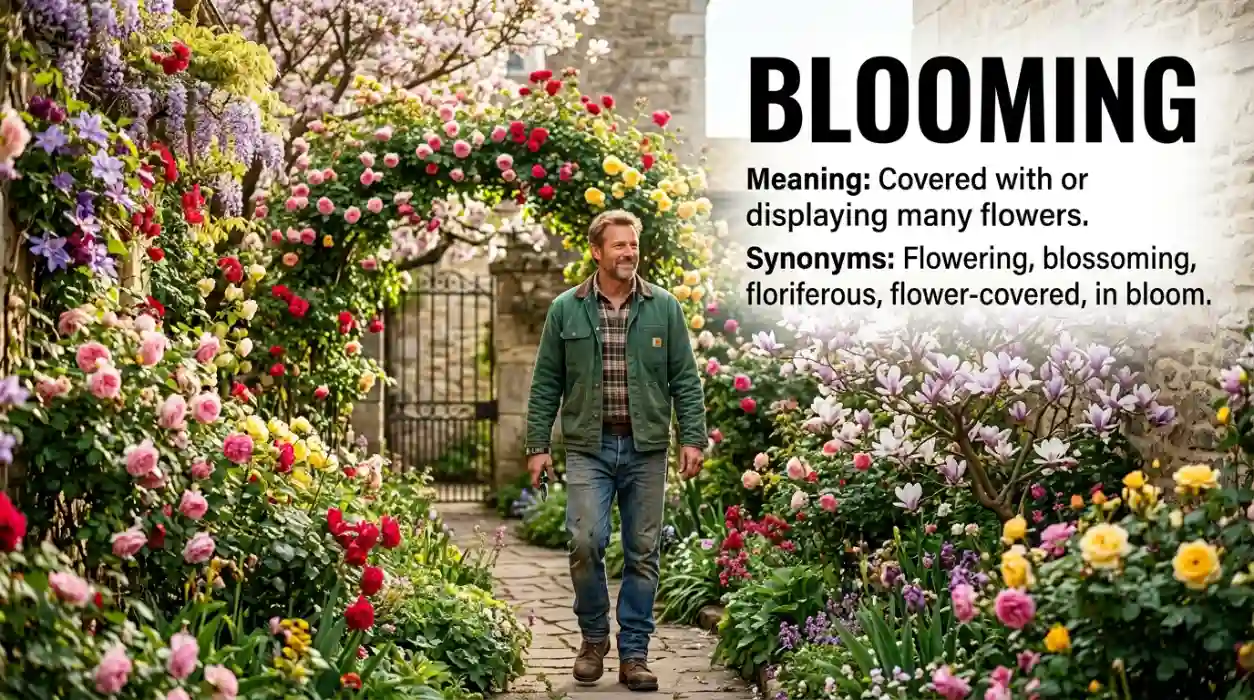
Abloom (Adjective) — US /əˈbluːm/ — UK /əˈbluːm/
Meaning: Abloom means covered with or displaying many flowers.
Tone/Register: Literary, descriptive.
Example:
The valley was abloom with spring flowers.
The old garden stood abloom after weeks of rain.
Flower-Filled (Adjective) — US /ˈflaʊər fɪld/ — UK /ˈflaʊə fɪld/
Meaning: Flower-filled describes a place or scene containing many flowers.
Tone/Register: Descriptive, informal.
Example:
They walked through a flower-filled courtyard.
Her photos showed a flower-filled meadow.
Floral (Adjective) — US /ˈflɔrəl/ — UK /ˈflɔːrəl/
Meaning: Floral means relating to flowers or featuring flowers.
Tone/Register: Neutral, descriptive, design-related.
Example:
She chose a floral pattern for the curtains.
The room has a soft floral scent.
Verdant (Adjective) — US /ˈvɜːrdənt/ — UK /ˈvɜːdənt/
Meaning: Verdant means covered with healthy green vegetation.
Tone/Register: Literary, descriptive.
Example:
The hills looked verdant after the rain.
We drove through a verdant valley.
Lush (Adjective) — US /lʌʃ/ — UK /lʌʃ/
Meaning: Lush describes vegetation that is rich, healthy, thick, and abundant.
Tone/Register: Descriptive, informal, literary.
Example:
The garden has lush green leaves.
Rain turned the dry field lush.
Vibrant (Adjective) — US /ˈvaɪbrənt/ — UK /ˈvaɪbrənt/
Meaning: Vibrant means full of energy, color, life, or activity.
Tone/Register: Positive, modern, versatile.
Example:
The blooming garden looked vibrant in the afternoon light.
Her vibrant personality filled the room.
Radiant (Adjective) — US /ˈreɪdiənt/ — UK /ˈreɪdiənt/
Meaning: Radiant describes someone or something that appears bright, healthy, joyful, or glowing.
Tone/Register: Positive, warm, expressive.
Example:
She looked radiant in the family photos.
His radiant smile made everyone relax.
Glowing (Adjective) — US /ˈɡloʊɪŋ/ — UK /ˈɡləʊɪŋ/
Meaning: Glowing describes a person or thing that appears healthy, bright, happy, or attractive.
Tone/Register: Positive, conversational.
Example:
You look glowing after your vacation.
The plants had a glowing green color in the morning light.
Healthy (Adjective) — US /ˈhelθi/ — UK /ˈhelθi/
Meaning: Healthy means showing good physical condition, growth, or vitality.
Tone/Register: Neutral, everyday.
Example:
The seedlings look healthy and strong.
She has a healthy, energetic appearance.
Energetic (Adjective) — US /ˌenərˈdʒetɪk/ — UK /ˌenəˈdʒetɪk/
Meaning: Energetic means full of physical or mental energy.
Tone/Register: Positive, everyday.
Example:
The energetic puppy raced around the garden.
She seemed energetic after a good night’s sleep.
Lively (Adjective) — US /ˈlaɪvli/ — UK /ˈlaɪvli/
Meaning: Lively means full of energy, movement, or enthusiasm.
Tone/Register: Positive, conversational.
Example:
The garden became lively with butterflies.
He gave a lively presentation to the class.
Radiating (Verb/Adjective) — US /ˈreɪdieɪtɪŋ/ — UK /ˈreɪdieɪtɪŋ/
Meaning: Radiating means visibly giving off a quality such as warmth, happiness, or energy.
Tone/Register: Expressive, literary.
Example:
She was radiating confidence on stage.
The flowers were radiating color across the field.
Flourishing (Adjective) — US /ˈflɜːrɪʃɪŋ/ — UK /ˈflʌrɪʃɪŋ/
Meaning: Flourishing describes something that is developing vigorously and successfully.
Tone/Register: Formal, positive.
Example:
The flourishing plants soon filled the greenhouse.
The school’s arts program is flourishing.
Prosperous (Adjective) — US /ˈprɑːspərəs/ — UK /ˈprɒspərəs/
Meaning: Prosperous means successful and financially or materially well developed.
Tone/Register: Formal, business.
Example:
The prosperous town has attracted new businesses.
They live in a prosperous farming region.
Successful (Adjective) — US /səkˈsesfəl/ — UK /səkˈsesfəl/
Meaning: Successful means achieving a desired result or developing well.
Tone/Register: Neutral, professional.
Example:
Her successful career developed slowly.
The garden project became a successful community effort.
Expanding (Adjective/Verb) — US /ɪkˈspændɪŋ/ — UK /ɪkˈspændɪŋ/
Meaning: Expanding means becoming larger, broader, or more extensive.
Tone/Register: Neutral, professional.
Example:
The expanding garden now covers the whole yard.
His expanding vocabulary helps him write more clearly.
Increasing (Adjective/Verb) — US /ɪnˈkriːsɪŋ/ — UK /ɪnˈkriːsɪŋ/
Meaning: Increasing means becoming greater in size, amount, strength, or number.
Tone/Register: Neutral, academic.
Example:
The increasing rainfall helped the plants.
She has an increasing interest in gardening.
Strengthening (Adjective/Verb) — US /ˈstreŋθənɪŋ/ — UK /ˈstreŋθənɪŋ/
Meaning: Strengthening means becoming stronger or making something stronger.
Tone/Register: Professional, neutral.
Example:
The strengthening plants can now survive the wind.
Their strengthening friendship became obvious.
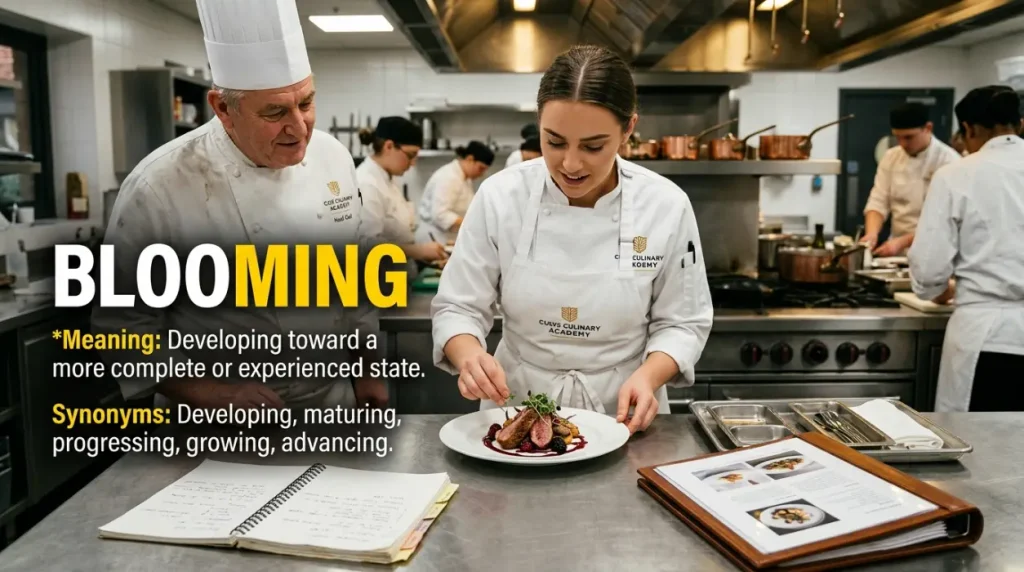
Maturing (Adjective/Verb) — US /məˈtʃʊrɪŋ/ — UK /məˈtjʊərɪŋ/
Meaning: Maturing means developing toward a more complete or experienced state.
Tone/Register: Neutral, professional.
Example:
The maturing vines now cover the fence.
Her maturing style is easy to recognize.
Awakening (Adjective/Verb) — US /əˈweɪkənɪŋ/ — UK /əˈweɪkənɪŋ/
Meaning: Awakening describes something beginning to become active, aware, or alive.
Tone/Register: Literary, figurative.
Example:
The awakening garden welcomed the spring sun.
An awakening interest in art changed his plans.
Reviving (Adjective/Verb) — US /rɪˈvaɪvɪŋ/ — UK /rɪˈvaɪvɪŋ/
Meaning: Reviving means returning to life, strength, activity, or popularity.
Tone/Register: Neutral, figurative.
Example:
The rain is reviving the dry plants.
The neighborhood is reviving after years of decline.
Renewed (Adjective) — US /rɪˈnuːd/ — UK /rɪˈnjuːd/
Meaning: Renewed means restored with fresh energy, strength, or activity.
Tone/Register: Neutral, positive.
Example:
The garden showed renewed growth after the storm.
She returned to work with renewed confidence.
Blossoming (Adjective/Verb) — US /ˈblɑːsəmɪŋ/ — UK /ˈblɒsəmɪŋ/
Meaning: Blossoming can describe a person, relationship, or talent that is developing beautifully.
Tone/Register: Warm, literary.
Example:
Their blossoming friendship became stronger each month.
His blossoming talent impressed the teacher.
Budding (Adjective) — US /ˈbʌdɪŋ/ — UK /ˈbʌdɪŋ/
Meaning: Budding describes someone or something that is beginning to develop successfully.
Tone/Register: Positive, common, figurative.
Example:
She is a budding photographer.
The budding friendship grew naturally.
Up-and-Coming (Adjective) — US /ˌʌp ən ˈkʌmɪŋ/ — UK /ˌʌp ən ˈkʌmɪŋ/
Meaning: Up-and-coming describes someone or something likely to become successful or important.
Tone/Register: Informal, modern.
Example:
The festival featured several up-and-coming musicians.
He is an up-and-coming writer.
On the Rise (Phrase) — US /ɑːn ðə raɪz/ — UK /ɒn ðə raɪz/
Meaning: On the rise means becoming more successful, popular, powerful, or noticeable.
Tone/Register: Informal, media, business.
Example:
The neighborhood is on the rise.
Her career is clearly on the rise.
Taking Off (Phrase) — US /ˈteɪkɪŋ ɔːf/ — UK /ˈteɪkɪŋ ɒf/
Meaning: Taking off means beginning to grow or become successful quickly.
Tone/Register: Informal, conversational.
Example:
Her small business is really taking off.
The new garden project is taking off.
Coming Into Its Own (Phrase) — US /ˌkʌmɪŋ ɪntuː ɪts oʊn/ — UK /ˌkʌmɪŋ ɪntuː ɪts əʊn/
Meaning: Coming into its own means reaching a stage where something shows its full ability or character.
Tone/Register: Idiomatic, conversational.
Example:
The garden is coming into its own this summer.
Her writing is finally coming into its own.
At Its Peak (Phrase) — US /æt ɪts piːk/ — UK /ət ɪts piːk/
Meaning: At its peak means at the highest or strongest stage of development or success.
Tone/Register: Neutral, formal.
Example:
The garden is at its peak in June.
Her career was at its peak during that decade
Synonyms by Tone
Positive
These words usually carry a positive feeling of growth, health, beauty, or success:
- Flowering
- Blossoming
- Flourishing
- Thriving
- Vibrant
- Radiant
- Glowing
- Lush
- Budding
- Prosperous
- Successful
- Resplendent
Neutral
These choices describe development without strongly adding emotion:
- Growing
- Developing
- Maturing
- Emerging
- Opening
- Increasing
- Expanding
- Progressing
- Strengthening
- Renewed
- Fully developed
- In bloom
Literary or Expressive
These choices can make descriptions more vivid:
- Abloom
- Unfolding
- Verdant
- In full flower
- Efflorescent
- Picturesque
- Resplendent
- Coming into its own
Informal or Conversational
These are useful in casual speech:
- Taking off
- On the rise
- Up-and-coming
- Bloomin’
- Alive
Why Tone Matters
Two words can describe similar growth but create different impressions.
Thriving sounds practical and confident.
Blossoming sounds warmer and more emotional.
Flourishing can sound polished and formal.
Radiant focuses more on appearance.
Budding suggests an early stage.
Choosing the right synonym helps your reader understand not just what is happening, but also how you want it to feel.
“Blooming” vs. Close Alternatives
| Word | Meaning | Tone | Best Use |
|---|---|---|---|
| Blooming | Flowering or developing strongly | Neutral/positive | Plants, people, ideas |
| Flowering | Producing flowers | Neutral | Botanical contexts |
| Blossoming | Flowering or developing beautifully | Warm/literary | Plants, people, relationships |
| Flourishing | Growing strongly and successfully | Formal/positive | Careers, businesses, communities |
| Thriving | Doing very well and growing healthily | Modern/positive | People, businesses, plants |
| Budding | Beginning to develop | Positive | Talents, careers, relationships |
| Radiant | Looking bright, healthy, or joyful | Warm/expressive | People and appearance |
When should you use “flowering”?
Use flowering when the literal production of flowers is the main point.
The flowering plants attract butterflies.
When should you use “blossoming”?
Use blossoming when you want either a floral meaning or a warmer figurative meaning.
Their friendship is blossoming.
When should you use “flourishing”?
Use flourishing for successful growth.
Her career is flourishing.
This word sounds more formal than blooming.
How “Blooming” Changes by Context
Daily Conversation
In everyday speech, blooming often describes flowers or a person’s appearance.
“The roses are blooming.”
For a person, native speakers may say:
“You look great.”
“You look radiant.”
In British English, blooming can also be an informal intensifier. Learners should recognize this use even if they do not use it themselves.
Writing and Blogging
Bloggers can use blooming, flowering, blossoming, thriving, and flourishing to create variety.
For example:
“The garden is blooming.”
can become:
“The garden is bursting into bloom.”
The second version creates a stronger visual image.
Good writing does not replace every repeated word. It chooses alternatives only when they improve meaning or style.
Professional and Academic Tone
Professional writing often favors flourishing, thriving, developing, progressing, expanding, or maturing.
For example:
“The program is flourishing.”
sounds more polished than:
“The program is blooming.”
For academic writing, developing, emerging, and progressing are often safer choices.
Creative and Informal Use
Creative writing has more freedom.
A novelist might write:
“The valley was abloom with wildflowers.”
A lifestyle blogger might write:
“Her confidence is blooming.”
A casual speaker might say:
“Her career is really taking off.”
Each choice changes the mood.
Common Mistakes Learners Make
Mistake 1: Using “blooming” only for flowers
Blooming can also describe people, relationships, talents, careers, and communities.
Her confidence is blooming.
This is figurative, but natural.
Mistake 2: Confusing “blooming” with “blossoming”
The two are close.
However, blossoming often feels more figurative or literary when describing personal development.
His talent is blossoming.
Blooming can sound more direct and lively.
Mistake 3: Using “flourishing” for every flower
Flourishing means thriving or developing successfully.
It can describe plants, but it often emphasizes health and successful growth rather than the actual appearance of flowers.
Mistake 4: Using “radiant” for plants
Radiant normally describes brightness, beauty, or a person’s glowing appearance.
It is not a direct botanical replacement for blooming.
Mistake 5: Missing the British intensifier
In British informal English, blooming can mean something like very or can add annoyance.
That’s a blooming shame.
This meaning has nothing to do with flowers. Cambridge and Oxford both identify this informal use.
Mistake 6: Overusing decorative synonyms
Words such as resplendent, efflorescent, and abloom can be useful, but they should not appear in every sentence.
Simple words often sound more natural.
Register Notes
For creative writing, choose:
- blossoming
- abloom
- radiant
- lush
- verdant
- unfolding
For informal British emphasis, recognize:
- blooming
- bloomin’
A useful internal vocabulary guide on synonyms for growth-related words can help you build the same kind of precision across other common adjectives.
Real-Life Mini Scenarios
Workplace
A manager might say:
“The new team is thriving.”
This sounds natural and professional.
For a more formal report:
“The department is flourishing.”
Social Situations
If a friend looks healthier after a vacation, you might say:
“You look radiant!”
In British informal speech, someone might also say:
“You look blooming!”
The exact effect depends on regional style and context.
Media and Pop Culture
Entertainment writing often uses budding, rising, or up-and-coming for people beginning successful careers.
“The show introduced several up-and-coming actors.”
This is more precise than simply saying they are “blooming.”
Writing and Storytelling
A novelist might describe spring like this:
“The valley was abloom with color.”
Another writer might prefer:
“Wildflowers were bursting into bloom.”
Both are vivid, but they create different rhythms.

Practice Exercise
1. The roses are producing flowers in the garden. Which word fits best?
A. Flourishing
B. Flowering
C. Prosperous
D. Successful
2. Her confidence is developing beautifully. Which word sounds most natural?
A. Blossoming
B. Tributary
C. Floral
D. Verdant
3. The small company is growing successfully.
A. Radiant
B. Flourishing
C. Picturesque
D. Floral
4. You want to describe someone who looks healthy and glowing.
A. Radiant
B. Emerging
C. Budding
D. Opening
5. A young writer is beginning to show talent.
A. Budding
B. Verdant
C. In bloom
D. Flower-filled
6. The garden is covered with healthy, thick vegetation.
A. Lush
B. Emphatic
C. Prosperous
D. Advancing
7. A new actor is becoming successful and attracting attention.
A. Up-and-coming
B. Flowering
C. Abloom
D. Opening
8. A career is becoming more successful.
A. On the rise
B. Floral
C. In full flower
D. Flower-filled
9. The roses have completely opened.
A. Fully developed
B. In bloom
C. Prosperous
D. Budding
10. You want a formal word for successful development.
A. Flourishing
B. Bloomin’
C. Lively
D. Flower-filled
Answer Key: 1-B | 2-A | 3-B | 4-A | 5-A | 6-A | 7-A | 8-A | 9-B | 10-A
Reflection and Application Task
Write five short sentences using five different alternatives for blooming.
Try one sentence about:
- a flower
- a person
- a career
- a relationship
- a business or community
Conclusion
A good synonym for blooming does more than replace a repeated word. It helps you show whether something is flowering, growing, glowing, developing, or becoming successful.
Words like flowering, blossoming, thriving, flourishing, radiant, and budding each carry a special shade. That small difference can make your English feel more natural.
Strong synonyms for blooming knowledge improve writing, blogging, speaking, and everyday communication. It also helps you describe people, plants, careers, relationships, and ideas with greater confidence.
Keep practicing these words in emails, essays, stories, and daily conversations. Choose one new synonym today and use it in a sentence that feels genuinely yours.
FAQs
1. What is the best synonym for blooming flowers?
The most direct synonym for blooming flowers is flowering. You can also say in bloom, blossoming, or bursting into bloom, depending on the sentence. Flowering is neutral and practical, while blossoming can sound more descriptive. Bursting into bloom emphasizes a noticeable or sudden display of flowers.
2. What is a good synonym for blooming when describing a person?
When describing a person’s healthy or attractive appearance, radiant, glowing, vibrant, and healthy-looking can work well. Blooming itself can suggest that someone looks healthy, energetic, and attractive. Radiant focuses more on visible happiness or brightness, while glowing often suggests a healthy, fresh appearance.
3. What does blooming mean when talking about a relationship?
When blooming describes a relationship, it means the relationship is developing and becoming stronger. Natural alternatives include blossoming, growing, deepening, and flourishing. For example, “Their friendship is blossoming” suggests that the friendship is becoming closer and more meaningful over time.
4. What is the difference between blooming and flourishing?
Blooming can describe literal flowers and figurative growth. Flourishing focuses more strongly on successful, healthy development. You can say “The roses are blooming,” but “The company is flourishing” sounds more natural. Both can describe people or situations, but flourishing often has a more formal and professional tone.
5. Can blooming mean very good in British English?
Not exactly. In mainly British informal English, blooming can act as an intensifier. It adds emphasis and can sometimes express annoyance, as in “It’s a blooming nuisance.” It is not normally a direct synonym for “very good.” This use is separate from its literal meaning related to flowers.

Hasnain Ali is an SEO Content Strategist and the founder of wordvora.com, a trusted vocabulary platform that helps writers, students, professionals, and English learners find accurate synonyms, antonyms, word meanings, and real-life usage examples. He specializes in keyword research, on-page SEO, topical authority, and creating search-first content that aligns with Google’s latest Search Quality and E-E-A-T guidelines. His work focuses on producing clear, well-structured, and reader-friendly resources that satisfy search intent while maintaining high editorial standards.
Through extensive hands-on experience with SEO tools such as Google Search Console, Google Analytics, SEMrush, and Ahrefs, Hasnain researches user search behavior and develops content that is both informative and easy to understand. Every article published on wordvora.com is carefully reviewed for accuracy, readability, and contextual relevance before publication. His mission is to build one of the web’s most reliable English vocabulary resources by providing practical language guidance, trustworthy explanations, and content that helps readers improve their writing, communication, and vocabulary with confidence.