
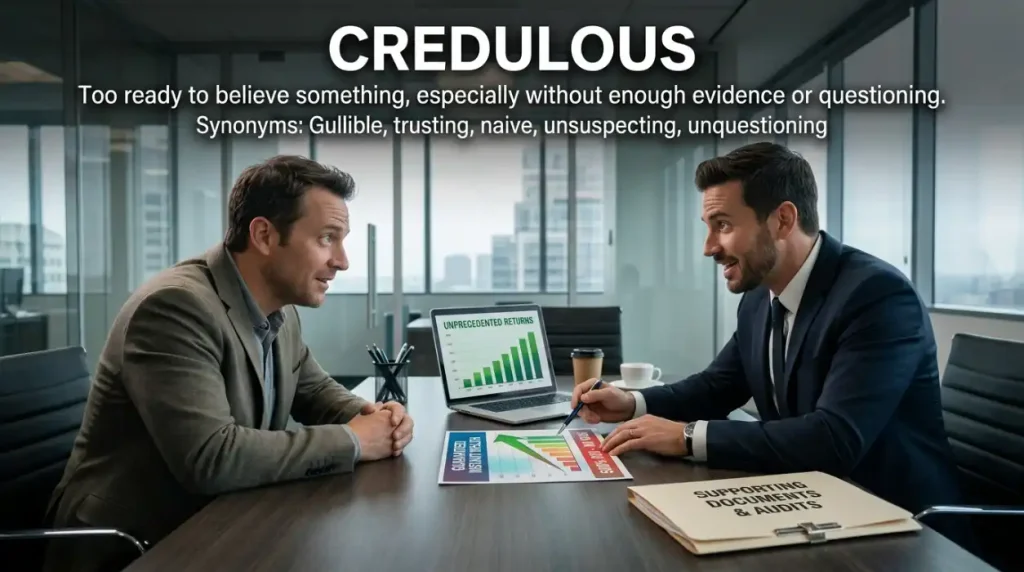
Synonym for credulous include words such as gullible, trusting, unsuspecting, naive, unquestioning, and easily deceived. The best choice depends on whether you want to stress innocence, excessive trust, lack of experience, or a tendency to believe claims without enough evidence.
You see a social media post promising instant success. A friend believes it immediately. You might call that friend credulous because they accept the claim too easily.
A synonym for credulous can change the feeling of your sentence. “Trusting” sounds kinder, while “gullible” sounds more critical.
The word is common when people discuss rumors, scams, false claims, and people who believe things without checking. Synonyms add useful precision.
For students, bloggers, content writers, and everyday English users, learning these alternatives makes opinions clearer and more natural.
What Does “Credulous” Really Mean?
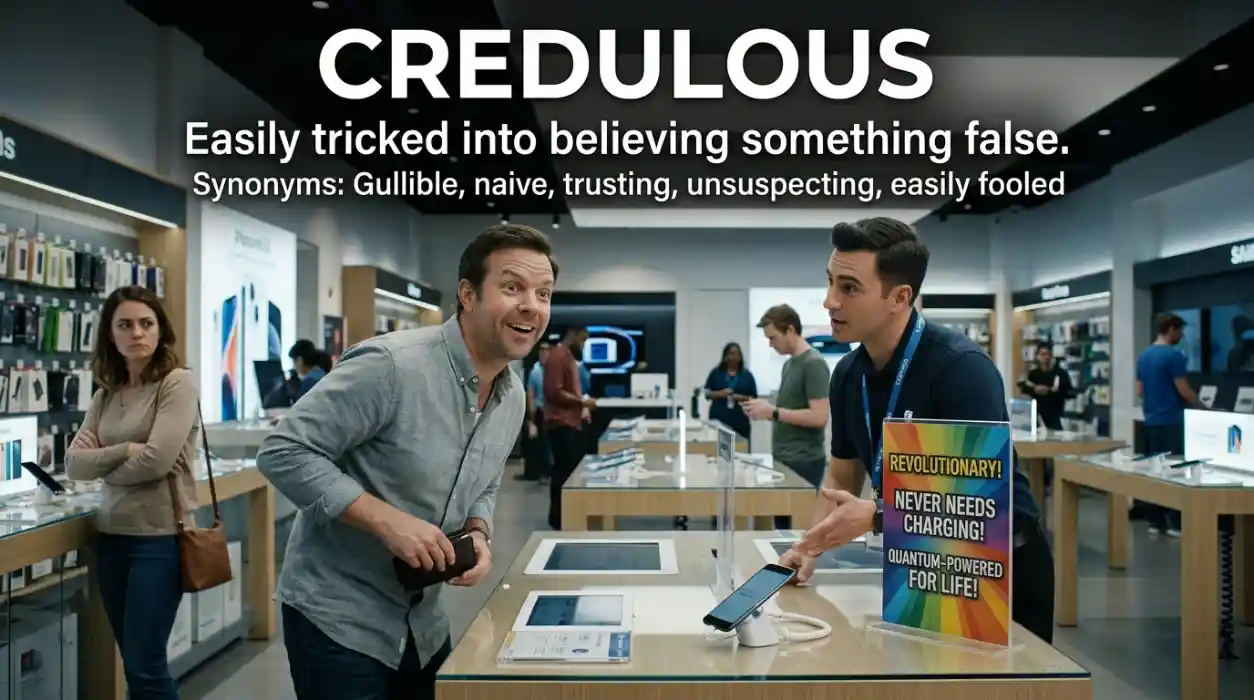
Credulous describes someone who is too ready to believe something, especially something that may be untrue or unlikely.
In simple English:
Credulous = too willing to believe what other people tell you.
For example:
“He was credulous enough to believe the fake story.”
The sentence suggests that he believed the story without enough skepticism.
Native speakers often use credulous when discussing a person’s judgment or response to information. It can appear in conversations about rumors, advertising, misinformation, deception, scams, politics, storytelling, or personal relationships.
The word usually describes a person, audience, reader, or mind rather than an object.
Part of Speech
Credulous is an adjective.
Related forms include:
- Credulously — adverb
- Credulousness — noun
- Credulity — noun
The key idea is not simply “believing.” It is believing too readily.
Someone can be trusting without being credulous. Someone becomes credulous when their willingness to believe exceeds reasonable judgment.
Connotative Meaning
Connotation (the emotional feeling or attitude associated with a word) helps explain why synonyms of “credulous” do not all sound the same.
Positive Tone
Trusting, open-minded, and sometimes innocent can suggest a person’s good faith or lack of cynicism.
Negative Tone
Gullible, naive, uncritical, and easily deceived can suggest poor judgment or vulnerability.
Neutral Tone
Credulous, believing, and unsuspecting can describe someone’s attitude without always sounding harsh.
The word credulous itself often carries a mildly negative judgment. It suggests that a person should have questioned the information more carefully.
Etymology
Credulous comes from Latin credulus, meaning “believing readily” or “inclined to believe.” It is related to the Latin verb credere, meaning “to believe, trust, or entrust.”
English adopted the word through French and Latin-based vocabulary.
Old English: 450–1100
The exact word credulous was not part of ordinary Old English vocabulary.
Old English had native Germanic words connected with belief, trust, faith, and confidence, but the modern Latin-derived form came later.
Middle English: 1100–1500
After the Norman Conquest, English absorbed many French and Latin-derived terms.
Words connected with belief and credibility became increasingly common in educated and literary English.
Modern English: 1500–Present
Credulous became established in English as a word for someone who is too ready to believe.
Its meaning remains relatively stable today. Modern speakers commonly use it when discussing misinformation, rumors, deception, or poor judgment.
Pronunciation
US: /ˈkredʒ.ə.ləs/
UK: /ˈkredʒ.ə.ləs/
Syllables
cred-u-lous
Three syllables.
Affixation Pattern of “Credulous”
Root: cred- / credul-
Prefix: none
Suffix: -ous
The Latin root cred- relates to believing or trusting.
The suffix -ous commonly forms adjectives meaning “characterized by” or “full of” a particular quality.
Synonyms List
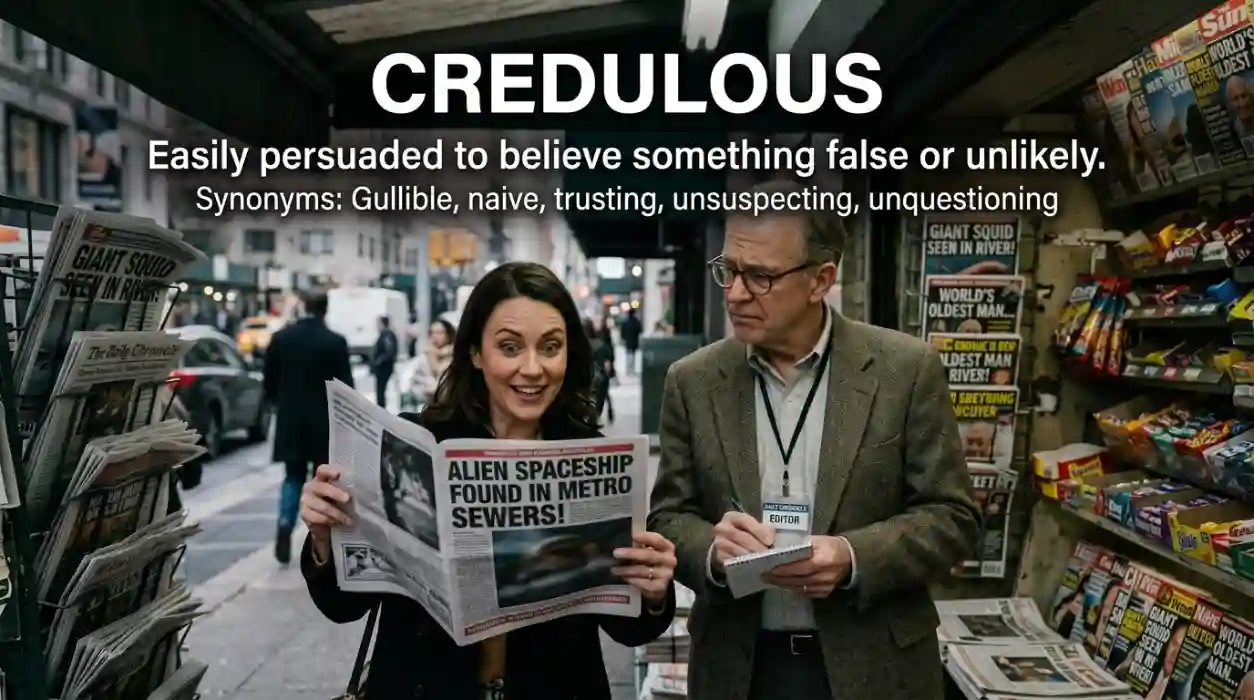
1. Gullible (Adjective) — US /ˈɡʌl.ə.bəl/ — UK /ˈɡʌl.ə.bəl/
Meaning: Easily persuaded to believe something false or unlikely.
Tone/Register: Informal to neutral; often negative.
Example: Tom is too gullible to spot obvious scams.
Example: She was gullible enough to believe the fake message.
2. Trusting (Adjective) — US /ˈtrʌs.tɪŋ/ — UK /ˈtrʌs.tɪŋ/
Meaning: Willing to believe that other people are honest or reliable.
Tone/Register: Neutral; often positive.
Example: He is naturally trusting with new people.
Example: Her trusting nature sometimes gets her into trouble.
3. Naive (Adjective) — US /naɪˈiːv/ — UK /naɪˈiːv/
Meaning: Lacking experience or understanding about how people or situations really work.
Tone/Register: Neutral to critical.
Example: I was naive when I first moved to the city.
Example: His naive assumption caused problems.
4. Unsuspecting (Adjective) — US /ˌʌn.səˈspek.tɪŋ/ — UK /ˌʌn.səˈspek.tɪŋ/
Meaning: Not expecting that someone or something may be harmful, deceptive, or dishonest.
Tone/Register: Neutral.
Example: The scam targeted unsuspecting customers.
Example: An unsuspecting visitor opened the link.
5. Unquestioning (Adjective) — US /ʌnˈkwes.tʃə.nɪŋ/ — UK /ʌnˈkwes.tʃə.nɪŋ/
Meaning: Accepting something without asking questions or expressing doubt.
Tone/Register: Formal to neutral.
Example: His unquestioning loyalty worried his friends.
Example: The group showed unquestioning support.
6. Uncritical (Adjective) — US /ʌnˈkrɪt̬.ɪ.kəl/ — UK /ʌnˈkrɪt.ɪ.kəl/
Meaning: Failing to examine or judge information carefully.
Tone/Register: Academic, formal.
Example: The article takes an uncritical view of the claim.
Example: Uncritical readers may accept the story too quickly.
7. Believing (Adjective) — US /bɪˈliː.vɪŋ/ — UK /bɪˈliː.vɪŋ/
Meaning: Ready to accept something as true.
Tone/Register: Neutral.
Example: She was a believing audience member.
Example: His believing attitude made the trick easy.
8. Innocent (Adjective) — US /ˈɪn.ə.sənt/ — UK /ˈɪn.ə.sənt/
Meaning: Lacking experience of dishonesty or harmful intentions.
Tone/Register: Neutral to positive.
Example: Her innocent trust made her vulnerable.
Example: He had an innocent view of the situation.
9. Inexperienced (Adjective) — US /ˌɪn.ɪkˈspɪr.i.ənst/ — UK /ˌɪn.ɪkˈspɪə.ri.ənst/
Meaning: Lacking practical knowledge gained through experience.
Tone/Register: Neutral, professional.
Example: The inexperienced buyer trusted the seller.
Example: An inexperienced investor may miss warning signs.
10. Unsophisticated (Adjective) — US /ˌʌn.səˈfɪs.tə.keɪ.t̬ɪd/ — UK /ˌʌn.səˈfɪs.tɪ.keɪ.tɪd/
Meaning: Lacking knowledge or awareness of complex social or practical realities.
Tone/Register: Formal to neutral.
Example: The campaign targeted unsophisticated consumers.
Example: His unsophisticated view ignored important details.
11. Simple (Adjective) — US /ˈsɪm.pəl/ — UK /ˈsɪm.pəl/
Meaning: Having a limited or uncomplicated understanding of a situation.
Tone/Register: Neutral; context-dependent.
Example: She has a simple view of the issue.
Example: His simple explanation left out important facts.
Note: “Simple” is not a direct synonym for credulous and should be used carefully.
12. Childlike (Adjective) — US /ˈtʃaɪld.laɪk/ — UK /ˈtʃaɪld.laɪk/
Meaning: Showing qualities associated with children, such as openness or trust.
Tone/Register: Neutral to positive.
Example: His childlike trust surprised everyone.
Example: She kept a childlike belief in people.
13. Innocent-Hearted (Adjective) — US /ˈɪn.ə.sənt ˌhɑːr.t̬ɪd/ — UK /ˈɪn.ə.sənt ˌhɑː.tɪd/
Meaning: Naturally trusting and free from suspicion.
Tone/Register: Literary, expressive.
Example: Her innocent-hearted nature made her easy to fool.
Example: He remained innocent-hearted despite past disappointments.
14. Trustful (Adjective) — US /ˈtrʌst.fəl/ — UK /ˈtrʌst.fəl/
Meaning: Willing to trust another person.
Tone/Register: Neutral, somewhat less common than “trusting.”
Example: The child was naturally trustful.
Example: His trustful personality attracted sincere friends.
15. Confiding (Adjective) — US /kənˈfaɪ.dɪŋ/ — UK /kənˈfaɪ.dɪŋ/
Meaning: Readily trusting others with personal thoughts or information.
Tone/Register: Neutral.
Example: She has a confiding nature.
Example: His confiding manner made strangers feel comfortable.
16. Open (Adjective) — US /ˈoʊ.pən/ — UK /ˈəʊ.pən/
Meaning: Willing to accept ideas or information without immediate rejection.
Tone/Register: Neutral to positive.
Example: She is open to new explanations.
Example: His open attitude sometimes makes him too trusting.
17. Open-Minded (Adjective) — US /ˌoʊ.pənˈmaɪn.dɪd/ — UK /ˌəʊ.pənˈmaɪn.dɪd/
Meaning: Willing to consider different ideas without judging them too quickly.
Tone/Register: Neutral to positive.
Example: Keep an open mind, but check the evidence.
Example: Being open-minded does not mean believing every claim.
Note: This is not inherently negative like “credulous.”
18. Receptive (Adjective) — US /rɪˈsep.tɪv/ — UK /rɪˈsep.tɪv/
Meaning: Willing to listen to or accept new ideas.
Tone/Register: Formal, academic, professional.
Example: The audience was receptive to the proposal.
Example: He was receptive to the new theory.
19. Suggestible (Adjective) — US /səɡˈdʒes.tə.bəl/ — UK /səɡˈdʒes.tə.bəl/
Meaning: Easily influenced by another person’s suggestions or opinions.
Tone/Register: Formal, psychological.
Example: Young children can be highly suggestible.
Example: The witness seemed suggestible during questioning.
20. Impressionable (Adjective) — US /ɪmˈpreʃ.ə.nə.bəl/ — UK /ɪmˈpreʃ.ə.nə.bəl/
Meaning: Easily influenced because of limited experience or strong emotional responsiveness.
Tone/Register: Neutral to formal.
Example: Teenagers can be impressionable.
Example: The impressionable audience followed the celebrity’s advice.
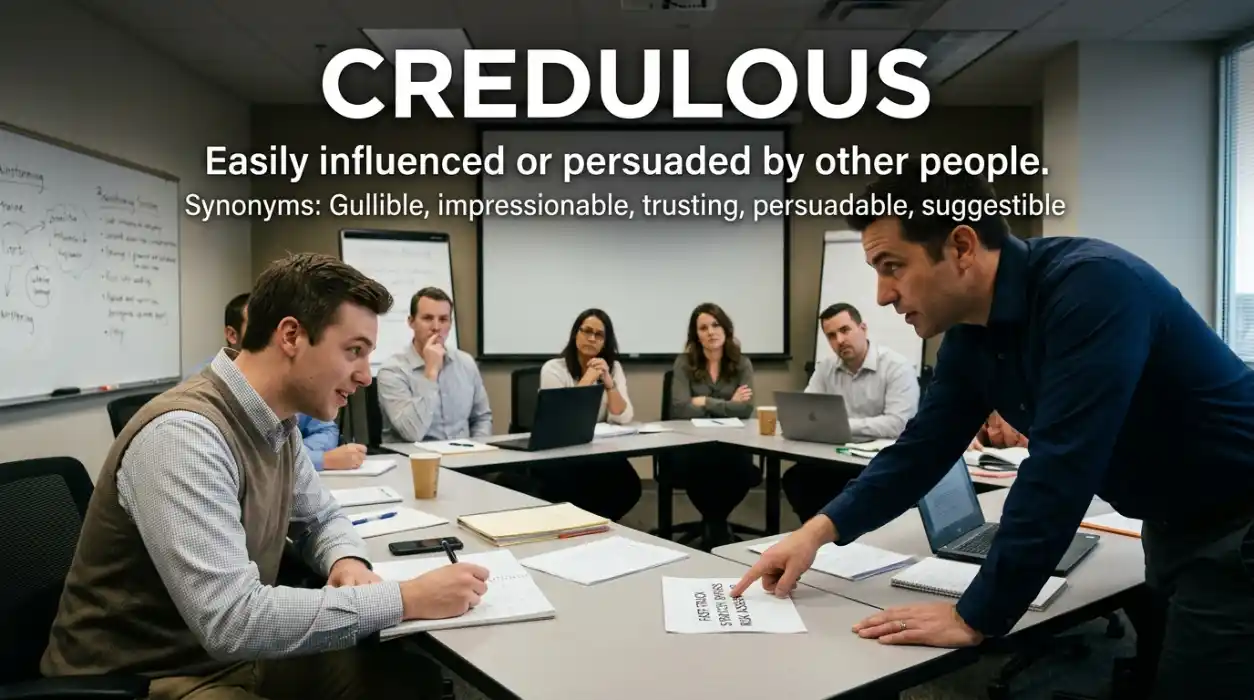
21. Easily Led (Adjective Phrase) — US /ˈiː.zə.li led/ — UK /ˈiː.zɪ.li led/
Meaning: Easily influenced or persuaded by other people.
Tone/Register: Neutral to informal.
Example: He is easily led by confident speakers.
Example: An easily led person may follow the crowd.
22. Easily Influenced (Adjective Phrase) — US /ˈiː.zə.li ˈɪn.fluənst/ — UK /ˈiː.zɪ.li ˈɪn.fluənst/
Meaning: Easily persuaded to change an opinion or behavior.
Tone/Register: Neutral.
Example: She is easily influenced by online trends.
Example: Younger audiences can be easily influenced.
23. Easily Persuaded (Adjective Phrase) — US /ˈiː.zə.li pɚˈsweɪdɪd/ — UK /ˈiː.zɪ.li pəˈsweɪdɪd/
Meaning: Quick to accept another person’s argument or suggestion.
Tone/Register: Neutral.
Example: He is easily persuaded by emotional stories.
Example: She was easily persuaded to change her decision.
24. Easily Deceived (Adjective Phrase) — US /ˈiː.zə.li dɪˈsiːvd/ — UK /ˈiː.zɪ.li dɪˈsiːvd/
Meaning: Easy for other people to trick or mislead.
Tone/Register: Neutral to formal.
Example: The victim was easily deceived.
Example: People who trust too quickly can be easily deceived.
25. Easily Fooled (Adjective Phrase) — US /ˈiː.zə.li fuːld/ — UK /ˈiː.zɪ.li fuːld/
Meaning: Easy to trick with false information or clever behavior.
Tone/Register: Informal.
Example: He is not easily fooled.
Example: The scam worked because the victim was easily fooled.
26. Unwary (Adjective) — US /ʌnˈwer.i/ — UK /ʌnˈweə.ri/
Meaning: Not cautious enough to notice possible danger or deception.
Tone/Register: Formal to neutral.
Example: The website collected information from unwary users.
Example: An unwary traveler may fall for the trick.
27. Unsuspecting (Adjective) — US /ˌʌn.səˈspek.tɪŋ/ — UK /ˌʌn.səˈspek.tɪŋ/
Meaning: Unaware that something unexpected or deceptive is happening.
Tone/Register: Neutral.
Example: An unsuspecting customer clicked the message.
Example: The thief approached an unsuspecting tourist.
Note: This overlaps strongly with “credulous,” but it emphasizes a lack of suspicion.
28. Unaware (Adjective) — US /ˌʌn.əˈwer/ — UK /ˌʌn.əˈweə/
Meaning: Not knowing about something.
Tone/Register: Neutral.
Example: She was unaware that the claim was false.
Example: He remained unaware of the warning signs.
Note: “Unaware” means lacking knowledge, not necessarily being too willing to believe.
29. Unsuspicious (Adjective) — US /ˌʌn.səˈspɪʃ.əs/ — UK /ˌʌn.səˈspɪʃ.əs/
Meaning: Not inclined to suspect that something is wrong.
Tone/Register: Neutral.
Example: His unsuspicious nature made him easy to surprise.
Example: She remained unsuspicious despite several clues.
30. Non-Skeptical (Adjective) — US /ˌnɑːnˈskep.tɪ.kəl/ — UK /ˌnɒnˈskep.tɪ.kəl/
Meaning: Not inclined to question whether a claim is true.
Tone/Register: Academic, analytical.
Example: The study examined non-skeptical audiences.
Example: His non-skeptical reaction surprised the researchers.
31. Uncritical Believer (Noun Phrase) — US /ʌnˈkrɪt̬.ɪ.kəl bɪˈliː.vɚ/ — UK /ʌnˈkrɪt.ɪ.kəl bɪˈliː.və/
Meaning: A person who accepts claims without examining their evidence.
Tone/Register: Academic, critical.
Example: An uncritical believer may share misinformation.
Example: The speaker appealed to uncritical believers.
32. Blindly Trusting (Adjective Phrase) — US /ˈblaɪnd.li ˈtrʌs.tɪŋ/ — UK /ˈblaɪnd.li ˈtrʌs.tɪŋ/
Meaning: Trusting someone or something without reasonable questioning.
Tone/Register: Strongly critical.
Example: Blindly trusting strangers can create serious problems.
Example: He was blindly trusting of the seller.
33. Overtrusting (Adjective) — US /ˌoʊ.vɚˈtrʌs.tɪŋ/ — UK /ˌəʊ.vəˈtrʌs.tɪŋ/
Meaning: Trusting people or information more than is reasonable.
Tone/Register: Informal to neutral.
Example: Her overtrusting nature caused problems.
Example: He can be overtrusting with strangers.
34. Overly Trusting (Adjective Phrase) — US /ˈoʊ.vɚ.li ˈtrʌs.tɪŋ/ — UK /ˈəʊ.və.li ˈtrʌs.tɪŋ/
Meaning: More willing to trust than a situation reasonably allows.
Tone/Register: Neutral.
Example: She is overly trusting with online contacts.
Example: His overly trusting attitude worried his family.
35. Credulous-Minded (Adjective) — US /ˈkredʒ.ə.ləs ˈmaɪn.dɪd/ — UK /ˈkredʒ.ə.ləs ˈmaɪn.dɪd/
Meaning: Inclined to accept claims too readily.
Tone/Register: Uncommon, descriptive.
Example: His credulous-minded approach made him vulnerable.
Example: A credulous-minded reader may accept the story without checking it.
Note: This is a descriptive phrase, not a common replacement for “credulous.”
36. Believing Too Easily (Adjective Phrase) — US /bɪˈliː.vɪŋ tuː ˈiː.zə.li/ — UK /bɪˈliː.vɪŋ tuː ˈiː.zɪ.li/
Meaning: Accepting information as true without enough evidence or thought.
Tone/Register: Neutral, explanatory.
Example: He has a habit of believing things too easily.
Example: Believing too easily can make people vulnerable to scams.
37. Ready to Believe (Adjective Phrase) — US /ˈred.i tə bɪˈliːv/ — UK /ˈred.i tə bɪˈliːv/
Meaning: Willing to accept a claim as true with little resistance.
Tone/Register: Neutral.
Example: She was ready to believe the exciting rumor.
Example: The audience seemed ready to believe him.
38. Too Trusting (Adjective Phrase) — US /tuː ˈtrʌs.tɪŋ/ — UK /tuː ˈtrʌs.tɪŋ/
Meaning: Trusting people or claims beyond what is sensible.
Tone/Register: Conversational.
Example: You’re too trusting with strangers.
Example: He is too trusting when someone sounds confident.
39. Easily Convinced (Adjective Phrase) — US /ˈiː.zə.li kənˈvɪnst/ — UK /ˈiː.zɪ.li kənˈvɪnst/
Meaning: Quick to accept another person’s explanation or argument.
Tone/Register: Neutral.
Example: She is easily convinced by emotional arguments.
Example: He was easily convinced that the rumor was true.
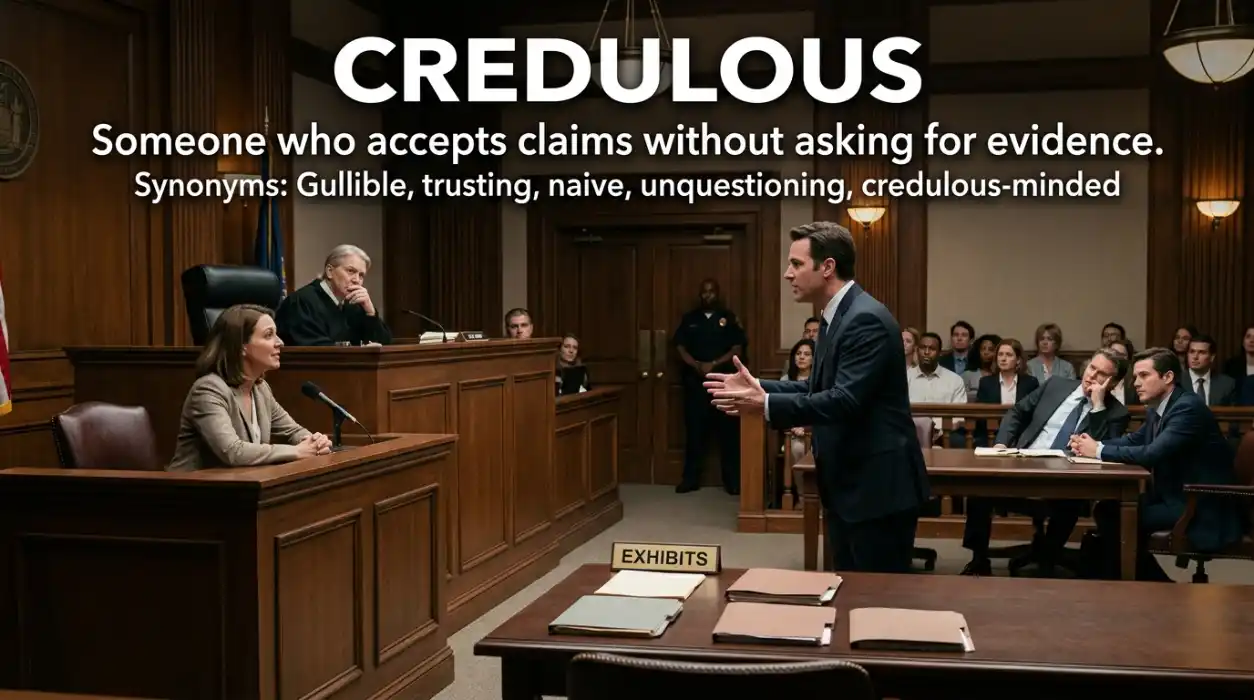
40. Unquestioning Believer (Noun Phrase) — US /ʌnˈkwes.tʃə.nɪŋ bɪˈliː.vɚ/ — UK /ʌnˈkwes.tʃə.nɪŋ bɪˈliː.və/
Meaning: Someone who accepts claims without asking for evidence.
Tone/Register: Formal, critical.
Example: The movement attracted unquestioning believers.
Example: An unquestioning believer may reject reasonable criticism.
41. Too Open to Claims (Adjective Phrase) — US /tuː ˈoʊ.pən tə kleɪmz/ — UK /tuː ˈəʊ.pən tə kleɪmz/
Meaning: Too willing to accept statements as true.
Tone/Register: Neutral, explanatory.
Example: He is too open to claims he sees online.
Example: Being too open to claims can weaken critical thinking.
42. Easily Swayed (Adjective Phrase) — US /ˈiː.zə.li sweɪd/ — UK /ˈiː.zɪ.li sweɪd/
Meaning: Easily influenced to change an opinion or decision.
Tone/Register: Neutral.
Example: The voters were not easily swayed.
Example: She is easily swayed by confident speakers.
43. Susceptible (Adjective) — US /səˈsep.tə.bəl/ — UK /səˈsep.tɪ.bəl/
Meaning: Easily affected or influenced by something.
Tone/Register: Formal, academic.
Example: Young users may be susceptible to misleading claims.
Example: He is susceptible to emotional persuasion.
44. Vulnerable (Adjective) — US /ˈvʌl.nər.ə.bəl/ — UK /ˈvʌl.nər.ə.bəl/
Meaning: Easily harmed, influenced, or exploited.
Tone/Register: Neutral to formal.
Example: New users can be vulnerable to online deception.
Example: Her lack of experience left her vulnerable.
45. Credulity-Prone (Adjective) — US /krəˈduː.lə.t̬i proʊn/ — UK /krəˈdjuː.lə.ti prəʊn/
Meaning: Having a tendency to accept claims too readily.
Tone/Register: Technical, uncommon.
Example: The study examined credulity-prone audiences.
Example: Credulity-prone readers may overlook weak evidence.
46. Gullible-Minded (Adjective) — US /ˈɡʌl.ə.bəl ˈmaɪn.dɪd/ — UK /ˈɡʌl.ə.bəl ˈmaɪn.dɪd/
Meaning: Having a tendency to believe things too easily.
Tone/Register: Informal, uncommon.
Example: His gullible-minded approach caused problems.
Example: A gullible-minded reader may trust an attractive headline.
47. Easily Misled (Adjective Phrase) — US /ˈiː.zə.li mɪsˈled/ — UK /ˈiː.zɪ.li mɪsˈled/
Meaning: Easily led toward an incorrect belief or conclusion.
Tone/Register: Neutral.
Example: People with little experience can be easily misled.
Example: He was easily misled by the edited video.
48. Prone to Belief (Adjective Phrase) — US /proʊn tə bɪˈliːf/ — UK /prəʊn tə bɪˈliːf/
Meaning: Likely to accept information as true.
Tone/Register: Formal, descriptive.
Example: Some audiences are prone to belief without evidence.
Example: He seems prone to belief when a story sounds convincing.
49. Overly Receptive (Adjective) — US /ˈoʊ.vɚ.li rɪˈsep.tɪv/ — UK /ˈəʊ.və.li rɪˈsep.tɪv/
Meaning: Too willing to accept ideas or claims without enough evaluation.
Tone/Register: Formal, academic.
Example: The audience was overly receptive to the rumor.
Example: An overly receptive reader may overlook obvious contradictions.
50. Easily Taken In (Adjective Phrase) — US /ˈiː.zə.li ˌteɪ.kən ˈɪn/ — UK /ˈiː.zɪ.li ˌteɪ.kən ˈɪn/
Meaning: Easily tricked into believing something false.
Tone/Register: Informal, idiomatic, especially British.
Example: He is easily taken in by dramatic stories.
Example: She was easily taken in by the fake advertisement.
Synonyms by Tone
Positive or Gentle
These choices can describe trust without directly insulting someone:
- trusting
- open
- open-minded
- receptive
- innocent
- childlike
- trustful
They work when you want to avoid making the person sound foolish.
Neutral
These are useful for objective explanations:
- credulous
- believing
- unsuspecting
- inexperienced
- unwary
- susceptible
- easily influenced
- easily persuaded
Negative
These clearly suggest poor judgment or excessive trust:
- gullible
- naive
- uncritical
- unquestioning
- blindly trusting
- overtrusting
- easily deceived
- easily fooled
Informal
These sound natural in everyday conversation:
- too trusting
- easily led
- easily fooled
- easily taken in
- overtrusting
Tone matters because credulous can describe a weakness without sounding as blunt as gullible.
“Credulous” vs Close Alternatives
Gullible vs Credulous
Credulous means someone is too ready to believe.
Gullible goes further. It often suggests that the person can easily be tricked.
“The audience was credulous.”
This sounds analytical.
“He is gullible.”
This sounds more personal and critical.
Credulous vs Naive
Naive focuses on lack of experience or sophistication.
Credulous focuses on willingness to believe.
A person can be naive without believing false claims. A person can also be credulous because they trust information too easily.
Credulous vs Trusting
Trusting is usually warmer.
“She is trusting.”
This can be praise.
“She is credulous.”
This usually suggests that her trust goes too far.
How “Credulous” Changes by Context
Daily Conversation
In casual conversation, gullible is usually more common than credulous.
“You’re so gullible!”
Friends might say this jokingly after someone falls for a harmless prank.
Credulous sounds more thoughtful and analytical.
Writing or Blogging
Writers can use credulous when discussing readers, audiences, rumors, or online information.
“Credulous readers may share sensational claims without checking them.”
This sounds precise without being excessively harsh.
Professional or Academic Tone
Credulous, uncritical, susceptible, and suggestible work well in formal writing.
For example:
“The researchers examined how suggestible participants responded to misleading information.”
This is more precise than simply calling the participants “gullible.”
Creative or Informal Use
A novelist may use gullible, naive, or too trusting to reveal a character’s personality.
“Don’t be so gullible,” Maya said.
The dialogue sounds natural and immediate.
Common Mistakes & Native Usage
Mistake 1: Thinking “credulous” means “credible”
These words are different.
Credulous describes a person who is ready to believe.
Credible describes something that seems believable or trustworthy.
“He is credulous.”
“His explanation is credible.”
Do not confuse them.
Mistake 2: Treating “trusting” as always negative
Trusting can be positive.
“She is a trusting person.”
This may suggest kindness.
But:
“She is too trusting.”
Now the phrase suggests excessive trust.
Mistake 3: Using “naive” when you mean “gullible”
Naive often refers to limited experience.
Gullible specifically emphasizes being easy to deceive.
“He was naive about business.”
“He was gullible enough to believe the fake offer.”
Mistake 4: Using “credulous” for an unbelievable thing
Credulous normally describes someone who believes.
You should not normally say:
“That story is credulous.”
Instead, say:
“That story is incredible.”
or:
“That story is unbelievable.”
Register Notes
Credulous is more common in formal or written English than in relaxed conversation.
Gullible and naive are more common in everyday speech.
Uncritical, susceptible, and suggestible fit academic or professional contexts better.
Real-Life Mini Scenarios
Workplace
A new employee believes every claim made by a persuasive colleague.
A manager might describe the employee as too trusting or inexperienced.
In a formal report, credulous may sound more appropriate.
Social Situation
Someone believes an obviously exaggerated story at a party.
A friend might laugh and say:
“You’re so gullible!”
The expression sounds playful if the relationship is friendly.
Media and Pop Culture
A reader accepts every celebrity rumor without checking its source.
A writer could describe that reader as credulous or uncritical.
The second word emphasizes the lack of evaluation.
Writing and Storytelling
A fictional character who trusts everyone can be described as naive, trusting, or innocent.
If the character repeatedly falls for lies, gullible becomes more accurate.
How to Choose the Right Synonym
- Ask yourself one simple question:
- What exactly do I want to emphasize?
- If you mean too willing to believe, choose credulous.
- If you mean easy to trick, choose gullible.
- If you mean lacking experience, choose naive.
- If you mean willing to trust, choose trusting.
- If you mean not expecting deception, choose unsuspecting.
- If you mean not questioning information, choose uncritical or unquestioning.
- This small distinction can make your English sound much more natural.
Practice Exercise
1. A person believes every rumor they hear.
A. Credulous
B. Skeptical
C. Suspicious
D. Doubtful
2. A friend easily falls for harmless practical jokes.
A. Gullible
B. Formal
C. Reliable
D. Cautious
3. A young person lacks experience with business.
A. Naive
B. Atrocious
C. Defective
D. Unpleasant
4. You want a kinder word for someone who believes people easily.
A. Trusting
B. Gullible
C. Uncritical
D. Deceptive
5. A reader accepts an online claim without checking evidence.
A. Uncritical
B. Generous
C. Careful
D. Skeptical
6. A customer does not realize that a salesperson is trying to deceive them.
A. Unsuspecting
B. Experienced
C. Suspicious
D. Critical
7. A person is easily influenced by another person’s suggestions.
A. Suggestible
B. Independent
C. Skeptical
D. Resistant
8. A formal paper discusses people who are easily affected by misinformation.
A. Susceptible
B. Childlike
C. Playful
D. Cheerful
9. You want to say that someone trusts strangers too much.
A. Too trusting
B. Sophisticated
C. Skeptical
D. Suspicious
10. Someone accepts a claim without asking any questions.
A. Unquestioning
B. Doubtful
C. Careful
D. Critical
Answer Key: 1-A | 2-A | 3-A | 4-A | 5-A | 6-A | 7-A | 8-A | 9-A | 10-A
Reflection Task
Write one sentence about a person who believes information too easily.
Then rewrite your sentence using gullible, trusting, naive, or uncritical. Notice how the emotional tone changes.
Suggested External Reference Sources
For readers who want to verify definitions, pronunciation, usage, and etymology, recommended reference sources include Cambridge Dictionary, Oxford Learner’s Dictionaries, Merriam-Webster, Collins Dictionary, and Etymonline.
Conclusion
A strong synonym for credulous depends on what you want to say. “Gullible” stresses deception, while “trusting” sounds kinder and more sympathetic.
“Naive” points to inexperience, while “uncritical” highlights a failure to examine information carefully. Small differences matter.
Learning these distinctions improves writing, blogging, speaking, and everyday communication. Your vocabulary becomes more precise without sounding forced.
Try using one new word in an email, essay, or daily conversation today. A little practice can turn passive vocabulary into confident, natural English.
FAQs
1. What is the best synonym for credulous in academic writing?
Uncritical, gullible, and susceptible can work, but the best choice depends on your intended meaning. Credulous is itself suitable for formal writing when you mean someone is too willing to believe. Use uncritical when the person fails to evaluate evidence, and susceptible when the focus is on being easily influenced.
2. Is gullible a stronger word than credulous?
Usually, yes. Gullible often sounds more direct and critical because it suggests that someone can easily be tricked. Credulous is more analytical and focuses on being too ready to believe. For example, a writer might call an audience “credulous,” while a friend might call someone “gullible” after they fall for a prank.
3. What is a polite way to say someone is credulous?
Trusting, open, or inexperienced can be gentler alternatives, depending on the situation. “Too trusting” is also useful because it identifies the problem without directly calling someone foolish. If the person simply lacks knowledge rather than judgment, inexperienced or naive may be more accurate.
4. What is the difference between credulous and credible?
The words describe completely different things. Credulous describes a person who is too ready to believe something. Credible describes a person, statement, explanation, or source that seems believable or trustworthy. For example, “The credulous reader believed the story” differs from “The source provided credible evidence.”
5. Can credulous have a positive meaning?
Usually, credulous carries a mildly negative meaning because it suggests believing too readily. However, the underlying quality of being trusting can be positive. If you want a warmer description, use trusting, open-minded, or innocent. These words can highlight someone’s openness without suggesting that they have poor judgment.

Hasnain Ali is an SEO Content Strategist and the founder of wordvora.com, a trusted vocabulary platform that helps writers, students, professionals, and English learners find accurate synonyms, antonyms, word meanings, and real-life usage examples. He specializes in keyword research, on-page SEO, topical authority, and creating search-first content that aligns with Google’s latest Search Quality and E-E-A-T guidelines. His work focuses on producing clear, well-structured, and reader-friendly resources that satisfy search intent while maintaining high editorial standards.
Through extensive hands-on experience with SEO tools such as Google Search Console, Google Analytics, SEMrush, and Ahrefs, Hasnain researches user search behavior and develops content that is both informative and easy to understand. Every article published on wordvora.com is carefully reviewed for accuracy, readability, and contextual relevance before publication. His mission is to build one of the web’s most reliable English vocabulary resources by providing practical language guidance, trustworthy explanations, and content that helps readers improve their writing, communication, and vocabulary with confidence.