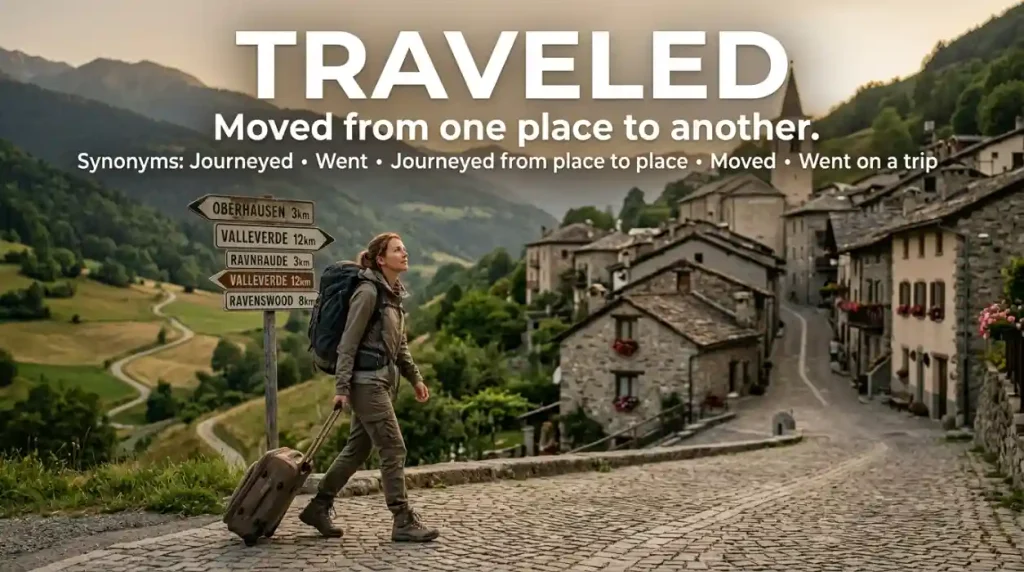
Synonyms for traveled can include journeyed, voyaged, toured, explored, roamed, wandered, and traversed. The best choice depends on whether you mean ordinary travel, exploration, movement across an area, or movement from one place to another.
Imagine telling a friend, “I traveled around Italy last summer.” The sentence is correct, but toured or explored may give your story a clearer picture.
The word traveled is extremely common because it works in everyday speech, school writing, travel stories, blogs, and professional communication.
Learning a synonym for traveled helps students, bloggers, content writers, and daily English users describe movement with more variety and precision.
What Does “Traveled” Really Mean?
Traveled is the past tense and past participle of travel. It generally means went from one place to another, especially over some distance.
For example:
We traveled to Lahore by train.
This means that we went from our starting point to Lahore.
The word can also describe moving through a particular area:
The explorers traveled across the desert.
It can describe a person’s lifestyle:
She traveled extensively after graduating.
And it can describe something other than a person physically moving:
News of the discovery traveled quickly.
Here, traveled means spread or passed from one person or place to another.
Part of Speech
Traveled is a verb.
It is the simple past tense and past participle of travel in American English. Travelled is the common British English spelling.
Simple definition: To go from one place to another.
Emotional Tone
On its own, traveled is usually neutral. It does not automatically express happiness, sadness, excitement, or criticism.
The surrounding words create the emotional effect.
We traveled across Europe.
This is neutral.
We wandered through the quiet villages.
This feels more relaxed and imaginative.
We raced across the country.
This suggests speed and urgency.
Connotative Meaning
Connotation (the feeling or association a word suggests beyond its basic dictionary meaning) can change how a sentence feels.
Positive Tone
Words such as explored, toured, ventured, cruised, and journeyed can create feelings of adventure, discovery, relaxation, or enjoyment.
They are useful when you want travel to sound memorable or exciting.
Negative Tone
Some alternatives can suggest difficulty or exhaustion.
Trekking, trudging, fleeing, and escaping may describe movement under challenging or unpleasant conditions.
The negative feeling comes from the context, not simply from the act of traveling.
Neutral Tone
Went, journeyed, traveled, moved, toured, and crossed can be neutral when the main goal is to communicate where someone went.
Neutral vocabulary is often the safest choice in academic and professional writing.
Etymology
The word travel has an interesting history.
It developed from Old French travailler, meaning “to work” or “to toil,” which came from Late Latin tripalium, a name associated with an instrument of torture. Over time, the English word developed a connection with difficult or laborious journeys.
The modern meaning became much more closely associated with going from one place to another.
Old English: 450–1100
Old English had several words for going, wandering, journeying, and moving from place to place. The modern word travel had not yet taken its present form.
Middle English: 1100–1500
Middle English adopted forms related to Old French travailler. The word gradually took on associations with labor, hardship, and journeys.
Modern English: 1500–Present
Over time, the hardship-related sense weakened. Travel became strongly associated with journeys and movement between places.
Today, traveled is one of the most common English verbs for describing movement between locations.

Pronunciation
US: /ˈtrævəld/
UK: /ˈtrævəld/
Syllables
trav-eled
British spelling:
travelled
Affixation Pattern of “Traveled”
Root: travel
Prefix: none
Suffix: -ed
The -ed ending marks the simple past and past participle.
In British English, the spelling is travelled, with a doubled l.
Synonyms List
A useful vocabulary warning comes first: not every synonym below can replace “traveled” in every sentence.
For example, explored emphasizes discovery, while commuted describes regular travel between places. Wandered suggests an aimless or relaxed path.
The best synonym depends on the exact meaning you want.
Journeyed (Verb) — US /ˈdʒɝːnid/ — UK /ˈdʒɜːnid/
Meaning: Went from one place to another, especially on a notable or extended journey.
Tone/Register: Neutral to literary.
Examples:
They journeyed through the mountains for three weeks.
The family journeyed south before winter arrived.
Went (Verb) — US /wɛnt/ — UK /wɛnt/
Meaning: Moved from one place to another and is the most basic everyday alternative.
Tone/Register: Very common, informal to neutral.
Examples:
We went to Karachi last weekend.
She went home after the meeting.
Journeyed On (Phrasal Verb) — US /ˈdʒɝːnid ɑːn/ — UK /ˈdʒɜːnid ɒn/
Meaning: Continued moving toward another destination.
Tone/Register: Literary, descriptive.
Examples:
After lunch, they journeyed on toward the coast.
The travelers journeyed on despite the rain.
Explored (Verb) — US /ɪkˈsplɔːrd/ — UK /ɪkˈsplɔːd/
Meaning: Traveled through a place to discover or learn about it.
Tone/Register: Neutral, academic, descriptive.
Examples:
We explored the old city on foot.
She explored several villages during her trip.
Toured (Verb) — US /tʊrd/ — UK /tʊəd/
Meaning: Traveled around a place or several places, usually visiting important or interesting locations.
Tone/Register: Neutral, travel-related.
Examples:
We toured the historic district yesterday.
The students toured several museums.
Voyaged (Verb) — US /ˈvɔɪɪdʒd/ — UK /ˈvɔɪɪdʒd/
Meaning: Traveled on a long journey, especially by sea or through a remote region.
Tone/Register: Formal, literary.
Examples:
The sailors voyaged across the Atlantic.
The expedition voyaged toward the distant islands.
Roamed (Verb) — US /roʊmd/ — UK /rəʊmd/
Meaning: Traveled freely across an area without following a strict route.
Tone/Register: Informal, descriptive.
Examples:
We roamed around the market for hours.
He roamed through the countryside during his holiday.
Wandered (Verb) — US /ˈwɑːndərd/ — UK /ˈwɒndəd/
Meaning: Moved around without a clear destination or fixed direction.
Tone/Register: Informal, literary.
Examples:
We wandered through the narrow streets.
She wandered around the park after dinner.
Trekked (Verb) — US /trɛkt/ — UK /trɛkt/
Meaning: Traveled a long distance on foot, especially through difficult terrain.
Tone/Register: Informal, outdoors-oriented.
Examples:
They trekked through the forest for six hours.
We trekked to a remote mountain village.
Hiked (Verb) — US /haɪkt/ — UK /haɪkt/
Meaning: Traveled on foot for pleasure or across natural terrain.
Tone/Register: Neutral, informal.
Examples:
We hiked along the coastal trail.
She hiked through the hills with her friends.
Migrated (Verb) — US /ˈmaɪɡreɪtɪd/ — UK /maɪˈɡreɪtɪd/
Meaning: Moved from one region to another, often seasonally or permanently.
Tone/Register: Formal, academic.
Examples:
The birds migrated south before winter.
Many families migrated to the city for work.
Relocated (Verb) — US /ˌriːloʊˈkeɪtɪd/ — UK /ˌriːləʊˈkeɪtɪd/
Meaning: Moved to a new place, usually to live or work there.
Tone/Register: Formal, professional.
Examples:
She relocated to Dubai for her new job.
The company relocated several employees overseas.
Commuted (Verb) — US /kəˈmjuːtɪd/ — UK /kəˈmjuːtɪd/
Meaning: Traveled regularly between home and work or school.
Tone/Register: Neutral, professional.
Examples:
He commuted to the office by train.
She commuted between two nearby cities.
Crossed (Verb) — US /krɔːst/ — UK /krɒst/
Meaning: Traveled from one side of an area, border, or physical feature to another.
Tone/Register: Neutral.
Examples:
They crossed the desert in five days.
We crossed the river before sunset.
Passed Through (Phrasal Verb) — US /pæst θruː/ — UK /pɑːst θruː/
Meaning: Traveled through a place without staying there for long.
Tone/Register: Neutral.
Examples:
We passed through a small village at noon.
The train passed through several towns.
Proceeded (Verb) — US /prəˈsiːdɪd/ — UK /prəˈsiːdɪd/
Meaning: Continued or moved forward toward a destination.
Tone/Register: Formal.
Examples:
The group proceeded toward the northern border.
After a short break, we proceeded down the trail.
Advanced (Verb) — US /ədˈvænst/ — UK /ədˈvɑːnst/
Meaning: Moved forward, especially during a journey or organized movement.
Tone/Register: Formal, military, academic.
Examples:
The team advanced through the valley.
The hikers advanced toward the summit.
Moved (Verb) — US /muːvd/ — UK /muːvd/
Meaning: Changed position or went from one location to another.
Tone/Register: Neutral, very common.
Examples:
We moved across the country last year.
The group moved toward the exit.
Departed (Verb) — US /dɪˈpɑːrtɪd/ — UK /dɪˈpɑːtɪd/
Meaning: Left a place, especially to begin or continue a journey.
Tone/Register: Formal.
Examples:
The train departed at six.
They departed from the hotel before sunrise.
Set Out (Phrasal Verb) — US /sɛt aʊt/ — UK /set aʊt/
Meaning: Began a journey toward a particular destination.
Tone/Register: Neutral, descriptive.
Examples:
We set out before dawn.
The hikers set out for the lake.
Headed (Verb) — US /ˈhɛdɪd/ — UK /ˈhedɪd/
Meaning: Traveled or moved in a particular direction.
Tone/Register: Informal, everyday.
Examples:
We headed north after breakfast.
She headed home before the storm.
Drove (Verb) — US /droʊv/ — UK /drəʊv/
Meaning: Traveled by car or another road vehicle.
Tone/Register: Neutral, everyday.
Examples:
We drove from Lahore to Islamabad.
He drove home after work.
Flew (Verb) — US /fluː/ — UK /fluː/
Meaning: Traveled by airplane.
Tone/Register: Neutral, everyday.
Examples:
She flew to London yesterday.
We flew home late at night.

Sailed (Verb) — US /seɪld/ — UK /seɪld/
Meaning: Traveled across water by boat or ship.
Tone/Register: Neutral, descriptive.
Examples:
They sailed along the coast.
We sailed to a nearby island.
Cruised (Verb) — US /kruːzd/ — UK /kruːzd/
Meaning: Traveled smoothly and leisurely, especially by ship or vehicle.
Tone/Register: Informal, relaxed.
Examples:
They cruised along the highway with the windows open.
We cruised around the harbor at sunset.
Embarked (Verb) — US /ɪmˈbɑːrkt/ — UK /ɪmˈbɑːkt/
Meaning: Began a journey, especially a significant one.
Tone/Register: Formal, literary.
Examples:
They embarked on a journey across Asia.
She embarked on her first solo trip.
Ventured (Verb) — US /ˈvɛntʃɚd/ — UK /ˈventʃəd/
Meaning: Traveled into an unfamiliar, difficult, or potentially risky place.
Tone/Register: Literary, adventurous.
Examples:
We ventured into the mountains.
She ventured beyond the village alone.
Journeyed Across (Phrase) — US /ˈdʒɝːnid əˈkrɔːs/ — UK /ˈdʒɜːnid əˈkrɒs/
Meaning: Traveled from one side of a large area or region to another.
Tone/Register: Literary, descriptive.
Examples:
They journeyed across the country by train.
He journeyed across the desert with a small group.
Traversed (Verb) — US /trəˈvɝːst/ — UK /trəˈvɜːst/
Meaning: Traveled across or through an area, especially from one side to another.
Tone/Register: Formal, academic, literary.
Examples:
The expedition traversed the mountain range.
We traversed the valley before nightfall.
Navigated (Verb) — US /ˈnævəɡeɪtɪd/ — UK /ˈnævɪɡeɪtɪd/
Meaning: Traveled through an area while carefully finding the correct route.
Tone/Register: Neutral to formal.
Examples:
The guide navigated the narrow mountain roads.
We navigated the city without a map.
Circled (Verb) — US /ˈsɝːkəld/ — UK /ˈsɜːkəld/
Meaning: Traveled around something or repeatedly moved around an area.
Tone/Register: Neutral.
Examples:
We circled the lake before returning home.
The aircraft circled the airport.
Drifted (Verb) — US /ˈdrɪftɪd/ — UK /ˈdrɪftɪd/
Meaning: Moved gradually without a strong sense of direction or control.
Tone/Register: Informal, literary.
Examples:
We drifted from one café to another.
They drifted around the city all afternoon.
Strolled (Verb) — US /stroʊld/ — UK /strəʊld/
Meaning: Walked slowly and casually, often for pleasure.
Tone/Register: Informal, relaxed.
Examples:
We strolled along the beach after dinner.
She strolled through the old town.
Marched (Verb) — US /mɑːrtʃt/ — UK /mɑːtʃt/
Meaning: Walked or traveled with regular, purposeful steps.
Tone/Register: Neutral, formal, sometimes military.
Examples:
The group marched toward the city center.
The soldiers marched across the field.
Rushed (Verb) — US /rʌʃt/ — UK /rʌʃt/
Meaning: Traveled or moved quickly because of urgency.
Tone/Register: Informal, energetic.
Examples:
We rushed to the station.
She rushed home after receiving the call.
Sped (Verb) — US /spɛd/ — UK /spɛd/
Meaning: Traveled quickly, usually in a vehicle.
Tone/Register: Neutral, slightly literary.
Examples:
The car sped down the highway.
We sped toward the airport.
Raced (Verb) — US /reɪst/ — UK /reɪst/
Meaning: Traveled extremely quickly, often because of competition or urgency.
Tone/Register: Informal, energetic.
Examples:
We raced across town to catch the train.
He raced home before the shops closed.
Hiked Along (Phrase) — US /haɪkt əˈlɔːŋ/ — UK /haɪkt əˈlɒŋ/
Meaning: Traveled on foot while following a path or route.
Tone/Register: Informal, outdoors-oriented.
Examples:
We hiked along the river for hours.
They hiked along a forest trail.
Walked (Verb) — US /wɔːkt/ — UK /wɔːkt/
Meaning: Traveled on foot.
Tone/Register: Very common, neutral.
Examples:
We walked to the station.
She walked home after class.
Biked (Verb) — US /baɪkt/ — UK /baɪkt/
Meaning: Traveled by bicycle.
Tone/Register: Informal, everyday.
Examples:
He biked to work every morning.
We biked around the city during our trip.
Cycled (Verb) — US /ˈsaɪkəld/ — UK /ˈsaɪkəld/
Meaning: Traveled by bicycle.
Tone/Register: Neutral, common in British English.
Examples:
They cycled through the countryside.
She cycled to the office.
Journeyed Through (Phrase) — US /ˈdʒɝːnid θruː/ — UK /ˈdʒɜːnid θruː/
Meaning: Traveled through a place as part of a longer journey.
Tone/Register: Literary, descriptive.
Examples:
They journeyed through several remote villages.
The travelers journeyed through the region for weeks.
Passed Along (Phrasal Verb) — US /pæst əˈlɔːŋ/ — UK /pɑːst əˈlɒŋ/
Meaning: Moved or continued along a route or path.
Tone/Register: Neutral.
Examples:
The hikers passed along the eastern trail.
We passed along the narrow road.
Spread (Verb) — US /sprɛd/ — UK /sprɛd/
Meaning: Moved from one person, place, or area to another, especially when referring to information, news, sound, or influence.
Tone/Register: Neutral.
Examples:
The news spread quickly across the city.
Word of the event spread online.
Circulated (Verb) — US /ˈsɝːkjəleɪtɪd/ — UK /ˈsɜːkjʊleɪtɪd/
Meaning: Moved among people or through a group rather than traveling physically from place to place.
Tone/Register: Formal, professional.
Examples:
The announcement circulated throughout the office.
The story circulated widely on social media.
Passed (Verb) — US /pæst/ — UK /pɑːst/
Meaning: Moved from one person or place to another.
Tone/Register: Neutral.
Examples:
The message passed from one team to another.
The rumor passed quickly through the neighborhood.

Flowed (Verb) — US /floʊd/ — UK /fləʊd/
Meaning: Moved continuously and smoothly through a place or space.
Tone/Register: Descriptive, literary.
Examples:
Tourists flowed through the station all morning.
People flowed into the square after the concert.
Roamed Around (Phrasal Verb) — US /roʊmd əˈraʊnd/ — UK /rəʊmd əˈraʊnd/
Meaning: Traveled casually around an area without a fixed route.
Tone/Register: Informal.
Examples:
We roamed around the city until sunset.
The children roamed around the park.
Wandered Around (Phrasal Verb) — US /ˈwɑːndərd əˈraʊnd/ — UK /ˈwɒndəd əˈraʊnd/
Meaning: Moved around casually without a specific destination.
Tone/Register: Informal, relaxed.
Examples:
I wandered around the museum for hours.
They wandered around downtown after lunch.
Fled (Verb) — US /flɛd/ — UK /flɛd/
Meaning: Traveled or moved away quickly to escape danger or an unpleasant situation.
Tone/Register: Formal, serious.
Examples:
The family fled the area before the fire spread.
Thousands fled the region during the conflict.
Escaped (Verb) — US /ɪˈskeɪpt/ — UK /ɪˈskeɪpt/
Meaning: Traveled away from a place to avoid danger, confinement, or control.
Tone/Register: Neutral, serious.
Examples:
They escaped across the border at night.
The hikers escaped the storm before it became severe.
Relayed (Verb) — US /rɪˈleɪd/ — UK /rɪˈleɪd/
Meaning: Passed information, a message, or a signal from one person or place to another.
Tone/Register: Formal, professional.
Examples:
The message was relayed to the emergency team.
The radio operator relayed the update immediately.
Synonyms by Tone
Positive or Adventurous
These words can make travel sound exciting, memorable, or exploratory:
- explored
- ventured
- toured
- cruised
- journeyed
- roamed
- strolled
They work especially well in travel writing and personal storytelling.
Neutral
These choices simply describe movement:
- went
- traveled
- moved
- crossed
- walked
- drove
- flew
- sailed
- headed
- departed
- passed through
They are useful when accuracy is more important than style.
Formal or Academic
These terms suit reports, essays, research, and formal descriptions:
- traversed
- migrated
- relocated
- proceeded
- advanced
- navigated
- embarked
- circulated
- relayed
They should be used because they express a specific meaning, not simply because they sound sophisticated.
Negative or Urgent
Some alternatives suggest danger, pressure, or urgency:
- rushed
- raced
- fled
- escaped
These words change the emotional meaning significantly.
Playful or Informal
Casual conversation often favors:
- roamed
- wandered
- cruised
- biked
- headed
- strolled
They can make everyday speech sound more natural.
Why Tone Matters
Consider these sentences:
We traveled around the city.
We wandered around the city.
We raced around the city.
All three describe movement, but they create different images.
The first is neutral. The second suggests relaxed exploration. The third suggests speed or urgency.
Choosing synonyms is therefore not just about avoiding repetition. It is about controlling meaning.
“Traveled” vs Close Alternatives
| Word | Main difference | Tone | Best use |
|---|---|---|---|
| Traveled | General movement between places | Neutral | Everyday and general writing |
| Journeyed | Emphasizes the journey itself | Literary | Stories and travel writing |
| Explored | Emphasizes discovery | Positive/descriptive | Travel and research |
| Wandered | Suggests an unfixed route | Informal/literary | Casual or creative writing |
Journeyed vs Traveled
Traveled focuses mainly on the fact that someone went somewhere.
Journeyed gives more attention to the experience or length of the trip.
She traveled to France.
She journeyed across France.
The second sentence feels more narrative.
Traveled vs Explored
Explored suggests that the person wanted to discover something.
We traveled through the city.
This simply describes movement.
We explored the city.
This suggests sightseeing, discovery, or investigation.
Traveled vs Wandered
Wandered usually suggests that the person did not follow a strict route.
We traveled through the town.
We wandered through the town.
The second sentence sounds more relaxed and spontaneous.
How “Traveled” Changes by Context
Daily Conversation
In everyday speech, simple verbs are usually best.
Native speakers commonly say:
We went to the beach.
I drove to work.
We traveled to Islamabad last month.
There is no need to replace traveled every time it appears.
Natural English values clarity more than constant synonym changes.
Writing and Blogging
Travel blogs can use more descriptive alternatives.
Instead of:
We traveled around the old city.
You could write:
We wandered through the old city.
Or:
We explored the old city on foot.
The new verbs tell readers more about the experience.
Professional or Academic Writing
Formal writing often needs precision.
For example, a research paper might use migrated when discussing population movement.
A transportation report might use commuted when discussing regular journeys between home and work.
An academic description might use traversed when a group moved across a defined geographical area.
Creative or Informal Writing
Creative writing can use words that create a stronger mental image.
Compare:
The travelers traveled through the forest.
with:
The travelers wandered through the forest.
The second version gives the reader a clearer sense of atmosphere.
Common Mistakes and Native Usage
Mistake 1: Using “Went” Everywhere
Went is extremely common, but repeating it can make writing sound basic.
Instead of:
She went to three countries and went through several villages.
Try:
She traveled to three countries and passed through several villages.
Mistake 2: Confusing “Explored” With “Traveled”
You can travel somewhere without exploring it.
For example, someone may travel through an airport without exploring the airport.
Use explored when discovery or investigation is important.
Mistake 3: Using “Wandered” for Planned Travel
Wandered often implies a loose or uncertain route.
If someone followed a planned itinerary, toured or traveled may be more accurate.
Mistake 4: Using “Journeyed” in Every Sentence
Journeyed is correct, but it can sound literary.
In casual conversation, “I traveled to Spain” usually sounds more natural than “I journeyed to Spain.”
Mistake 5: Confusing “Relocated” With “Traveled”
Relocated normally suggests moving to a new place to live or work.
She relocated to Canada.
This is different from:
She traveled to Canada.
The first suggests a change of residence. The second simply describes a trip.
Mistake 6: Using “Commuted” for a One-Time Trip
Commuted normally implies repeated travel between home and work or school.
He commuted to the office every day.
For a single visit, say:
He traveled to the office.
Register Notes
Traveled is neutral and widely used.
Went is extremely common in spoken English.
Journeyed is more literary.
Traversed is formal.
Explored is descriptive and discovery-focused.
Wandered is informal or literary.
Relocated and commuted are professional terms with specific meanings.
For more vocabulary practice, an internal guide on synonyms for journey can help you distinguish travel words by tone and context.
Real-Life Mini Scenarios
Workplace
A manager explains an employee’s regular travel:
Maria commuted between the two offices every week.
Here, commuted is better than wandered because the travel was regular and work-related.
Social Situation
A friend describes a relaxed holiday:
We wandered around the old town and found a tiny café.
Wandered creates a casual, spontaneous feeling.
Media and Pop Culture
A documentary describes an expedition:
The filmmakers followed a team that trekked across the mountains.
Trekking emphasizes difficult travel, especially on foot.
Writing and Storytelling
A novelist wants to create a sense of adventure:
The travelers ventured into the unknown before sunrise.
Ventured adds a feeling of uncertainty and courage.
Travel Blog
A blogger wants to emphasize discovery:
We explored the historic streets before the crowds arrived.
Explored tells the reader that sightseeing and discovery were important.
Academic Writing
A researcher describes population movement:
Thousands of families migrated toward the coastal region.
Migrated is more precise than the general word traveled.

Practice Exercise
1. You went sightseeing around a historic city.
A. Explored
B. Fled
C. Relocated
D. Commuted
2. You traveled to work by train every weekday.
A. Wandered
B. Commuted
C. Voyaged
D. Ventured
3. You moved to another country to live there permanently.
A. Strolled
B. Relocated
C. Cruised
D. Passed through
4. You walked for several hours through difficult mountain terrain.
A. Trekked
B. Flew
C. Circulated
D. Went
5. You moved around the city without a specific plan.
A. Wandered
B. Migrated
C. Relocated
D. Departed
6. You traveled across a desert from one side to the other.
A. Traversed
B. Strolled
C. Commuted
D. Circulated
7. You began a major expedition.
A. Embarked
B. Walked
C. Passed
D. Commuted
8. You moved quickly because you were late.
A. Rushed
B. Wandered
C. Strolled
D. Roamed
9. You traveled by ship across the ocean.
A. Sailed
B. Hiked
C. Drove
D. Marched
10. You traveled into an unfamiliar forest despite some uncertainty.
A. Ventured
B. Commuted
C. Circulated
D. Relocated
Answer key: 1-A | 2-B | 3-B | 4-A | 5-A | 6-A | 7-A | 8-A | 9-A | 10-A
Reflection Task
Write one sentence about a real or imaginary trip. Use traveled first, then rewrite the sentence with a more precise alternative such as explored, wandered, trekked, toured, journeyed, or ventured.
Conclusion
Choosing a synonym for traveled is really about choosing the exact shade of movement you want. A small word change can make your sentence clearer, warmer, or more vivid.
Words such as explored, wandered, journeyed, and trekked add detail to stories, while formal terms like traversed and migrated improve precise academic writing.
Better travel vocabulary also strengthens blogs, essays, emails, and everyday speech. It helps you explain not only where someone went, but how and why.
Keep practicing these alternatives in your own sentences. Try them in conversations, essays, emails, and travel stories until the right word starts to feel natural.
External sources
For dictionary definitions, pronunciation, and usage, useful references include Cambridge Dictionary — travel and Merriam-Webster — travel. For word history, see Online Etymology Dictionary — travel.
FAQs
1. What is the best synonym for traveled in an essay?
The best alternative depends on the sentence. Journeyed works well when discussing a significant trip, while traversed suits geographical movement. Explored works when discovery is important. For academic writing, choose the word that expresses the exact type of movement rather than replacing traveled simply to avoid repetition.
2. What is a more formal word for traveled?
Journeyed, traversed, proceeded, embarked, migrated, and relocated can sound more formal, but they have different meanings. Traversed emphasizes crossing an area, while relocated usually means moving to a new place to live or work. In formal writing, precision matters more than choosing the longest or most sophisticated word.
3. What is a good synonym for traveled in a travel story?
Journeyed, explored, toured, wandered, roamed, ventured, and trekked can work well in travel writing. Each creates a different image. Explored emphasizes discovery, wandered suggests an unplanned route, and trekked suggests a demanding journey, usually on foot.
4. What can I say instead of “traveled around”?
You can use toured, explored, roamed around, wandered around, or traveled throughout, depending on the meaning. Toured suggests visiting planned attractions, while wandered around suggests casual movement without a fixed route. Choose the phrase that reflects what actually happened.
5. What is the difference between traveled, journeyed, and explored?
Traveled is the broadest and most neutral term. Journeyed emphasizes the trip itself, often making it sound longer or more significant. Explored adds the idea of discovering or investigating a place. Therefore, someone can travel somewhere without exploring it, but exploration normally involves some form of travel.

Hasnain Ali is an SEO Content Strategist and the founder of wordvora.com, a trusted vocabulary platform that helps writers, students, professionals, and English learners find accurate synonyms, antonyms, word meanings, and real-life usage examples. He specializes in keyword research, on-page SEO, topical authority, and creating search-first content that aligns with Google’s latest Search Quality and E-E-A-T guidelines. His work focuses on producing clear, well-structured, and reader-friendly resources that satisfy search intent while maintaining high editorial standards.
Through extensive hands-on experience with SEO tools such as Google Search Console, Google Analytics, SEMrush, and Ahrefs, Hasnain researches user search behavior and develops content that is both informative and easy to understand. Every article published on wordvora.com is carefully reviewed for accuracy, readability, and contextual relevance before publication. His mission is to build one of the web’s most reliable English vocabulary resources by providing practical language guidance, trustworthy explanations, and content that helps readers improve their writing, communication, and vocabulary with confidence.