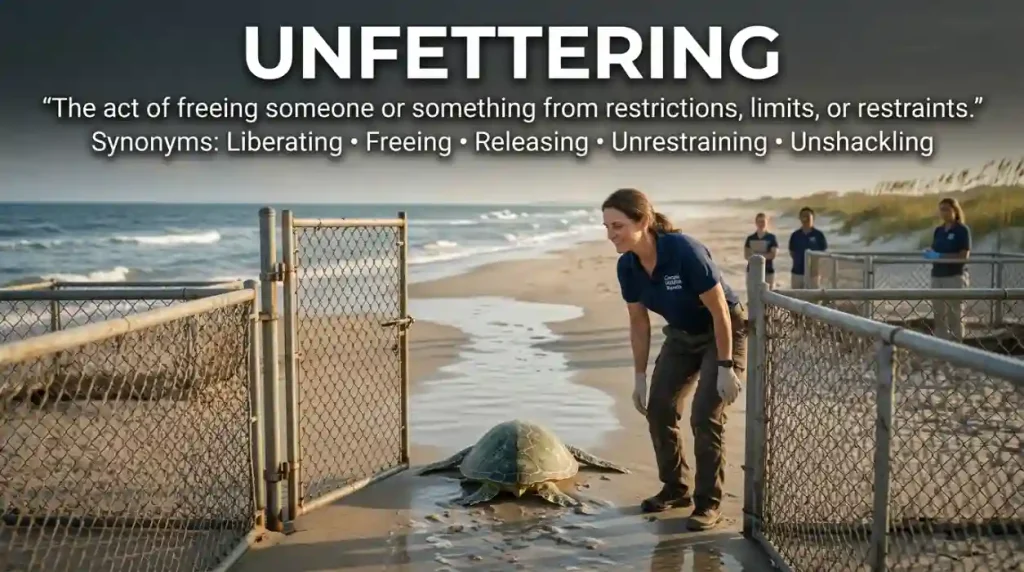
Synonyms for unfettering can mean freeing, liberating, releasing, unshackling, emancipating, or removing restrictions. The best choice depends on whether you mean physical release, personal freedom, creative freedom, or freedom from rules or limits.
Synonyms for unfettering become useful when one word cannot express the exact kind of freedom you mean. A writer may choose liberating for emotional freedom or unrestricted for fewer limits.
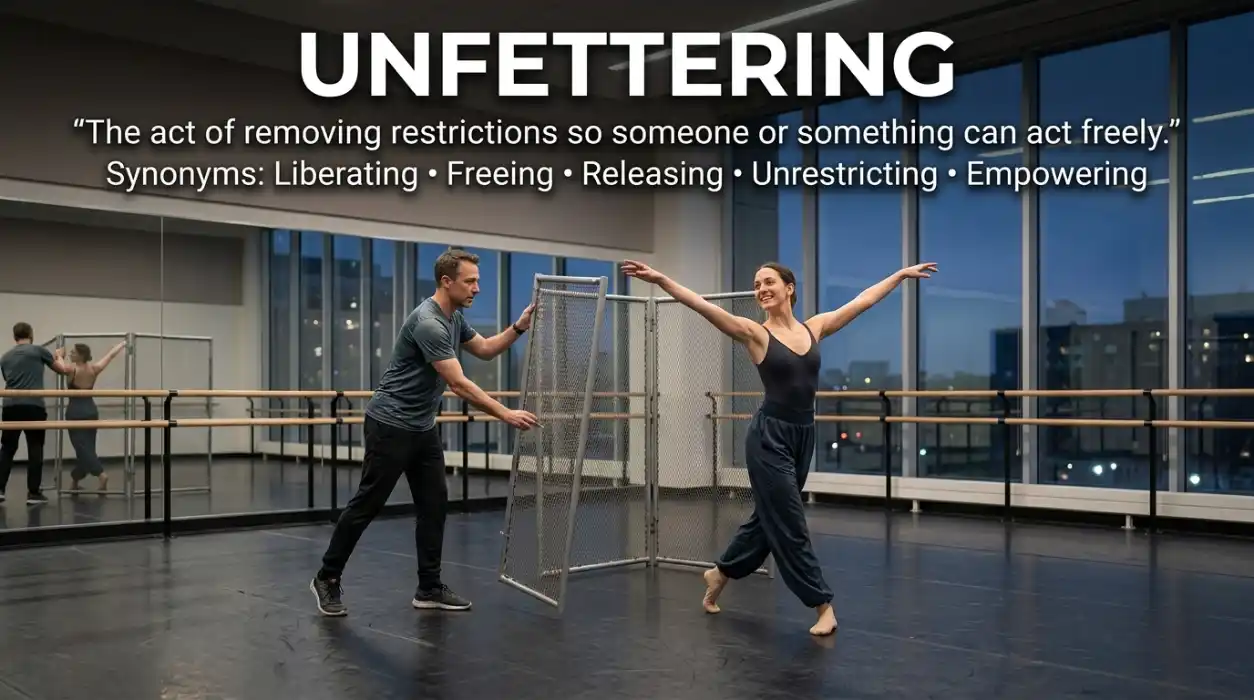
Imagine an artist finally receives permission to create without strict rules. You might describe the experience as unfettered or liberating. The second word sounds more natural in everyday English.
Students, bloggers, and content writers can use these alternatives to make descriptions more precise. Daily English users can also choose words that match the situation naturally.
The word unfettering is especially useful when discussing freedom, creativity, independence, social restrictions, or systems that prevent action. Learning its alternatives gives your writing more range.
What Does “Unfettering” Really Mean?
Unfettering means the act or process of freeing someone or something from restraints, restrictions, limitations, or controlling conditions.
The word comes from the verb unfetter, which literally means to remove fetters or restraints. In modern English, its meaning is often figurative.
For example:
The new policy was unfettering for small businesses.
This suggests that the policy removed restrictions.
Another example:
The experience was emotionally unfettering.
Here, the word means that the experience helped someone feel free from emotional constraints.
Simple Definition
Unfettering: freeing someone or something from physical, social, emotional, legal, creative, or other restrictions.
The word can describe:
- Physical release
- Personal freedom
- Creative freedom
- Emotional liberation
- Political or social freedom
- Freedom from rules
- Removal of limitations
- Greater independence
- Greater flexibility
Part of Speech
Unfettering is the present participle and gerund form of the verb “unfetter.”
The basic forms are:
- Verb: unfetter
- Present participle: unfettering
- Past tense: unfettered
- Noun: unfettering
As a gerund, unfettering can function like a noun.
Unfettering the creative process took time.
As a present participle, it can describe an ongoing action.
The reforms are unfettering the industry.
Emotional Tone
Unfettering generally has a positive or empowering tone.
It suggests that something restrictive has been removed.
The word can create feelings of:
- Freedom
- Relief
- Independence
- Possibility
- Empowerment
- Creativity
- Renewal
However, its tone depends on context. Removing restrictions may be positive in one situation but potentially problematic in another.
Connotative Meaning
Connotation (the emotional or cultural feeling associated with a word beyond its basic dictionary meaning) helps explain why different synonyms create different impressions.
Positive Tone
Words such as liberating, emancipating, empowering, freeing, and setting free usually create a positive feeling.
They emphasize opportunity and independence.
Neutral Tone
Words such as releasing, removing restrictions, loosening, and relaxing constraints can sound more factual.
They focus on what changed rather than how emotionally positive the change was.
Negative Tone
Some contextual alternatives can highlight what existed before freedom was achieved.
Words such as breaking free, escaping, breaking loose, and throwing off may suggest that the original restrictions were oppressive or unwanted.
Etymology
The word unfettering comes from unfetter, which combines the negative or reversing prefix un- with fetter.
A fetter was originally a physical restraint used to restrict someone’s movement, especially a chain or shackle attached to the feet.
Over time, fetter developed a figurative meaning. It came to describe anything that restricts freedom, progress, thought, creativity, or action.
The prefix un- gives the word the sense of removing or reversing the restraint.
Old English: 450–1100
The modern verb unfetter is not an Old English word in its current form.
However, the element fetter has Germanic roots. Old English had fetor, referring to a chain or shackle used to restrain the feet.
The concept was therefore associated with physical restriction from an early stage of English.
Middle English: 1100–1500
During Middle English, forms related to fetter continued to refer to chains, restraints, and devices that restricted movement.
English also increasingly used physical restraint figuratively.
A person could be “fettered” not only by chains but also by circumstances.
Modern English: 1500–Present
Modern English expanded fetter into a powerful metaphor for limitation.
People can now be fettered by:
- Rules
- Fear
- Tradition
- Debt
- Bureaucracy
- Expectations
- Social pressure
- Lack of opportunity
Therefore, unfettering can describe removing either literal restraints or abstract limitations.
Pronunciation
Because unfettering is formed from unfetter + -ing, pronunciation follows the verb closely.
US: /ʌnˈfetərɪŋ/
UK: /ʌnˈfetərɪŋ/
Syllables
un-fet-ter-ing
Affixation Pattern of “Unfettering”
Root: fetter
Prefix: un-
Suffix: -ing
The structure is:
un + fetter → unfetter → unfettering
The prefix un- indicates removal or reversal.
The suffix -ing forms the present participle or gerund.
Synonyms List
The following alternatives cover the main meanings of unfettering. Some are direct lexical equivalents, while others are close contextual expressions.
Freeing (Verb/Gerund) — US / UK: /ˈfriːɪŋ/ / /ˈfriːɪŋ/
Meaning: Removing restrictions so that someone or something can act freely.
Tone/Register: Neutral, common.
Examples:
Freeing the team from unnecessary rules improved morale.
The process felt freeing after years of strict control.
Liberating (Verb/Gerund) — US / UK: /ˈlɪbəˌreɪtɪŋ/ / /ˈlɪbəˌreɪtɪŋ/
Meaning: Giving someone greater freedom from control, limitation, or oppression.
Tone/Register: Positive, formal, common.
Examples:
Leaving the restrictive environment was liberating.
The new approach felt creatively liberating.
Releasing (Verb/Gerund) — US / UK: /rɪˈliːsɪŋ/ / /rɪˈliːsɪŋ/
Meaning: Letting someone or something go from restraint or control.
Tone/Register: Neutral.
Examples:
Releasing the animal required careful planning.
The manager supported releasing the team from the old procedure.
Unshackling (Verb/Gerund) — US / UK: /ʌnˈʃækəlɪŋ/ / /ʌnˈʃækəlɪŋ/
Meaning: Removing restraints that severely limit freedom.
Tone/Register: Strong, figurative, journalistic.
Examples:
The reforms focused on unshackling local businesses.
She described the experience as unshackling.
Unbinding (Verb/Gerund) — US / UK: /ʌnˈbaɪndɪŋ/ / /ʌnˈbaɪndɪŋ/
Meaning: Removing something that binds, ties, or restricts.
Tone/Register: Formal, literary.
Examples:
Unbinding the old restrictions changed the process.
The story explores unbinding people from tradition.
Emancipating (Verb/Gerund) — US / UK: /ɪˈmænsəˌpeɪtɪŋ/ / /ɪˈmænsəˌpeɪtɪŋ/
Meaning: Freeing someone from legal, social, or political control.
Tone/Register: Formal, historical, academic.
Examples:
The movement focused on emancipating oppressed communities.
Education can play an emancipating role.
Liberating (Adjective) — US / UK: /ˈlɪbəˌreɪtɪŋ/ / /ˈlɪbəˌreɪtɪŋ/
Meaning: Creating a strong sense of freedom or release.
Tone/Register: Positive, expressive.
Examples:
The artist found the new format liberating.
Travel can be a liberating experience.
Unrestricting (Verb/Gerund) — US / UK: /ˌʌnrɪˈstrɪktɪŋ/ / /ˌʌnrɪˈstrɪktɪŋ/
Meaning: Removing restrictions or limits.
Tone/Register: Technical, formal.
Examples:
Unrestricting access helped more students participate.
The proposal focuses on unrestricting movement.
Loosening (Verb/Gerund) — US / UK: /ˈluːsənɪŋ/ / /ˈluːsənɪŋ/
Meaning: Making a restriction, rule, or control less strict.
Tone/Register: Neutral.
Examples:
Loosening the rules gave employees more flexibility.
The government discussed loosening the restrictions.
Relaxing (Verb/Gerund) — US / UK: /rɪˈlæksɪŋ/ / /rɪˈlæksɪŋ/
Meaning: Making rules or controls less strict.
Tone/Register: Neutral, professional.
Examples:
Relaxing the requirements made the application easier.
The company is relaxing its previous restrictions.
Freeing Up (Phrasal Verb) — US / UK: /ˈfriːɪŋ ʌp/ / /ˈfriːɪŋ ʌp/
Meaning: Making something available by removing restrictions or commitments.
Tone/Register: Informal, business.
Examples:
Freeing up the schedule gave us more time.
The change is freeing up resources for new projects.
Unleashing (Verb/Gerund) — US / UK: /ʌnˈliːʃɪŋ/ / /ʌnˈliːʃɪŋ/
Meaning: Allowing something powerful or previously controlled to develop or act fully.
Tone/Register: Strong, energetic.
Examples:
The new format is unleashing creative ideas.
The campaign focused on unleashing young talent.
Unleashing Potential (Phrase) — US / UK: /ʌnˈliːʃɪŋ pəˈtenʃəl/ / /ʌnˈliːʃɪŋ pəˈtenʃəl/
Meaning: Allowing abilities or possibilities to develop more fully.
Tone/Register: Positive, professional.
Examples:
The program focuses on unleashing potential.
Better feedback can help with unleashing potential.
Removing Constraints (Phrase) — US / UK: /rɪˈmuːvɪŋ kənˈstreɪnts/ / /rɪˈmuːvɪŋ kənˈstreɪnts/
Meaning: Taking away limits that prevent action or progress.
Tone/Register: Formal, business, academic.
Examples:
Removing constraints allowed the engineers to experiment.
The project succeeded after removing several constraints.
Removing Restrictions (Phrase) — US / UK: /rɪˈmuːvɪŋ rɪˈstrɪkʃənz/ / /rɪˈmuːvɪŋ rɪˈstrɪkʃənz/
Meaning: Ending rules or conditions that limit freedom.
Tone/Register: Neutral, formal.
Examples:
Removing restrictions increased access.
The policy emphasizes removing unnecessary restrictions.
Breaking Free (Phrase) — US / UK: /ˈbreɪkɪŋ friː/ / /ˈbreɪkɪŋ friː/
Meaning: Escaping from control, limitation, or an unwanted situation.
Tone/Register: Informal, expressive.
Examples:
She is breaking free from old expectations.
The character dreams of breaking free.
Breaking Loose (Phrase) — US / UK: /ˈbreɪkɪŋ luːs/ / /ˈbreɪkɪŋ luːs/
Meaning: Escaping from physical or figurative restraint.
Tone/Register: Informal, vivid.
Examples:
The horse broke loose from the fence.
His imagination seemed to be breaking loose.
Escaping (Verb/Gerund) — US / UK: /ɪˈskeɪpɪŋ/ / /ɪˈskeɪpɪŋ/
Meaning: Getting away from something restrictive, dangerous, or unwanted.
Tone/Register: Neutral, strong.
Examples:
Escaping the rigid routine gave her new energy.
The novel follows a character escaping social expectations.
Detaching (Verb/Gerund) — US / UK: /dɪˈtætʃɪŋ/ / /dɪˈtætʃɪŋ/
Meaning: Separating something from an attachment or controlling connection.
Tone/Register: Neutral, formal.
Examples:
Detaching the system from the old network increased flexibility.
She found detaching from old habits difficult.
Disengaging (Verb/Gerund) — US / UK: /ˌdɪsɪnˈɡeɪdʒɪŋ/ / /ˌdɪsɪnˈɡeɪdʒɪŋ/
Meaning: Separating from an activity, system, relationship, or controlling situation.
Tone/Register: Professional, formal.
Examples:
Disengaging from the outdated system took several weeks.
He considered disengaging from the constant debate.
Separating (Verb/Gerund) — US / UK: /ˈsepəˌreɪtɪŋ/ / /ˈsepəˌreɪtɪŋ/
Meaning: Moving apart from something that limits or controls you.
Tone/Register: Neutral.
Examples:
Separating the project from old assumptions opened new possibilities.
She began separating herself from unhealthy expectations.
Detethering (Verb/Gerund) — US / UK: /diːˈteðərɪŋ/ / /diːˈteðərɪŋ/
Meaning: Freeing something from a tether or limiting connection.
Tone/Register: Technical, figurative.
Examples:
Detethering the device made it more mobile.
The company discussed detethering the service from older systems.
Unhooking (Verb/Gerund) — US / UK: /ʌnˈhʊkɪŋ/ / /ʌnˈhʊkɪŋ/
Meaning: Removing a physical or figurative attachment.
Tone/Register: Informal, technical.
Examples:
Unhooking the equipment took only a minute.
Unhooking from the old process proved difficult.
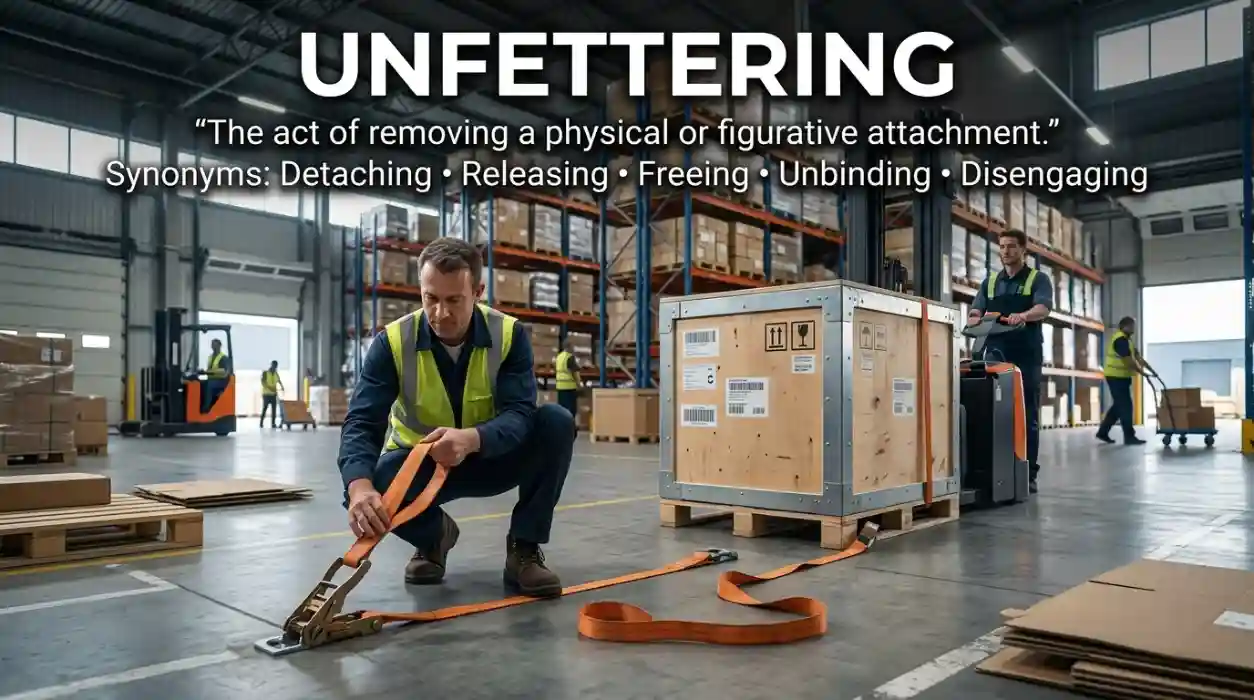
Unclipping (Verb/Gerund) — US / UK: /ʌnˈklɪpɪŋ/ / /ʌnˈklɪpɪŋ/
Meaning: Releasing something from a clip or fastener.
Tone/Register: Neutral, literal.
Examples:
Unclipping the strap released the equipment.
The design allows quick unclipping.
Unchaining (Verb/Gerund) — US / UK: /ʌnˈtʃeɪnɪŋ/ / /ʌnˈtʃeɪnɪŋ/
Meaning: Removing chains or figurative restrictions.
Tone/Register: Strong, literary.
Examples:
The story centers on unchaining the prisoners.
The metaphor represents unchaining the imagination.
Unfettering (Verb/Gerund) — US / UK: /ʌnˈfetərɪŋ/ / /ʌnˈfetərɪŋ/
Meaning: Freeing someone or something from restraints or limitations.
Tone/Register: Formal, literary.
Examples:
Unfettering creativity can change the way people work.
The reforms were aimed at unfettering innovation.
Unhampering (Verb/Gerund) — US / UK: /ʌnˈhæmpərɪŋ/ / /ʌnˈhæmpərɪŋ/
Meaning: Removing something that prevents progress or movement.
Tone/Register: Formal, professional.
Examples:
Unhampering communication improved the project.
The reform focused on unhampering trade.
Facilitating (Verb/Gerund) — US / UK: /fəˈsɪləˌteɪtɪŋ/ / /fəˈsɪləˌteɪtɪŋ/
Meaning: Making an action or process easier.
Tone/Register: Formal, academic, business.
Examples:
The new system is facilitating collaboration.
Better access is facilitating independent learning.
Empowering (Verb/Gerund) — US / UK: /ɪmˈpaʊərɪŋ/ / /ɪmˈpaʊərɪŋ/
Meaning: Giving someone greater confidence, authority, or ability to act.
Tone/Register: Positive, professional.
Examples:
The training was empowering for new employees.
Giving students choices can be empowering.
Enabling (Verb/Gerund) — US / UK: /ɪˈneɪblɪŋ/ / /ɪˈneɪblɪŋ/
Meaning: Making something possible or allowing someone to do something.
Tone/Register: Neutral, professional.
Examples:
The update is enabling faster communication.
The scholarship is enabling students to continue studying.
Authorizing (Verb/Gerund) — US / UK: /ˈɔːθəˌraɪzɪŋ/ / /ˈɔːθəraɪzɪŋ/
Meaning: Giving official permission to act.
Tone/Register: Formal, legal, business.
Examples:
Authorizing local decisions reduced delays.
The new policy supports authorizing independent action.
Granting Freedom (Phrase) — US / UK: /ˈɡræntɪŋ friːdəm/ / /ˈɡrɑːntɪŋ friːdəm/
Meaning: Giving someone the right or opportunity to act independently.
Tone/Register: Formal, neutral.
Examples:
Granting freedom to the research team improved creativity.
The agreement focused on granting greater freedom.
Giving Liberty (Phrase) — US / UK: /ˈɡɪvɪŋ ˈlɪbərti/ / /ˈɡɪvɪŋ ˈlɪbəti/
Meaning: Allowing greater independence from control.
Tone/Register: Formal, philosophical.
Examples:
The reform was intended to give citizens greater liberty.
The discussion centered on giving liberty to individuals.
Granting Autonomy (Phrase) — US / UK: /ˈɡræntɪŋ ɔːˈtɑːnəmi/ / /ˈɡrɑːntɪŋ ɔːˈtɒnəmi/
Meaning: Giving a person or group greater power to make their own decisions.
Tone/Register: Academic, professional.
Examples:
Granting autonomy improved the team’s decision-making.
The school is considering granting students more autonomy.
Decentralizing (Verb/Gerund) — US / UK: /ˌdiːˈsentrəˌlaɪzɪŋ/ / /ˌdiːˈsentrəlaɪzɪŋ/
Meaning: Moving control away from a central authority.
Tone/Register: Formal, business, political.
Examples:
Decentralizing decision-making gave regional teams more freedom.
The organization is decentralizing several functions.
Deregulating (Verb/Gerund) — US / UK: /ˌdiːˈreɡjəˌleɪtɪŋ/ / /ˌdiːˈreɡjəˌleɪtɪŋ/
Meaning: Reducing or removing government rules controlling an activity or industry.
Tone/Register: Formal, economic, political.
Examples:
Deregulating the sector changed how companies operated.
The debate focused on the effects of deregulating the market.
Deconstraining (Verb/Gerund) — US / UK: /ˌdiːkənˈstreɪnɪŋ/ / /ˌdiːkənˈstreɪnɪŋ/
Meaning: Removing constraints that limit a process or system.
Tone/Register: Technical, formal.
Examples:
Deconstraining the design process encouraged experimentation.
The research examines ways of deconstraining innovation.
Expanding Freedom (Phrase) — US / UK: /ɪkˈspændɪŋ ˈfriːdəm/ / /ɪkˈspændɪŋ ˈfriːdəm/
Meaning: Increasing the range of choices or actions available.
Tone/Register: Neutral, positive.
Examples:
Expanding freedom of choice changed the service.
The policy focuses on expanding freedom for local communities.
Increasing Autonomy (Phrase) — US / UK: /ɪnˈkriːsɪŋ ɔːˈtɑːnəmi/ / /ɪnˈkriːsɪŋ ɔːˈtɒnəmi/
Meaning: Giving someone more independence in decision-making.
Tone/Register: Academic, professional.
Examples:
Increasing autonomy helped the team respond faster.
The program supports increasing autonomy for learners.
Removing Barriers (Phrase) — US / UK: /rɪˈmuːvɪŋ ˈbæriərz/ / /rɪˈmuːvɪŋ ˈbæriəz/
Meaning: Eliminating obstacles that prevent progress or participation.
Tone/Register: Neutral, professional.
Examples:
Removing barriers made the program more accessible.
The initiative focuses on removing barriers to education.
Clearing the Way (Phrase) — US / UK: /ˈklɪərɪŋ ðə weɪ/ / /ˈklɪərɪŋ ðə weɪ/
Meaning: Removing obstacles so that progress can happen.
Tone/Register: Idiomatic, conversational.
Examples:
The agreement is clearing the way for cooperation.
Her decision cleared the way for a fresh start.
Opening Up (Phrasal Verb) — US / UK: /ˈoʊpənɪŋ ʌp/ / /ˈəʊpənɪŋ ʌp/
Meaning: Making something more available, accessible, or unrestricted.
Tone/Register: Informal, neutral.
Examples:
Opening up the schedule created more flexibility.
The changes are opening up new opportunities.
Widening (Verb/Gerund) — US / UK: /ˈwaɪdənɪŋ/ / /ˈwaɪdənɪŋ/
Meaning: Increasing the range of choices, possibilities, or opportunities.
Tone/Register: Neutral.
Examples:
Widening access helped more people participate.
The reform is widening opportunities for young workers.
Broadening (Verb/Gerund) — US / UK: /ˈbrɔːdənɪŋ/ / /ˈbrɔːdənɪŋ/
Meaning: Expanding the range or scope of something.
Tone/Register: Neutral, academic.
Examples:
Broadening the rules encouraged more creative work.
The program is broadening access to education.
Expanding (Verb/Gerund) — US / UK: /ɪkˈspændɪŋ/ / /ɪkˈspændɪŋ/
Meaning: Making something larger, wider, or more extensive.
Tone/Register: Neutral.
Examples:
Expanding the available options gave users more choice.
The company is expanding opportunities for remote work.

Unleashing Creativity (Phrase) — US / UK: /ʌnˈliːʃɪŋ kriˈeɪtɪvəti/ / /ʌnˈliːʃɪŋ kriˈeɪtɪvəti/
Meaning: Allowing creative ideas to develop without unnecessary limitations.
Tone/Register: Positive, expressive.
Examples:
The new format is unleashing creativity.
More flexible assignments can help with unleashing creativity.
Casting Off (Phrasal Verb) — US / UK: /ˈkæstɪŋ ɔːf/ / /ˈkæstɪŋ ɒf/
Meaning: Deliberately getting rid of something restrictive or unwanted.
Tone/Register: Literary, expressive.
Examples:
She was casting off old expectations.
The character spends the novel casting off convention.
Throwing Off (Phrasal Verb) — US / UK: /ˈθroʊɪŋ ɔːf/ / /ˈθrəʊɪŋ ɒf/
Meaning: Getting rid of an unwanted control, influence, or limitation.
Tone/Register: Informal, expressive.
Examples:
He is throwing off years of rigid habits.
The movement focused on throwing off old traditions.
Shaking Off (Phrasal Verb) — US / UK: /ˈʃeɪkɪŋ ɔːf/ / /ˈʃeɪkɪŋ ɒf/
Meaning: Getting rid of an unwanted influence, feeling, or limitation.
Tone/Register: Informal.
Examples:
She is shaking off her fear of public speaking.
The team is shaking off its old assumptions.
Disencumbering (Verb/Gerund) — US / UK: /ˌdɪsɪnˈkʌmbərɪŋ/ / /ˌdɪsɪnˈkʌmbərɪŋ/
Meaning: Freeing someone or something from a burden or obstruction.
Tone/Register: Formal, uncommon.
Examples:
Disencumbering the process reduced unnecessary steps.
The reform aimed at disencumbering local administration.
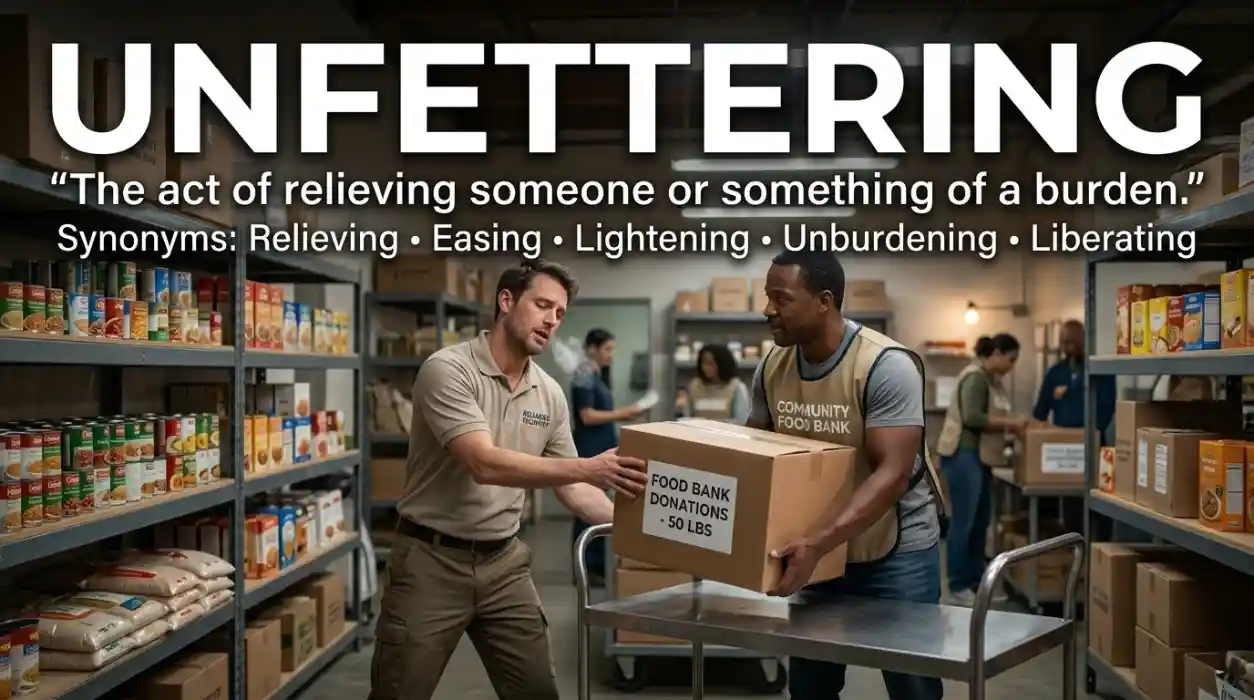
Unburdening (Verb/Gerund) — US / UK: /ʌnˈbɜːrdənɪŋ/ / /ʌnˈbɜːdənɪŋ/
Meaning: Relieving someone or something of a burden.
Tone/Register: Neutral, emotional.
Examples:
Talking openly was emotionally unburdening.
The restructuring focused on unburdening staff from unnecessary tasks.
Synonyms by Tone
Positive and Empowering
These alternatives emphasize opportunity, independence, and personal or creative freedom:
- Freeing
- Liberating
- Emancipating
- Empowering
- Enabling
- Expanding freedom
- Granting autonomy
- Unleashing creativity
- Broadening
- Opening up
These are useful when the removal of restrictions is clearly beneficial.
Neutral
These choices focus on the process rather than the emotional effect:
- Releasing
- Unbinding
- Loosening
- Relaxing
- Removing restrictions
- Removing constraints
- Facilitating
- Widening
- Expanding
- Increasing autonomy
They work particularly well in informative and professional writing.
Strong or Dramatic
These alternatives create a stronger sense of escape or liberation:
- Unshackling
- Unchaining
- Breaking free
- Breaking loose
- Escaping
- Casting off
- Throwing off
- Shaking off
- Unleashing
These are especially useful in storytelling, journalism, speeches, and persuasive prose.
Technical or Professional
For specialized writing, consider:
- Deregulating
- Decentralizing
- Deconstraining
- Disengaging
- Removing constraints
- Granting autonomy
- Unhampering
- Facilitating
The technical term should match the actual mechanism of freedom.
“Unfettering” vs Close Alternatives
Unfettering vs Freeing
Freeing is the broadest and most natural alternative.
It can describe physical, emotional, social, and creative freedom.
Unfettering is more formal and metaphorical. It often emphasizes the removal of constraints.
Freeing the workers from the old system helped morale.
Unfettering the creative process encouraged experimentation.
Unfettering vs Liberating
Liberating has a stronger emotional or philosophical quality.
It suggests that freedom feels empowering.
Unfettering focuses more directly on removing restraints.
Use liberating when describing an experience.
Use unfettering when emphasizing the removal of constraints.
Unfettering vs Unshackling
Unshackling is vivid and dramatic.
It strongly suggests escape from serious restrictions.
Unfettering is more restrained and can sound more sophisticated in professional or literary writing.
The reforms were unshackling small businesses.
Sounds more forceful than:
The reforms were unfettering small businesses.
How “Unfettering” Changes by Context
Daily Conversation
Unfettering is not the most common choice in casual speech.
Native speakers often choose freeing, letting go, opening up, or breaking free.
For example:
“It felt freeing to stop worrying about everyone’s opinions.”
This sounds more conversational than:
“It felt unfettering to stop worrying about everyone’s opinions.”
The latter is understandable but less idiomatic.
Writing and Blogging
Bloggers can use unfettering when discussing creativity, personal growth, education, or innovation.
For example:
“Unfettering your creativity can make writing more enjoyable.”
However, freeing or liberating may sound more natural for a general audience.
Professional or Academic English
The word can work well in formal writing when discussing restrictions.
For example:
“The reform aims to unfetter research from unnecessary administrative constraints.”
In a highly technical context, removing constraints, deregulating, or increasing autonomy may be more precise.
Creative Writing
Creative writing gives unfettering more room to shine.
It can create a sense of release:
“The silence was unfettering.”
Still, writers should consider whether liberating or freeing would sound more natural.
Business Context
Business writers often use unfetter as a metaphor for reducing restrictions.
Examples include:
- unfetter innovation
- unfetter entrepreneurship
- unfetter investment
- unfetter creativity
- unfetter decision-making
For general readers, however, remove restrictions may be clearer.
Common Mistakes Learners Make
Mistake 1: Assuming “Unfettering” Is Common Everyday English
The word is legitimate, but it is more formal and literary than freeing.
In casual conversation, “freeing” usually sounds more natural.
Mistake 2: Using “Unfettering” for Every Kind of Freedom
The word specifically emphasizes removing restraints.
It is not always the best synonym for general independence.
For example, “She is independent” does not necessarily mean “She is unfettered.”
Mistake 3: Confusing “Unfettering” With “Unleashing”
Unleashing often suggests releasing energy, power, talent, or potential.
Unfettering emphasizes removing restrictions.
The program unleashed creativity.
The program unfettered creativity.
Both work, but their emphasis differs.
Mistake 4: Using “Emancipating” Too Broadly
Emancipating often has social, political, legal, or historical associations.
It may sound excessive when describing something simple.
For example, “The flexible schedule was emancipating” sounds much stronger than “The flexible schedule was freeing.”
Mistake 5: Confusing Physical and Figurative Meaning
Unfettering can be literal or figurative.
A person can be unfettered from physical restraints.
A business can also be unfettered by unnecessary regulations.
The context determines the meaning.
Native Usage Notes
Native speakers are more likely to use freeing, liberating, unrestricted, unleashing, or breaking free in everyday communication.
Unfettering is more likely to appear in:
- Essays
- Opinion writing
- Business writing
- Literary prose
- Academic discussion
- Speeches
- Articles about creativity or innovation
The related adjective unfettered is much more common than unfettering.
For example:
“The artist enjoyed unfettered creative freedom.”
This is more idiomatic than forcing unfettering into every sentence.
Real-Life Mini Scenarios
Workplace
A company removes several unnecessary approval stages.
You could say:
“The changes are unfettering decision-making.”
A simpler version is:
“The changes are freeing employees to make decisions faster.”
Social Situation
Someone stops trying to meet everyone’s expectations.
You could describe the experience as:
“Letting go of those expectations felt liberating.”
Here, liberating sounds more natural than unfettering.
Media and Pop Culture
A filmmaker receives complete creative control over a project.
A reviewer might describe the opportunity as unfettering or liberating.
If the writing is dramatic, unleashing the filmmaker’s creativity may sound more vivid.
Storytelling
A character escapes a restrictive environment.
A novelist might write:
“Breaking free changed everything.”
For a more literary style:
“The experience was an unfettering of everything she had kept inside.”
The choice depends on the desired voice.
Practice Exercise
1. An artist finally receives complete creative freedom. Which word fits best?
A. Liberating
B. Restrictive
C. Binding
D. Confined
2. A company removes unnecessary regulations from an industry. Which term is most precise?
A. Deregulating
B. Hesitating
C. Narrowing
D. Confining
3. A student receives more control over how to complete an assignment. Which phrase fits?
A. Granting autonomy
B. Removing confidence
C. Increasing pressure
D. Restricting access
4. Someone escapes years of controlling expectations. Which phrase sounds natural and expressive?
A. Breaking free
B. Tightening control
C. Becoming restricted
D. Adding limits
5. A new system makes collaboration easier. Which word fits best?
A. Facilitating
B. Shackling
C. Confining
D. Restricting
6. A government makes a regulation less strict. Which word fits?
A. Loosening
B. Chaining
C. Narrowing
D. Blocking
7. A program allows young people to develop their abilities fully. Which phrase fits?
A. Unleashing potential
B. Creating barriers
C. Limiting autonomy
D. Increasing restrictions
8. A person talks about feeling better after leaving a controlling relationship. Which word best describes the feeling?
A. Liberating
B. Binding
C. Restrictive
D. Confining
9. A team is given greater authority to make its own decisions. Which phrase fits?
A. Increasing autonomy
B. Increasing control
C. Removing independence
D. Narrowing choices
10. A writer removes unnecessary rules from a creative project. Which word fits the process?
A. Unfettering
B. Restricting
C. Confining
D. Limiting
Reflection Task
Write one sentence using unfettering, freeing, liberating, unleashing, or granting autonomy. Then explain what kind of freedom your chosen word communicates.
Answer key: 1-A | 2-A | 3-A | 4-A | 5-A | 6-A | 7-A | 8-A | 9-A | 10-A
External References
For a learner-friendly definition and pronunciation of unfetter, consult the Cambridge Dictionary.
For historical information about fetter and unfetter, the Online Etymology Dictionary provides useful background on the word’s development.
Conclusion
Learning a synonym for unfettering helps you describe freedom with greater precision. You can show release from rules, emotional burdens, social expectations, or creative limitations.
The best word depends on the kind of freedom involved. Freeing is simple, liberating is emotional, and unshackling is vivid and powerful.
These distinctions strengthen essays, blogs, stories, professional writing, and everyday communication. They also help readers understand exactly what kind of freedom you mean.
Practice by writing one sentence with unfettering, then replace it with freeing, liberating, or unleashing. Notice how each version changes the tone.
FAQs
1. What is the best synonym for unfettering in formal writing?
Liberating, freeing, removing constraints, and unrestricting can work in formal writing, but the best choice depends on context. Removing constraints is especially precise in technical or academic prose. Liberating sounds more emotional, while freeing is simpler and more broadly understood.
2. Is “unfettering” a common English word?
Unfettering is a valid English word, but it is less common than freeing or liberating. The related adjective unfettered is considerably more familiar. It frequently describes something operating without restrictions, such as “unfettered creativity” or “unfettered access.”
3. What is a simple synonym for unfettering?
The simplest synonym is usually freeing. It communicates the basic idea without sounding formal or literary. Depending on the sentence, releasing, opening up, loosening, or removing restrictions can also be clear alternatives for everyday readers.
4. What is the difference between unfettering and liberating?
Both words involve freedom, but they emphasize different things. Unfettering focuses on removing restraints or limitations. Liberating emphasizes the resulting feeling or condition of freedom. Therefore, “unfettering the process” highlights fewer restrictions, while “a liberating experience” highlights the person’s emotional response.
5. Can unfettering be used for creativity?
Yes. Unfettering can describe removing restrictions that limit creative thought or expression. For example, “unfettering creativity” suggests allowing ideas to develop without unnecessary rules. However, freeing creativity and unleashing creativity are often more natural choices for general audiences and conversational writing.

Hasnain Ali is an SEO Content Strategist and the founder of wordvora.com, a trusted vocabulary platform that helps writers, students, professionals, and English learners find accurate synonyms, antonyms, word meanings, and real-life usage examples. He specializes in keyword research, on-page SEO, topical authority, and creating search-first content that aligns with Google’s latest Search Quality and E-E-A-T guidelines. His work focuses on producing clear, well-structured, and reader-friendly resources that satisfy search intent while maintaining high editorial standards.
Through extensive hands-on experience with SEO tools such as Google Search Console, Google Analytics, SEMrush, and Ahrefs, Hasnain researches user search behavior and develops content that is both informative and easy to understand. Every article published on wordvora.com is carefully reviewed for accuracy, readability, and contextual relevance before publication. His mission is to build one of the web’s most reliable English vocabulary resources by providing practical language guidance, trustworthy explanations, and content that helps readers improve their writing, communication, and vocabulary with confidence.