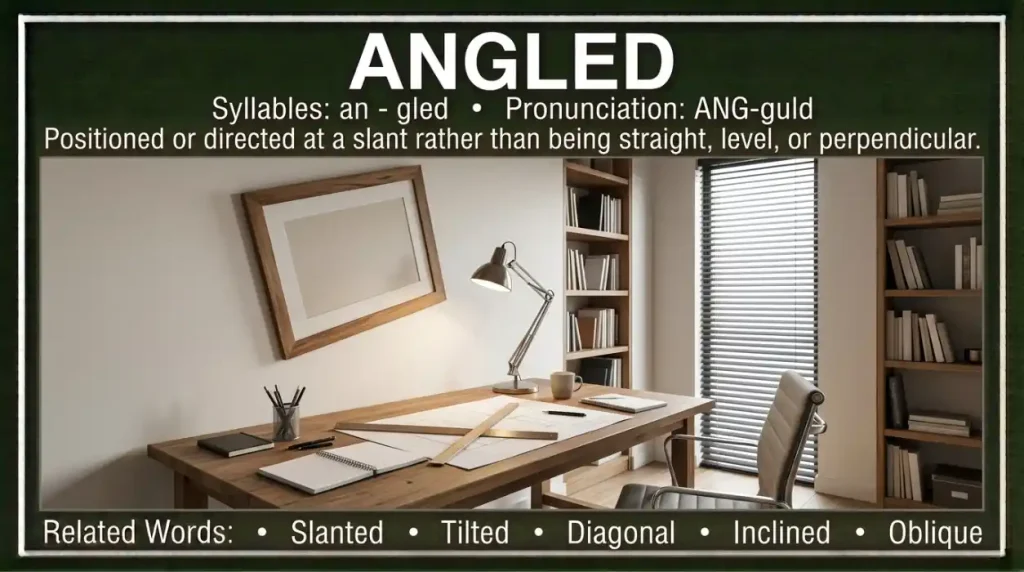
A synonym for angled depends on the context. Common alternatives include slanted, tilted, inclined, oblique, and diagonal. These words describe different positions or directions. In photography, design, or writing, angled can also mean directed toward a particular subject or purpose.
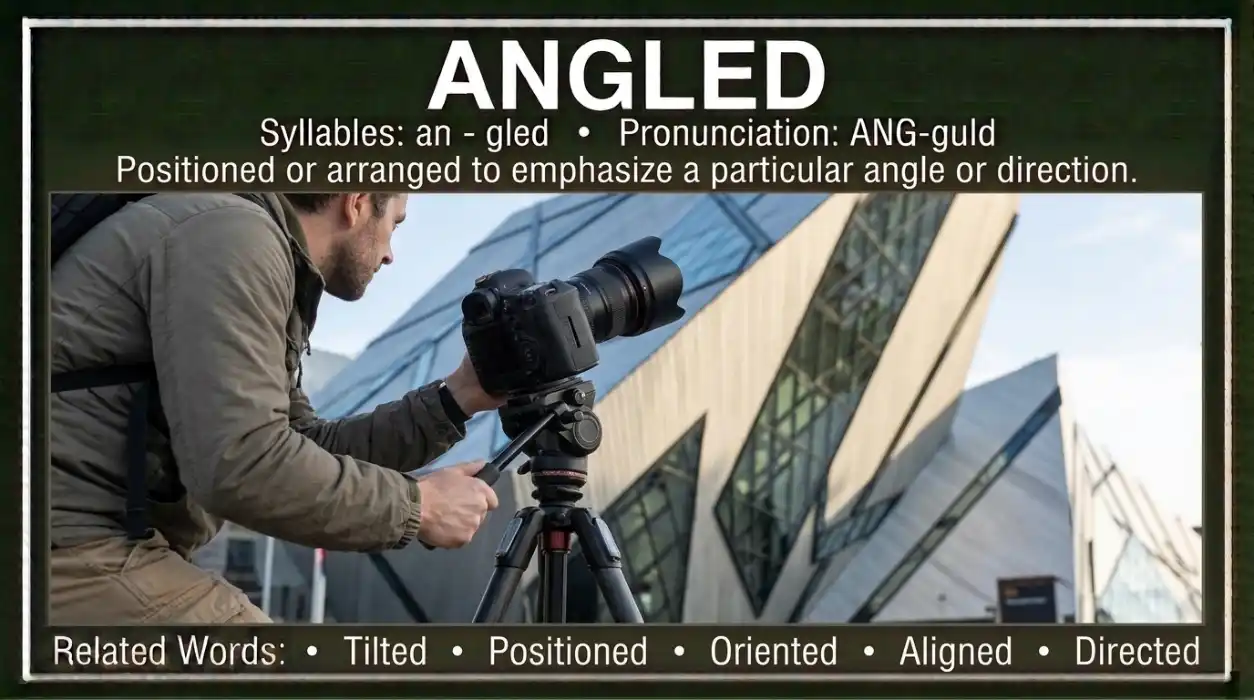
Imagine hanging a picture on your wall. If the frame is not straight, you might describe it as tilted or slanted. If a photographer points a camera from the side, the camera is set at an angle.
The word angled appears in everyday conversation, geometry, architecture, photography, and technical writing. It helps describe position, direction, shape, and perspective.
Learning a suitable synonym for angled helps students explain geometric relationships, bloggers describe images, and content writers avoid repeating the same adjective. Daily English users can also choose words that make directions and descriptions easier to understand.
Not every alternative means the same thing. Diagonal describes a particular direction, while inclined can describe a slope or a tendency. The examples below explain how to choose the most natural word.
What Does “Angled” Really Mean?
Angled is an adjective and the past-tense or past-participle form of the verb angle. As an adjective, it commonly describes something positioned, shaped, or directed at an angle rather than being straight, level, or directly aligned.
It can also describe something deliberately arranged to achieve a particular effect. For example, a photographer may use an angled camera position to create a dramatic image.
Native English speakers understand angled through context. In “an angled roof,” it describes shape or slope. In “an angled photograph,” it may describe the camera’s position or the way the image was composed.
The word is generally neutral. It does not automatically suggest that something is wrong. The surrounding words determine whether the angle appears useful, attractive, awkward, or unusual.
Connotative Meaning
(Connotation is the feeling, attitude, or association a word carries beyond its basic dictionary meaning.)
- Positive tone: “The angled lighting made the portrait look dramatic.” Here, the angle creates an artistic effect.
- Negative tone: “The angled shelf made the books slide off.” The context presents the angle as a problem.
- Neutral tone: “The road follows an angled path along the hillside.” This describes direction.
Etymology
The word angle entered English through Old French angle and Latin angulus, meaning “corner” or “angle.” The Latin word is related to the Greek ankylos, meaning “bent” or “crooked.”
The adjective angled developed from angle with the suffix -ed. It can describe something that has an angle, has been placed at an angle, or has been shaped to form one.
A Brief History
- Old English (450–1100): The modern word angle was not yet established in its present form. Old English speakers used native vocabulary for corners, bends, and directions.
- Middle English (1100–1500): Angle entered English through French and Latin-influenced learning. Its geometric meaning became established in mathematical and scholarly contexts.
- Modern English (1500–present): The word expanded into everyday descriptions of position, design, photography, construction, and figurative perspective. Angled became a useful adjective for objects and arrangements with particular directions or slopes.
Pronunciation, Syllables, and Affixation
Pronunciation of “angled”
- US IPA: /ˈæŋɡəld/
- UK IPA: /ˈæŋɡəld/
Syllables: an-gled
Affixation pattern
- Root: angle
- Prefix: None
- Suffix: -ed
The ending -ed forms the past tense and past participle of the verb angle. In the adjective angled, it can also mean “having an angle” or “made with a particular angle.”
Related words include angle (noun and verb), angular (adjective), angularity (noun), and angling (verb form or the activity of fishing, depending on context).
Synonyms List
The alternatives below cover common uses of angled: sloping, tilted, diagonal, oblique, pointed in a direction, or shaped with corners. Some fit only particular contexts, so use the definition and example to choose carefully.
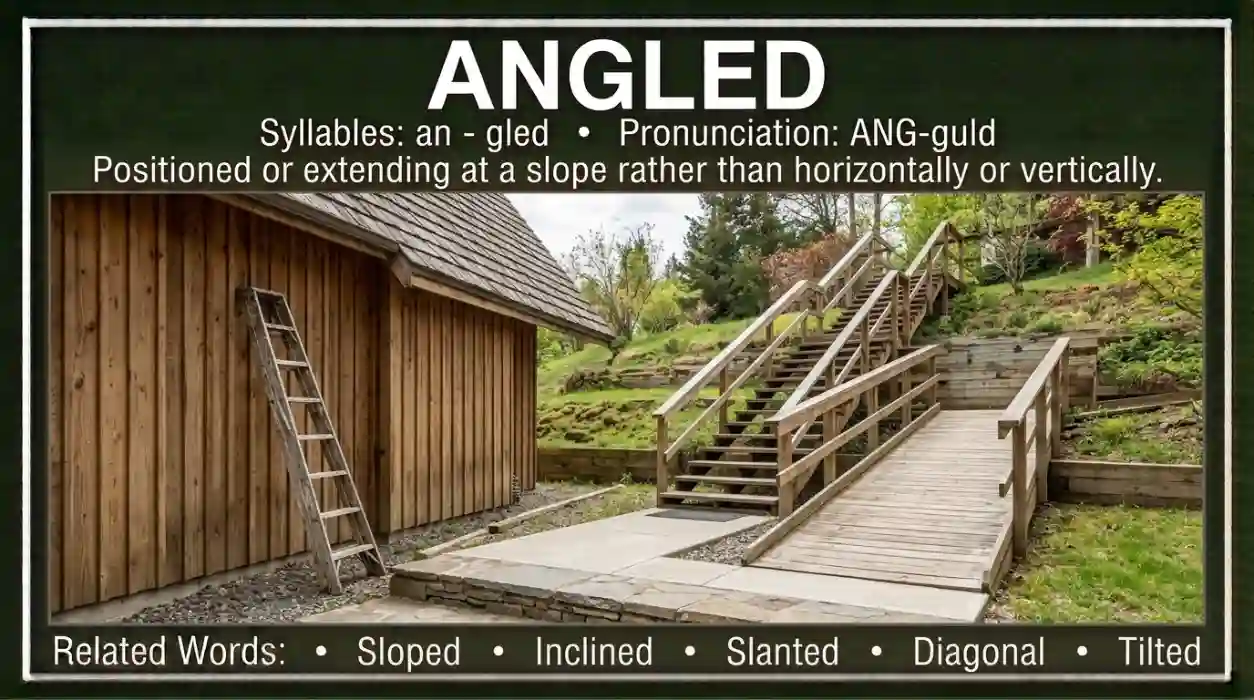
1. Slanted (adjective) — US /ˈslæntɪd/ | UK /ˈslɑːntɪd/
Meaning: Positioned or extending at a slope rather than horizontally or vertically.
Tone/Register: Neutral, everyday.
Examples:
The old roof has slanted sides.
She wrote her name on the slanted label.
2. Tilted (adjective) — US /ˈtɪltɪd/ | UK /ˈtɪltɪd/
Meaning: Leaning or positioned so that it is not level or upright.
Tone/Register: Neutral, conversational.
Examples:
The picture looked tilted above the sofa.
He wore his cap tilted slightly to one side.
3. Inclined (adjective) — US /ɪnˈklaɪnd/ | UK /ɪnˈklaɪnd/
Meaning: Sloping in a particular direction or, figuratively, tending toward a particular choice or action.
Tone/Register: Neutral, formal.
Examples:
The path is inclined toward the river.
I’m inclined to agree with your suggestion.
4. Oblique (adjective) — US /əˈbliːk/ | UK /əˈbliːk/
Meaning: Neither parallel nor perpendicular to a reference line, or indirect in expression.
Tone/Register: Technical, academic, formal.
Examples:
The diagram shows an oblique line across the rectangle.
He made an oblique reference to the disagreement.
5. Diagonal (adjective) — US /daɪˈæɡənəl/ | UK /daɪˈæɡənəl/
Meaning: Extending between corners or across a shape at an angle rather than following its sides.
Tone/Register: Neutral, mathematical.
Examples:
Draw a diagonal line from the top-left corner.
The tiles form a diagonal pattern across the floor.
6. Sloping (adjective) — US /ˈsloʊpɪŋ/ | UK /ˈsləʊpɪŋ/
Meaning: Rising or falling gradually from one level to another.
Tone/Register: Neutral, descriptive.
Examples:
They built a house on sloping ground.
The garden has a sloping lawn behind it.
7. Leaning (adjective) — US /ˈliːnɪŋ/ | UK /ˈliːnɪŋ/
Meaning: Resting or bending toward one side instead of standing straight.
Tone/Register: Everyday, descriptive.
Examples:
A leaning fence marks the edge of the garden.
The ladder was leaning against the wall.
8. Canted (adjective) — US /ˈkæntɪd/ | UK /ˈkæntɪd/
Meaning: Set at a deliberate angle, especially in photography, film, architecture, or engineering.
Tone/Register: Technical, specialist.
Examples:
The director used a canted camera angle to create tension.
The machine has a canted control panel.
9. Askew (adjective/adverb) — US /əˈskjuː/ | UK /əˈskjuː/
Meaning: Not straight, level, or properly aligned.
Tone/Register: Descriptive, slightly literary.
Examples:
The mirror hung askew after the door slammed.
His tie was sitting askew in the family photograph.
10. Crooked (adjective) — US /ˈkrʊkɪd/ | UK /ˈkrʊkɪd/
Meaning: Bent or not straight, often irregularly or unevenly.
Tone/Register: Everyday, sometimes negative.
Examples:
A crooked branch stretched over the path.
The shelf looked crooked after we moved the books.
11. Slanting (adjective) — US /ˈslæntɪŋ/ | UK /ˈslɑːntɪŋ/
Meaning: Extending or pointing diagonally in a particular direction.
Tone/Register: Neutral, descriptive.
Examples:
Slanting sunlight filled the kitchen.
The artist painted slanting lines across the background.
12. Leaned (adjective/participle) — US /liːnd/ | UK /liːnd/
Meaning: Positioned so that something rests or bends toward one side.
Tone/Register: Neutral, conversational.
Examples:
The ladder leaned against the brick wall.
He placed the leaned panel back into position.
Usage note: Leaning is usually more natural as an adjective. Leaned is more often used as the past tense of lean.
13. Pitched (adjective) — US /pɪtʃt/ | UK /pɪtʃt/
Meaning: Set at a particular slope or angle, especially when describing a roof, surface, or structure.
Tone/Register: Construction, technical.
Examples:
The shed has a steeply pitched roof.
Rain runs off the pitched surface quickly.
14. Sloped (adjective) — US /sloʊpt/ | UK /sləʊpt/
Meaning: Made or positioned with a surface that rises or falls at an angle.
Tone/Register: Neutral, technical or everyday.
Examples:
The sloped driveway becomes slippery in winter.
They installed a sloped desk for easier reading.
15. Skewed (adjective) — US /skjuːd/ | UK /skjuːd/
Meaning: Turned away from a straight alignment or distorted from a balanced position.
Tone/Register: Technical, analytical.
Examples:
The frame looked skewed after the move.
A skewed sample can produce misleading results.
16. Angled-off (adjective phrase) — US /ˈæŋɡəld ɔːf/ | UK /ˈæŋɡəld ɒf/
Meaning: Cut, shaped, or directed away at an angle from the main line or surface.
Tone/Register: Technical, descriptive.
Examples:
The carpenter created an angled-off edge on the shelf.
The road has an angled-off entrance near the bridge.
Usage note: This is a context-specific phrase, not a universal substitute for angled.
17. Beveled (adjective) — US /ˈbɛvəld/ | UK /ˈbɛvəld/
Meaning: Having an edge cut at a slant rather than meeting the adjoining surface at a right angle.
Tone/Register: Technical, design, construction.
Examples:
The table has a beveled glass top.
A beveled edge gave the mirror a polished finish.
18. Chamfered (adjective) — US /ˈtʃæmfərd/ | UK /ˈtʃæmfəd/
Meaning: Having a corner or edge cut away to form a sloping surface.
Tone/Register: Engineering, woodworking, technical.
Examples:
The metal part has chamfered corners.
The carpenter chamfered the edge to remove its sharp point.
19. Angular (adjective) — US /ˈæŋɡjələr/ | UK /ˈæŋɡjələ/
Meaning: Having noticeable angles or sharp-edged shapes rather than smooth, rounded forms.
Tone/Register: Descriptive, artistic, technical.
Examples:
The sculpture has an angular design.
His angular features stood out in the portrait.
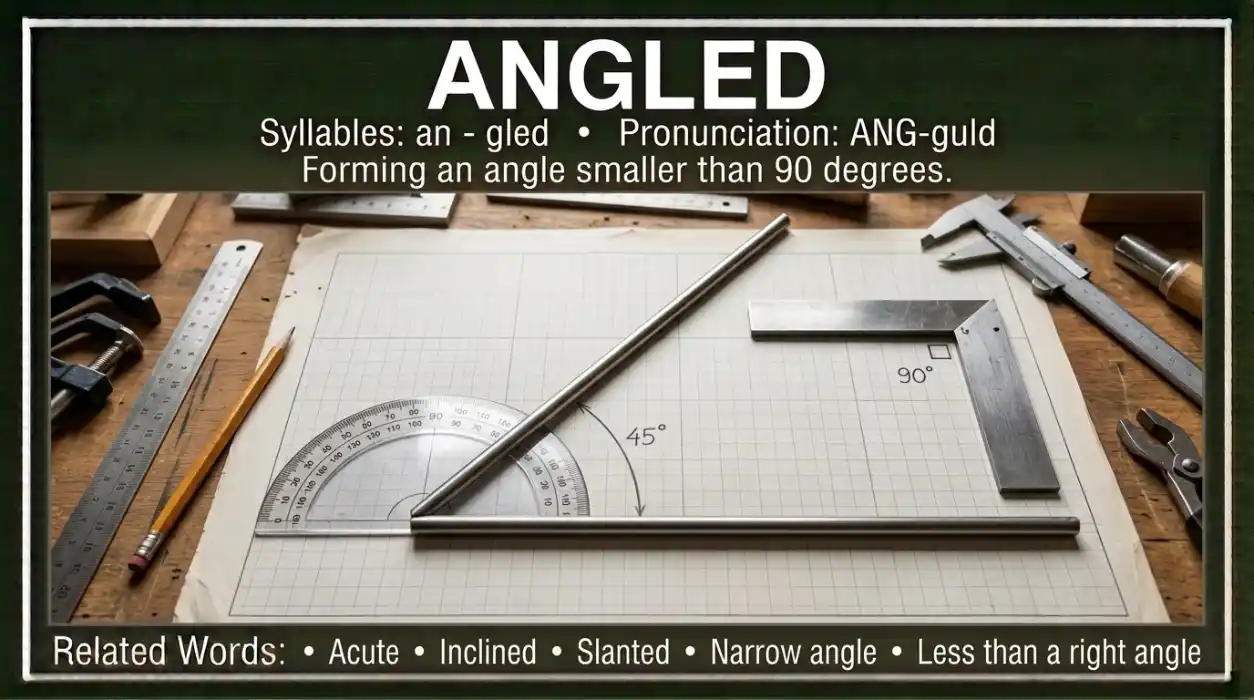
20. Acute (adjective) — US /əˈkjuːt/ | UK /əˈkjuːt/
Meaning: Forming an angle smaller than 90 degrees.
Tone/Register: Mathematical, academic.
Examples:
The triangle contains one acute angle.
Measure the acute corner before drawing the final line.
Usage note: Acute describes the size of an angle, not simply the fact that something is angled.
21. Obtuse (adjective) — US /ɑːbˈtuːs/ | UK /əbˈtjuːs/
Meaning: Forming an angle greater than 90 degrees but less than 180 degrees.
Tone/Register: Mathematical, academic.
Examples:
One corner of the triangle is obtuse.
The diagram highlights the obtuse angle in blue.
22. Perpendicular (adjective) — US /ˌpɜːrpənˈdɪkjələr/ | UK /ˌpɜːpənˈdɪkjələ/
Meaning: Meeting another line or surface at a right angle.
Tone/Register: Mathematical, technical.
Examples:
The vertical support is perpendicular to the floor.
Draw a perpendicular line through the marked point.
Usage note: This is a specific kind of angle relationship, not a general synonym for angled.
23. Diagonally oriented (adjective phrase) — US /daɪˈæɡənəli ˈɔːrientɪd/ | UK /daɪˈæɡənəli ˈɔːrienteɪtɪd/
Meaning: Positioned so that the main direction runs diagonally.
Tone/Register: Technical, descriptive.
Examples:
The display was diagonally oriented across the room.
Place the labels on the diagonally oriented panels.
24. Obliquely positioned (adjective phrase) — US /əˈbliːkli pəˈzɪʃənd/ | UK /əˈbliːkli pəˈzɪʃənd/
Meaning: Positioned at a slant rather than parallel or perpendicular to a reference.
Tone/Register: Formal, technical.
Examples:
The sensor was obliquely positioned to capture the surface.
The photograph shows the building from an obliquely positioned camera.
25. Tilted sideways (adjective phrase) — US /ˈtɪltɪd ˈsaɪdweɪz/ | UK /ˈtɪltɪd ˈsaɪdweɪz/
Meaning: Turned or leaning toward one side.
Tone/Register: Informal, descriptive.
Examples:
The screen was tilted sideways during the demonstration.
He held the phone tilted sideways to record the match.
26. Off-kilter (adjective) — US /ˌɔːf ˈkɪltər/ | UK /ˌɒf ˈkɪltə/
Meaning: Not level, balanced, or aligned correctly.
Tone/Register: Informal, expressive.
Examples:
The old cabinet looked a little off-kilter.
The camera angle gave the scene an off-kilter feeling.
27. Uneven (adjective) — US /ʌnˈiːvən/ | UK /ʌnˈiːvən/
Meaning: Not level, regular, or equal across a surface or arrangement.
Tone/Register: Neutral, sometimes critical.
Examples:
The floor is uneven near the doorway.
Uneven cuts made the frame look poorly finished.
Usage note: An uneven surface may be angled, but the word emphasizes irregularity rather than direction.
28. Aslant (adjective/adverb) — US /əˈslænt/ | UK /əˈslɑːnt/
Meaning: Positioned or directed at a slant.
Tone/Register: Literary, descriptive.
Examples:
The afternoon light fell aslant across the desk.
A narrow beam shone aslant through the window.
29. Inclining (adjective/participle) — US /ɪnˈklaɪnɪŋ/ | UK /ɪnˈklaɪnɪŋ/
Meaning: Sloping in a direction or leaning toward a particular position.
Tone/Register: Formal, technical.
Examples:
The inclining ramp leads to the upper entrance.
The path becomes more steeply inclining near the summit.
30. Raked (adjective) — US /reɪkt/ | UK /reɪkt/
Meaning: Set at a slope, especially when describing seats, a roof, or a surface.
Tone/Register: Architectural, technical.
Examples:
The theater has raked seating for a better view.
The designer added a raked ceiling to the room.
31. Bevel-edged (adjective) — US /ˈbɛvəl ɛdʒd/ | UK /ˈbevəl edʒd/
Meaning: Having an edge that slopes away from the main surface.
Tone/Register: Technical, product description.
Examples:
The cabinet door has a bevel-edged frame.
A bevel-edged mirror softened the look of the bathroom.
32. Tapered (adjective) — US /ˈteɪpərd/ | UK /ˈteɪpəd/
Meaning: Becoming narrower toward one end or gradually changing in width or thickness.
Tone/Register: Neutral, design, technical.
Examples:
The table has tapered legs.
The artist drew a tapered shape that narrowed toward the top.
Usage note: Tapered describes a change in width or thickness, not necessarily an angle in position.
33. Wedge-shaped (adjective) — US /ˈwɛdʒ ʃeɪpt/ | UK /ˈwedʒ ʃeɪpt/
Meaning: Shaped like a wedge, with sides that converge toward a thinner edge or point.
Tone/Register: Descriptive, technical.
Examples:
The designer chose a wedge-shaped support.
A wedge-shaped piece fitted neatly into the gap.
34. Triangular (adjective) — US /traɪˈæŋɡjələr/ | UK /traɪˈæŋɡjələ/
Meaning: Having the shape of a triangle, with three sides and three angles.
Tone/Register: Neutral, mathematical.
Examples:
The garden has a triangular flower bed.
They installed a triangular brace beneath the shelf.
Usage note: A triangular object has angles, but triangular does not mean angled in every context.
35. Faceted (adjective) — US /ˈfæsɪtɪd/ | UK /ˈfæsɪtɪd/
Meaning: Having multiple flat faces or surfaces that meet at angles.
Tone/Register: Technical, artistic, jewelry.
Examples:
The faceted crystal reflected the light.
The sculpture has a faceted surface instead of smooth curves.
36. Zigzag (adjective) — US /ˈzɪɡzæɡ/ | UK /ˈzɪɡzæɡ/
Meaning: Forming a series of sharp turns in alternating directions.
Tone/Register: Everyday, descriptive.
Examples:
A zigzag path climbs the hillside.
The artist painted a zigzag border around the poster.
37. Bent (adjective) — US /bɛnt/ | UK /bɛnt/
Meaning: Curved or forced away from a straight shape or position.
Tone/Register: Everyday, neutral.
Examples:
The bent metal rod would not fit into the slot.
He noticed a bent corner on the frame.
38. Twisted (adjective) — US /ˈtwɪstɪd/ | UK /ˈtwɪstɪd/
Meaning: Turned or distorted from its original straight or regular position.
Tone/Register: Neutral, sometimes negative.
Examples:
The twisted bracket made the shelf sit at an angle.
A twisted wire held the sign in place.
39. Rotated (adjective/participle) — US /ˈroʊteɪtɪd/ | UK /rəʊˈteɪtɪd/
Meaning: Turned around a central point or axis into a different orientation.
Tone/Register: Technical, everyday.
Examples:
The image was rotated slightly to straighten the horizon.
She rotated the chair toward the window.
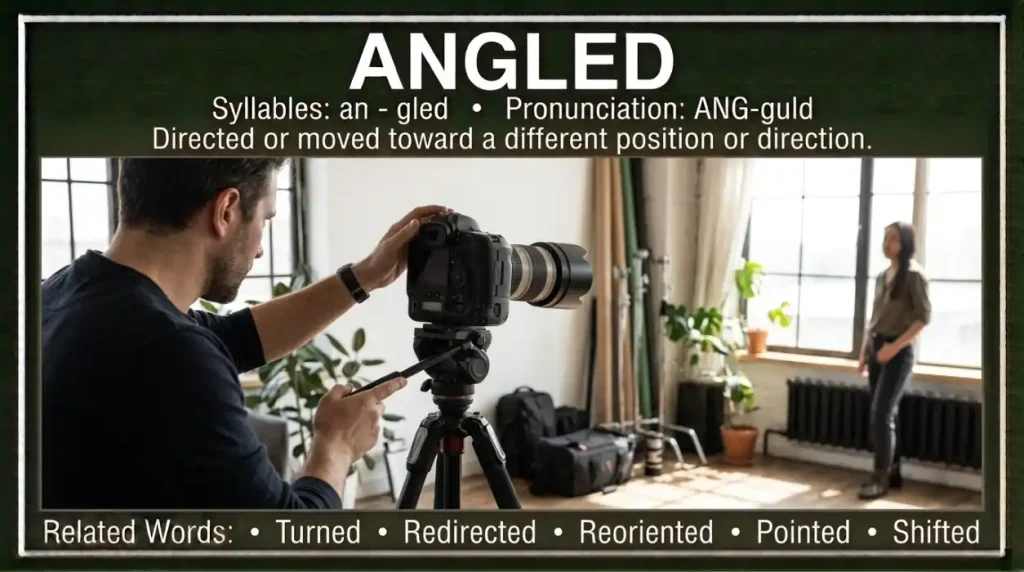
40. Turned (adjective/participle) — US /tɜːrnd/ | UK /tɜːnd/
Meaning: Directed or moved toward a different position or direction.
Tone/Register: Neutral, conversational.
Examples:
The chair was turned toward the fireplace.
He placed the turned panel beside the door.
Usage note: Turned is broad and does not necessarily imply a sloping angle.
41. Offset (adjective) — US /ˈɔːfˌsɛt/ | UK /ˈɒfset/
Meaning: Positioned away from a central line or aligned position.
Tone/Register: Technical, design, professional.
Examples:
The offset handle makes the door easier to open.
The designer placed the text in an offset position.
42. Misaligned (adjective) — US /ˌmɪsəˈlaɪnd/ | UK /ˌmɪsəˈlaɪnd/
Meaning: Not correctly lined up with another object or reference point.
Tone/Register: Technical, often negative.
Examples:
The printer produced a misaligned image.
The two panels looked misaligned after installation.
43. Askance (adverb) — US /əˈskæns/ | UK /əˈskɑːns/
Meaning: With a sideways or suspicious look.
Tone/Register: Literary, formal.
Examples:
She glanced askance at the unusual sculpture.
He looked askance at the proposal.
Usage note: Askance describes a way of looking, not the physical position of an object. It is only a related choice when angled describes a sideways glance.
44. Sideways (adjective/adverb) — US /ˈsaɪdweɪz/ | UK /ˈsaɪdweɪz/
Meaning: Directed toward or positioned on one side rather than straight ahead.
Tone/Register: Everyday, informal.
Examples:
The car slid sideways on the wet road.
She turned the monitor sideways to show the wider image.
45. Diagonally set (adjective phrase) — US /daɪˈæɡənəli sɛt/ | UK /daɪˈæɡənəli sɛt/
Meaning: Placed so that the object or feature follows a diagonal direction.
Tone/Register: Neutral, descriptive.
Examples:
The tiles were diagonally set to make the hallway look wider.
The sign was diagonally set across the entrance.
46. Sloped-back (adjective) — US /ˈsloʊpt bæk/ | UK /ˈsləʊpt bæk/
Meaning: Designed with a back surface that slopes backward rather than standing upright.
Tone/Register: Design, furniture, descriptive.
Examples:
The chair has a sloped-back design for a relaxed posture.
They selected a sloped-back seat for the reading area.
47. Angulated (adjective) — US /ˈæŋɡjəˌleɪtɪd/ | UK /ˈæŋɡjʊleɪtɪd/
Meaning: Having distinct angles or bends, especially in technical or anatomical descriptions.
Tone/Register: Scientific, medical, specialist.
Examples:
The scan showed an angulated bone fragment.
The instrument has an angulated tip for reaching narrow spaces.
48. Oblique-angled (adjective) — US /əˈbliːk ˈæŋɡəld/ | UK /əˈbliːk ˈæŋɡəld/
Meaning: Set at an oblique angle rather than parallel or perpendicular to a reference line.
Tone/Register: Technical, geometric.
Examples:
The diagram shows an oblique-angled support.
The photographer used an oblique-angled view of the building.
49. Dihedral (adjective) — US /daɪˈhiːdrəl/ | UK /daɪˈhiːdrəl/
Meaning: Relating to the angle formed between two intersecting planes.
Tone/Register: Mathematical, engineering, specialist.
Examples:
The engineer measured the dihedral angle between the panels.
The model uses a dihedral joint at the corner.
Usage note: This is a precise technical term, not a general synonym for angled.
50. Angularly positioned (adjective phrase) — US /ˈæŋɡjələrli pəˈzɪʃənd/ | UK /ˈæŋɡjələli pəˈzɪʃənd/
Meaning: Positioned in a way that emphasizes an angle or angular orientation.
Tone/Register: Technical, formal.
Examples:
The sensor was angularly positioned to detect movement.
The components were angularly positioned around the central frame.
Usage note: For most everyday situations, the strongest alternatives are slanted, tilted, inclined, diagonal, sloping, and oblique. Terms such as beveled, chamfered, and dihedral apply to specific shapes or technical relationships rather than all uses of angled.
Synonyms by Tone
The best synonym depends on the impression you want to create. Some words describe a simple position, while others sound technical or suggest that something is incorrectly aligned.
Positive or design-focused
These words can describe intentional, attractive, or functional angles:
- Slanted — useful for describing a deliberate slope.
- Diagonal — clear and precise when describing lines and patterns.
- Beveled — suggests a carefully finished edge.
- Faceted — emphasizes a designed surface with multiple faces.
- Inclined — useful for describing ramps and surfaces that slope upward or downward.
Neutral
These alternatives describe position or direction without automatically suggesting a problem:
- Tilted
- Sloping
- Leaning
- Oblique
- Rotated
- Sideways
- Pitched
Negative or critical
These words may suggest a problem with alignment or shape:
- Askew — not straight or level.
- Crooked — bent or irregular.
- Skewed — out of alignment or distorted.
- Misaligned — not properly lined up.
- Off-kilter — unbalanced or not quite right.
The words are not always negative. A skewed camera angle, for example, can be an intentional artistic choice.
Playful or informal
In casual conversation, tilted, crooked, sideways, and off-kilter are often easy to understand.
You might say, “The frame is a little crooked” rather than “The frame is obliquely positioned.” The simpler phrase sounds more natural in an everyday setting.
“Angled” vs. Close Alternatives
| Word | Main difference | Best use |
|---|---|---|
| Angled | General term for something positioned or shaped at an angle | Everyday descriptions and technical contexts |
| Slanted | Emphasizes a slope or diagonal direction | Roofs, surfaces, writing, and lines |
| Tilted | Emphasizes a change from level or upright | Pictures, heads, screens, and objects |
| Diagonal | Describes a direction across a shape, usually between corners | Geometry, layouts, patterns |
| Oblique | Describes a slant that is neither parallel nor perpendicular; can also mean indirect | Technical writing and formal expression |
Consider these examples:
- “The picture is angled toward the window.” This gives a broad description of its position.
- “The picture is tilted.” This suggests it is not level.
- “A diagonal line crosses the picture.” This describes a specific direction.
- “The camera took an oblique view.” This suggests the view is from a slanted angle.
The most natural choice depends on what you want to emphasize: position, slope, direction, or the relationship between two lines.
How “Angled” Changes by Context
Daily conversation
In everyday speech, tilted, slanted, and crooked are usually easy choices. You might describe a tilted phone, a slanted roof, or a crooked picture frame.
Choose angled when the exact direction is not important or when you simply want to describe a position that is not straight.
Writing and blogging
Writers can use more precise vocabulary to make descriptions vivid. Instead of saying that a room has an angled ceiling, you could say it has a sloping ceiling if you mean that the surface rises or falls.
For visual content, diagonal, oblique, and slanted can help readers imagine the layout more clearly. Avoid changing words merely to reduce repetition if the replacement changes the meaning.
Professional and academic English
In architecture, manufacturing, and engineering, terms such as beveled, chamfered, perpendicular, and dihedral have specific meanings.
A technical report should use the exact term required by the design or measurement. In mathematics, an acute angle is less than 90 degrees, while an obtuse angle is greater than 90 degrees and less than 180 degrees.
Creative and informal writing
In fiction and photography, angle-related vocabulary can create mood and perspective. A canted camera angle can make a scene feel unsettling, while slanting sunlight can make a setting feel warm and atmospheric.
In informal speech, however, simpler language is often more effective. Use tilted or crooked unless the technical distinction matters.
Common Mistakes Learners Make
Confusing “angled” with “diagonal”
These words overlap, but they are not identical. Angled is broad, while diagonal describes a specific direction across a shape.
- General: “The mirror is angled toward the door.”
- More specific: “A diagonal line runs across the square.”
Using “inclined” for every tilted object
Inclined often describes a slope or a tendency. It works well for an inclined ramp or a person inclined to agree, but “the picture is inclined” may sound unnatural when you simply mean that it is not level.
For a picture hanging unevenly, tilted or askew is usually clearer.
Treating “crooked” as a neutral technical term
Crooked often suggests an irregular shape or an unwanted misalignment. In engineering documents, misaligned, offset, or a precise angle measurement may be more appropriate.
Confusing “beveled” and “sloped”
A beveled edge has been cut at an angle. A sloped surface rises or falls across a distance. A surface can be sloped without having a beveled edge.
Overusing technical words
Words such as angulated and dihedral are valuable in specialist contexts. They can sound confusing or unnecessarily complex in general writing.
Choose the simplest accurate expression for your audience.
Register notes
- Everyday: tilted, slanted, crooked, sideways.
- Formal: oblique, inclined, askew.
- Design and construction: beveled, chamfered, pitched.
- Mathematics and engineering: acute, obtuse, perpendicular, dihedral.
- Creative description: aslant, canted, slanting.
For further vocabulary practice, compare slanted, tilted, and diagonal. These three words are common, useful, and easy to apply in daily English.
Real-Life Mini Scenarios
At work:
An interior designer might describe a desk as angled toward the window. If the desk surface slopes, slanted may be more accurate.
In social situations:
A friend might say, “Your photo frame is tilted.” This sounds natural when the frame hangs unevenly.
In media and photography:
A filmmaker might use a canted camera angle to create tension. A photographer may take an oblique view to show the side of a building.
In writing and storytelling:
An author might describe slanting rain against a window. The word gives readers a clearer picture of the weather and movement.
In geometry:
A student may identify a diagonal line or measure an acute angle. These specific terms are more useful than the general adjective angled.
Practice Quiz
1. A picture frame is no longer level on the wall.
Tilted
Dihedral
Tapered
2. A line crosses a square from one corner to the opposite corner.
Crooked
Diagonal
Beveled
3. A glass table has edges cut at a slant.
Beveled
Askance
Rotated
4. A road rises gradually toward a hill.
Sloping
Misaligned
Faceted
5. A line forms an angle smaller than 90 degrees.
Acute
Obtuse
Perpendicular
6. A camera is deliberately tilted to make a movie scene feel unsettling.
Canted
Tapered
Chamfered
7. Two panels do not line up correctly.
Misaligned
Inclined
Triangular
8. A roof has a particular slope.
Pitched
Askew
Rotated
9. A surface has several flat faces meeting at angles.
Faceted
Sideways
Leaning
10. Two surfaces meet at a right angle.
Perpendicular
Oblique
Slanted
Answer key:
1. Tilted · 2. Diagonal · 3. Beveled · 4. Sloping · 5. Acute · 6. Canted · 7. Misaligned · 8. Pitched · 9. Faceted · 10. Perpendicular
Reflection task
Write two sentences describing an object in your room. Use angled in the first sentence, then replace it with a more precise synonym in the second. Explain why your second choice is clearer.
External Source
For definitions, pronunciation, and examples of how these words are used, visit the Merriam-Webster Dictionary.
Conclusion: Choose the Right Synonym for Angled
Choosing the right synonym for angled makes your descriptions more accurate. Words such as tilted, slanted, diagonal, and oblique express different positions and relationships.
A stronger vocabulary can improve essays, blogs, technical writing, and everyday conversations. The goal is not to use complicated words, but to express each idea clearly and confidently.
Start with a few alternatives that match your daily needs. Practice them in emails, essays, image descriptions, and conversations until they feel natural.
Keep experimenting with new words and creating your own examples. With regular practice, you will describe objects, directions, and designs with greater confidence and precision.
Frequently Asked Questions
1. What is the best synonym for angled in interior design?
Slanted, tilted, and beveled are useful alternatives, depending on the feature. Use slanted for a surface that slopes, tilted for an object that is not level, and beveled for an edge cut at an angle. These distinctions help designers describe furniture, mirrors, ceilings, and decorative details accurately.
2. What is another word for angled in photography?
Oblique, canted, and diagonal may work in photography. An oblique view shows a subject from a slanted direction. A canted camera angle deliberately tilts the camera, often to create tension or visual imbalance. Diagonal is more suitable when describing lines, shapes, or compositions that cross the frame.
3. What is the difference between angled and angular?
Angled usually describes something positioned or shaped at a particular angle. Angular describes something with noticeable angles, corners, or sharp-edged forms. For example, an angled mirror may be turned toward a window, while an angular mirror may have a geometric frame with distinct corners.
4. What is a synonym for angled in engineering?
The correct alternative depends on the design. Oblique describes a slanted orientation, beveled describes an edge cut at an angle, and chamfered describes a corner or edge cut away to create a sloping face. Engineering documents should use the term that accurately describes the component rather than treating these words as interchangeable.
5. Can “inclined” replace “angled” in every sentence?
No. Inclined works well for slopes, ramps, and surfaces, and it can also describe a person’s tendency or preference. For example, “The road is inclined” describes a slope, while “I’m inclined to agree” expresses an opinion. For an uneven picture frame, tilted or askew is usually more natural.

Hasnain Ali is an SEO Content Strategist and the founder of wordvora.com, a trusted vocabulary platform that helps writers, students, professionals, and English learners find accurate synonyms, antonyms, word meanings, and real-life usage examples. He specializes in keyword research, on-page SEO, topical authority, and creating search-first content that aligns with Google’s latest Search Quality and E-E-A-T guidelines. His work focuses on producing clear, well-structured, and reader-friendly resources that satisfy search intent while maintaining high editorial standards.
Through extensive hands-on experience with SEO tools such as Google Search Console, Google Analytics, SEMrush, and Ahrefs, Hasnain researches user search behavior and develops content that is both informative and easy to understand. Every article published on wordvora.com is carefully reviewed for accuracy, readability, and contextual relevance before publication. His mission is to build one of the web’s most reliable English vocabulary resources by providing practical language guidance, trustworthy explanations, and content that helps readers improve their writing, communication, and vocabulary with confidence.