
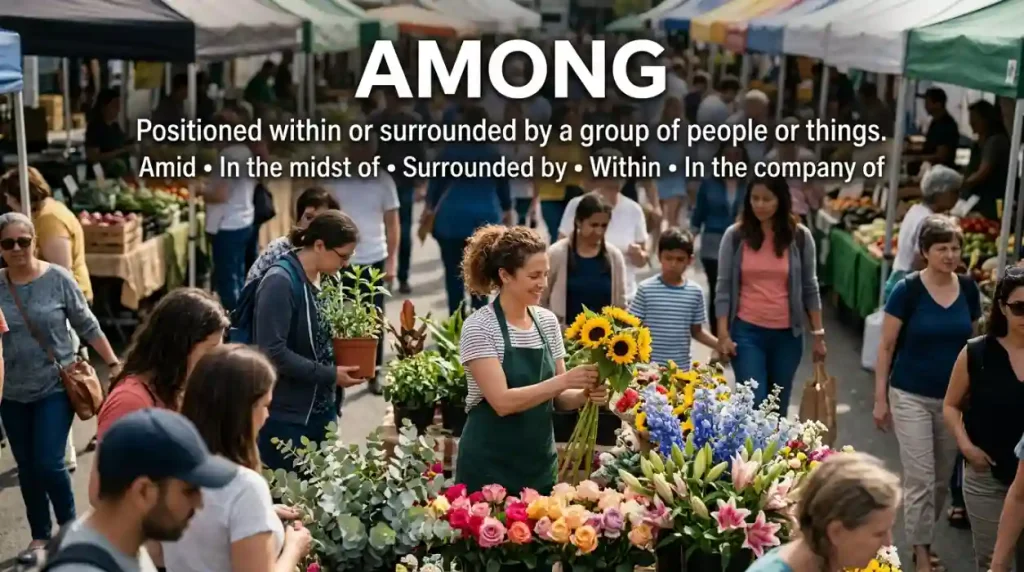
Synonyms for among become useful when you want to describe people, things, or ideas within a group. Imagine standing among friends at a busy café.
A student may write, “She felt comfortable among her classmates.” Another phrase can change the rhythm or make the setting sound more formal.
Learning synonyms for among helps students, bloggers, content writers, and daily English users avoid repetition while choosing words that fit each context.
Because among is common in speech and writing, knowing its alternatives makes your English more flexible. These choices can add clarity without changing your meaning.
What Does “Among” Really Mean?
Among is a preposition used when someone or something is surrounded by, included with, or connected to members of a group.
In simple English, among means “in the middle of a group” or “within a group.”
For example:
She was sitting among her friends.
This means she was sitting with her friends as part of the group.
Native speakers commonly use among when talking about people, objects, ideas, places, or things that exist within a larger collection.
You may see it in sentences such as:
- He found his keys among the books.
- She is popular among young readers.
- The rumor spread among the students.
- There was disagreement among the team members.
Part of Speech
Among is mainly a preposition.
It normally introduces a noun or noun phrase.
Pattern: among + noun/group
Examples:
- among friends
- among students
- among the trees
- among several choices
- among the documents
Unlike some emotional words, among has no strong positive or negative feeling by itself. Its tone usually comes from the surrounding sentence.
Connotative Meaning
Connotation (the emotional or implied feeling connected with a word beyond its basic dictionary meaning) can vary depending on the phrase.
Positive Tone
Among can appear in positive contexts involving belonging, friendship, trust, or acceptance.
Example:
She felt safe among people who understood her.
Negative Tone
It can also appear in negative situations involving conflict, confusion, fear, or disagreement.
Example:
Tension grew among the employees.
Neutral Tone
Most uses of among are neutral. The word simply shows that something exists within or is connected to a group.
Example:
The teacher handed out the papers among the students.
Etymology of “Among”
The word among comes from the Germanic branch of English.
It developed from older English forms related to the idea of being in a group or mixed with others. Its history connects it with the older expression on gemang, where gemang referred to a company, gathering, or mixture.
Old English: 450–1100
Old English used forms such as on gemang to express the idea of being in the company or midst of others.
Middle English: 1100–1500
During Middle English, the expression developed into forms such as among and amongst. These forms became increasingly familiar in English writing and speech.
Modern English: 1500–Present
Modern English established among as the standard form in most contexts. Amongst remains correct, although it can sound slightly more traditional or literary in some varieties of English.

Pronunciation
US: /əˈmʌŋ/
UK: /əˈmʌŋ/
Syllables
a-mong
Affixation Pattern of “Among”
Root: mong / historical Germanic element
Prefix: none in the modern English analysis
Suffix: none
The modern word should not be treated like a regular prefixed or suffixed word. Its historical development comes from older English expressions rather than a simple modern root-plus-affix pattern.
Synonyms List
Amid (Preposition) — US /əˈmɪd/ | UK /əˈmɪd/
Meaning: Amid means in the middle of or surrounded by people, things, or circumstances.
Tone/Register: Neutral to formal; common in writing.
Examples:
She stayed calm amid the confusion.
The cabin stood amid tall pine trees.
Amidst (Preposition) — US /əˈmɪdst/ | UK /əˈmɪdst/
Meaning: Amidst means surrounded by or in the middle of something.
Tone/Register: Literary; somewhat formal.
Examples:
They found peace amidst the noise.
A small garden grew amidst the buildings.
Amongst (Preposition) — US /əˈmʌŋst/ | UK /əˈmʌŋst/
Meaning: Amongst is a direct variant of among with the same basic meaning.
Tone/Register: Neutral; slightly traditional or British-leaning in some contexts.
Examples:
She walked amongst the visitors.
The message created excitement amongst the fans.
In the Midst of (Prepositional Phrase) — US /ɪn ðə mɪdst əv/ | UK /ɪn ðə mɪdst əv/
Meaning: This phrase means directly surrounded by or in the middle of something.
Tone/Register: Formal; common in writing.
Examples:
He remained focused in the midst of the debate.
They built a home in the midst of nature.
In the Middle of (Prepositional Phrase) — US /ɪn ðə ˈmɪdəl əv/ | UK /ɪn ðə ˈmɪdəl əv/
Meaning: This phrase describes something positioned in the center of a place, group, or situation.
Tone/Register: Neutral; very common in conversation.
Examples:
She stood in the middle of the crowd.
I found my wallet in the middle of the papers.
In the Company of (Prepositional Phrase) — US /ɪn ðə ˈkʌmpəni əv/ | UK /ɪn ðə ˈkʌmpəni əv/
Meaning: This phrase means being together with or accompanied by other people.
Tone/Register: Neutral to formal.
Examples:
He feels relaxed in the company of close friends.
She traveled in the company of experienced guides.
In a Group of (Prepositional Phrase) — US /ɪn ə ɡruːp əv/ | UK /ɪn ə ɡruːp əv/
Meaning: This phrase identifies someone or something as part of a particular group.
Tone/Register: Neutral; conversational.
Examples:
She was in a group of new students.
The bird was in a group of five.
Within the Group (Prepositional Phrase) — US /wɪˈðɪn ðə ɡruːp/ | UK /wɪˈðɪn ðə ɡruːp/
Meaning: Within the group means inside or as part of a specific group.
Tone/Register: Neutral to formal.
Examples:
A new leader emerged within the group.
There was strong agreement within the group.
Within the Ranks of (Prepositional Phrase) — US /wɪˈðɪn ðə ræŋks əv/ | UK /wɪˈðɪn ðə ræŋks əv/
Meaning: This phrase means inside the membership of an organization or structured group.
Tone/Register: Formal; organizational or military.
Examples:
Several experts worked within the ranks of the organization.
A talented writer appeared within the ranks of the team.
In the Ranks of (Prepositional Phrase) — US /ɪn ðə ræŋks əv/ | UK /ɪn ðə ræŋks əv/
Meaning: This phrase describes membership within an organized group.
Tone/Register: Formal.
Examples:
She quickly became respected in the ranks of the staff.
A new voice appeared in the ranks of the movement.
Within the Circle of (Prepositional Phrase) — US /wɪˈðɪn ðə ˈsɝːkəl əv/ | UK /wɪˈðɪn ðə ˈsɜːkəl əv/
Meaning: It means inside a social or professional circle of people.
Tone/Register: Neutral to formal.
Examples:
He became trusted within the circle of senior editors.
She was well known within the circle of local artists.
In the Circle of (Prepositional Phrase) — US /ɪn ðə ˈsɝːkəl əv/ | UK /ɪn ðə ˈsɜːkəl əv/
Meaning: This phrase refers to being part of a connected social or professional group.
Tone/Register: Neutral.
Examples:
She was popular in the circle of young designers.
He had several friends in the circle of musicians.
Within (Preposition) — US /wɪˈðɪn/ | UK /wɪˈðɪn/
Meaning: Within means inside a particular space, group, boundary, or system.
Tone/Register: Neutral to formal; common in academic writing.
Examples:
The answer lies within the community.
Several disagreements appeared within the committee.
Inside (Preposition) — US /ɪnˈsaɪd/ | UK /ɪnˈsaɪd/
Meaning: Inside means within an enclosed place or defined group.
Tone/Register: Neutral; conversational.
Examples:
There was a lot of talent inside the group.
She felt comfortable inside the small community.
With (Preposition) — US /wɪð, wɪθ/ | UK /wɪð, wɪθ/
Meaning: With can replace among when the main idea is being together or in someone’s company.
Tone/Register: Neutral; extremely common.
Examples:
He spent the afternoon with his classmates.
She felt relaxed with her closest friends.
Surrounded By (Prepositional Phrase) — US /səˈraʊndɪd baɪ/ | UK /səˈraʊndɪd baɪ/
Meaning: Surrounded by emphasizes that people or things are all around someone or something.
Tone/Register: Neutral; descriptive.
Examples:
The child stood surrounded by balloons.
The house was surrounded by trees.
Encircled By (Prepositional Phrase) — US /ɪnˈsɝːkəld baɪ/ | UK /ɪnˈsɜːkəld baɪ/
Meaning: Encircled by means completely or closely surrounded by something.
Tone/Register: Formal; descriptive.
Examples:
The village was encircled by mountains.
The speaker stood encircled by reporters.
Enclosed By (Prepositional Phrase) — US /ɪnˈkloʊzd baɪ/ | UK /ɪnˈkləʊzd baɪ/
Meaning: Enclosed by means surrounded or bounded by something.
Tone/Register: Formal; technical or descriptive.
Examples:
The garden was enclosed by a stone wall.
The courtyard was enclosed by tall buildings.
Mixed With (Prepositional Phrase) — US /mɪkst wɪð/ | UK /mɪkst wɪð/
Meaning: Mixed with means combined or physically placed together with other things.
Tone/Register: Neutral.
Examples:
The red flowers were mixed with yellow ones.
Her excitement was mixed with nervousness.
Mingled With (Prepositional Phrase) — US /ˈmɪŋɡəld wɪð/ | UK /ˈmɪŋɡəld wɪð/
Meaning: Mingled with means naturally mixed or blended with other people or things.
Tone/Register: Literary; descriptive.
Examples:
Laughter mingled with the sound of music.
The guests mingled with residents.
Blended With (Prepositional Phrase) — US /blendɪd wɪð/ | UK /blendɪd wɪð/
Meaning: Blended with means combined so that separate elements become less distinct.
Tone/Register: Neutral; descriptive.
Examples:
The old buildings blended with the modern streets.
Her voice blended with the choir.
Interspersed With (Prepositional Phrase) — US /ˌɪntərˈspɝːst wɪð/ | UK /ˌɪntəˈspɜːst wɪð/
Meaning: Interspersed with means scattered between or throughout other things.
Tone/Register: Formal; academic and descriptive.
Examples:
The article contains photographs interspersed with text.
Small villages are interspersed with farmland.

Scattered Among (Prepositional Phrase) — US /ˈskætərd əˈmʌŋ/ | UK /ˈskætəd əˈmʌŋ/
Meaning: Scattered among describes things spread irregularly through a group or area.
Tone/Register: Neutral; descriptive.
Examples:
Small cafés were scattered among the old streets.
A few errors were scattered among the pages.
Scattered Throughout (Prepositional Phrase) — US /ˈskætərd θruːˈaʊt/ | UK /ˈskætəd θruːˈaʊt/
Meaning: This phrase describes things distributed in many parts of an area or collection.
Tone/Register: Neutral to formal.
Examples:
Several notes were scattered throughout the report.
Wildflowers were scattered throughout the field.
Distributed Across (Prepositional Phrase) — US /dɪˈstrɪbjətɪd əˈkrɔːs/ | UK /dɪˈstrɪbjʊtɪd əˈkrɒs/
Meaning: Distributed across means spread between different members, places, or sections.
Tone/Register: Formal; business and academic.
Examples:
The tasks were distributed across the team.
The resources were distributed across several departments.
Spread Across (Prepositional Phrase) — US /spred əˈkrɔːs/ | UK /spred əˈkrɒs/
Meaning: Spread across means spread over several people, places, or areas.
Tone/Register: Neutral.
Examples:
The news spread across the community.
Small shops are spread across the neighborhood.
Shared Between (Prepositional Phrase) — US /ʃerd bɪˈtwiːn/ | UK /ʃeəd bɪˈtwiːn/
Meaning: Shared between describes something divided or experienced by two parties.
Tone/Register: Neutral.
Examples:
The responsibility was shared between two managers.
The secret stayed shared between close friends.
Shared Within (Prepositional Phrase) — US /ʃerd wɪˈðɪn/ | UK /ʃeəd wɪˈðɪn/
Meaning: Shared within describes information, feelings, or resources circulated inside a group.
Tone/Register: Formal to neutral.
Examples:
The department shared the information.
The idea was shared within the research team.
Divided Among (Prepositional Phrase) — US /dɪˈvaɪdɪd əˈmʌŋ/ | UK /dɪˈvaɪdɪd əˈmʌŋ/
Meaning: Divided among describes something separated and given to several members of a group.
Tone/Register: Neutral; formal in some contexts.
Examples:
The prize money was divided among the winners.
The work was divided among four students.
Divided Between (Prepositional Phrase) — US /dɪˈvaɪdɪd bɪˈtwiːn/ | UK /dɪˈvaɪdɪd bɪˈtwiːn/
Meaning: Divided between usually refers to something shared or separated between two parties.
Tone/Register: Neutral.
Examples:
The bill was divided between the two friends.
The decision was divided between two departments.
Shared By (Prepositional Phrase) — US /ʃerd baɪ/ | UK /ʃeəd baɪ/
Meaning: Shared by means possessed, experienced, or used by several people.
Tone/Register: Neutral.
Examples:
The apartment was shared by three students.
The concern was shared by many parents.
Held By (Prepositional Phrase) — US /held baɪ/ | UK /held baɪ/
Meaning: Held by can describe an opinion, position, or belief possessed by members of a group.
Tone/Register: Neutral to formal.
Examples:
The view was held by several researchers.
The opinion was held by many voters.
Common Among (Adjectival Phrase) — US /ˈkɑːmən əˈmʌŋ/ | UK /ˈkɒmən əˈmʌŋ/
Meaning: Common among means frequently found or experienced within a particular group.
Tone/Register: Neutral; academic and everyday.
Examples:
This habit is common among teenagers.
The problem is common among new learners.
Popular With (Prepositional Phrase) — US /ˈpɑːpjələr wɪð/ | UK /ˈpɒpjʊlə wɪð/
Meaning: Popular with means liked or admired by a particular group.
Tone/Register: Neutral; conversational.
Examples:
The show is popular with younger viewers.
This style is popular with local students.
Widespread Within (Adjectival Phrase) — US /ˈwaɪdspred wɪˈðɪn/ | UK /ˈwaɪdspred wɪˈðɪn/
Meaning: Widespread within means something exists or occurs across many parts of a specific group.
Tone/Register: Formal; academic.
Examples:
The practice is widespread within the industry.
The belief became widespread within the community.
Prevalent Among (Adjectival Phrase) — US /ˈprevələnt əˈmʌŋ/ | UK /ˈprevələnt əˈmʌŋ/
Meaning: Prevalent among means frequently found among members of a group.
Tone/Register: Formal; academic.
Examples:
The habit is prevalent among young adults.
The condition is prevalent among frequent travelers.
Present Among (Adjectival Phrase) — US /ˈprezənt əˈmʌŋ/ | UK /ˈprezənt əˈmʌŋ/
Meaning: Present among means existing within a particular group or collection.
Tone/Register: Formal; academic.
Examples:
Several concerns were present among the participants.
A strong sense of trust was present among the team.
Found Within (Prepositional Phrase) — US /faʊnd wɪˈðɪn/ | UK /faʊnd wɪˈðɪn/
Meaning: Found within means existing or located inside a particular group, place, or system.
Tone/Register: Neutral to formal.
Examples:
Several rare plants are found within the forest.
The same pattern was found within the data.
Located Within (Prepositional Phrase) — US /ˈloʊkeɪtɪd wɪˈðɪn/ | UK /ləʊˈkeɪtɪd wɪˈðɪn/
Meaning: Located within identifies something as being physically or conceptually inside a defined area.
Tone/Register: Formal; technical.
Examples:
The museum is located within the old district.
The office is located within the university campus.
Situated Among (Prepositional Phrase) — US /ˈsɪtʃueɪtɪd əˈmʌŋ/ | UK /ˈsɪtʃueɪtɪd əˈmʌŋ/
Meaning: Situated among describes something positioned within or surrounded by other things.
Tone/Register: Formal; descriptive.
Examples:
The hotel is situated among green hills.
A small temple is situated among ancient trees.
Positioned Among (Prepositional Phrase) — US /pəˈzɪʃənd əˈmʌŋ/ | UK /pəˈzɪʃənd əˈmʌŋ/
Meaning: Positioned among means deliberately or physically placed within a group or surrounding set.
Tone/Register: Formal; technical.
Examples:
The sculpture was positioned among modern artworks.
The chair was positioned among the other seats.
Placed Among (Prepositional Phrase) — US /pleɪst əˈmʌŋ/ | UK /pleɪst əˈmʌŋ/
Meaning: Placed among means put inside or together with a group of things.
Tone/Register: Neutral.
Examples:
The letter was placed among the old photographs.
A red flower was placed among the white ones.
Nestled Among (Prepositional Phrase) — US /ˈnesəld əˈmʌŋ/ | UK /ˈnesəld əˈmʌŋ/
Meaning: Nestled among describes something comfortably positioned within surrounding things.
Tone/Register: Descriptive; warm and literary.
Examples:
The cottage was nestled among tall trees.
A quiet café was nestled among busy shops.
Embedded In (Prepositional Phrase) — US /ɪmˈbedɪd ɪn/ | UK /ɪmˈbedɪd ɪn/
Meaning: Embedded in means firmly set or deeply included within something larger.
Tone/Register: Formal; academic and technical.
Examples:
The message was embedded in the article.
The tradition is embedded in local culture.
Integrated Into (Prepositional Phrase) — US /ˈɪntəɡreɪtɪd ˈɪntuː/ | UK /ˈɪntɪɡreɪtɪd ˈɪntuː/
Meaning: Integrated into means fully combined with or made part of a larger group or system.
Tone/Register: Formal; business and academic.
Examples:
The new students were integrated into the class.
The feature was integrated into the existing system.

Included In (Prepositional Phrase) — US /ɪnˈkluːdɪd ɪn/ | UK /ɪnˈkluːdɪd ɪn/
Meaning: Included in means counted as part of a larger group or collection.
Tone/Register: Neutral; very common.
Examples:
Her name was included in the final list.
The cost is included in the total amount.
Part Of (Prepositional Phrase) — US /pɑːrt əv/ | UK /pɑːt əv/
Meaning: Part of means belonging to or forming a section of a larger whole.
Tone/Register: Neutral; extremely common.
Examples:
She is part of the school orchestra.
These books are part of the collection.
Belonging To (Participial Phrase) — US /bɪˈlɔːŋɪŋ tuː/ | UK /bɪˈlɒŋɪŋ tuː/
Meaning: Belonging to identifies something or someone as a member or possession connected with a group.
Tone/Register: Neutral.
Examples:
The bag belonged to one of the visitors.
Several paintings belonging to the museum were displayed.
Involving (Verb/Participial Form) — US /ɪnˈvɑːlvɪŋ/ | UK /ɪnˈvɒlvɪŋ/
Meaning: Involving can replace among when describing several people participating in an activity or situation.
Tone/Register: Neutral to formal.
Examples:
The meeting involved several department heads.
A discussion involving residents followed.
Participating With (Verb Phrase) — US /pɑːrˈtɪsəpeɪtɪŋ wɪð/ | UK /pɑːˈtɪsɪpeɪtɪŋ wɪð/
Meaning: Participating with means taking part alongside other people.
Tone/Register: Formal; academic and professional.
Examples:
She was participating with other volunteers.
Students participated with community leaders.
Together With (Prepositional Phrase) — US /təˈɡeðər wɪð/ | UK /təˈɡeðə wɪð/
Meaning: Together with means in combination or company with another person or group.
Tone/Register: Neutral to formal.
Examples:
She worked together with local artists.
The report was prepared together with several researchers.
Alongside (Preposition/Adverb) — US /əˈlɔːŋsaɪd/ | UK /əˈlɒŋsaɪd/
Meaning: Alongside means next to or working together with another person or group.
Tone/Register: Neutral; common in professional writing.
Examples:
She worked alongside experienced teachers.
The new team played alongside local clubs.
Between (Preposition) — US /bɪˈtwiːn/ | UK /bɪˈtwiːn/
Meaning: Between usually refers to a relationship involving two distinct people or things, but it can also apply to more than two when the relationships are individual or distinct.
Tone/Register: Neutral.
Examples:
The agreement was made between the three organizations.
There was trust between the members.
Across (Preposition) — US /əˈkrɔːs/ | UK /əˈkrɒs/
Meaning: Across can describe something distributed or occurring over several members, areas, or sections.
Tone/Register: Neutral to formal.
Examples:
The survey was conducted across several age groups.
The trend appeared across the entire community.
Throughout (Preposition/Adverb) — US /θruːˈaʊt/ | UK /θruːˈaʊt/
Meaning: Throughout means in every part of a place, period, or collection.
Tone/Register: Neutral to formal.
Examples:
Small signs appeared throughout the building.
The theme continues throughout the novel.
Synonyms by Tone
Choosing a replacement depends heavily on tone and context.
Positive
Some alternatives can suggest belonging, cooperation, comfort, or connection.
- in the company of
- alongside
- together with
- part of
- integrated into
- nestled among
For example, “She felt comfortable in the company of her friends” sounds warmer than a purely factual description.
Neutral
These are useful for ordinary conversation and general writing:
- among
- amongst
- within
- inside
- with
- in a group of
- around
- included in
- part of
- between
These choices work well when you simply need to explain location, membership, or connection.
Formal
Academic, business, and professional writing often favors:
- amid
- amidst
- within
- interspersed with
- distributed across
- prevalent among
- in association with
- in connection with
- in relation to
- with respect to
For instance, “prevalent among” sounds more academic than “common among.”
Negative or Serious Contexts
The words themselves are not necessarily negative, but they often appear naturally in serious situations:
- amid
- in the midst of
- surrounded by
- encircled by
- prevalent among
- widespread within
For example:
Tension increased amid the disagreement.
Playful or Informal
Casual alternatives include:
- with
- around
- inside
- alongside
- in between
These options are especially useful in everyday speech.
Why Tone Matters
A synonym does more than replace a word. It can change the atmosphere of a sentence.
Among is neutral and flexible. Amid can sound more polished. Nestled among creates a softer image. Prevalent among sounds analytical.
Therefore, the best choice depends on what you want your reader to feel or understand.
“Among” vs Close Alternatives
Amid vs. Among
Among usually focuses on membership or position within a group.
She was among her classmates.
Amid often emphasizes being surrounded by circumstances, events, or things.
She remained calm amid the confusion.
Use among for group membership. Use amid when the surrounding situation is more important.
Among vs. Between
Among traditionally works naturally with a group or collection.
The teacher walked among the students.
Between often highlights separate relationships or positions.
The discussion was between the two managers.
However, between can also be used with more than two entities when the relationships are considered individually or distinctly.
Among vs. Within
Among emphasizes being part of or surrounded by a group.
He felt comfortable among friends.
Within emphasizes an internal boundary, system, or defined space.
There was disagreement within the organization.
Use within when the boundary or system matters more than the social group itself.
How “Among” Changes by Context
Daily Conversation
In everyday speech, among is simple and natural.
I found your notebook among the papers.
However, speakers often use with, around, or in the middle of when they want a more conversational style.
I was with my friends.
She was in the middle of the crowd.
Writing and Blogging
Writers often use among, amid, within, and amongst to vary sentence rhythm.
For example:
The restaurant became popular among local readers.
You could write:
The restaurant became popular with local readers.
The second version sounds slightly more conversational.
Professional and Academic English
Formal writing often needs precision.
Instead of repeating among, writers can use:
- within
- prevalent among
- distributed across
- interspersed with
- in relation to
- in association with
For example:
The study identified differences within the population.
This sounds more precise than using a general alternative without considering the intended relationship.
Creative and Informal Writing
Creative writing benefits from descriptive phrases.
Compare:
The cottage stood among the trees.
with:
The cottage was nestled among the trees.
The second version creates a stronger visual image.
Common Mistakes Learners Make
Mistake 1: Using “Between” Automatically
Some learners think among is always for three or more things and between is always for two.
That rule is too simple.
Between can work with more than two people when the sentence focuses on distinct relationships.
Mistake 2: Using “Amid” for Every Group
Amid is not a universal replacement for among.
She sat among her classmates.
Sounds natural.
She sat amid her classmates.
is grammatical in some contexts, but it sounds more literary and emphasizes the surrounding group.
Mistake 3: Confusing “Among” and “Within”
Among focuses on membership or being surrounded by a group.
Within focuses on an internal boundary.
Compare:
There was excitement among the students.
There was excitement within the school.
The first focuses on people. The second focuses on the institution or boundary.
Mistake 4: Overusing Formal Alternatives
Words such as amidst, prevalent, and with respect to can sound unnatural in casual conversation.
Do not replace every ordinary among with a more complicated phrase.
Simple English is often the most natural English.
Register Notes
Formal vs. Informal
Formal:
- amid
- amidst
- within
- interspersed with
- prevalent among
- with respect to
Neutral:
- among
- amongst
- within
- with
- around
- part of
More conversational:
- with
- around
- in the middle of
- in between
Spoken vs. Written English
In conversation, among remains perfectly natural.
In polished writing, however, carefully chosen alternatives can prevent repetition and improve precision.
For example, a blog writer might use among in one paragraph and within in another when the meanings genuinely differ.
For related vocabulary practice, an internal vocabulary guide can help you compare nearby words rather than memorizing isolated synonyms.
Real-Life Mini Scenarios
Workplace
Imagine a manager discussing cooperation:
Trust grew among the employees.
A more professional version might be:
Trust grew within the department.
The first highlights people. The second highlights the organizational unit.
Social Situation
At a birthday party:
She felt relaxed among her old friends.
A conversational alternative is:
She felt relaxed with her old friends.
Both are natural, but with sounds more casual.
Media and Pop Culture
A writer discussing a television series might say:
The show became popular among younger viewers.
Another option is:
The show became popular with younger viewers.
Here, with is especially natural in everyday media writing.
Writing and Storytelling
A novelist may write:
A small house stood among the hills.
For stronger imagery:
A small house was nestled among the hills.
The second phrase creates a warmer and more visual scene.

Practice Exercise
1. Which word best describes a student sitting in a group of classmates?
A. Amid
B. Among
C. Throughout
D. Across
2. Which phrase sounds most natural in a formal sentence about a difficult situation?
A. Amid
B. Around
C. With
D. Inside
3. Which option best describes a house surrounded by trees?
A. In terms of
B. Nestled among
C. Between
D. With respect to
4. Which expression is most suitable for academic writing about a defined population?
A. Within the population
B. Around the population
C. With the population
D. In between the population
5. Which word means “mixed naturally with”?
A. Mingled
B. Divided
C. Positioned
D. Included
6. Which alternative sounds especially conversational?
A. With
B. Prevalent among
C. With respect to
D. Interspersed with
7. Which phrase best describes resources given to several departments?
A. Distributed across
B. Nestled among
C. Encircled by
D. In the company of
8. Which alternative focuses on two or more distinct relationships?
A. Between
B. Amidst
C. Within
D. Throughout
9. Which expression means “inside a larger system”?
A. Within
B. Around
C. Alongside
D. Amid
10. Which phrase suggests that something is firmly included in a larger culture or system?
A. Embedded in
B. In between
C. Around
D. With
Answer Key: 1-B | 2-A | 3-B | 4-A | 5-A | 6-A | 7-A | 8-A | 9-A | 10-A
Reflection Task
Choose one sentence you often write with among. Replace it with a suitable alternative such as amid, within, alongside, with, or in the company of.
Conclusion
Understanding the synonyms for among can help you make your writing more varied and precise. Depending on the context, words and phrases such as amidst, surrounded by, in the midst of, and in the company of can provide suitable alternatives.
The synonyms for among may differ based on how the word is used in a sentence. Choosing the right alternative can help you express relationships, locations, or situations more clearly while making your writing sound natural and engaging.
Learning different synonyms for among is a useful way to expand your vocabulary and improve communication skills. By selecting an alternative that matches the context, you can create clearer, more effective, and meaningful sentences.
FAQs
1. What is the closest synonym for “among” in everyday English?
The closest everyday alternatives are amongst, within, with, and in the middle of, depending on the sentence. Amongst has almost the same meaning as among. However, within emphasizes an internal group or boundary, while with emphasizes companionship. Therefore, the best choice depends on whether you mean membership, location, or company.
2. Is “amongst” more correct than “among”?
No. Among and amongst are both correct. They have essentially the same meaning. Among is more common in modern international English, while amongst can sound slightly traditional, literary, or British in some contexts. For general writing, among is usually the simplest choice. You can use amongst when its rhythm or style fits the sentence.
3. Can I use “between” instead of “among”?
Sometimes, but not automatically. Between often focuses on separate relationships or positions, while among usually presents something as part of or surrounded by a group. For example, “trust among the students” highlights the group, while “trust between the students” can emphasize relationships between individual members. Context determines which word sounds natural.
4. What is the difference between “among” and “amid”?
Among usually describes being within a group of people or things. Amid often emphasizes being surrounded by circumstances, events, or things. For example, “She stood among her friends” focuses on the group, while “She remained calm amid the confusion” focuses on the surrounding situation. Both can describe physical surroundings, but their emphasis differs.
5. What is a formal synonym for “among” in academic writing?
Within is often a useful formal alternative when you are discussing a defined group, system, population, or organization. Other choices include prevalent among, distributed across, interspersed with, and in relation to, depending on the intended meaning. Academic writing should prioritize precision rather than simply choosing the longest or most formal-looking phrase.

Hasnain Ali is an SEO Content Strategist and the founder of wordvora.com, a trusted vocabulary platform that helps writers, students, professionals, and English learners find accurate synonyms, antonyms, word meanings, and real-life usage examples. He specializes in keyword research, on-page SEO, topical authority, and creating search-first content that aligns with Google’s latest Search Quality and E-E-A-T guidelines. His work focuses on producing clear, well-structured, and reader-friendly resources that satisfy search intent while maintaining high editorial standards.
Through extensive hands-on experience with SEO tools such as Google Search Console, Google Analytics, SEMrush, and Ahrefs, Hasnain researches user search behavior and develops content that is both informative and easy to understand. Every article published on wordvora.com is carefully reviewed for accuracy, readability, and contextual relevance before publication. His mission is to build one of the web’s most reliable English vocabulary resources by providing practical language guidance, trustworthy explanations, and content that helps readers improve their writing, communication, and vocabulary with confidence.