
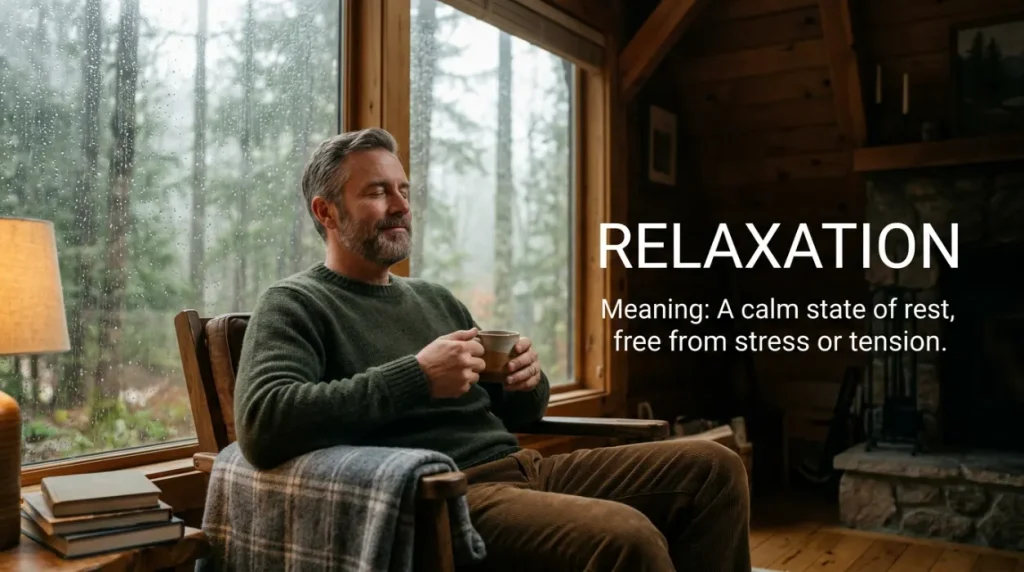
Synonyms for relaxation can make everyday English sound richer. Imagine finishing work, sinking into a chair, and finally feeling your mind slow down.
For example, you might say you need rest, downtime, or a breather. Each phrase describes relaxation, but each creates a slightly different feeling.
Learning synonyms helps students, bloggers, content writers, and daily English users choose words that fit the situation. It also prevents repetition.
The word relaxation is common because modern English often describes rest, stress relief, leisure, and calm. Knowing alternatives makes your writing more natural.
What Does “Relaxation” Really Mean?
Relaxation is the state or process of becoming less tense, stressed, busy, or physically strained.
In simple English, relaxation means resting your body or mind so that you feel calmer and less tense.
The word is a noun.
Simple definition
Relaxation: a period or state of physical or mental rest in which tension, stress, or activity decreases.
Native speakers commonly use relaxation in several contexts:
- After a busy workday
- During holidays
- In health and wellness discussions
- When talking about sleep
- In conversations about stress
- In academic writing about mental well-being
- In descriptions of hobbies and leisure
- In creative writing
For instance, someone might say, “I need some relaxation after this busy week.”
However, a native speaker could also say, “I need some downtime,” “I need to unwind,” or “I need a little peace.”
The best choice depends on context.
Connotative Meaning
Connotation (the feeling or association that a word suggests beyond its basic dictionary meaning) matters when choosing a synonym.
Positive tone
Words such as serenity, rejuvenation, tranquility, refreshment, and repose can create a pleasant and peaceful impression.
Negative tone
Some words can suggest excessive inactivity in certain contexts. Idleness, for example, may sound critical when a speaker means that someone is avoiding useful work.
Neutral tone
Words such as rest, relaxation, break, pause, downtime, and leisure are usually neutral.
Therefore, choosing the right synonym is not only about meaning. It is also about attitude, audience, and situation.
Etymology of “Relaxation”
The English word relaxation ultimately comes from Latin relaxatio, meaning a loosening or easing.
It is related to the Latin verb relaxare, meaning “to loosen” or “to slacken.”
Old English: 450–1100
The modern word relaxation was not part of everyday Old English vocabulary in its current form. Old English had native expressions connected with rest, ease, quietness, and relief.
Middle English: 1100–1500
After the Norman Conquest, English absorbed many French and Latin terms. Words related to easing, loosening, and relief gradually became more established.
Modern English: 1500–Present
Relaxation developed into a familiar noun describing reduced physical tension, reduced mental stress, and periods of rest or leisure.
Today, it can describe both a state and an activity. Someone can experience relaxation, seek relaxation, or practice relaxation techniques.

Pronunciation
- US: /ˌriːlækˈseɪʃən/
- UK: /ˌriːlækˈseɪʃən/
Syllables
re-lax-a-tion
Affixation Pattern
- Root: lax
- Prefix: re-
- Suffix: -ation
The root lax carries the idea of looseness. The prefix re- can suggest returning to a previous state. The suffix -ation forms a noun describing a process or result.
Synonyms List
Rest (Noun) — US /rɛst/; UK /rɛst/
Meaning: A period of stopping activity so your body or mind can recover.
Tone/Register: Neutral, everyday.
Example:
I need some rest after the long trip.
A short rest helped me feel ready for the afternoon.
Repose (Noun) — US /rɪˈpoʊz/; UK /rɪˈpəʊz/
Meaning: A peaceful state of rest or inactivity.
Tone/Register: Formal, literary.
Example:
The garden offered a quiet place for repose.
She enjoyed a few moments of repose beside the lake.
Ease (Noun) — US /iːz/; UK /iːz/
Meaning: A comfortable state without physical or emotional strain.
Tone/Register: Neutral.
Example:
The soft music put him at ease.
After the meeting, she finally felt a sense of ease.
Calm (Noun) — US /kɑːm/; UK /kɑːm/
Meaning: A peaceful state with little emotional or mental disturbance.
Tone/Register: Neutral.
Example:
A few quiet minutes restored my calm.
He spoke slowly to maintain a sense of calm.
Calmness (Noun) — US /ˈkɑːmnəs/; UK /ˈkɑːmnəs/
Meaning: The quality of being peaceful and free from agitation.
Tone/Register: Neutral, formal.
Example:
Her calmness helped everyone relax.
The room had a feeling of calmness.
Serenity (Noun) — US /səˈrɛnəti/; UK /səˈrɛnəti/
Meaning: A deep feeling of peacefulness and emotional quiet.
Tone/Register: Formal, literary.
Example:
The mountain view gave him a sense of serenity.
She enjoys the serenity of early mornings.
Tranquility (Noun) — US /træŋˈkwɪləti/; UK /træŋˈkwɪləti/
Meaning: A state of complete quiet and peacefulness.
Tone/Register: Formal, literary.
Example:
They visited the countryside for its tranquility.
The lake created an atmosphere of tranquility.
Peace (Noun) — US /piːs/; UK /piːs/
Meaning: A state free from disturbance, conflict, or stress.
Tone/Register: Neutral.
Example:
I just want some peace after work.
The quiet room gave her a little peace.
Peacefulness (Noun) — US /ˈpiːsfəlnəs/; UK /ˈpiːsfəlnəs/
Meaning: The quality of being calm, quiet, and undisturbed.
Tone/Register: Neutral, descriptive.
Example:
I love the peacefulness of Sunday mornings.
The peacefulness helped him clear his thoughts.
Stillness (Noun) — US /ˈstɪlnəs/; UK /ˈstɪlnəs/
Meaning: A condition of quietness with little movement or activity.
Tone/Register: Literary, neutral.
Example:
She sat in stillness for several minutes.
The stillness of the forest felt refreshing.
Quiet (Noun) — US /ˈkwaɪət/; UK /ˈkwaɪət/
Meaning: A period with little noise, activity, or interruption.
Tone/Register: Everyday.
Example:
I need some quiet before I start studying.
He found a quiet corner to read.
Unwinding (Noun) — US /ˌʌnˈwaɪndɪŋ/; UK /ˌʌnˈwaɪndɪŋ/
Meaning: The process of becoming less tense after stress or activity.
Tone/Register: Informal, modern.
Example:
Cooking is my favorite way of unwinding.
We spent the evening unwinding with music.
Downtime (Noun) — US /ˈdaʊntaɪm/; UK /ˈdaʊntaɪm/
Meaning: Free time when you are not working or dealing with responsibilities.
Tone/Register: Informal, workplace.
Example:
I usually read during my downtime.
Everyone needs some downtime during a busy week.
Leisure (Noun) — US /ˈliːʒər/; UK /ˈleʒə/
Meaning: Free time available for enjoyment rather than work.
Tone/Register: Neutral, formal.
Example:
She spends her leisure time painting.
Leisure activities can support a healthy routine.
Leisure Time (Noun Phrase) — US /ˈliːʒər taɪm/; UK /ˈleʒə taɪm/
Meaning: Time that is free from work or required duties.
Tone/Register: Neutral.
Example:
I use my leisure time to walk outdoors.
He has more leisure time during the summer.
Recreation (Noun) — US /ˌrɛkriˈeɪʃən/; UK /ˌrɛkriˈeɪʃən/
Meaning: An enjoyable activity done during free time.
Tone/Register: Formal, neutral.
Example:
Swimming is a popular form of recreation.
The park provides space for outdoor recreation.
Respite (Noun) — US /ˈrɛspaɪt/; UK /ˈrɛspʌɪt/
Meaning: A short period of relief from something difficult or tiring.
Tone/Register: Formal.
Example:
The weekend gave her a welcome respite from work.
He needed a brief respite from the constant noise.
Relief (Noun) — US /rɪˈliːf/; UK /rɪˈliːf/
Meaning: A feeling of comfort after pain, stress, worry, or pressure decreases.
Tone/Register: Neutral.
Example:
Finishing the exam brought a huge sense of relief.
The break provided relief from the pressure.
Refreshment (Noun) — US /rɪˈfrɛʃmənt/; UK /rɪˈfrɛʃmənt/
Meaning: Something that restores energy, freshness, or strength.
Tone/Register: Formal, neutral.
Example:
A short walk gave me some refreshment.
The cool air was a welcome refreshment after the hike.
Recuperation (Noun) — US /rɪˌkuːpəˈreɪʃən/; UK /rɪˌkuːpəˈreɪʃən/
Meaning: The process of recovering strength after illness, injury, or exhaustion.
Tone/Register: Medical, formal.
Example:
He spent several weeks in recuperation.
Rest was important during her recuperation.
Recovery (Noun) — US /rɪˈkʌvəri/; UK /rɪˈkʌvəri/
Meaning: The process of returning to a normal or healthy condition.
Tone/Register: Neutral, formal.
Example:
Sleep supported his recovery after the race.
She took time for recovery between demanding activities.
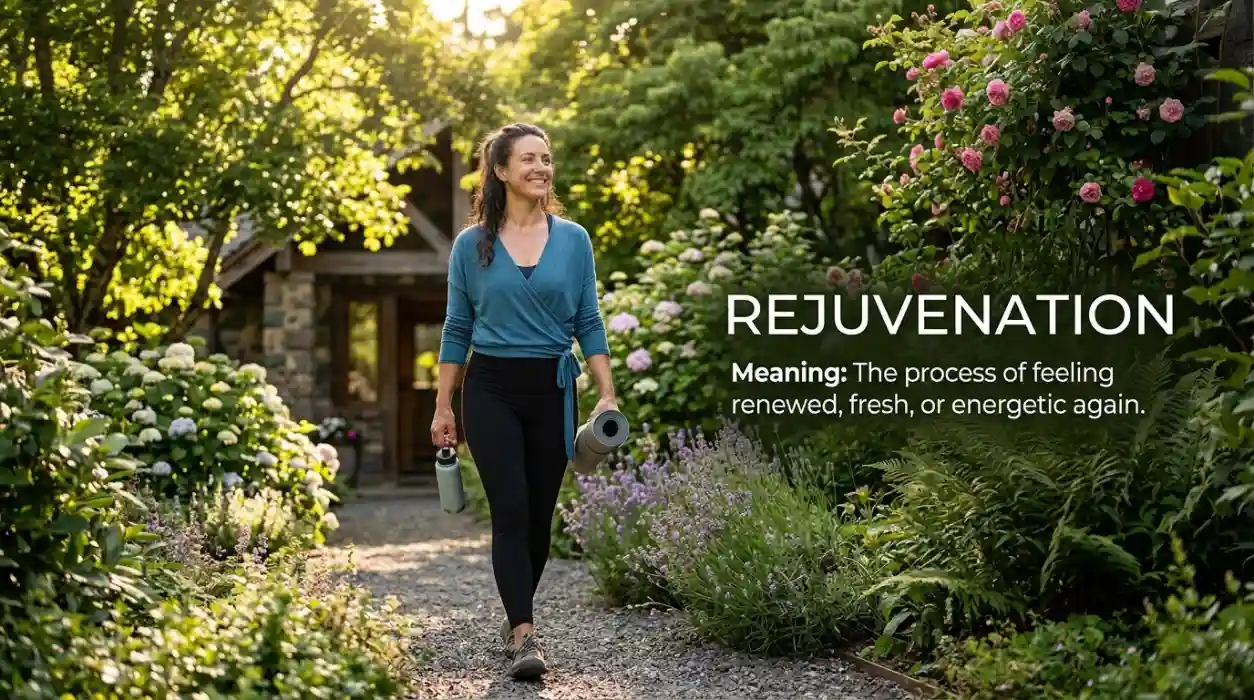
Rejuvenation (Noun) — US /rɪˌdʒuːvəˈneɪʃən/; UK /rɪˌdʒuːvəˈneɪʃən/
Meaning: The process of feeling renewed, fresh, or energetic again.
Tone/Register: Formal, wellness-oriented.
Example:
A weekend in nature gave her a sense of rejuvenation.
The quiet trip felt like emotional rejuvenation.
Renewal (Noun) — US /rɪˈnuːəl/; UK /rɪˈnjuːəl/
Meaning: A feeling or process of becoming fresh, restored, or renewed.
Tone/Register: Formal, literary.
Example:
The holiday brought a sense of renewal.
He returned home with renewed energy.
Restoration (Noun) — US /ˌrɛstəˈreɪʃən/; UK /ˌrɛstəˈreɪʃən/
Meaning: The process of returning energy, strength, or balance.
Tone/Register: Formal.
Example:
Sleep is essential for physical restoration.
The quiet routine supported her emotional restoration.
Retreat (Noun) — US /rɪˈtriːt/; UK /rɪˈtriːt/
Meaning: A period or place used to withdraw from ordinary demands.
Tone/Register: Neutral, formal.
Example:
The cabin became his weekend retreat.
She planned a short retreat from city life.
Break (Noun) — US /breɪk/; UK /breɪk/
Meaning: A short period when you stop working or doing an activity.
Tone/Register: Everyday.
Example:
Let’s take a break before the next task.
I usually take a short break at noon.
Breather (Noun) — US /ˈbriːðər/; UK /ˈbriːðə/
Meaning: A short pause that gives you time to recover from pressure or activity.
Tone/Register: Informal.
Example:
I need a quick breather before the presentation.
She stepped outside for a breather.
Time-Out (Noun) — US /ˈtaɪmaʊt/; UK /ˈtaɪmaʊt/
Meaning: A deliberate short pause from an activity or stressful situation.
Tone/Register: Informal.
Example:
I took a time-out after the argument.
Sometimes a short time-out helps me think clearly.
Pause (Noun) — US /pɔːz/; UK /pɔːz/
Meaning: A temporary stop that creates space before continuing.
Tone/Register: Neutral.
Example:
She paused before answering.
A short pause helped him regain focus.
Idleness (Noun) — US /ˈaɪdl.nəs/; UK /ˈaɪdl.nəs/
Meaning: A state of having nothing particular to do.
Tone/Register: Neutral to negative.
Example:
He enjoyed a little idleness on Sunday.
Too much idleness can feel uncomfortable for some people.
Comfort (Noun) — US /ˈkʌmfərt/; UK /ˈkʌmfət/
Meaning: A state of physical or emotional ease.
Tone/Register: Neutral.
Example:
The warm blanket provided instant comfort.
She found comfort in her familiar routine.
Contentment (Noun) — US /kənˈtɛntmənt/; UK /kənˈtɛntmənt/
Meaning: A peaceful feeling of satisfaction with your present situation.
Tone/Register: Formal, positive.
Example:
He felt contentment while sitting in the garden.
Simple routines often bring her contentment.
Composure (Noun) — US /kəmˈpoʊʒər/; UK /kəmˈpəʊʒə/
Meaning: A calm state that remains stable under pressure.
Tone/Register: Formal.
Example:
She maintained her composure during the stressful call.
A few slow breaths helped him regain his composure.
Placidity (Noun) — US /pləˈsɪdəti/; UK /pləˈsɪdəti/
Meaning: A calm and undisturbed state.
Tone/Register: Formal, literary.
Example:
The lake reflected the placidity of the morning.
Its quiet atmosphere created a sense of placidity.
Sedateness (Noun) — US /sɪˈdeɪtnəs/; UK /sɪˈdeɪtnəs/
Meaning: A calm, unhurried, and serious manner.
Tone/Register: Formal.
Example:
The room had a mood of sedateness.
He appreciated the sedateness of the quiet village.
Equanimity (Noun) — US /ˌiːkwəˈnɪməti/; UK /ˌiːkwəˈnɪməti/
Meaning: Mental calmness that remains steady during difficulty.
Tone/Register: Formal, academic.
Example:
She handled the criticism with equanimity.
Meditation helped him develop greater equanimity.
Peace of Mind (Noun Phrase) — US /ˌpiːs əv ˈmaɪnd/; UK /ˌpiːs əv ˈmaɪnd/
Meaning: A comfortable mental state without worry or anxiety.
Tone/Register: Everyday, neutral.
Example:
Finishing my work early gave me peace of mind.
A clear plan can bring peace of mind.
Stress Relief (Noun Phrase) — US /ˈstrɛs rɪˌliːf/; UK /ˈstrɛs rɪˌliːf/
Meaning: Reduction in physical or emotional stress.
Tone/Register: Neutral, wellness.
Example:
Walking is a simple form of stress relief.
She uses music for stress relief after work.
Tension Relief (Noun Phrase) — US /ˈtɛnʃən rɪˌliːf/; UK /ˈtɛnʃən rɪˌliːf/
Meaning: A reduction in physical or emotional tightness.
Tone/Register: Neutral, health-related.
Example:
Stretching provided tension relief after sitting all day.
The massage brought noticeable tension relief.
Decompression (Noun) — US /ˌdiːkəmˈprɛʃən/; UK /ˌdiːkəmˈprɛʃən/
Meaning: A period of easing away from intense pressure or activity.
Tone/Register: Informal to professional.
Example:
I need an hour of decompression after work.
The evening walk became his daily decompression time.
Unwinding Time (Noun Phrase) — US /ʌnˈwaɪndɪŋ taɪm/; UK /ʌnˈwaɪndɪŋ taɪm/
Meaning: Time deliberately spent becoming calmer after a demanding period.
Tone/Register: Informal.
Example:
Friday evening is my unwinding time.
She protects a little unwinding time before bed.
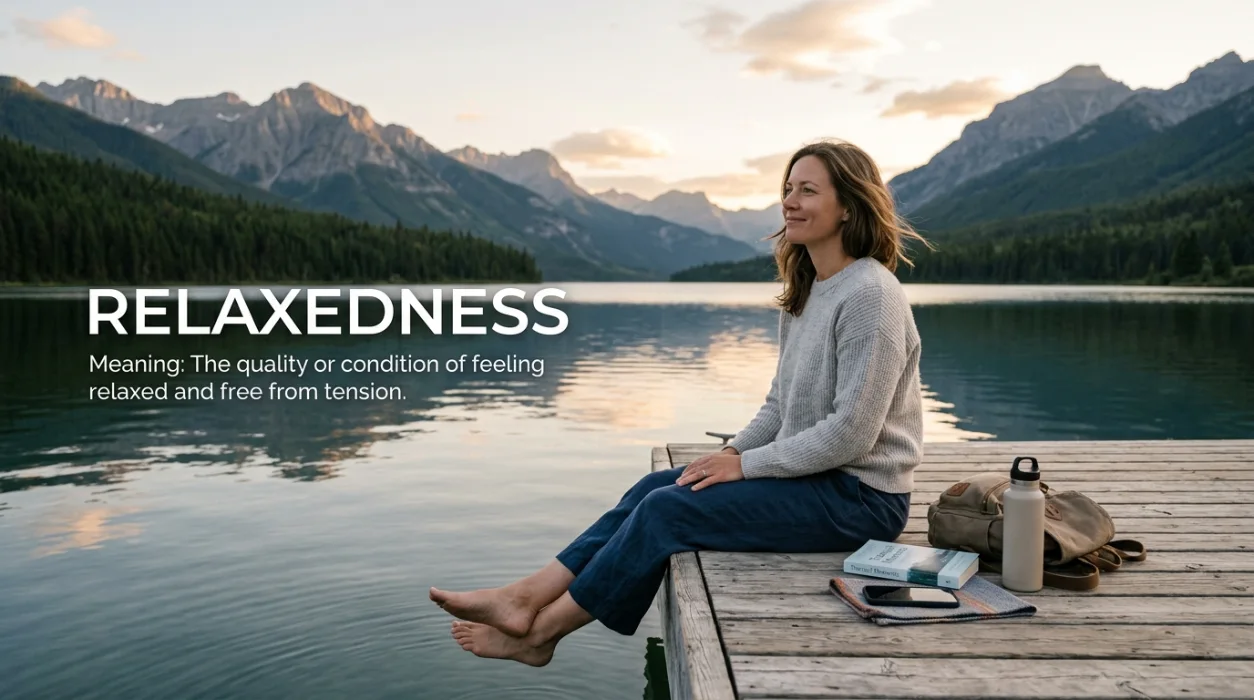
Relaxedness (Noun) — US /rɪˈlækstnəs/; UK /rɪˈlækstnəs/
Meaning: The quality or condition of feeling relaxed and free from tension.
Tone/Register: Neutral, less common.
Example:
His relaxedness made the conversation comfortable.
The relaxedness of the setting encouraged everyone to stay longer.
Restfulness (Noun) — US /ˈrɛstfəlnəs/; UK /ˈrɛstfəlnəs/
Meaning: A quality that encourages peaceful rest.
Tone/Register: Neutral.
Example:
The room’s restfulness helped me sleep.
She liked the restfulness of the countryside.
Reposefulness (Noun) — US /rɪˈpoʊzfəl.nəs/; UK /rɪˈpəʊzfəl.nəs/
Meaning: The quality of being peaceful and restful.
Tone/Register: Literary, uncommon.
Example:
The landscape had a gentle reposefulness.
Its quiet design created a sense of reposefulness.
Quietude (Noun) — US /ˈkwaɪətuːd/; UK /ˈkwaɪətuːd/
Meaning: A state of calm and quiet.
Tone/Register: Literary, formal.
Example:
She traveled there to enjoy the quietude.
The early morning offered perfect quietude.
Stillness of Mind (Noun Phrase) — US /ˈstɪlnəs əv maɪnd/; UK /ˈstɪlnəs əv maɪnd/
Meaning: A calm mental state with fewer distracting thoughts.
Tone/Register: Reflective, wellness.
Example:
Breathing exercises helped him find stillness of mind.
She values stillness of mind before making important decisions.
Mental Rest (Noun Phrase) — US /ˈmɛntl rɛst/; UK /ˈmɛntl rɛst/
Meaning: A period when the mind is allowed to reduce active concentration.
Tone/Register: Neutral.
Example:
Reading fiction gives me mental rest.
A screen-free evening can provide mental rest.
Physical Rest (Noun Phrase) — US /ˈfɪzɪkəl rɛst/; UK /ˈfɪzɪkəl rɛst/
Meaning: A period when the body stops demanding physical effort.
Tone/Register: Neutral, health-related.
Example:
Your body needs physical rest after intense exercise.
He scheduled physical rest between training sessions.
Recess (Noun) — US /ˈriːsɛs/; UK /rɪˈsɛs/
Meaning: A short period away from regular work or activity.
Tone/Register: Formal, educational.
Example:
The students went outside during recess.
The committee took a brief recess.
Holiday (Noun) — US /ˈhɑːlədeɪ/; UK /ˈhɒlədeɪ/
Meaning: A period away from ordinary work or routine, often used for rest or enjoyment.
Tone/Register: Everyday.
Example:
They spent their holiday beside the coast.
I always feel refreshed after a quiet holiday.
Vacation (Noun) — US /veɪˈkeɪʃən/; UK /vəˈkeɪʃən/
Meaning: A period away from work or school, especially for rest or travel.
Tone/Register: Everyday, especially US English.
Example:
We’re taking a vacation next month.
She wants a peaceful vacation this year.
Recreation Time (Noun Phrase) — US /ˌrɛkriˈeɪʃən taɪm/; UK /ˌrɛkriˈeɪʃən taɪm/
Meaning: Free time used for enjoyable or refreshing activities.
Tone/Register: Formal.
Example:
The schedule includes recreation time each afternoon.
Children need recreation time as well as study time.
Synonyms by Tone
Tone matters because two words can share a basic meaning while creating different impressions.
Positive
Use serenity, tranquility, rejuvenation, renewal, contentment, refreshment, peace, and peace of mind when you want a warm or pleasant impression.
These words work well in personal writing, lifestyle articles, reflective essays, and descriptive passages.
Neutral
Use rest, relaxation, calm, break, pause, leisure, recreation, downtime, recovery, and relief for ordinary communication.
These choices usually sound natural without adding a strong emotional judgment.
Negative or Potentially Negative
Idleness and languor can carry less positive meanings in certain contexts.
For example, rest suggests recovery, while idleness can suggest a lack of productive activity.
Playful or Informal
Use chilling, kicking back, lazing, lounging, taking it easy, taking a load off, and taking a breather in casual conversations.
They may sound inappropriate in academic or highly formal writing.
Relaxation vs Close Alternatives
Rest vs Relaxation
Relaxation focuses on becoming less tense or stressed.
Rest focuses more directly on stopping activity and recovering energy.
Use relaxation when discussing mental or emotional calm. Use rest when physical recovery or sleep is especially important.
Relaxation vs Leisure
Relaxation describes a state or process of becoming calmer.
Leisure describes free time that is not devoted to work or required duties.
For example, reading during leisure time may produce relaxation, but leisure itself does not always mean relaxation.
Relaxation vs Repose
Relaxation is common and natural in modern speech.
Repose is more formal and literary. It works especially well when describing peaceful settings, quiet moments, or elegant prose.
How “Relaxation” Changes by Context
Daily Conversation
In everyday speech, native speakers often choose simple words.
Instead of saying, “I need relaxation,” someone may naturally say, “I need a break,” “I need some rest,” or “I need to unwind.”
The phrase I need some relaxation is correct, but it can sound slightly more formal than I need to relax.
Writing and Blogging
Bloggers can use relaxation when introducing a broad topic.
However, semantic variation makes an article easier to read. For example, a writer might discuss downtime, rest, stress relief, unwinding, and leisure in different sections.
This approach also helps avoid keyword stuffing.
Professional or Academic English
Formal contexts favor terms such as recovery, recuperation, respite, restoration, composure, equanimity, and recreation, depending on the subject.
For example, a workplace report may discuss employee recovery rather than repeatedly using the word relaxation.
Creative or Informal English
Creative writing allows more expressive alternatives.
Words such as serenity, stillness, quietude, languor, repose, and leisureliness can create atmosphere.
Meanwhile, casual dialogue can use chilling, kicking back, lazing, or taking it easy.
Common Mistakes Learners Make
Mistake 1: Using every synonym interchangeably
Synonyms often overlap, but they rarely match perfectly.
For example, recovery implies returning to strength. Serenity emphasizes deep peace. Leisure emphasizes free time.
Mistake 2: Using informal expressions in formal writing
Phrases such as chilling and kicking back work well with friends.
However, an academic essay usually needs more neutral vocabulary.
Mistake 3: Confusing rest with sleep
Sleep is one form of rest, but rest does not always mean sleeping.
Someone can rest by reading quietly, sitting outdoors, or taking a short break.
Mistake 4: Treating “idleness” as completely positive
Idleness can simply mean inactivity, but it can also suggest laziness.
Therefore, choose it carefully.
Mistake 5: Overusing “relaxation”
Repeating the same word can make writing sound mechanical.
Instead, vary your vocabulary according to meaning. Use downtime for free time, recovery for rebuilding strength, and serenity for deep peacefulness.
Register Notes
Formal: repose, respite, recuperation, rejuvenation, equanimity, placidity, quietude.
Neutral: relaxation, rest, calm, ease, leisure, break, recovery, relief.
Informal: chilling, kicking back, lazing, lounging, taking it easy, taking a breather.
Academic or professional: recovery, recreation, recuperation, stress relief, composure, equanimity.
For additional vocabulary learning, an internal article about words for calm and peace can naturally support this topic.
Real-Life Mini Scenarios
Workplace
After several hours of meetings, an employee might say:
“I need a short break.”
If the person wants to describe the mental effect, they could say:
“I need some downtime to decompress.”
Social Situation
A friend might ask what you are doing on Saturday.
You could answer:
“Nothing special. I’m just taking it easy.”
This sounds natural and relaxed in casual conversation.
Media and Pop Culture
A lifestyle article might describe a celebrity’s quiet weekend as a retreat or escape from a busy schedule.
A casual interview might simply call it downtime.
Writing and Storytelling
A novelist might describe a character sitting beside a lake in stillness.
A travel writer might describe the same location as offering serenity or tranquility.

Practice Quiz
1. You have worked for three hours and want to stop for ten minutes. What would you most naturally say?
A. I need a break.
B. Quietude
C. I need Idleness
D. Respite
2. A formal writer wants to describe a peaceful state beside a lake. Which word fits best?
A. Chilling
B. Serenity
C. Breather
D. Kicking back
3. You are chatting with a friend about spending Saturday at home without plans. Which phrase sounds most natural?
A. I’m pursuing repose.
B. I’m practicing recuperation.
C. I’m just chilling.
D. I’m seeking placidity.
4. Someone is recovering after an injury. Which word best describes the process?
A. Recovery
B. Quietude
C. Leisureliness
D. Chilling
5. You want to describe free time away from work. Which noun fits best?
A. Leisure
B. Composure
C. Relief
D. Stillness
6. A person remains calm during a difficult argument. Which word is especially suitable?
A. Composure
B. Vacation
C. Idling
D. Recreation
7. You want to describe a short period of relief from a difficult situation. Which word fits?
A. Respite
B. Lazing
C. Leisure
D. Quiet
8. A friend says, “Let’s sit down and relax after carrying these boxes.” Which informal phrase could replace this idea?
A. Take a load off
B. Seek equanimity
C. Enter repose
D. Experience recuperation
9. Which word can suggest a peaceful state without emotional disturbance?
A. Calmness
B. Vacation
C. Recess
D. Idling
Answer key: 1-A | 2-B | 3-C | 4-A | 5-A | 6-A | 7-A | 8-A | 9-A
Reflection Task
Write one sentence about your own routine using a synonym for relaxation.
Try to choose a word that matches your exact meaning. For example, decide whether you mean rest, downtime, leisure, serenity, or unwinding.
Conclusion
Understanding relaxation can help you describe a state of rest, calmness, and freedom from stress or tension. Learning its synonyms, meaning, and examples can improve your English vocabulary and help you express ideas more clearly.
The word relaxation is commonly used when talking about rest, leisure, comfort, and activities that help the mind or body unwind. Knowing its related synonyms can help you choose suitable words for different situations and make your writing more natural.
By practicing relaxation in sentences and exploring related words, you can strengthen your vocabulary and communication skills. A clear understanding of this word will help you express feelings of calmness and rest more confidently in everyday English and writing.
Frequently Asked Questions
1. What are the best synonyms for relaxation in everyday English?
The most natural everyday alternatives include rest, break, downtime, unwinding, calm, peace, taking it easy, and taking a breather. The best choice depends on the situation.
2. What is a formal synonym for relaxation?
Several formal alternatives can work, including repose, respite, recuperation, rejuvenation, tranquility, serenity, quietude, and equanimity. However, they are not identical. Repose emphasizes peaceful rest, while recuperation focuses on recovery. Serenity and tranquility emphasize a deeply peaceful atmosphere or state.
3. What is a synonym for relaxation in academic writing?
Academic writing often uses context-specific terms instead of repeatedly using relaxation. Depending on the subject, useful choices include recovery, recreation, stress relief, respite, recuperation, and mental rest. Choose the term that describes the exact process being discussed rather than replacing the keyword automatically.
4. What is a good synonym for relaxation in an essay?
For a general essay, rest, leisure, recreation, calm, relief, recovery, and respite are useful choices. More expressive essays may use serenity or tranquility. The safest approach is to consider the sentence first. A synonym should preserve the intended meaning rather than simply look different.
5. What is the difference between relaxation, rest, and leisure?
Relaxation describes reduced tension or stress. Rest usually means stopping activity so the body or mind can recover. Leisure means free time away from work or obligations. They can overlap, but they are not interchangeable in every sentence. Leisure may include active hobbies that are not especially relaxing.

Hasnain Ali is an SEO Content Strategist and the founder of wordvora.com, a trusted vocabulary platform that helps writers, students, professionals, and English learners find accurate synonyms, antonyms, word meanings, and real-life usage examples. He specializes in keyword research, on-page SEO, topical authority, and creating search-first content that aligns with Google’s latest Search Quality and E-E-A-T guidelines. His work focuses on producing clear, well-structured, and reader-friendly resources that satisfy search intent while maintaining high editorial standards.
Through extensive hands-on experience with SEO tools such as Google Search Console, Google Analytics, SEMrush, and Ahrefs, Hasnain researches user search behavior and develops content that is both informative and easy to understand. Every article published on wordvora.com is carefully reviewed for accuracy, readability, and contextual relevance before publication. His mission is to build one of the web’s most reliable English vocabulary resources by providing practical language guidance, trustworthy explanations, and content that helps readers improve their writing, communication, and vocabulary with confidence.