
Synonyms for bombard include pelt, assail, overwhelm, inundate, besiege, barrage, and flood. The best choice depends on whether you mean attacking a place, asking many questions, sending repeated messages, or overwhelming someone with information.
Imagine opening your phone to find dozens of messages before breakfast. You might say your friends bombarded you with questions. In another situation, reporters might bombard a public figure with requests for answers.
The word bombard appears in news reports, books, workplace conversations, and everyday English. It can describe physical attacks, intense criticism, or a large amount of information arriving at once.
Learning synonyms for bombard helps students write with greater precision, bloggers avoid repetition, and content writers choose language that matches the situation. It also helps everyday English users sound more natural.
This guide explains alternatives to bombard, including their meanings, pronunciation, tone, and practical examples. You will also find usage tips, a comparison guide, and a quiz to build confidence.
What Does “Bombard” Really Mean?
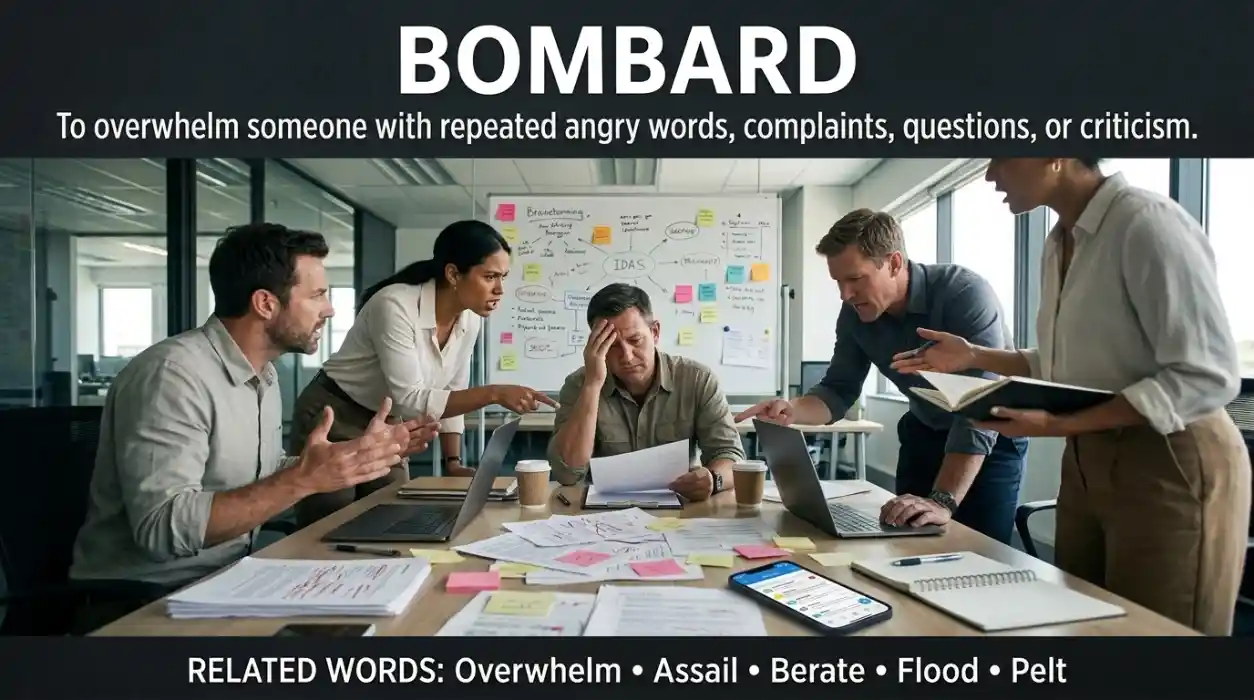
Bombard is a verb that means to attack a place repeatedly, direct a large number of things at someone, or overwhelm a person with questions, messages, criticism, or information.
The word has both literal and figurative uses. In a military context, it can mean attacking a place with artillery or other weapons. In everyday conversation, it often describes something happening in excessive amounts.
For example, a journalist might bombard a politician with questions. A teacher might feel bombarded with emails before an exam. A website visitor might be bombarded with pop-up notifications.
Native English speakers understand bombard as a forceful word. It often suggests intensity, repetition, and a lack of breathing room. However, it does not always describe a physical attack.
Connotative Meaning
(Connotation means the feeling or association a word carries beyond its basic definition.)
- Positive tone: Surround with praise or shower with compliments can describe an overwhelming amount of positive attention.
- Negative tone: Assail, pester, and overwhelm can suggest pressure, irritation, or aggression.
- Neutral tone: Flood, inundate, and send repeated messages may be neutral or negative, depending on the context.
The word bombard usually has a forceful or negative edge. When describing welcome attention, words such as shower or deluge may sound more appropriate.
Etymology
The English verb bombard entered the language through French, from forms related to bombarde, a name for a large gun. Its history is connected with artillery and explosive projectiles.
The word later expanded beyond warfare. Speakers began using it figuratively for repeated questions, criticism, demands, and large amounts of information.
- Old English (450–1100): The modern word bombard was not an established Old English term. English used other words to describe attacks and weapons.
- Middle English (1100–1500): Forms related to bombard entered English through French influence during the later medieval period. The word was associated with artillery.
- Modern English (1500–present): The word became established for attacks involving heavy weapons. Figurative uses developed to describe overwhelming people with questions, messages, criticism, or other things.

Pronunciation (US and UK IPA)
- US: /bɑːmˈbɑːrd/
- UK: /bɒmˈbɑːd/
The stress falls on the second syllable: bom-BARD.
Syllables
Bombard: bom-bard (two syllables)
Affixation Pattern of “Bombard”
- Root/base: bombard
- Prefix: None
- Suffix: None in the base verb
- Related forms: bombarded, bombarding, bombardment
The endings -ed and -ing form common verb forms. The noun bombardment refers to the act or process of bombarding.
Synonyms List
Not every synonym fits every use of bombard. Some describe repeated attacks, while others refer to too many questions, messages, demands, or pieces of information. Choose the alternative that matches your intended meaning.
1. Pelt (verb) — US: /pɛlt/ | UK: /pɛlt/
Meaning: To throw many things at someone or something, or direct something repeatedly toward a target.
Tone/Register: Neutral to forceful; conversational and descriptive.
Examples:
The children pelted the target with soft balls during practice.
Reporters pelted the actor with questions as she left the event.
2. Assail (verb) — US: /əˈseɪl/ | UK: /əˈseɪl/
Meaning: To attack someone verbally or physically, often with force or persistence.
Tone/Register: Formal, forceful, often negative.
Examples:
Critics assailed the proposal for ignoring local concerns.
The speaker was assailed with hostile questions after the announcement.
3. Overwhelm (verb) — US: /ˌoʊvərˈwɛlm/ | UK: /ˌəʊvəˈwɛlm/
Meaning: To affect someone so strongly or in such large amounts that they struggle to cope.
Tone/Register: Neutral to negative; common in everyday and professional English.
Examples:
The new employee felt overwhelmed by the volume of instructions.
A wave of notifications overwhelmed the small support team.
4. Inundate (verb) — US: /ˈɪnənˌdeɪt/ | UK: /ˈɪnʌndeɪt/
Meaning: To flood someone or something with more requests, information, or other things than can easily be handled.
Tone/Register: Formal, professional, often negative.
Examples:
The admissions office was inundated with applications.
Please do not inundate the team with duplicate requests.
5. Besiege (verb) — US: /bɪˈsiːdʒ/ | UK: /bɪˈsiːdʒ/
Meaning: To surround or pressure a person or place persistently, literally or figuratively.
Tone/Register: Formal, dramatic, forceful.
Examples:
Journalists besieged the spokesperson after the press conference.
The castle was besieged for several weeks.
6. Barrage (verb) — US: /bəˈrɑːʒ/ | UK: /ˈbærɑːʒ/
Meaning: To direct a concentrated stream of questions, criticism, messages, or other things at someone.
Tone/Register: Strong, journalistic, common in professional writing.
Examples:
The minister was barraged with questions about the new policy.
Customers barraged the company with complaints after the outage.
7. Flood (verb) — US: /flʌd/ | UK: /flʌd/
Meaning: To send or provide something in such large quantities that it becomes difficult to manage.
Tone/Register: Neutral to negative; widely used.
Examples:
My inbox flooded with invitations after the announcement.
The office was flooded with calls during the first hour.
8. Deluge (verb) — US: /ˈdɛluːdʒ/ | UK: /ˈdeljuːdʒ/
Meaning: To overwhelm someone with a very large amount of something arriving at once.
Tone/Register: Formal, vivid, often dramatic.
Examples:
The charity was deluged with offers of help.
The announcement deluged the website with new visitors.
9. Swamp (verb) — US: /swɑːmp/ | UK: /swɒmp/
Meaning: To overwhelm someone with more work, requests, or information than they can manage.
Tone/Register: Informal to professional; usually negative.
Examples:
A sudden staff shortage swamped the customer service team.
I am swamped with assignments this week.
10. Overload (verb) — US: /ˌoʊvərˈloʊd/ | UK: /ˌəʊvəˈləʊd/
Meaning: To give someone or something more work, information, or demands than it can handle effectively.
Tone/Register: Neutral, technical, and professional.
Examples:
Too many alerts can overload employees and reduce concentration.
The system overloaded when thousands of users logged in.
11. Pester (verb) — US: /ˈpɛstər/ | UK: /ˈpestə/
Meaning: To bother someone repeatedly with questions, requests, or demands.
Tone/Register: Informal, negative, everyday English.
Examples:
My little brother kept pestering me to lend him my headphones.
Please stop pestering the receptionist for an immediate answer.
12. Badger (verb) — US: /ˈbædʒər/ | UK: /ˈbædʒə/
Meaning: To repeatedly pressure someone with questions or requests until they become annoyed or give in.
Tone/Register: Informal, negative.
Examples:
The reporter badgered the coach about the team’s poor performance.
My friends badgered me until I agreed to join them.
13. Harass (verb) — US: /həˈræs/ | UK: /ˈhærəs/
Meaning: To subject someone to persistent unwanted behavior, pressure, or intimidation.
Tone/Register: Serious, negative; often legal or workplace-related.
Examples:
The employee reported repeated messages that made her feel harassed.
Fans should not harass performers online.
14. Hound (verb) — US: /haʊnd/ | UK: /haʊnd/
Meaning: To pursue or pressure someone persistently, often by asking for answers or action.
Tone/Register: Informal to journalistic; negative.
Examples:
The press hounded the official for a response.
Debt collectors hounded him with repeated calls.
15. Nag (verb) — US: /næɡ/ | UK: /næɡ/
Meaning: To repeatedly complain to or remind someone about something in an irritating way.
Tone/Register: Informal, negative.
Examples:
My roommate kept nagging me about the dishes.
The manager did not want to nag the team about every deadline.
16. Assail with questions (verb phrase) — US: /əˈseɪl wɪð ˈkwɛstʃənz/ | UK: /əˈseɪl wɪð ˈkwestʃənz/
Meaning: To confront someone with many questions, often in an intense or challenging way.
Tone/Register: Formal, dramatic, usually negative.
Examples:
The interviewer assailed the candidate with questions about the missing figures.
After the speech, the director was assailed with questions from the audience.
17. Pepper (verb) — US: /ˈpɛpər/ | UK: /ˈpepə/
Meaning: To scatter something throughout a conversation, text, or experience, especially questions or remarks.
Tone/Register: Neutral, vivid, conversational.
Examples:
The students peppered the guest speaker with thoughtful questions.
The article is peppered with examples from everyday life.
18. Shower (verb) — US: /ˈʃaʊər/ | UK: /ˈʃaʊə/
Meaning: To give someone a large amount of something, often praise, gifts, or affection.
Tone/Register: Warm, positive, expressive.
Examples:
Fans showered the athlete with praise after the final.
Her colleagues showered her with congratulations on her promotion.
19. Accost (verb) — US: /əˈkɔːst/ | UK: /əˈkɒst/
Meaning: To approach or confront someone suddenly and sometimes aggressively, often to ask questions or make demands.
Tone/Register: Formal, negative, often implies intrusion.
Examples:
A stranger accosted me outside the station and demanded directions.
Reporters accosted the spokesperson as he entered the building.
20. Attack (verb) — US: /əˈtæk/ | UK: /əˈtæk/
Meaning: To act aggressively against a person, place, idea, or position, physically or verbally.
Tone/Register: Direct, forceful; neutral in some technical contexts.
Examples:
Several commentators attacked the proposal during the debate.
The army attacked the fortified position at dawn.

21. Assault (verb) — US: /əˈsɔːlt/ | UK: /əˈsɔːlt/
Meaning: To make a forceful physical or verbal attack on someone or something.
Tone/Register: Strong, formal, often serious or legal.
Examples:
The article was assaulted by critics who challenged its evidence.
The report described an assault on the town during the conflict.
22. Strike (verb) — US: /straɪk/ | UK: /straɪk/
Meaning: To hit or attack a target; in figurative use, to affect someone suddenly or forcefully.
Tone/Register: Neutral to dramatic, depending on context.
Examples:
The storm struck the coast before sunrise.
The news struck the family with unexpected force.
23. Shell (verb) — US: /ʃɛl/ | UK: /ʃel/
Meaning: To attack a place with artillery shells or, figuratively, subject someone to a heavy stream of criticism or questions.
Tone/Register: Military, journalistic, forceful.
Examples:
The historic town was shelled during the conflict.
The spokesperson was shelled with questions at the hearing.
24. Bombard with messages (verb phrase) — US: /bɑːmˈbɑːrd wɪð ˈmɛsɪdʒɪz/ | UK: /bɒmˈbɑːd wɪð ˈmesɪdʒɪz/
Meaning: To send someone a large number of messages in a short period.
Tone/Register: Informal to professional; usually negative.
Examples:
The group chat bombarded me with messages while I was in class.
Please do not bombard the client with updates from different departments.
25. Flood with questions (verb phrase) — US: /flʌd wɪð ˈkwɛstʃənz/ | UK: /flʌd wɪð ˈkwestʃənz/
Meaning: To ask someone a large number of questions, often all at once.
Tone/Register: Neutral to negative; common in everyday English.
Examples:
The children flooded their teacher with questions about space.
I was flooded with questions after sharing the news.
26. Overwhelm with information (verb phrase) — US: /ˌoʊvərˈwɛlm wɪð ˌɪnfərˈmeɪʃən/ | UK: /ˌəʊvəˈwɛlm wɪð ˌɪnfəˈmeɪʃən/
Meaning: To provide so much information that someone struggles to process it.
Tone/Register: Neutral, educational, professional.
Examples:
The long presentation overwhelmed new staff with information.
Give readers a clear summary instead of overwhelming them with details.
27. Saturate (verb) — US: /ˈsætʃəˌreɪt/ | UK: /ˈsætʃəreɪt/
Meaning: To fill something so completely with a substance, message, or influence that little room remains for more.
Tone/Register: Formal, technical, or media-related.
Examples:
The campaign saturated social media with promotional messages.
The market was saturated with similar products and advertisements.
28. Drown (verb) — US: /draʊn/ | UK: /draʊn/
Meaning: To overwhelm someone so thoroughly with sound, demands, or information that other things become difficult to notice or manage.
Tone/Register: Vivid, informal to literary.
Examples:
The presenter’s voice was drowned out by noise from the crowd.
I felt drowned in paperwork during the final week of the project.
29. Crush (verb) — US: /krʌʃ/ | UK: /krʌʃ/
Meaning: To defeat or suppress someone or something forcefully; figuratively, to put someone under intense pressure.
Tone/Register: Strong, dramatic, sometimes informal.
Examples:
The team crushed its opponents in the championship match.
A sudden wave of deadlines crushed the small department’s schedule.
30. Batter (verb) — US: /ˈbætər/ | UK: /ˈbætə/
Meaning: To hit repeatedly or subject something to repeated force, damage, or harsh criticism.
Tone/Register: Forceful, dramatic, often negative.
Examples:
Strong winds battered the coastline throughout the night.
Reviewers battered the film for its weak ending.
31. Pummel (verb) — US: /ˈpʌməl/ | UK: /ˈpʌməl/
Meaning: To hit someone or something repeatedly; figuratively, to subject someone to a sustained series of attacks or criticism.
Tone/Register: Vivid, forceful, dramatic.
Examples:
The boxer pummelled his opponent in the final round.
The editorial pummelled the proposal with detailed objections.
32. Hammer (verb) — US: /ˈhæmər/ | UK: /ˈhæmə/
Meaning: To criticize, question, or pressure someone repeatedly and forcefully.
Tone/Register: Informal to journalistic; strong.
Examples:
Opposition leaders hammered the minister over the budget cuts.
The reviewer hammered the app for its frequent crashes.
33. Drill (verb) — US: /drɪl/ | UK: /drɪl/
Meaning: To question someone intensively or repeatedly to obtain precise information.
Tone/Register: Professional, investigative, sometimes intimidating.
Examples:
The lawyer drilled the witness about the timeline.
The interviewer drilled the candidate on technical details.
34. Interrogate (verb) — US: /ɪnˈtɛrəˌɡeɪt/ | UK: /ɪnˈterəɡeɪt/
Meaning: To question someone closely and systematically, often in an official or intense setting.
Tone/Register: Formal, investigative, potentially intimidating.
Examples:
Investigators interrogated the suspect for several hours.
The panel interrogated the proposal’s assumptions before approving it.
35. Grill (verb) — US: /ɡrɪl/ | UK: /ɡrɪl/
Meaning: To question someone intensely, often about a decision, action, or mistake.
Tone/Register: Informal, journalistic, direct.
Examples:
Reporters grilled the coach about the unexpected defeat.
My colleagues grilled me about the new schedule during lunch.
36. Cross-examine (verb) — US: /ˌkrɔːs ɪɡˈzæmɪn/ | UK: /ˌkrɒs ɪɡˈzæmɪn/
Meaning: To question someone closely, especially in a legal setting, to test the accuracy of their statements.
Tone/Register: Formal, legal.
Examples:
The attorney cross-examined the witness about the conflicting accounts.
The documentary showed how experts cross-examined the evidence.
37. Criticize (verb) — US: /ˈkrɪtɪˌsaɪz/ | UK: /ˈkrɪtɪsaɪz/
Meaning: To express disapproval or identify faults in a person, idea, or action.
Tone/Register: Neutral to negative; common in speech and writing.
Examples:
Readers criticized the article for relying on outdated information.
The manager criticized the plan but offered a better solution.
38. Lambaste (verb) — US: /læmˈbeɪst/ | UK: /læmˈbeɪst/
Meaning: To criticize someone or something very strongly.
Tone/Register: Strong, journalistic, often dramatic.
Examples:
The editorial lambasted the council for delaying the repairs.
Fans lambasted the club’s decision to sell its captain.
39. Denounce (verb) — US: /dɪˈnaʊns/ | UK: /dɪˈnaʊns/
Meaning: To publicly condemn an action, policy, or person as wrong or unacceptable.
Tone/Register: Formal, serious, public-facing.
Examples:
Community leaders denounced the discriminatory policy.
The organization denounced the attack in a public statement.
40. Rail against (verb phrase) — US: /reɪl əˈɡɛnst/ | UK: /reɪl əˈɡenst/
Meaning: To complain or speak angrily and forcefully about something.
Tone/Register: Expressive, literary, often negative.
Examples:
The columnist railed against the lack of affordable housing.
He railed against the rules during the entire meeting.
41. Accumulate (verb) — US: /əˈkjuːmjəˌleɪt/ | UK: /əˈkjuːmjəleɪt/
Meaning: To gather or build up gradually, sometimes creating an overwhelming amount.
Tone/Register: Neutral, formal, descriptive.
Examples:
Unanswered emails accumulated while the team was away.
Small complaints accumulated until the manager arranged a review.
42. Pour (verb) — US: /pɔːr/ | UK: /pɔː/
Meaning: To deliver or send something in a steady, abundant flow.
Tone/Register: Neutral, vivid, common in everyday English.
Examples:
Questions poured in after the company announced its new policy.
Messages poured into the newsroom as the story developed.
43. Deluge with requests (verb phrase) — US: /ˈdɛluːdʒ wɪð rɪˈkwɛsts/ | UK: /ˈdeljuːdʒ wɪð rɪˈkwests/
Meaning: To overwhelm someone by sending an exceptionally large number of requests.
Tone/Register: Formal, vivid, usually negative.
Examples:
Residents deluged the council with requests for road repairs.
The small team was deluged with interview requests after the story went viral.
44. Pile on (phrasal verb) — US: /paɪl ɑːn/ | UK: /paɪl ɒn/
Meaning: To add more criticism, pressure, or demands when someone is already dealing with difficulty.
Tone/Register: Informal, often negative.
Examples:
Several commenters piled on after the athlete admitted the mistake.
Please do not pile on when your colleague is already under pressure.
45. Lay into (phrasal verb) — US: /leɪ ˈɪntuː/ | UK: /leɪ ˈɪntuː/
Meaning: To criticize or attack someone forcefully and often angrily.
Tone/Register: Informal, emotional, negative.
Examples:
The coach laid into the team after a careless performance.
Online users laid into the company for its confusing announcement.
46. Hurl (verb) — US: /hɜːrl/ | UK: /hɜːl/
Meaning: To throw something forcefully; figuratively, to direct insults or accusations at someone.
Tone/Register: Forceful, vivid, often negative.
Examples:
The angry crowd hurled insults at the referee.
Commenters hurled accusations before the facts were confirmed.
47. Heap (verb) — US: /hiːp/ | UK: /hiːp/
Meaning: To give or direct a large amount of something toward someone, especially praise, blame, or criticism.
Tone/Register: Neutral to formal; the object determines the tone.
Examples:
The review heaped praise on the young director.
Opponents heaped blame on the committee after the delay.
48. Ply (verb) — US: /plaɪ/ | UK: /plaɪ/
Meaning: To keep giving someone questions or offers, often persistently.
Tone/Register: Neutral to formal; sometimes implies pressure.
Examples:
The interviewer plied the author with questions about the novel.
Vendors plied tourists with offers near the station.
49. Beset (verb) — US: /bɪˈsɛt/ | UK: /bɪˈset/
Meaning: To trouble or surround someone with persistent problems, demands, or difficulties.
Tone/Register: Formal, literary, usually negative.
Examples:
The project was beset by delays and unexpected technical issues.
The new principal was beset with complaints during the first week.
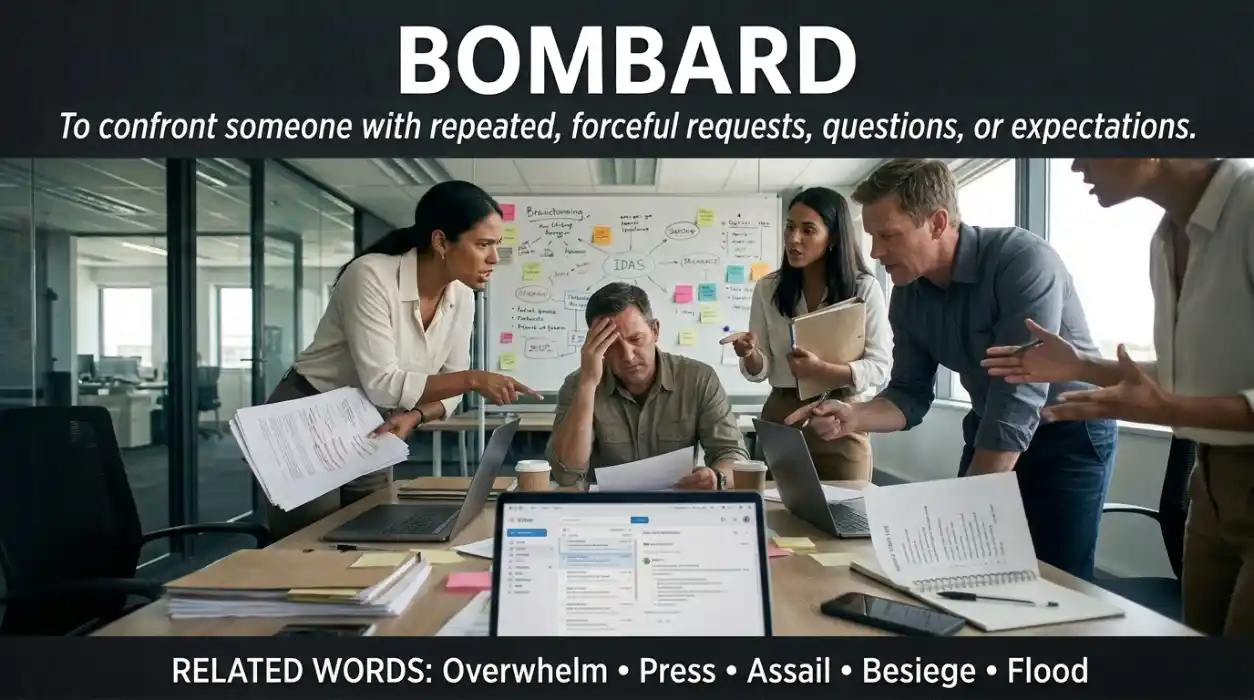
50. Accost with demands (verb phrase) — US: /əˈkɔːst wɪð dɪˈmændz/ | UK: /əˈkɒst wɪð dɪˈmɑːndz/
Meaning: To confront someone suddenly with forceful requests or expectations.
Tone/Register: Formal, dramatic, negative.
Examples:
The visitor accosted the manager with demands for an immediate refund.
The official was accosted with demands for answers outside the meeting.
Synonyms by Tone
Tone matters because bombard can suggest aggression, pressure, or simply an overwhelming amount. Choosing a more precise word helps readers understand your attitude.
Positive or appreciative
- Shower: Best for praise, gifts, affection, and congratulations.
- Heap: Works with praise or blame, depending on the phrase.
- Pour: Can describe a welcome flow of support or interest.
These words can describe abundance without suggesting an attack.
Neutral or descriptive
- Flood: Useful for calls, messages, questions, and requests.
- Inundate: Suitable for formal descriptions of large volumes.
- Overload: Emphasizes exceeding a person’s or system’s capacity.
- Accumulate: Focuses on things building up over time.
- Pour: Highlights a steady stream.
Negative or forceful
- Assail: Suggests a strong verbal or physical attack.
- Harass: Implies persistent unwanted behavior.
- Pester: Describes repeated, irritating requests.
- Badger: Emphasizes pressure through repeated questioning.
- Lambaste: Means to criticize very harshly.
- Denounce: Means to publicly condemn.
Playful or informal
- Pepper: Often makes repeated questions sound lively rather than hostile.
- Grill: Common when someone asks tough questions.
- Pile on: Describes adding more criticism to an existing situation.
- Hammer: Suggests repeatedly challenging someone or something.
The best synonym depends on the object and situation. Shower someone with praise sounds warm, while shower someone with complaints is possible but less natural than flood someone with complaints.
“Bombard” vs. Close Alternatives
| Word | Main meaning | Best use |
|---|---|---|
| Bombard | To attack repeatedly or overwhelm with a large amount | General use for attacks, questions, messages, or information |
| Barrage | To direct a concentrated stream at a target | Strong emphasis on a sudden, intense series of questions or criticism |
| Pester | To bother someone repeatedly | Everyday situations involving annoying requests |
| Inundate | To flood someone with too much of something | Formal or professional writing about large volumes |
| Assail | To attack forcefully, verbally or physically | Strong criticism, hostile questions, or direct attacks |
Quick guide: Use bombard when you want a broad, forceful term. Choose barrage for a concentrated burst, pester for irritating repetition, inundate for excessive volume, and assail for a strong attack.
How “Bombard” Changes by Context
Daily conversation: People often say they were bombarded with questions after sharing news. For a lighter situation, peppered with questions can sound more conversational.
Writing and blogging: Choose a word that clarifies what happened. “ Flooded with messages” describes volume, while “criticized” describes negative opinions. Avoid replacing every instance of bombard with a synonym that changes the meaning.
Professional or academic tone: Inundate, overload, and assail can fit formal writing, but they carry different shades of meaning. Use inundate for high volume, overload for excessive demands, and assail for a forceful attack.
Creative or informal use: Pelt, hammer, grill, and pile on create vivid scenes. They work well in dialogue, storytelling, and commentary when the context supports their stronger tone.
Common Mistakes Learners Make
- Using pester for a serious attack: Pester usually describes annoying repetition, not military action or severe criticism.
- Treating flood and assail as identical: Flood emphasizes quantity. Assail emphasizes attack or hostility.
- Using harass too casually: Harassment can describe serious unwanted behavior. Do not use it for every ordinary question or reminder.
- Confusing shower with a negative attack: Shower with praise is positive. The noun that follows shower affects the tone.
- Assuming inundate always means physical flooding: It can also describe an excessive volume of emails, applications, requests, or information.
- Overusing dramatic vocabulary: Words such as pummel, crush, and lambaste are forceful. In a neutral report, question, criticize, or send many messages may be clearer.
Register Notes
In casual speech, pester, badger, grill, and pile on sound natural. In formal reports, inundate, assail, and denounce may fit better when their meanings are accurate.
Real-Life Mini Scenarios
Workplace:
A project manager receives dozens of urgent requests at once. The manager might say, “We have been inundated with requests,” which emphasizes volume rather than aggression.
Social situations:
A friend announces an engagement and receives many questions. “Everyone peppered them with questions” makes the scene sound lively and curious.
Media and pop culture:
A public figure faces repeated criticism after a controversial comment. A report might say that commentators assailed the decision or lambasted the statement.
Writing and storytelling:
A character arrives late and is immediately questioned by family members. The phrase “They bombarded him with questions” conveys the moment’s speed and intensity.
Practice Quiz
1. A customer receives hundreds of emails after signing up for a service. Which word best describes the volume?
A. Denounce
B. Inundate
C. Accost
D. Strike
2. A child repeatedly asks a parent to buy a toy, even after being told no. Which word fits best?
A. Pester
B. Denounce
C. Shell
D. Saturate
3. A reporter asks a politician a long series of challenging questions. Which word is most suitable?
A. Shower
B. Grill
C. Accumulate
D. Drown
4. Fans give an actor lots of compliments after a performance. Which phrase sounds most positive?
A. Assail with criticism
B. Pile on blame
C. Shower with praise
D. Hound with demands
5. A newspaper strongly condemns a new policy in a public statement. Which verb fits best?
A. Denounce
B. Pepper
C. Swamp
D. Ply
6. A lawyer asks a witness detailed questions in court to test their statement. Which term is most precise?
A. Shower
B. Cross-examine
C. Flood
D. Nag
7. A group of journalists approaches a celebrity abruptly and starts demanding answers. Which word fits best?
A. Accost
B. Accumulate
C. Saturate
D. Overload
8. An online crowd adds more criticism to a person who has already apologized. Which phrase best describes this?
A. Pour in
B. Pile on
C. Shower with praise
D. Progress tracking
9. A reviewer attacks a film very harshly in a published column. Which verb fits best?
A. Lambaste
B. Inundate
C. Ply
D. Accumulate
Reflection task:
Write one sentence about a situation in which someone receives too many messages, questions, or demands. Choose a synonym for bombard, then explain why it fits better than another option.
Answer key: 1-B, 2-A, 3-B, 4-C, 5-A, 6-A, 7-B, 8-A, 9-B, 10-A
External Sources
Explore these established references for definitions, pronunciation, word history, and usage:
- Merriam-Webster Dictionary — definitions and examples of English word usage.
- Cambridge Dictionary — learner-friendly meanings and US/UK pronunciation.
- Oxford English Dictionary — historical evidence and etymology.
- Collins English Dictionary — synonyms, definitions, and usage notes.
Use dictionary examples to check whether a synonym suits your sentence. The closest word is not always the clearest one; meaning, tone, and context should guide your final choice.
Conclusion
Learning synonyms for bombard helps you describe attacks, criticism, questions, and messages with greater precision. The right word communicates both the action and its intensity.
A varied vocabulary can strengthen essays, blog posts, emails, and conversations. Words such as inundate, pester, assail, and shower express different shades of meaning.
Always consider the context before choosing an alternative. Some words sound playful, while others suggest hostility or serious pressure. Precision helps your readers understand what you mean.
Practice by writing a few sentences with new synonyms in your emails, essays, or daily conversations. Notice the tone each word creates, and keep building confidence one word at a time.
FAQs
1. What is a polite alternative to “bombard someone with questions”?
A polite alternative is to ask someone several questions, ask a few follow-up questions, or seek clarification. These expressions sound less aggressive and are suitable for workplace emails, interviews, and classroom discussions. If you want to emphasize curiosity without implying pressure, you could say, “The audience asked the speaker several thoughtful questions.”
2. What is a synonym for “bombard” when talking about emails?
Flood with emails, inundate with emails, and overwhelm with messages are common alternatives. Flood sounds natural in everyday speech, while inundate is more formal. Overwhelm emphasizes the effect on the recipient. For example, “The team was inundated with emails after the announcement.”
3. Can “bombard” be used in a positive sentence?
Yes, but the word itself often suggests excessive force or pressure. When describing welcome attention, expressions such as shower someone with praise, pour in with congratulations, or receive a flood of support may sound warmer. The best choice depends on whether the emphasis is on the large quantity or the positive feeling.
4. What is the difference between “bombard” and “harass”?
Bombard can describe a large number of messages, questions, or attacks, without necessarily implying wrongdoing. Harass emphasizes persistent unwanted behavior that troubles, intimidates, or targets someone. A person may be bombarded with harmless questions during an interview, while harassment suggests a more serious problem.
5. Which synonym for “bombard” is best for academic writing?
The best option depends on what the evidence shows. Use inundate for an excessive volume of material, assail for a forceful attack or criticism, and overwhelm when the effect is that a person or system cannot cope. Academic writing often benefits from a precise description, such as “participants received a large number of requests,” rather than an unnecessarily dramatic verb.

Hasnain Ali is an SEO Content Strategist and the founder of wordvora.com, a trusted vocabulary platform that helps writers, students, professionals, and English learners find accurate synonyms, antonyms, word meanings, and real-life usage examples. He specializes in keyword research, on-page SEO, topical authority, and creating search-first content that aligns with Google’s latest Search Quality and E-E-A-T guidelines. His work focuses on producing clear, well-structured, and reader-friendly resources that satisfy search intent while maintaining high editorial standards.
Through extensive hands-on experience with SEO tools such as Google Search Console, Google Analytics, SEMrush, and Ahrefs, Hasnain researches user search behavior and develops content that is both informative and easy to understand. Every article published on wordvora.com is carefully reviewed for accuracy, readability, and contextual relevance before publication. His mission is to build one of the web’s most reliable English vocabulary resources by providing practical language guidance, trustworthy explanations, and content that helps readers improve their writing, communication, and vocabulary with confidence.